child restraint AUDI R8 COUPE 2020 User Guide
[x] Cancel search | Manufacturer: AUDI, Model Year: 2020, Model line: R8 COUPE, Model: AUDI R8 COUPE 2020Pages: 308, PDF Size: 82.41 MB
Page 196 of 308
Airbag system
— Always move the front passenger seat to the
highest position in the up and down adjust-
ment range and move it back to the rear-
most position in the seat's fore and aft ad-
justment range, as far away from the airbag
as possible, before installing the forward-
facing child restraint.
— Always make sure that the safety belt upper
anchorage is behind the child restraint and
not next to or in front of the child restraint
so that the safety belt will be properly posi-
tioned.
— Always make sure that there is nothing on
the front passenger seat that will cause the
capacitive passenger detection system in
the seat to signal to the Airbag System that
the seat is occupied by a person when it is
not, or to signal that it is occupied by some-
one who is heavier than the person actually
sitting on the seat. The presence of addi-
tional objects could cause the passenger
front airbag to be turned on when it should
be off, or could cause the airbag to work ina
way that is different from the way it would
have worked without the object on the seat.
— Make sure that the PASSENGER AIR BAG
OFF %; light comes on and stays on all the
time whenever the ignition is switched on.
Advanced Airbag System components
The front passenger seat in your vehicle has a lot
of very important parts of the Advanced Airbag
System in it. These parts include the capacitive
passenger detection system, wiring, brackets,
and more. The control unit monitors the system
on the front passenger seat when the ignition is
switched on and turns the airbag indicator light
on when a malfunction in the one of the system
components is detected > page 199. Because the
front passenger seat contains important parts of
the Advanced Airbag System, you must take care
to prevent it from being damaged. Damage to
the seat may prevent the Advanced Airbag Sys-
tem for the front passenger seat from doing its
job ina crash.
194
The front Advanced Airbag System consists
of the following:
— Crash sensors in the front of the vehicle that
measure vehicle acceleration/deceleration to
provide information to the Advanced Airbag
System about the severity of the crash.
—An electronic control unit, with integrated
crash sensors for front and side impacts. The
control unit “decides” whether to fire the front
airbags based on the information received from
the crash sensors. The control unit also “de-
cides” whether the safety belt pretensioners
should be activated.
— An Advanced Airbag with gas generator for the
driver inside the steering wheel hub.
— An Advanced Airbag with gas generator inside
the instrument panel for the front passenger.
— A capacitive passenger detection system under-
neath the front passenger seat cover. This sys-
tem measures the electrical capacitance of the
person in the seat. The information registered
is sent continuously to the electronic control
unit to regulate deployment of the front Ad-
vanced Airbag on the passenger side.
— An airbag monitoring system and indicator
light ka in the instrument cluster.
—Asensor in each front seat registers the dis-
tance between the respective seat and the
steering wheel or instrument panel. The infor-
mation registered is sent continuously to the
electronic control unit to regulate deployment
of the front Advanced Airbags.
— The PASSENGER AIR BAG OFF 3%; light comes
on and stays on in the headliner > page 199,
fig. 160 and tells you when the front Advanced
Airbag on the passenger side has been turned
off.
—Asensor in the safety belt latch for the driver
and for the front seat passenger that senses
whether that safety belt is latched or not and
transmits this information to the electronic
control unit.
ZA\ WARNING
Damage to the front passenger seat can pre-
vent the front airbag from working properly.
— Improper repair or disassembly of the front
passenger and driver seat will prevent the >
Page 197 of 308
4S1012721BA
Airbag system
Advanced Airbag System from functioning
properly.
— Repairs to the front passenger seat must be
performed by qualified and properly trained
workshop personnel.
— Never remove the front passenger or driver
seat from the vehicle.
— Never remove the upholstery from the front
passenger Seat.
— Never disassemble or remove parts from the
seat or disconnect wires from it.
— Never carry sharp objects in your pockets or
put them on the seat. The capacitive passen-
ger detection mat in the front passenger
seat will not function properly if it is punc-
tured.
— Never carry things on your lap or carry ob-
jects on the front passenger seat. Such ob-
jects can
influence the capacitance regis-
tered by the capacitive passenger detection
system, so that incorrect information is pro-
vided to the airbag control unit.
— Never store items under the front passenger
seat. Parts of the Advanced Airbag System
under the passenger seat could be dam-
aged, preventing them and the airbag sys-
tem from working properly.
— Never place seat covers or replacement up-
holstery that have not been specifically ap-
proved by Audi on the front seats.
— Seat covers can prevent the Advanced Airbag
System from recognizing child restraints or
occupants on the front passenger seat and
prevent the side airbag in the seat backrest
from deploying properly.
— If a seat heater has been retrofitted or oth-
erwise added to the front passenger seat,
never install any child restraint system on
this seat.
— Never use cushions, pillows, blankets, or
similar items on the front passenger seat.
The additional layers prevent the capacitive
passenger detection system from accurately
measuring the capacitance of the child safe-
ty seat and/or the person on the seat and
thus keep the Advanced Airbag System from
working properly.
— Never place or use any electrical device
(such as a laptop, CD player, electronic
games device, power inverter or seat heater
for child seats) on the front passenger seat
if the device is connected to the 12-volt
socket or the cigarette lighter socket. Such
devices can influence the capacitance regis-
tered by the capacitive passenger detection
system, so that incorrect information is pro-
vided to the airbag control unit.
— If you must use a child restraint on the front
passenger seat and the child restraint man-
ufacturer's instructions require the use of a
towel, foam cushion or something else to
properly position the child restraint, make
certain that the PASSENGER AIR BAG OFF
3%; light comes on and stays on whenever
the child restraint is installed on the front
passenger Seat.
— If the PASSENGER AIR BAG OFF #; light
does not come on and stay on, have the air-
bag system inspected by your Audi dealer.
ZA WARNING
If the front passenger seat gets wet, dry it im-
mediately.
— If liquid soaks into the front passenger seat,
this can keep the airbag system from work-
ing properly and may, for instance, deacti-
vate the passenger frontal airbag. If this
happens, the PASSENGER AIR BAG OFF 3;
light will come on and stay on together with
the airbag indicator light ka in the instru-
ment cluster.
— If liquid is pooled on the seat, but has not
soaked in, this may also keep the airbag sys-
tem from working properly and cause the
passenger frontal airbag to be enabled
(turned on), even though there is a properly
installed child restraint system on the seat.
Wet towels or other wet things on the seat
cushion can have the same effect. If the
front passenger frontal airbag is turned on,
the PASSENGER AIR BAG OFF #; light will
turn off.
195
Page 201 of 308
4S1012721BA
Airbag system
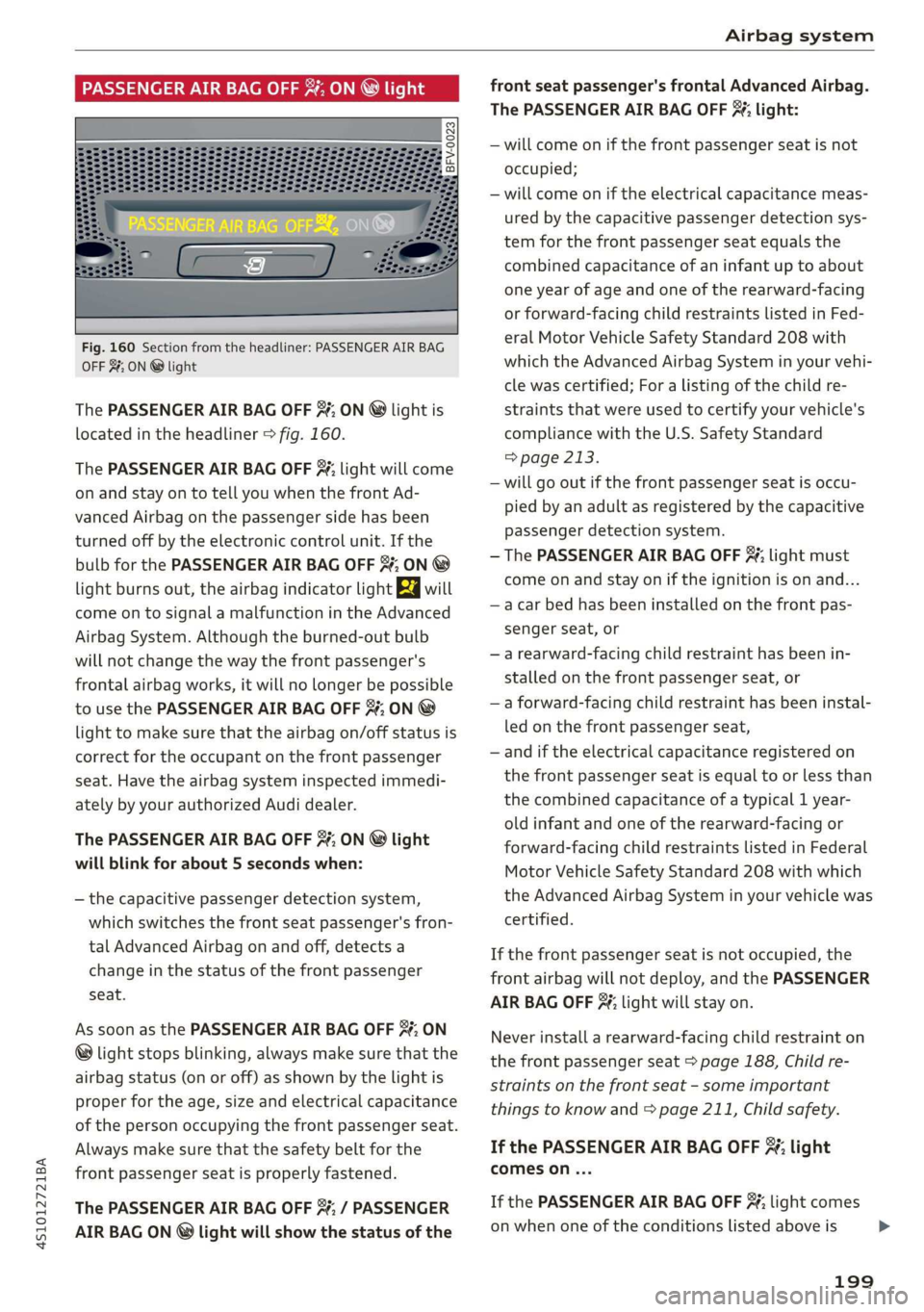
PASSENGER AIR BAG OFF ACR hits
Fig. 160 Section from the headliner: PASSENGER AIR BAG
OFF 3%; ON @ light
The PASSENGER AIR BAG OFF %; ON @ light is
located in the headliner > fig. 160.
The PASSENGER AIR BAG OFF 3; light will come
on and stay on to tell you when the front Ad-
vanced Airbag on the passenger side has been
turned off by the electronic control unit. If the
bulb for the PASSENGER AIR BAG OFF 3; ON @
light burns out, the airbag indicator light ka will
come on to signal a malfunction in the Advanced
Airbag System. Although the burned-out bulb
will not change the way the front passenger's
frontal airbag works, it will no longer be possible
to use the PASSENGER AIR BAG OFF #7; ON ®
light to make sure that the airbag on/off status is
correct for the occupant on the front passenger
seat. Have the airbag system inspected immedi-
ately by your authorized Audi dealer.
The PASSENGER AIR BAG OFF 3; ON @ light
will blink for about 5 seconds when:
— the capacitive passenger detection system,
which switches the front seat passenger's fron-
tal Advanced Airbag on and off, detects a
change in the status of the front passenger
seat.
As soon as the PASSENGER AIR BAG OFF #¥; ON
® light stops blinking, always make sure that the
airbag status (on or off) as shown by the light is
proper for the age, size and electrical capacitance
of the person occupying the front passenger seat.
Always make sure that the safety belt for the
front passenger seat is properly fastened.
The PASSENGER AIR BAG OFF 3%; / PASSENGER
AIR BAG ON ® light will show the status of the
front seat passenger's frontal Advanced Airbag.
The PASSENGER AIR BAG OFF 3%; light:
— will come on if the front passenger seat is not
occupied;
— will come on if the electrical capacitance meas-
ured by the capacitive passenger detection sys-
tem for the front passenger seat equals the
combined capacitance of an infant up to about
one year of age and one of the rearward-facing
or forward-facing child restraints listed in Fed-
eral Motor Vehicle Safety Standard 208 with
which the Advanced Airbag System in your vehi-
cle was certified; For a listing of the child re-
straints that were used to certify your vehicle's
compliance with the U.S. Safety Standard
=> page 213.
— will go out if the front passenger seat is occu-
pied by an adult as registered by the capacitive
passenger detection system.
— The PASSENGER AIR BAG OFF #; light must
come on and stay on if the ignition is on and...
—a-car bed has been installed on the front pas-
senger seat, or
—arearward-facing child restraint has been in-
stalled on the front passenger seat, or
—a forward-facing child restraint has been instal-
led on the front passenger seat,
—and if the electrical capacitance registered on
the front passenger seat is equal to or less than
the combined capacitance of a typical 1 year-
old infant and one of the rearward-facing or
forward-facing child restraints listed in Federal
Motor Vehicle Safety Standard 208 with which
the Advanced Airbag System in your vehicle was
certified.
If the front passenger seat is not occupied, the
front airbag will not deploy, and the PASSENGER
AIR BAG OFF 8; light will stay on.
Never install a rearward-facing child restraint on
the front passenger seat > page 188, Child re-
straints on the front seat - some important
things to know and > page 211, Child safety.
If the PASSENGER AIR BAG OFF &; light
comes on...
If the PASSENGER AIR BAG OFF 3¥; light comes
on when one of the conditions listed above is
199
>
Page 202 of 308
Airbag system
met, be sure to check the light regularly to make
certain that the PASSENGER AIR BAG OFF 3;
light stays on continuously whenever the ignition
is on. If the PASSENGER AIR BAG OFF %; light
does not appear on and does not stay on all the
time, stop as soon as it is safe to do so and
— reactivate the system by turning the ignition off
for more than 4 seconds and then turning it on
again;
— remove and reinstall the child restraint. Make
sure that the child restraint is properly installed
and that the safety belt for the front passenger
seat has been correctly routed through the
child restraint as described in the child restraint
manufacturer's instructions;
— make sure that the convertible locking retractor
on the safety belt for the front passenger seat
has been activated and that the safety belt has
been pulled tight.
— make sure that no electrical device (such as a
laptop, CD player, electronic games device,
power inverter or seat heater for child seats) is
placed or used on the front passenger seat if
the device is connected to the 12-volt socket or
the cigarette lighter socket;
— make sure that no seat heater has been retrofit-
ted or otherwise added to the front passenger
seat;
— make sure that nothing can interfere with the
safety belt buckles and that they are not ob-
structed;
— make sure that there are no wet objects (such
as a wet towel) and no water or other liquids on
the front passenger seat cushion.
If the PASSENGER AIR BAG OFF 3; light still
does not come on...
If the PASSENGER AIR BAG OFF 3%; light still
does not come on and does not stay on continu-
ously (when the ignition is switched on),
— take the child restraint off the front passenger
seat and have the airbag system inspected by
your Audi dealer immediately.
The PASSENGER AIR BAG OFF 3; light
should NOT come on...
The PASSENGER AIR BAG OFF %; light should
NOT come on when the ignition is on and an adult
200
is sitting in a proper seating position on the front
passenger seat. If the PASSENGER AIR BAG OFF
#; light comes on and stays on while driving, un-
der these circumstances, make sure that:
— the adult on the front passenger seat is proper-
ly seated on the center of the seat cushion with
his or her back up against the backrest and the
backrest is not reclined,
— the adult is not taking weight off the seat by
holding on to the passenger assist handle
above the front passenger door or supporting
their weight on the armrest,
— the safety belt is being properly worn and that
there is not a lot of slack in the safety belt web-
bing,
— there are no aftermarket seat covers or cush-
ions or other things (such as blankets) on the
front passenger seat that might cause the ca-
pacitive passenger detection system to miscal-
culate electrical capacitance.
Me eT eae toleol g)
monitoring the Advanced Airbag System
ZX WARNING
— If the status of the Advanced Airbag System
has changed while the vehicle is moving, the
PASSENGER AIR BAG OFF 7; ON @ light
blinks for about 5 seconds to catch the driv-
er's attention. If this happens, always stop
as soon as it is safe to do so and check the
steps described above.
— If the PASSENGER AIR BAG OFF %; light
does not go off when an adult who is not
very small is sitting on the front passenger
seat after taking the steps described above,
have the airbag system inspected by your
authorized Audi dealer before transporting
anyone on the front passenger seat.
ZA WARNING
An airbag system that is not functioning prop-
erly cannot provide supplemental protection
in a frontal crash.
— If the airbag indicator light > page 17
comes when the vehicle is being used, have
the system inspected immediately by your
Page 203 of 308
4S1012721BA
Airbag system
authorized Audi dealer. It is possible that
the airbag will inflate when it is not sup-
posed to, or will not inflate when it should.
ZA WARNING
If the front airbag inflates, a child without a
child restraint, or in a rearward-facing child
safety seat, or in a forward-facing child re-
straint that has not been properly installed
will be seriously injured and can be killed.
— If you must install a rearward-facing child
seat on the front passenger seat because of
exceptional circumstances and the PASSEN-
GER AIR BAG OFF #%; light does not appear
and stay on, have the airbag system inspect-
ed by your Audi dealer.
— If, in exceptional circumstances, you must
install a forward-facing child restraint on
the front passenger seat, always move the
seat into its rearmost position in the seat's
fore and aft adjustment range, as far away
from the airbag as possible. The backrest
must be adjusted to an upright position.
Make sure that the PASSENGER AIR BAG
OFF %; light comes on and stays on all the
time whenever the ignition is switched on.
Z\ WARNING
If the PASSENGER AIR BAG OFF %; light does
not go out when an adult is sitting on the
front passenger seat after taking the steps
described above, have the airbag system in-
spected by your Audi dealer before transport-
ing anyone on the front passenger seat.
@) Tips
If the capacitive passenger detection system
determines that the front passenger seat is
empty, the frontal airbag on the passenger
side will be turned off, and the PASSENGER
AIR BAG OFF 3%; light will stay on.
Repair, care and disposal of the airbags
Parts of the airbag system are installed at many
different places on your Audi. Installing, remov-
ing, servicing or repairing a part in an area of the
vehicle can damage a part of an airbag system
and prevent that system from working properly
in acollision.
There are some important things you have to
know to make sure that the effectiveness of the
system will not be impaired and that discarded
components do not cause injury or pollute the
environment.
Z\ WARNING
Improper care, servicing and repair proce-
dures can increase the risk of personal injury
and death by preventing an airbag from de-
ploying when needed or deploying an airbag
unexpectedly:
— Never cover, obstruct, or change the steer-
ing wheel horn pad or airbag cover or the in-
strument panel or modify them in any way.
— Never attach any objects such as cup holders
or telephone mountings to the surfaces cov-
ering the airbag units.
— For cleaning the horn pad or instrument
panel, use only a soft, dry cloth or one mois-
tened with plain water. Solvents or cleaners
could damage the airbag cover or change
the stiffness or strength of the material so
that the airbag cannot deploy and protect
properly.
— Never repair, adjust, or change any parts of
the airbag system.
— All work on the steering wheel, instrument
panel, front seats or electrical system (in-
cluding the installation of audio equipment,
cellular telephones and CB radios, etc.)
must be performed by a qualified technician
who has the training and special equipment
necessary.
— For any work on the airbag system, we
strongly recommend that you see your au-
thorized Audi dealer or qualified workshop.
— Never modify the front bumper or parts of
the vehicle body.
— Always make sure that the side airbag can
inflate without interference:
— Never install seat covers or replacement
upholstery over the front seatbacks that
201
Page 206 of 308
Airbag system
Although they are not a soft pillow, they can ing your safety belt. The risk increases even
“cushion” the impact and in this way they can more should the airbag deploy.
help to reduce the risk of injury to the lower ex- — Always make sure that the knee airbag can
tremities. inflate without interference. Objects be-
All of this takes place in the blink of an eye, so tween you and the airbag can increase the
fast that many people don't even realize that the risk of injury in an accident by interfering
airbags have deployed. The airbags also inflate with the way the airbag deploys or by being
with a great deal of force and it is important for pushed into you as the airbag deploys.
occupant safety that nothing should be in their — Never let anybody, especially children or
way when they deploy. animals ride in the footwell in front of the
passenger seat. If the airbag deploys, this
can result in serious or fatal injuries.
— Never carry objects of any kind in the foot-
well area in front of the driver's or pas-
senger's seat. Bulky objects (shopping
bags, for example) can interfere with or
ALS Made ad tle eel mW a1) prevent proper deployment of the airbag.
lL Ty Small objects can be thrown through the
Fully inflated airbags in combination with proper-
ly worn safety belts slow down and limit the oc-
cupant's forward movement and help to reduce
the risk of injury.
Airbags are only supplemental restraints. Always vehicle if the airbag deploys and injure you
wear safety belts correctly and ride in a proper or your passenger.
seating position. — Make sure there are
no cracks, deep scratch-
es or other damage in the area of the instru-
ment panel where the knee airbags are lo-
cated.
There is a lot that you and your passenger must
know and do to help the safety belts and airbags
to provide supplemental protection. —If children are incorrectly seated, their risk
of injury increases in a collision > page 211,
Child safety.
Z\ WARNING
An inflating knee airbag can cause serious in-
jury. Wearing safety belts incorrectly and im- Side ai rbags
proper seating positions increase the risk of
serious personal injury and death whenever a Description of side airbags
vehicle is being used.
The airbag system can provide supplemental
— The knee airbag system cannot protect you ; 2
protection to properly restrained occupants.
properly if you are seated too close to any of
the airbag locations. When adjusting their
seat positions, it is important that both the
driver and the front passenger keep their
upper bodies and knees at the following
minimum safe distances:
—at least 10 in (25 cm) between the chest
and
the steering wheel/instrument panel.
—at least 4 in (10 cm) between the knees
and the lower part of the instrument pan-
© 8 3
iT o + aS
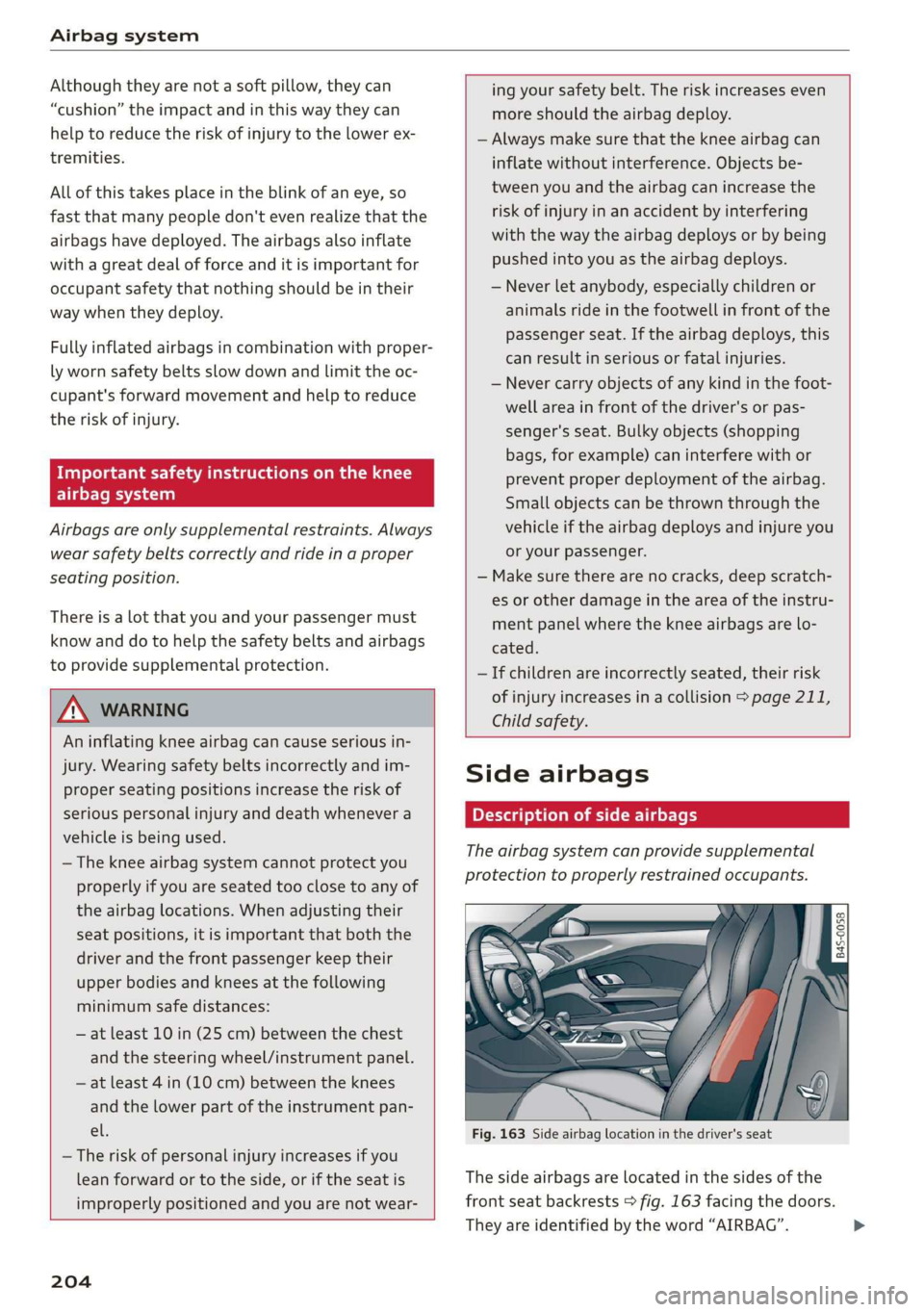
el Fig. 163 Side airbag location in the driver's seat
— The risk of personal injury increases if you
lean forward or to the side, or if the seat is The side airbags are located in the sides of the
improperly positioned and you are not wear- front seat backrests > fig. 163 facing the doors.
They are identified by the word “AIRBAG”.
204
Page 207 of 308
4S1012721BA
Airbag system
The side airbags installed for the front seating
positions have been designed and certified to
help reduce the risk of injury that can be caused
by airbags when they inflate, particularly when
the occupant sitting next to it is not seated prop-
erly. The side airbag for the front passenger seat
can be used with properly installed child re-
straints. Please be sure to read the important in-
formation and warnings whenever using a child
restraint in a vehicle: Safety belts > page 180,
Airbag system > page 187, Child safety
> page 211.
The side airbag system basically consists of:
— the electronic control module and external side
impact sensors
— the two side airbags located in the sides of the
front backrests
— the airbag warning light in the instrument clus-
ter.
The airbag system is monitored electronically to
make certain that it is functioning properly at all
times. Each time you turn on the ignition, the air-
bag system indicator light will come on for a few
seconds (self diagnostics).
The side airbag system supplements the safety
belts and can help to reduce the risk of injury to
the driver's and front passenger's upper torso on
the side of the vehicle that is struck in a side col-
lision. The airbag deploys in side impacts and on-
ly when the vehicle acceleration registered by the
control unit is high enough. If this rate is below
the reference value programmed into the control
unit, the side airbags will not be triggered, even
though the car may be badly damaged as a result
of the collision. It is not possible to define an air-
bag triggering range that will cover every possi-
ble angle of impact, since the circumstances will
vary considerably between one collision and an-
other. Important factors include, for example,
the nature (hard or soft) of the impacting object,
the angle of impact, vehicle speed, etc.
= page 206, Important safety instructions on
the side airbag system.
Aside from their normal safety function, safety
belts work to help keep the driver or front pas-
senger in position in the event of a side collision
so that the side airbags can provide protection.
The airbag system is not a substitute for your
safety belt. Rather, it is part of the overall occu-
pant restraint system in your vehicle. Always re-
member that the side airbag system can only
help to protect you if you are wearing your safety
belt and wearing it properly. This is another rea-
son why you should always wear your safety
belts, not just because the law requires you to do
so > page 180, General notes.
It is important to remember that while the sup-
plemental side airbag system is designed to re-
duce the likelihood of serious injuries, other inju-
ries, for example, swelling, bruising, friction
burns and minor abrasions can also be associated
with deployed side airbags. Remember too, side
airbags will deploy only once and only in certain
kinds of accidents - your safety belts are always
there to offer protection.
Vehicle damage, repair costs or even the lack of
vehicle damage are not necessarily an indication
of over-sensitive or failed airbag activation. In
some collisions, both front and side airbags may
inflate. Remember too, that airbags will deploy
only once and only in certain kinds of collisions -
your safety belts are always there to offer protec-
tion in those accidents in which airbags are not
supposed to deploy or when they have already
deployed.
The side airbag system will not deploy:
— when the ignition is switched off
— in side collisions when the acceleration meas-
ured by the sensor is too low
— in front-end collisions
—in rear-end collisions
—in rollovers.
In some types of accidents the front airbags, side
curtain airbags* and side airbags may be trig-
gered together.
Z\ WARNING
- Safety belts and the airbag system will only
provide protection when occupants are in
the proper seating position > page 206.
205
Page 208 of 308
Airbag system
- If the airbag indicator light > page 17
comes when the vehicle is being used, have
the system inspected immediately by your
authorized Audi dealer. It is possible that
the airbag will inflate when it is not sup-
posed to, or will not inflate when it should.
How supplemental side airbags work
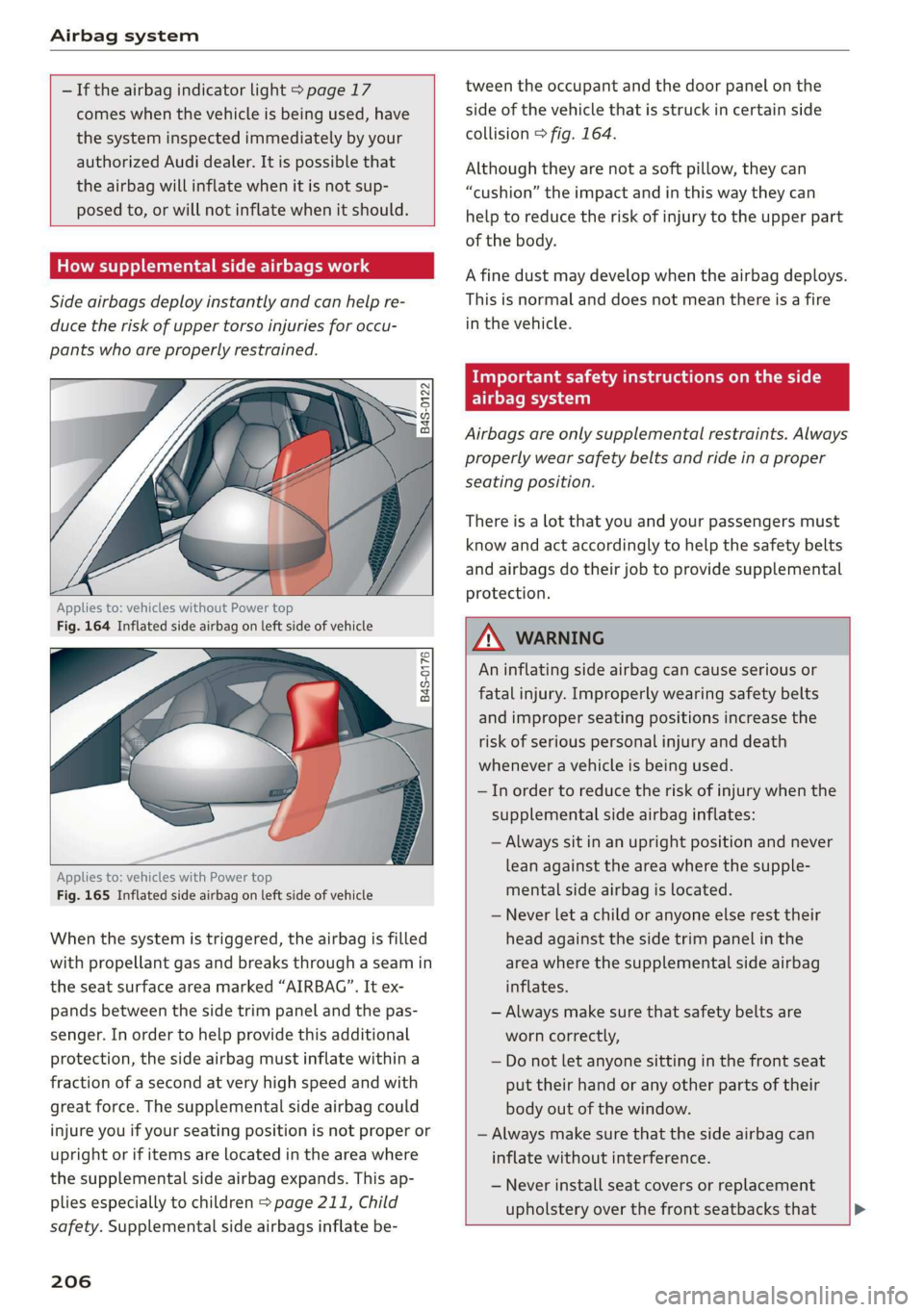
Side airbags deploy instantly and can help re-
duce the risk of upper torso injuries for occu-
pants who are properly restrained.
B4S-0122
Applies to: vehicles without Power top
Fig. 164 Inflated side airbag on left side of vehicle
B4S-0176
Applies to: vehicles with Power top
Fig. 165 Inflated side airbag on left side of vehicle
When the system is triggered, the airbag is filled
with propellant gas and breaks through a seam in
the seat surface area marked “AIRBAG”. It ex-
pands between the side trim panel and the pas-
senger. In order to help provide this additional
protection, the side airbag must inflate within a
fraction of a second at very high speed and with
great force. The supplemental side airbag could
injure you if your seating position is not proper or
upright or if items are located in the area where
the supplemental side airbag expands. This ap-
plies especially to children > page 211, Child
safety. Supplemental side airbags inflate be-
206
tween the occupant and the door panel on the
side of the vehicle that is struck in certain side
collision > fig. 164.
Although they are not a soft pillow, they can
“cushion” the impact and in this way they can
help to reduce the risk of injury to the upper part
of the body.
A fine dust may develop when the airbag deploys.
This is normal and does not mean there is a fire
in the vehicle.
Important safety instructions on the side
airbag system
Airbags are only supplemental restraints. Always
properly wear safety belts and ride in a proper
seating position.
There is a lot that you and your passengers must
know and act accordingly to help the safety belts
and airbags do their job to provide supplemental
protection.
Z\ WARNING
An inflating side airbag can cause serious or
fatal injury. Improperly wearing safety belts
and improper seating positions increase the
risk of serious personal injury and death
whenever a vehicle is being used.
—In order to reduce the risk of injury when the
supplemental side airbag inflates:
— Always sit in an upright position and never
lean against the area where the supple-
mental side airbag is located.
— Never let a child or anyone else rest their
head against the side trim panel in the
area where the supplemental side airbag
inflates.
— Always make sure that safety belts are
worn correctly,
— Do not let anyone sitting in the front seat
put their hand or any other parts of their
body out of the window.
— Always make sure that the side airbag can
inflate
without interference.
— Never install seat covers or replacement
upholstery over the front seatbacks that
Page 211 of 308
4S1012721BA
Airbag system
How side curtain airbags work
Applies to: vehicles with side curtain airbags
Side curtain airbags can work together with side
airbags to help reduce the risk of head and upper
torso injuries for occupants who are properly re-
strained.
B4S-0115
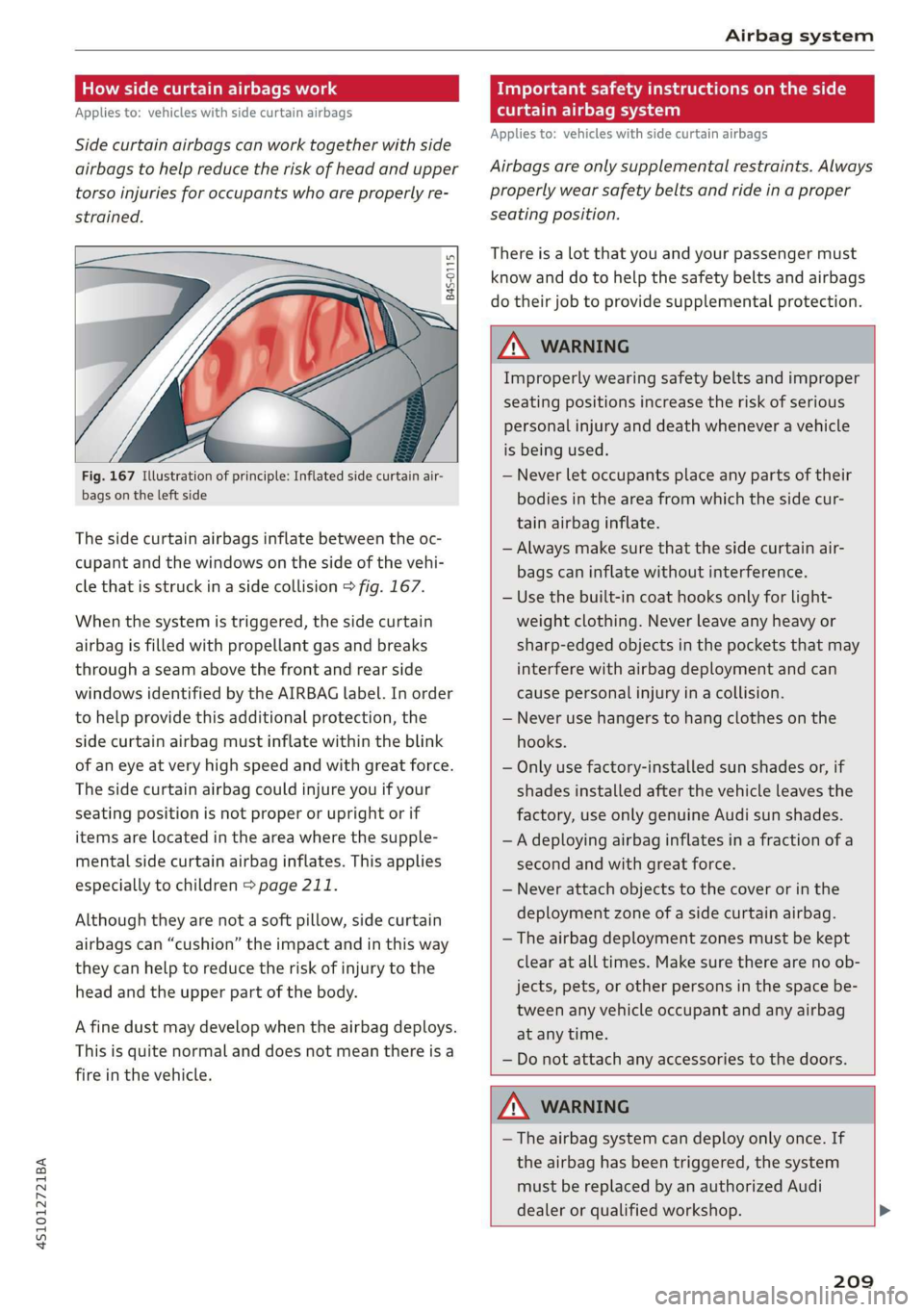
Fig. 167 Illustration of principle: Inflated side curtain air-
bags on the left side
The side curtain airbags inflate between the oc-
cupant and the windows on the side of the vehi-
cle that is struck in a side collision > fig. 167.
When the system is triggered, the side curtain
airbag is filled with propellant gas and breaks
through a seam above the front and rear side
windows identified by the AIRBAG label. In order
to help provide this additional protection, the
side curtain airbag must inflate within the blink
of an eye at very high speed and with great force.
The side curtain airbag could injure you if your
seating position is not proper or upright or if
items are located in the area where the supple-
mental side curtain airbag inflates. This applies
especially to children > page 211.
Although they are not a soft pillow, side curtain
airbags can “cushion” the impact and in this way
they can help to reduce the risk of injury to the
head and the upper part of the body.
A fine dust may develop when the airbag deploys.
This is quite normal and does not mean there is a
fire in the vehicle.
Important safety instructions on the side
ty le S)i)
Applies to: vehicles with side curtain airbags
Airbags are only supplemental restraints. Always
properly wear safety belts and ride in a proper
seating position.
There is a lot that you and your passenger must
know and do to help the safety belts and airbags
do their job to provide supplemental protection.
ZA WARNING
Improperly wearing safety belts and improper
seating positions increase the risk of serious
personal injury and death whenever a vehicle
is being used.
— Never let occupants place any parts of their
bodies in the area from which the side cur-
tain airbag inflate.
— Always make sure that the side curtain air-
bags can inflate without interference.
— Use the built-in coat hooks only for light-
weight clothing. Never leave any heavy or
sharp-edged objects in the pockets that may
interfere with airbag deployment and can
cause personal injury in a collision.
— Never use hangers to hang clothes on the
hooks.
— Only use factory-installed sun shades or, if
shades installed after the vehicle leaves the
factory, use only genuine Audi sun shades.
—A deploying airbag inflates in a fraction of a
second and with great force.
— Never attach objects to the cover or in the
deployment zone of a side curtain airbag.
— The airbag deployment zones must be kept
clear at all times. Make sure there are no ob-
jects, pets, or other persons in the space be-
tween any vehicle occupant and any airbag
at any time.
— Do not attach any accessories to the doors.
ZA WARNING
—The airbag system can deploy only once. If
the airbag has been triggered, the system
must be replaced by an authorized Audi
dealer or qualified workshop.
209
Page 213 of 308
4S1012721BA
Child safety
Child safety
Important information
Introduction
The physical principles of what happens when
your vehicle is in a crash apply also to children
= page 181, What happens to occupants not
wearing safety belts?. But unlike adults and
teenagers, their muscles and bones are not fully
developed. In many respects children are at
greater risk of serious injury in crashes than
adults.
Because children's bodies are not fully developed,
they require restraint systems especially de-
signed for their size, weight, and body structure.
Many countries and all states of the United
States and provinces of Canada have laws requir-
ing the use of approved child restraint systems
for infants and small children.
Ina frontal crash at a speed of 20-35 mph
(30-56 km/h) the forces acting on a 13 Lbs (6 kg)
infant will be more than 20 times the weight of
the child. This means the weight of the child
would suddenly be more than 260 lbs (120 kg).
Under these conditions, only an appropriate child
restraint properly used can reduce the risk of seri-
ous injury. Child restraints, like adult safety belts,
must be used properly to be effective. Used im-
properly, they can increase the risk of serious in-
jury in an accident.
If you must install a child restraint on the front
passenger seat in exceptional circumstances, be
sure to read and heed the important information
and warnings > page 188. Infants and other chil-
dren who are properly restrained in an appropri-
ate child restraint that is for their size and age
can benefit from the protection that supplemen-
tal side airbags provide in some kinds of crashes.
For more information please see information pro-
vided by the:
— National Highway Traffic Safety Administration
(NHTSA), currently at : http://www.safercar.gov
(for the USA)
— Transport Canada Information Centre, currently
at: http://www.tc.gc.ca (for Canada)
Consult the child safety seat manufacturer's in-
structions in order to be sure the seat is right for
your child's size > page 214, Important safety
instructions for using child safety seats. Please
be sure to read and heed all of the important in-
formation and WARNINGS about child safety, Ad-
vanced Airbags, and the installation of child re-
straints in this chapter.
There is a lot you need to know about the Ad-
vanced Airbags in your vehicle and how they work
when infants and children in child restraints are
on the front passenger seat. Because of the large
amount of important information, we cannot re-
peat it all here. We urge you to read the detailed
information in this owner's manual about airbags
and the Advanced Airbag System in your vehicle
and the very important information about trans-
porting children on the front passenger seat.
Please be sure to heed the WARNINGS - they are
extremely important for your safety and the safe-
ty of your passengers, especially infants and
small children.
ZA\ WARNING
All vehicle occupants and especially children
must be restrained properly whenever riding
in a vehicle. An unrestrained or improperly re-
strained child could be injured by striking the
interior or by being ejected from the vehicle
during a sudden maneuver or impact. An un-
restrained or improperly restrained child is al-
so at greater risk of injury or death through
contact with an inflating airbag.
Z\ WARNING
Children on the front seat of any car even with
Advanced Airbags can be seriously injured or
even killed when an airbag inflates. A child in
a rearward-facing child safety seat installed
on the front passenger seat will be seriously
injured and can be killed if the front airbag in-
flates.
— The inflating airbag will hit the child safety
seat or infant carrier with great force and
will smash the child safety seat and child
against the backrest, center armrest, or
door.
211