air condition AUDI R8 SPYDER 2011 User Guide
[x] Cancel search | Manufacturer: AUDI, Model Year: 2011, Model line: R8 SPYDER, Model: AUDI R8 SPYDER 2011Pages: 244, PDF Size: 59.74 MB
Page 156 of 244
154 Intelligent technology
Other road users must not be put at risk -
you may cause an accident!
- Before descending a steep grade, reduce
speed and shift transmission into a lower
gear or lower driving position . Do not
ride the brakes or hold the pedal down
too long or too often. This could cause
the brakes to get hot and diminish brak ing efficiency .
- Do not "ride the brakes" by resting your
foot on the pedal when you do not intend
to brake . This may cause the brakes to
overheat, premature wear and increased
stopping distance.
- Under certain climatic and operating
conditions such as passing through wa
ter, driving in heavy rain or after washing
the vehicle, the effectiveness of the
brakes can be reduced. In winter, ice can
accumulate on the brake pads, linings,
discs and drums. Cautiously apply brakes
for a test . Brakes will dry and ice coat
ings will be cleaned off after a few cau
tious brake applications .
- Driving for an extended period of time on
salt-covered roads without using your
brakes can also affect braking efficiency .
Clean off accumulated salt coating from
brake discs and pads with a few cautious
brake applications.
- If you damage the front spoiler, or if you
install a different spoiler, be sure the air
flow to the front brakes is not obstruct
ed. Otherwise the brake system could
overheat reducing the effectiveness of
the entire brake system.
- Failure of one brake circuit will impair
braking capability, resulting in increased
stopping distance. Avoid driving the vehi
cle and have it towed to the nearest au
thorized Audi dealer or qualified work
shop.
- Never let the vehicle roll to a stop with
the engine shut off .
- If the brake booster is not working, for
example when towing your vehicle, or because the brake booster has somehow
been damaged, the brake pedal must be pressed considerably harder to make up
for the lack of booster assistance.
Power steering
When the engine is running , power steering
makes i t easier for the driver to steer.
Power steering helps the driver steer the vehi
cle with little physical effort.
If the engine is not running, the power steer
ing system is also not working . In this case ,
you will find it extremely difficult to turn the
steering wheel.
If you turn the steering fully to the left or
right when the vehicle is stationary, you place
a very heavy load on the power steering sys
tem. Turning the steering wheel fully to the left or right will cause noise in the system. It
also reduces engine idle speed.
(D Note
Do not hold the steering turned fully to
the left or right for more than 10 seconds
when the engine is running . There is a risk
of damage to the power steering system .
(D Tips
-In the event of a power steering system
failure, or if the engine is not running
(while being towed), you will still be able
to steer the vehicle. However, you will re
quire more effort to do so .
- If the power steering system has a leak
or is defective, you should immediately
contact a qualified workshop .
- The power steering system requires a
special hydraulic fluid. The power steer
ing fluid reservoir is located in the en
gine compartment. The correct hydraulic
fluid level is important for proper opera
tion of the power steering system. The
power steering fluid level is checked ac
cording to the Audi maintenance service
schedule.
Page 159 of 244
will be recharged and the notification will go
out.
Driver notification appears and goes out
again
If this driver notification appears after the ig
nition is turned on or while driv ing and it goes
out again after a wh ile, the battery has been
adequately recharged.
Driver notification appears and does not
go out again
If this driver notification appears after the ig
nition is turned on or while driv ing and does
not go out again, the battery's state of charge
is not in the optimal range. Starting ability is
restricted. Have the battery checked as soon
as poss ible by an author ized Audi dealer or
qualified workshop.
Dry sump lubrication
H igh lateral and long itud inal forces affect the
engine and the vehicle during sporty driving.
Dr y sump l ubr ica tion ensures that your engine
i s supplied w ith oil and properly lub ricated
even under these conditions.
I n a "normal" veh icle the o il pump sends the
oil from the oil pan to the lubrication points in
the engine. The oil then returns to the oil pan .
I n extreme situations, the oil pump may draw
in air, which results in insufficient oil pressure.
With dry sump lubrication, the oil is not in the
oil pan (it is "d ry"), but in a separate oi l tank.
While one pump supplies the engine with oi l,
a second pump suctions the oi l out of the en
g ine and returns it to the oil tank . Because the
oil tank is ta ll and narrow, o il pressure is con
stant even under extreme conditions.
In addition, the oil pan in vehicles with dry
sump lubrication is noticeably sha llower. Th is
allows the engine to be installed lower in the
vehicle, bringing down the center of gravity .
This improves your vehicle's handling .
Intelligent technology 157
•
•
Page 161 of 244
-Have you r vehicle maintained properly
and in accordance with the service rec
ommendat ions in your Warranty
& Main
tenance booklet.
- Lack of proper maintenance as well as
improper use of the vehicle will impair
the function of the Emission Control Sys
tem and could lead to damage.
Sporty driving
Warming up and cooling down
By carefully warming up and cooling down
your vehicle, you can he lp ensure that it is not
overstressed unnecessarily during sporty driv
ing.
When warming up, the vehicle is driven at a maximum engine speed of
6000 RPM
(Vl0 engine) or 7000 RPM (V8 engine) in or
der to raise the engine oil temperature to a minimum of
140 °F (60 °(). The tires also on
ly reach their full road holding capability once
they have warmed up .
The cooling fan can continue to run in your ve h icle after the engine is switched
off. H owev
er, driving the vehicle to cool it down is part ic
ularly important. During sporty driving, the
engine and brakes, the exhaust system, and
the t ransm ission all become ex treme ly hot.
Before you park the vehicle, you shou ld d rive
it for a few mi les/kilometers at light load in
the low rpm range to allow it to coo l down .
Driving on a track
Before you take your vehicle out on a track,
ensure that it is in perfect condition. For ex
ample, you should check the tire tread and the brake pads . It is best to increase t ire pressure
by about 0 .3 bar .
When driving on a track, oil consumption may be somewhat higher than in "normal" opera
tion ¢page
180.
You shou ld definitely inspect your vehicle af
ter subjecting it to severe condit ions. Are the
brake pads OK? Is there anything unusual
Dri vin g and en vironm ent 159
about the ti res, including the inner and outer
sidewa lls (e.g . tread, blistering)? Are the air
intakes free of leaves and tire dust? Is the o il
l evel OK?
Your authorized Audi dea ler or qua lified work
shop will be happy to undertake an inspection
before and after use on the race track.
(D Tips
- Some race tracks (e.g . steeply banked
t u rns) may affect the response of the
ESP .
- When driven on a race track, all vehicle
parts are severe ly stressed. This can re
sult in increased wear.
Operation and maintenance
Fuel economy, env ironme nta l impact, and
wear on your eng ine, brakes and tires largely
depend on three factors:
- your personal driving style
- operating conditions
- technical limitations
By having your ve hicle reg ularly se rv iced by an
authorized Aud i dea ler helps to ens ure that i t
r uns properly and econom ica lly. The condition
of your veh icle not only affects its safety and
ability to ho ld its va lue, it a lso affects
f u el
con sumptio n.
The amount o f oi l used is re lated to engine
load and speed .
It is normal fo r the oil consump tion of a new
engine to reac h its lowest value after a certa in
mileage has been d riven.
You must drive your veh icle about 3,000 mi les
(5,000 kilometers) before you can p rope rly
assess oil consumpt ion.
This also app lies to fue l cons umption and en
gine output.
(D Note
- Have your veh icle ma inta ined properly
and in accordance with the service
•
•
Page 162 of 244
160 Driving and en vi ro nment
recommendations in your Warranty &
Maintenance booklet . Lack of proper
maintenance as well as improper use of
the veh icle w ill impair the funct ion of
the emission control system and could
l ead to damage.
- Do not alter or remove any component of
the Em ission Contro l System unless ap
proved by the manufacturer.
- Do not alter or remove any device, such
as heat shields, switches, ignition wires,
valves, wh ich are designed to protect
you r vehicle's Emiss ion Control System
and othe r important veh icle compo
nen ts.
(D Tips
The consumpt ion estimates as publish ed
by the ENVIRONM EN TAL PRO TECTIO N
AG ENCY ( EPA) and Transpor t Canada may
no t correspond to yo ur actua l cons ump
tion on the road, which will vary depend
ing upon vehicle load and speed, road and
weather conditions, trip length, etc.
Trailer towing
Your Audi RB is not designed to tow a trailer.
Towing a trai le r with yo ur Audi R8 is not rec
ommended and ca n cause damage to the vehi
cle . Damage caused by towing a tra iler is not
covered under warranty .
Page 163 of 244
Cleaning and protect ion
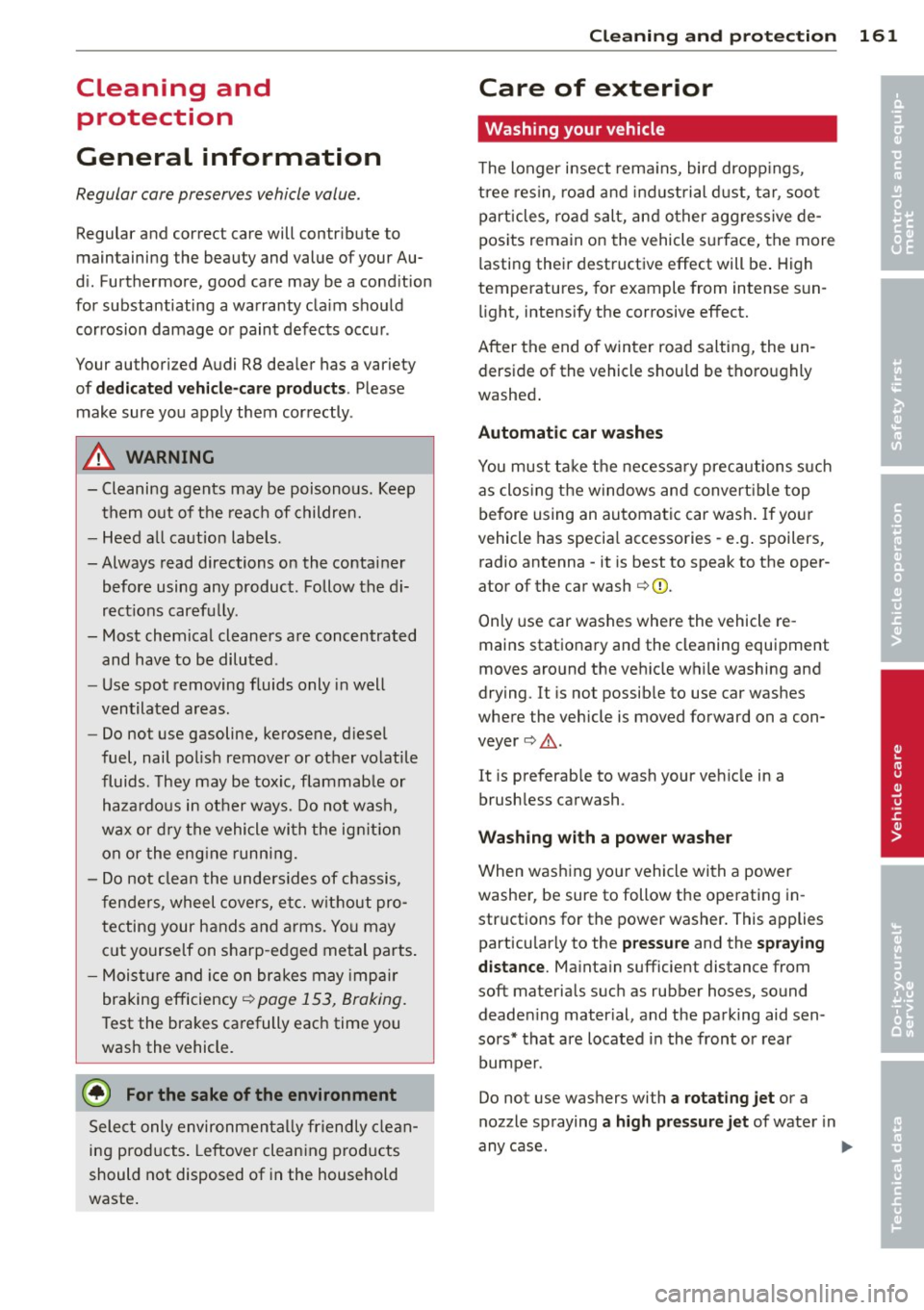
General information
Regular core preserves vehicle value.
Regular and correct care will contribute to
maintaini ng the beauty and value of your Au
d i. Furthermore, good care may be a condition
for substantiating a warranty cla im should
corrosion damage or paint defects occur.
Your authorized Audi R8 dealer has a variety
of
d edicat ed ve hicl e-car e produ ct s. Please
make sure you apply them correctly .
A WARNING
-Cleaning agents may be poisonous. Keep
them out of the reach of children.
- Heed all caution labels .
- Always read directions on the container before using any product. Follow the di
rect ions carefu lly.
- Most chemical cleaners are concentrated and have to be diluted .
- Use spot removing fluids only in well
ventilated areas .
- Do not use gasoline, kerosene, d iesel
fuel, nail polis h remover or other volatile
fluids . They may be toxic, flammab le or
haza rdous in other ways. Do not wash,
wa x or d ry the vehicle wi th the ign it ion
on or the eng ine running.
- Do not clean the undersides of chassis,
fenders, wheel covers, e tc. wit h out pro
tecting your hands and arms . You may
c u t yourself on sharp -edged metal parts .
- Moist ure and ice on brakes may imp air
braking efficiency
c:> page 153, Broking.
T est the brakes carefully each time you
wash the vehicle.
@) For the sake of the environment
Select only environmentally friend ly clean
ing products . Leftover clean ing products
should not disposed of in the household
waste .
Cleaning and protec tion 16 1
Care of exterior
Washing your vehicle
The longer i nsect rema ins, bird dropp ings,
t ree res in , ro ad and indust rial dust, tar , soo t
particles, road salt, and o ther aggressive de
pos its remain on the vehicle su rface, the more
lasting their destructive effect will be . High
temperatures, for example from intense s un
light, intensify the corrosive effect.
After the end of winter road salting, the un derside of the vehicle shou ld be thoroughly
washed .
Automatic car washes
You must t ake the necessary precautions s uch
as clos ing t he windows and convert ible top
before using an automatic car wash.
If yo ur
vehicle has specia l accessories - e.g . spoilers,
radio antenna -it is best to speak to the oper
ator of the car wash c:>(D .
Only use car washes where the vehicle re
mains stationary and the cleaning equipment
moves around the veh icle while washing and
drying. It is not possib le to use car washes
where the vehicle is moved forward on a con
veyer
c:> ,& .
It is preferab le to wash your vehicle in a
brush less carwash .
Washing with a pow er wa sher
When was hing yo ur vehicle with a power
washe r, be sure to follow the operating in
structions for the power washer. This applies particu larly to the
p ressure and the spra ying
distance .
Mainta in sufficient distance from
soft materials such as rubber hoses, sound
deade ning mater ial, and the park ing aid sen
sors* that are located i n the front or rear
bumper.
Do not use washers with
a ro tating jet or a
nozzle spraying
a h igh pr essur e je t of wate r in
any case.
IJl,-
•
•
Page 180 of 244
178 Checking and filling
Engine oil
Engine oil specifications
The engine oil used in your Audi needs the
right kind of oil.
The engine in your Audi is a sophisticated
powerplant that was built to exacting specifi
cations. This engine needs the right kind of
engine o il that meets spec ificat ions regarding
qua lity and viscos ity so that it can run
smoothly and reliably . Choos ing the righ t oi l
and changing oil w ith in the time a nd mileage
interva ls printed in your vehicle's Warranty
&
Maintenance book let matters a lot more to
day than it did yea rs ago. A udi has developed
a special quality standard for engine oil that
will help assure that your veh icle's eng ine will
get the lubrication it needs for proper opera
tion .
Modern engine lubrication has taken a quan
tum leap in the last few years. Many synthetic
oils ava ilable today provide better engine lu
b rication that can outlast traditiona l petrole
um-based o ils, making them a smart choice
for use throughout the life of you r A udi .
Whether you use synthetic or petroleum based engine oil, the oil that you use must
conform to Audi's oil qual ity standard
VW 502 00 to help keep your veh icle 's eng ine
r unning smoo thly and help prevent t he fo r
ma tion of harmfu l deposi ts, some times called
"s ludge," that over t ime can lead to expensive
repairs.
A t the time of pr intin g, engine o ils availab le in
the U .S . and Canad a that meet the exact ing
specifications o f A udi oil standard VW 502 00
are synthetic engine oils . This does not mean,
however, that eve ry synthetic engine oil wi ll
meet A udi oil standard VW 502 00. So a lways
be sure that you use an approved o il.
To help preve nt the formation of harmful de
posits use only oi l with the fo llow ing spec ifi
cations printed on the oil container :
Audi oil standard VW 502 00
Oil container labels may car ry the specifica
tion sing ly or in combination with othe r desig
nations and oil quality standa rds .
Viscosity
Engine o ils are graded accord ing to their vis
cosity . Th e pr oper viscos ity grade oil fo r you r
engine de pends on clim actic o r seaso nal con
di tions where yo u drive. You can use o il wit h a
viscosity grade o f SAE SW40 across all tem
perature ranges for norma l driving conditions.
However, if engine oil visco sity g rade SA E
SW40 is not ava ilable, you can a lso use v iscos
ity grade SA E SW -30 or SA E OW -40 as long as
it meets Audi oil q ua lity standard VW 502 00
specificat ions.
Beca use engine o il that mee ts the Audi o il
standard may not be availab le everywhere
when you need it, we strong ly recommend
t h at you a lways carry with you an extra quart
( li ter) of oil that express ly conforms to the
VW 502 00 specification, in case you have to
top off the oil while on the road .
Only if the level of the oil is at or be low the
min imum ma rk on the o il dipstick - and n o oi l
that expressly conforms to Audi o il standard
VW 502 00 specifications is availab le -may
yo u top off with a high quali ty engine o il, p ref
erably synthet ic-based, that me ets ACEA A3,
AC EA AS o r AC EA B S or A PI SL spec ifi cat io ns,
but even t hen, only in v iscosi ty g rades SA E
SW -40, SA E SW-3 0, or SAE OW-40 . However,
during the entire time between oi l change in
te rva ls , never top
off with more than a tota l
of 0 .5 qt/liter engine oil that does not con
form to Audi oil specification VW 502 00.
F or more information abo ut engine oi l that
has been approved for your ve hicle, please
contact e ither yo ur authorized Aud i dea ler or
Audi C ustomer Re lations at 1 (800) 822-2834
or v is it our web site at www.audiusa.com or
www .aud icanada .ca. Here you w ill also find a
c ur rent l ist of oils (manufacturers, bra nd
names etc.) that conform to Aud i oil standa rd
vw 50 2 00.
Changing the engine oil
Page 181 of 244
The engine oil and oil filter must be changed
according to the mi leage (kilometers) and
time interva ls specified in your vehicle's War
ranty & Maintenance booklet. Do not exceed
these intervals -harmful deposits from old
engine o il can reduce engine performance and
can lead to expensive engine repairs.
Changing the o il at the recommended inter
vals is so very important because the lubricat
ing properties of oil decrease gradually during
normal vehicle use . If you are not sure when
you have your oi l changed, ask your author
i zed A udi Service Advisor.
Under some circumstances the engine o il
should even be changed more frequently.
Change o il more often if you drive mostly
short distances, ope ra te the vehicle in dusty
areas or mostly under s top-and-go traffic con
d itions, or when yo u use your vehicle whe re
temperatures stay below freezing point for
l ong periods.
D etergen t additives i n the o il w il l make fresh
oil look dark after the eng ine has been run
ning for a short time . This is norma l and is not
a reason to change the oi l more often than
recommended.
Damage or malfunction s due t o lack of
m aintenance
It is essen tial that you change your oil at the
r ecommended inte rva ls using only engine o il
that complies with A udi oil standard
VW 502 00. Yo ur Limited New Vehicle War
ranty does not cover damage or malfunctions
d ue to fai lure to fo llow recommended mainte
nance and use req uirements as set forth in
the Audi Owner's Manua l and Warranty&
Ma intenance book let . Your autho rized Aud i
deale r will have to deny warranty coverage un
l ess you present to the dealer p roof in the
fo rm of Se rvice o r Repair Orde rs t hat all
sched uled main tenance w as performed in a
time ly manner .
Checkin g and fillin g 179
Engine oil consumption
The engine in your vehicle depends on an ade
quate amount of oil to lubricate and cool all
of its moving parts .
In order to provide effective lubrication and
cooling of interna l eng ine components, all in
te rnal combust io n engines consume a certain
amount of oil. Oil consumpt io n va ries from
engine to e ngine and may change sig nifican tly
ove r the life of the engine. Typically, engines
with a spec ified break -in pe riod (see
c::> page 158) consume more oil d uri ng the
break-in pe riod than they consume afte r oi l
consumption has stabilized.
U nder normal cond itions, the rate of oi l con
s u mption depends on t he q uality and viscos ity
of the oil, the RP M (revolut ions per minute) at
which the engine is operated, the ambient
temperature and road conditions. Further fac
tors are the amount of oil dilut ion from water
condensa tion or fue l residue a nd the oxida
tion level of the oil. As any eng ine is subject to
wear as m ileage builds up, t he oil co nsump
t ion may increase over time until repla cement
of wo rn components may be come necessary.
Wi th a ll these va riab les coming into p lay, no
standard rate of oil consumpt io n can be es
t a bl is h ed o r spec ified . There is no alte rnative
to regular and frequent chec king of the o il lev
el, see
Note.
If the yellow engine o il level wa rning symbo l
i n the instrument cluster
1\11 lights up, yo u
sho uld check the oil leve l as soon as possib le
c::> page 180 . Top off the oil at your ear liest
convenience
c::> page 180 .
A WARNING
-Before you check anything in the engine
compartment, always read and heed a ll
WARNINGS
c::> & in Working in the engine
compartment on pag e 175.
(D Note
Driving w ith an insufficient o il level is like-
-
ly to cause severe damage to the engine. .,.
•
•
Page 195 of 244
Tires and wheels 193
Cold tire inflation pressure
Tire pressure affects the overall handling, performance and safety of a vehicle.
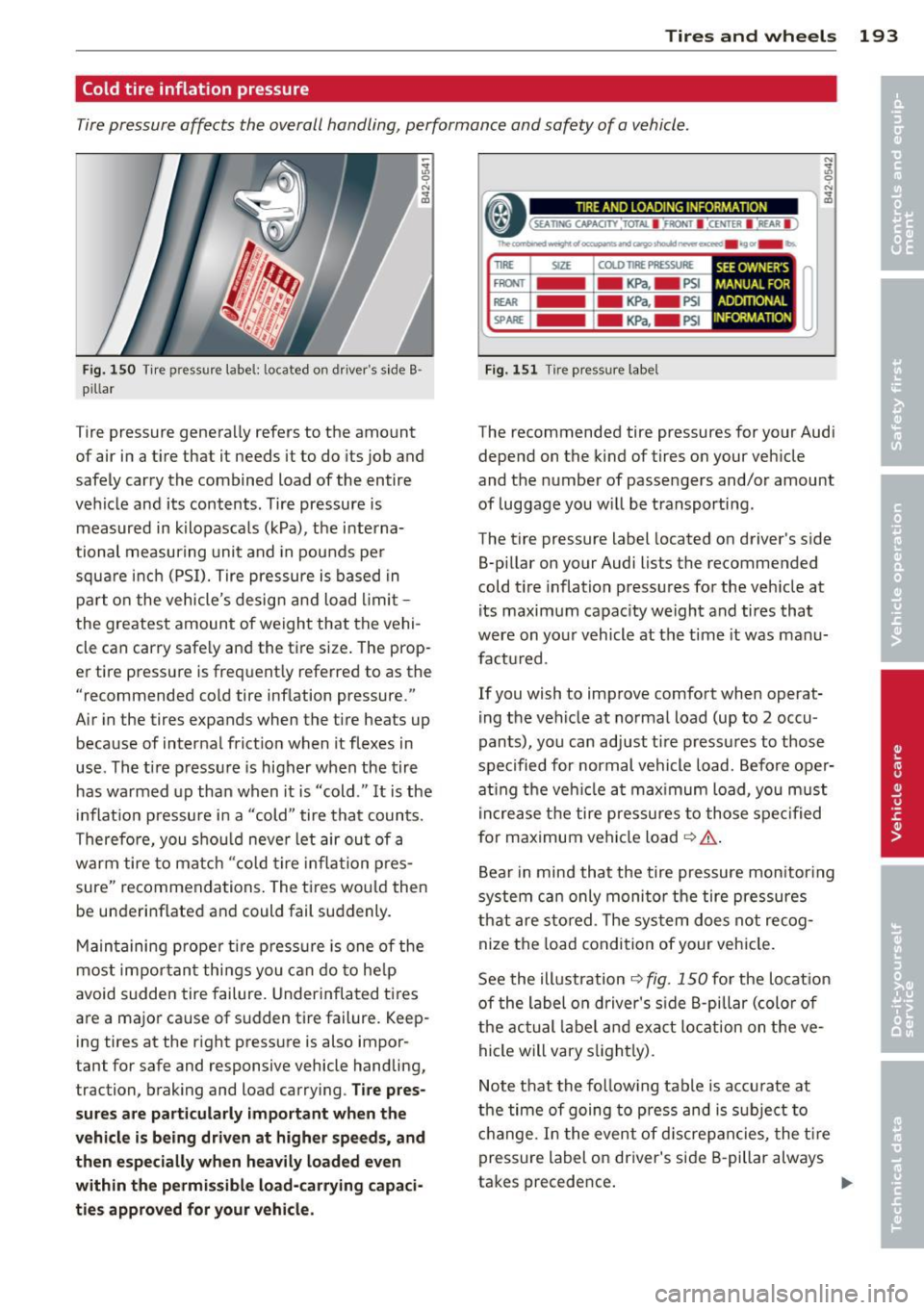
Fig. 150 Tire pressure label: located on driver's side B·
pillar
Tire pressure generally refers to the amount
of air in a tire that it needs it to do its job and
safely carry the combined load of the entire
vehicle and its contents. Tire pressure is measured in kilopascals (kPa), the interna
tional measuring unit and in pounds per
square inch (PSI). Tire pressure is based in
part on the vehicle's design and load limit
the greatest amount of weight that the vehi
cle can carry safely and the tire size. The prop
er tire pressure is frequently referred to as the
"recommended cold tire inflation pressure."
Air in the tires expands when the tire heats up
because of internal friction when it flexes in
use. The tire pressure is higher when the tire
has warmed up than when it is "cold." It is the
inflation pressure in a "cold" tire that counts.
Therefore, you should never let air out of a
warm tire to match "cold tire inflation pres
sure" recommendations. The tires would then be underinflated and could fail suddenly.
Maintaining proper tire pressure is one of the
most important things you can do to help
avoid sudden tire failure. Underinflated tires
are a major cause of sudden tire failure. Keep
ing tires at the right pressure is also impor
tant for safe and responsive vehicle handling,
traction, braking and load carrying .
Tire pres
sures are particularly important when the
vehicle is being driven at higher speeds, and
then especially when heavily loaded even
within the permissible load-carrying capaci
ties approved for your vehicle.
"' ..,
-~ --------------- ~ a ;l!; TIRE AND LOADING INFORMATION
• (SfATING CAPAOTY JOTAI. I }ROHT I :CUITTR I :R£AR I)
l'hl!o combned~c:loo:upain.sanoatg0,sbo&AdnM'fexeeC1 •"'.gcw -b.
COI.O TIRE PRESSURE
- KPa.- PSI
- KPa,- PSI
_ KPa,. PSI
Fig. 151 Tire pressure label
SEE OWNER'S
MANUA L FOR
ADDITTONAL
INFOl
u
The recommended tire pressures for your Audi
depend on the kind of tires on your vehicle
and the number of passe ngers and/or amount
of luggage you will be transporting.
The tire pressure label located on driver's side
B-pillar on your Audi lists the recommended
cold tire inflation pressures for the vehicle at
its maximum capacity weight and tires that
were on your vehicle at the time it was manu
factured.
If you wish to improve comfort when operat
ing the vehicle at normal load (up to 2 occu
pants), you can adjust tire pressures to those
specified for normal vehicle load. Before oper
ating the vehicle at maximum load, you must
increase the tire pressures to those specified
for maximum vehicle load
9 .&.
Bear in mind that the tire pressure monitoring
system can only monitor the tire pressures
that are stored. The system does not recog
nize the load condition of your vehicle.
See the illustration,:;,
fig. 150 for the location
of the label on driver's side B-pillar (color of
the actual label and exact location on the ve
hicle will vary slightly).
Note that the following table is accurate at
the time of going to press and is subject to
change. In the event of discrepancies, the tire
pressure label on driver's side B-pillar always
ta kes precedence. ..,.
Page 202 of 244
200 Tires and wheels
contribution to good road holding and safe
handling when in good condition and properly
inflated
¢ ,& .
We recommend that all work on tires and
wheels be performed by an authorized Audi
dealer. They are familiar with recommended
procedures and have the necessary special
tools and spare parts as well as the proper fa
cilities for disposing of the old tires.
Authorized Audi dealers have the necessary
information about technical requirements for
installing or changing tires and rims.
Replacing tires and wheels
Tires should be replaced at least in pairs and
not individually (for example both front tires
or both rear tires together).
Be sure to read and heed the information to
the tire pressure monitoring system
¢page 201.
Always buy replacement radial tires that have
the same specifications as the tires approved
for your vehicle by Audi. Replacement tires
must always have the same load rating speci
fication as the original equipment or approved optional tires listed in the table
¢page 193.
Audi-approved specification tires are specially
matched to your vehicle and its load limits,
and can contribute to the important road hold
ing, driving characteristics, and safety of the
vehicle. The table(¢
page 193) lists specifica
tions of the tires approved for the Audi mod
els covered by your Owner's Literature .
The tire pressure label located on driver's side
B-pillar (
¢ page 193, fig. 151) lists the speci
f ications of the original equipment tires in
stalled on your vehicle at the time it was man
ufactured.
Federal law requires tire manufacturers to
place standardized information on the side
wall of all tires¢
fig. 153. This information
identifies and describes the fundamental
characteristics, the quality grade of the tire
and also provides a tire identification number for
safety standard certification and in case of
a recall.
Tire specifications
Knowledge of tire specifications makes it eas
ier to choose the correct tires. Radial tires
have the tire specifications marked on the
sidewall, for example:
P235 / 35 R 18 91 Y
This contains the following information:
P Indicates the tire is for passenger cars
235 Nominal tire width in mm of the tire
from sidewall edge to sidewall edge. In general, the larger the number, the wider
the tire
35 Height/width ratio in percent (aspect ra-
tio)
R Tire construction: Radial
18 Rim diameter code (in inches)
91 Load rating code
Y Speed rating letter code
XL (or "xl", "EXTRA LOAD", or "RF") indicates
that the tire is a"Reinforced" or an "Extra
Load" tire
M+S (or "M/S") Indicates that the tire has
some mud and snow capability
The tires could also have the information of
direction of rotation¢
page 189.
Tire manufacturing date
The manufacturing date is also indicated on
the tire sidewall (possibly only on the
inner
side of the wheel):
"DOT ... 2210 ... " means, for example, that
the tire was produced in the 22nd week of 2010.
Speed rating (letter code)
The speed rating letter code on the wheels in
dicates the maximum permissible road speeds
¢ .&. in Winter tires on page 204.
P up to 93 mph (150 km/h)
Q up to 99 mph (158 km/h)
R up to 106 mph (170 km/h)
S up to 110 mph (180 km/h)
Page 205 of 244
dealer will g ladly provide you with more
information.
Uniform tire quality grading
- Tread wear
- Traction AA A B C
- T emperature ABC
Quality grades can be found where applicable
on the ti re side wa ll between tread shoulde r
and maximum section wid th ¢ page 199,
fig. 153 .
For example : Tread wear 200, Tract ion AA ,
Tempe ratu re A .
All passenger car tires must conform to Feder
al Safety Requi rements in addition to these
grad es.
Tread we ar
The tread wear grade is a comparative rating
based on the wear rate of the tire when tested
under controlled conditions on a spec ified
government test course.
For example, a t ire graded 150 would wear
one and one half (1 1/2) t imes as well on the
government course as a tire graded 100 .
The relat ive perform a nee of ti res depends
upon the actual conditions of their use, how
ever, and may depart sign ificantly from the
norm due to var iat ions in dr iv ing habits, serv
i ce practices and differences in road cha racter
i stics and climate.
Traction
The traction grades, from highest to lowest,
are AA, A, Band
C. Those grades represent the
tire's abil ity to stop on wet pavement as
measured unde r controlled cond it ions on
spec ified gove rnment test su rfaces of asphalt
and concrete . A tire ma rked C may h ave poor
tr action perfo rm ance¢ &..
Temp erature
The temperature grades are A (the h ighest),
B, and C, repr ese nting the t ire's resistance to
the gene rat io n of heat and i ts ab ility to dissi-
Tire s an d wheel s 203
pate heat when tested under controlled condi
tions on a specified indoor laboratory test
whee l.
Sustaine d high temperature can cause the
mater ia l of the tire to degenerate and red uce
tire life, and excessive tempe rat ure ca n lead
to s udden tire failure ¢ &. .
T he gr ade C correspon ds to a level of pe rform
ance which all passenger car tires must meet u nder the Federal Motor Vehicle Safety Stand
ard No . 109 . Grades Band A represent higher
l evels of performance on the laboratory test
whee l than the minimum requ ired by law.
A WARNING
The traction grade assigned to th is tire is
based on straight-ahead braking traction
tests, and does not include accele rat ion,
cor neri ng, hy droplaning or peak t ra ction
ch aracte rist ics.
A WARNING
T he temperature grade for this tire is es
tablished for a tire that is properly inf lated
and not overloaded . Excess ive speed, un
derinflation, or excessive loading, e it h er
separately or in combinat ion, can ca use
heat bui ldup and possible tire failure.
Winter tires
Winter tires con improve vehicle handling on
snow and ice. At temperatures below 45 °F (7 °C) we recommend changing to winter
tires.
In some heavy snow areas, local governments
may require true w inter or "snow" tires, those
with very deeply cut tread. T hese tires should
o nl y be used in pairs and be installed o n all
fou r wheels . Make sure you purchase snow
ti res that a re the same si ze and construction
type as the othe r ti res on you r vehicle.
If your vehicle is equipped w ith all-whee l
drive*, th is w ill improve traction during winter
driv ing, even with the s tanda rd tires . Howev-
er, we stro ngly recommend that you always ..,.
•
•