engine oil AUDI R8 SPYDER 2011 User Guide
[x] Cancel search | Manufacturer: AUDI, Model Year: 2011, Model line: R8 SPYDER, Model: AUDI R8 SPYDER 2011Pages: 244, PDF Size: 59.74 MB
Page 80 of 244
78 On the road
Ignition on @
Afte r switching the ignition on, the needles
move a ll the way up and then down .
I f it is difficult to tu rn the key afte r you have
i nserted it into the ignition lock, turn the
steering wheel back and forth. This will take
the load off the steering lock mechan ism and
you will be able to turn the key freely and start the engine .
Starting the engine @
In th is position the engine sta rts. While the
engine is start ing, the power s upply to the
headlights and other e lectr ica l cons umers is
tempo rari ly interrupted to conserve battery
power. After the engine has started, release
the key and it will return to posit ion @.
Before the starter can be operated again the
key must be turned back to position@. The
non-repeat lock prevents you from damaging
the starter when the engine is runn ing .
A WARNING
-Never remove the key from the ign ition
lock whi le the vehicle is moving. The
steeri ng wheel will lock causing loss of
contro l.
- If you have to leave your vehicle - even
for just a m inute - always remove t he ig
nition key and ta ke it with you. This is es
pecially important if you a re going to
leave ch ildren behind in the vehicle. The
children co uld star t t he engine or use
other vehicle controls . Unsupervised use
of vehicle controls (for examp le, power
windows) can cause serious personal in
jur ies.
(D Tips
If the veh icle battery has been discon nect
ed and then reconnected, then you must leave the key in pos ition @for abo ut 5
seconds before you can start t he engine.
-
Starting the engine
The engine can only be started with your orig
inal Audi key.
On vehicles with R tronic *, the engine can be
started in the ne utra l position N and in each
gear (1 - 6 and R).
.. Se t the park ing brake ¢,&. .
.. On ve hicles with ma nual transmission *, fully
depress the cl utch peda l.
.. Press and hold the brake peda l.
.. Turn the ignition key to posit ion @
¢ page 77, fig . 85 - do not depress the gas
pedal when starting the engine .
.. Let go of the key as soo n as the engine
starts - the sta rter must not cont inue to
r u n. On veh icles w it h R t ro nic , sele ct ge ar
posi tion N.
A cold engine may at first be loud afte r it has
been started. This is due to the hydrau lic
valves b uilding up the oil p ress ure. This is no r
mal and no need fo r conce rn .
If th e engine does not start imm ediately, stop
t ry ing after 10 seconds and t hen t ry to res tart
t h e engine abou t 30 seconds later.
A WARNING
-
- Never star t or le t the eng ine run in a con
f ined o r enclosed area . Exha ust fumes
from the en gine contain carbon monox
ide, a co lorless and odorless gas. Carbon
monox ide ca n be fatal if inhaled.
- Never leave the engine id ling unattend
ed. An unattended veh icle w ith a run ning
e ngine poses a danger of personal injury
or theft.
- With the engine r unning and a gear en
gaged, you have to hold the ve hicle w it h
the foot brak e.
(D Note
-Avo id h igh engine speeds, fast accelera
tion or heavy engine loads while the en
gine is still cold. This could damage the
eng ine.
Page 153 of 244
as a pulsing motion of the brake pedal, ac
companied by some noises. In order for ABS
to be able to operate optimally in th is range,
you must keep the brake pedal depressed -
never "pump the brakes" . You should not ex
pect that braking d istances w ill be
shortened
under all circumstances with ABS . Braking dis
tance may even be slightly
longer, for exam
p le on gravel or wi th fresh snow on a slippery
surface .
If a sign ificant
speed differential between the
d rive wheels on one axle is determined (for
examp le, on a su rface that is s lippery
on one
side),
the EDS brakes the spinn ing whee l and
transfers power to the other drive whee ls.
This is done up to a speed of about 60 mph (100 km/h) . Noises from the brake system
signal that whee l spin is being controlled.
I f one whee l spins when starting from a com
p lete stop because o f a different grip (for ex
ample , one wheel o n ice), keep your foot
hard
on the accelerator until the veh icle starts to
move.
If the wheels spin , ASR wi ll automatically re
duce engine torque and match power to road
surface conditions .
Switching on Sport mod e
In specific driving situations (e.g. Launch Con
trol), you swi tch ASR and ESP to Sport mode
by pressing the
[!I button once . The indicator
light
11 illuminates and ESP sport -Wa rni ng!
Restric ted stab ility
appears . "Slip" is matched
to the speed. You should do this only if your
driving skill and traffic cond it ions permit .
Switching ASR /ESP off
In certain sit uations (e .g . in deep snow, on a
l oose surface, o r when rocking the vehicle
free), switch ASR and ESP off by pressing the
[ill button for more than 3 seconds. The ind ica
tor light
I) illuminates and ES P sw itc hed off -
Warning! R estricted stability
appears . You
should do th is only if your driving skill and
traffic cond itions pe rmit .
Int ellig ent technolog y 151
Switching ASR /ESP on
Activate ASR/ ESP by p ressing the [!I button
again. The message
ESP on appears in the d is
play briefly.
Brake overheating
So that the disc b rake on a b raked wheel does
not overheat, the EDS switches off automati
ca lly if there is un usua lly severe loa ding at
th is wheel. The vehicle is st ill drivable and has
the same properties as a vehicle wit hout EDS .
As soon as the brake has cooled down, EDS
swi tches on aga in automatically.
A WARNING
- Even ESP, ABS, EDS and ASR cannot over
come the laws of physics . You should
keep this in m ind in particular on an icy
or wet road. If the systems intervene,
you shou ld adjust your speed immediate
ly to road and traff ic conditions . Do not
be tempted by the increased safety pro
vided to take risks -you risk having an
accident.
- Please keep in mind that the r isk of an
accident is i ncreased by driving too fast,
pa rti cularly in corners and on icy or wet
ro ads, and by drivi ng too close to the ve
hicle ahead . Even ES P, ABS, E DS and ASR
cannot eliminate the increased risk of
having an accident.
-Apply the throttle ca re fully when accel
erating on a consistently s lippery sur
face, e.g. on ice and snow . The drive
wheels can spin in spite of the EDS and thereby affect vehicle stability -you risk
having an accident .
- Please note that when ASR or ESP/ASR is
deactivated, the drive wheels can spin on
icy and slippery roads and the veh icle can
break away -the re is a risk of skidd ing!
(D Tips
- In the event of a defect in the rear spoil-
er system or in Audi magnet ic ride, it can
happen that ASR and ASR/ESP cannot be .,.
•
•
Page 154 of 244
152 Intelligent te chn olog y
deactivat ed, or they are activated auto
matically in the deactivated state .
- If a malfunction occurs in the E DS, this is
signaled by an indicator light, see
~ page 18.
- Some tracks (e.g . steeply banked turns)
may affect ESP response.
Rear spoiler
T h e rear spoil er improv es vehicle handling
and enhances driver control .
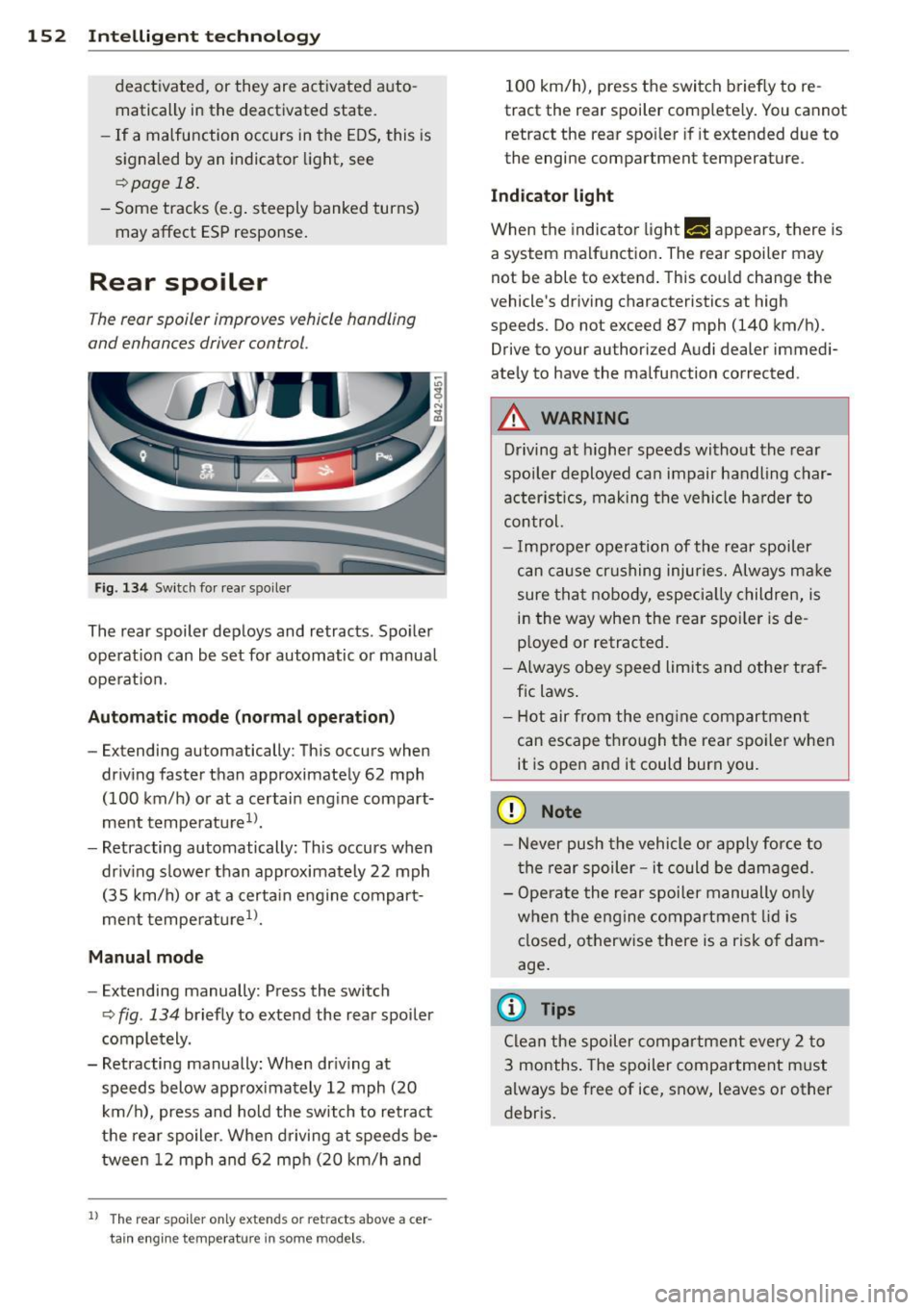
Fig . 134 Sw it ch for re ar s po ile r
The rear spoi ler deploys and retracts . Spo iler
operat ion can be set fo r automatic or manual
operation.
Automatic mode (no rmal operation )
-Extending automa tically : This oc curs when
driv ing faster than approximately 62 mph
(100 km/h) or at a certain eng ine compart
ment tempe rature
1>.
- Retracting automatically : This occurs when
dr iv ing slower than approximately 22 mph
(35 km/h) or at a certain engine compart
ment temperature
1> .
M anual mode
- Extending manually : Press the switch
~ fig . 134 briefly to extend the rear spoiler
completely .
- Retracting manually : When dr iv ing at
speeds below approximately 12 mph (20 km/h), press and hold the switch to retract
the rear spo iler. When driving at speeds be
tween 12 mph and 62 mph (20 km/h and
l) The rear s po iler o nly e xten ds or ret racts a bove ac er
ta in eng in e te mp erat ure in some m odels.
100 km/h), press the switch briefly to re
tract the rea r spoiler comp lete ly. You cannot
retract the rear spoi ler if it extended due to
the engine compartment temperature .
Indicator light
When the indicato r light f.-j appears, there is
a system malfunction . The rear spoiler may
not be able to extend . This cou ld change the
veh icle's d riving characterist ics at h igh
s peeds. Do not exceed 87 mph (140 km/h) .
Drive to your au thorized Audi dealer immedi
ately to have the malfunction corrected .
A WARNING
Driving at higher speeds without the rear
spoiler deployed ca n impair handling char
acteristics, making the ve hicle ha rder to
control.
- I mp rope r operation of the rear spoiler
can cau se crushing injuries. Always ma ke
sure tha t nobody, especia lly children, is
i n the way when the rear spoi ler is de
p loyed or retracted.
- Always obey speed limits and other traf
fic laws .
- H ot air from the eng ine compartmen t
can escape thro ugh the rear spo iler when
it is open and it could burn you .
(D Note
-Never push the vehicle or apply force to
t he rear spoiler -it could be damaged.
- Ope rate the rear spoiler manually on ly
when the eng ine compartmen t lid is
closed, otherwise there is a ris k of dam
age .
(D Tips
Clean the spoiler comp artment eve ry 2 to
3 months. The spoiler compa rtment m ust
always be free of ice, snow, leaves or other
debr is.
Page 156 of 244
154 Intelligent technology
Other road users must not be put at risk -
you may cause an accident!
- Before descending a steep grade, reduce
speed and shift transmission into a lower
gear or lower driving position . Do not
ride the brakes or hold the pedal down
too long or too often. This could cause
the brakes to get hot and diminish brak ing efficiency .
- Do not "ride the brakes" by resting your
foot on the pedal when you do not intend
to brake . This may cause the brakes to
overheat, premature wear and increased
stopping distance.
- Under certain climatic and operating
conditions such as passing through wa
ter, driving in heavy rain or after washing
the vehicle, the effectiveness of the
brakes can be reduced. In winter, ice can
accumulate on the brake pads, linings,
discs and drums. Cautiously apply brakes
for a test . Brakes will dry and ice coat
ings will be cleaned off after a few cau
tious brake applications .
- Driving for an extended period of time on
salt-covered roads without using your
brakes can also affect braking efficiency .
Clean off accumulated salt coating from
brake discs and pads with a few cautious
brake applications.
- If you damage the front spoiler, or if you
install a different spoiler, be sure the air
flow to the front brakes is not obstruct
ed. Otherwise the brake system could
overheat reducing the effectiveness of
the entire brake system.
- Failure of one brake circuit will impair
braking capability, resulting in increased
stopping distance. Avoid driving the vehi
cle and have it towed to the nearest au
thorized Audi dealer or qualified work
shop.
- Never let the vehicle roll to a stop with
the engine shut off .
- If the brake booster is not working, for
example when towing your vehicle, or because the brake booster has somehow
been damaged, the brake pedal must be pressed considerably harder to make up
for the lack of booster assistance.
Power steering
When the engine is running , power steering
makes i t easier for the driver to steer.
Power steering helps the driver steer the vehi
cle with little physical effort.
If the engine is not running, the power steer
ing system is also not working . In this case ,
you will find it extremely difficult to turn the
steering wheel.
If you turn the steering fully to the left or
right when the vehicle is stationary, you place
a very heavy load on the power steering sys
tem. Turning the steering wheel fully to the left or right will cause noise in the system. It
also reduces engine idle speed.
(D Note
Do not hold the steering turned fully to
the left or right for more than 10 seconds
when the engine is running . There is a risk
of damage to the power steering system .
(D Tips
-In the event of a power steering system
failure, or if the engine is not running
(while being towed), you will still be able
to steer the vehicle. However, you will re
quire more effort to do so .
- If the power steering system has a leak
or is defective, you should immediately
contact a qualified workshop .
- The power steering system requires a
special hydraulic fluid. The power steer
ing fluid reservoir is located in the en
gine compartment. The correct hydraulic
fluid level is important for proper opera
tion of the power steering system. The
power steering fluid level is checked ac
cording to the Audi maintenance service
schedule.
Page 159 of 244
will be recharged and the notification will go
out.
Driver notification appears and goes out
again
If this driver notification appears after the ig
nition is turned on or while driv ing and it goes
out again after a wh ile, the battery has been
adequately recharged.
Driver notification appears and does not
go out again
If this driver notification appears after the ig
nition is turned on or while driv ing and does
not go out again, the battery's state of charge
is not in the optimal range. Starting ability is
restricted. Have the battery checked as soon
as poss ible by an author ized Audi dealer or
qualified workshop.
Dry sump lubrication
H igh lateral and long itud inal forces affect the
engine and the vehicle during sporty driving.
Dr y sump l ubr ica tion ensures that your engine
i s supplied w ith oil and properly lub ricated
even under these conditions.
I n a "normal" veh icle the o il pump sends the
oil from the oil pan to the lubrication points in
the engine. The oil then returns to the oil pan .
I n extreme situations, the oil pump may draw
in air, which results in insufficient oil pressure.
With dry sump lubrication, the oil is not in the
oil pan (it is "d ry"), but in a separate oi l tank.
While one pump supplies the engine with oi l,
a second pump suctions the oi l out of the en
g ine and returns it to the oil tank . Because the
oil tank is ta ll and narrow, o il pressure is con
stant even under extreme conditions.
In addition, the oil pan in vehicles with dry
sump lubrication is noticeably sha llower. Th is
allows the engine to be installed lower in the
vehicle, bringing down the center of gravity .
This improves your vehicle's handling .
Intelligent technology 157
•
•
Page 161 of 244
-Have you r vehicle maintained properly
and in accordance with the service rec
ommendat ions in your Warranty
& Main
tenance booklet.
- Lack of proper maintenance as well as
improper use of the vehicle will impair
the function of the Emission Control Sys
tem and could lead to damage.
Sporty driving
Warming up and cooling down
By carefully warming up and cooling down
your vehicle, you can he lp ensure that it is not
overstressed unnecessarily during sporty driv
ing.
When warming up, the vehicle is driven at a maximum engine speed of
6000 RPM
(Vl0 engine) or 7000 RPM (V8 engine) in or
der to raise the engine oil temperature to a minimum of
140 °F (60 °(). The tires also on
ly reach their full road holding capability once
they have warmed up .
The cooling fan can continue to run in your ve h icle after the engine is switched
off. H owev
er, driving the vehicle to cool it down is part ic
ularly important. During sporty driving, the
engine and brakes, the exhaust system, and
the t ransm ission all become ex treme ly hot.
Before you park the vehicle, you shou ld d rive
it for a few mi les/kilometers at light load in
the low rpm range to allow it to coo l down .
Driving on a track
Before you take your vehicle out on a track,
ensure that it is in perfect condition. For ex
ample, you should check the tire tread and the brake pads . It is best to increase t ire pressure
by about 0 .3 bar .
When driving on a track, oil consumption may be somewhat higher than in "normal" opera
tion ¢page
180.
You shou ld definitely inspect your vehicle af
ter subjecting it to severe condit ions. Are the
brake pads OK? Is there anything unusual
Dri vin g and en vironm ent 159
about the ti res, including the inner and outer
sidewa lls (e.g . tread, blistering)? Are the air
intakes free of leaves and tire dust? Is the o il
l evel OK?
Your authorized Audi dea ler or qua lified work
shop will be happy to undertake an inspection
before and after use on the race track.
(D Tips
- Some race tracks (e.g . steeply banked
t u rns) may affect the response of the
ESP .
- When driven on a race track, all vehicle
parts are severe ly stressed. This can re
sult in increased wear.
Operation and maintenance
Fuel economy, env ironme nta l impact, and
wear on your eng ine, brakes and tires largely
depend on three factors:
- your personal driving style
- operating conditions
- technical limitations
By having your ve hicle reg ularly se rv iced by an
authorized Aud i dea ler helps to ens ure that i t
r uns properly and econom ica lly. The condition
of your veh icle not only affects its safety and
ability to ho ld its va lue, it a lso affects
f u el
con sumptio n.
The amount o f oi l used is re lated to engine
load and speed .
It is normal fo r the oil consump tion of a new
engine to reac h its lowest value after a certa in
mileage has been d riven.
You must drive your veh icle about 3,000 mi les
(5,000 kilometers) before you can p rope rly
assess oil consumpt ion.
This also app lies to fue l cons umption and en
gine output.
(D Note
- Have your veh icle ma inta ined properly
and in accordance with the service
•
•
Page 177 of 244
Checking and filling Engine compartment
lid
Relea sing the engine compartment lid
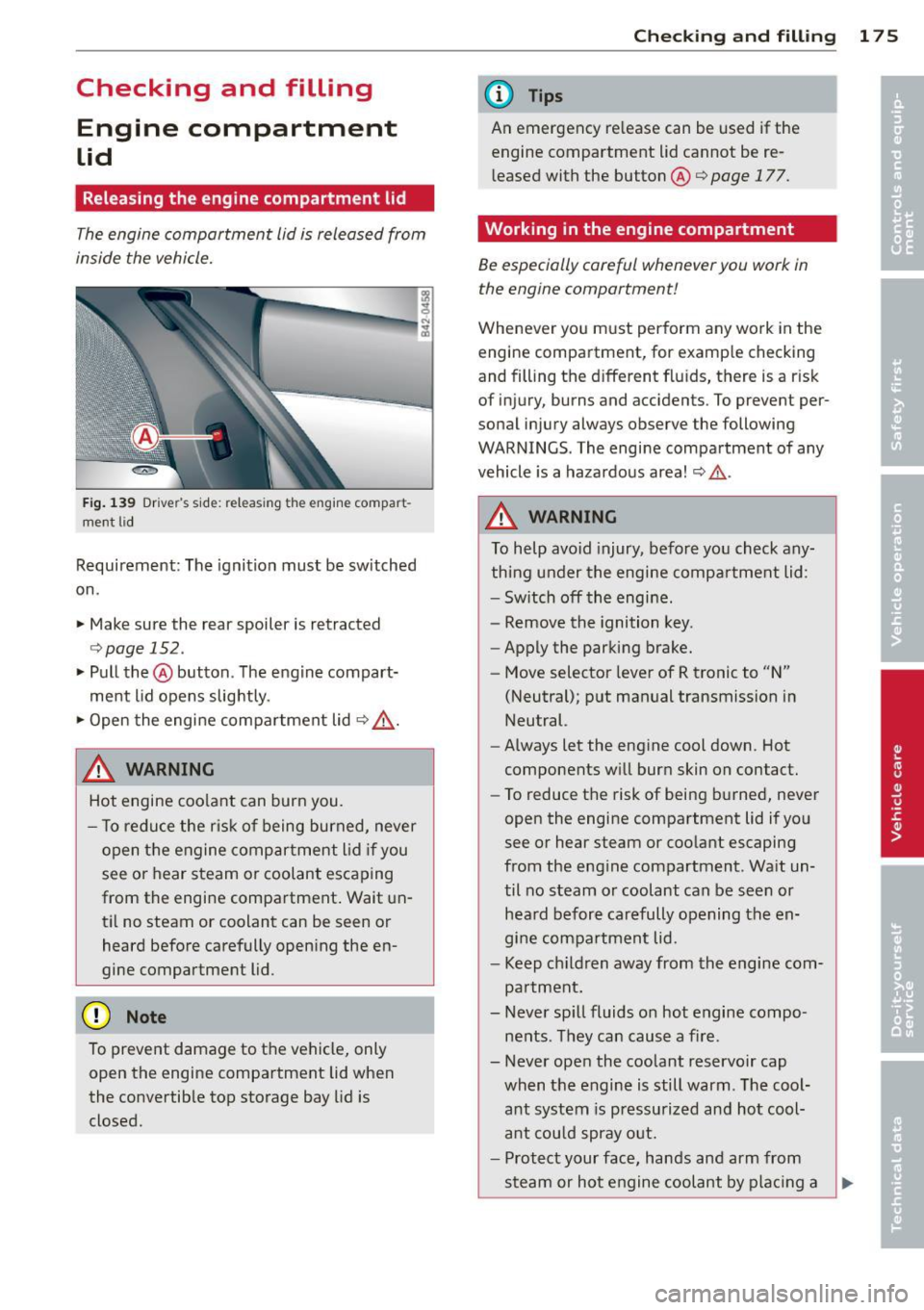
The engi ne compartment lid is released from
inside the vehicle.
F ig . 139 Dr ive r's side: releasing the engine compart
ment lid
Requi rement: The ignition must be switched
on.
• Make sure the rear spoiler is retracted
9page 152.
• Pull the@ button. The engine compart
ment lid opens slightly.
• Open the engine compartment lid
9 .&,.
_& WARNING
Hot engine coolant can burn you.
- To redu ce the r isk of being burned, never
open the engine compartment lid if you
see or hear steam or coolant escaping
from the engine compartment . Wait un
ti l no steam or coolant can be seen or
heard before carefully opening the en
gine compartment lid .
(D Note
To prevent damage to t he vehicle, only
open the engine compartment lid when
the convertib le top storage bay lid is
closed.
Checkin g and fillin g 175
@ Tips
An emergency release can be used if the
engine compartment lid cannot be re- l eased with the button @
i:> page 177.
Working in the engine compartment
Be especially careful whenever you work in
the engine compartment!
Whenever you must perform any work in the
engine compartment, for example checking
and filling the d ifferent flu ids, there is a risk
of in jury, burns and accidents . To prevent per
sonal injury always observe the following
WARNINGS . The engine compartment of any
vehicle is a hazardous area'
i:> A .
_& WARNING ,.;;
To help avoid injury, before you check any
thing under the engine compa rtment lid:
- Sw itch off the engine.
- Remove the ignition key.
- Apply the parking brake.
- Move selector lever of R tronic to "N"
(Neutral); p ut manual transmission in
Neutral.
- Always let the eng ine cool down. Hot
components w ill burn skin on contact.
- To reduce the risk of being b urned, never
open the engine compartment lid if you
see or hear steam or coo lant escaping
from the eng ine compartment. Wa it un
til no steam or coolant can be seen or
hea rd before carefully opening the en
gine compa rtment lid.
- Keep ch ild ren away from the engine com
pa rtment.
- Never sp ill fluids o n hot engine compo
nents. T hey can cause a fi re .
- Never open the coolant reservoir cap
when the engine is still warm. The cool
ant system is pressurized and hot cool
ant cou ld spray o ut.
- Protect your face, hands and arm from
steam or hot e ngine coolant by plac ing a ""
Page 178 of 244
176 Checking and filling
thick rag over the cap when you open the coolant reservoir .
-If work on the fuel system or the electri
cal system is necessary:
- Always disconnect the battery .
- Never smoke or work near heaters or
open flames. Fluids in the engine com partment could start a fire .
- Keep an approved fire extinguisher im
mediately available.
- To avoid electrical shock and personal in
jury while the engine is running or being
started, never touch:
- Ignition cables
- Other components of the high voltage
electronic ignition system.
- If you must perform a check or repair
with the engine running:
- First, fully apply the parking brake,
move selector lever of R tronic to "N"
(Neutral); put manual transmission in
Neutral.
- Always use extreme caution to prevent
clothing, jewelry, or long hair from get
ting caught in the radiator fan, V-belts
or other moving parts, or from contact
ing hot parts . Tie back hair before
starting, and wear no clothing that will
hang or droop into the engine.
- Minimize exposure to emission and
chemical hazards~&. .
.&_ WARNING
California Proposition 65 Warning:
- Engine exhaust, some of its constituents,
and certain vehicle components contain
or emit chemicals known to the State of
California to cause cancer and birth de
fects and reproductive harm. In addition,
certain fluids contained in vehicles and
certain products of component wear con
tain or emit chemicals known to the
State of California to cause cancer and
birth defects or other reproductive harm .
- Battery posts, terminals and related ac cessories contain lead and lead com
pounds, chemicals known to the State of California to cause cancer and
reproduc
tive harms. Wash hands after handling.
@ Note
When adding fluids, always make sure that
they are poured into the proper container
or filler opening, otherwise serious dam
age to vehicle systems will occur.
@ For the sake of the environment
To detect leaks in time, inspect the vehicle
floor pan from underneath regularly. If
you see spots from oil or other vehicle flu
ids, have your vehicle inspected by an au
thorized Audi dealer.
Closing the engine compartment lid
... Make sure that the rear spoiler is retracted
~page 152.
""Pull the engine compartment lid down until
the pressure from the struts is reduced.
.., Press the engine compartment lid closed
c::>& .
A WARNING ,_
A engine compartment lid that is not com
pletely latched could fly up and block your
view while driving.
- When you close the engine compartment lid, check it to make sure the safety catch
has properly engaged . The engine com
partment lid should be flush with the
surrounding vehicle body parts .
- If you notice while driving that the en
gine compartment lid is not secured properly, stop at once and close it.
Page 180 of 244
178 Checking and filling
Engine oil
Engine oil specifications
The engine oil used in your Audi needs the
right kind of oil.
The engine in your Audi is a sophisticated
powerplant that was built to exacting specifi
cations. This engine needs the right kind of
engine o il that meets spec ificat ions regarding
qua lity and viscos ity so that it can run
smoothly and reliably . Choos ing the righ t oi l
and changing oil w ith in the time a nd mileage
interva ls printed in your vehicle's Warranty
&
Maintenance book let matters a lot more to
day than it did yea rs ago. A udi has developed
a special quality standard for engine oil that
will help assure that your veh icle's eng ine will
get the lubrication it needs for proper opera
tion .
Modern engine lubrication has taken a quan
tum leap in the last few years. Many synthetic
oils ava ilable today provide better engine lu
b rication that can outlast traditiona l petrole
um-based o ils, making them a smart choice
for use throughout the life of you r A udi .
Whether you use synthetic or petroleum based engine oil, the oil that you use must
conform to Audi's oil qual ity standard
VW 502 00 to help keep your veh icle 's eng ine
r unning smoo thly and help prevent t he fo r
ma tion of harmfu l deposi ts, some times called
"s ludge," that over t ime can lead to expensive
repairs.
A t the time of pr intin g, engine o ils availab le in
the U .S . and Canad a that meet the exact ing
specifications o f A udi oil standard VW 502 00
are synthetic engine oils . This does not mean,
however, that eve ry synthetic engine oil wi ll
meet A udi oil standard VW 502 00. So a lways
be sure that you use an approved o il.
To help preve nt the formation of harmful de
posits use only oi l with the fo llow ing spec ifi
cations printed on the oil container :
Audi oil standard VW 502 00
Oil container labels may car ry the specifica
tion sing ly or in combination with othe r desig
nations and oil quality standa rds .
Viscosity
Engine o ils are graded accord ing to their vis
cosity . Th e pr oper viscos ity grade oil fo r you r
engine de pends on clim actic o r seaso nal con
di tions where yo u drive. You can use o il wit h a
viscosity grade o f SAE SW40 across all tem
perature ranges for norma l driving conditions.
However, if engine oil visco sity g rade SA E
SW40 is not ava ilable, you can a lso use v iscos
ity grade SA E SW -30 or SA E OW -40 as long as
it meets Audi oil q ua lity standard VW 502 00
specificat ions.
Beca use engine o il that mee ts the Audi o il
standard may not be availab le everywhere
when you need it, we strong ly recommend
t h at you a lways carry with you an extra quart
( li ter) of oil that express ly conforms to the
VW 502 00 specification, in case you have to
top off the oil while on the road .
Only if the level of the oil is at or be low the
min imum ma rk on the o il dipstick - and n o oi l
that expressly conforms to Audi o il standard
VW 502 00 specifications is availab le -may
yo u top off with a high quali ty engine o il, p ref
erably synthet ic-based, that me ets ACEA A3,
AC EA AS o r AC EA B S or A PI SL spec ifi cat io ns,
but even t hen, only in v iscosi ty g rades SA E
SW -40, SA E SW-3 0, or SAE OW-40 . However,
during the entire time between oi l change in
te rva ls , never top
off with more than a tota l
of 0 .5 qt/liter engine oil that does not con
form to Audi oil specification VW 502 00.
F or more information abo ut engine oi l that
has been approved for your ve hicle, please
contact e ither yo ur authorized Aud i dea ler or
Audi C ustomer Re lations at 1 (800) 822-2834
or v is it our web site at www.audiusa.com or
www .aud icanada .ca. Here you w ill also find a
c ur rent l ist of oils (manufacturers, bra nd
names etc.) that conform to Aud i oil standa rd
vw 50 2 00.
Changing the engine oil
Page 181 of 244
The engine oil and oil filter must be changed
according to the mi leage (kilometers) and
time interva ls specified in your vehicle's War
ranty & Maintenance booklet. Do not exceed
these intervals -harmful deposits from old
engine o il can reduce engine performance and
can lead to expensive engine repairs.
Changing the o il at the recommended inter
vals is so very important because the lubricat
ing properties of oil decrease gradually during
normal vehicle use . If you are not sure when
you have your oi l changed, ask your author
i zed A udi Service Advisor.
Under some circumstances the engine o il
should even be changed more frequently.
Change o il more often if you drive mostly
short distances, ope ra te the vehicle in dusty
areas or mostly under s top-and-go traffic con
d itions, or when yo u use your vehicle whe re
temperatures stay below freezing point for
l ong periods.
D etergen t additives i n the o il w il l make fresh
oil look dark after the eng ine has been run
ning for a short time . This is norma l and is not
a reason to change the oi l more often than
recommended.
Damage or malfunction s due t o lack of
m aintenance
It is essen tial that you change your oil at the
r ecommended inte rva ls using only engine o il
that complies with A udi oil standard
VW 502 00. Yo ur Limited New Vehicle War
ranty does not cover damage or malfunctions
d ue to fai lure to fo llow recommended mainte
nance and use req uirements as set forth in
the Audi Owner's Manua l and Warranty&
Ma intenance book let . Your autho rized Aud i
deale r will have to deny warranty coverage un
l ess you present to the dealer p roof in the
fo rm of Se rvice o r Repair Orde rs t hat all
sched uled main tenance w as performed in a
time ly manner .
Checkin g and fillin g 179
Engine oil consumption
The engine in your vehicle depends on an ade
quate amount of oil to lubricate and cool all
of its moving parts .
In order to provide effective lubrication and
cooling of interna l eng ine components, all in
te rnal combust io n engines consume a certain
amount of oil. Oil consumpt io n va ries from
engine to e ngine and may change sig nifican tly
ove r the life of the engine. Typically, engines
with a spec ified break -in pe riod (see
c::> page 158) consume more oil d uri ng the
break-in pe riod than they consume afte r oi l
consumption has stabilized.
U nder normal cond itions, the rate of oi l con
s u mption depends on t he q uality and viscos ity
of the oil, the RP M (revolut ions per minute) at
which the engine is operated, the ambient
temperature and road conditions. Further fac
tors are the amount of oil dilut ion from water
condensa tion or fue l residue a nd the oxida
tion level of the oil. As any eng ine is subject to
wear as m ileage builds up, t he oil co nsump
t ion may increase over time until repla cement
of wo rn components may be come necessary.
Wi th a ll these va riab les coming into p lay, no
standard rate of oil consumpt io n can be es
t a bl is h ed o r spec ified . There is no alte rnative
to regular and frequent chec king of the o il lev
el, see
Note.
If the yellow engine o il level wa rning symbo l
i n the instrument cluster
1\11 lights up, yo u
sho uld check the oil leve l as soon as possib le
c::> page 180 . Top off the oil at your ear liest
convenience
c::> page 180 .
A WARNING
-Before you check anything in the engine
compartment, always read and heed a ll
WARNINGS
c::> & in Working in the engine
compartment on pag e 175.
(D Note
Driving w ith an insufficient o il level is like-
-
ly to cause severe damage to the engine. .,.
•
•