ECU AUDI R8 SPYDER 2011 Owner's Manual
[x] Cancel search | Manufacturer: AUDI, Model Year: 2011, Model line: R8 SPYDER, Model: AUDI R8 SPYDER 2011Pages: 244, PDF Size: 59.74 MB
Page 190 of 244
188 Checking and filling
(D Note
-Your vehicle is equipped with a specia l
battery. Installing a different type of
battery can cause prob lems in the vehi
cle electrical system. When replacing the
vehicle battery, always install one with
the same spec ificat ions as the original
batte ry .
- Make sure that the gas venting hose is
always connected to the o riginal open ing
on the battery side. Otherw ise gasses or
ba tte ry acid cou ld leak out .
- Battery ho lder and term inals a lways
have to be secured cor rectly.
- Read and follow the warnings under
9 page 185, Working on the battery be
fore performing any work on the batte ry.
@ For the sake of the environment
Because of the problem of proper disposal
of a battery, we recommend your author
ized Audi dealer change the batte ry for
you . Batter ies contain s ulf uric ac id and
lead and must always be disposed of prop
erly in compliance with all environmenta l
reg ulations. D isposing of vehicle batteries
improperly is very dangerous to the envi
ronment. Make sure that the removed bat
tery ca nnot overbalance, otherwise sulfu
r ic acid might escape!
Windshield washer
container
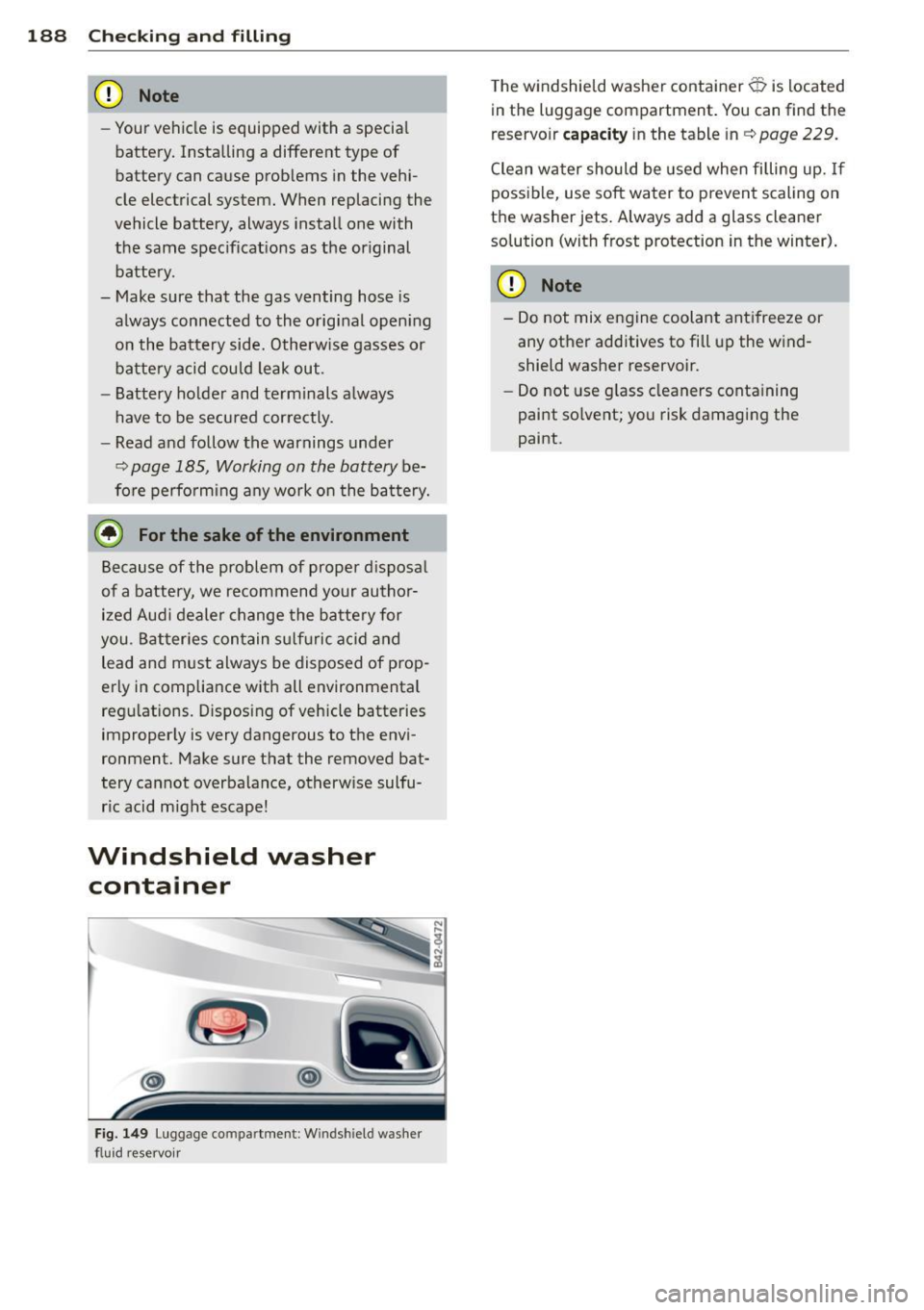
Fig. 149 Luggage co m pa rtment : W inds hield washer
fl uid reservo ir
T he windshield washer container O is located
in the luggag e compartment. You can find the
reservo ir
c a pacit y in the table in c::> page 229.
Clean water should be used when filling up. If
possible, use soft water to prevent scaling on
the washer jets . Always add a glass cleaner
solution (with frost protection in the winter) .
(D Note
-Do not mix engine coolant antifreeze or
any other additives to fill up the wind
shield washer reservoir.
- Do not use g lass cleaners conta ining
pai nt so lvent; you risk damaging the
paint.
Page 198 of 244
196 Tires and wheels
wheels you have to adjust the tire pressures
on all wheels.
A WARNING
Incorrect tire pressures and/or underinfla
tion can lead sudden tire failure, loss of
control, collision, serious personal injury
or even death.
- When the warning symbol
RI] appears in
the instrument cluster, stop and inspect
the tires .
- Incorrect tire pressure and/or underinfla
tion can cause increased tire wear and
can affect the handling of the vehicle and
stopping ability .
- Incorrect tire pressures and/or underin flation can also lead to sudden tire fail
ure, including a blowout and sudden de
flation, causing loss of vehicle control.
- The driver is responsible for the correct
tire pressures for all tires on the vehicle .
The applicable pressure values are locat
ed on a sticker on the driver's side 8-pil
lar.
- Only when all tires on the vehicle are fil
led to the correct pressure, the tire pres
sure monitoring system can work cor
rectly.
- The use of incorrect tire pressure values
can lead to accidents or other damage.
Therefore it is essential that the driver
observe the specified tire pressure values
for the tires and the correct pressures for
the function of the tire pressure monitor
ing system .
- Always inflate tires to the recommended
and correct tire pressure before driving
off .
- Driving with underinflated tires bend
more, letting them get too hot resulting
in tread separation, sudden tire failure
and loss of control.
- Excessive speed and/overloading can
cause heat build-up, sudden tire failure
and loss of control.
- If the tire pressure is too low or too high,
the tires will wear prematurely and the
vehicle will not handle well. -
If the tire is not flat and you do not have
to change a wheel immediately, drive at
reduced speed to the nearest service sta
tion to check the tire pressure and add
air as required .
(D Note
Driving without valve stem caps can cause
damage to the tire valves. To prevent this,
always make sure that factory installed
valve stem caps on all wheels are securely mounted on the valve.
@ For the sake of the environment
Underinflated tires will also increase the
fuel consumption .
Tires and vehicle load limits
There are limits to the amount of load or
weight that any vehicle and any tire can carry .
A vehicle that is overloaded will not handle
well and is more difficult to stop. Overloading
can not only lead to loss of vehicle control,
but can also damage important parts of the
vehicle and can lead to sudden tire failure, in cluding a blowout and sudden deflation that
can cause the vehicle to crash.
Your safety and that of your passengers also depends on making sure that load limits are
not exceeded. Vehicle load includes everybody
and everything in and on the vehicle . These
load limits are technically referred to as the
vehicle 's
Gross Vehicle Weight Rating
("GVWR").
The "GVWR" includes the weight of the basic
vehicle, all factory installed accessories, a full
tank of fuel, oil, coolant and other fluids plus
maximum load. The maximum load includes
the number of passengers that the vehicle is
intended to carry ("seating capacity") with an
assumed weight of 150 lbs. (68 kg) for each
passenger at a designated seating position
and the total weight of any luggage in the ve-
hicle. ..,_
Page 207 of 244
the wheel bolts. These are available from au
thorized Audi dealers.
A WARNING
Using the wrong snow chains for your vehi
cle or installing them incorrectly can in
crease the risk of loss of control leading to
serious personal injury.
- Snow chains are available in different
sizes. Always make sure to follow the in
structions provided by the snow chain
manufacturer .
- When driving with snow chains, never
drive faster than the speed permitted for
your specific snow chains.
- Always observe local regulations.
- Remove snow chains before driving on
roads not covered with snow to avoid
damaging tires and wearing the snow
chains down unnecessarily.
- Snow chains, which come into direct con
tact with the wheel rim, can scratch or
damage it. Therefore, make sure that the
snow chains are suitably covered . Check
the position of the snow chains after
driving a few yards and correct if neces
sary. Follow the instructions from the
snow chain manufacturer when doing so.
(D Tips
Where snow chains are mandatory oncer
tain roads, this normally also applies to ve
hicles with all-wheel drive.
Wheel bolts
Wheel bolts must always be tightened to the
correct torque.
The design of wheel bolts is matched to the
factory installed rims. If different rims are fit
ted, the correct wheel bolts with the right
length and correctly shaped bolt heads must
be used. This ensures that wheels are fitted
securely and that the brake system functions
correctly .
Tires and wheels 205
In certain circumstances, you may not use
wheel bolts from a different vehicle -even if it
is the same model
r:!> page 211.
A WARNING
Improperly tightened or maintained wheel
bolts can become loose causing loss of
control, a collision and serious personal in
jury.
- Always keep the wheel bolts and the
threads in the wheel hubs clean so the
wheel bolts can turn easily and be prop erly tightened.
- Never grease or oil the wheel bolts and
the threads in the wheel hubs. They can
become loose while driving if greased or
oiled, even if tightened to the specified
torque.
- Only use wheel bolts that belong to the
rim being installed.
- Never use different wheels bolts on your
vehicle.
-Always maintain the correct tightening
torque for the wheel bolts to reduce the
risk of a wheel loss. If the tightening tor
que of the wheel bolts is too low, they
can loosen and come out when the vehi
cle is moving.
If the tightening torque is
too high, the wheel bolts and threads
can be damaged and the wheel can be
come loose.
(D Note
The specified torque for the wheel bolts is
90 ft lb (120 Nm) with a tolerance of ± 7 .4
ft lb( ± 10 Nm). Torque wheel bolts diago
nally. After changing a wheel, the torque
must be checked as soon as possible with a
torque wrench -preferably by an author
ized Audi dealer or qualified workshop.
Low aspect ratio tires
Your Audi is factory-equipped with low aspect
ratio tires. These tires have been thoroughly
tested and been selected specifically for your model for their superb performance, road feel
and handling under a variety of driving
IJ>,
•
•
Page 212 of 244
210 Consum er Inf orm ati on
steadi ly reduced the scope of maintenance
and repairs which can be carried out by vehicle
owners.
Als o, sa fe ty a nd en vir onm ent al con
cerns p lace very strict limits on the nature of
repairs and adjustments to engine and trans
miss ion parts which an owner can perform .
Maintenance, adjustments and repa irs usua lly
require special tools, testing devices and oth
er equipment available to specially trained
workshop personnel in order to assure proper pe rformance, reliab ility and safety of the vehi
cle and its many systems .
Improper maintenance, adjustments and re pa irs can impair the operation and reliab ility
of your vehicle and even void your vehicle war
ranty. Therefore , proof of servic ing in accord
ance w ith the ma intenance schedule may be a
condition for upholding a poss ible warranty
claim made within the warranty period.
Above all, operational safety can be adversely
affected, c reating unnecessary risks for you
and your passengers .
If in doubt about any se rv icing, have it done
by your author ized Audi dealer or any other
p roperly equipped and qualified workshop .
We strong ly urge you to give yo ur a utho rized
Aud i dealer the opportunity to perfo rm all
schedu led maintenance and necessary repairs.
Your dea ler has the facilities, original parts
and trained spec ialists to keep your vehicle
running properly .
Performing limit ed ma int enance your self
The following pages describe a limited num
ber of proced ures which can be performed on
your ve hicle with ordinary too ls, shou ld the
need arise and trained personnel be unavaila
ble. Before performing any of these proce
dures, always thoroughly read all of the app li
cable text and carefully follow the instruc
tions given . Always rigorously observe the
WARNINGS p rovided.
Before you ch eck a nything in th e eng ine
co mpartm ent , alwa ys re ad and h eed all
WA RNINGS
c::> .&. and c::> ..&. in Working in the
engine compartment on page 175.
A WARNING
- Serious personal injury may occur as a re
sult of improperly performed mainte
nance, adjustments or repa irs .
- Always be extremely careful when work
ing on the vehicle . Always follow com
monly accepted safety pract ices and gen
eral common sense. Never r is k personal
injury.
- Do not attempt any of the maintenance ,
checks or repairs descr ibed on the fol
lowing pages if you are not fu lly fam iliar
with these or other procedures with re
spect to the vehicle, or are uncertain how
to proceed .
- Do not do any work without the proper
too ls and equipment. Have the necessa ry
work done by your authorized A udi deal
er or another proper ly equipped and
qualified workshop.
- Always remove the ignition key before
anyone gets under the veh icle.
- Always support your veh icle with safety
stands if it is necessary to work under neath the vehicle . The jack* is not ade
quate for this purpose and cou ld collapse
causing ser ious personal inju ry.
- If you must work underneath the vehicle
with the wheels on the ground, a lways
make sure the vehicle is on level ground,
that the wheels a re a lways secure ly
b locked and that t he engine cannot be
started.
- Always make sure the transmission se
lec to r l ever is in "N" (Neut ral) (R t ron ic)
or Neutral (manual transmission) and
the hand bra ke is f irmly app lied.
@ For the sake of the environment
- Changing the engine sett ings will ad
verse ly affect emission leve ls. Th is is det
r imental to the environment and increas
es fuel consumpt ion .
- Always observe environmenta l regu la
tions when disposing of old eng ine oil,
used brake flu id, dirty engine coo lant,
spent batte ries o r worn out tires.
Page 221 of 244
Tightening wheel bolts
.,. Fit the wh eel b olt wrench ove r the wheel
bolt and push it down as far as it will go
1l.
.,. Close your grip around the
end of the
wrenc h handle fo r maximum torque and
turn each wheel bolt
clockwi se u nti l it sits
t ight.
H ave the
tightening torque of the whee l bolts
checked as soon as possible with a torque
wrench . It shou ld be 120 Nm.
Chec k the
tire pre ssure as soon as possible.
Return the vehicle tool kit to its proper place.
A WARNING
Loose ning t he wheel bo lts is prohib ited;
da nger of an accident!
@ Tips
- Never try and use the hexagona l socke t
i n the handle of the screwdr iver to loos
en or tighten the w heel bolts.
- If yo u have dete rm ined t hat wheel bolts
a re cor roded and difficult to t urn, the
bo lts must be rep laced befo re checking
the to rque.
- Unti l the tig hte ning torque is checked,
d rive at redu ced speeds as a pre caution.
Notes on wheel change
Pl ease read the information¢ page 199, New
tires and replacing tires and wheels,
if you are
going to use a spare tire which is different
from the tires on your veh icle.
Afte r you change a tire:
- Check the tire pressure on the spare imme
dia tely after mounting.
- Have the whee l bolt t ightening torque
chec ked w ith a torq ue wrench as soon as
poss ible by your author ized A udi dealer or a
qu alified service sta tion.
1 ) You need th e appropr iate adapter to tighte n the a nti
t h eft wheel bolts
c:, page 216.
What do I do now? 219
- With stee l and alloy whee l rims, the whee l
bolts are correctly tightened at a torque of
90 ft lb (120 Nm) .
- If you notice while changing a tire that the
wheel bo lts are corroded and difficu lt to
turn, then they should be rep laced before
you check the tightening torque.
- Replace the flat tire with a new one and
have it installed on your vehicle as soon as
possible. Remount the wheel cover.
Until then , d riv e with e xtra care and at re
duced speeds.
A WARNING
- If you are going to equ ip your vehicle
with tires or rims which differ from those
which were facto ry installed, then be
sure to read the information ¢
page 199,
New tires and replacing tir es and
wheels.
- Always sto re the tools secu rely in lug
gage compartment. Othe rwise, in a n ac
cident o r su dden maneuver they cou ld fly
forwdrd, CciU5ing injury to pd55enger5 in
the vehicle.
(D Note
Do not use comme rcially avai lab le tire
sea lants. Otherwise, the e le ctr ic al com po
nen ts of t he tire p ressu re monitoring sys
tem * wi ll no longe r work proper ly an d the
sensor fo r the tire pressure mon itor ing
system will have to be rep laced by a quali
fied wor kshop.
Jump-starting
General
If necessary, the engine can be started by
connecting it ta the battery of another vehi
cle.
If the engi ne should fail to start because of a
discharged or weak battery, the battery ca n be.,.. •
•
Page 223 of 244
Use of jumper cables
Make sure to connect the jumper cable
clamps in exactly the order described below'
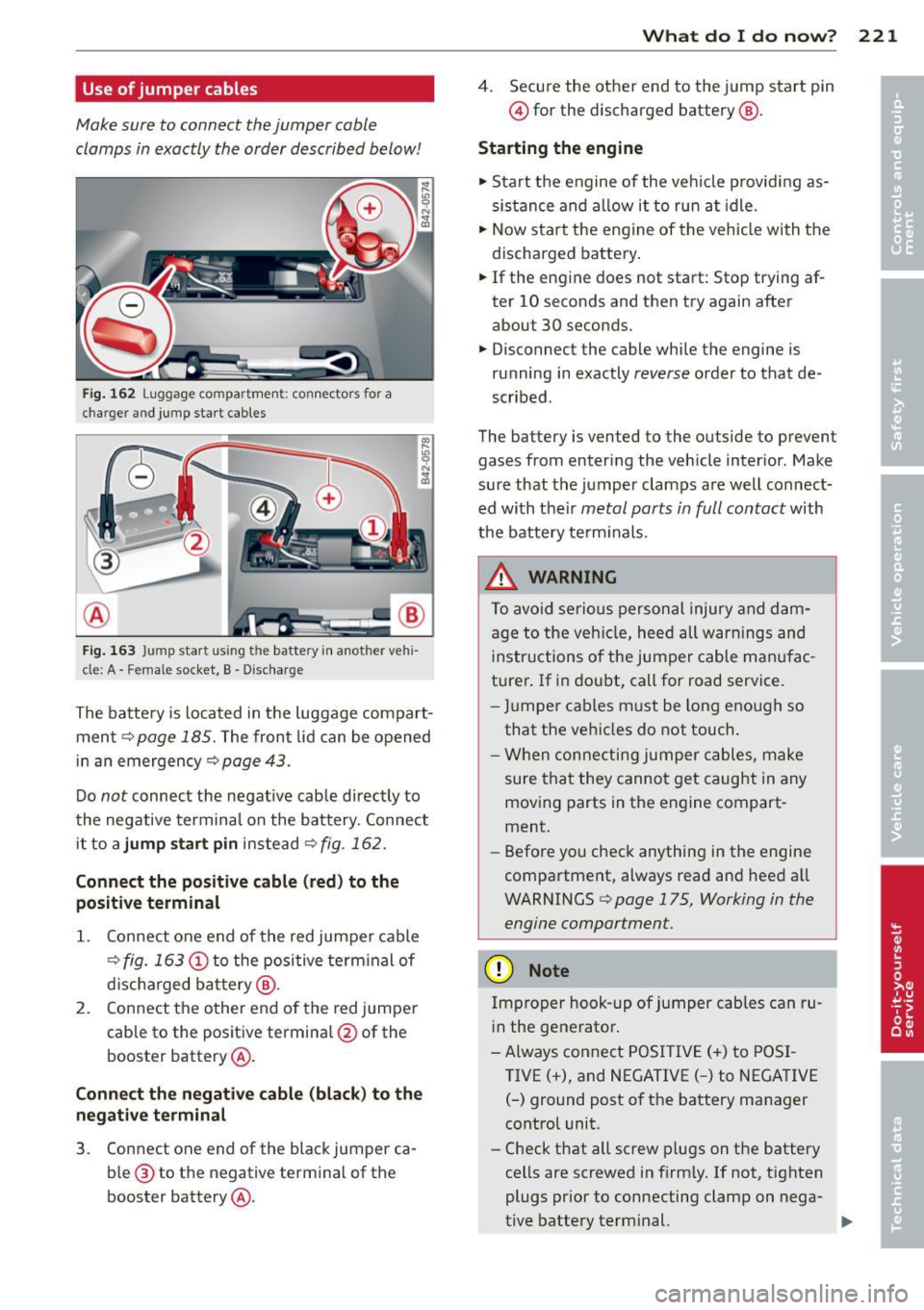
Fig . 162 Luggage co m pa rtme nt: connec tor s for a
ch arge r and jump start cab les
F ig . 163 Ju m p sta rt usin g t he batte ry in a not her ve hi
cl e: A -Fem ale socket , B · Dis charge
The batte ry is located in the luggage compart
ment ¢
page 185. The front lid can be opened
in an emergency
C? page 43 .
Do not connect the negat ive cable directly to
the negative termina l on the battery. Connect
it to a
j u mp start pin instead ¢ fig. 162.
Connect the posi tive cable (red) to the
posit ive t ermin al
1. Connect one end of the red jumper cable
¢
fig. 163 (D to the positive te rm inal of
d ischarged battery @.
2. Connect the other end of the red jumper
cable to the positive termina l@ of the
booster battery @.
Conn ect the negat ive cable (black ) to the
n egati ve ter minal
3. Connect one end of the black jumper ca
b le @ to the negative terminal of the
booster battery @.
What do I d o now ? 221
4. Secure the other end to the jump start pin
@for the discharged battery @.
Starting the engine
~ Start the engine of the veh icle providing as
sistance and al low it to run at idle.
~ Now sta rt the engine of the vehicle with the
discharged battery .
~ If the engine does not start: Stop trying af
ter 10 seconds and then try again after
about 30 seconds.
~ Disconnect the cable while the engine is
running in exactly
reverse order to that de
scribed .
The ba ttery is ven ted to the ou tside to prevent
gases from entering the vehicle interior . Make
sure that the jumper clamps are well connect
ed with their
metal parts in full contact with
the battery term inals .
.&, WARNING
To avoid serious personal injury and dam
age to the veh icle, heed all warnings and
instructions o f the jumper cable manufac
turer . If in doubt, call for road service.
- Ju mper cables m ust be long enough so
that the vehicles do not touch.
- When connecting jumper cables, make
sure that they cannot get caught in any
mov ing parts in the engine compart
ment.
- Before you check anything in the engine
compartment, always read and heed a ll
WARNINGS ¢
page 175, Working in the
engine compar tment.
(D Note
Improper hook-up of jumper cables can ru
in the generator .
- Always connect POSITIVE(+) to POSI
TIVE(+), and NEGATIVE( -) to NEGATIVE
( - ) ground post of the battery manager
control unit.
- Check that all screw p lugs on the battery
cells are screwed in firm ly. If not, tighten
plugs prior to connecting clamp on nega-
-
tive battery terminal. .,..
Page 224 of 244
222 What do I do now ?
-Please note that the procedure for con
necting a jumper cable as described
above applies spec ifically to the case of
your vehicle be ing jump started. When
you are giving a jump start to another ve
hicle, do
not connect the negative( -) ca
ble to the negat ive( -) terminal on the
discharged battery ©-Instead, securely
connect the negative (- ) cable to either a
solid metal component that is firmly
bo lted to the engine b lock or to the en
gine block itself . If the battery that is be
ing charged does not vent to the outside,
escaping battery gas cou ld ign ite and ex
plode!
Emergency towing
with commercial tow
truck
General hints
Your Audi requires special handling for tow
ing.
The following information is to be used by
commercia l tow truck operators who know
how to operate their equipment safely.
- Never tow your Audi, towing will cause dam
age to the engine and transmission .
- Never wrap the safety chains or winch cables
around the brake lines.
- To prevent unnecessary damage, your Audi
must be transported with a car carrier (flat
bed truck).
- To load the vehicle on to the flat bed, use
the towing loop found in the vehicle tools
and attach to the front anchorage
~ page 222.
A WARNING
A vehicle being towed is not safe for pas
sengers. Never allow anyone to ride in a
vehicle being towed, for any reason.
(D Note
The vehicle has very low ground clearance.
Make sure that no damage is caused to the
-
underside of the vehicle when it is being
loaded onto a f lat bed truck .
Front towing loop
Do not install the front towing loop until it is
needed.
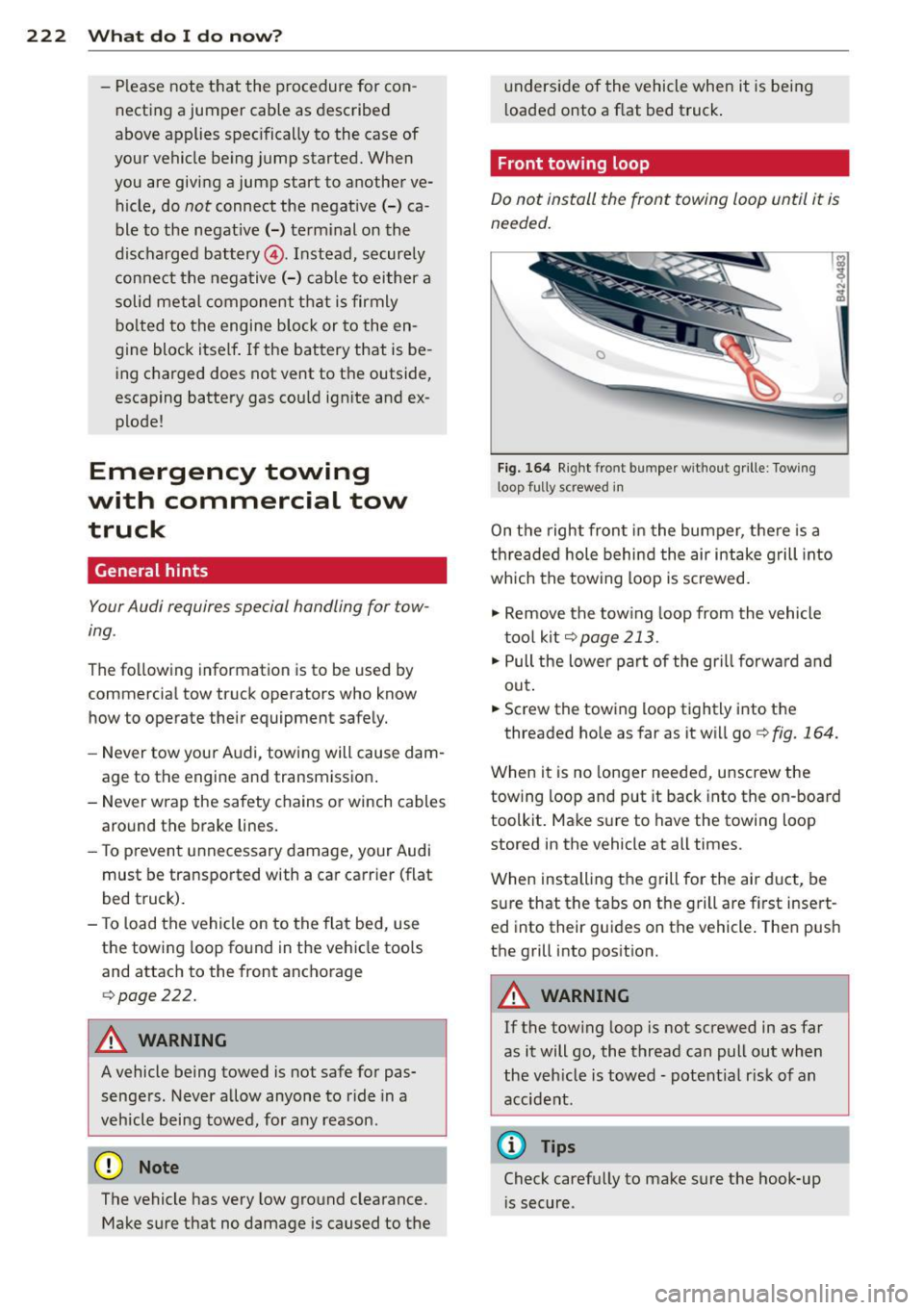
Fig. 164 Right front bumper without grille : Tow ing
loop
fully screwed in
On the right front in the bumper, there is a
threaded hole behind the air intake grill into
which the towing loop is screwed.
"' Remove the towing loop from the vehicle
tool kit~
page 213.
"'Pull the lower part of the grill forwa rd and
out .
"' Screw the towing loop tightly into the
threaded ho le as far as it wi ll go ¢
fig. 164.
When it is no longer needed, unscrew the
towing loop and put it back into the on-board
toolkit. Make sure to have the towing loop stored in the vehicle at all times.
When installing the grill for the air duct, be
sure that the tabs on the grill are first insert ed into their guides on the vehicle. Then push
the grill into position.
A WARNING
= If the towing loop is not screwed in as far
as it will go, the thread can pull out when
the veh icle is towed -potential r isk of an
accident.
@ Tips
Check carefully to make sure the hook-up i s secure.
Page 234 of 244
232 Index
Controls and displays ........... .... .. . 8
Convenience close/open feature .. .. ....
40
Convertible child safety seats .. .. ..... 144
Conve rtible locking retractor
Activating . . . . . . . . . . . . . . . . . . . . . . . .
148
Deactivating . . . . . . . . . . . . . . . . . . . . . . 149
Using to secure a child safety seat l46, 148
Convertible top
Emergency operation .... .. .. .. .. .. . .
49
Error message ............ ... .... .. 47
General information ....... ..... .. . .
46
Indicator light ............ ... .... .. 16
Malfunction ............... .. .... .. 4 7
Opening/closing .......... .. .. .. .. ..
46
Retracting/ex tending rear window . .... 48
Wind deflector ............... .. ... . 48
Coolant system ..................... 181
Adding coolant ............. .. .... . 183
Checking the engine coolant level .....
182
Cruise control .............. ... .... .. 81
Changing speed .................... 81
Deactivating . . . . . . . . . . . . . . . . . . . . . . .
82
Driving in control mode .... .. .. .. .. . . 81
Switching off temporarily .. .. .. .. .. . . 82
Warning/indicator light .... .. .. .. .. .. 17
Cup holder . . . . . . . . . . . . . . . . . . . . . . . . . . 68
Current fuel mileage . . . . . . . . . . . . . . . . . 23
D
Damping
refer to Audi magnetic ride ..... .. .... 82
Data . ... .. .. ................ ..... . 228
Data recorder ............. .. .. .... . 150
Date display . . . . . . . . . . . . . . . . . . . . . . . . 11
Daytime running lights ....... ... .... .. 55
Declaration of compliance
Cell phone package ..... .. .. .. .. .. .
212
Electronic immobilize r ..... .. .. .. .. . 212
H omelink ® universal remote control .. 212
Remote control key ........ ... .... . 212
Tire pressure monitoring system . ... . 212
def . .. .. .. ............... .... .... .. 12
Defective light bulb wa rning . .. .. .... .. 35
Defrosting the windows ...............
75
Determining correct load limit ..... .. . 197
Digita l compass ........... .. .. .... .. 64
Dimensions ..... .. ............. .... 229
Dipst ick ... .... ... .. .............. . 180
Distance ..... .. .. .. ........... .... . 23
Doors Emergency locking ................ ..
42
Driver information ...... ........... .. 31
Driver informat ion system
Menu button . . . . . . . . . . . . . . . . . . . . . . 25
Menu display . . . . . . . . . . . . . . . . . . . . . .
24
Open door or front lid warning ........ 20
Outside temperature display . . . . . . . . . . 20
Red symbols . .. .. .......... ...... .. 30
Serv ice interval display ......... .. .. .
21
Setting ... .... .. .. ........... .... . 25
Sound system display . . . . . . . . . . . . . . .
20
Trip computer .... ............. ..... 22
Yellow symbo ls . . . . . . . . . . . . . . . . . . . . 30
Driver seat
refer to Seating position . . . . . . . 100, 101
Driving safely . . . . . . . . . . . . . . . . . . . . . . . 99
Driving through water .............. . 158
Dry sump lubrication .... ..... ... .. .. 157
Duplicate key . . . . . . . . . . . . . . . . . . . . . . . 3 7
Dust filter . . . . . . . . . . . . . . . . . . . . . . . . . . 73
E
Elapsed time .... .. ............. .... . 23
Electrical voltage .. ............. .... . 13
Electronic differential lock (EDL) ....... 150
Warning/indicator light ............ ..
18
Electronic immob ilizer . . . . . . . . . . . . 12, 38
Electronic power control ( EPC) . . . . . . . . . 15
Electronic Stabilization Program ....... 150
Electronic stabilization program (ESP)
Warning/indicator lights .............
16
Emergency flasher . ............. .... . 57
Warning/indicator lights ........ .. .. . 16
Emergency key . . . . . . . . . . . . . . . . . . . . . . 3 7
Emergency locking ........ ...... .. .. .
42
Emergency operation
Convertible top .. ... .......... .. .. .
49
Emergency release
Front lid . . . . . . . . . . . . . . . . . . . . . . . . . . 43
Emergency starting ................ .
219
Emergency towing . ............... .. 222
Page 239 of 244
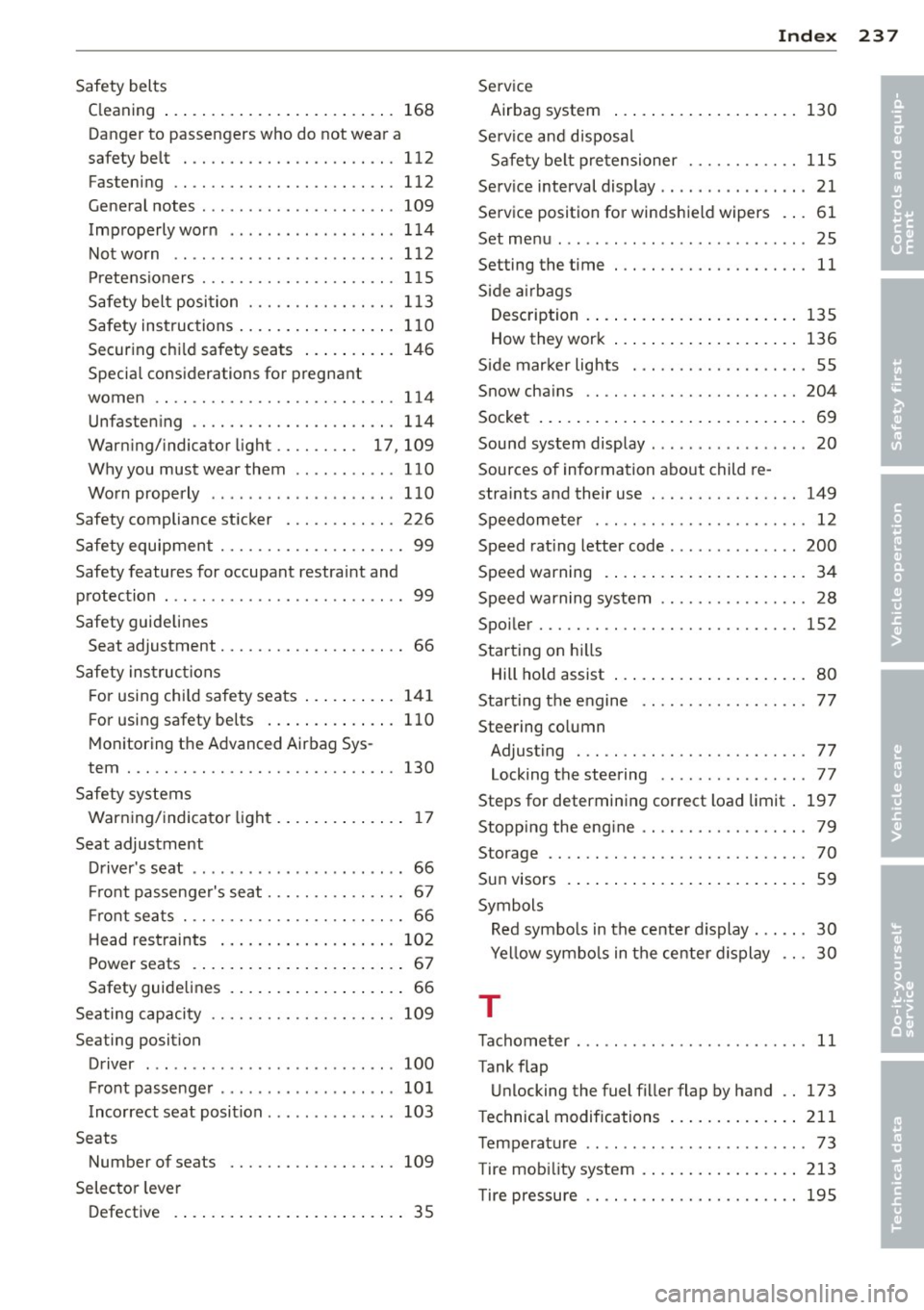
Safety belts Cleaning ... ..... ..... ... .. .. .. ... 168
Danger to passengers who do not wear a
sa fety belt . . . . . . . . . . . . . . . . . . . . . . . 1 12
Fastening .. .... ......... .... .. .. . 112
General notes ................. .... 109
Improperly worn . . . . . . . . . . . . . . . . . . 114
Not worn ...................... .. 112
P retens ioners . . . . . . . . . . . . . . . . . . . . . 115
Safety bel t position . . . . . . . . . . . . . . . . 113
Safety instructions ..... ... .. .. .. .. . 110
Securing ch ild safety seats ... .. .. .. . 146
Special consid erations for pregna nt
women .. .. .. ........... .. .. .. .. . 1 14
Unfasten ing ............. .... .. ... 114
Warn ing/ indicator light .... .. .. . 17, 109
Whyyoumustwearthem ....... .... 110
Wo rn properly . . . . . . . . . . . . . . . . . . . . 110
Safety compliance st icker ... .. .. .. .. . 226
Safety equipment . . . . . . . . . . . . . . . . . . . . 99
Safety features for occupant restraint and protection . . . . . . . . . . . . . . . . . . . . . . . . . . 99
Safety guide lines
Seat adjustment . . . . . . . . . . . . . . . . . . . . 66
Safety ins truc tions
F or using chi ld safety seats ... .. .. ... 1 41
F or using safety be lts .. ... .. .. .. .. . 110
Mo nitoring the Advanced Airbag Sys-
tem . .. .. .. .. ............. .. .. .. . 130
Safety systems Warn ing/ indicato r light . ... .. .. .. .. .. 17
Seat adjustment Driver's seat . . . . . . . . . . . . . . . . . . . . . . . 66
Fr ont passenge r's seat . . . . . . . . . . . . . . . 67
Fr ont se ats . . . . . . . . . . . . . . . . . . . . . . . . 66
H ead res traints . . . . . . . . . . . . . . . . . . . 102
Power seats . ... ...... ... .. .. .. .... 67
Safety guideli nes . ..... ... .. .. .. .. .. 66
Seating capacity ...... ..... .... .. .. . 109
Sea ting position
Driver ... .. .. .... .... ..... ... ... . 100
F ront passenge r ............... .... 101
Incorrect seat position ......... ... .. 103
Seats Number of seats 109
Selector lever
D efective . . . . . . . . . . . . . . . . . . . . . . . . . 3 5
Inde x 237
Serv ice
Airbag system 130
Se rv ice and disposa l
Safety be lt p re tensioner ... ..... .. .. 115
Serv ice interval display .... .... ... .. .. . 21
Serv ice position for windsh ield wipers . .. 61
Set me nu .. ... .. .... .......... ...... 25
Setting the time . .. ........ ......... . 11
S ide a irbags
Desc ription . ... .... . ... ...... ... .. 135
How they work . . . . . . . . . . . . . . . . . . . . 136
S ide mar ker lights . . . . . . . . . . . . . . . . . . . 55
Snow cha ins .. .. .. .. ............... 204
Socket ... .. .. .... ... .. .. ..... ... .. . 69
Sound system display . . . . . . . . . . . . . . . . . 20
Sources of information abo ut child re -
stra ints and their use ....... ..... .. .. 149
Speedometer . . . . . . . . . . . . . . . . . . . . . . . 12
Speed rat ing letter code ............. . 200
Speed warning . ..... . .. .. ..... ... .. . 34
Speed warning system . . . . . . . . . . . . . . . . 28
Spoi ler ....... .. .. .. . .............. 152
Star ting on h ills
Hill ho ld assist ..... . .. .. ..... ... .. . 80
Starting the e ngine . . . . . . . . . . . . . . . . . . 77
Steering co lumn
Adjusting . . . . . . . . . . . . . . . . . . . . . . . . . 77
Locking the steering . . . . . . . . . . . . . . . . 77
Steps for determining correct load limit . 197
Stopping the eng ine ................. . 79
Storage .... .. .. .. ................. . 70
Sun visors . ... .. .... . ... ...... ... .. . 59
Symbols Red symbo ls in the cente r display . .. .. . 30
Ye llow symbo ls in the ce nte r display 30
T
Tachometer . . . . . . . . . . . . . . . . . . . . . . . . . 11
T ank flap
U nlocking the fuel filler flap by hand .. 173
T echnical modifications .. ..... ... .. .. 211
T emperature .. .. .. .. .......... ...... 73
Tire mob ility system . ... .. .... ... .. .. 213
T ire pressu re .. .. .. .... ............. 195
•
•