steering AUDI R8 SPYDER 2011 Owner's Manual
[x] Cancel search | Manufacturer: AUDI, Model Year: 2011, Model line: R8 SPYDER, Model: AUDI R8 SPYDER 2011Pages: 244, PDF Size: 59.74 MB
Page 126 of 244
124 Airbag sys te m
- Always move the passenger seat into its
rearmost position in the seat's fore and
aft adjustment range, as far away from
the a irbag as poss ible, before insta lling
the forward-facing child restraint. The backrest must be adjusted to an upr ight
posit io n.
- Make sure that the
PASSENGER AIR BAG
OFF
light comes on and stays on all the
t ime w henever the ignition is switched
on.
Advanced Airbag System components
The fron t passenger sea t in your vehicle h as a
lot of very important par ts of the Advanced
Airbag System in it. These parts include t he
weight -sensing mat, sensors, wiring, brack
ets, and more. The function of the system in
the front passenger seat is checked by the
e lectronic control u nit when the ignit ion is on.
The control unit mon itors the Advanced Air
bag System and turns the airbag indicator
l ight on when a ma lfunction in t he system
components is detected. The func tion of the
a ir bag ind icator light is described in greater
detai l be low . Because the fro nt passenger
seat contains important parts of the Ad
vanced A irbag System, you m ust take care to
prevent it from be ing damaged. Damage to
the seat may prevent the Advanced Airbag for
the front passenger seat from doing its job in
a crash .
The front Advanced Airb ag System
consists of the following:
- Crash sensors in the front of the veh icle that
measure veh icle acceleration/decele ration
to provide information to the Advanced Air
bag System abou t the seve rity of the crash.
- An e lectron ic co ntrol unit, with integ rated
c rash sensors for front and side impacts .
T he cont rol unit "dec ides " w het her to fire
the front airbags based on the information
received from the crash senso rs . The contro l
unit a lso "decides" whethe r the safety be lt
pretensioners should be activated . -
An Advanced Ai rbag w ith gas generator for
the driver inside the steering w heel hub.
- An Advanced A irbag w ith gas gene rato r in
side the inst rument panel for the front pas
senger.
- A we ight -sensing mat unde r th e upho lstery
pa dding of the front passenger seat cushion
that measures the total weight on the seat .
The informat ion registered is sent continu
ously to the electronic control unit to regu late deployment of the front Advanced Air
bag on the passenger side .
- An airbag monitoring sys tem and indicator
light in t he instrument cluster
c:> page 128 .
-The PASSENGER AIR BAG OFF light comes
on and stays on in the center of the instru
ment panel
c::> page 128, fig. 125 and tells
you when the front Advanced Airbag on the passe nger side has been tu rned off.
- A sensor below the safety be lt latch fo r the
front seat passenger to measure the t ension
on t he safety be lt. T he tension o n the safety
be lt a nd the weight regis tered by the
weigh t-sensing mat he lp the cont rol uni t
"decide" whether the front airbag for the
front passenger seat should be turned off or
not
c:> page 119, Child restraints on the
front seat -some important things to
know.
-A sensor in the safety belt latch for the driv er and for the front seat passenger that
senses whether t hat safety belt is latched or
not and transmits this information to the
electronic control un it .
_&. WARNING
D amage to the fron t passenger seat can
p revent t he fro nt airbag from wor king
proper ly.
- I mp roper repai r or d isassembly of the
front passenge r and dr ive r sea t w ill pre
vent the Advanced Air bag System from
functioning p roperly.
- Repairs to the front passenge r seat m ust
be pe rformed by qualifie d and p roperly
trained workshop person nel.
- Never remove the front passenger o r
d river seat from t he vehicle .
-
Page 129 of 244
electronic control unit (the PA SS ENGE R AIR
BAG OFF
light comes on and stays on).
A WARNING
Sitting in the wrong position can increase
the risk of serious injury in crashes.
- To reduce the risk of injury when the air
bags inflate, the driver and passengers
must always sit in an upright posit ion,
must not lean against or place any part
of the ir body too close to the area where
the a irbags are located .
- Occupants who are unbelted, out of posi
t ion or too close to the airbag can be se
riously injured by an airbag as it unfolds
with great force in the blin k of an eye
¢ page 119.
A WARNING
A child in a rearward-facing child safety
seat insta lled on the front passenger seat
wi ll be seriously injured and can be k illed if
the front ai rbag inflates -even with an Ad
vanced Airbag System.
-
-The inflating airbag will hit the child
safety seat or infant carrier w ith great
force and w ill smash the ch ild safety seat
and child against the backrest, center
armrest , door or roof.
- Never install a rearward facing child
safety seat on the front passenger seat
unless the
PASSENGER A IR BAG OFF
light comes on and stays on . If the PAS
SENGER AIR BAG OFF
light does not
come on and stay on, the inflating airbag
will hit the child safety seat o r infant car
rier wi th great force and will smash the
child safety seat and child against the
backrest, door or roof . Have the airbag
system inspected immediately by your
authorized Audi dealer .
A WARNING
Objects between you and the a irbag will
increase the risk of in ju ry in a c rash by in
terfering with the way the airbag unfolds
A irbag system 127
or by be ing p ushed into you as the airbag
inflates.
- Never hold things in you r hands o r on
your lap when the veh icle is in use.
- Never transport items on or in the area
of the front passenger seat . Objects
could move into the area of the front air
bags during braking or other sudden ma
neuvers and become dangerous projec
tiles that can cause ser ious personal in
jury if the a irbags inflate .
- Never p lace or attach accessories or oth
er objects (such as cup holders, te le
phone b rac kets, large, heavy or bulky ob
jects) on the doors, ove r o r near the area
marked "AIRBAG " on the steering wheel,
instrument panel, seat bac krests or be
tween those areas and yo urself. These
objects could cause injury in a crash, es
pecially when the airbags inflate .
- Never recline the front passenger's seat
to transport objects . Items can a lso
move into the area of the s ide a irbag or
the front a irbag during braking or in a
sudden maneuver. Objects near the air bags can become projec tiles and cause
in ju ry, partic ula rly when the seat is re
clined.
A WARNING
T he fine dust created when airbags deploy
can cause breathing prob lems fo r people
with a history of as thma or other breath
ing cond itions.
- T o reduce t he risk of bre ath ing problems,
those wi th asthma o r other respiratory
conditions shou ld get fresh air right
away by getting o ut of the vehicle or
open ing windows or doors.
- If you are in a collision in which airbags
deploy, wash your hands and face with
mild soap and water before eating .
- Be ca reful not to get the dust into your
eyes, or into any c uts or scratches.
- If the resi due should get into your eyes,
f lush them w ith wate r.
•
•
Page 133 of 244
A WARNING
1
Improper care, servicing and repair proce
dures can increase the risk of personal in
jury and death by preventing an airbag from deploy ing when needed or deploying
an airbag unexpected ly:
- Never cover, obstr uct, o r change the
steering wheel horn pad or airbag cover
or the instr ument pane l or modify them
in any way.
- Never attach any objects such as cup
holders or telephone mountings to the
s u rfaces covering the airbag units .
- For cleaning the ho rn pad or ins trumen t
pane l, use only a soft, dry cloth or one
moistened w ith plain water . Solvents or
cl eaners cou ld damage the airbag cover
or change the stiffness or strength of the
material so that the airbag cannot de
ploy and protect properly.
- Never repai r, adjust, or change any parts
of the airbag system.
- All work on the stee ring wheel, instru
ment pane l, front seats or electrical sys
tem (including the installation of aud io
equipment, cellular telephones and CB
radios, etc.) must be performed by a
qualified technician who has the training
and special equipmen t necessa ry.
- For any work on the ai rbag system, we
st rongly recommend that you se e you r
au thori zed Aud i dealer o r qualified wo rk
shop.
- Never mod ify the front bumper or parts
of the veh icle body.
- Always make sure that the side airbag
can inflate witho ut interferen ce:
- Never insta ll seat covers or replace
ment upho lstery over the front seat
backs that have not been spec ifically
approved by Audi.
- Never use add itiona l seat cushions that
cover the areas where the side airbags
inflate.
- Damage to the origina l seat covers or
to the seam in the area of the side air bag module must always be repa ired
A irbag system 13 1
immediately by an author ized Audi
dealer.
- The airbag system can be activate d only
once. After an airbag has inflated, it m ust be replaced by an authorized Aud i
dea ler or qualified technician who has
the technical info rmation , training and
special equipment necessary .
- The airbag system can be deployed only
once. After an airbag has been deployed,
it must be replaced with new replace
men t pa rts designed and approved espe
cially fo r you r A udi model versi on. Re
placemen t of complete airbag systems
or airbag components must be pe r
formed by qualified wo rkshops on ly .
Make sure that any airbag serv ice action
is entered in your Audi Warranty
& Main
tenance booklet under
AIRBAG REPLACE
MENT RECORD.
- For safety reasons in severe accidents,
the alternator and starter are sepa rated
from the veh icle battery with a pyrotech
nic circuit inte rrupte r.
- Wor k on the pyrotechnic c ircui t inte r
rupter m ust only be performed by a
qualified dea le r - risk of an accident!
- If the vehicle or the circuit interr upter
is scrapped, a ll applicable safety pre
cautions must be followed.
@ For the sake of the environment
Undeployed airbag modules and preten
sioners might be cl assified as Perchlorate
Materia l - specia l hand ling may a pply, see
www .dtsc .ca. gov/hazard o u swaste/ per-
ch [orate. When the veh icle or parts of the
restraint system including airbag modules
and safety be lts with pretensioners are
scrapped, all app licab le laws and regu la
tions must be obse rved. Your authorized
A udi dealer is familia r with these require
ments and we recommend that you have
your dealer per form this service for you .
•
•
• •
Page 134 of 244
132 Airbag system
Other things that can affect Advanced
Airbag performance
Changing the vehicle's suspension system can
change the way that the Advanced Airbag Sys
tem performs in a crash. For example, using
tire-r im combinations not approved by Aud i,
lowering the vehicle, changing the stiffness of
the suspension, including the sp rings, suspen
sion struts, shock absorbe rs etc. can change
the forces that are measured by the a irbag
sensors a nd sent to the electron ic control
un it. Some suspension changes ca n, for exam
p le, increase the force levels measured by the
sensors and make the airbag system deploy in
crashes in which it would not dep loy if the
changes had not been made . Other kinds of
changes may reduce the force levels meas ured by the sensors and prevent the airbag
from deploying when it should .
The sensors in the safety belt buckle for the driver and front passenger seat tell the elec
tronic con trol module if the safety bel t is
latched or not .
If the safety belt is being used,
the front a irbag will deploy at a slightly high
e r rate of vehicle deceleration than if the safe
ty belt i s not being used. Therefo re, i n a par
ticular co llision, it is poss ible that an a irbag
will not deploy at a seati ng position where the
safety be lt is being used but will inflate at the
position where the safety belt is not being
used. It is important that nothing interfere
with the safety belt buckles so that the sen
sors can send the correct information about
safety belt use to the electron ic control unit .
A WARNING
Changing the vehicle 's s uspension includ
ing use of unapproved tire-rim combina
t ions can change Advan ced Airbag per
formance and increase the risk of ser io us
personal in jury in a crash.
- Never install suspens io n components
that do not have the same performance
characteristics as the components origi
nally installed on your vehicle .
- Never use tire -rim combinat ions that
have not been approved by Audi.
A WARNING
-Items stored between the safety be lt
buckle and the center console can cause
the sensors in the buckle to send the
wrong information to the e lectronic con
trol module and prevent the Advanced Air
bag System from wo rking properly.
- Always ma ke sure that nothing can inter
fere wi th the safety belt buckles a nd that
they are not obstruc ted .
@ For the sake of the env ironment
Undeployed airbag modules and preten
s ione rs might be classified as Perchlorate
Ma teria l - specia l hand ling may apply, see
www .d tsc.ca.gov/hazardouswaste/per
ch lorate. W hen the vehicle or parts of t he
restraint system including airbag modu les
and safety belts with pretensioners are
scrapped, all applicab le laws and regu la
tions must be observed. Your authorized
Audi dealer is familia r with these require
ments and we recommend that you have
your dealer perform this service fo r you.
Knee airbags
Description of knee airbags
The airbag system can provide supplemental
protection to properly restrained front seat occupants .
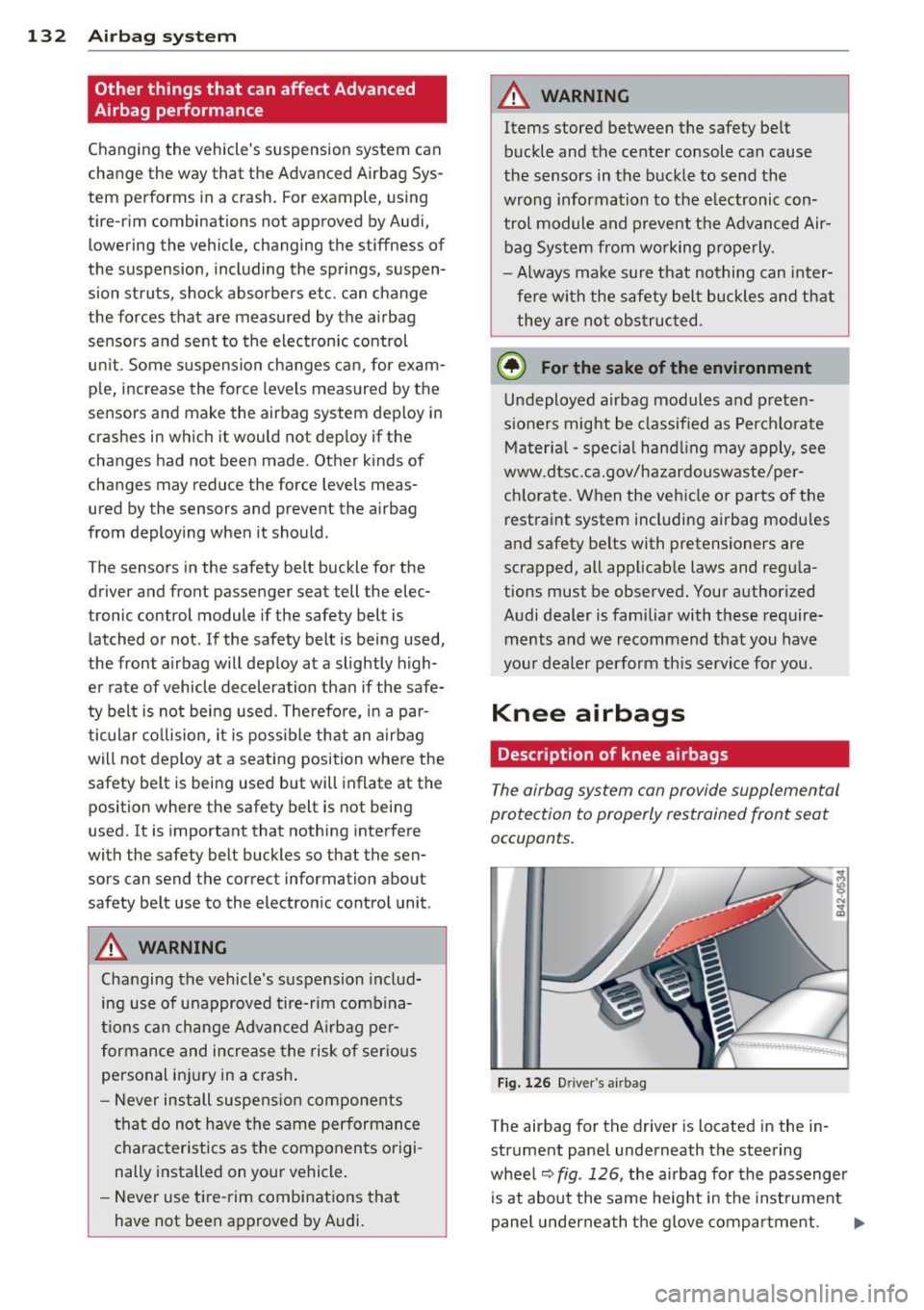
Fig. 1 26 D river 's ai rb ag
The airbag for the driver is Located in the in
strument panel underneath the steering
whee l
c::> fig. 126, the airbag for the passenger
is at about the same height in the inst rument
panel underneath the g love compartment . ..,_
Page 136 of 244
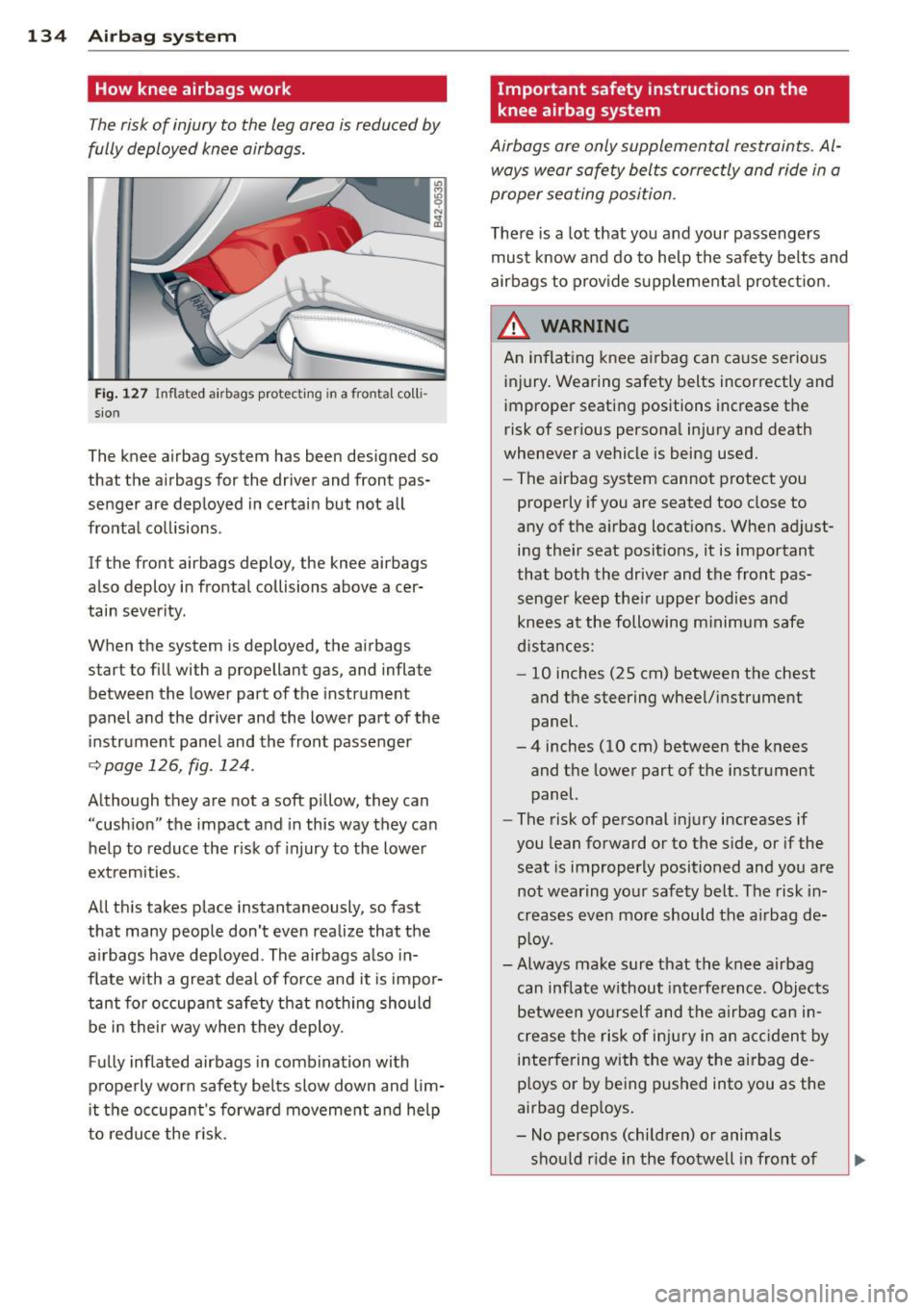
134 Airbag system
How knee airbags work
The risk of injury to the leg area is reduced by
fully deployed knee airbags .
Fig. 127 Inflated airbags protecting in a frontal coll i
sion
The knee airbag system has been designed so
that the airbags for the driver and front pas
senger are deployed in certain but not all
frontal collisions .
If the front airbags deploy, the knee airbags
also deploy in frontal collisions above acer
tain severity .
When the system is deployed, the airbags
start to fill with a propellant gas, and inflate
between the lower part of the instrument
panel and the driver and the lower part of the
instrument panel and the front passenger
¢ page 126, fig. 124.
Although they are not a soft pillow, they can
"cushion" the impact and in this way they can
help to reduce the risk of injury to the lower
extremities.
All this takes place instantaneously, so fast
that many people don't even realize that the
airbags have deployed. The airbags also in
flate with a great deal of force and it is impor
tant for occupant safety that nothing should be in their way when they deploy.
Fully inflated airbags in combination with
properly worn safety belts slow down and lim
it the occupant's forward movement and help
to reduce the risk. Important safety instructions on the
knee airbag system
Airbags are only
supplemental restraints. Al
ways wear safety belts correctly and ride in a
proper seating position.
There is a lot that you and your passengers
must know and do to help the safety belts and
airbags to provide supplemental protection.
A WARNING ~
An inflating knee airbag can cause serious injury. Wearing safety belts incorrectly and
improper seating positions increase the
risk of serious personal injury and death
whenever a vehicle is being used.
- The airbag system cannot protect you
properly if you are seated too close to
any of the airbag locations. When adjust
ing their seat positions, it is important
that both the driver and the front pas
senger keep their upper bodies and
knees at the following minimum safe
distances:
- 10 inches (25 cm) between the chest
and the steering wheel/instrument
panel.
- 4 inches (10 cm) between the knees
and the lower part of the instrument
panel.
- The risk of personal injury increases if
you lean forward or to the side, or if the
seat is improperly positioned and you are not wearing your safety belt . The risk in
creases even more should the airbag de ploy .
- Always make sure that the knee airbag
can inflate without interference. Objects
between yourself and the airbag can in
crease the risk of injury in an accident by
interfering with the way the airbag de
ploys or by being pushed into you as the
airbag deploys.
- No persons (children) or animals
should ride in the footwell in front of
Page 141 of 244
A WARNING ,~
If, in exceptional circumstances, you must
install a forward-facing child restraint on
the front passenger's seat:
- Always make sure the forward-facing
seat has been designed and certified by
its manufacturer for use on a front seat
with a passenger front and side airbag.
-Always follow the manufacturer's in
structions provided with the child safety
seat or carrier.
- Always move the passenger seat into its
rearmost position in the seat's fore and
aft adjustment range, as far away from
the airbag as possible before installing
the child restraint. The backrest must be
adjusted to an upright position.
- Always make sure that the
PASSENGER
AIR BAG OFF light comes on and stays
on all the time whenever the ignition is
switched on.
Advanced front airbag system and children
Your vehicle is equipped with an "Advanced
Airbag System" in compliance with United
States Federal Motor Vehicle Safety Standard
(FMVSS) 208 as applicable at the time your
vehicle was manufactured.
The Advanced Airbag system in your vehicle
has been certified to meet the "low-risk" re
quirements for 3- and 6- year-old children on
the passenger side and small adults on the
driver side. The low risk deployment criteria
are intended to reduce the risk of injury
through interaction with the airbag that can
occur, for example, by being too close to the
steering wheel and instrument panel when
the airbag inflates. In addition, the system has been certified to comply with the "sup
pression" requirements of the Safety Stand
ard, to turn
off the front airbag for infants up
to 12 months who are restrained on the front
passenger seat in child restraints that are list
ed in the Standard.
Child Safety 139
Even though your vehicle is equipped with an
Advanced Airbag system, a child should al
ways ride in the seat properly restrained for
its age and si ze. The airbag on the passenger
side makes the front seat a potentially dan
gerous place for a child to ride . The front seat
is not the safest place for a child in a forward
facing child safety seat . It can be a very dan
gerous place for an infant or a larger child in a
rearward-facing seat.
Advanced Airbags and the weight
sensing mat in the front seat
The Advanced Airbag System in your vehicle detects the presence of an infant or child in a
child restraint on the front passenger seat us
ing the weight -sensing mat in the seat cush
ion and the sensor below the safety belt latch
on the front passenger seat that measures the
tension on the safety belt.
The weight -sensing mat measures total
weight of the child and the child safety seat
and a child blanket on the front passenger
seat. The weight on the front passenger seat
is related to the design of the child restraint
and its "footprint", the size and shape of the
bottom of the child restraint as it sits on the
seat. The weight of a child restraint and its
"footprint" vary for different kinds of child re
straints and for the different models of the
same kind of child restraint offered by child
restraint manufacturers .
The weight ranges for the individual types,
makes and models of child restraints that the
NHTSA has specified in the Safety Standard
together with the weight ranges of typical in
fants and typical 1 year-old child have been
stored in the control unit of the Advanced Air
bag System. When a child restraint is being
used on the front passenger seat with a typi
cal 1 year-old child, the Advanced Airbag Sys
tem compares the weight measured by the
weight sensing mat with the information stor
ed in the electronic control unit.
The electronic control unit also registers the
tension on the front passenger safety belt. ..,. •
•
Page 152 of 244
150 Intelligent te chn olog y
Intelligent technology
Notice about data
recorded by vehicle
control modules
Your veh icle is not equipped with an Event Da
ta Recorder (EDR), installed by some manu
facture rs fo r the express p urpose o f capturing
data for retrieval after an accident or cras h
event. EDR's are sometimes called "crash re
corders".
Some state laws restrict the retrieval or down loading of data stored by EDR 's that were in
stalled in a vehicle for the express purpose of retrieving data after an accident or crash
event without the owner's consent.
A lthough yo ur vehicle is not equ ipped wit h an
EDR, it is equipped with a number of elect ron
ic control modules for various v ehicl e systems
such as, for examp le, eng ine function, emis
sion control, as well as for the airbags and
sa fety belts .
These electron ic co ntrol modules also record
vehicle-re lated data du ring norma l vehicle op
er ation for diagno stic and repa ir purposes .
T he recording capacity of the elec tronic con
trol modules is limited to data (no sound is re
corded) and only a small amount of data is ac
tually recorded ove r a ve ry limited pe riod of
time and stored when a system fault or other condition is sensed by a cont ro l u nit. Some of
the data t hen stored may re late to vehicle
speed, direction, braking as we ll as restraint
syst em use and performanc e in the event of a
c rash or other condition. Stored data can only
be read and downloaded w ith special equip
ment .
Electronic Stabilization
Program (ESP)
The Electronic Stabilization Program increas
es driving stability .
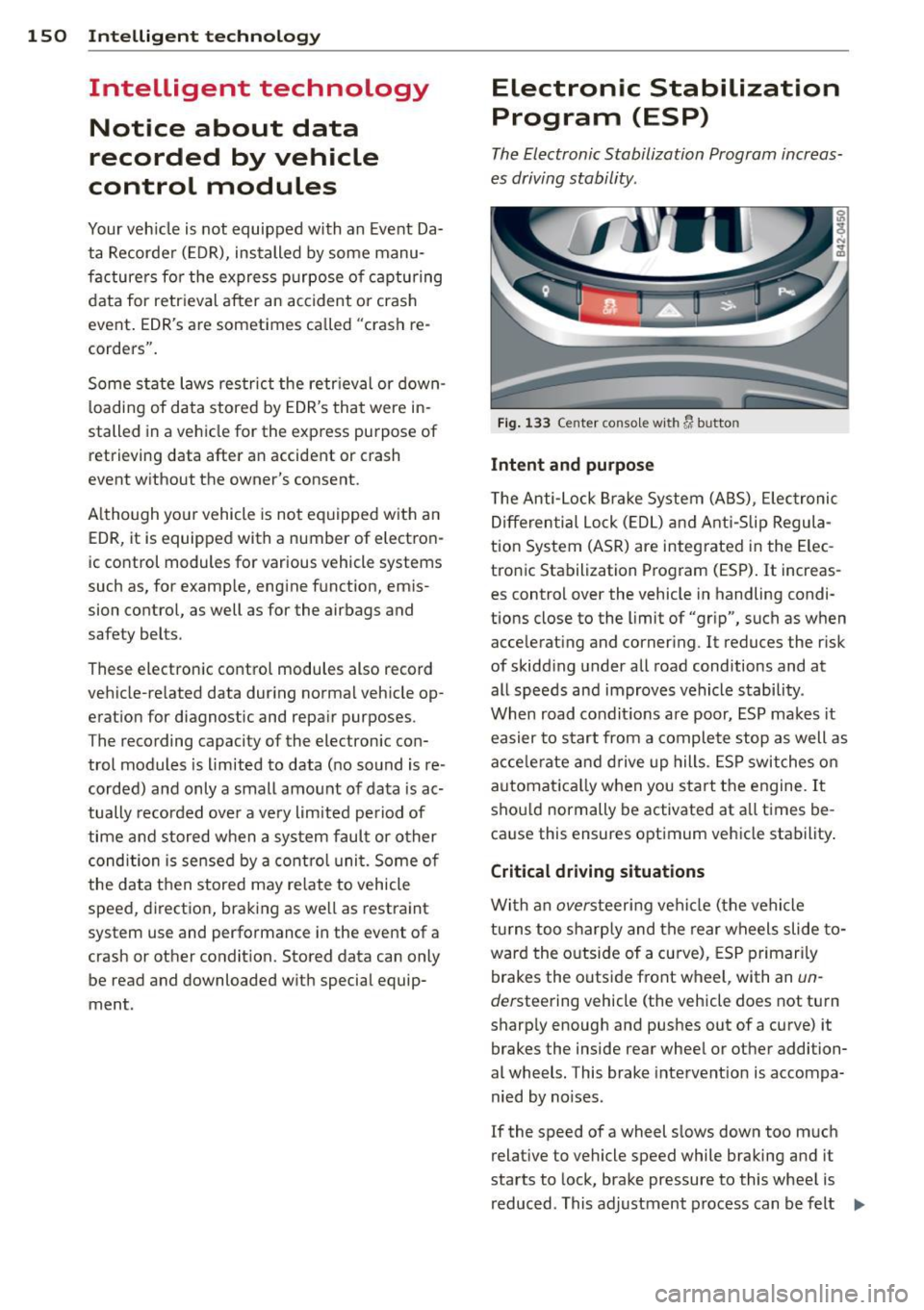
Fig . 1 33 Ce nt er conso le wi th~ bu tto n
Intent and purpose
T he Anti-Lock Brake System (ABS), Elec tronic
D ifferential Lock (EDL) a nd Anti-Slip Regula
tion System (ASR) are integrated i n the Elec
tronic Stabilization Program (ES P).
It increas
es control over the vehicle in handling condi
tions close to the limit of "grip", such as when
acce lerat ing and cornering .
It reduces the r isk
of skidd ing under all road conditions and at
all speeds and improves vehicle stability .
When road condit ions are poor, ES P makes it
easier to start from a complete stop as well as
acce le rate a nd d rive up hills . E S P s witches o n
automatica lly when you start the engine. It
shou ld normally be activated at a ll t imes be
cause this ensures optimum veh icle stability .
Critical driving situations
Wi th an oversteering vehi cle ( the vehicle
tu rns too sharply and the rear wheels slide to
ward the o utside of a cu rve), ESP primari ly
brakes the o utside front wheel, with an
un
dersteering vehicle (the vehicle does not turn
sharp ly enough and pushes out of a curve) it
brakes the inside rear whee l or other addition
al wheels. This brake inte rvent ion is accompa
nied by noises .
If the speed of a wheel s lows down too m uch
rela tive to vehicle speed while braking and i t
starts to lock, brake pressure to this whee l is
reduced . This adjustment process can be felt ..,.
Page 156 of 244
154 Intelligent technology
Other road users must not be put at risk -
you may cause an accident!
- Before descending a steep grade, reduce
speed and shift transmission into a lower
gear or lower driving position . Do not
ride the brakes or hold the pedal down
too long or too often. This could cause
the brakes to get hot and diminish brak ing efficiency .
- Do not "ride the brakes" by resting your
foot on the pedal when you do not intend
to brake . This may cause the brakes to
overheat, premature wear and increased
stopping distance.
- Under certain climatic and operating
conditions such as passing through wa
ter, driving in heavy rain or after washing
the vehicle, the effectiveness of the
brakes can be reduced. In winter, ice can
accumulate on the brake pads, linings,
discs and drums. Cautiously apply brakes
for a test . Brakes will dry and ice coat
ings will be cleaned off after a few cau
tious brake applications .
- Driving for an extended period of time on
salt-covered roads without using your
brakes can also affect braking efficiency .
Clean off accumulated salt coating from
brake discs and pads with a few cautious
brake applications.
- If you damage the front spoiler, or if you
install a different spoiler, be sure the air
flow to the front brakes is not obstruct
ed. Otherwise the brake system could
overheat reducing the effectiveness of
the entire brake system.
- Failure of one brake circuit will impair
braking capability, resulting in increased
stopping distance. Avoid driving the vehi
cle and have it towed to the nearest au
thorized Audi dealer or qualified work
shop.
- Never let the vehicle roll to a stop with
the engine shut off .
- If the brake booster is not working, for
example when towing your vehicle, or because the brake booster has somehow
been damaged, the brake pedal must be pressed considerably harder to make up
for the lack of booster assistance.
Power steering
When the engine is running , power steering
makes i t easier for the driver to steer.
Power steering helps the driver steer the vehi
cle with little physical effort.
If the engine is not running, the power steer
ing system is also not working . In this case ,
you will find it extremely difficult to turn the
steering wheel.
If you turn the steering fully to the left or
right when the vehicle is stationary, you place
a very heavy load on the power steering sys
tem. Turning the steering wheel fully to the left or right will cause noise in the system. It
also reduces engine idle speed.
(D Note
Do not hold the steering turned fully to
the left or right for more than 10 seconds
when the engine is running . There is a risk
of damage to the power steering system .
(D Tips
-In the event of a power steering system
failure, or if the engine is not running
(while being towed), you will still be able
to steer the vehicle. However, you will re
quire more effort to do so .
- If the power steering system has a leak
or is defective, you should immediately
contact a qualified workshop .
- The power steering system requires a
special hydraulic fluid. The power steer
ing fluid reservoir is located in the en
gine compartment. The correct hydraulic
fluid level is important for proper opera
tion of the power steering system. The
power steering fluid level is checked ac
cording to the Audi maintenance service
schedule.
Page 179 of 244
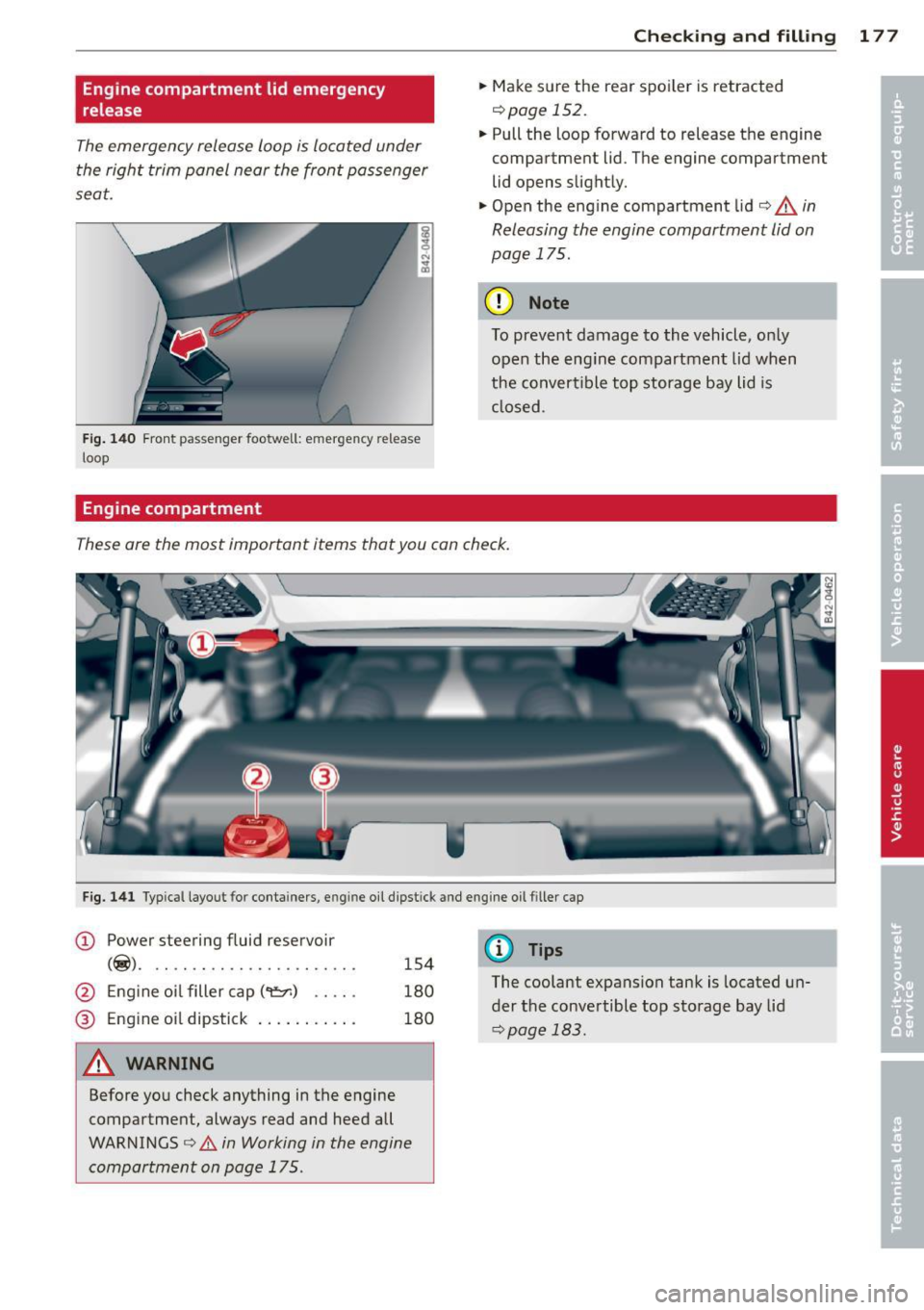
Engine compartment lid emergency
release
The emergency release loop is located under
the right trim panel near the front passenger
seat.
F ig . 140 Front pas se n ge r footwe ll: emer gen cy re lease
l oo p
Engine compartment
Checkin g and fillin g 177
.. Make sure the rear spoi le r is retracted
¢ page 152 .
.. Pull the loop forward to release the engine
compartment lid . The engine compartment
lid opens sligh tly.
.. Open the eng ine compartment lid ¢
& in
Releasing the engine compartment lid on
page 175.
(D Note
To prevent damage to the vehicle, on ly
open the eng ine compartment lid when
the convert ible top storage bay lid is
closed .
Th es e ar e th e most important it ems that you can ch eck.
F ig. 1 41 Ty pical layout for conta iners , en gin e o il dipst ick and engine o il fi ller cap
(D Power steering fluid reservoi r
(@) ... .. .... .... ... ...... .
@ Eng ine oi l filler cap ('l=r.) .. ...
® Eng in e oi l dipstick
154
180
180
A WARNING
Before yo u check anything in the engine
compartment, always read and heed all
WARNINGS ¢.&. in Working in the engine
compartment on page 175 .
-
{!) Tips
The coolant expansion tank is located un
der the convertible top storage bay lid
¢ page 183.
Page 200 of 244
198 Tires and wheels
cargo and lugg age load ca
pacity is 650 lb s. (1400-750
(5
X 150) = 650 lb s.)
5. Determin e the combined
weight of luggage and cargo
being loaded on the vehicle .
That weight may not safely exceed the a vailable cargo
and luggage load capacity
c alculated in Step
4.
6. If your vehicle will be towing
a trailer , load from your trail
er w ill be tran sferred to your
vehi cle . Consult this manual
to determine how thi s re
duces the available cargo
and luggage load capacity of
your vehicle.
.,.Che ck the tire sidewall
( ¢ page 199 , fig. 153) to de
termine the designated load rating for a specific tire.
Tire service life
The service life of tires depends on a lot of
diff erent things i ncluding prop er installation
and balancing, correct tire pressure and driv ·
ing s tyle.
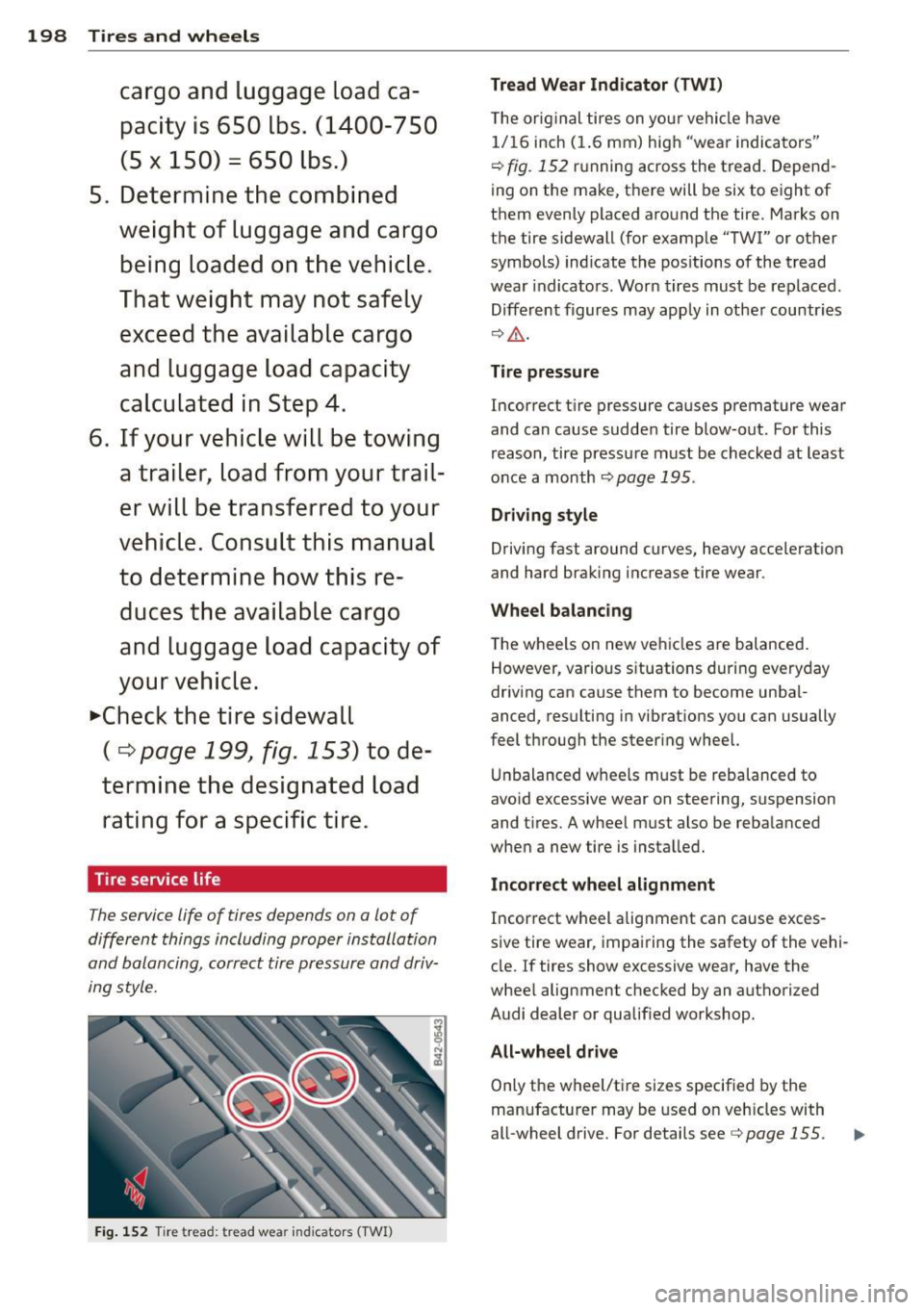
Fig. 152 T ire tread: trea d wea r ind icators (TWI)
Tread Wear Indicator (TWI)
The orig in al tires on yo ur vehi cle ha ve
1/ 16 inch ( 1.6 mm) hig h "wear indica tors"
¢ fig . 152 ru nning acro ss the tread . Depend·
ing on the ma ke , t here will be six to e ight of
them even ly placed aro und the tire. Marks on
t he tire sidewall (for example "TWI" or ot her
symbols) ind icate the pos itions of the tread
wea r indica to rs. Wor n tir es must be rep laced .
Differ ent figures may apply in othe r countries
¢ .&_ .
Tire pressure
Incor rect t ire pressure causes premature wea r
and can cause sudde n tire blow-out . For this
reason, tire pressu re must be checked at least
o nce a month
¢ page 195.
Driving style
Driving fast around c urves, heavy accele rat ion
and hard braking increase tire wear .
Wheel balancing
The wheels on new ve hicles are balance d.
However, va rious s ituations dur ing everyday
driv ing can cause them to become unbal·
anced, resulting in vib rations you can usually
feel t hrough the steer ing whee l.
Unb alanced w hee ls m ust be rebalance d to
avo id excessive wear on steering, suspension
and ti res. A whee l m ust also be reba lanced
whe n a new tire is insta lled.
Incorrect wheel alignment
Incor rect wheel alig nment can cause exces
s ive tire wear , impa iring the safety of the vehi
cle.
If tires show excessive wear , have the
w hee l alignment chec ked by an authoriz ed
Audi deal er or qualified wo rksh op.
All-wheel drive
Only the wheel/ti re sizes specif ied by the
manufacture r may be used on veh icles with
all-wheel drive. For detai ls see ¢
page 155.