warning AUDI R8 SPYDER 2012 Owners Manual
[x] Cancel search | Manufacturer: AUDI, Model Year: 2012, Model line: R8 SPYDER, Model: AUDI R8 SPYDER 2012Pages: 236, PDF Size: 59.24 MB
Page 192 of 236
190 Tire s and wheel s
wheels you have to adjust t he tire pressures
on all w heels .
A WARNING
Incorrec t tire pressures and/or underinfla
t ion can lea d sudden tire failure, loss of
contro l, collision, ser ious personal injury
or even death.
- When the warning symbo l
RI] appears in
the instrument cluster, stop and inspect
the tires .
- Incorrect tire pressure and/or underinfla
t io n can cause increased t ire wear and
can affect the handling of the ve hicle and
stopp ing ability .
- Incorrect tire pressures and/or underin fla tion can also lead to sudden tire fa il
ure, incl uding a blowo ut and sudden de
fla tion, causing loss of vehicle control.
- T he d river is responsible for the cor rect
t ire pressures fo r all tires on the vehicle .
T he ap plic a b le p ress ure v alues are locat
ed on a st ic ker on the drive r's side 8-pil
lar.
- O nly when all t ires on the vehi cle ar e fi l
led to the correct pressure, the tire pres
sure monitoring system can wor k co r
rect ly .
- Th e use of incorrect tire pressure values
can lead to accidents or other damage.
Therefore it is essential that the driver
observe the specif ied tire pressure va lues
for the tires and the correct pressures for
the funct ion of the tire pressure mo nitor
ing system .
- Always inflate tires to the recommended
and correct tire pressure befo re drivi ng
off .
- Driv ing with under inflated tires bend
more, lett ing them get too ho t res ulting
in t read separation, sudden t ire fail ure
and loss of control.
- Excess ive speed and/ove rloading can
cause heat bui ld-up, sudden t ire fa ilu re
and loss of control.
- If the t ire pressur e is too low or too high,
the ti res w ill wea r pre matu rely a nd the
vehicle will not h and le we ll. -
If the tire is not flat and you do not have
to change a wheel immediately, drive at
red uced speed to the nearest service sta
tion to check the t ire pressure and add
air as req uired.
(D Note
Driving without valve stem caps can ca use
damage to the tire valves. To prevent this,
a lways make sure that factory installed
valve stem caps o n all whee ls are sec urely
mounted o n the valve.
@ For the sake of the environment
Underinflated tires w ill also increase the
fuel consum ptio n.
Tires and vehicle load limits
T he re a re lim its to the amount of load o r
weight tha t any veh icle a nd any tire can ca rry .
A vehi cle that is overloaded will no t handle
well and is mo re d iff icu lt to stop . Ove rloading
can not only lead to loss of vehicle control,
but can also damage important parts of the
vehicle and can lead to sudden tire fa ilure, in
clud ing a b lowout and sudden deflation that
can cause the vehicle to cras h.
Your safety and that of your passengers also depends on making sure that load limits are
not exceeded. Vehicle load includes everybody
and everything in and on the veh icle . These
load lim its are technically referred to as the
vehicle 's
Gro ss Vehicle Weight Rating
("GVWR").
The "GVWR" includes the weight of the basic
vehicle, all facto ry installed accessor ies, a full
tank of fuel, o il, coolant and other fluids plus
max imum load . T he max imum load includes
t h e nu mbe r of p assenge rs t hat the vehicle is
i n tended to c arry ("seat ing c apac ity") wi th an
ass umed we ight of 150 lbs . (68 kg) for each
passenger at a designated seating position
and the total weight of any luggage in the ve -
hicle. ..,_
Page 193 of 236
The Gross Axle Weight Rating ("GAWR") is
the maximum load that can be applied at each
of the vehicle's two axles.
The Gross Vehicle Weight Rating and the
Gross Axle Weight Rating are listed on the
safety compliance sticker labe l located on the
driver's side B-pi llar . Your Audi has 2 seating
positions in the front for total seat ing capac i
ty of 2. Each seating posit ion has a safety belt
c::> page 101, Safety belts.
The fact that there is an upper limit to your
ve hicle's Gross Veh icle Weight Rating means
that the total weight of whatever is being car
ried in the veh icle is limited . The more passen
gers in the veh icle or passengers who a re
heavier than the standard weights assumed
mean that less weight can be carried as lug
gage.
The t ire pressure label on your Audi also lists
the maximum combined we ight of all of the
occupants and luggage o r othe r cargo that
the vehicle can carry. For the location of the
la be l c::>page 187, fig. 148.
A WARNING
Overloading a vehicle can cause loss of ve
hicle control, a crash or other accident, se
r ious personal injury, and even death.
- Carrying more weight than yo ur vehicle
was designed to carry will prevent the
vehicle from handling properly and in
crease the risk of the loss of veh icle con
trol.
- The brakes on a veh icle that has been
overloaded may not be able to stop the
vehicle within a safe distance .
- Tires on a vehicle that has been overload
ed can fail suddenly, includ ing a b lowout
and sudden deflation, causing loss of
control and a crash.
Determining correct load limit
Use the example below to cal
culate the total weight of the
Tires and wheels 191
passengers and luggage or oth
er things that you plan to trans
port so that you can make sure
that your vehicle will not be
overloaded.
Steps for Determining
Correct Load Limit
1. Locate the statement "THE
COMBINED WEIGHT OF OC
CUPANTS AND CARGO
SHOULD NEVER EXCEED XXX KG OR XXX LBS"on your vehi
cle's placard (tire inflation
pressure label)
¢ page 187,
fig. 148.
2. Determine the combined weight of the driver and pas
sengers that will be riding in
your vehicle.
3. Subtract the combined
weight of the driver and pas
sengers from
"XXX" kilo
grams or
"XXX" pounds
shown on the sticker
¢ page 187, fig. 148.
4. The resulting figure equals
the available amount of car
go and luggage load capaci-
ty. For example, if the
"XXX"
amount equals 1400 lbs.
and there will be five 150
lbs. passengers in your vehi
c le, the amount of available .,..
•
•
Page 195 of 236
A WARNING
Sudden tire failure can lead to loss of con
trol, a crash and serious personal injury !
- Never drive a vehicle when the tread on
any tire is worn down to the wear indica
tors.
- Worn tires are a safety hazard, they do
not grip well on wet roads and increase
your risk of "hydroplaning " and loss of
control.
- Always keep chemicals that can cause tire damage, such as grease, oil, gasoline
and brake fluid away from t ires.
- Tires age even if they are not be ing used
and can fail suddenly, especially at high
speeds . Tir es that are more than 6 years
old can only be used in an emergency
and then with special care and at lower
speeds.
- Never mount used tires on your vehicle if
you are not sure of their" previous histo
ry ." Old used tires may have been dam
aged even though the damage cannot be
seen that can lead to sudden tire failure
and loss of vehicle control.
Tires and wheels 193
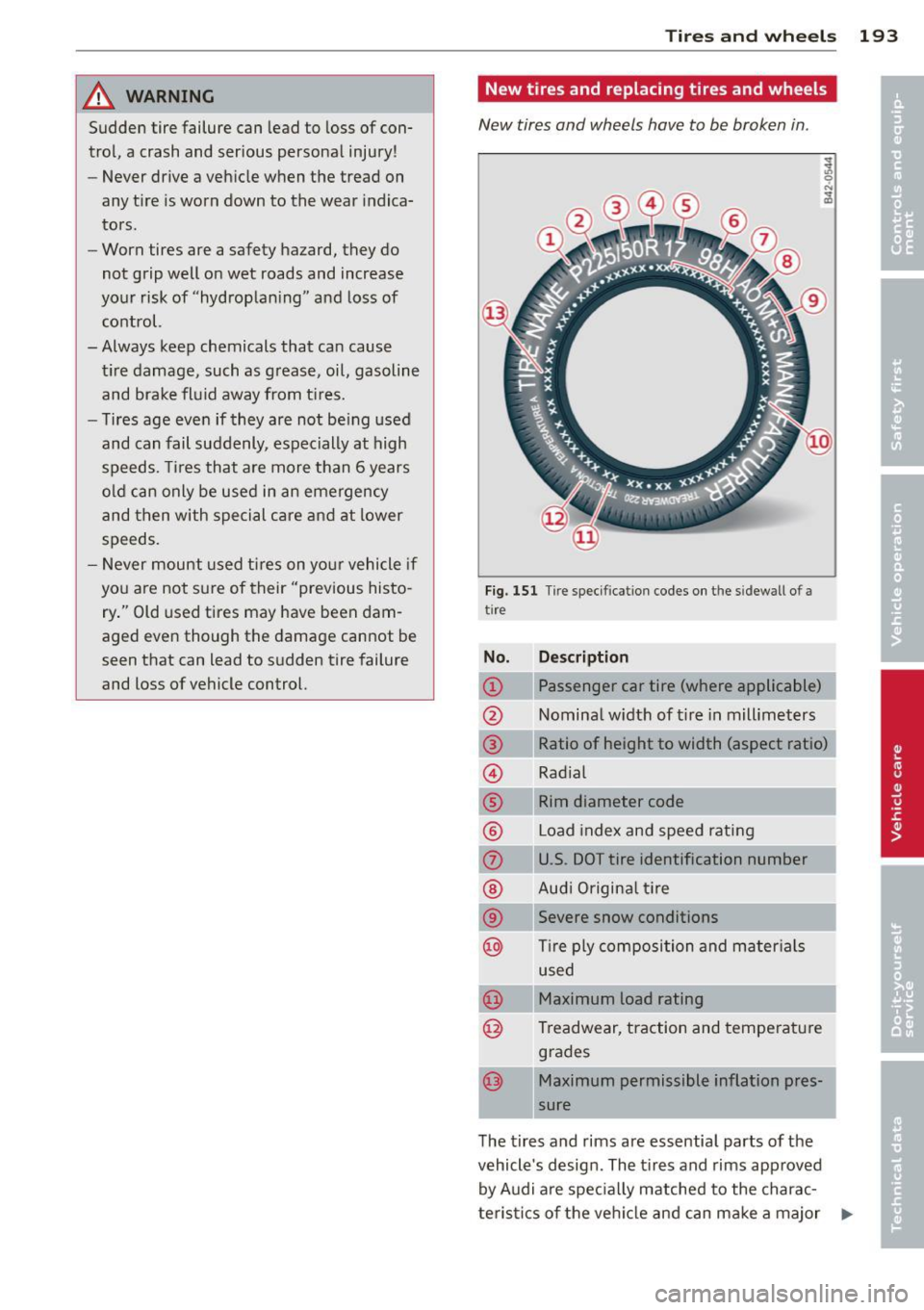
New tires and replacing tires and wheels
New tires and wheels have to be broken in .
Fig. 151 Tir e specifica tion codes on t he s idew all o f a
t ir e
No. Description
CD Passenger car tire (where applicable)
@ Nominal w idth of tire in millimeters
® Ratio of height to width (aspect ratio)
© Radial
® Rim diameter code
® Load index and speed rating
(f) U.S . DOT tire identification number
® Audi Origina l tire
® Severe snow conditions
@ T ire ply composition and materials
used
@ Maximum load rating
@ Treadwear, traction and temperature
grades
@ Maximum permissible inflation pres-
sure
The tires and rims are essential parts of the
vehicle's design . The tires and rims approved
by Audi are spec ially matched to the charac
teristics of the vehicle and can make a major .,.
•
Page 198 of 236

196 Tire s and wheel s
The insta llation of replacement tires with
steel cord body plies in the tire sidewall may
cause ma lfunction of the tire pressure mon i
toring system, and is not recommended (cord material information in molded on the t ire
sidewall) .
A lways check your tire pressure monitoring
system ind icator after replacing one or more
tires on your vehicle. If the tire pressure mon i
toring system ind icator flashes, or is on, your
system is not work ing properly.
A WARNING
- Us ing incorrect or unmatched ti res and/
o r wheels or imp roper tire and whee l
c ombin ations can lead to loss of contro l,
co llision and serious persona l injury.
- Always use tires, rims and wheel bo lts
that meet the specifications of or ig inal
f ac to ry-installed t ires or other combina
tions that have been spec ifically ap
proved by the vehicle manufacturer .
- Tires age even if they are not being used
and can fail suddenly, es pecially at high
speeds. Tires that are more than 6 years
o ld can only be used in an emergency
and then with special care and at lower
speeds .
- Never mount used tires on your vehicle if
you a re not sure of their "previous histo ry." Old used tires may have been dam
aged even though the damage cannot be
seen that can lead to s udden tire failure
and loss o f vehicle control.
- Only t he wheel/tire s izes spec ified by t he
ma nufactu rer may be used o n veh icles
with all-wheel dr ive.
- N ever drive faste r th an the maxim um
speed for whi ch the tires o n your ve hicle
are ra ted because ti res that are driven
f as ter than their rated speed can fail
s u dden ly .
- Overloading t ires cause heat build- up,
s u dden tire failure, incl uding a blowout
and sudden deflation and loss of control. -
Temperature grades apply to tires that
are properly inflated and not over or un
derinflated.
- For technica l reasons it is not always
possible to use whee ls from other vehi
cles -in some cases not even wheels
from the same ve hicle model.
- Do not use run-flat tires on yo ur vehicle.
Using run-flat t ires ca n lead to veh icle
damage or crashes .
@ Note
- For technical reasons, it is not generally
poss ible to use the w heel rims from oth
er ve hicles . Th is can hold true for wheels
of the same vehicle type .
- If you should put different wheels and
tires on your veh icle (e.g . winter wheels
and tires), you must be certain that the
wheels and tires are compatible with the ti re pressure monitor ing system. Other
w ise the system will regi ste r a mal func
t ion and a fa ult message w ill be dis
played. For more information, contact
your authorized Audi dealer.
(D Note
- When installing new tires, be care ful not
to damage the va lves or tire pressure
monitoring system sensors.
- N ever drive without the valve stem cap.
The va lves co uld get damaged.
- If the sensors must be replaced, then
the valve must also be replaced at the
same time .
@ For the sake of the environment
Dis pose o f old tires in accordance with the
l ocal requirements .
@ Tips
Tires with the iden tific ation "ROl " have
been specially matched with you r A udi. We
r ecommend using on ly these tires because
they meet the highest standards rega rding
safety and driving characteristics when used correctly . Your authorized Aud i R8
Page 199 of 236
dealer will g ladly provide you with more
information.
Uniform tire quality grading
- Tread wear
- Traction AA A B C
- T emperature ABC
Quality grades can be found where applicable
on the ti re side wa ll between tread shoulde r
and maximum section wid th ¢ page 193,
fig. 151 .
For example : Tread wear 200, Tract ion AA ,
Temperatu re A .
All passenger car tires must conform to Feder
al Safety Requi rements in addition to these
grad es.
Tread we ar
The tread wear grade is a comparative rating
based on the wear rate of the tire when tested
under controlled conditions on a spec ified
government test course .
For example, a t ire graded 150 would wear
one and one half (1 1/2) t imes as well on the
government course as a tire graded 100 .
The relat ive perform a nee of ti res depends
upon the actua l conditions of their use, how
ever, and may depart sign ificantly from the
norm due to var iat ions in dr iv ing habits, serv
i ce practices and differences in road character
i stics and climate.
Traction
The traction grades, from highest to lowest,
are AA, A, B and
C. Those grades represent the
tire's abil ity to stop on wet pavement as
measured unde r controlled cond it ions on
spec ified gove rnment test su rfaces of asphalt
and concrete . A tire ma rked C may h ave po or
t ra ction perfo rm ance¢ &..
Temp erature
The temperature grades are A (the h ighest),
B, and C, repr ese nting the t ire's resistance to
the gene rat io n of heat and its ab ility to dissi-
Tire s an d wheel s 197
pate heat when tested under controlled condi
tions on a specified indoor laboratory test
whee l.
Sustaine d high temperature can cause the
mater ia l of the tire to degenerate and red uce
tire life, and excessive tempe rat ure ca n lead
to s udden tire failure ¢ &. .
T he gr ade C correspon ds to a level of pe rform
ance which all passenger car tires must meet u nder the Federal Motor Vehicle Safety Stand
ard No . 109 . Grades Band A represent higher
l evels of performance on the laboratory test
whee l than the minimum requ ired by law.
A WARNING
The traction grade assigned to th is tire is
based on straight-ahead braking traction
tests, and does not include accele rat ion,
cor neri ng, hy droplaning or peak t ra ction
ch aracte rist ics.
A WARNING
T he temperature grade for this tire is es
tablishe d for a tire that is properly inf lated
and not overloaded . Excess ive speed, un
derinflation, or excessive loading, e it h er
separately or in combinat ion, can ca use
heat bui ldup and possible tire failure.
Winter tires
Winter tires can improve vehicle handling on
snow and ice. At temperatures below 45 °F (7 °C) we recommend changing to winter
tires.
In some heavy snow areas, local governments
may require true w inter or "snow" tires, those
with very deeply cut tread. T hese tires should
o nl y be used in pairs and be installed o n all
fou r wheels . Make sure you purchase snow
ti res that a re the same si ze and construction
type as the othe r ti res on you r vehicle.
If your vehicle is equipped w ith all-whee l
drive*, th is w ill improve traction during winter
driv ing, even with the s tanda rd tires . Howev-
er, we stro ngly recommend that you always ..,.
•
•
Page 200 of 236
198 Tire s and wheel s
equip a ll four wheels on your vehicle with cor
rectly fitted winter tires or all-season tires,
when winter road conditions are expected .
This a lso improves the vehicle's braking per
formance and reduces stopping distances.
Summer tires provide less grip on ice and
snow.
W inter t ires (snow t ires) must always be fitted
on all four whee ls .
Compat ible tire pressure mo nitor ing sensors
must be installed on all fo ur winter tires for
the tire pressure monitoring system to func
tion proper ly
i=;, poge 195 .
Ask your autho rized Aud i dea ler o r qualified
wo rkshop fo r permitted
winter tir e size s . Use
on ly radia l w inte r tires .
W inter t ires lose the ir effectiveness when the
tread is worn down to a depth of 0.157 inch
(4 mm) .
Only drive with wi nter tires under winter con
d itions . Summer tires hand le better when
there is no snow or ice on the roads and the
temperature is above 45 °F (7 °C).
Please always remembe r that w inte r tires may
have a lower speed rating than the t ires origi
na lly installed on your veh icle at the t ime i t
was manufactured. Please see
r=;, page 194 ,
Speed roting (letter code) for a list ing of the
speed rating letter codes and the maximum
speed at which the tires can be driven.
The speed ra ting lette r code
(i=;, poge 185) is
on the s ide wall of the tire
i=;, poge 193.
A WARNING
Winter tires have maximum speed limits
that may be lower than your vehicle's max
im um speed . Always know the maxim um
speed before driving off. Never drive faster
than the speed permitted for your specific
w inte r tires . This will cause damage to the
tires leading to an accident and serious
personal in ju ry to you and yo ur passen
gers.
A WARNING
Driving faster than the maximum speed
for which the winter tires on your veh icle
were designed can cause t ire failure in
cluding a blowout and sudden deflation,
l oss of cont ro l, crashes and ser ious per
sonal injuries. Have wo rn o r damaged ti res
r eplaced immedia tely.
- W inte r ti res have maxim um speed rating
tha t may be lower than your vehicle 's
maximum speed.
- Never drive fas ter than the speed for
which the win ter or othe r ti res installed
on yo ur vehicle are rated.
A WARNING ~
A lways ad just your driving to the road and
traffic condit ions. Never let the good ac
celeration o f the winter tires and a ll-wheel
drive tempt yo u into taking extra risks. Al
ways remember:
- When braking, an all-wheel drive veh icle
handles in the same way as a front drive
veh icle.
- Drive carefully and reduce your speed on
icy and slippery roads, even w inter t ires
cannot help under black ice conditions .
~ For the sake of the environment
Use summer tires when weather condi
tions permit. They are qu ieter, do not wear
as quickly and reduce fuel consumpt ion.
Snow chains
-
Snow cha ins may be fitted only to the rea r
whee ls, and o nly to certa in tire sizes . Ask your
autho rized Aud i dea le r o n whi ch t ire si zes
snow c hains ca n be used.
T he snow chains must have low-p rofile links
and must not be t hicker than 0 .53 inch
(13 .5 mm), in cl ud ing the lo ck.
Remove wheel center covers before putt ing
snow c ha ins on your vehicle
r=;, @ . For safety
reasons cover caps must then be f itted over
Page 201 of 236
the wheel bolts. These are available from au
thorized Audi dealers.
A WARNING
Using the wrong snow chains for your vehi
cle or installing them incorrectly can in
crease the risk of loss of control leading to
serious personal injury.
- Snow chains are available in different
sizes. Always make sure to follow the in
structions provided by the snow chain
manufacturer .
- When driving with snow chains, never
drive faster than the speed permitted for
your specific snow chains.
- Always observe local regulations.
- Remove snow chains before driving on
roads not covered with snow to avoid
damaging tires and wearing the snow
chains down unnecessarily.
- Snow chains, which come into direct con
tact with the wheel rim, can scratch or
damage it. Therefore, make sure that the
snow chains are suitably covered . Check
the position of the snow chains after
driving a few yards and correct if neces
sary. Follow the instructions from the
snow chain manufacturer when doing so.
(D Tips
Where snow chains are mandatory oncer
tain roads, this normally also applies to ve
hicles with all-wheel drive.
Wheel bolts
Wheel bolts must always be tightened to the
correct torque.
The design of wheel bolts is matched to the
factory installed rims. If different rims are fit
ted, the correct wheel bolts with the right
length and correctly shaped bolt heads must
be used. This ensures that wheels are fitted
securely and that the brake system functions
correctly .
Tires and wheels 199
In certain circumstances, you may not use
wheel bolts from a different vehicle -even if it
is the same model
r:!> page 221.
A WARNING
Improperly tightened or maintained wheel
bolts can become loose causing loss of
control, a collision and serious personal in
jury.
- Always keep the wheel bolts and the
threads in the wheel hubs clean so the
wheel bolts can turn easily and be prop erly tightened.
- Never grease or oil the wheel bolts and
the threads in the wheel hubs. They can
become loose while driving if greased or
oiled, even if tightened to the specified
torque.
- Only use wheel bolts that belong to the
rim being installed.
- Never use different wheels bolts on your
vehicle.
-Always maintain the correct tightening
torque for the wheel bolts to reduce the
risk of a wheel loss. If the tightening tor
que of the wheel bolts is too low, they
can loosen and come out when the vehi
cle is moving.
If the tightening torque is
too high, the wheel bolts and threads
can be damaged and the wheel can be
come loose.
(D Note
The specified torque for the wheel bolts is
90 ft lb (120 Nm) with a tolerance of ± 7 .4
ft lb( ± 10 Nm). Torque wheel bolts diago
nally. After changing a wheel, the torque
must be checked as soon as possible with a
torque wrench -preferably by an author
ized Audi dealer or qualified workshop.
Low aspect ratio tires
Your Audi is factory-equipped with low aspect
ratio tires. These tires have been thoroughly
tested and been selected specifically for your model for their superb performance, road feel
and handling under a variety of driving
IJ,,
•
•
Page 203 of 236
soon as possible, and inflate them to the
proper pressure . Driving on a significant ly un
der-inflated tire causes the tire to overheat
and can lead to tire failure. Under-inflation a l
so reduces fuel efficiency and tire tread l ife,
and may affect the veh icle 's handling and
stopping ab ility.
Please note that the TPMS is not a substitute
for proper t ire maintenance, and it is the dr iv
er's responsib ility to ma inta in correct t ire
p ress ure , even if under- inflation has not
reached the leve l to t rigger illumination of the
TPMS low tire pressure telltale .
Your veh icle has also been equ ipped with a
TPMS malfunction indicato r to indicate when
the system is not ope rating properly. The
TPMS malfunc tion indica to r i s combined wi th
the low t ire pr essu re tellta le. When the sys
tem detec ts a ma lf u nct ion, the te lltale will
flash for approximately one minute and then remain continuo usly ill uminated . This se
q uence will continue upon subsequent vehicle
start-ups as long as the malfunction ex ists.
When the malfunction indicator is ill uminat
ed, the system may not be able to detect or
signa l low t ire pressure as intended . TPMS
malfunct ions may occ ur for a variety of rea
sons, including the ins talla tio n of replace
ment or a lternate tires o r whee ls on the veh i
cle that prevent the TPMS from funct io ni ng
p roperly . Always check the TPMS malfunct ion
t ellta le afte r replacing one o r more t ires or
wheels o n your veh icle to ensure tha t the re
p lacemen t or a lternate tires and wheels allow
the TPMS to continue to function properly .
Introduction
The tire pressure monitoring system monitors
air pressure in all four road wheels while the
vehicle is moving .
As soon as the tire pressu re mo nitor ing sys
tem senses a s ignificant loss of a ir pressure in
one or severa l ti res, text messages and yellow
symbo ls appear in the instr ument cluster dis
p lay to alert the driver. The
[ti warning light
Tire s an d wheel s 201
in the instrument cluster comes on when the
ti re is significant ly underinflated .
T he wa rni ng lig ht
[ti also illu minates i n the
case of a system mal funct io n.
Be aware that t ire pressure is a lso dependent
o n the tempe ratu re of the t ire. For eve ry 18 ° F
(10 °C) incre ase in tir e te mper ature, tire pres
s u re inc reases by about 1.5 psi (0 .1 bar). The
ti re warms up while the ve hicle is moving and
tire p ress ure rises . So you sho uld ad just tire
pressure only when they a re
cold, when the
temperature of the tires is ro ughly the same
as the ambient a ir temperature.
In order to keep the tire press ure monito ring
system p roperly ca librated, t ire press ure on
all four tires sho uld be checked at regu lar in
terva ls.
The tire pressure is shown on the label located
on the dr iver's side B-pillar (v is ib le when the
door is open) .
A WARNING
When the tire pressure mo nitoring system
war ning light is lit , one o r m ore of your
tires is s ignificantly under-infla ted . You
shou ld stop and check your tires as soon as
pos sib le, and in flate t hem to the proper
p ress ure a s in dic ate d on the ve hicle's ti re
p ress ure lab el
¢page 187. Driving on a
significantly under -inflated ti re causes t he
tire to over heat and can lead to tire failure .
Under-inflat ion also is like ly to impair the
vehicle's handling and stopping ab ility.
@ For the sake of the environment
D riving wit h un der -inflated tires red uces
fuel efficiency an d tire t read life.
(D Tips
- E ach tire should be chec ked monthly
w hen the tem perature of the tires is
about the same as amb ient a ir tempera
t u re and set to the recommended infla
tion press ure as specified on the tire
pressure label¢
page 187.
•
•
Page 205 of 236
What do I do now? Trunk escape handle
Appl ies to vehicles: with trunk escape handle
In case of an emergency, the front lid can be
opened from the inside using the trunk es
cape handle.
.. To open the front lid pull the handle.
The trunk escape handle inside the luggage
compartment is made of fluorescent materia l
to g low in the dark.
.&_ WARNING
The trunk escape handle is to be used only
in an emergency.
Breakdown kit
The breakdown kit consists of vehicle tool kit
and tire mobility system.
Fig. 152 Breakdown kit in luggage compartment
@ Vehicle tool kit
@ Tire mobility system c::> page 203
The breakdown kit is located in the luggage
compartment under the cargo floor .
The tool kit consists of the following items :
- Hook for removing hub cap
- Lug wrench
- Alignment pin for changing wheels
- Screwdriver w ith reversible blade
- Towing eye
- Jack* (not a vehicle component; contact your
authorized Audi dealer if needed)
Before returning the jack* to its place, retract
the jack arm fully .
What do I do now ? 203
Note: some of the items listed above are pro
vided on certain mode ls only or are optional
extras.
.&_ WARNING
- Never use the hexagonal socket in the
handle of the screwdriver to loosen or
tighten the wheel bolts .
- The jack* (available as a replacement
part) is intended only for your vehicle
model. Under no circumstances use it to
lift heavy vehicles o r other loads; you risk
injuring yourse lf.
- Never start or run the eng ine while the
veh icle is supported by the jack *.
- If you must work under the veh icle, al
ways use safety stands specifically de signed fo r th is purpose.
- Using a bumper jack to ra ise the vehicle
wi ll damage the bumpe r system. The
jack may slip, caus ing injury.
Tire repair
General and safety pointers
Tire repair is intended only for temporary,
short-term use .
Fig. 153 Ti re damage for which the Tire Mob ility Sys
tem is not suited
-
Your vehicle is equipped wi th a tire repa ir k it,
the
Tire M obility Sy stem (T M S).
In the event of a t ire failure, the TM S is in the
luggage compartment under the floor.
It con
s ists of the tire sealan t and an elec tric air
pump.
Page 206 of 236
204 What do I do now?
Using TM S, tire damage caused by foreign
bodies up to about
0.16 inch (4 mm ) in diam
eter can be sealed reliably.
The foreign object must s tay in the t ire.
The tir e sea lant mu st not be us ed :
- for cuts or punctures in the tire which are
larger than 0.16 inch (4 mm)¢ fig. 153
(D
- for damage to the rim@
- if you have been driving with very low tire
pressures or tires with no air @
Using the
TM S is described in the section
¢ page 204, Preliminary steps.
TMS can be used at temperatures down to
-4 °F (- 20 °C).
A WARNING
Take the following preca utions after re
pairing the tire:
-
- Do not drive faster than 50 mph (80 km/
h)!
- Avoid full-throttle acce leration, heavy
braking an d fast cornering.
- The vehicle's road behavior can be affect
ed.
- Tires sealed w ith
TMS are intended only
for
temporar y, short-term use . Dam
aged tires must be replaced . Drive care
fully to the next professional repair fa
cility.
- After using the t ire sea lant the tire pres
sure monitoring system may no longer
work properly. Drive carefully to the next professional repair fac ility.
- TMS must NOT be used,
- for cuts or pu nctures in the ti re whi ch
are larger than 0.16 inch (4 mm)
- for damage to the r im
- if you have been dr iv ing with very low
tire pressures or t ires with no air
- Seek profess ional assistance if it is not
poss ible to repair the tire with the tire
sealant.
- The tire sealant must not come into con
tact with sk in, eyes or clothing. -
If you get any ti re sea lant in yo ur eyes or
come into contact w ith it, rinse the af
fected area thoroughly with clean water. Find a phys ician immediately!
- Change any clothing contaminated with
tire sealant immediately.
- Do not inha le the vapor!
- If you have swallowed tire sealant, rinse
your mouth thoroughly right away and
drink plenty of water.
- Do not induce vomit ing! Find a physi
c ian immediately!
- I f you have allergic react ions, find a
phys ic ian immediately.
- Keep the tire sealant away from children.
(D Note
Do not use commercially avai lab le tire
sealants. The e lectr ica l components of the
tire pressure monitoring system will no longe r work properly.
@) For the sake of the environment
Used sealant bottles ca n be dropped off at
a recycling facility.
(D Tips
- If sea lant has run out, allow it to dry.
Then you can peel it off.
- Have the t ire sea lant rep laced every 4
years at a dealership.
Preliminary steps
Some preliminary steps are necessary for tire
repair.
... If you have a flat tire, park the vehicle as far
as possible from moving traffic .
... App ly the
parking brake firmly.
... Engage a gear.
... Check whether a repair using the Tire Mobi
lity System is poss ible ¢ page 203 .
... Have all passengers
lea ve the veh icle and
stay away from the danger zone¢.&_ .
... Take the
sea lant bottle and the ele ctri c air
pum p from the luggage compartment un-
de r the floor ¢ page 203, fig. 152. ....