brakes AUDI R8 SPYDER 2012 User Guide
[x] Cancel search | Manufacturer: AUDI, Model Year: 2012, Model line: R8 SPYDER, Model: AUDI R8 SPYDER 2012Pages: 236, PDF Size: 59.24 MB
Page 148 of 236
146 Intellig ent technolog y
Other road users must not be put at risk -
yo u may cause an acc ident!
- Before descending a steep grade, reduce
speed and shift transmission into a lower
gear or lower driving position . Do not
ride the brakes or ho ld the pedal down
too long or too often . This cou ld cause
the brakes to get hot and d iminish brak
ing efficiency .
- Do not "ride the brakes" by resting your
foot on the pedal when you do not intend
to brake . Thi s may cause the b rakes to
overheat, premature wea r and inc reased
stopp ing distance.
- Under certain climat ic and operating
condit ions such as passing through wa
ter, driving in heavy ra in or after wash ing
the vehicle, the effectiveness of the
brakes can be reduced . In winter, ice can
accumulate on the brake pads, linings,
discs and drums. Cautiously apply brakes
for a test . Brakes will dry and ice coat
ings w ill be cleaned off after a few cau
t ious brake applications .
- Driv ing for an extended period of time on
salt-covered roads w ithout us ing your
brakes can also affect braking efficiency .
Clean off accumulated salt coating from
brake discs and pads w ith a few cautious
brake applicat ions.
- If you damage the front spoiler, or if you
ins tall a different spoiler, be su re the air
flow to the front brakes is not obstruct
ed. Otherwise the brake system co uld
overheat red ucing the effectiveness of
the ent ire brake system.
- Failure of one brake circuit will impair
braking capab ility, resulting in increased
stopp ing distance. Avoid driv ing the vehi
cle and have it towed to the nearest au
thorized Aud i dealer or qualified work
shop .
- Never let the vehicle roll to a stop w ith
the engine shut off .
- If the brake booster is not working, for
example when tow ing your vehicle, or
because the b rake booste r has somehow
been damaged, the brake pedal must be pressed considerably harder to make up
for the lack of booster assistance .
Power steering
When the engine is running, power steering
makes i t easier for the driver to s teer .
Power steering helps the driv er steer the vehi
cle with litt le physica l effort.
If the engine is not running, the power steer
ing system is also not working . In this case ,
you wi ll find it extremely d ifficu lt to turn the
steering wheel.
If you turn the steering fully to the left or
rig ht when the vehicle is stationary, you p lace
a very heavy load on the power steering sys
tem. Turning the steering wheel fully to the left or right will cause noise in the system. It
also reduces engine id le speed.
(D Note
Do not hold the steering t urned fu lly to
the left or r ight for more than 10 seconds
when the engine is running . There is a r isk
of damage to the power steering system .
(D Tips
-In the event of a power steering system
failure, or if the engine is not running
(while being towed), you will still be ab le
to steer the vehicle. However, you will re
quire more effort to do so .
- If the powe r stee ring system has a leak
or is defect ive , you should immediately
contact a qualified wor kshop .
- The power steer ing system req uires a
special hydraulic fl uid. The power steer
ing fluid reservoir is located in t he en
gine comp artment. The co rrect hydrauli c
fluid level is important for proper opera
tion of the power steering system. The
power steering fluid level is checked ac
cording to the Audi maintenance service
schedule.
Page 152 of 236
150 Driving and en vironm ent
Driving and
environment
Break-in period
A new vehicle must be broken in, and the break-in per iod should be 1,500 miles (2,500
km) . Do not use full acceleration for the first
600 miles (1,000 km) and do not exceed the
maximum eng ine speed of 6,000 rpm You
m ust also not use fu ll acce lerat ion between
600 and 1,200 m iles ( 1,000 to 2,000 km).
Fr om 1,200 to 1 ,500 mi les (2,000 to 2,500
km), you can gradua lly increase maxim um en
gine speed to 8,250 rpm for brief periods.
During the first ho urs of operation, there is
g reater friction in the engine and the trans
mission than later when a ll the moving parts
have broken in.
The way yo u drive duri ng the first 1 ,500 miles
(2,500 km) affects engine quality. If you drive
at moderate engine speeds thereafter, partic
u lar ly when the engine is cold, yo u reduce en
gine wear and increase the potential mileage
of the engine.
Do not drive at RPMs that are too low. Shift
down when the engine is no longer running
"smoothly". Extreme ly high RPMs are gov
erned automa tically.
Driving through water
on roads
Note the following to avoid vehicle damage
when dr iving t hrough water, for example on
flooded roads:
- The water must not be any higher than the
bottom of the vehicle body .
- Do not drive faster than wa lking speed .
.&_ WARNING
After driving through water, mud, slush,
etc., the brakes may be slow to take effect
because of wet b rake roto rs and pads. Dry
t he brakes fi rst by bra king carefully to re
sto re the full braking effect .
-
(D Note
Vehicle components such as the eng ine,
transmission, suspension or e lectrical sys
tem can be severe ly damaged by dr iv ing
through water .
@ Tips
-Check the depth of the water before d riv
ing through it.
- Do not stop the vehicle, drive in reverse
or switch the engine off when driving
through water.
- Keep in mind that oncoming vehicles
may create waves that raise the water
level and make it too deep for your vehi
cle to drive through safely .
- Avo id driving through salt water because
it can cause corros ion.
Catalytic converter
You must use lead-free gasoline in your veh i
cle, otherwise you will destroy the ca talyt ic
converter .
Never run the fuel tank completely dry; their
regular fue l supply could cause misfires . This
allows unburned fue l into the exhaus t system,
poss ibly resulting in overheating and damage
to the catalytic converter .
.&_ WARNING ,-
-Do not park or operate the vehicle in
a reas where the hot exha ust system may
come in co nta ct with dry g rass, brush,
fue l spills or o ther material which can
cause a fire.
- Do not app ly addition al under coating or
r u stproofing on or nea r the exhaust
manifold, exhaust pipes, catalytic con
verter or heat shields . Dur ing driving, the
substance used for undercoating could
overheat and cause a fire.
(D Note
To ensure efficient o peration of the Emis
s ion Control System :
Page 153 of 236
-Have you r vehicle maintained properly
and in accordance with the service rec
ommendat ions in your Warranty
& Main
tenance booklet.
- Lack of proper maintenance as well as
improper use of the vehicle will impair
the function of the Emission Control Sys
tem and could lead to damage.
Sporty driving
Warming up and cooling down
By carefully warming up and cooling down
your vehicle, you can he lp ensure that it is not
overstressed unnecessarily during sporty driv
ing.
When warming up, the vehicle is driven at a maximum engine speed of 6000 RPM
(Vl0 engine) or 7000 RPM (V8 engine) in or
der to raise the engine oil temperature to a minimum of 140 °F (60 °(). The tires also on
ly reach their full road holding capability once
they have warmed up.
The cooling fan can continue to run in your ve hicle after the engine is switched
off. H owev
er, driving the vehicle to cool it down is part ic
ularly important. During sporty driving, the
engine and brakes, the exhaust system, and
the t ransm ission all become extreme ly hot.
Before you park the vehicle, you shou ld d rive
it for a few mi les/kilometers at light load in
the low rpm range to allow it to coo l down .
Driving on a track
Before you take your vehicle out on a track,
ensure that it is in perfect condition. For ex
ample, you should check the tire tread and the brake pads . It is best to increase t ire pressure
by about 0 .3 bar .
When driving on a track, oil consumption may be somewhat higher than in "normal" opera
tion
¢ page 17 4 .
You shou ld definitely inspect your vehicle af
ter subjecting it to severe condit ions. Are the
brake pads OK? Is there anything unusual
Dri vin g and en vironm ent 151
about the ti res, including the inner and outer
sidewa lls (e.g . tread, blistering)? Are the air
intakes free of leaves and tire dust? Is the o il
l evel OK?
Your authorized Audi dea ler or qua lified work
shop will be happy to undertake an inspection
before and after use on the race track.
_& WARNING
-
Some race tracks (e.g. steeply banked
turns) may affect the response of the ESC.
(D Tips
- Review the track requirements and con
ditions before you start driving.
- When driven on a race track, all vehicle
parts are severe ly stressed. This can re
sult in increased wear.
Operation and maintenance
Fuel economy, env ironmenta l impact, and
wear on your eng ine, brakes and tires la rgely
depend on three facto rs:
- your personal driving style
- operating conditions
- technical limitations
By havi ng your ve hicle reg ularly se rviced by an
a uthorized Aud i dea le r helps to ens ure that i t
runs properly and economica lly. The condition
of your vehicle not only affects its safety and
ability to ho ld its va lue, it a lso affects
f u el
consumption .
The amount of oi l used is re lated to engine
load and speed .
It is normal for the oil consump tion of a new
engine to reach its lowest value after a certa in
mileage has been driven.
You must drive your veh icle about 3,000 m iles
(5,000 kilometers) before yo u can p rope rly
assess oil consumpt io n.
Th is also app lies to fue l consumption and en-
gine o utp ut.
IJll>
•
•
Page 155 of 236
Cleaning and protect ion
General information
Regular core preserves vehicle value.
Regular and correct care will contribute to
maintaining the beauty and value of your Au
d i. Furthermore, good care may be a condition
for substantiating a warranty cla im should
corrosion damage or paint defects occur.
Your authorized Audi R8 dealer has a variety
of
d edicat ed ve hicl e-car e produ ct s. Please
make sure you apply them correctly .
A WARNING
-Cleaning agents may be poisonous. Keep
them out of the reach of children.
- Heed all caution labels .
- Always read directions on the container before using any product. Follow the di
rect ions carefu lly.
- Most chemical cleaners are concentrated and have to be diluted .
- Use spot removing fluids only in well
ventilated areas .
- Do not use gasoline, kerosene, d iesel
fuel, nail polis h remover or other volatile
fluids . They may be toxic, flammab le or
haza rdous i n other ways. Do not wash,
wa x or d ry the vehicle wi th the ign it ion
on or the eng ine running.
- Do not clean the undersides of chassis,
fenders, wheel covers, e tc. wit h out pro
tecting your hands a nd arms . You may
c u t yourself on sharp -edged metal parts .
- Mois ture and ice on brakes may imp air
braking efficiency
c:> page 145, Broking.
T est the brakes ca refully each time you
wash the vehicle.
@) For the sake of the environment
Select only environmenta lly fr iend ly clean
ing prod ucts . Leftover clean ing products
should not disposed of in the household
waste .
Cleaning and protec tion 153
Care of exterior
Washing your vehicle
T he longer i nsect rema ins, bird dropp ings,
t ree res in, road and indust rial d ust, tar , soo t
part icles, road salt, and o ther aggressive de
pos its remain on the vehicle su rface, the more
lasting their destructive effect will be . High
temperatures, for example from intense sun light, intensify the corrosive effect.
After the end of winter road salting, the un derside of the vehicle shou ld be thoroughly
washed .
Automatic car washes
You must t ake the necessary precautions s uch
as clos ing t he windows and convert ible top
before using an automatic car wash.
If yo ur
vehicle has specia l accessories - e.g . spoilers,
radio antenna -it is best to speak to the oper
ator of the car wash c:>(D .
Only use car washes where the vehicle re
mains stationary and the cleaning equipment
moves aro und the veh icle while washing and
drying. It is not possib le to use car washes
where the vehicle is moved forward on a con
veyer
c:> ,& .
It is preferab le to wash your vehicle in a
brush less carwash .
Washing with a pow er wa sher
When was hing yo ur vehicle with a power
washe r, be sure to follow the operating in
structions for the power washer. This applies particu larly to the
p ressure and the spra ying
distance .
Mainta in sufficient distance from
soft materials such as rubber hoses, sound
deade ning mater ial, and the park ing aid sen
sors* that are located i n the front or rear
bumper.
Do not use washers with
a ro tating jet or a
nozzle spraying
a h igh pressur e je t of wate r in
any case.
IJl,-
•
•
Page 156 of 236
154 Cleaning and protection
Hand washing
When washing your vehicle by hand, first soft
en the dirt with copious amounts of water and rinse it
off as best you can.
Then clean the vehicle using a soft
sponge, an
auto glove or a low-pressure wash brush.
Work from the top down to the bottom, start
ing with the convertible top
¢ page 156. Use
a
shampoo only for very stubborn dirt.
Rinse the sponge or auto glove thoroughly at
frequent intervals.
Clean the wheels, door sills and similar areas last . Use a separate sponge for this.
_& WARNING
- Car washes with conveyors can damage
the vehicle tires, which could cause the tire to lose pressure suddenly while driv
ing and put you at risk for an accident.
Do not use car washes with conveyors.
- Switch
off the ignition when you wash
your vehicle to avoid an accident.
- Protect your hands and arms from sharp
metal edges when you clean the under
body, the inside of the wheel wells or the
wheel covers to avoid cutting yourself.
- When washing your vehicle in the winter:
Moisture and ice in the brake system can
affect the brakes.
- Never wash tires with a jet that sprays
water in a direct stream. This could cause invisible damage to the tires and weaken
them, even if the spray is from a relative ly long distance and for a short time.
Damaged and weakened tires can fail
and cause accidents and personal injury.
(D Note
- Never drive your vehicle through any au tomatic car wash that fails to provide ei
ther sufficient clearance for your vehicle
or sufficient track width for your tires. Risk of expensive damage to the vehicle's
underbody , tires, and rims!
- As described in your Warranty
& Mainte
nance booklet, damage or malfunction due to misuse of the vehicle or failure to
operate the vehicle in accordance with
the
instructions of this Owner's Manual
will not be covered under warranty.
- Fold the exterior mirrors flat - there is a
risk of damaging the exterior mirrors.
Power folding exterior mirrors must not
be folded in or out by hand. Use the pow
er function!
- Do not wash the vehicle in direct sun
light. You may damage the paint.
- Do not use sponges designed to remove
insects, rough kitchen sponges, or simi
lar products. You risk damaging the
paint surface.
- You should remove debris (such as in
sects) from the headlight lenses on a
regular basis, for example when refuel
ing your vehicle. Never clean the head
lights with a dry cloth or sponge . Use a
wet cloth or sponge.
It is best to use
soapy water.
- Never clean tires using a nozzle that
sprays water in a direct stream. Damage
can occur even with a relatively long
spraying distance and for a very short
time.
- To avoid damaging your vehicle, always
make sure that there is sufficient dis
tance between the spray head and soft materials like rubber hoses, plastic parts
and sound-deadening materials. Never
aim the spray head at the same point for
a long time. This also applies to cleaning
headlights and painted bumpers. Re
member: the closer the nozzle is to the
surface of the material, the greater the
stress on the material.
- Never clean the convertible top using a
power washer.
@) For the sake of the environment
Wash your vehicle only at specially de
signed facilities. They can prevent any dirty
water contaminated by oil from entering
the waste water. In certain areas washing
a car outside of such facilities is not per mitted.
Page 180 of 236
178 Checking and filling
Brake fluid
Hove the brake fluid changed by an experi
enced technician .
Brake fluid absorbs moisture from the air. If
the water content in the brake fluid is too
h igh, corrosion in the brake system may result
after a per iod of t ime . The bo iling po int of the
brake fluid w ill also decrease considerably and
decrease b rak ing performance .
Therefore, the brake f lu id must be changed
every two years . Always use new brake fluid
which conforms to Federal Motor Vehicle
Standard "FMVSS 1 16 DOT 4".
Brake fl uid is rep laced according to the Audi
maintenance service schedule. Your author
ized Audi dealer is equipped with the necessa
ry special tools and replacement parts, has
the necessary expe rtise, and can d ispose of
the used fluid .
.&_ WARNING
- Brake fluid is po iso nous. It mus t be s to r
ed on ly in the closed orig inal con taine r
o ut o f th e reac h of children!
- Br ake f ailure can resul t from old o r in ap
propr iate brake fluid. Observe these pre
caut ions:
- Use o nly brake fluid that meets SAE
specification
J 1703 and co nfo rms to
Federal Motor Vehicle Sta ndard 116 .
A lways check wi th you r a uthori zed Aud i
dealer to m ake sur e you are u sing the
correct br ake f luid. The co rrec t type of
b rake fluid is a lso indica ted on the
b rake fluid reservoir .
- The brake flui d must be new. Heavy use
of the brakes can ca use a vapor loc k if
the brake fl uid is left in t he system too
l o ng. This can ser io usly affect the effi
ciency of the brakes as well as yo ur
safety. This could result in an acc ident.
Brake fluid will damage the paint of your
veh icle.
{® For the sake of the environment
Because of the p rob lem of proper disposal
of brake fluid as well as the spec ia l too ls
required and the necessary expertise, we
recommend that you have the brake flu id
cha nged by yo ur autho rized Aud i dea le r.
Battery
General information
All work on the ba ttery requires technical
knowledge.
The battery is located be hind the cov er in the
l u ggage compa rtment. Remove the cover by
pu shing i t to the left an d lift ing it o ut.
The battery is practically maintenance-free
and is checked as pa rt of your ve hicle's main
tenance se rv ices .
You are we ll advised to replace a battery that
i s older tha n 5 yea rs .
Disconnecting the battery terminals
Some vehicle f unctions (power window reg u
l ators, for example) are lost if the battery te r
mina ls are disconnected. T hese functions have
to be relearned after the battery termina ls are
co nn ected aga in . T o p revent th is, t he battery
shou ld only be disconnected from the ve hicle
elect ric al sy stem w hen abso lutely ne cessary
f or rep airs.
Vehicles not driven for long periods
The battery becomes d ischarged due to quies
cent current consume rs even when the vehicle
is not used. With extended pe riods of non-use
in t he
cold season, yo u should have t he ve hi
cle b attery removed by an autho riz ed Aud i
dealer or qualif ied workshop and stored in an
frost-free place. T his prevents the battery
from "freezing" and thereby being destroyed.
D uring the
warme r seasons it is enough to
disco nnect the battery negat ive terminal. Oc-
cas ionally charge a disconnected battery.
II>
Page 186 of 236
184 Tire s and wheel s
-Ne ver mount used tires on yo ur vehicle if
yo u are not sure of their "previous histo
ry. " Old used tires may have been dam
aged even though the damage cannot be
seen that can lead to sudden tire failure
and loss of vehicle control.
Glossary of tire and loading terminology
Accessory weight means t he comb ined we ight (in excess of
those standard items which may be rep laced)
of R t ron ic, powe r stee ring, powe r brakes,
power w indows, power sea ts, r ad io, and hea t
e r, to the extent that these i tems are available
as facto ry -in stalled equipment (whether in
stalled or not).
Aspect ratio
means t he ratio o f the he ight to the w idth of
the tire in percent. Numbers of 55 or lower in
d icate a low sidewall fo r improved s teer ing re
sponse and better overall handling on dry
pavement.
Bead
means t he part of the tire that is made o f
steel wires, wr apped o r reinforce d by p ly co rds
and that is shaped to fi t the r im.
Bead separation
means a b reakdown of the bond between
compo nents in the bead.
Cord means the strands forming the plies in the
tire.
Cold tire inflation pressure
means t he tire pressure recommended by the
ve hicle manufacturer for a tire of a designated
size that has not been dr iven for more than a
couple of miles (kilometers) at low speeds in
the three hour period before the tire pressure i s measu red or adjusted. -
If you notice un usual vibration or if the
veh icle pulls to one side when driv ing, a l
ways stop as soon as it is safe to do so and check the wheels and tires for dam
age.
Curb weight
means the we ight of a motor ve hicle w it h
standard equipment includ ing the max imum
capa city of fuel, o il, and coolant, a ir cond i
ti on ing and additional weig ht o f option al
equipmen t.
Extra load tire
means a t ire designed to operate at higher
loads and at highe r inflat ion p ress ures tha n
the cor responding standard tire. Extr a load
t i r es my be i dent ified as "XL" , "xl", "E XTRA
LO AD", or "RF" on the sidewall.
Gross Axle Weight Rating ( "GAWR ")
means the load-carry ing capacity of a s ingle
axle system, measured at the tire-ground in
te rfaces.
Gross Vehicle Weight Rating ( "GVWR ")
means the maximum tota l loaded we ight of
the vehicle.
Groove
means the space between two adjacent tread
ribs .
Load rat ing (code )
me ans the maximum load that a tire is rated
to carry fo r a given inflation press ure. Yo u
may not fi nd this information on all tires be
ca use it is not required by law.
Maximum load rating
me ans the lo ad r ati ng fo r a tire a t the m axi
mum perm issib le inf lation pressure for that
ti re .
Page 187 of 236
Maximum loaded vehicle weight
means the sum of:
(a) Curb weight
(b) Accessory weight
(c) Vehicle capacity weight, and
(d) Production options weight
Maximum (permissible) inflation pressure
means the maximum cold inflation pressure
to which a tire may be inflated. Also called
"maximum inflation pressu re."
Normal occupant weight
means 150 lbs. (68 k ilograms) times the
number of occupants seated in the vehicle up
to the total seating capacity of your vehicle.
Occupant distribution
means distribution of occupants in a vehicle .
Outer diameter means the overall diameter of an inflated new
tire.
Overall width
means the linear distance between the exteri
ors of the sidewalls of an inflated tire, includ
ing e levations due to labeling, decorations, or
protective bands or ribs.
Ply
means a layer of rubber-coated para llel cords.
Production options weight
means the comb ined weight of those installed
regular production options weighing over 5
lbs . (2 .3 kg) in excess of those standard items
which they replace, not previously considered
in curb weight or accessory weight, including
heavy duty brakes, r ide leve lers, roof rack,
heavy duty battery, and specia l trim .
Radial ply tire
means a pneumatic t ire in which the p ly cords
that extend to the beads are laid at substan
tially 90 degrees to the centerline of the
tread.
Tires and wheels 185
Recommended inflation pressure
see~
page 184, Cold tire inflation pressure.
Reinforced tire
means a t ire designed to operate at higher
loads and at higher inflat ion pressures than
the corresponding standard tire. Reinforced
ti res my be ident ified as "XL" , "xl", " EXTRA
LOAD", or "RF" on the sidewall.
Rim
means a metal support for a tire or a t ire and
tube assembly upon which the tire beads are
seated.
Rim diameter
means nom inal d iameter of the bead seat. If
you change your wheel s ize, you w ill have to
purchase new tires to match the new r im di
ameter.
Rim size designation
means r im diameter and width.
Rim width
means nom inal distance between rim fla nges.
Sidewall
means that portion of a tire between the
tread and bead.
Speed rating (letter code)
means the speed at which a tire is designed to
be driven for extended periods of time. The
ratings range from 93 mph (150 km/h) to
186 mph (298 km/h)
~pag e 194 . You may
not find this information on all tires because
it is not requ ired by law.
T he speed rating letter code, where applica
ble, is molded on the tire sidewall and indi
cates the maximum pe rmissib le road speeds
~ .&. in Winter tires on page 198.
Tire pressure monitoring system
means a system that detects when one or
more of a veh icle's tires are underinflated and
illuminates a low tire pressure warning tell
tale.
•
•
Page 190 of 236
188 Tire s and wheel s
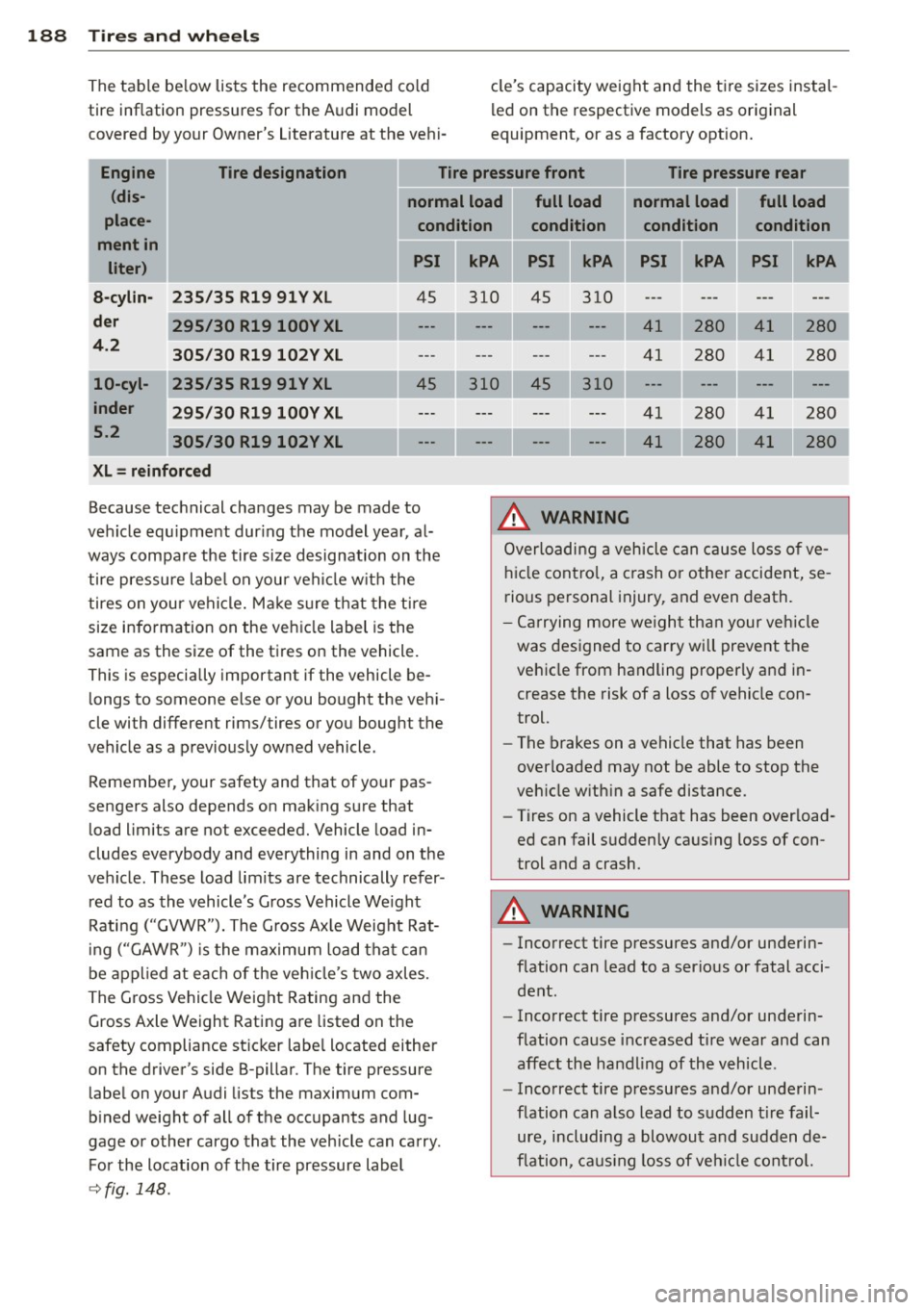
The table below lists the recommended cold
tire inflation pressures for the Audi model
covered by your Owner's Literature at the vehi- cle's capacity weight and the ti
re sizes instal
led on the respective models as original
equipment, or as a factory option.
Engine
(dis
place
ment in Tire designation
Tire pressure front Tire pressure rear
normal load full load normal load full load condition condition condition condition
liter )
a -cylin
der
4 .2
inder
5.2 235
/3 5 R1 9 9 1 V
XL
295 /30 R19 100V X L
305 /30 R1 9 10 2V X L
235 /35 R19 91 V X L
295 /30 R1 9 100V XL
305 /30 R19 102V X L
XL= reinfor ced
PSI
45
Because tec hnical changes may be made to
vehicle equ ipment dur ing the model yea r, al
ways compare the tire size designation on the
tire pressure labe l on you r vehi cle w it h the
tires on your vehicle. Ma ke s ure that the ti re
size information on the veh icle label is the
same as the size of the tires on the vehicle.
This is especially important if the vehicle be
longs to someone else or you bought the vehi
cle with different rims/tires or you bought the
vehicle as a previously owned vehicle.
Remember, your safety and that of your pas
sengers also depends on mak ing sure that
load limits are not exceeded. Vehicle load in
cludes everybody and everything in and on the
vehicle . These load lim its are technically refer
red to as the vehicle's G ross Vehicle We ight
Rati ng ("GVWR"). The G ross Ax le Weight Rat
i ng ("GAWR") is the max imum load that can
be app lied at each o f the veh icle's two axles.
The G ross Vehicle Weight Rating and the
Gross Axle Weight Rating are listed on the
safety compliance stic ker labe l located either
on the driver's side B-pillar. The tire pressure
labe l on your Audi lists the maximum com
b ined weight of all of the occupants and lug
gage or other cargo that the veh icle can carry.
For the location of the tire pressure label
¢ fig. 148.
kPA PSI kPA PSI
310 45 310
41
41
kPA PSI
280 41
280 41
kPA
280
280
280
280
.&_ WARNING
Overloading a vehicle can cause loss o f ve
h icle cont ro l, a crash o r other accident, se
r ious pe rsonal injury, and even death.
- Ca rrying more we igh t than your veh icle
was designed to car ry wi ll prevent the
vehicle from handling properly and in
crease the risk of a loss of vehicle con
trol.
- The brakes on a vehicle that has been
overloaded may not be able to stop the
veh icle w ith in a safe distance.
- Tires on a vehicle that has been over load
ed can fail s uddenly caus ing loss of con
trol and a crash.
.&_ WARNING
- Incorrect tire pressures and/or underin
flation can lead to a serious or fatal acci
dent.
- Inco rrect tire pressures and/or underin
f lation cause increased tire wear and can
affect the handling of the vehicle.
- Inco rrect tire pressures and/or underin
f lation can a lso lead to s udden t ire fail
ure, including a blowout and sudden de
fl ation, ca using loss of veh icle cont ro l.
Page 193 of 236
The Gross Axle Weight Rating ("GAWR") is
the maximum load that can be applied at each
of the vehicle's two axles.
The Gross Vehicle Weight Rating and the
Gross Axle Weight Rating are listed on the
safety compliance sticker labe l located on the
driver's side B-pi llar . Your Audi has 2 seating
positions in the front for total seat ing capac i
ty of 2. Each seating posit ion has a safety belt
c::> page 101, Safety belts.
The fact that there is an upper limit to your
ve hicle's Gross Veh icle Weight Rating means
that the total weight of whatever is being car
ried in the veh icle is limited . The more passen
gers in the veh icle or passengers who a re
heavier than the standard weights assumed
mean that less weight can be carried as lug
gage.
The t ire pressure label on your Audi also lists
the maximum combined we ight of all of the
occupants and luggage o r othe r cargo that
the vehicle can carry. For the location of the
la be l c::>page 187, fig. 148.
A WARNING
Overloading a vehicle can cause loss of ve
hicle control, a crash or other accident, se
r ious personal injury, and even death.
- Carrying more weight than yo ur vehicle
was designed to carry will prevent the
vehicle from handling properly and in
crease the risk of the loss of veh icle con
trol.
- The brakes on a veh icle that has been
overloaded may not be able to stop the
vehicle within a safe distance .
- Tires on a vehicle that has been overload
ed can fail suddenly, includ ing a b lowout
and sudden deflation, causing loss of
control and a crash.
Determining correct load limit
Use the example below to cal
culate the total weight of the
Tires and wheels 191
passengers and luggage or oth
er things that you plan to trans
port so that you can make sure
that your vehicle will not be
overloaded.
Steps for Determining
Correct Load Limit
1. Locate the statement "THE
COMBINED WEIGHT OF OC
CUPANTS AND CARGO
SHOULD NEVER EXCEED XXX KG OR XXX LBS"on your vehi
cle's placard (tire inflation
pressure label)
¢ page 187,
fig. 148.
2. Determine the combined weight of the driver and pas
sengers that will be riding in
your vehicle.
3. Subtract the combined
weight of the driver and pas
sengers from
"XXX" kilo
grams or
"XXX" pounds
shown on the sticker
¢ page 187, fig. 148.
4. The resulting figure equals
the available amount of car
go and luggage load capaci-
ty. For example, if the
"XXX"
amount equals 1400 lbs.
and there will be five 150
lbs. passengers in your vehi
c le, the amount of available .,..
•
•