roof AUDI R8 SPYDER 2012 User Guide
[x] Cancel search | Manufacturer: AUDI, Model Year: 2012, Model line: R8 SPYDER, Model: AUDI R8 SPYDER 2012Pages: 236, PDF Size: 59.24 MB
Page 137 of 236
-Never install a rearward facing child
safety seat on the front passenger seat
unless the
PAS SENGER AIR BA G OFF
light comes on and stays on . If the PA S
SEN GER AI R BAG OFF
light does not
come on and stay on the inflating airbag
will hit the child safety seat o r infant car
r ie r with great fo rce and will smash the
child safety seat and child against the
backrest, door or roof . Have the airbag
system inspected immediately by your authorized Audi dealer .
Child safety seats
Infant seats
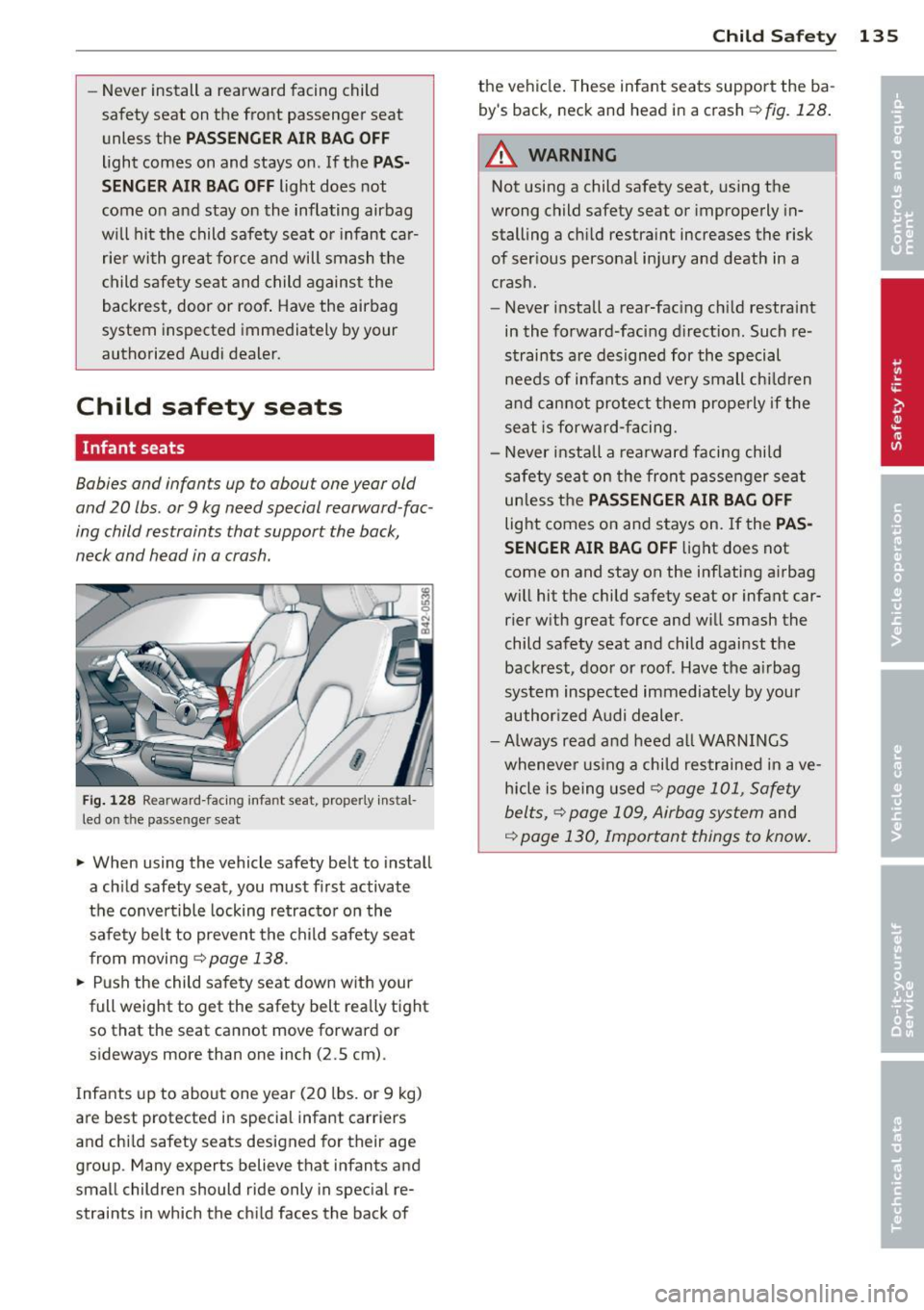
Babies and infants up to abou t one year old
and 20 lbs . or 9 kg need special rearward -fac
ing child restraints that support the back,
neck and head in a crash.
Fig . 128 Re arwar d-fa cing in fan t sea t, pr operly instal
l e d on t he p asseng er se at
"' When using the vehicle safety belt to install
a ch ild safety seat , you must first activate
the convertible locking retractor on the
safety belt to prevent the ch ild safety seat
from moving
r::!v page 138 .
"' Push the child safety seat down wit h your
full weight to get the safety bel t rea lly tight
so that the seat cannot move forward or
sideways more than one inch (2 .5 cm) .
I nfants up to about one year (20 lbs. or 9 kg)
are best prot ected in special infant carriers
and chi ld safety seats design ed for their age
group . Many experts believe that infants and
sm all ch ildren should ride only in spec ia l re
straints in which the ch ild faces the back of
Child S afety 13 5
the vehicle. These infant seats support the ba
by 's back, neck and head in a crash
~ fig. 128.
A WARNING
Not using a child safety seat, using the
wrong child safety seat or improperly in
stalling a child restraint increases the risk
of ser ious personal injury and death in a
crash.
- Never install a rear-fac ing ch ild restraint
in the forward -facing d irect ion . Such re
straints are designed for the special needs of infants and very small chi ld ren
and cannot protect them properly if the
seat is forward-facing.
- Never install a rearward facing child
safety sea t on the fron t passenger seat
un less t he
PASSENGER AIR BAG OFF
light comes on and stays on. If the PAS·
SENGER A IR BAG OFF
light does not
come on and stay on the inf lating a irbag
will hit the child safety seat or infant car
rier w ith great f orce and w ill smash the
child safety seat and child against the backrest, door or roof . Have the a irbag
system inspected immediately by your
author ized Audi dealer.
- Always read and heed al l WARNINGS
whenever us ing a child restrained in ave
hicle is being used
r::!v page 101, Safety
belts, r::!vpage 109, Airbag system
and
r::!v page 130, Important things to know .
Page 138 of 236
136 Child Safet y
Convertible child safety seats
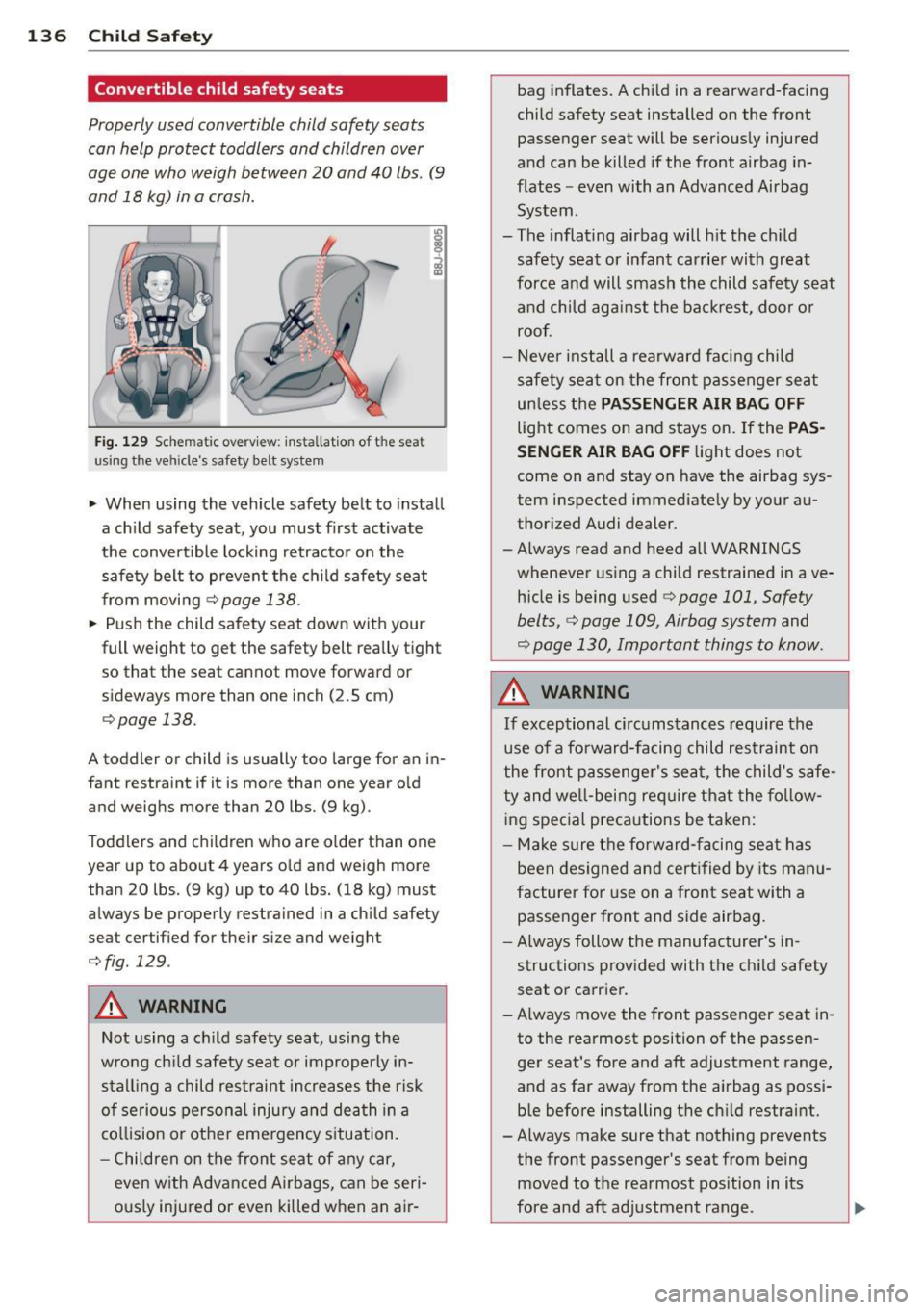
Properly used convertible child safety s eats
can h elp protect toddlers and children over
age one who weigh between
20 and 40 lbs. (9
and 18 kg) in a crash.
Fig . 129 Schematic overv iew: installat ion of the seat
usin g the vehicle's safety belt system
~ When using the vehicle safety belt to install
a ch ild safety seat, you must first activate
the convertible locking retractor on the safety belt to prevent the c hild safety seat
from movi ng
Q page 138.
~ Push the child safety seat down with your
full weight to get the safety belt rea lly tight
so that the seat cannot move forward or
sideways more than one inch (2.5 cm)
Qpage 138.
A toddler or child is usually too large for an in
fant restraint if it is more than one year old
and weighs more than 20 lbs. (9 kg) .
Toddlers and ch ildren who are o lder than one
year up to about 4 years o ld and weigh more
than 20 lbs . (9 kg) up to 40 lbs. (18 kg) must
always be properly restrained in a child safety
seat certi fied for the ir size and weight
Q fig. 129.
&_ WARNING
Not using a ch ild safety seat, us ing the
w rong ch ild safety seat or improperly in
stal ling a child restraint increases the risk
o f se rious persona l injury and death in a
co llision or othe r eme rgency s ituation.
- Children on t he front seat of a ny car,
even w ith Advanced A irbags, can be seri
ous ly injured or even killed when an air -bag inflates. A chi
ld in a rearward-facing
child safety seat installed on the front
passenger seat will be seriously injured
and can be killed if the front airbag in
flates -even with an Advanced Airbag
System .
- The inflating airbag will h it the ch ild
safety seat or infant carrie r with great
for ce and will smash the child saf ety seat
and child aga inst the ba ckrest, door o r
roof .
- Neve r install a rearward facing child
safety sea t on the fron t passenger seat
un less t he
PASSENGER AIR BAG OFF
light comes on and stays on. If the PAS
SENGER AIR BAG OF F
light does not
come on and stay on have the airbag sys
tem inspected immediately by your au
thorized Audi dealer.
- Always read and heed all WARNINGS
whenever us ing a child restrained in ave
h icle is being used
¢ page 101, Safety
belts,
Q page 109, Airbag system and
Q page 130, Important things to know .
&_ WARNING
--
If exceptional circumstances require the
use of a fo rward-facing child restraint on
the front pa ssenger 's sea t, the child's safe
ty and we ll-bei ng req uire t hat the fo llow
i ng spec ial precautions be taken:
- Make sure the forward- facing seat has
been designed and cert ified by its man u
facturer for use on a front seat with a
passenger front and side airbag.
- Always follow the manufacturer 's in
structions p rovided with the chi ld safety
seat or carrie r.
- A lways move the front passenger seat in
to the rearmost position of the passen ger seat's fore and aft adjustment range,
and as far away from the airbag as possib le before installing the ch ild restraint.
- Always make sure that nothing prevents
the front passenger 's seat from being
moved to the rearmost position in its
fore and aft adjustment range .
Page 140 of 236
138 Child Saf ety
will receive serious or possibly even fata l
injury .
I n o rder for the airbag to offe r protection, it is
important that all vehicle occ upants, especia l
l y any children, who must be in the front seat
because of exceptional circ umstances, be
properly restrained and as far away from the
a irbag as poss ible. By keep ing room between
the child's body and the front of the passen
ger compartment, the airbag can inflate com
p letely and provide supplemental protection
in certain frontal col lisions.
_& WARNING
Not using a booster seat, using the boos
t er sea t imprope rly, incorre ct ly ins talling a
booste r seat or using the vehicle safety
belt improperly increases the risk of se ri
ous personal injury and death in a collision
or other eme rgency s ituation. To help re
duce the risk of ser ious persona l injury
and/or death:
- The shoulder be lt must lie as close to the
center of the child 's collar bone as poss i
ble and must lie and snug on the upper
body. It mus t never lie across the throat
o r neck . The lap belt must lie across the
pelvis and never across the stomach o r
abdomen. Make sure the belt lies flat
and snug. Pull on the be lt to t igh ten if
necessary.
- F ailure to properly route sa fety belts
over a ch ild' s body will cause severe inju
ries in an acc ident or other emergency
situation
<:!;,page 101.
- Children on the front seat of any car,
even w ith Advanced A irbags, can be seri
o usly injured or even killed when an a ir
bag inflates.
- Never let a child stand or knee l on the
seat.
- Never let a child ride in the ca rgo a rea of
yo ur vehicle.
- Always remember that a chi ld leaning
forward, sitt ing s ideways or out of posi
t ion in any way during an acc ident can be
-
struck by a dep loying a irbag . This will re
sult in ser ious personal injury or death .
- If you must install a booster seat on the
front passenger seat because o f excep
tional circ umstances the
PASSENGER
AIR BAG OFF
li ght must come on and
stay on , whenever the ignition is switch
ed on .
-If the PASSENGER AIR BAG OFF light
does not come on and stay on, pe rform
the ch ecks descr ibed ¢
page 120, Moni
toring the Advanced Airbag System .
-If the PASSENGER AIR BAG OFF light
does not come on and stay on whenever
the ig nit ion is switched on the infla ting
ai rb ag w ill hi t the child sa fe ty seat or in
fant car rier with g reat force an d will
smash the child sa fety seat and child
aga inst the backrest, door or roof . Have
the airbag system inspected immed iately
by your Audi dea ler.
- Always read and heed all WAR NIN GS
whenever using a child restrained in ave
h icle is being used
¢ page 101, Safety
belts,
¢ page 109 , Airbag system and
r:!;, page 130, Important things to know.
Installing a child safety
seat
Securing a child safety seat using a
safety belt
Safety belts for the front passenger con be
locked with the convertible locking retractor
to properly secure child safety seats .
The safety belts emergency locking retracto rs
for the front passenger's seat safety belt have
a convertible locking retracto r for child re
stra ints . The safety be lt must be loc ked so
that be lt webb ing cannot unree l. The r etrac
tor can be a ctivated to lock the safety belt and
prevent the s afety be lt webb ing from loosen
ing up d uring norma l dr iv ing. A child safety
seat can only be properly insta lled when t he
safety belt is locked so that the chi ld and child
safety seat will stay in place. ..,.
Page 141 of 236
Always remember: Even though your vehicle is
equipped with an Advanced Airbag system, a
child should always ride in the seat properly
restrained for its age and size.
_&. WARNING
Improperly installed child safety seats in
crease the risk of serious personal injury
and death in a collision.
- Always make sure that the safety belt re
tractor is locked when installing a child
safety seat. An unlocked safety belt re
tractor cannot hold the child safety seat
in place during normal driving or in a
crash .
- Always buckle the child safety seat firmly
in place even if a child is not sitting in it.
A loose child safety seat can fly around
during a sudden stop or in a collision.
- The inflating airbag will hit the child
safety seat or infant carrier with great
force and will smash the child safety seat
and child against the backrest, door or
roof.
- Forward-facing child safety seats or in
fant carriers installed on the front pas
senger's seat may interfere with the de ployment of the airbag and cause serious
injury to the child.
- Always read and heed all WARNINGS
whenever using a child restrained in ave
hicle is being used
c:::;, page 130. Special
precautions apply when installing a child
safety seat on the front passenger seat
c:::;, page 111, Child restraints on the front
seat -some important things to know.
_&. WARNING
-
Always take special precautions if you
must install a forward or rearward-facing
child restraint on the front passenger's
seat in exceptional situations:
- Whenever a forward or rearward-facing child restra int is installed on the front
passenger seat, the
PASSENGER AIR
BAG OFF
light must come on and stay on
whenever the ignition is switched on.
Child Safety 139
-If the PASSENGER AIR BAG OFF light
does not come on and stay on, perform
the checks described
c:::;, page 120, Moni
toring the Advanced Airbag System.
- If the PASSENGER AIR BAG OFF light
does not come on and stay on whenever
the ignition is switched on the inflating
airbag will hit the child safety seat or in
fant carrier with great force and will
smash the child safety seat and child
against the backrest, door or roof. Have
the airbag system inspected immediately
by your Audi dealer.
- Improper installation of child restraints
can reduce their effectiveness or even prevent them from providing any protec
tion.
- An improperly installed child restraint
can interfere with the airbag as it de
ploys and seriously injure or even kill the
child.
- Always carefully follow the manufactur
er's instructions provided with the child
safety seat or carrier.
- Never place additional items on the seat
that can increase the total weight regis
tered by the weight-sensing mat and can
cause injury in a crash.
_&. WARNING
Forward-facing child restraints:
- Always make sure the forward-facing
seat has been designed and certified by
its manufacturer for use on a front seat
with a passenger front and side airbag.
- Never put the forward-facing child re straint up, against or very near the in
strument panel.
- Always move the passenger seat into its
rearmost position in the seat's fore and
aft adjustment range, as far away from
the airbag as possible before installing
the forward-facing child restraint. The
backrest must be adjusted to an upright
position. •
•
Page 142 of 236
140 Child Saf ety
- Make sure that the PASSENGER AIR BAG
OFF
light comes on and stays on all the
time whenever the ignition is switched on .
A WARNING
Rearward -fac ing c hild restra ints:
- A ch ild in a rearward-facing child safety
seat installed on the front passenger
seat will be ser iously injured and can be
killed if the front airbag inflates - even
with an Advanced Airbag System.
- The inflating a irbag will hit the child
safety seat or infant carrier wit h great
force and w ill smash the ch ild safety seat
and child against the b ackrest , door or
roof.
- Alway s be espe cially caref ul if you must
ins tall a re arwa rd fa cing child s afety seat
on the front passenge r seat in exception
al circumstances .
- A tight tet her strap on a rearward-facing
child rest raint attached to the front pas
senger seat can put too much pressu re
on the weight-mat in the seat and reg is
ter a heavier weight in the Advanced A ir
bag System. The heav ier we ight regis
tered can make the system work as
though an adult were on the seat and de
ploy the Advanced Ai rbag when it must
be s uppressed causing ser ious o r even
f a tal injury to the child .
- Make su re that the
PASSENGER AIR BAG
OFF
light comes on and stays on all the
t ime whenever the ignition is switched
on.
- Never install a rearward facing child
safety seat on the front passenger seat
unless the
PASSENGER AIR BAG OFF
light comes on and stays on . If t he PAS·
SENGER AIR BAG OFF
light does not
come on and stay on the inflating airbag
will hit the child safety seat or infant car
rie r with great fo rce and will smash the
child safety seat and child against the
backrest, door or roof. Have the airbag
system inspected immedia tely by your
au thori zed Au di d ealer .
Activating the convertible locking
retractor
Use the convertible locking retractor to se
cu re a child re strain t.
Always heed the ch ild safety sea t manufactur
er's instr uctions when installing a child re
st ra in t in your veh icle . To a ctivate the conve r
t ible lo cking re tractor:
" Place t he child res traint o n a seat .
" Slowly pu ll the belt
all the way out .
" Route it a round or throug h the child re
s train t belt pa th
~ ,& .
" Push the ch ild safety sea t down wi th yo ur
full weight to get t he safety be lt really tight.
" Insert the belt tong ue into the b uckl e for
that seating position .
" Guide the safety be lt back into the retractor
until the be lt lies flat and snug o n the child
safety seat.
" You should hear a "cl icking " noise as the
be lt winds back into the inertia ree l. Test the
convert ible lo cki ng re tr actor by pulling on
t he belt. You s hould no longer be ab le to
pull t he be lt out of the retrac to r. T he con
vertible locking retracto r is now activated .
" Ma ke s ure that the red release b utton is fac
ing away from the child restraint so that it
can be unbuckled quick ly.
" Pull on the belt to make sure the safety belt
is properly tight and fastened so that the
s e at ca nnot move forwa rd or sideways more
than one inch ( 2.S cm).
A WARNING
Using the wrong child res traint o r an i m
pr operly ins talled chi ld restraint can cause
se rious pe rsonal injury or deat h in a c rash.
- Always ma ke sure tha t t he safe ty belt re-
trac to r i s loc ked when insta lling a child
safety seat. An un locke d safety belt re
tracto r cannot hold the child safety seat
in place dur ing norma l dr iving o r in a
crash.
- Always buckle the child sa fety seat firmly
-
in place even if a ch ild is not sitt ing in it. ~
Page 152 of 236
150 Driving and en vironm ent
Driving and
environment
Break-in period
A new vehicle must be broken in, and the break-in per iod should be 1,500 miles (2,500
km) . Do not use full acceleration for the first
600 miles (1,000 km) and do not exceed the
maximum eng ine speed of 6,000 rpm You
m ust also not use fu ll acce lerat ion between
600 and 1,200 m iles ( 1,000 to 2,000 km).
Fr om 1,200 to 1 ,500 mi les (2,000 to 2,500
km), you can gradua lly increase maxim um en
gine speed to 8,250 rpm for brief periods.
During the first ho urs of operation, there is
g reater friction in the engine and the trans
mission than later when a ll the moving parts
have broken in.
The way yo u drive duri ng the first 1 ,500 miles
(2,500 km) affects engine quality. If you drive
at moderate engine speeds thereafter, partic
u lar ly when the engine is cold, yo u reduce en
gine wear and increase the potential mileage
of the engine.
Do not drive at RPMs that are too low. Shift
down when the engine is no longer running
"smoothly". Extreme ly high RPMs are gov
erned automa tically.
Driving through water
on roads
Note the following to avoid vehicle damage
when dr iving t hrough water, for example on
flooded roads:
- The water must not be any higher than the
bottom of the vehicle body .
- Do not drive faster than wa lking speed .
.&_ WARNING
After driving through water, mud, slush,
etc., the brakes may be slow to take effect
because of wet b rake roto rs and pads. Dry
t he brakes fi rst by bra king carefully to re
sto re the full braking effect .
-
(D Note
Vehicle components such as the eng ine,
transmission, suspension or e lectrical sys
tem can be severe ly damaged by dr iv ing
through water .
@ Tips
-Check the depth of the water before d riv
ing through it.
- Do not stop the vehicle, drive in reverse
or switch the engine off when driving
through water.
- Keep in mind that oncoming vehicles
may create waves that raise the water
level and make it too deep for your vehi
cle to drive through safely .
- Avo id driving through salt water because
it can cause corros ion.
Catalytic converter
You must use lead-free gasoline in your veh i
cle, otherwise you will destroy the ca talyt ic
converter .
Never run the fuel tank completely dry; their
regular fue l supply could cause misfires . This
allows unburned fue l into the exhaus t system,
poss ibly resulting in overheating and damage
to the catalytic converter .
.&_ WARNING ,-
-Do not park or operate the vehicle in
a reas where the hot exha ust system may
come in co nta ct with dry g rass, brush,
fue l spills or o ther material which can
cause a fire.
- Do not app ly addition al under coating or
r u stproofing on or nea r the exhaust
manifold, exhaust pipes, catalytic con
verter or heat shields . Dur ing driving, the
substance used for undercoating could
overheat and cause a fire.
(D Note
To ensure efficient o peration of the Emis
s ion Control System :
Page 175 of 236
The engine oil and oil filter must be changed
according to the mi leage (kilometers) and
time interva ls specified in your vehicle's War
ranty
& Maintenance booklet. Do not exceed
t hese intervals -harmful deposits from old
engine o il can reduce engine performance and
can lead to expensive engine repairs .
Changing the o il at the recommended inter
vals is so very important because the lubricat
ing properties of oil decrease gradually during
norma l vehicle use . If you are not sure when
you have your oi l changed, ask your author
i zed A udi Service Advisor.
Under some circumstances the engine o il
should even be changed more frequently .
Change o il more often if you drive mostly
short distances, ope ra te the vehicle in dusty
areas or mostly under s top -and-go traffic con
d itions, or when yo u use your vehicle whe re
temperatures stay below freezing point for
l ong periods.
D etergen t additives i n the o il w il l make fresh
oil look dark after the eng ine has been run
ning for a short time . This is norma l and is not
a reason to change the oi l more often than
recommended.
Damage or malfunction s due t o lack of
m aintenance
It is essen tial that you change your oil at the
r ecommended inte rva ls using only engine o il
that complies with A udi oil standard
VW 502 00 . Your Limited New Vehicle War
ranty does not cover damage or malfunctions
d ue to fai lure to fo llow recommended mainte
nance and use req uirements as set forth in
t he Audi Owner's Manua l and Warranty
&
Ma intenance book let . Your authorized Aud i
deale r will have to deny warranty coverage un
l ess you present to the dealer p roof in the
fo rm of Se rvice o r Repair Orde rs t hat all
sched uled main tenance w as performed in a
time ly manner .
Checkin g and fillin g 173
Engine oil consumption
The engine in your vehicle depends on an ade
quate amount of oil to lubricate and cool all
of its moving parts .
In order to provide effective lubrication and
cooling of interna l eng ine components, all in
te rnal combust io n engines consume a certain
amount of oil. Oil consumpt io n va ries from
engine to engine and may change sig nifican tly
ove r the life of the engine. Typically, engines
with a spec ified break -in pe riod (see
¢
page 150) consume more oil duri ng the
break-in pe riod than they consume afte r oi l
consumption has stabili zed.
U nder normal cond itions , the rate of oi l con
s u mption depends on t he q uality and viscos ity
of the oil, the RP M (revolut ions per minute) at
which the engine is operated, the ambient
temperature and road conditions. Further fac
tors are the amount of oil dilut ion from water
condensa tion or fue l residue a nd the oxida
tion level of the oi l. As any eng ine is subject to
wear as mileage builds up, t he oil co nsump
t ion may incre ase over time until repla cement
of wo rn components may be come necessary.
With a ll these va riab les coming into p lay, no
standard rate of oil consumpt io n can be es
t a bl is h ed o r spe cified . There is no alte rnative
to regular an d frequent chec king of the o il lev
el , see
Note.
If the yellow engine o il level wa rning symbo l
i n the instrument cluster
Ill lights up, yo u
sho uld check the oil leve l as soon as possib le
¢
page 174 . Top off the oil at your ear liest
convenience
¢ page 174.
A WARNING
-Before you check anything in the engine
c o mpartment, always read and heed a ll
WARNINGS¢
& in Working in the engine
compartment on pag e 169 .
(D Note
Driving w ith an insufficient o il level is like-
-
ly to cause severe damage to the engine. Ill>-
•
•
Page 187 of 236
Maximum loaded vehicle weight
means the sum of:
(a) Curb weight
(b) Accessory weight
(c) Vehicle capacity weight, and
(d) Production options weight
Maximum (permissible) inflation pressure
means the maximum cold inflation pressure
to which a tire may be inflated. Also called
"maximum inflation pressu re."
Normal occupant weight
means 150 lbs. (68 k ilograms) times the
number of occupants seated in the vehicle up
to the total seating capacity of your vehicle.
Occupant distribution
means distribution of occupants in a vehicle .
Outer diameter means the overall diameter of an inflated new
tire.
Overall width
means the linear distance between the exteri
ors of the sidewalls of an inflated tire, includ
ing e levations due to labeling, decorations, or
protective bands or ribs.
Ply
means a layer of rubber-coated para llel cords.
Production options weight
means the comb ined weight of those installed
regular production options weighing over 5
lbs . (2 .3 kg) in excess of those standard items
which they replace, not previously considered
in curb weight or accessory weight, including
heavy duty brakes, r ide leve lers, roof rack,
heavy duty battery, and specia l trim .
Radial ply tire
means a pneumatic t ire in which the p ly cords
that extend to the beads are laid at substan
tially 90 degrees to the centerline of the
tread.
Tires and wheels 185
Recommended inflation pressure
see~
page 184, Cold tire inflation pressure.
Reinforced tire
means a t ire designed to operate at higher
loads and at higher inflat ion pressures than
the corresponding standard tire. Reinforced
ti res my be ident ified as "XL" , "xl", " EXTRA
LOAD", or "RF" on the sidewall.
Rim
means a metal support for a tire or a t ire and
tube assembly upon which the tire beads are
seated.
Rim diameter
means nom inal d iameter of the bead seat. If
you change your wheel s ize, you w ill have to
purchase new tires to match the new r im di
ameter.
Rim size designation
means r im diameter and width.
Rim width
means nom inal distance between rim fla nges.
Sidewall
means that portion of a tire between the
tread and bead.
Speed rating (letter code)
means the speed at which a tire is designed to
be driven for extended periods of time. The
ratings range from 93 mph (150 km/h) to
186 mph (298 km/h)
~pag e 194 . You may
not find this information on all tires because
it is not requ ired by law.
T he speed rating letter code, where applica
ble, is molded on the tire sidewall and indi
cates the maximum pe rmissib le road speeds
~ .&. in Winter tires on page 198.
Tire pressure monitoring system
means a system that detects when one or
more of a veh icle's tires are underinflated and
illuminates a low tire pressure warning tell
tale.
•
•
Page 222 of 236
220 Consumer Inf ormation
steadi ly reduced the scope of maintenance
and repairs which can be carried out by vehicle
owners.
Als o, sa fe ty a nd en vir onm ent al con
cerns place very strict limits on the nature of
repairs and adjustments to engine and trans
miss ion parts which an owner can perform .
Maintenance, adjustments and repa irs usua lly
require special tools, testing devices and oth
er equipment available to specially trained
workshop personnel in order to assure proper pe rformance, reliab ility and safety of the vehi
cle and its many systems.
Improper maintenance, adjustments and re
pa irs can impair the operation and reliab ility
of your vehicle and even void your vehicle war
ranty. Therefore, proof of servic ing in accord
ance w ith the ma intenance schedule may be a
condition for upholding a poss ible warranty
claim made within the warranty period.
Above all, operational safety can be adversely
affected, c reating unnecessary risks for you
and your passengers.
If in doubt about any se rv icing, have it done
by your author ized Audi dealer or any other
p roperly equipped and qualified workshop.
We strong ly urge you to give yo ur autho rized
Audi dealer the opportunity to perfo rm all
schedu led maintenance and necessary repairs.
Your dea ler has the facilities, original parts
and trained specialists to keep your vehicle
running properly.
Performing limit ed m aint enance yours elf
The following pages describe a limited num
ber of proced ures which can be performed on
your vehicle with ordinary too ls, shou ld the
need arise and trained personnel be unavaila
ble. Before performing any of these proce
dures, always thoroughly read all of the app li
cable text and carefully follow the instruc
tions given . Always rigorously obse rve the
WARNINGS p rovided.
Before you ch eck anything in th e eng ine
co mpartm ent , alway s re ad and h eed all
WA RNINGS
c::> .&. and c::> ..&. in Working in the
engine compartment on page 169.
A WARNING
- Serious personal injury may occur as a re
sult of improperly performed mainte
nance, adjustments or repa irs.
- Always be extremely careful when work
ing on the vehicle. Always follow com
monly accepted safety pract ices and gen
eral common sense. Never r is k personal
injury.
- Do not attempt any of the maintenance,
checks or repairs descr ibed on the fol
lowing pages if you are not fu lly fam iliar
with these or other procedures with re
spect to the vehicle, or are uncertain how
to proceed .
- Do not do any work without the proper
too ls and equipment. Have the necessa ry
work done by your author ized A udi deal
er or another proper ly equipped and
qualified workshop.
- Always remove the ignition key before
anyone gets under the vehicle.
- Always support your veh icle with safety
stands if it is necessary to work under
neath the vehicle. The jack* is not ade
quate for this purpose and cou ld collapse
causing ser ious personal inju ry.
- If you must work underneath the vehicle
with the wheels on the ground, a lways
make sure the vehicle is on level ground,
that the wheels a re a lways secure ly
b locked and that t he engine cannot be
s tarted.
- Always make sure the transmission se
lec to r l ever is in
"N" (Neut ral) (R t ron ic)
or Neutral (manual transmission) and
the hand bra ke is f irmly app lied.
@ For the sake of the environment
- Changing the engine sett ings will ad
verse ly affect emission leve ls. Th is is det
r imental to the environment and increas
es fuel consumpt ion .
- Always observe environmenta l regu la
tions when disposing of old eng ine oil,
used brake flu id, dirty engine coo lant,
spent batteries or worn out tires.