brake AUDI R8 SPYDER 2012 Owner's Manual
[x] Cancel search | Manufacturer: AUDI, Model Year: 2012, Model line: R8 SPYDER, Model: AUDI R8 SPYDER 2012Pages: 236, PDF Size: 59.24 MB
Page 81 of 236
even if the parking brake is firmly ap
plied.
- Before you or other persons open the en
gine compartment lid and work on a r un
ning eng ine, se lect neutral position
N
and firmly apply the handbrake. Follow
the warning notes .
(D Tips
If you accidentally sh ifted into N whi le
driving, you can engage a gear in the nor
mal way using the selector lever.
Manual operation
App lies to vehicles: with R tron ic
R tronic allows the driver to shift gears man
ually.
Starting from a stop
.. Press and ho ld the brake pedal.
.. Move the selector lever to the left.
.. Tap the se lector lever forward
0 -
.. Re lease the brake pedal and acce lerate
c> _& .
Shifting
.. To shift up, tap the selector lever fo rward
0 -
.. To shift down, tap the selector lever to the
rear
0 .
Stopp ing temporarily
.,. Prevent the ve hicl e from mov ing by using
the foot brake, e.g. at t raffic signa ls.
.. Do not accelerate.
If you do not press either
the brake peda l or the acce lerator pedal for
some time when stat ionary, neutral position
N is engaged automatically and a ch ime
sounds.
P a rking
.. Press and ho ld the brake pedal¢_& .
.. Apply the hand brake f irm ly.
.. Engage a gear.
.. Switc h the ignition
off .
Tran sm iss ion 79
Stopping on an incline
.. Always keep t he veh icle s tat io nary using
the foot brake to prevent it from "rolling
back" ¢_& . D o
not try to p revent the vehi
cle from "rolling back" when a gear is en
gaged by increasing engine speed.
.. App ly the hand brake firmly.
Sta rting on a hill
.. With a gear engaged, remove your foot
from the brake, acce lerate and slowly re
lease the hand brake .
When accelera ting, R tronic shifts into the
next gear i n gea rs 1, 2, 3, 4 and 5 short ly be
fore the maxim um permissible engine speed
is reached. Exception: You have activated the
sport funct ion ¢
page 78.
If you have se lected a lower gear tha n the c ur
rent one, R tro nic wi ll shift down only when
the engine will not be over-revved .
You can swi tch to a utomat ic operation at any
time
c> page 80 .
_& WARNING
- Never leave your vehicle with the engine
r u nning while in gear . If you must leave
your veh icle w ith the engine r unning, set
the park ing brake fi rm ly and engage neu
tral N.
- With the engine r unning and a gear en
gaged, you have to hold the ve hicle w ith
the foot brake .
- Do not accelerate when you s hift gears
wit h the vehicle stationary and the en
g ine runni ng .
- Before dr iving dow n a steep slope, re
duce your sp eed and shift i nto a lowe r
gea r with R tronic.
- Do not ride the brakes or apply the bra ke
pedal too ofte n or too long . Constant
b ra ki ng c auses the brakes to ove rheat
a nd substantially redu ce s bra king per
form ance, in cre ases br aking d ist ance or
causes complete fa il ur e of the brake sys
tem .
Page 82 of 236
80 Transmi ssion
(0 Note
If you must stop on an incline, always hold
the vehicle in place w ith the foot brake to
prevent it from roll ing back. Never hold
the vehicle on an incline w ith a slipping
clutch. The clutch was overloaded if
Clutch
overheat ing! If possib le pl ea se st op ve hi
cle appears in the Driver Information Sys
t em disp lay.
Automatic operation
Ap plies to ve hicles : wit h R tro nic
The forward gears are shifted up or down au
tomatically.
Startin g from a stop
11-Press and ho ld the brake pedal.
11-Tap the se lector lever towards A .
... Re lease the brake pedal and acce lerate
¢ ,& in Manual operation on page 79 .
Under certain circumstances (driving in the
mounta ins for example), it can be beneficia l
to switch tempo rarily to the manual shift pro
g ram ¢
page 79in order to adjust th e gear ra
tios to driv ing cond itions
manually.
Kick-down
A ppl ies to vehicles : wit h R tro nic
When you depress the accelera to r pedal be
yond the resistance po int, R tron ic downsh ifts
into a lower gear, depending on vehicle speed
and engine rpm. The ups hift into the next
h igher gear takes place once the max imum
specified engine speed is reached. Exception:
You have activated the sport funct ion .
A WARNING
Please note that the drive wheels can spin
if kick-down is used on a smooth slippery
road -there is a risk of skidding.
Launch Control Program
App lies to veh icles : w it h R tro nic
The Launch Control Program enables maxi
mum acceleration .
Requirement: The engine must be at operat
ing temperature and the steering wheel must
not be turned .
... With the engine running, press the
I!! but
ton one time. The ESC ind icator light
I in
the Driver Information System d isplay illu
m inates and the message
ESP sport - Warn
ing! R estr icted stability
appears .
... Press the b rake pedal w it h your l eft foot
and hold i t down.
11-Eng age a gear.
11-Press the I SPORT I button on the selector
lever cover .
... Press the accelerator peda l wit h your right
foot sim ultaneously until the engine has
reached a constant speed .
... Remove your left foot from the brake¢,& .
A WARNING ,-
-Always adapt your dr iving to the traffic
f low.
- Onl y use Launch Control when road and
traffic cond itions allow it and ot her dr iv
ers will not be endange red o r annoyed by
your driving and the vehicle's ac celera
t ion .
- Please note that t he d riving wheels ca n
sp in and the vehicle can br eak away
when ESC is swi tched off, especially
when the roa d is s lippery.
- Once the s tarting procedure is comple te,
you sho uld sw itch ESC on again by press
i n g the
I!] switch.
(D Tips
When a ccele rat ing using the Lau nch Con
t rol program, all vehicle parts are s ubje ct
to heavy loads . This can result in increase d
wear .
-
Page 90 of 236
88 Homelin k®
Homelink ®
Universal remote
control
General information
The Homelink universal remote control can
be programmed with hand-held transmitters
from existing equipment.
You must first program the Homelink ® trans
mitter before you can use the system
~ page 88, Programming the Homelink ®
transmitter.
In order to program the Homelink® transmit
ter for devices utilizing rolling code, a second person on a ladder who can safely reach the
garage door opener motor is recommended.
It is also necessary to locate the "learn" but
ton on your garage door opener motor . Refer
to the operating instructions for the opener,
as the location and color of this button may
vary by manufacturer .
You can still use the original remote control
for the device at any time.
A WARNING
-
- Never use the Homelink® transmitter
with any garage door opener that does
have not the safety stop and reverse fea
ture as required by federal safety stand
ards. This includes any garage door open
er model manufactured before April 1,
1982.
- A garage door opener which cannot de
tect an object, signaling the door to stop
and reverse does not meet current feder
al safety standards. Using a garage door
opener without these features increases
risk of serious injury or death.
- For safety reasons never release the
parking brake or start the engine while
anyone is standing in front of the vehicle.
- A garage door or an estate gate may
sometimes be set in motion when the
Homelink ® remote control is being pro
grammed. If the device is repeatedly ac- tivated, this can overstrain motor and
damage its electrical components
-an
overheated motor is a fire hazard!
- To avoid possible injuries or property
damage, please always make absolutely
certain that no persons or objects are lo
cated in the range of motion of any
equipment being operated.
{!) Tips
- If you would like more information on
Homelink ®, where to purchase the
Homelink ® compatible products, or
would like to purchase the Homelink®
Home Lighting Package, please call toll
free: 1-800-355-3515.
- For Declaration of Compliance to United
States FCC and Industry Canada regula
tions ~
page 222.
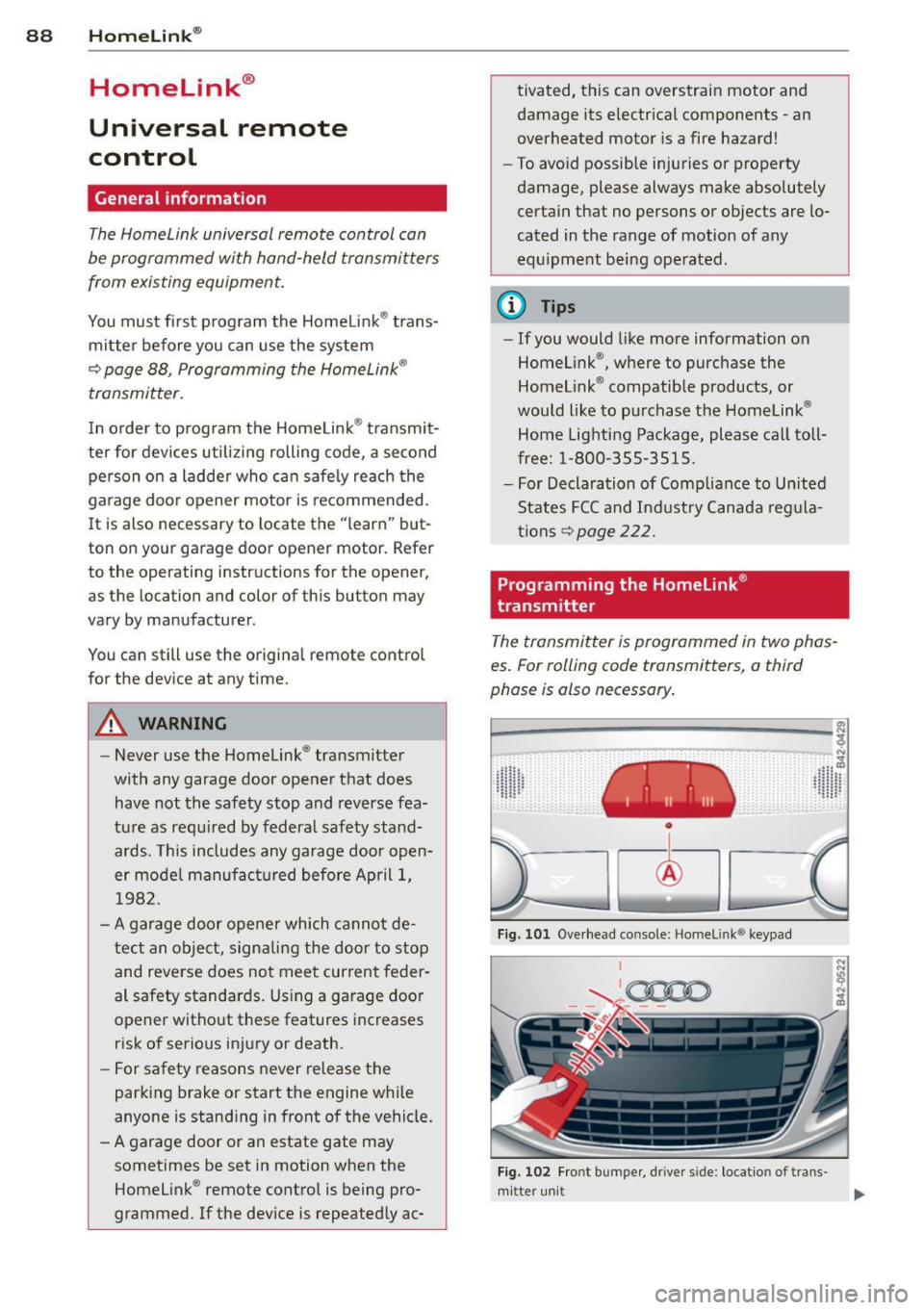
Programming the Homelink ®
transmitter
The transmitter is programmed in two phas
es. For rolling code transmitters, a third
phase is also necessary.
~----------------- ~ ,:.
~
Fig. 101 Overhead console: Homeli nk® keypad
I
'-..~0000 - - ,r.;-_ - -
Fig. 102 Fro nt bumper , driver side : loc ation of trans -
mi tter unit ..,_
Page 91 of 236
Phase 1:
p rogramming th e overh ead k eypad
1. Make sure your vehicle is wit hin operating
range of the remote controlled garage
door opener.
2. Set the parking brake
q A in General in
formation on page 88.
3 . Turn the ignition on . Do not start the en
g ine!
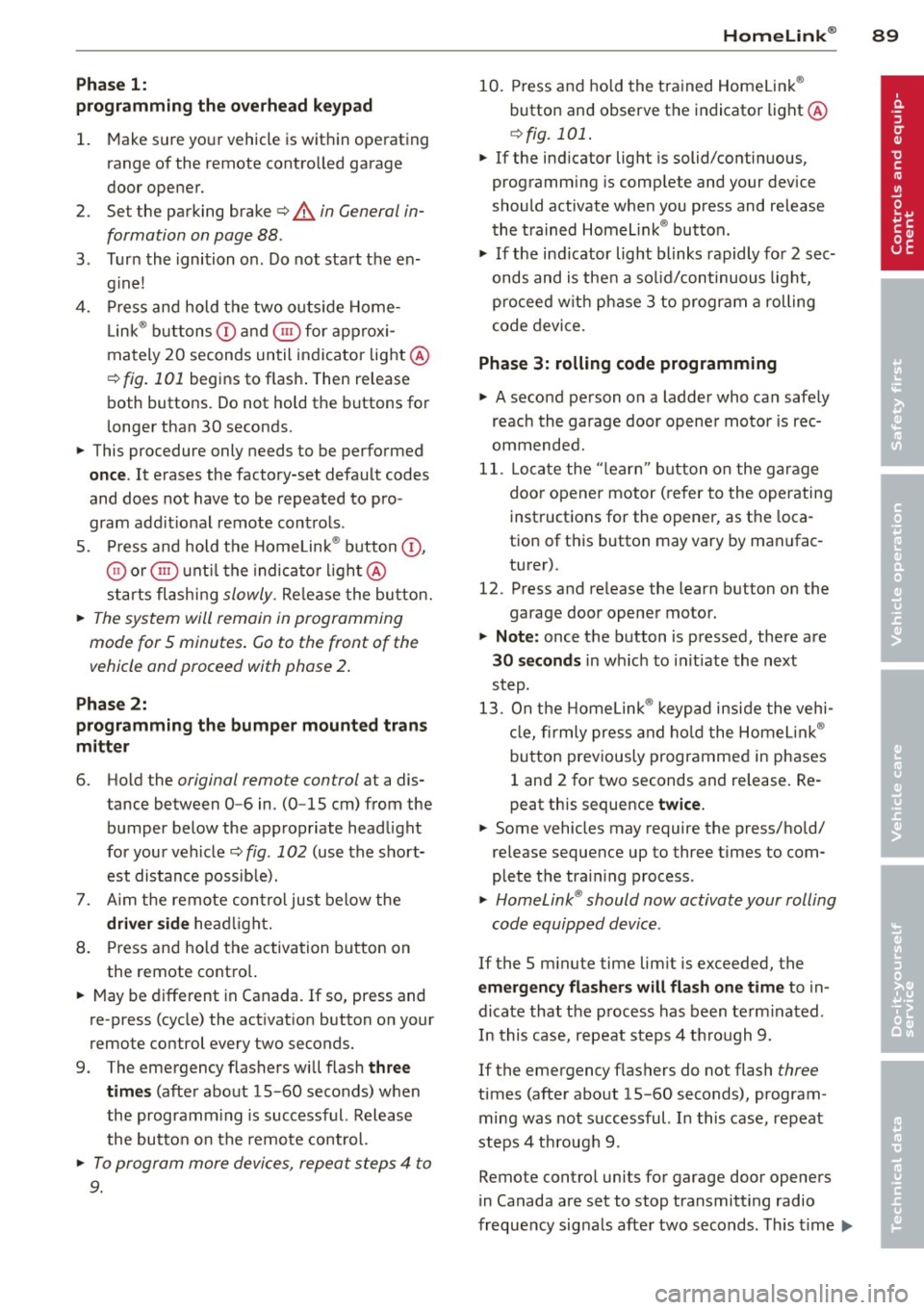
4. P ress and hold the two outs ide Home
Link ® buttons
(D and @for approxi
mately 20 seconds until indicator light @
¢fig. 101 begins to flash . Then release
both buttons. Do not ho ld the buttons for
longer than 30 seconds.
.,. This procedure only needs to be performed
once . It erases the factory-set default codes
and does not have to be repeated to pro
gram add it ional remote controls.
S. P ress and hold the Home Link ® button
(D ,
® or @ until the indicato r ligh t@
starts flashing
slowly. Re lease the bu tton.
.,. The system will remain in programming
mode for 5 minutes . Co to the front of the
vehicle and proceed with phase 2 .
Phase 2:
programmin g th e bumper mounted tran s
m itter
6. Hold the original remote control at a dis
tance between 0 -6 in. (0 -15 cm) from the
bumper below the appropriate headlight
for your vehicle
c:!;> fig. 102 (use the short
est distance possib le).
7 . A im the remote con trol just be low the
driver sid e head light.
8. P ress and hold the activation button on
the remote contro l.
.,. May be different in Canada.
If so, press and
re-press (cycle) the act ivation button on your
remote control every two seconds.
9. The emergency flashers will flash
three
time s
(after about 15-60 seconds) when
the programm ing is successful. Release
the butto n on the remote control.
.,. To program more devices, repeat steps 4 to
9.
Homelink ® 89
10. Press and hold the tra ined Homelink ®
button and observe the indicator light @
qfig. 101 .
.,. If the indicator light is solid/contin uous,
programm ing is complete and your device
should activate when you press and release
the t ra ined Homel ink® button .
.,. If the ind icator light blinks rapidly fo r 2 sec
onds and is the n a solid/continuous light,
p roceed w ith phase 3 to program a roll ing
code device.
Phase 3: rolling code programming
.,. A second pe rson on a ladder who can safely
reach the garage door opene r motor is rec
ommended .
11. Lo ca te the "learn" button on the ga rage
doo r opener motor ( re fer to the operating
instructions for the opener, as t he loca
tion of t his button may vary by man ufac
turer).
12. Press and re lease the learn button on the
garage door opener motor .
.,. Not e: once the button is pressed, there are
30 s econds in wh ich to in it iate the next
step.
13. On t he Homelink ® keypad inside the vehi
cl e, firmly press and ho ld the Homel in k®
bu tton prev iously programmed in phases
1 and 2 for two seconds and release. Re
peat this sequence
twice.
.,. Some vehicles may require the press/hold/
release sequence up to three times to com
plete t he trai ning process .
.,. Homelink ® should now activate your rolling
code equipped device.
If the S m inute time limit is exceeded, the
emergency flash ers will flash one time to in
dicate that the p rocess has been te rm inated.
In this case, repeat steps 4 t hrough 9.
If the emergency flashers do not flash
three
times (after about lS-60 seconds), program ming was not successful. In this case, repeat
steps 4 through 9 .
Remote contro l units for garage door openers
in Canada are set to stop transmitting radio
frequency sig nals afte r two seconds. This t ime
Ill-
Page 98 of 236
96 Driving Safely
Pedal area
The pedals must always be free to move and
must never be interfered with by a floor mat
or any other object.
• Make sure tha t all pedals move freely with
out interference.
• Make sure that nothing prevents all pedals
from returning to their original positions.
Only use floor mats that leave the pedal area
free and can be secured with floor mat fasten
ers.
If a brake circuit fails, increased brake pedal
travel is required to bring the vehicle to a full
stop .
A WARNING ,_
Pedals that cannot move freely can cause
loss of vehicle control and increase the risk
of serious injury.
- Never place any objects in the driver's
footwell. An object could get into the
pedal area and interfere with pedal func
tion. In case of sudden braking or an ac
cident, you would not be able to brake or
accelerate!
-Always make sure that nothing can fall or move into the driver's footwell.
Floor mats on the driver side
Always use floor mats that can be securely attached to the floor mat fasteners and do
not interfere with the free movement of the
pedals.
• Make sure that the floor mats are properly
secured and cannot move and interfere with
the pedals
q .&_ .
Use only floor mats that leave the pedal area
unobstructed and that are firmly secured so
that they cannot slip out of position. You can
obtain suitable floor mats from your author
ized Audi dealer .
A WARNING
Pedals that cannot move freely can result
in a loss of vehicle control and increase the
risk of serious personal injury.
- Always make sure that floor mats are
properly secured .
- Never place or install floor mats or other
floor coverings in the vehicle that cannot be properly secured in place to prevent
them from slipping and interfering with
the pedals or the ability to control the
vehicle.
- Never place or install floor mats or other
floor coverings on top of already instal
led floor mats. Additional floor mats and
other coverings will reduce the size of
the pedal area and interfere with the pedals.
- Always properly reinstall and secure floor
mats that have been taken out for clean
ing.
- Always make sure that objects cannot
fall into the driver footwell while the ve
hicle is moving. Objects can become
trapped under the brake pedal and accel
erator pedal causing a loss of vehicle
control.
Stowing luggage
Loading the luggage compartment
All luggage and other objects must be prop erly stowed and secured in the luggage com
partment.
Loose items in the luggage compartment can
shift suddenly, changing vehicle handling
characteristics. Loose items can also increase
the risk of serious personal injury in a sudden
vehicle maneuver or in a collision.
In a collision, the laws of physics mean that
even smaller items that are loose in the vehi
cle will become heavy missiles that can cause
serious injury. Items in the vehicle possess en
ergy which vary with vehicle speed and the
weight of the item. Vehicle speed is the most
significant factor.
Page 144 of 236
142 Intelligent technology
Intelligent technology
Notice about data
recorded by vehicle
control modules
Your veh icle is not equipped with an Event Da
ta Recorder (EDR), installed by some manu
facture rs fo r the express p urpose o f capturing
data for retrieval after an accident or cras h
event. EDR's are sometimes called "crash re
corders".
Some state laws res trict the retrieval or down
loading of data stored by EDR's that were in
stalled in a vehicle for the express purpose of retrieving data after an accident or crash
event without the owner's consent.
A lthough yo ur vehicle is not equ ipped wit h an
EDR, it is equipped with a number of elect ron
ic control modules for various vehicle systems
such as, for examp le, eng ine function, emis
sion control, as well as for the airbags and
safety belts.
These electron ic control modules also record
vehicle-re lated data during norma l vehicle op
eration for diagnostic and repa ir purposes.
The recording capacity of the electronic con
trol modules is limited to data (no sound is re
corded) and only a small amount of data is ac
tually recorded ove r a ve ry limited pe riod of
time and stored when a sys tem fault or other
condition is sensed by a cont ro l u nit. Some of
the data then stored may re late to vehicle
speed, direction, braking as we ll as restraint
system use and performance in the event of a
crash or other condition. Stored data can only be read and downloaded w ith special equip
ment .
Electronic Stability
Control (ESC)
The Electronic Stability Control increases driv
ing stability.
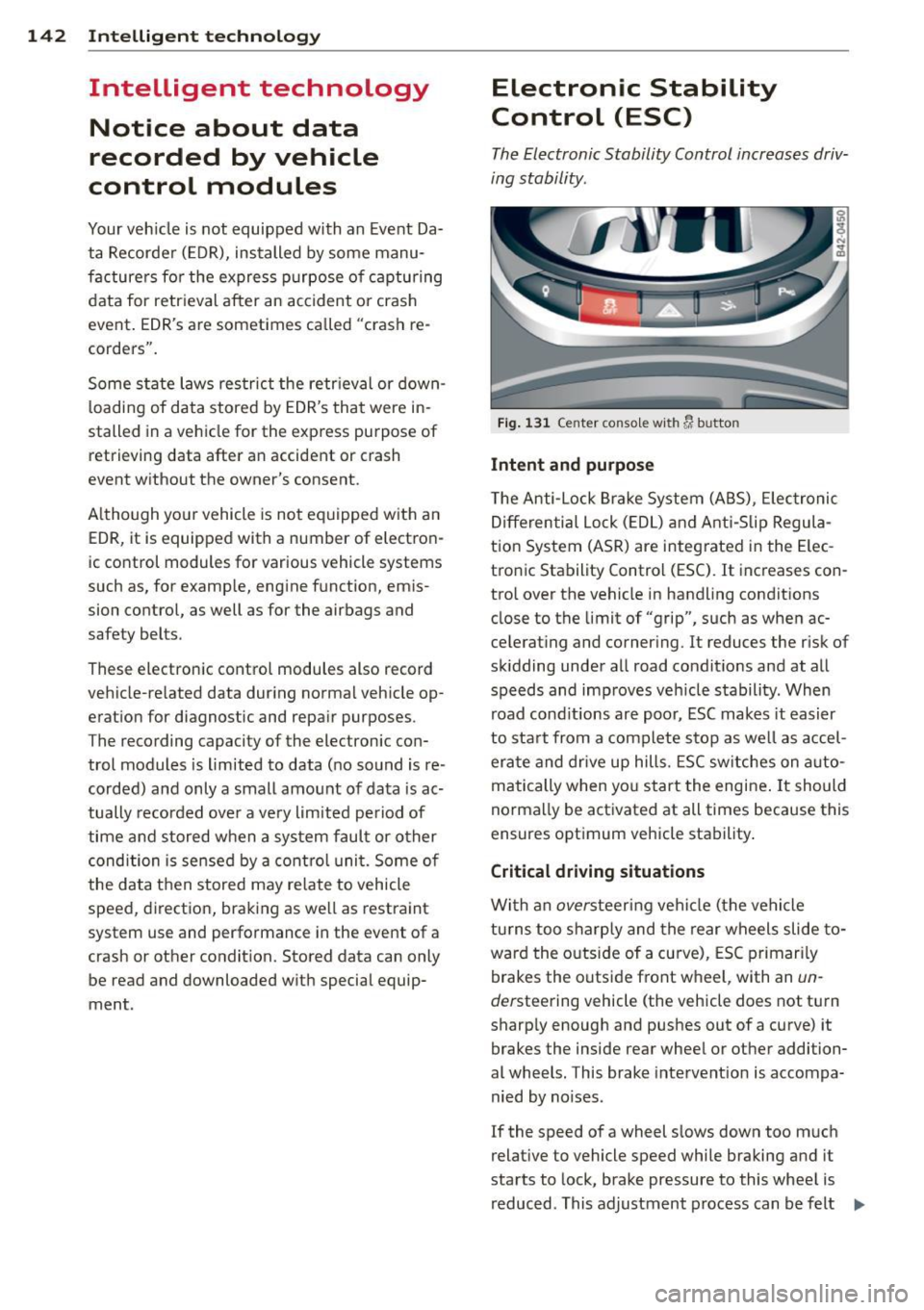
F ig . 1 31 Center console with~ button
Intent and purpose
The Anti-Lock B ra ke System (ABS), Elec tronic
Differential Lo ck (EDL) and Anti-Slip Regula
tion System (ASR) are integrated i n the Elec
tronic Stability Control (ESC). It increases con
tro l over the vehicle in handling conditions
close to the limit of "grip", such as when ac
celerating and corner ing. It reduces the risk of
skidding under all road condit ions and at all
speeds and improves veh icle stability. When
road cond itions are poor, ESC makes it easier
to sta rt from a comp lete s top as we ll as accel
era te and drive up hills. ESC sw itches on auto
matically when yo u start the engine . It should
norma lly be activated at all times because this
ensures optimum vehicle stability .
Critical driving situations
With an overs teering vehicle ( the vehicle
tu rns too s harply and the rear wheels slide to
ward the o utsi de of a curve), ESC primarily
brakes the outside front wheel, with an
un
dersteering vehicle (the vehicle does not turn
sharp ly enough and pushes out of a curve) it
brakes the inside rear whee l or other addition
al wheels. This brake inte rvent ion is accompa
nied by noises.
If the speed of a wheel s lows down too much
relat ive to vehicle speed while braking and it
starts to lock, brake pressure to this whee l is
reduced . This adjustment process can be felt ..,.
Page 145 of 236
as a pulsing mo tio n of the brake pe dal, ac
companied by some noises. I n order for ABS
to be a ble to operate optimally in th is range,
you must keep the brake pedal depressed -
never "pump the brakes" . You should not ex
pect that braking d is tances w ill be
shortened
under all circumstances w ith ABS . Braking dis
tance may even be slightly
longer , for exam
p le on gravel or wi th fresh snow on a slippery
surface .
If a sign ificant
speed differential between the
d rive w heels on one axle is determined (for
examp le, on a su rface that is s lippery
on one
side),
t he EDS brakes the spinn ing whee l and
transfers power to the other drive whee ls.
This is done up to a speed of about 60 mph (100 km/h) . Noises from the brake system
signal that whee l spin is being controlled.
I f one wheel spins when s tarting from a com
p lete stop because o f a different grip (for ex
ample , one wheel o n ice), keep your foot
hard
on the acce lerator until the veh icle starts to
move.
If the wheels spin , ASR wi ll automatically re
duce engine torque and match power to road
su rface condit ions .
Switching on Sport mode
In specific drivi ng situa tions (e.g. La unch Con
trol), you switch ASR and ESC to Sport mode
by pressing the
[!I button once . The indicator
light
11 illuminates and ESP sport -Warning!
Restricted stability
appears . "Slip" is matched
to the speed. You should do this only if your
driving skill a nd traffic cond it ions permit .
Switching ASR /ESC off
In certain sit uat ions (e .g . in deep snow, on a
l oose surface, o r when rocking the vehicle
free), switch ASR and ESC off by pressing the
[ill button for more than 3 seconds. The ind ica
tor light
II i lluminates and E SP swit ched off -
Warning! Re stricted stability appea rs . You
should do th is only if your driving skill and
traffic cond it io ns pe rmit .
Int ellig ent technolog y 143
Switching ASR /ESC on
Activate ASR/ ESC by pre ssing the [!I bu tton
again. The message
ESP on appears in the dis
play briefly.
Brake overheating
So that the disc b rake on a b raked wheel does
not over heat, the EDS switche s off au toma ti
ca lly if there is un usua lly severe loa ding a t
th is wheel. The vehicle is st ill drivable and has
the same properties as a vehicle without EDS .
As soon as the brake has coo le d down, EDS
swi tches on aga in automatically .
A WARNING
- Even ESC, ABS, EDS and AS R cannot over
come the laws of physics . You should
keep t his in m ind in particular on an icy
or wet road. If the systems intervene,
you shou ld ad just your speed immediate
ly to road and traff ic conditions . Do not
be tempted by the increased safety pro
vided to take risks -you risk having an
accide nt.
- Please keep in mind that the risk of an
accident is i ncreased by d riving too fast,
pa rti cularly in corners and on icy or wet
ro ads, and by drivi ng too close to the ve
hicle ahead . Even ESC, ABS, E DS and A SR
cannot eliminate the increased risk of
having an accident.
-Apply the throttle ca re fully when accel
erating on a consistently s lippery sur
face, e .g. on ice and snow . The drive
wheels can spin in spite of the EDS and thereby affect vehicle stability -you risk
having an accide nt.
- Please note that when ASR or ESC/ASR is
deactivated , the drive wheels can spin on
icy and sl ippery roads a nd the veh icle can
break away -the re is a risk of skidd ing!
(D Tips
- In the event of a defect in the rear spoil-
er system or in Audi magnet ic ride, it can
happen that ASR and ASR/ESC cannot be .,.
•
•
Page 147 of 236
Braking
New brake pads
During the first 250 miles (400 km), new
b rake pads do not possess their full braking
effect, they have to be "broken in" first. The
distance can be ten times longer in veh icles
with ceramic brakes*. You can compensate for
this slightly reduced brak ing power by push
ing harder on the brake pedal. Avoid heavy
braking loads during the break-in period.
Operating conditions and driving habits
The brakes on today's automobi les are sti ll
subject to wear, depending largely on operat
ing conditions and dr iv ing habits
c:> & . On ve
hicles that are either driven mostly in stop
and-go city traffic or a re driven hard, the
brake pads should be checked by your author
ized Audi dealer more often than specified in
the
Warranty & Maintenan ce booklet . Failure
to have your b rake pads inspected can result
in reduced brake performance.
On steep slopes, you shou ld use the brak ing
effect of the engine. This way, you prevent un
necessary wear on the brake system . If you
must use your brakes, do not hold the brakes
down continuously. Pump the brakes at inter
va ls.
Moisture or road salt
Under ce rta in conditions, for example, when
d riving through water or very heavy rain, or
even after washing your vehicle, the braking
effect can be reduced due to moisture (or in
freezing conditions ice) on the brake pads. A
few cautious brake applicat ions should dry
off
the brake pads or remove any ice coatings.
When you are driving at higher speeds with
the windshield wipers on, the brake pads will
briefly touch the brake d iscs in regular inter
vals so as to improve reaction t ime when brak
ing on wet surfaces. You, the driver, will not
notice anything.
The effectiveness of the brakes can be reduced
when the vehicle is dr iven on a salt-covered
road and the brakes are not used . Likewise,
Intelligent technology 145
you clean off accumulated salt coating from
brake discs and pads with a few cautious ap
plications of the brake
c:> & .
Corrosion
The re may be a tendency for dirt to build up
on the brake pads and corros ion to form on
the discs if the car is not driven regularly or
on ly for short trips with litt le use of the
brakes.
If the brakes are not used frequently, o r if cor
rosion has formed on the discs, it is advisable
to clean
off the pads and discs by braking
firmly a few times from a moderately high
speed
c:> & .
Faults in the brake system
If you shou ld notice a sudden increase in
brake pedal travel, then one of the two brake
circuits may have fai led . Drive immediately to
the nearest qualified workshop to have the
damage repaired. Drive at reduced speed on
the way there and anticipate longer stopping
distances and higher pedal pressure c:> &,.
Low brake fluid level
Malfunctions can occur in the brake system if
the brake fluid level is too low. The brake flu id
level is monitored electronically.
Brake power assist unit
T he brake power assist unit increases the
pressure that you generate with the brake
pedal. It works only when the engine is run
ning.
Brake lining wear status
Brake lining wear may be checked by visual in
spection of t he condition of the brake pads
thro ugh the openings in the wheel. If neces
sary, the whee l may be removed for this in
spection
c:> page 206 .
A WARNING
--You should perform braking maneuvers
for the purpose of cleaning the brake
system only if road conditions permit.
•
•
Page 148 of 236
146 Intellig ent technolog y
Other road users must not be put at risk -
yo u may cause an acc ident!
- Before descending a steep grade, reduce
speed and shift transmission into a lower
gear or lower driving position . Do not
ride the brakes or ho ld the pedal down
too long or too often . This cou ld cause
the brakes to get hot and d iminish brak
ing efficiency .
- Do not "ride the brakes" by resting your
foot on the pedal when you do not intend
to brake . Thi s may cause the b rakes to
overheat, premature wea r and inc reased
stopp ing distance.
- Under certain climat ic and operating
condit ions such as passing through wa
ter, driving in heavy ra in or after wash ing
the vehicle, the effectiveness of the
brakes can be reduced . In winter, ice can
accumulate on the brake pads, linings,
discs and drums. Cautiously apply brakes
for a test . Brakes will dry and ice coat
ings w ill be cleaned off after a few cau
t ious brake applications .
- Driv ing for an extended period of time on
salt-covered roads w ithout us ing your
brakes can also affect braking efficiency .
Clean off accumulated salt coating from
brake discs and pads w ith a few cautious
brake applicat ions.
- If you damage the front spoiler, or if you
ins tall a different spoiler, be su re the air
flow to the front brakes is not obstruct
ed. Otherwise the brake system co uld
overheat red ucing the effectiveness of
the ent ire brake system.
- Failure of one brake circuit will impair
braking capab ility, resulting in increased
stopp ing distance. Avoid driv ing the vehi
cle and have it towed to the nearest au
thorized Aud i dealer or qualified work
shop .
- Never let the vehicle roll to a stop w ith
the engine shut off .
- If the brake booster is not working, for
example when tow ing your vehicle, or
because the b rake booste r has somehow
been damaged, the brake pedal must be pressed considerably harder to make up
for the lack of booster assistance .
Power steering
When the engine is running, power steering
makes i t easier for the driver to s teer .
Power steering helps the driv er steer the vehi
cle with litt le physica l effort.
If the engine is not running, the power steer
ing system is also not working . In this case ,
you wi ll find it extremely d ifficu lt to turn the
steering wheel.
If you turn the steering fully to the left or
rig ht when the vehicle is stationary, you p lace
a very heavy load on the power steering sys
tem. Turning the steering wheel fully to the left or right will cause noise in the system. It
also reduces engine id le speed.
(D Note
Do not hold the steering t urned fu lly to
the left or r ight for more than 10 seconds
when the engine is running . There is a r isk
of damage to the power steering system .
(D Tips
-In the event of a power steering system
failure, or if the engine is not running
(while being towed), you will still be ab le
to steer the vehicle. However, you will re
quire more effort to do so .
- If the powe r stee ring system has a leak
or is defect ive , you should immediately
contact a qualified wor kshop .
- The power steer ing system req uires a
special hydraulic fl uid. The power steer
ing fluid reservoir is located in t he en
gine comp artment. The co rrect hydrauli c
fluid level is important for proper opera
tion of the power steering system. The
power steering fluid level is checked ac
cording to the Audi maintenance service
schedule.
Page 152 of 236
150 Driving and en vironm ent
Driving and
environment
Break-in period
A new vehicle must be broken in, and the break-in per iod should be 1,500 miles (2,500
km) . Do not use full acceleration for the first
600 miles (1,000 km) and do not exceed the
maximum eng ine speed of 6,000 rpm You
m ust also not use fu ll acce lerat ion between
600 and 1,200 m iles ( 1,000 to 2,000 km).
Fr om 1,200 to 1 ,500 mi les (2,000 to 2,500
km), you can gradua lly increase maxim um en
gine speed to 8,250 rpm for brief periods.
During the first ho urs of operation, there is
g reater friction in the engine and the trans
mission than later when a ll the moving parts
have broken in.
The way yo u drive duri ng the first 1 ,500 miles
(2,500 km) affects engine quality. If you drive
at moderate engine speeds thereafter, partic
u lar ly when the engine is cold, yo u reduce en
gine wear and increase the potential mileage
of the engine.
Do not drive at RPMs that are too low. Shift
down when the engine is no longer running
"smoothly". Extreme ly high RPMs are gov
erned automa tically.
Driving through water
on roads
Note the following to avoid vehicle damage
when dr iving t hrough water, for example on
flooded roads:
- The water must not be any higher than the
bottom of the vehicle body .
- Do not drive faster than wa lking speed .
.&_ WARNING
After driving through water, mud, slush,
etc., the brakes may be slow to take effect
because of wet b rake roto rs and pads. Dry
t he brakes fi rst by bra king carefully to re
sto re the full braking effect .
-
(D Note
Vehicle components such as the eng ine,
transmission, suspension or e lectrical sys
tem can be severe ly damaged by dr iv ing
through water .
@ Tips
-Check the depth of the water before d riv
ing through it.
- Do not stop the vehicle, drive in reverse
or switch the engine off when driving
through water.
- Keep in mind that oncoming vehicles
may create waves that raise the water
level and make it too deep for your vehi
cle to drive through safely .
- Avo id driving through salt water because
it can cause corros ion.
Catalytic converter
You must use lead-free gasoline in your veh i
cle, otherwise you will destroy the ca talyt ic
converter .
Never run the fuel tank completely dry; their
regular fue l supply could cause misfires . This
allows unburned fue l into the exhaus t system,
poss ibly resulting in overheating and damage
to the catalytic converter .
.&_ WARNING ,-
-Do not park or operate the vehicle in
a reas where the hot exha ust system may
come in co nta ct with dry g rass, brush,
fue l spills or o ther material which can
cause a fire.
- Do not app ly addition al under coating or
r u stproofing on or nea r the exhaust
manifold, exhaust pipes, catalytic con
verter or heat shields . Dur ing driving, the
substance used for undercoating could
overheat and cause a fire.
(D Note
To ensure efficient o peration of the Emis
s ion Control System :