sensor AUDI R8 SPYDER 2012 Owner's Manual
[x] Cancel search | Manufacturer: AUDI, Model Year: 2012, Model line: R8 SPYDER, Model: AUDI R8 SPYDER 2012Pages: 236, PDF Size: 59.24 MB
Page 133 of 236
A WARNING
-=
If, in exceptional circumstances, you must
install a forward-facing child restraint on
the front passenger's seat:
- Always make sure the forward-facing
seat has been designed and certified by
its manufacturer for use on a front seat
with a passenger front and side airbag.
-Always follow the manufacturer's in
structions provided with the child safety
seat or carrier.
- Always move the passenger seat into its
rearmost position in the seat's fore and
aft adjustment range, as far away from
the airbag as possible before installing
the child restraint. The backrest must be
adjusted to an upright position.
- Always make sure that the
PASSENGER
AIR BAG OFF light comes on and stays
on all the time whenever the ignition is
switched on.
(D Tips
Always replace child restraints that were
installed in a vehicle during a crash. Dam
age to a child restraint that is not visible
could cause it to fail in another collision
situation.
Advanced front airbag system and children
Your vehicle is equipped with an "Advanced
Airbag System" in compliance with United
States Federal Motor Vehicle Safety Standard
(FMVSS) 208 as applicable at the time your
vehicle was manufactured.
The Advanced Airbag system in your vehicle
has been certified to meet the "low-risk " re
quirements for 3- and 6- year-old children on
the passenger side and small adults on the
driver side. The low risk deployment criteria
are intended to reduce the risk of injury
through interaction with the airbag that can
occur, for example, by being too close to the
steering wheel and instrument panel when
the airbag inflates. In addition, the system
Child Safety 131
has been certified to comply with the "sup
pression" requirements of the Safety Stand
ard, to turn off the front airbag for infants up
to 12 months who are restrained on the front passenger seat in child restraints that are list
ed in the Standard .
Even though your vehicle is equipped with an
Advanced Airbag system, a child should al
ways ride in the seat properly restrained for
its age and size . The airbag on the passenger
side makes the front seat a potentially dan
gerous place for a child to ride. The front seat
is not the safest place for a child in a forward
facing child safety seat .
It can be a very dan
gerous place for an infant or a larger child in a
rearward-facing seat.
Advanced Airbags and the weight
sensing mat in the front seat
The Advanced Airbag System in your vehicle
detects the presence of an infant or child in a
child restraint on the front passenger seat us
ing the weight-sensing mat in the seat cush
ion and the sensor below the safety belt latch
on the front passenger seat that measures the
tension on the safety belt.
The weight-sensing mat measures total
weight of the child and the child safety seat
and a child blanket on the front passenger
seat. The weight on the front passenger seat
is related to the design of the child restraint
and its "footprint", the size and shape of the
bottom of the child restraint as it sits on the
seat. The weight of a child restraint and its
"footprint" vary for different kinds of child re
straints and for the different models of the
same kind of child restraint offered by child restraint manufacturers.
The weight ranges for the individual types,
makes and models of child restraints that the
NHTSA has specified in the Safety Standard
together with the weight ranges of typical in
fants and typical 1 year-old child have been
stored in the control unit of the Advanced Air
bag System. When a child restraint is being
used on the front passenger seat with a
ll-
•
•
Page 149 of 236
Driving with your
quattro ®
With all-wheel drive, all four wheels are driv
en .
Gene ral inform ation
W ith all-wheel dr ive, power is distributed to
all four wheels . This happens automatically
depending on your driving style and the road
conditions at the t ime . See also <::;>
page 142.
Winter t ires
When driving in the winter, your vehicle with
all-wheel drive has an advantage, even with
regular tires. In winter road conditions it may
be advisable to mount winter tires (or all -sea
son t ires) for improved driveability and brak
ing: these tires must be mounted on
a ll f our
wheel s.
Snow chain s
Where snow chains are mandatory on certain
roads, th is normally also applies to vehicles
with all-wheel drive
Qpage 198, Snow
chains.
Replacing wheel s/tire s
Only the wheel/tire sizes specified by the
manufacturer may be used on vehicles with
all-wheel drive
<=> page 193 .
A WARNING
-Always adjust your driving to road and
traffic conditions. Do not let the extra
safety affo rded by a ll-wheel d rive tempt
you into taking extra risks .
- Although a ll-wheel drive is ve ry effect ive,
always remember that braking capacity
is limited by tire traction . You should
therefore not drive at excessive speeds
on icy or slippery road surfaces.
- On wet road surfaces, be careful not to drive too fast because the front wheels
cou ld begin to slide on top of the water
(aquaplaning). If this should occur, you
will have no warning from a sudden in crease in engine speed as with a front-
-
Int ellig ent technolog y 147
wheel drive vehicle. Always drive at
speeds which are su ited to the road con
ditions. -risk of crash.
Energy management
Starting ability is optimized
Energy management controls the distribution
of electrical energy and thus optimizes the
availability of electrical energy for starting the engine.
If a vehicle with a conventional energy system
is not driven for a long per iod of t ime, the bat
te ry is d ischarged by idling current consumers
(e .g. immobi lizer). In certain circumstances it
can resu lt in the re being insufficient energy
available to start the engine.
Intelligent energy management in your vehi
cle handles the distribution of e lectr ica l ene r
gy. Starting ability is markedly improved and
the life of the battery is extended .
Bas ica lly, energy management consists of
b atte ry diag nosis, idling current m an age
m ent
and dy namic energ y manag ement .
Batte ry diagno sis
Battery diagnosis continuously determines
the state of the batte ry. Sensors determine
battery voltage, battery current and batte ry
temperature . This determines the current
state of charge and the power of the battery.
Idling current manag ement
Idling current management reduces energy
consumption while the vehicle is standing.
Wi th the ign ition switched off, it controls the
energy supply to the various electrica l compo
nents. Data from battery diagnosis is consid
ered.
Depend ing on the ba ttery's state of charge,
individual cons umers are gradually turned off
to prevent excessive discharge of the battery
and thus maintain starting capability. .,..
•
•
Page 157 of 236
Caring for vehicles with matte finish
paint
Applies to vehicles: with matte finish paint
Vehicles with matte finish paint require spe
cial care due to the characteristics of the
paint.
Automatic car washes
You must take the necessary precautions such
as closi ng the windows before us ing an auto
mat ic car wash. See the ca r wash attendant if
the re is special eq uipment on yo ur vehicle
such as a spoiler or remote cont ro l an tenna
¢ 0 .
Only use ca r was hes where t he vehicle re
mains stationary and the washing eq uipment
moves around the vehicle when washing and
d rying.
It is not possible to use ca r washes
that move the ve hicle through the ca r wash
using a chain
~ .&. .
Only use car w ashes tha t use cloth cleaning
eq uipment, not brushes .
Washing with pressure washers
When washing your ve hicles w ith a pressure
washer, always follow the operating instruc
tions provided w ith the pressure washer. This
i s especially important in rega rd to t he
pre s
sure
and s praying di stance. Be su re to keep
enough distance from soft materials such as
rubber hoses or insulat ing mater ial as we ll as
from the parking system sensors*, wh ich are
loca ted in the front or rear bumper.
Never use
rotary nozzle s or high pre ssure
nozzles .
Washing by hand
To avo id damag ing t he pa int when w ash ing ,
firs t remove d ust and large pa rticles from
your vehicle . Insects, grease spots and finger
p rints a re best removed with a
special cleaner
for matte finish pa int .
Apply the produc t using a mi crofiber cloth . To
avoid damaging the paint surface, do not use
too m uch press ure.
Cleaning and protec tion 155
Rinse the ve hicle thoroughly wi th water. Clean
the ve hicle starting at t he top and working to
ward the bottom using a
neutral shampoo
and a soft microfiber cloth . Stop frequent ly to
rinse the cloth thoroughly.
Clean the wheels and si ll pane ls last. Use a
clean
sponge on these areas.
R inse t he ve hicle thoroughly again and le t it
air dry. If there are any water spots, they can
be removed using a
leathe r cloth.
Clean again with the spe cial cleaner for matte
finish paint
if necessary .
Removing stubborn dirt
Bird droppings or tre e sap
are best remov ed
with plenty of wate r and a microfiber cloth .
You should rinse off
gasoline res idue immed i
ate ly w ith plenty of water .
_& WARNING
-Wash your vehicle only whe n the ignition
is switched off to red uce the risk of a
cras h.
- To reduce the risk of c utting yourse lf,
protect your hands and a rms fro m meta l
pa rt s wi th sha rp edges when clea ning
the underbody, the ins ide of the whee l
housings or the whee l covers .
- If washing your ve hicle dur ing the win
ter, mois ture and i ce in the brake system
can affect the vehicle 's braking ab ility .
(D Note
-Do not treat veh icle parts pain te d wi th
m att e fini sh paint u sing pol ishing m ate
r ia ls or hard wax. These p rod ucts cou ld
cause damage to the appearance o r sur
face that cannot be repaired .
- N ever use protective wax . It ca n destroy
the matte finish effect.
- Do not pla ce an y s tickers or magnetic
signs on vehi cle pa rts painted with
matte finish paint. The paint could be
damaged when the stickers or magnets
are removed.
•
•
Page 178 of 236
1 7 6 Che cking and filling
your cooling system and could result in
damage not covered by your New Vehicle Limited Warranty .
Checking the engine coolant level
Proceed carefully when checking the coolant.
Fig . 1 43 Co nvert ible top: se rv ice pos it ion
F ig . 14 4 Convert ib le top storage bay: coolant expan·
sio n tank
Before you check anything in the engine com
partment,
a lwa ys r ead and heed all WARN
INGS ¢.&.. in Working in the engine compart
ment on page
169 and park your vehicle on a
level surface .
The coolant expansion tank is located in the right s ide of the convertible top storage bay
under the round metal cover¢
fig. 144 . The
convertible top must be in the service position
to check the coolant leve l
¢fig . 143 .
Bringing the closed con ve rtible top into
th e s ervic e position
~ Switch the ignition on .
~ Pull and hold the convert ible top switch .
~ Press and hold the rear window switch too
u nti l the convertib le top moves into the
service position¢
fig. 143.
Bringing the op en conv ertible to into the
service position
~ Switch the ignition on.
~ Press and hold the convertible top switch.
~ Press and hold the rear window switch too
until the convertible top moves into the
service position¢
fig . 143 .
Opening the coolant e xpan sion tank cover
~ Stop the engine and allow it to cool.
~ Switch the ignition off.
~ Carefully remove the bolts in the cover (D
using a screwdriver and remove the cover.
The coolant reservoir is located below
¢fig. 144.
Chec king the engine cool ant level
~ Place a rag or cloth on the cap of the cool
ant expansion tank and turn the cap
careful
ly
to the left (counter-clockwise) ¢ .&_.
~ Read the coolant level inside the coolant ex
pans ion tank ¢
fig. 144 . With a co ld engine,
it must be above the "min" mark. With a hot
eng ine, it can be a little above the indicated
range.
T o obtain an accu rate reading, the engine
must be switched off.
The expansion ta nk in your vehicle is equ ipped
with an electric coo lant level sensor
¢page 15. We still recommend you check the
c oolant level from time to time.
Coolant loss
Coolant loss may indicate a leak in the cooling
system . In the event of coolant loss, the cool
i ng system shou ld be inspected immediately
by your aut horized Audi dea ler. It is not
eno ugh me rely to add coolant.
In a
s ea le d system, losses can occur on ly if
the boiling point of the coo lant is exceeded as
a resu lt of overheating.
Page 197 of 236
T up to 118 mph (190 km/h)
U up to 124 mph (200 km/ h)
H up to 130 mph (210 km/ h)
V up to 149 mph (240 km/h)
1 )
Z over 149 mph (240 km/h)1l
W up to 168 mph (270 km/h)
1
)
Y up to 186 mph (298 km/h)1
)
Your veh icle is no rma lly factory equipped with
tires , which possess excellent driving charac
teristics and give yo ur Audi opt imum driving
comfort ¢&. .
U.S. DO T Tire Identification Numbe r (TIN )
and ti re manufacture date
This is the ti re's "serial number". It begins
with the letters "DOT" and indicates that the
ti re meets all federal standards. The next two
numbers or letters indicate the plant where it
was manufac tured, and the last four numbers
represent the week and year of manufacture .
For example, the numbers 2210 mean that
the t ire was produced in the 22nd week of
20 11. The othe r numbe rs a re mar keting co
des tha t may or may not be used by the t ire
manufacturer . This information is used to con
tact consumers if a tire defect requires a re
call.
Audi original tire
Tires wi th the ident ificat io n "AO" or "RO" have
been spec ia lly matched with your Aud i. We
r ecommend using only these tires because
they meet the highest standards regarding
safety and driving character istics when used
correctly . Your authori zed Audi dealer will
g lad ly provide you with more information .
Tire ply composit ion and materials u sed
The number of p lies ind icates the n umbe r of
l ayers of rubber-coated fabric in the t ire. In
general, the greater the number of p lies, the
more weig ht a tire can support. Tire manufac
turers also must indicate the materials in the
ll Fo r tires wit h a m ax im um s pee d ca pabil ity over 149
mph (2 4 0 km/ h), ti re ma nufa ctur ers some times use
t h e l ett ers " ZR."
Tire s an d wheel s 195
tire, which incl ude stee l, nylon, po lyester, and
others .
Maximum Load Rating
This number ind icates the max imum load in
kil ograms and po unds that can be ca rr ied by
the tire.
Tire quality grading for treadwear ,
traction, and temperature resistance
T read wear, t raction and tempe ra tur e grades
¢page 197 .
Maximum Permissible Inflation Pressure
This number is the greatest amount of a ir
pressure that should ever be put in the tire
u nder norma l dr iv ing cond itions .
Replacing tires or rims on veh icles
equipped with tire p ressure monitoring
system
T he w heels on yo ur vehicle are equippe d with
a sensor which constantly monito rs the ai r
pressure inside the tire, a nd then transmits
th is information to the tire p ress ure monitor ·
ing system. If yo u are going to replace the
whee l rims on your veh icle, make sure the new
rims also have these sensors . The sensors
must be compatib le with the t ire pressure
monito rin g sys tem on your vehicle .
If you install rims, wh ic h do not have the sen
sors, or have senso rs which are not compati
ble , then the t ire p ressure monitoring system
will not wor k prope rly. In t his case, the tire
pressure monitor ing system wou ld no t be
able to moni tor the tire pressure or warn yo u
i f i t is necessary .
- The battery inside of t he tire pressure sen
sor has a limited se rvice life .
- Always dr ive with the va lve stem caps se
curely mounted . We recommend using fac
t o ry installed valve stem caps. As k yo ur au
t hori zed A udi dealer to rep lace lost valve
stem caps .
•
•
Page 198 of 236

196 Tire s and wheel s
The insta llation of replacement tires with
steel cord body plies in the tire sidewall may
cause ma lfunction of the tire pressure mon i
toring system, and is not recommended (cord material information in molded on the t ire
sidewall) .
A lways check your tire pressure monitoring
system ind icator after replacing one or more
tires on your vehicle. If the tire pressure mon i
toring system ind icator flashes, or is on, your
system is not work ing properly.
A WARNING
- Us ing incorrect or unmatched ti res and/
o r wheels or imp roper tire and whee l
c ombin ations can lead to loss of contro l,
co llision and serious persona l injury.
- Always use tires, rims and wheel bo lts
that meet the specifications of or ig inal
f ac to ry-installed t ires or other combina
tions that have been spec ifically ap
proved by the vehicle manufacturer .
- Tires age even if they are not being used
and can fail suddenly, es pecially at high
speeds. Tires that are more than 6 years
o ld can only be used in an emergency
and then with special care and at lower
speeds .
- Never mount used tires on your vehicle if
you a re not sure of their "previous histo ry." Old used tires may have been dam
aged even though the damage cannot be
seen that can lead to s udden tire failure
and loss o f vehicle control.
- Only t he wheel/tire s izes spec ified by t he
ma nufactu rer may be used o n veh icles
with all-wheel dr ive.
- N ever drive faste r th an the maxim um
speed for whi ch the tires o n your ve hicle
are ra ted because ti res that are driven
f as ter than their rated speed can fail
s u dden ly .
- Overloading t ires cause heat build- up,
s u dden tire failure, incl uding a blowout
and sudden deflation and loss of control. -
Temperature grades apply to tires that
are properly inflated and not over or un
derinflated.
- For technica l reasons it is not always
possible to use whee ls from other vehi
cles -in some cases not even wheels
from the same ve hicle model.
- Do not use run-flat tires on yo ur vehicle.
Using run-flat t ires ca n lead to veh icle
damage or crashes .
@ Note
- For technical reasons, it is not generally
poss ible to use the w heel rims from oth
er ve hicles . Th is can hold true for wheels
of the same vehicle type .
- If you should put different wheels and
tires on your veh icle (e.g . winter wheels
and tires), you must be certain that the
wheels and tires are compatible with the ti re pressure monitor ing system. Other
w ise the system will regi ste r a mal func
t ion and a fa ult message w ill be dis
played. For more information, contact
your authorized Audi dealer.
(D Note
- When installing new tires, be care ful not
to damage the va lves or tire pressure
monitoring system sensors.
- N ever drive without the valve stem cap.
The va lves co uld get damaged.
- If the sensors must be replaced, then
the valve must also be replaced at the
same time .
@ For the sake of the environment
Dis pose o f old tires in accordance with the
l ocal requirements .
@ Tips
Tires with the iden tific ation "ROl " have
been specially matched with you r A udi. We
r ecommend using on ly these tires because
they meet the highest standards rega rding
safety and driving characteristics when used correctly . Your authorized Aud i R8
Page 200 of 236
198 Tire s and wheel s
equip a ll four wheels on your vehicle with cor
rectly fitted winter tires or all-season tires,
when winter road conditions are expected .
This a lso improves the vehicle's braking per
formance and reduces stopping distances.
Summer tires provide less grip on ice and
snow.
W inter t ires (snow t ires) must always be fitted
on all four whee ls .
Compat ible tire pressure mo nitor ing sensors
must be installed on all fo ur winter tires for
the tire pressure monitoring system to func
tion proper ly
i=;, poge 195 .
Ask your autho rized Aud i dea ler o r qualified
wo rkshop fo r permitted
winter tir e size s . Use
on ly radia l w inte r tires .
W inter t ires lose the ir effectiveness when the
tread is worn down to a depth of 0.157 inch
(4 mm) .
Only drive with wi nter tires under winter con
d itions . Summer tires hand le better when
there is no snow or ice on the roads and the
temperature is above 45 °F (7 °C).
Please always remembe r that w inte r tires may
have a lower speed rating than the t ires origi
na lly installed on your veh icle at the t ime i t
was manufactured. Please see
r=;, page 194 ,
Speed roting (letter code) for a list ing of the
speed rating letter codes and the maximum
speed at which the tires can be driven.
The speed ra ting lette r code
(i=;, poge 185) is
on the s ide wall of the tire
i=;, poge 193.
A WARNING
Winter tires have maximum speed limits
that may be lower than your vehicle's max
im um speed . Always know the maxim um
speed before driving off. Never drive faster
than the speed permitted for your specific
w inte r tires . This will cause damage to the
tires leading to an accident and serious
personal in ju ry to you and yo ur passen
gers.
A WARNING
Driving faster than the maximum speed
for which the winter tires on your veh icle
were designed can cause t ire failure in
cluding a blowout and sudden deflation,
l oss of cont ro l, crashes and ser ious per
sonal injuries. Have wo rn o r damaged ti res
r eplaced immedia tely.
- W inte r ti res have maxim um speed rating
tha t may be lower than your vehicle 's
maximum speed.
- Never drive fas ter than the speed for
which the win ter or othe r ti res installed
on yo ur vehicle are rated.
A WARNING ~
A lways ad just your driving to the road and
traffic condit ions. Never let the good ac
celeration o f the winter tires and a ll-wheel
drive tempt yo u into taking extra risks. Al
ways remember:
- When braking, an all-wheel drive veh icle
handles in the same way as a front drive
veh icle.
- Drive carefully and reduce your speed on
icy and slippery roads, even w inter t ires
cannot help under black ice conditions .
~ For the sake of the environment
Use summer tires when weather condi
tions permit. They are qu ieter, do not wear
as quickly and reduce fuel consumpt ion.
Snow chains
-
Snow cha ins may be fitted only to the rea r
whee ls, and o nly to certa in tire sizes . Ask your
autho rized Aud i dea le r o n whi ch t ire si zes
snow c hains ca n be used.
T he snow chains must have low-p rofile links
and must not be t hicker than 0 .53 inch
(13 .5 mm), in cl ud ing the lo ck.
Remove wheel center covers before putt ing
snow c ha ins on your vehicle
r=;, @ . For safety
reasons cover caps must then be f itted over
Page 204 of 236
202 Tire s and whee ls
- The tire pressure monitoring system
helps the driver to keep an eye on tire
pressures. But the driver st ill has the re
spons ibility for maintaining the correct
tire pressure.
- Tire pressure must only be adjusted
when the temperature of the tires is
about the same as ambient air tempera
ture.
- When t ires are replaced, the sensors and
valves should not be exchanged . The
valve core, nut, valve sealing and seal
washer (rep lacement kit) needs to be re
placed. If necessary, the valve and the
whee l electronics have to be rep laced.
- The tire pressure monitoring system on
your Audi was calibrated us ing tires w ith
"RO" identification. We recommend us
ing these tires.
- If you should put different whee ls and
ti res on yo ur vehicle (e.g. w inter wheels
and tires), yo u m ust be certain that the
whee ls and tires are compatible with the
tire pressure monitoring system . Other
wise the system w ill reg ister a ma lfunc
tion and a fault message will be d is
played . For more information, contact
your authorized Audi dealer .
- For Declaration of Compliance to United
States FCC and Industry Canada regula
tions
~ page 222 .
Programming a new set of tires
App lies to vehicles: with tire pressure monitoring system
When driving with a new set of ti res, you can
program them to the t ire pressure monitoring
system using the menu disp lay.
"' Turn the ign ition on.
"' Se lect the menu :
Set> Tir e pr essu re >
Wh eel cha ng e.
"' Co nfirm that you wou ld like to begin the
programming process. The message
Wh eel
s en sors a re being in it ia lised. Thi s ma y ta ke
a fe w minute s .. .
appears in the instrument
cluster disp lay. You can switch between programmed tire sets
at any time without reinitializing the system .
(D Tips
If the programming process was not com
pleted successfully, the message
Wheel
s en sors could not be initi alis ed
appears in
the disp lay and the
IIQIS, indicator light
turns on. If this happens, repeat the pro
cedure.
Page 211 of 236
Tightening wheel bolts
~ Fit the wheel bolt wren ch over the wheel
bolt and push it down as far as it will go
1l.
~ Close your gr ip around the end of the
wrenc h handle fo r maximum torque and
turn each whee l bolt
clockwi se u nti l it sits
t ight.
H ave the
tightening torque of the whee l bolts
checked as soon as possible with a torque
wrench. It shou ld be 120 Nm.
Chec k the
tir e pre ssure as soon as possible .
Return the vehicle tool kit to its proper place .
A WARNING
Loosening the wheel bo lts is prohib ited;
da nger of an accident!
@ Tips
- Never try and use the hexagona l socke t
i n the handle of the screwdr iver to loos
en or tighten the w heel bolts.
- If yo u have dete rm ined t hat wheel bolts
a re cor roded and difficult to t urn, the
bo lts must be rep laced befo re checking
the to rque.
- Unti l the tig hte ning torque is checked,
d rive at redu ced speeds as a precaution .
Notes on wheel change
Please read the information ¢ page 193, New
tires and replacing tires and wheels ,
if you are
going to use a spare t ire which is different
from the tires on you r veh icle.
Afte r you change a tire :
- Check the tire pressure on the spare imme
diately after mounting.
- Have the wheel bolt t ightening torque
chec ked w ith a torq ue wrench as soon as
poss ib le by your author ized A udi dealer or a
qualified service sta tion .
1) You need t he appro pria te adapte r to t ig hte n th e an ti
t h eft whee l bolt s
c:> page 206 .
What do I do now? 209
- With stee l and alloy wheel rims, the whee l
bolts are correctly tightened at a torque of
90 ft lb (120 Nm) .
- If you notice while changing a tire that the
wheel bo lts are corroded and difficu lt to
turn, then they shou ld be rep laced before
you check the tightening torque.
- Replace the flat tire with a new one and
have it installed on your vehicle as soon as
possible . Remount the wheel cover.
Until then , d riv e with e xtra care and at re
duced speeds.
A WARNING
- If you are going to equ ip your vehicle
with tires or rims which differ from those
which were facto ry installed, then be
sure to read the information ¢
page 193,
New tires and replacing tir es and
wheels.
- Always sto re the tools secu rely in lug
gage compartment. Othe rwise, in a n ac
cident o r su dden maneuver they cou ld fly
forwdrd, CciU5ing injury to pd55enger5 in
the vehicle.
(D Note
Do not use comme rcially avai lab le tire
sea lants . Otherwise, the e le ctr ic al compo
nen ts of t he tire p ressu re monitoring sys
tem * wi ll no longe r work proper ly and the
sensor fo r the tire pressure mon itor ing
system will have to be rep laced by a quali
fied workshop.
Jump-starting
General
If necessary, the engine can be started by
connecting it to the battery of another vehi
cle.
If the engi ne should fail to start because of a
discharged or weak battery, the battery can be
II>
•
•
Page 216 of 236
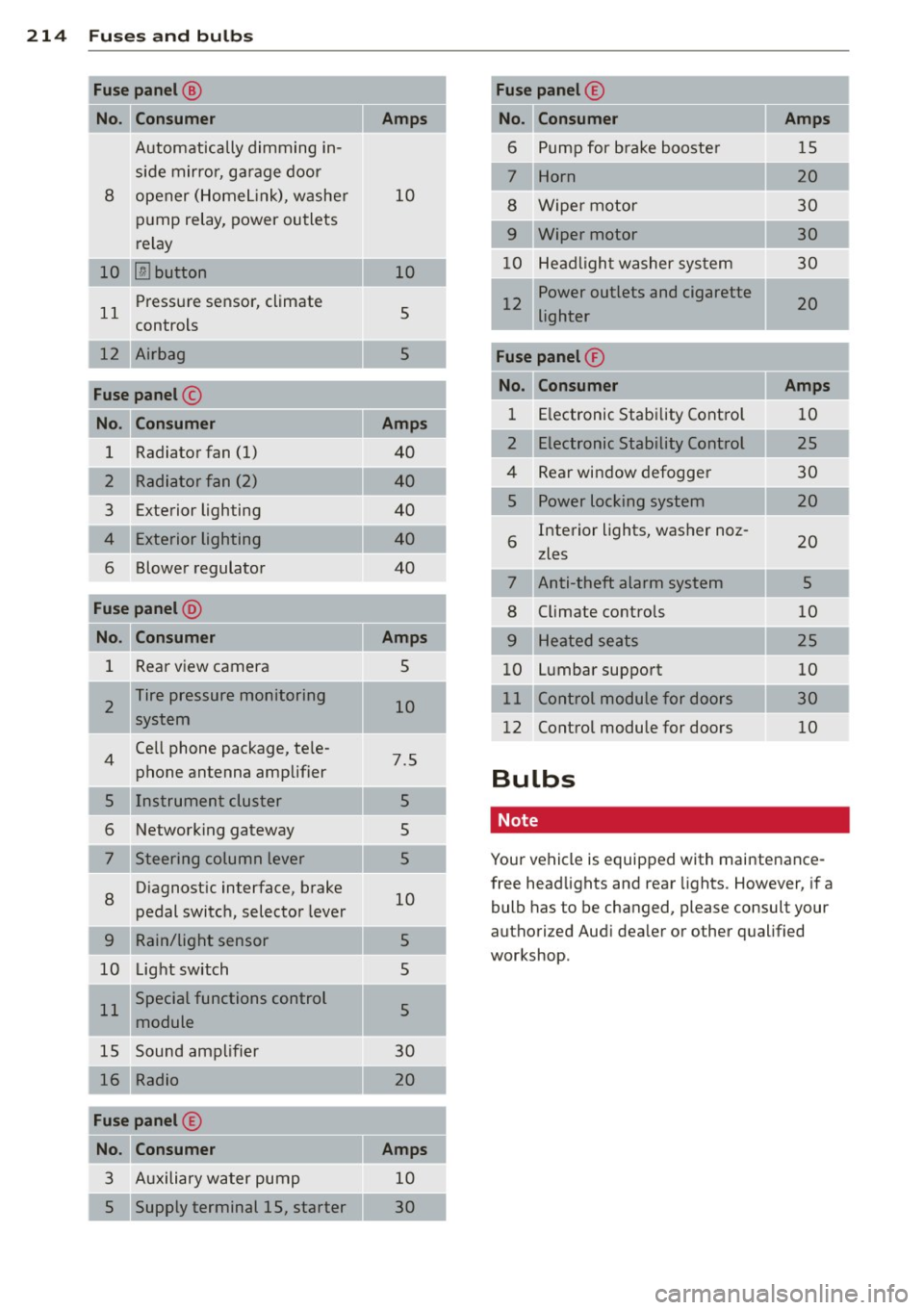
214 Fuses and bulbs
Fuse panel @
Consumer
Automatically dimming in-
side mirror, garage door
8 opener (Homel
ink), washer
pump relay, power outlets
relay
10
[ru button
11 Pressure sensor, climate
controls
12 Airbag
Fuse panel @
No . II Consumer
II
1 Radiator fan (1)
Radia
tor fan (2)
Exterior lighting
4 Exterior lighting
6 Blower regulator
Fuse panel@
No . II Consumer
II
1 Rear view camera
2
Tire pressure monitoring
system
4 Cell phone package, te
le-
phone antenna amplifier
5 Instrument cluster
6 Networking gateway
7 Steering column lever
8
Diagnostic interface, brake
pedal switch, selector lever
9 Rain/light sensor
10 Light switch
11 Special functions control
module
15 Sound amplifier
Radio
Fuse panel E
No. Consumer
3 Auxiliary water pump
5 Supply terminal 15, starter
Amps
10
10 5
5
Amps
40 40
40
40
40
Amps
5
10
7.5 5
5
5
10 5
5
5
30
20
Amps
10
30
Fuse panel @
No. Consumer
6 Pump for brake booster
7 Horn
8 Wiper motor
9 Wiper motor
10 Headlight washer system
12 Power outlets and cigarette
lighter
Fuse panel
®
No. !!Consumer
1 Electronic Stabi lity Control
2 Electronic Stability Control
4
5
6 Rear
window defogger
Power locking system
Interior lights, washer noz
zles
Anti-theft alarm system
Climate controls
Heated seats
10 Lumbar support
11 Control module for doors
12 Control module for doors
Bulbs
Note
Amps
15
20
30
30
30
20
ll Amps ,
10
25
30
20
20
5
10
25
10
30
10
Your vehicle is equipped with maintenance
free headlights and rear lights. However, if a
bulb has to be changed, please consult your
authorized Audi dealer or other qualified
workshop.