transmission AUDI R8 SPYDER 2012 Owners Manual
[x] Cancel search | Manufacturer: AUDI, Model Year: 2012, Model line: R8 SPYDER, Model: AUDI R8 SPYDER 2012Pages: 236, PDF Size: 59.24 MB
Page 9 of 236
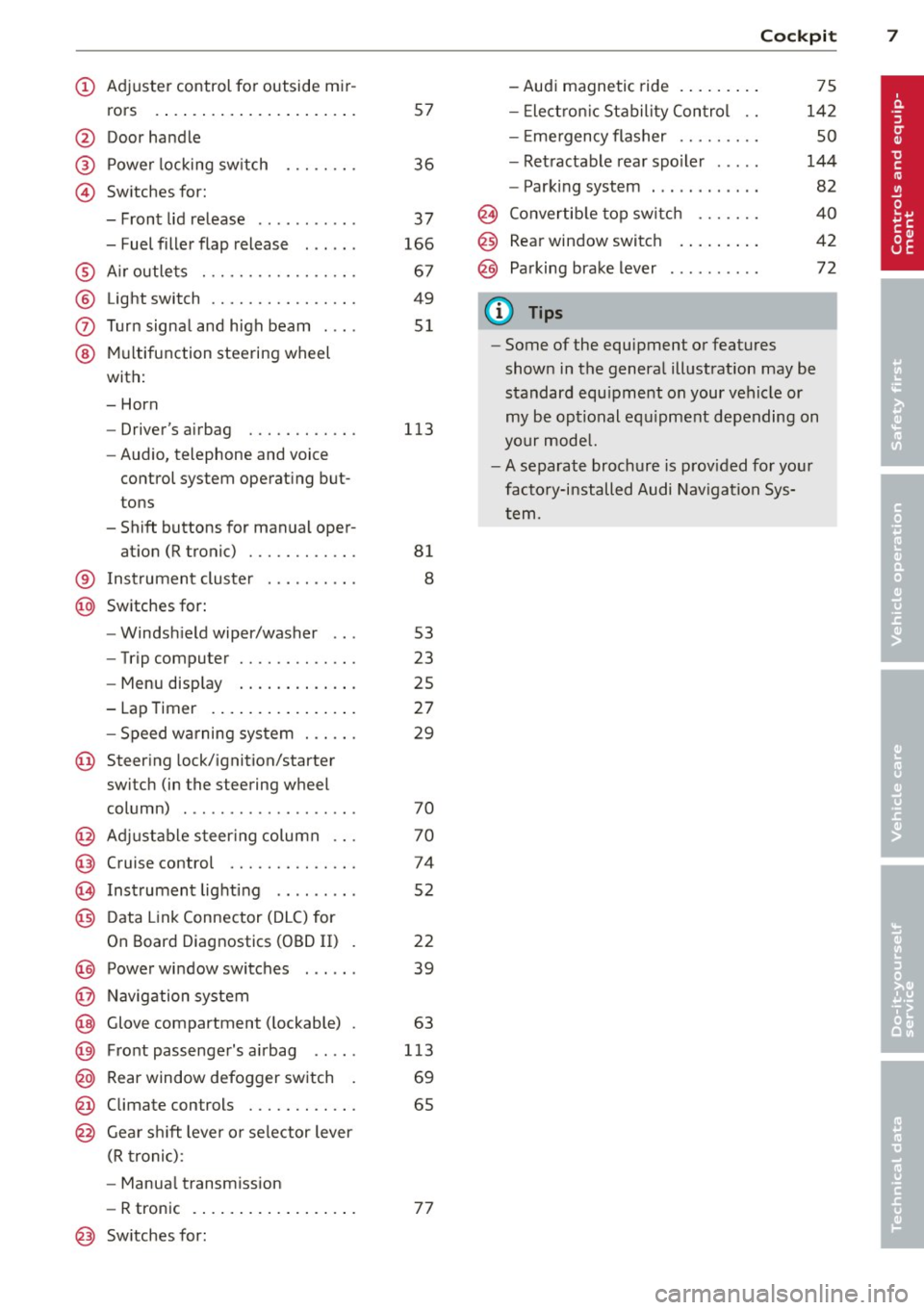
(!) Adjuster control for outside mir-rors .... ..... .......... .. .
@ Door handle
@ Power locking switch
© Switches for:
- Front lid release .......... .
- Fuel filler flap release . .. .. .
® Air outlets ............ .... .
® Light switch ............... .
(J) Turn signal and high beam ... .
@ Multifunction steering wheel
with:
- Horn
- Driver's airbag ........... .
- Audio, telephone and voice
control system operating but
tons
- Shift buttons for manual oper-
at ion (R tronic) ........... .
® Instrument cluster
@ Switches for: 57
36
37
166
67
49
51
113
81
8
- Windshield wiper/washer 53
- Trip computer . . . . . . . . . . . . . 23
- Menu display . . . . . . . . . . . . . 25
- Lap Timer . . . . . . . . . . . . . . . . 27
- Speed warning system . . . . . . 29
@ Steering lock/ignition/starte r
switch (in the steering wheel
column) . . . . . . . . . . . . . . . . . . . 70
@ Adjustable steering column . . . 70
@ Cruise control . . . . . . . . . . . . . . 74
@ Instrument lighting . . . . . . . . . 52
@) Data Link Connector (DLC) for
On Board Diagnostics (OBD II) . 22
@) Power window switches . . . . . . 39
@ Navigation system
@ Glove compartment (lockable) . 63
@ Front passenger's airbag . . . . . 113
@ Rear window defogger switch . 69
@ Climate controls . . . . . . . . . . . . 65
@ Gear shift lever or selector lever
(R tronic) :
- Manual transmission
- R tronic . . . . . . . . . . . . . . . . . . 77
@ Switches for: -Audi magnetic ride ........
.
- Electronic Stability Control ..
- Em ergency flasher ........ .
- Retractable rear spoiler .... .
- Parking system ...... ..... .
Cockpit 7
75
142
so
144
82
@ Convertible top switch . . . . . . . 40
@ Rear window switch . . . . . . . . . 42
@ Parking brake lever . . . . . . . . . . 72
(D Tips
-Some of the equipment or features
shown in the general illustration may be
standard equipment on your vehicle or
my be optional equipment depending on
your model.
-A separate brochure is provided for your
factory-installed Audi Navigation Sys
tem.
Page 21 of 236
Instruments and warning/indicator lights 19
Contact your authorized Audi dealer for assis
tance if necessary.
@ Tips
The brake light switch is only inspected as
pa rt of the functional check after the en
gine is started.
@ Light/rain sensor defective
Applies to vehicles: with automatic headlights
The indicator light indicates a defect in the
automatic headlights/automatic wiper sys
tem.
If the symbol illum inates, the light sensor has
failed. For safety reasons, the low beams are
turned on permanently with the switch in
AU
TO. However, you can continue to turn the
lights on and off using the light switch. In the
case of a defect in the rain sensor, the wind
shield wiper lever functions are still available .
H ave the light/ra in sensor checked as soon as
possible at an author ized Audi dealer.
; Audi magnetic ride
The indicator light monitors vehicle damping.
The indicator light E ill uminates when the ig
nition is switched on as
a function check.
(D Tips
If the ind icator lamp illuminates while you
are driving, there is a malfunct ion in the
veh icle damping. The chass is should be in
spected immediately by an authorized Au
di dealer.
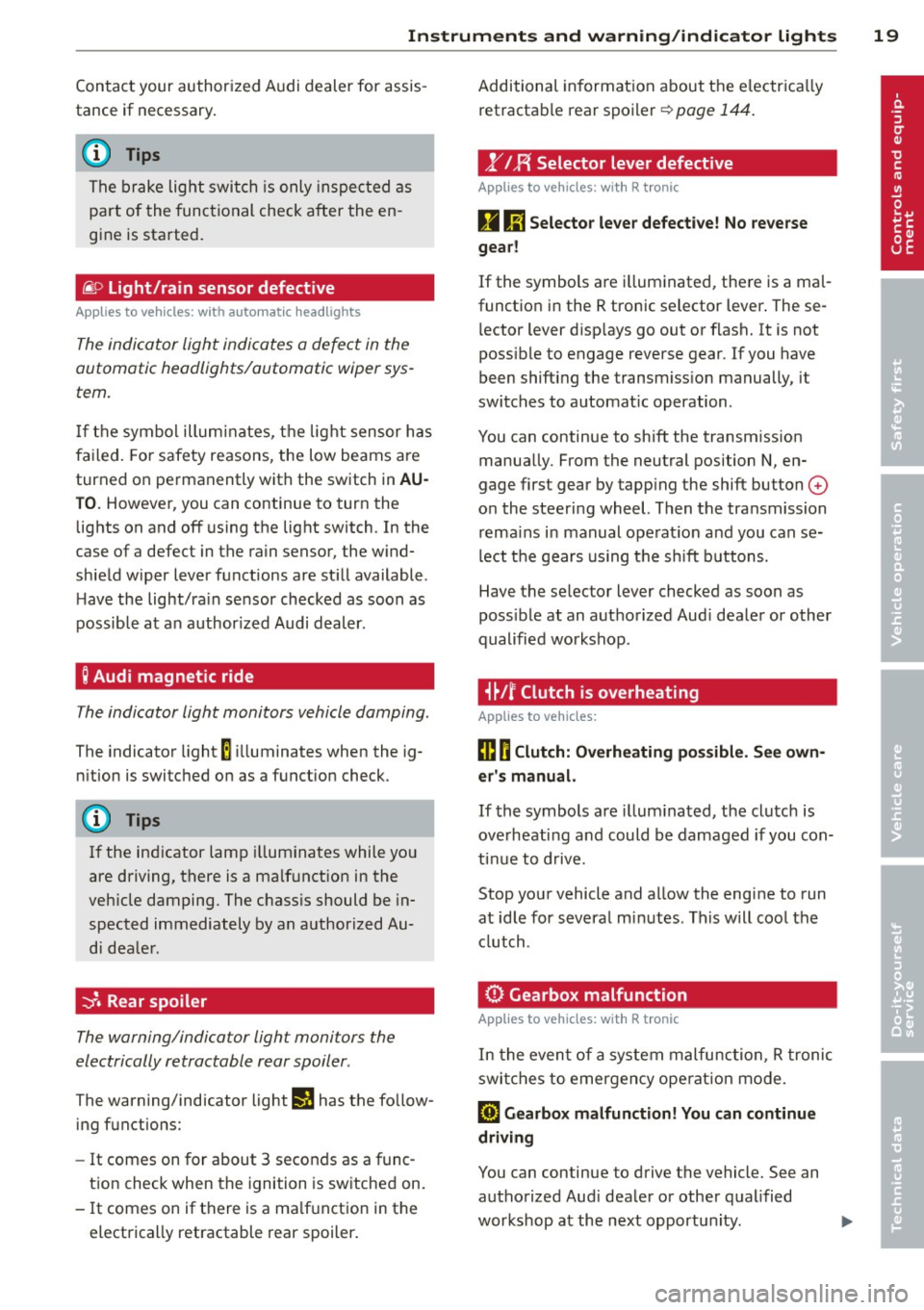
-:;J. Rear spoiler
The warning/indicator light monitors the
electrically retractable rear spoiler .
The warning/indicator light Ii! has the follow
ing functions:
-It comes on for about 3 seconds as a func
t ion check when the ignition is switched on.
- It comes on if there is a ma lfunction in the
electrically retractable rear spoiler . Additional
information about the electr ica lly
retractable rear spoiler
r:;, page 144.
,.YI F{ Selector lever defective
Applies to vehicles : with R tronic
g Ii] Selector lever defective! No reverse
gear!
If the symbols are i lluminated, there is a mal
function in the R tronic selector lever . These
l ector lever d isp lays go out or flash. It is not
poss ible to engage reverse gear. If you have
been shifting the transm iss ion manually, it
switches to automat ic operation.
You can continue to shift the transmission manually. From the neutral position N, en
gage first gear by tapp ing the shift button
0
o n the steering wheel. Then the transmission
remains in manual operat ion and you can se
lect the gears using the s hift buttons.
Have the selector lever checked as soon as
poss ible at an authorized Aud i dealer or other
qualified workshop .
i~Jf Clutch is overheating
Applies to vehicles:
ffl O Clutch: Overheating possible. See own
er's manual.
If the symbols are i llum inated, the clutch is
ove rheating and could be damaged if you con
tinue to drive.
Stop your vehicle and allow the engine to run
at idle for several m inutes . This w ill cool the
clutch.
0 Gearbox malfunction
App lies to vehicles: wit h R tro nic
In the event of a system malfunction, R tronic
switches to emergency ope rat ion mode.
[O) Gearbox malfunction! You can continue
driving
You can continue to drive the vehicle. See an authorized Aud i dealer or other qualified
workshop at the next opportun ity . ..,.
Page 47 of 236
Opening the convertible top storage bay
lid
• From th e rear of the vehicle, reach into the
center ventilation slot in the storage bay lid
with both hands and raise the lid approxi
mately 12 in (30 cm).
"' Hold the storage bay lid in this position and
pull it toward you until it stops ¢
fig. 48 .
& WARNING
When working in the engine compart
ment:
- Turn the engine off .
- Act ivate the parking brake.
-
-In veh icles with a manual transm ission,
move the shifter lever into idle. In vehi -
cles with the R tronic transmission, move
the selector lever into the N position.
- Remove the ignit ion key.
- Let the engine cool down.
- Keep children away from the engine com- partment .
(D Note
To prevent damage to the vehicle, only
open the convertible top storage bay lid
when the engine compartment lid is
closed.
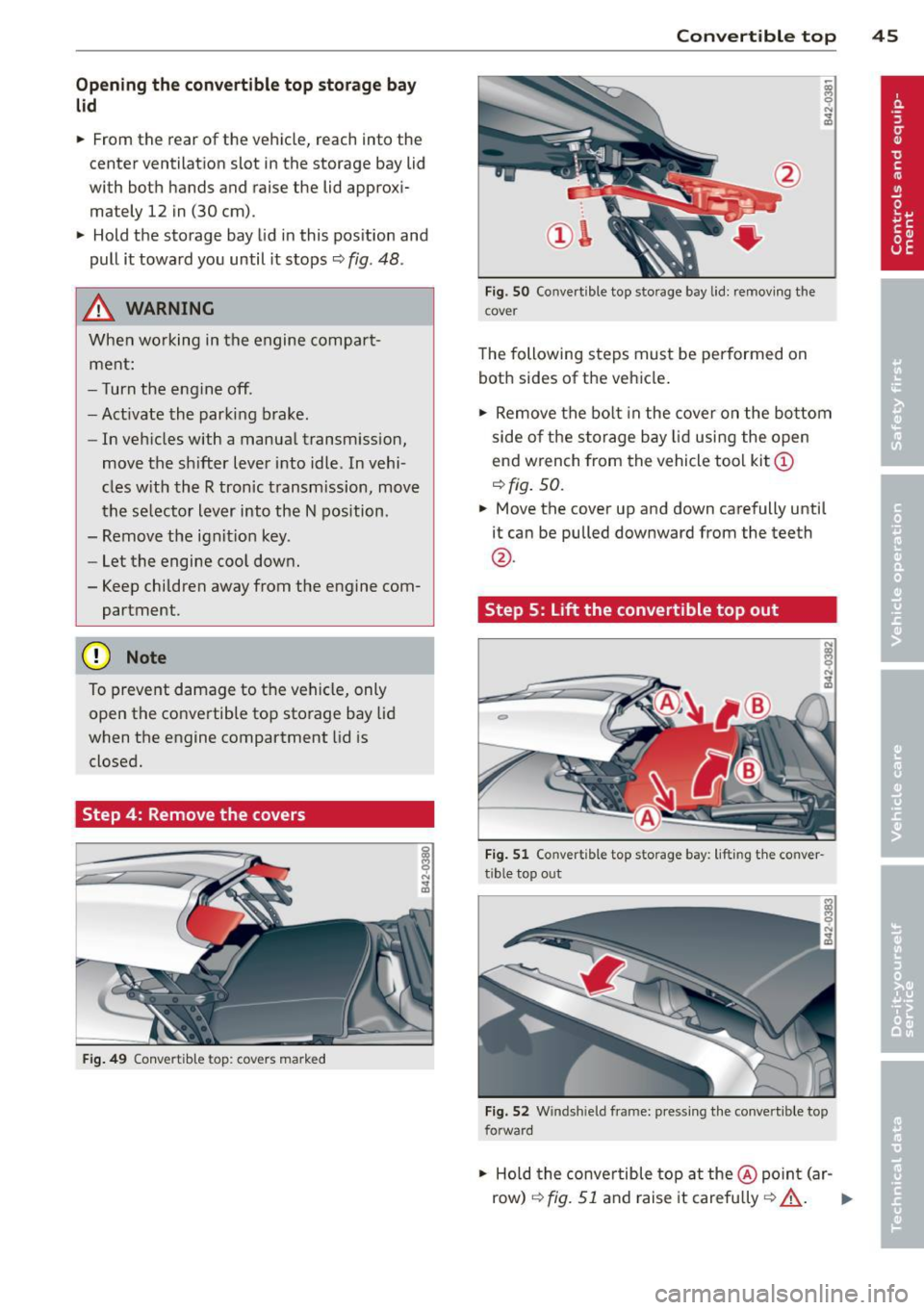
Step 4: Remove the covers
Fig. 49 Conve rtib le t op : cove rs ma rk e d
Convertible top 45
Fig . SO Co nver tible top sto rage bay lid: remov ing the
c ov er
The following steps must be performed on
both sides of the vehicle.
"' Remove the bolt in the cover on the bottom
side of the st orage bay lid using the open
end wrench from the vehicle tool kit@
¢fig. 50.
• Move the cover up and down carefully unt il
it can be pulled downward from the teeth
@ .
Step 5:
Lift the convertible top out
Fig. 51 Co nve rtible top s tora ge bay: liftin g th e co nver
tible top out
Fig. 52 Wind shi eld fra me: press ing the conve rti ble top
fo rward
"' Ho ld the conve rtible top at the@ point (ar-
row)
¢ fig. 51 and raise it carefully ¢_& . II--
Page 73 of 236
Ignition on @
Afte r switch ing the ignition on, the needles
move all the way up and then down .
I f it is difficult to turn the key afte r you have
i nse rted it into the ignit ion lo ck, tur n the
steer ing whee l back and forth. This will take
the load off the steering lock mechanism and
you will be able to turn the key freely and start the engine .
Starting the engin e@
In th is position the engine starts. While the
engine is start ing, the power s upply to the
headlights and other e lectrica l consumers is
temporari ly interrupted to conserve battery
pow er. Aft er the engine has started, release
the key and it will return to posit ion @.
Before the starter can be operated again the
key must be turned back to position@. The
non -repe at lock prevents you from damaging
the starter when the engine is runn ing .
A WARNING
-Never remove the key from the ign ition
lock whi le the vehicle is moving. The
steering wheel will lock causing loss of control.
- If you have to leave your veh icle -even
for just a m in ute - always remove the ig
nition key and take it with you. This is es
pecially important if you a re going to
leave c hildren behind in the vehicle. The
children co uld start the engine or use
other vehicle controls . Unsupervised use
of vehicle controls (for example, power
windows) can cause serious personal in
jur ies .
If the vehicle battery has been disconnect
ed and then reconnected, then you m ust
leave the key in pos ition @for abo ut 5
seconds before you can start the engine.
On th e ro ad 71
Starting the engine
The engine can only be started with your orig
inal Audi key.
On vehicles with R tronic *, the engine can be
start ed in the ne utra l position N and in each
gea r (1 - 6 and R).
.. Set the park ing brake ¢,&. .
.. On vehicles with man ua l transmission *,
fu lly depress the clutch pedal.
.. Press and hold the brake pedal.
.. Turn the ignition key to pos it ion ®
¢ page 70, fig. 82 - do not depress the gas
pedal when starting the engine .
.. Let go of the key as soon as the engine
starts - the sta rter must not cont inue to
r u n. On ve hicles w ith R t ro ni c, selec t gea r
posi tion N .
A cold engine may at first be loud afte r it has
been sta rted. This is due to the hydraulic
valves bu ild ing up the oil press ure . Thi s is nor
mal and no need for concern.
If the engine does not start immediately, stop
tryi ng after 10 seconds and then try to restart
the engine abou t 30 seconds later.
A WARNING
- Never start or let the eng ine run in a con
fined or enclosed area . Exha ust fumes
from the engine contain carbon monox
ide, a co lor less and odorless gas. Carbon
mo nox ide ca n be fatal if inhaled.
- Never leave the engine idling unattend
ed. An unattended veh icle with a runn ing
engine poses a danger of personal injury
or theft .
- With the engine r unning and a gear en
gaged, you have to hold the veh icle w ith
the foot brake .
(D Note
- Avoid h igh engine speeds, fast accelera
tion or heavy engine loads while the en
gine is still cold. This could damage the
eng ine .
Page 76 of 236
7 4 On the road
Cruise control
Introduction
The cruise control system keeps the speed
constant.
The cruise control system makes it possible to
drive at a constant speed over 20 mph (US
model) or 30 km/h (Canadian model) . This is
true only to the extent that engine power or
engine braking effect allow . Using the system
takes the strain off the "gas pedal foot" - es
pecially on long trips.
In the control mode, the indicator light in the
instrument cluster is lit
aijj(1)~1~ (US model);II
(Canadian model).
The cruise control system automatically
switches itself off immediately under the fol
lowing conditions:
- Pressing the brake pedal.
- Pressing the clutch pedal.
A WARNING
-Always pay attention to traffic even when
the cruise control system is switched on.
You are always responsible for your speed and the distance between your ve
hicle and other vehicles.
- For safety reasons, the cruise control sys
tem should not be used in the city, in
stop-and-go traffic, on twisting roads
and when road conditions are poor (such
as ice, fog, gravel, heavy rain and hydro
planing) -risk of accident.
- Turn off the cruise control system tem
porarily when entering turn lanes, high
way exit lanes or in construction zones.
- Please note that inadvertently "resting"
your foot on the accelerator pedal causes
the cruise control system not to brake.
This is because the cruise control system
is overridden by the driver's acceleration.
(D Note
On manual transmission vehicles: If you
shift into neutral with the cruise control system switched on, always depress the
clutch
pedal! Otherwise the engine will
race and could be damaged as a result.
(D Tips
When driving on steep downward grades,
the cruise control system cannot keep the
speed constant. The vehicle's own weight increases the speed. Shift into a lower gear
in plenty of time or brake the vehicle with
the foot brake.
Saving the speed
The desired speed must be saved.
®-
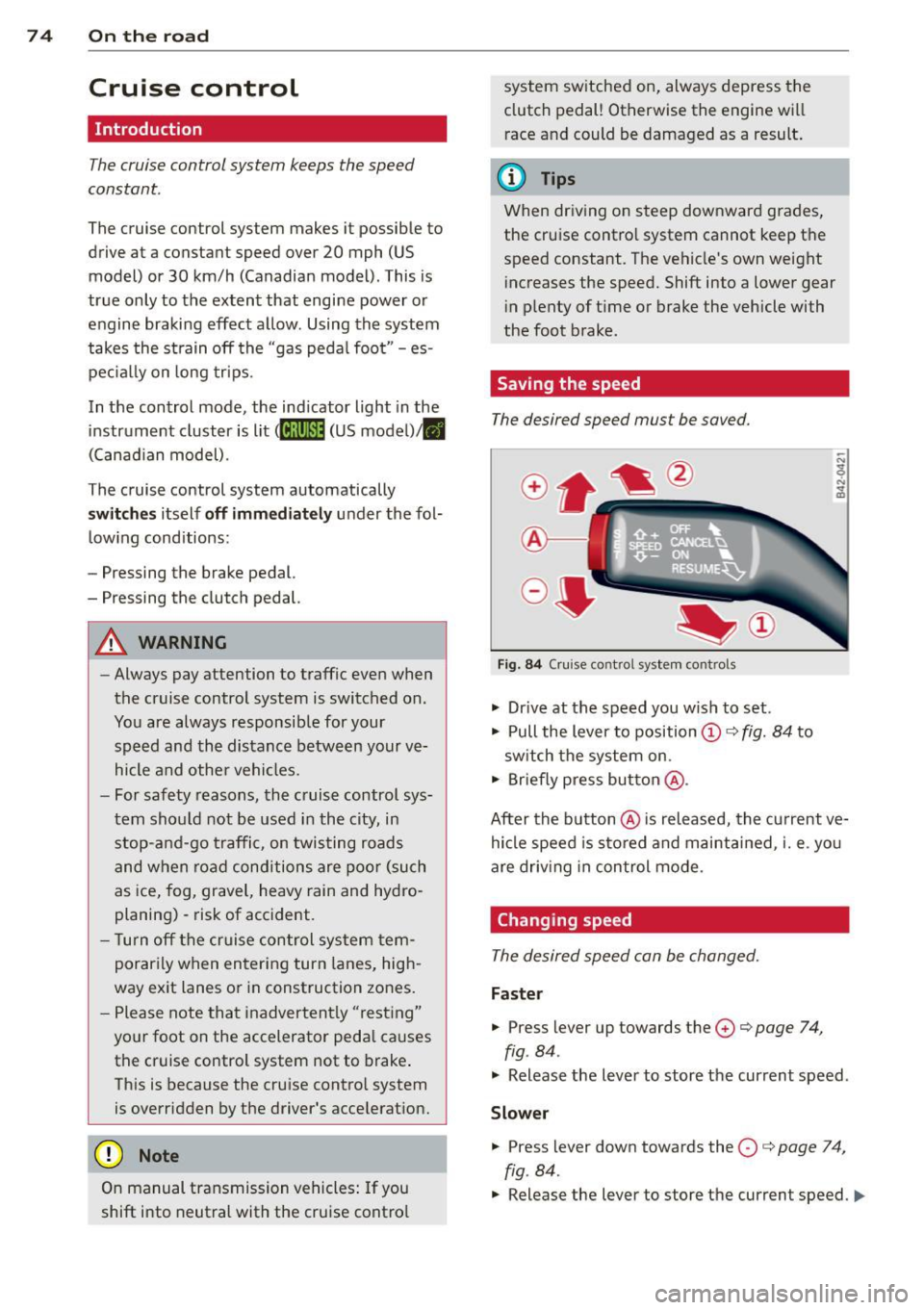
Fig. 84 Cruise control system cont rols
.,. Drive at the speed you wish to set.
.,. Pull the lever to position@¢
fig. 84 to
switch the system on.
.,. Briefly press button @.
After the button @is released, the current ve
hicle speed is stored and maintained,
i. e. you
are driving in control mode .
Changing speed
The desired speed can be changed.
Faster
.,. Press lever up towards the 0 ¢ page 7 4,
fig . 84 .
.,. Release the lever to store the current speed .
Slower
.. Press lever down towards the O ¢ page 74,
fig . 84.
.,. Release the lever to store the current speed. IJ,,,
Page 79 of 236
Transmission Manual transmission
Gearshift lever
App lies to vehicles: with manual transmission
The clutch pedal must be depressed all the
way before you can start the engine.
T he manual transmission in your Audi is
equipped with an
interlock-feature.
• Depress the clutch pedal all the way.
• Start the engine with the gearshift lever in
Neutral and the clutch pedal depressed.
(D Note
Always depress the clutch pedal fully when
changing gears . Do not hold the vehicle on
a hill with the clutch pedal partially de
pressed. This may cause premature clutch
wear or damage .
@ Tips
- Resting your hand on the gearshift lever
knob while driving will cause premature
wear in the transmission.
- The back-up lights go on when you sh ift
into Reverse w ith the ignition on.
Gearshift pattern (6-speed manual
transmission)
Applies to vehicles: with 6-speed manual transmission
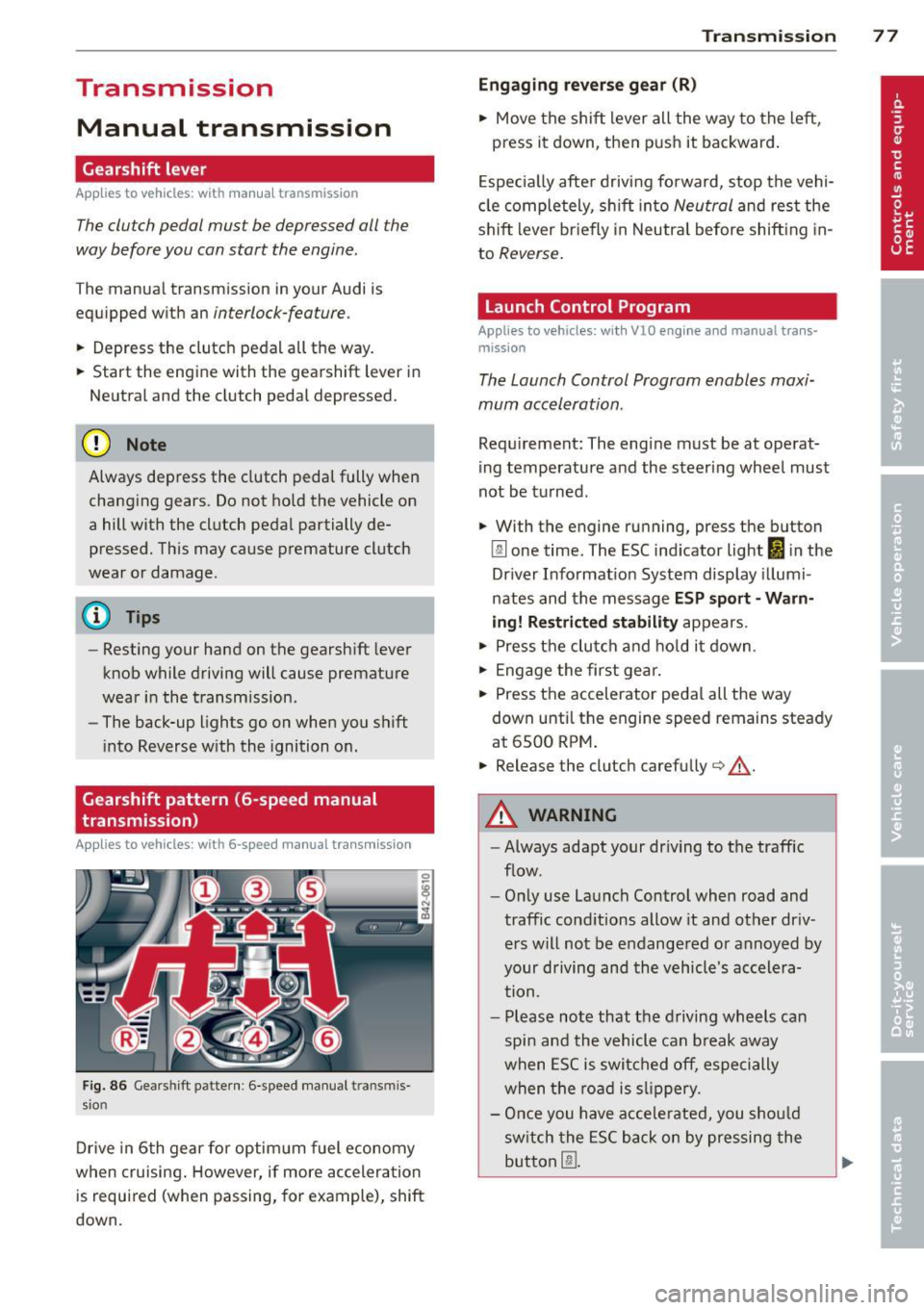
Fig. 86 Gearshift pattern : 6 -speed manual tran smi s
sio n
Drive in 6th gear for optim um fuel economy
when cruising . However, if more acceleration
is required (when passing, for example), shift
down.
Transmission 77
Engaging reverse gear (R)
• Move the shift lever all the way to the left,
press it down, then push it backward.
Especially after driving forward, stop the vehi
cle completely, sh ift into
Neutral and rest the
shift lever br iefly in Neutra l before shift ing in
to
Reverse .
Launch Control Program
Applies to vehicles: with VlO eng ine and manual t ra ns·
miss ion
The Launch Control Program enables maxi
mum acceleration .
Requirement: The engine must be at operat
ing temperature and the steering wheel must
not be turned .
• With the engine running, press the button
Im one time. The ESC indicator light 1B in the
Driver Informat ion System display illumi
nates and the message
ESP sport - Warn
ing! Restricted stability
appears.
• Press the clutch and hold it down.
• Engage the first gear.
• Press the accelerator pedal all the way
down until the engine speed remains steady
at 6500 RPM .
• Release the clutch carefu lly <=> .& ..
A WARNING
- Always adapt your dr iving to the traffic
flow.
- Only use Launch Control when road and
traffic conditions allow it and other dr iv
ers will not be endangered or annoyed by
your driving and the vehicle's accelera
tion.
- Please note that the driving wheels can
spin and the vehicle can break away
when ESC is switched off, especially
when the road is slippery.
- Once you have accelerated, you sho uld
sw itch the ESC back on by pressing the
button
[fil .
Page 80 of 236
78 Transmission
@ Tips
-When accelerating using the Launch
Control program, all vehicle parts are
subject to heavy loads. This can result in
increased wear.
- The Launch Control Program only func tions when the parking brake is released
and the vehicle speed is less than 3 mph
(5 km/h).
R tronic
Description
Applies to vehicles: with R tro nic
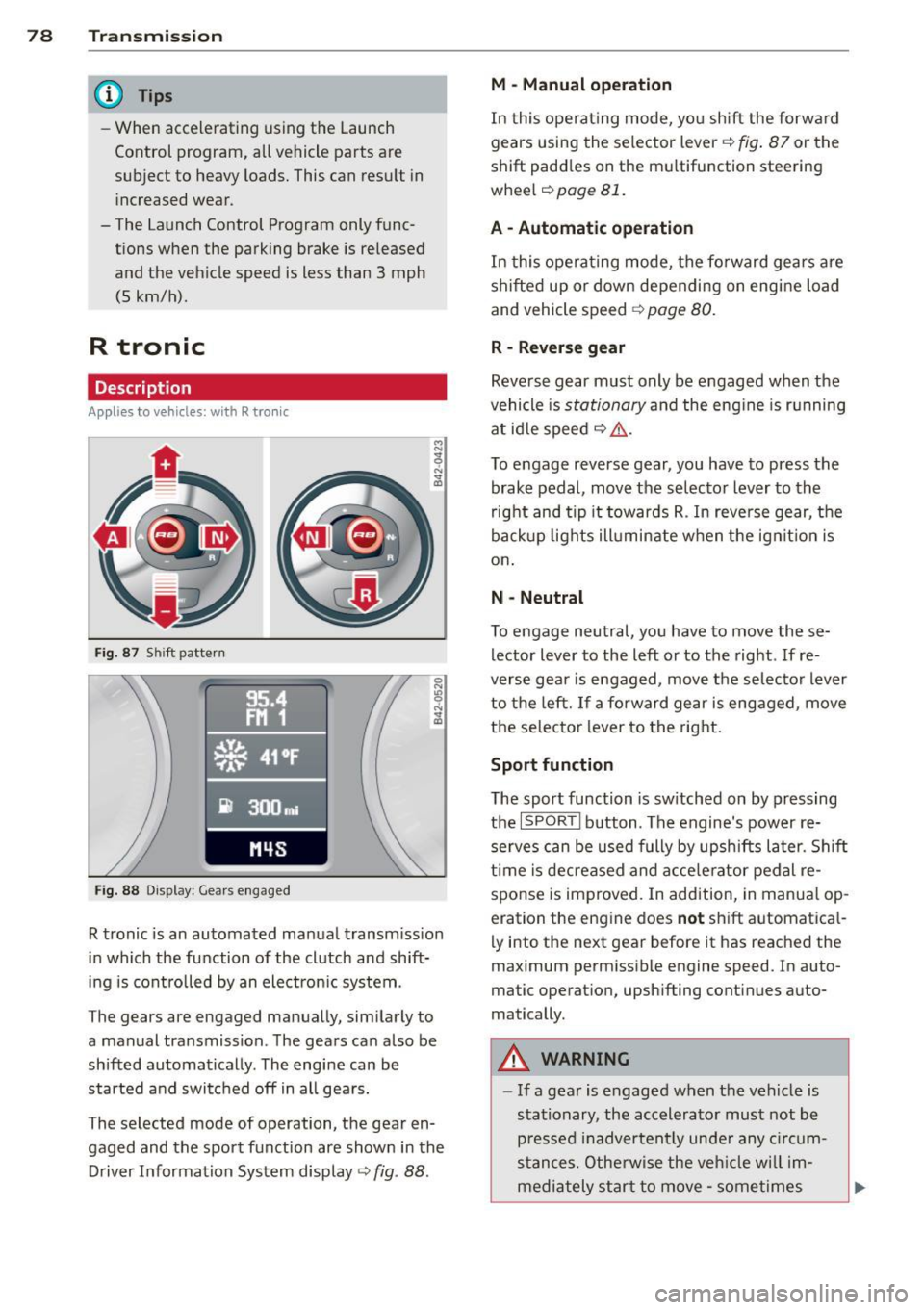
Fig. 87 Shi ft pattern
Fig. 88 Disp lay: Gea rs engaged
R tronic is an automated manual transmission
in which the function of the clutch and shift
ing is controlled by an electron ic system .
The gears are engaged manually, sim ilarly to
a manual transmission . The gears can also be
shifted automatically . The engine can be
started and switched off in all gears.
The selected mode of operation, the gear en
gaged and the sport function are shown in the
Driver Information System display
Q fig . 88 .
M -Manual operation
In this operat ing mode, you shift the forward
gears using the selector lever
Q fig. 87 or the
shift paddles on the mu ltifunction steering
whee l
Q page 81.
A - Automatic operation
In this opera ting mode, the forward gears are
shifted up or down depending on engine load
and vehicle speed
Q page 80.
R -Reverse gear
Reverse gear must only be engaged when the
vehicle is
stationary and the eng ine is running
at idle speed
¢ ,&. .
To engage reverse gear, you have to press the
brake pedal,
move the selector lever to the
right and tip it to wards R . In reverse gear, the
backup lights illuminate when the ignit ion is
on .
N -Neutral
To engage neutral, you have to move these
lector lever to the left or to the right.
If re
verse gear is engaged,
move the selector lever
to the left.
If a forward gear is engaged , move
the selector lever to the right.
Sport function
The sport function is sw itched on by pressing
the
I SPOR T I button. The engine's power re
serves can be used fully by upshifts later. Shift
time is decreased and accelerator pedal re
sponse is improved. In addition, in manual op
eration the engine does
not shift automatica l
ly into the next gear before it has reached the
maximum permissible engine speed. In auto
matic operation, upsh ifting cont inues auto
matically.
A WARNING
-- If a gear is engaged when the vehicle is
stationary, the accelerato r must not be
p ressed inadvertently under any circum
stances. Otherwise the vehicle w ill im
mediately star t to
move -sometimes
Page 83 of 236
Steering wheel with shift paddles
Applies to vehicles: with R tro nic
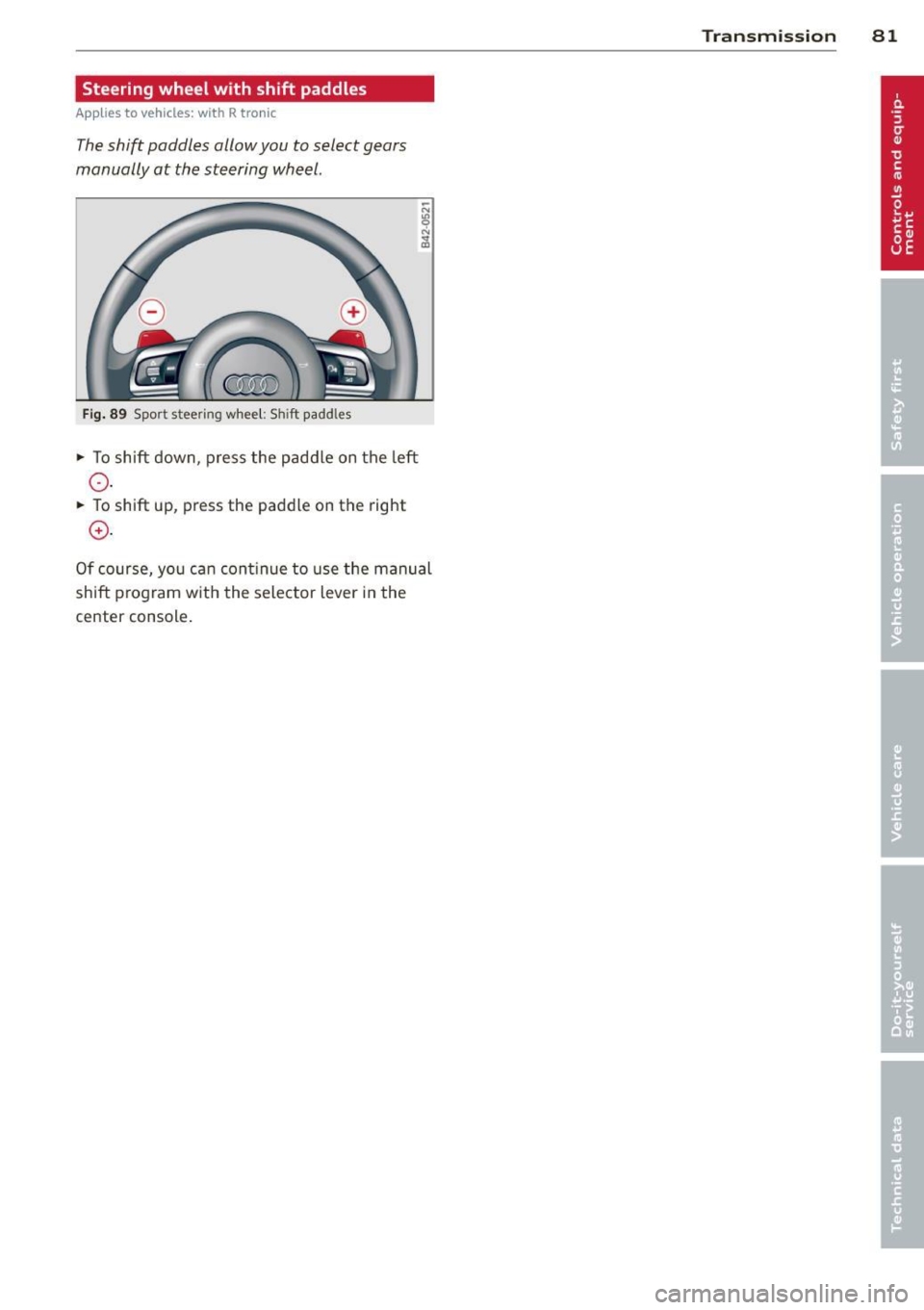
The shift paddles allow you to select gears
manually at the steering wheel.
Fi g. 89 Spo rt steering wheel: Sh ift paddles
.,. To shift down, press the p ad d le on t he le ft
0 .
.,. To shift up, press the paddle on the right
0 .
Of course, yo u ca n con tinue to use the manual
shift p rog ram w it h the selector lever in the
center console .
Transmission 81
Page 148 of 236
146 Intellig ent technolog y
Other road users must not be put at risk -
yo u may cause an acc ident!
- Before descending a steep grade, reduce
speed and shift transmission into a lower
gear or lower driving position . Do not
ride the brakes or ho ld the pedal down
too long or too often . This cou ld cause
the brakes to get hot and d iminish brak
ing efficiency .
- Do not "ride the brakes" by resting your
foot on the pedal when you do not intend
to brake . Thi s may cause the b rakes to
overheat, premature wea r and inc reased
stopp ing distance.
- Under certain climat ic and operating
condit ions such as passing through wa
ter, driving in heavy ra in or after wash ing
the vehicle, the effectiveness of the
brakes can be reduced . In winter, ice can
accumulate on the brake pads, linings,
discs and drums. Cautiously apply brakes
for a test . Brakes will dry and ice coat
ings w ill be cleaned off after a few cau
t ious brake applications .
- Driv ing for an extended period of time on
salt-covered roads w ithout us ing your
brakes can also affect braking efficiency .
Clean off accumulated salt coating from
brake discs and pads w ith a few cautious
brake applicat ions.
- If you damage the front spoiler, or if you
ins tall a different spoiler, be su re the air
flow to the front brakes is not obstruct
ed. Otherwise the brake system co uld
overheat red ucing the effectiveness of
the ent ire brake system.
- Failure of one brake circuit will impair
braking capab ility, resulting in increased
stopp ing distance. Avoid driv ing the vehi
cle and have it towed to the nearest au
thorized Aud i dealer or qualified work
shop .
- Never let the vehicle roll to a stop w ith
the engine shut off .
- If the brake booster is not working, for
example when tow ing your vehicle, or
because the b rake booste r has somehow
been damaged, the brake pedal must be pressed considerably harder to make up
for the lack of booster assistance .
Power steering
When the engine is running, power steering
makes i t easier for the driver to s teer .
Power steering helps the driv er steer the vehi
cle with litt le physica l effort.
If the engine is not running, the power steer
ing system is also not working . In this case ,
you wi ll find it extremely d ifficu lt to turn the
steering wheel.
If you turn the steering fully to the left or
rig ht when the vehicle is stationary, you p lace
a very heavy load on the power steering sys
tem. Turning the steering wheel fully to the left or right will cause noise in the system. It
also reduces engine id le speed.
(D Note
Do not hold the steering t urned fu lly to
the left or r ight for more than 10 seconds
when the engine is running . There is a r isk
of damage to the power steering system .
(D Tips
-In the event of a power steering system
failure, or if the engine is not running
(while being towed), you will still be ab le
to steer the vehicle. However, you will re
quire more effort to do so .
- If the powe r stee ring system has a leak
or is defect ive , you should immediately
contact a qualified wor kshop .
- The power steer ing system req uires a
special hydraulic fl uid. The power steer
ing fluid reservoir is located in t he en
gine comp artment. The co rrect hydrauli c
fluid level is important for proper opera
tion of the power steering system. The
power steering fluid level is checked ac
cording to the Audi maintenance service
schedule.
Page 152 of 236
150 Driving and en vironm ent
Driving and
environment
Break-in period
A new vehicle must be broken in, and the break-in per iod should be 1,500 miles (2,500
km) . Do not use full acceleration for the first
600 miles (1,000 km) and do not exceed the
maximum eng ine speed of 6,000 rpm You
m ust also not use fu ll acce lerat ion between
600 and 1,200 m iles ( 1,000 to 2,000 km).
Fr om 1,200 to 1 ,500 mi les (2,000 to 2,500
km), you can gradua lly increase maxim um en
gine speed to 8,250 rpm for brief periods.
During the first ho urs of operation, there is
g reater friction in the engine and the trans
mission than later when a ll the moving parts
have broken in.
The way yo u drive duri ng the first 1 ,500 miles
(2,500 km) affects engine quality. If you drive
at moderate engine speeds thereafter, partic
u lar ly when the engine is cold, yo u reduce en
gine wear and increase the potential mileage
of the engine.
Do not drive at RPMs that are too low. Shift
down when the engine is no longer running
"smoothly". Extreme ly high RPMs are gov
erned automa tically.
Driving through water
on roads
Note the following to avoid vehicle damage
when dr iving t hrough water, for example on
flooded roads:
- The water must not be any higher than the
bottom of the vehicle body .
- Do not drive faster than wa lking speed .
.&_ WARNING
After driving through water, mud, slush,
etc., the brakes may be slow to take effect
because of wet b rake roto rs and pads. Dry
t he brakes fi rst by bra king carefully to re
sto re the full braking effect .
-
(D Note
Vehicle components such as the eng ine,
transmission, suspension or e lectrical sys
tem can be severe ly damaged by dr iv ing
through water .
@ Tips
-Check the depth of the water before d riv
ing through it.
- Do not stop the vehicle, drive in reverse
or switch the engine off when driving
through water.
- Keep in mind that oncoming vehicles
may create waves that raise the water
level and make it too deep for your vehi
cle to drive through safely .
- Avo id driving through salt water because
it can cause corros ion.
Catalytic converter
You must use lead-free gasoline in your veh i
cle, otherwise you will destroy the ca talyt ic
converter .
Never run the fuel tank completely dry; their
regular fue l supply could cause misfires . This
allows unburned fue l into the exhaus t system,
poss ibly resulting in overheating and damage
to the catalytic converter .
.&_ WARNING ,-
-Do not park or operate the vehicle in
a reas where the hot exha ust system may
come in co nta ct with dry g rass, brush,
fue l spills or o ther material which can
cause a fire.
- Do not app ly addition al under coating or
r u stproofing on or nea r the exhaust
manifold, exhaust pipes, catalytic con
verter or heat shields . Dur ing driving, the
substance used for undercoating could
overheat and cause a fire.
(D Note
To ensure efficient o peration of the Emis
s ion Control System :