engine oil AUDI R8 SPYDER 2014 User Guide
[x] Cancel search | Manufacturer: AUDI, Model Year: 2014, Model line: R8 SPYDER, Model: AUDI R8 SPYDER 2014Pages: 244, PDF Size: 61.06 MB
Page 149 of 244
The effectiveness of the brakes can be reduced
when the vehicle is dr iven on a salt -covered
road and the brakes are not used. Likewise,
you clean
off accumulated salt coating from
brake discs and pads with a few ca utious ap
plications of the brake<=>,& .
Co rrosion
There may be a tendency for dirt to build up
on the brake pads and corrosion to form on
the discs if the car is not dr iven regularly or
only for short trips with little use of the
brakes.
If the brakes are not used frequently, or if cor rosion has formed on the discs, it is advisable
to clean
off the pads and discs by brak ing
firmly a few times from a moderately high
speed<=> ,&.
Fa ult s in th e bra ke s yste m
If you should notice a sudden increase in
brake pedal travel, then one of the two brake
circu its may have failed. Drive immed iately to
the nearest qualified workshop to have the
damage repa ired. Drive at reduced speed on
the way there and anticipate longer stopping
d istances and higher peda l pressure¢ _&.
Low brake fluid level
Malfunctions can occur in the brake system if
the brake flu id level is too low . The brake fluid
l eve l is monito red electronically .
Brake po wer ass ist un it
The brake power assist un it increases the
pressure that you generate with the brake
pedal. It works only when the eng ine is run
ning.
Br ake lining w ear statu s
Brake lining wear may be checked by visual in
spection of the condition of the brake pads
through the openings in the wheel. If neces
sary, the wheel may be removed for this in
spection
¢ page 214 .
Int ellig ent technolog y 147
_& WARNING
-You should perform braking maneuvers
for the purpose of cleaning the brake
system only if road conditions permit.
Other road use rs must not be put at risk -
you may ca use an accident!
- Before descend ing a steep grade, reduce
speed and sh ift transmission into a lower
gear o r lower dr iving range. Do not ride
the brakes or hold the pedal down too
long o r too often. Th is could cause the
brakes to get hot and diminish braking
efficiency .
- Do not " ride the brakes" by resting you r
foot on the pedal when you do not intend to brake. This may cause the brakes to
overheat, premature wear and increased
stopping distance.
- Under certain cl imatic and operat ing
conditions such as passing through wa
ter, dr iv ing in heavy rain o r after washing
the vehicle, the effectiveness of the brakes can be reduced. In winte r, ice can
accumu late on the bra ke pads, lin ings,
discs and drum s. Carefully app ly bra ke s
for a test. Brakes w ill dry and ice coa t
ings w ill be cleaned
off after a few care
fu l brake applications.
- Driving for an extended period of time on
salt -cove red roads without using your
brakes can a lso affect braking efficiency .
Clean
off accum ulated salt coating from
brake discs and pads with a few cautious
brake applications.
- I f you damage the front spoiler, or if you
install a different spoiler, be sure the air
f low to the front brakes is not obstruct
ed. Otherw ise the brake system could
overheat reducing the effectiveness of
the entire brake system.
- Failure of one b rake circuit will impai r
the braking capab ility result ing in an in
creased stopping distance. Avoid driving
the vehicle a nd have it towed to the near
est A udi dealer or qualified workshop .
- Never let the veh icle roll to a s top with
the engine shut
off. .,.
•
•
Page 150 of 244
148 Intelligent technology
-If the brake booster is not working, for
example when towing your vehicle, or
because the brake booster has somehow
been damaged, the brake pedal must be
pressed considerably harder to make up
for the lack of booster assistance .
Rear spoiler
The rear spoiler improves vehicle handling
and enhances driver control.
SPORT •
Fig. 129 Switch for rea r sp o ile r
The rear spoiler deploys and retracts. Spoi ler
operation can be set for automatic or manual
operation.
Automatic mode (normal operation )
-Extending automatically: This occu rs when
driving faster than approximate ly 62 mph
(100 km/h) or at a certain engine compart
ment temperature
1> .
- Retracting automatically: This occurs when
driv ing s lower than approximately 22 mph
(35 km/h) or at a certain engine compart
ment temperature
1> .
Manual mode
- Extending manually: Press the switch
~ fig. 129 briefly to extend the rear spo iler
completely.
- Retracting manually: When dr iving at
speeds below approximately 12 mph (20
km/h), press and hold the switch to retract
the rear spoiler . When driving at speeds be
tween 12 mph and 62 mph (20 km/h and
l ) The rear s poiler o nly exten ds or ret racts a bove a cer
ta in eng in e te mp erat ure in s ome m odels.
100 km/h), press the switch briefly to re
tract the rear spoiler complete ly. You cannot
retract the rear spoiler if it extended due to
the engine compartment temperature .
Indicator light
When the indicato r light (.-) appears, there is
a system malfunction . The rear spoiler may
not be able to extend . This cou ld change the
vehicle's driving characteristics at high
speeds. Do not exceed 87 mph (140 km/h) .
Drive to your authorized Audi dealer immedi
ately to have the malfunction corrected .
A WARNING
Driving at higher speeds without the rear
spoiler deployed can impair handling char
acteristics, making the vehicle ha rder to
control.
- Imp roper operation of the rear spoiler
can cause crushing injuries. Always ma ke
sure that nobody, especia lly children, is
in the way when the rear spoi ler is de
p loyed or retracted.
- Always obey speed limits and other traf
fic laws .
- Ho t air from the eng ine compartment
can escape thro ugh the rear spoiler when
it is open and it could burn you.
(D Note
- Never push the vehicle or apply force to
t he rear spoiler -it could be damaged.
- Operate the rear spoiler manually only
when the eng ine compartment lid is
closed, otherwise there is a risk of dam
age .
(D Tips
Clean the spoiler compartment every 2 to
3 months. The spoiler compa rtment must
always be free of ice, snow, leaves or other
debris.
Page 151 of 244
Power steering
When the engine is running, power steering
makes it easier for the driver to steer.
Power steering he lps the driver steer the vehi
cle with little physical effort .
If the engine is not runn ing, the power steer
ing system is also not wo rking. In this case,
you will find it extreme ly difficult to turn the
steering whee l.
If you t urn t he steering fully to the le ft or
right when the vehicle is stationary, you place
a very heavy load on t he power steering sys
tem . T urning the steering wheel fu lly to the
left or r ight will cause noise in the system . It
a lso reduces engine idle speed.
(D Note
Do not hold the steering turned fully to
the left or right for more than 10 seconds
when t he engine is running. There is a risk
of damage to the power steeri ng system .
@ Tips
-In the event of a power steering system
failure, or if the eng ine is not running
(while being towed), you wi ll st ill be able
to stee r the ve hicle . However, you will re
quire more effort to do so .
- If the power steer ing system has a leak
or is defective, you should immed iately
contact a qualif ied wo rkshop.
- The powe r stee ring system requires a
spec ial hyd raulic f luid. The powe r stee r
i ng fl uid reservo ir is lo cated in the en
g ine compar tment . Th e cor re ct hydra ulic
f lui d leve l is important for p ro per opera
tion o f the power steering sys tem . The
power steer ing fl uid leve l is checked ac
cord ing to the Aud i maintenance service
schedule.
Dry sump Lubrication
H igh lateral and long itud inal forces affect the
engine and the vehicle d uring sporty driving.
Ory sump lubr ication ensures that your eng ine
Int ellig ent technolog y 149
is supplied wi th oi l and properly lubricated
even under these conditions .
In a "no rma l" veh icle the o il pump sends the
o il from the o il p an t o the lubr ication points in
t h e engine. The oi l then ret urns to the o il pan .
In extreme situations , the oil p ump may draw
in a ir, which results in insufficient oi l pressure.
Wi th dr y sump lubri cat ion, the o il is not in the
oi l pan (it is "dry"), but in a separate oil tank.
While one p ump supplies t he e ngine with oil ,
a second pump suctions the oil out of the en
gine and returns it to the oil tank. Because the
o il tank is tall and narrow, oil pressure is con
stant even under extreme conditions .
In add ition, the oi l pan in vehicles with dry
sump l ubrication is noticeab ly shallower. This
allows the engine to be installed lower in the
vehicle , bring ing down the center of grav ity .
T his imp roves your ve hicle's handling .
Driving with your
quattro ®
With all-wheel drive, all four wheels are driv
en.
General information
With a ll-wheel d rive, powe r is distr ib uted to
al l four wheels. This happens autom atic ally
depen ding on your d riving s tyle and the ro ad
conditions a t the time . See also ¢
page 144.
The all-whee l dr ive concept is des igned for
high eng ine power. Your veh icle is except ion
al ly powe rf ul and h as ex cellen t driving charac
teristics both under normal driving cond itions
and on snow and ice . Always read and follow
safety precaut ions ¢&. .
Winter tires
When dr iving in the win ter, yo ur vehicle wi th
a ll- wheel d rive h as an advantage, even w it h
regular tires. In winter road conditions it may
be advisable to mount winter tires (or all-sea
son tires) for improved driveability and brak
ing : these tires must be mounted on
all four
wheels . See also¢ page 203, Winter tires. .,..
•
•
Page 155 of 244
Driving and
environment
Break-in period
A new vehicle must be broken in, and the
break-in period should be 1,500 miles (2,500
km) . Do not use full acceleration for the first
600 m iles (1,000 km) and do not exceed the
maximum engine speed of 6,000 rpm You
must also not use full accelerat ion between
600 and 1,200 mi les (1,000 to 2,000 km).
Fr om 1,200 to 1,500 miles (2,000 to 2,500
km), you can gradua lly increase maximum en
gine speed to 8,250 rpm for brief periods.
During the first hours of operation, there is
greater friction in the engine and the trans
mission than later when all the moving parts
have broken in.
The way you drive during the first 1,500 miles
(2,500 km) affects engine quality. If you drive
at moderate eng ine speeds thereafter, partic
ularly when the engine is cold, you reduce en
gine wear and increase the potential mileage
of the engine.
Do not drive at RPMs that are too
low. Shift
down when the engine is no longer running
"smoothly". Extreme ly high RPMs are gov
erned automatically.
Avoid damaging the
vehicle
When you are driving on poor roads, or over
curbs, steep ramps, etc., make certain that
low-lying parts such as spoilers and exhaus t
system parts do not bottom out and get dam
aged.
This is especially true for vehicles with low
slung chassis (sports chassis) and fully loaded
veh icles.
Driving and environment 153
Driving through water
on roads
Note the following to avoid vehicle damage
when driving through water, for example on
flooded roads:
- The water must not be any higher than the
bottom of the vehicle body.
- Do not drive faster than walking speed .
A WARNING
After driving through water, mud, slush,
etc ., the brakes may be slow to take effect
because of wet brake rotors and pads . Dry
the brakes first by braking carefully to re
store the full braking effect.
(D Note
Vehicle components such as the eng ine,
transmission, suspension or electrical sys
tem can be severe ly damaged by dr iv ing
th rough water.
(D Tips
- Check the depth of the water before d riv
ing through it.
- Do not stop the vehicle, drive in reverse
or switch the engine off when driving
through water.
- Keep in mind that oncoming vehicles
may create waves that ra ise the water
level and make it too deep for your vehi
cle to drive through safely.
- Avo id driving through salt water because
it can cause corrosion.
Catalytic converter
It is very important that your emission con
trol system (catalytic converter) is function
ing properly to ensure that your vehicle is run
ning in on environmentally sound manner .
.,. Always use lead-free gasoline ~ page 167,
Fuel supply .
.,. Never run the tank down all the way to emp-
~. ~
•
•
Page 156 of 244
154 Driving and en vironm ent
• Never put too much motor oil in your engine
¢ page 180, Adding engine oil
The cata lytic converter is an efficient "clean
up" device built into the exhaust system of
the vehicle. The catalytic converter burns
many of the pollutants in the exhaust gas be
fore they are released into the atmosphere.
The exclusive use of unleaded fue l is critically
important for the life of the cata lytic convert
er and proper functioning of the engine.
A WARNING
- Do not park or operate the veh icle in
areas where the hot exhaust system may
come in contact with dry grass, brush,
fuel sp ill or other material which can
cause a fi re.
- Do not apply additional undercoating or
rustproofing on or near the exhaust
man ifold, exhaust p ipes, catalytic con
verte r o r heat shie lds . D uring d riving, the
substance used for undercoating cou ld
overheat and cause a fire.
([) Note
- Be aware that just one tank f illing with
le aded fuel will already seriously de
grade the performance of the catalytic
converter.
- Do not exceed the correct engine oil leve l
¢page 180 .
-Do not drive until the fuel tank becomes
completely empty. The eng ine could mis
fire. Unburned f uel could a lso get into
the exhaust system and this could cause
the catalytic converter to overheat.
- Do not turn
off the ignition while the ve
hicle is moving .
- Do not continue to operate your vehicle
under these conditions, as otherwise fuel
can reach the catalytic converter. This
could result in overheat ing of the con
verter, requ iring its replacement.
- To assure efficient operation of the Emis sion Control System: -
Have your vehicle maintained properly
and in accordance with the service rec
ommendat ions in yo ur Warranty
&
Maintenance book let.
- Lack of proper maintenance as we ll as
improper use of the vehicle will impair
the function of the emission contro l
system and could lead to damage.
@ For the sake of the env ironment
Even when the Emission Control System is
operating proper ly, the exhaust gas can
have a sulfur-like exhaust gas smell under
some operat ing states . This depends on
the sulfur content of the fuel being used .
Using a different brand of fue l may help,
or fil ling the tank with lead-free super
grade gasoline.
Shutting down vehicle
If you would like your vehicle to remain inop
erative for a longer per iod of t ime, contact an
Audi or othe r specialized dealer. They can ad
vise you on necessary precautions e.g . corro
sion prevention, maintenance and storage.
Pay attention to additional informat ion con
cerning the battery. Refer to<=>
page 184.
Operation and
maintenance
Fuel economy, env ironmental impact, and
wear on your eng ine, brakes and tires largely
depend on three facto rs:
-your personal driving style
- operating conditions
- technical limitat ions
By having your veh icle regu larly se rviced by an
authorized Audi dea ler helps to ensure that it
runs properly and economica lly. The condition
of your vehicle not only affects its safety and ability to hold its va lue, it also affects
fu el
cons umpt ion.
The amount of oi l used is re lated to engine
l oad and speed.
Page 157 of 244
It is normal for the oil consumption of a new
engine to reach its lowest value after a certain
mileage has been driven.
You must drive your vehicle about 3,000 miles
(5,000 kilometers) before you can properly
assess oi l consumption.
This also applies to fuel consumption and en
g ine output.
(y Note
-Have your vehicle maintained properly
and in accordance with the service rec
ommendations in your Warranty
& Main
tenance booklet. Lack of proper mainte
nance as well as improper use of the ve
hicle will impair the function of the
emission control system and could lead
to damage.
- Do not alter or remove any component of the Emission Control System unless ap
proved by the manufacturer.
- Do not alter or remove any dev ice, such
as heat shields, switches, ignition wires,
valves, which are designed to protect
your vehicle's Emission Control System
and other important vehicle compo
nents.
(D Tips
The consumpt ion estimates as published
by the ENVIRONMENTAL PROTECTION
AGENCY (EPA) and Transport Canada may
not correspond to your actua l consump
tion on the road, which will vary depend
ing upon vehicle load and speed, road and
weather conditions, trip length, etc.
Trailer towing
General information
Your Audi RB Spyder is not designed to tow a
trailer.
Towing a trai ler with your Audi RB Spyder is
not recommended and can cause damage to
the car . Damaged caused by towing a trailer is
not covered by your Aud i Warranty .
Driving and environment 155
•
•
Page 158 of 244
156 Cleaning and protection
Cleaning and protect ion
General information
Regular core preserves vehicle value .
Regular and correct care will contribute to
maintaining the beauty and value of your
Audi. Furthermore, good care may be a condi
tion for substant iat ing a warranty claim
should corrosion damage or pa int defects oc
cur.
Your authorized Audi R8 dealer has a variety
of
dedicated vehicle-care products. Please
make sure you apply them correctly .
.8, WARNING
-Cleaning agents may be poisonous. Keep
them out of the reach of children.
- Heed all caution labels.
- Always read directions on the container
before using any product . Follow the di
rect ions carefu lly.
- Most chemical cleaners are concentrated
and have to be diluted.
- Use spot removing fluids only in well
ventilated areas.
- Do not use gasoline, kerosene, d iesel
fuel, nail pol ish remover or other volatile
fluids. They may be toxic, flammable or
haza rdous in other ways. Do not wash,
wax or dry the vehicle with the ignit ion
on or the engine running.
- Do not clean the undersides of chassis,
fenders, wheel covers, etc. without pro
tecting your hands and arms. You may cut yourse lf on sharp-edged metal parts.
- Moisture and ice on brakes may impair
braking efficiency¢
page 146, General
information .
Test the brakes carefully
each time you wash the vehicle.
@ For the sake of the environment
Select only environmentally friend ly clean
ing products . Leftover cleaning products
should not disposed of in the household
waste.
Care of exterior
Washing your vehicle
T he longer i nsect remains, bird dropp ings,
tree res in , road and indust rial dust, tar, soot
part icles, road salt, and other aggressive de
posits remain on the vehicle surface, the more
lasting their destructive effect will be . High
temperatures, for example from intense sun
li ght, intens ify the corrosive effect.
After the end of winter road salting, the un
derside of the vehicle should be thoroughly
washed .
Automatic car washes
Before going through an automatic car wash,
yo u should take the usual precautions (closing
the windows). If your vehicle has special ac cessories -e.g . spoilers, radio antenna -it is
best to speak to the operator of the car wash
c:> (D .
Only use car washes where the vehicle re
mains stationary and the cleaning equipment
moves aro und the vehicle while washing and
drying . It is not possib le to use car washes
where the vehicle is moved forward on a con
veyer
c:> ,& .
It is preferab le to wash your vehicle in a
brush less carwash .
Washing with a power washer
When washing yo ur vehicle with a power
washer, be sure to follow the operating in
structions for the power washer . This applies
particularly to the
pressure and the spraying
distance.
Maintain sufficient distance from
soft materials such as rubber hoses, sound
deaden ing mater ial, and the parking aid sen
sors* that are located in the front or rear
bumper .
Do not use washers with
a rotating jet or a
nozzle spraying
a high pressure jet of water in
any case. ..,.
Page 167 of 244
(D Note
-Never use chemical solvents (e.g . lighter
flu id, turpentine), waxes, shoe polish or
s imilar products on Alcantara ® surfaces.
- To avoid damage, have stubborn stains
removed by a commercia l cleaning spe
cialist.
- Do not use brushes, stiff sponges or sim
ilarly abrasive cleaning aids.
Safety belts
Heavily soiled safety belts may not retract
properly .
~ Keep belts clean.
~ For cleaning, use a mild soap and water sol
ution. Let belts dry thoroughly and away
from direct sunlight.
~ Do not allow inertia reel safety belts to re
tract before they are completely d ry.
~ Check the condition of your safety belts reg
ularly.
A WARNING
Damaged safety belts can break in a crash.
- Any thing tha t might damage you r safety
belts co uld mean that you and your pas
sengers wo uld not be adequately pro
tected in an accident.
- Safety belt performance depends on cor rect installation . Never remove belts
from the vehicle to clean them.
- Do not use chemical cleaning agents,
bleach o r dyes . They have corrosive prop
erties which weaken the webbing.
- When cleaning your safety belts, inspect
them for damage. If you discover dam
age, see your authorized Audi dea ler.
- Always read and heed all WARNINGS and
the informat ion
¢page 156.
1) Use o nly the correct cleaning sol utio ns. Neve r use gas
oline or d iese l fuel.
Cleaning and protec tion
Engine compartment
Be especially careful when cleaning the en
gine compartment.
Corrosion p rotection
The engine compartment and transmission
have been corrosion-protected at the factory.
Good anti-corrosion treatmen t is very impor
tant, partic ularly in the winter.
If the vehicle
is frequently driven on salt treated roads, the
entire engine compartment and plenum panel
shou ld be thoroughly cleaned at the end of
winter and retreated to prevent salt damage .
At the same time, the underside of the veh icle
shou ld be washed as well.
If the engine compartment is cleaned at any
time with grease remov ing solutions
1>, or if
you have the engine washed, the a nti-corro
s ion treatment is almost always removed as
well.
It i s therefo re essentia l to have a long
lasti ng corrosion protection reapplied to all
su rfaces, seams, joints and components in the
engine compa rtment .
A WARNING
--=
Be aware: The eng ine compartment of any
motor veh icle is a potentially hazardous
area.
- Before work ing in the engine compart
ment, be sure to read the information
¢page 172.
-Before reaching into the front p lenum
panel, a lways remove the ignit ion key.
Otherwise, the w indshield wiper system
could u nintentionally be sw itched on,
possibly caus ing persona l injury from the
mov ing wipe r linkage.
- Never reach i nto the area around or
touch the rad iator fan. The aux iliary fan
is tempe ratu re controlled and ca n sw itch
on s uddenly -even when the ignition is
off. .,.
165
•
•
Page 174 of 244
17 2 Che cking and filling
Checking and filling
Engine compartment
Lid
Releasing the engine compartment lid
The engine compartment lid is released from
in side the vehicle.
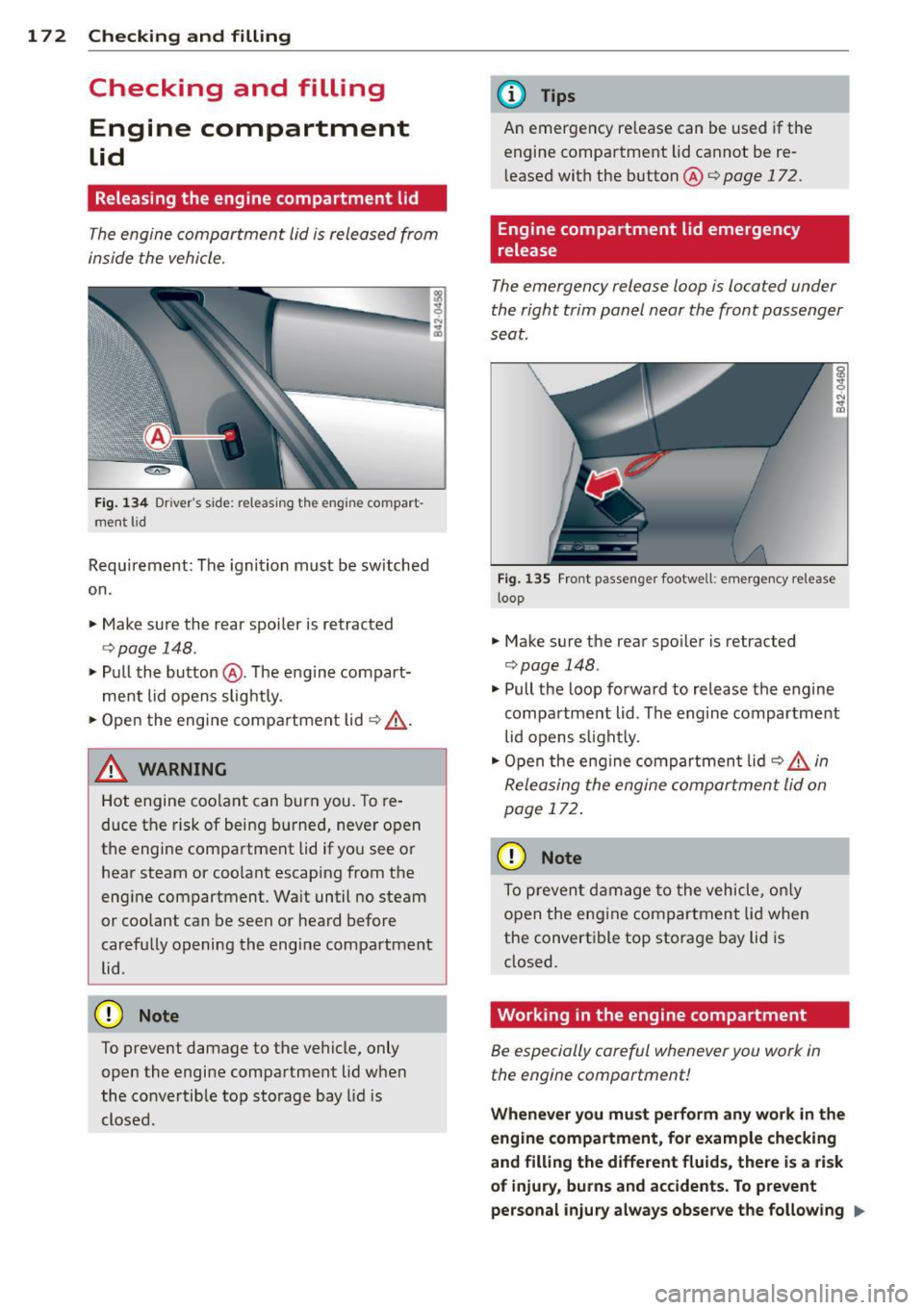
Fi g. 1 34 Drive r's s id e: re le asi ng th e eng ine co mpart
ment lid
R equ irement : The ignition must be sw itched
on.
.,. Make sure the rear spoiler is retracted
<=> page 148 .
.,. Pull the button @. The e ngine compart
ment lid opens slightly .
.,. Ope n the engi ne compa rtme nt lid
c:> .&, .
.&_ WARNING
Hot engine coo lant can burn you. To re
duce the risk of bei ng bur ned,
neve r open
the engine compartment lid if yo u see or
hear steam or coolant escaping from the
eng ine compartment. Wa it until no steam
or coolant can be seen or heard before
carefu lly opening the engine compartment
lid .
CD Note
To prevent damage to the vehicle, only
ope n the engi ne compartment lid when
t he convertib le top storage bay lid is
closed .
(D Tips
An emergency re lease can be used i f th e
engine compartment lid cannot be re
l eased with the
button @r::::>page 172.
Engine compartment lid emergency
release
The emergency release loop is located under
the right trim panel near the front passenger
seat.
F ig . 1 35 Fro nt passenger footwe ll: em erge ncy release
l oop
.,. Make sure the rear spo iler is retracted
<=> page 148 .
.,. Pull the loop forwa rd to release the engine
compa rtme nt lid . The engine compar tment
lid o pens s lig htly .
.,. Open the eng ine comp artmen t lid
c:> .&, in
Releasing the engine compartment lid on
page 172 .
CD Note
To preven t dam age to the vehicle, only
open the en gine compartment lid when
the convert ible top stora ge bay lid is
closed.
Working in the engine compartment
Be especially careful whenever you work in
the engine compartment!
Whenever you mu st perform any work in the
engine compartment, for example checking and filling the different fluids, there is a risk
of injury, burn s and accidents. To prevent
personal injury always observe the following
Ill-
Page 175 of 244
WARNINGS. The engine compartment of any
vehicle is a hazardous area!
c::> &.
A WARNING
To help avoid injury, before you check any
thing under the engine compartment lid:
- Switch off the engine.
- Remove the ignition key.
- Apply the parking brake.
- Move selector lever of S tronic to "N"
(Neutral); put manual transmission in
Neutral.
- Always let the engine cool down. Hot
components will burn skin on contact.
- To reduce the risk of being burned, never
open the engine compartment lid if you
see or hear steam or coolant escaping
from the engine compartment. Wait un
til no steam or coolant can be seen or heard before carefully opening the en
gine compartment lid .
- Keep children away from the engine com
partment .
-Never spill fluids on hot engine compo
nents. They can cause a fire.
- Never open the coolant reservoir cap when the engine is still warm. The coolant system is pressurized and hot cool
ant could spray out.
- Protect your face, hands and arm from
steam or hot engine coolant by placing a
thick rag over the cap when you open the
coolant reservoir .
- Do not remove the engine cover under
any circumstances. This increases the
risk of burns.
- If work on the fuel system or the electri
cal system is necessary:
- Always disconnect the battery.
- Never smoke or work near heaters or
open flames. Fluids in the engine com
partment could start a fire.
- Keep an approved fire extinguisher im
mediately available.
- To avoid electrical shock and personal in
jury while the engine is running or being
started, never touch:
Checking and filling 173
- Ignition cables
- Other components of the high voltage electronic ignition system.
- If you must perform a check or repair
with the engine running:
- First, fully apply the parking brake,
move selector lever of S tronic to "N"
(Neutral); put manual transmission in
Neutral.
- Always use extreme caution to prevent
clothing, jewelry, or long hair from get
ting caught in the radiator fan, V-belts
or other moving parts, or from contact ing hot parts. Tie back hair before
starting, and wear no clothing that will hang or droop into the engine.
- Minimize exposure to emission and chemical hazards
c::> .&. .
A WARNING
California Proposition 65 Warning:
- Engine exhaust, some of its constituents,
and certain vehicle components contain
or emit chemicals known to the State of
California to cause cancer and birth de
fects and reproductive harm. In addition, certain fluids contained in vehicles and
certain products of component wear con
tain or emit chemicals known to the
State of California to cause cancer and birth defects or other reproductive harm.
- Battery posts, terminals and related ac
cessories contain lead and lead com
pounds, chemicals known to the State of
California to cause cancer and reproduc
tive harms. Wash hands after handling.
@ Note
When adding fluids, always make sure that
they are poured into the proper container
or filler opening, otherwise serious dam
age to vehicle systems will occur.
@ For the sake of the environment
To detect leaks in time, inspect the vehicle
floor pan from underneath regularly. If
you see spots from oil or other vehicle
IJI>
•
•