instrument cluster AUDI R8 SPYDER 2014 User Guide
[x] Cancel search | Manufacturer: AUDI, Model Year: 2014, Model line: R8 SPYDER, Model: AUDI R8 SPYDER 2014Pages: 244, PDF Size: 61.06 MB
Page 50 of 244
48 Clear vis ion
Turn sign als¢ Q (D@
.,. Push the lever up as far as it can go to turn
on the r ight turn signal or down to turn on
the left turn signal
c;, fig. 53 .
.,. Move the lever briefly until you meet resist
ance and release it to flash three times .
.,. Move the lever (up or down) until you meet
resistance and ho ld it there to determine
the flash ing t ime for the turn signals.
High beam [D @
.,. Push the lever forward to switch on the high
beam.
.,. Pull the lever back towards you to swi tch off
the high beam .
Headl ight fla she r [D ©
.,. Pull the lever toward the steering wheel to
use the headlight f lasher.
Notes on these features
- T he turn signals only work with the igni tion
switched on . The ind icator lights
II or 1M in
the instrument cluster
i::> page 11 also b link .
- After you have turned a corner, the tur n sig -
nal switches off a utomat ica lly.
- T he
high beam works only when the head
li gh ts are on. The indicator light
II in the
instrument cluste r illuminates when the
high beams are on.
- T he
headlight flasher works on ly as long as
yo u hold the lever -even if there are no
li ghts turned on . The indicator light
II in
the instrument cl uster i llum inates when you
use the headl ight f lasher.
A WARNING
Do not use the hig h beam or headlight
flashe r if you know that these could blind
oncoming traffic.
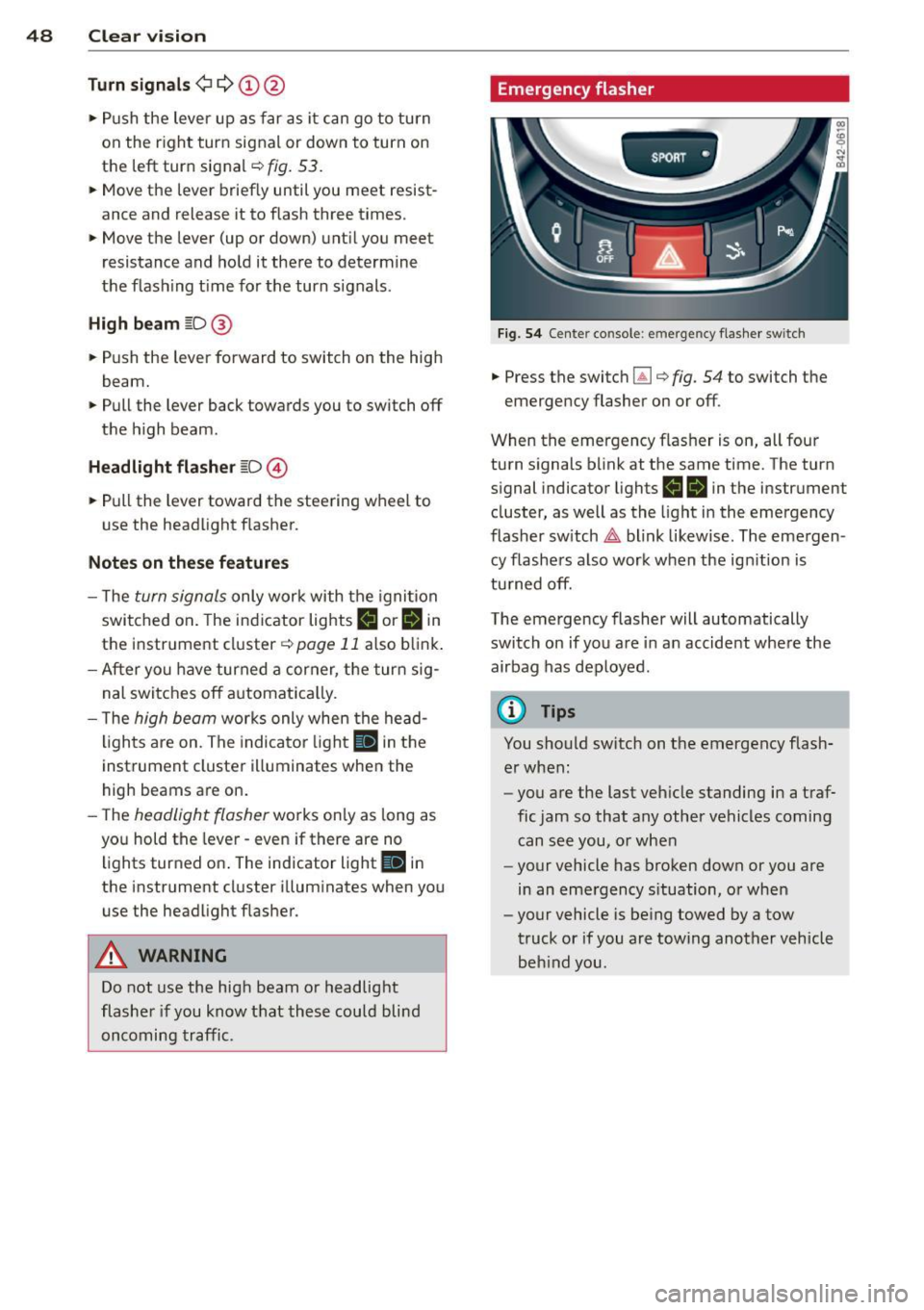
Emergency flasher
SPORT •
Fig. 5 4 Center co nsole : em erge ncy flashe r sw itc h
.,. Press the switc h lil i::> fig. 54 to switch the
emergency flasher on or off .
When the emergency flasher is on, all four
turn s ignals b link at the same time. The turn
s ignal indicator lights
II IB in the instrument
cluster, as well as the light i n the emergency
flasher sw itch
&,. blink likew ise . The eme rgen
cy flashe rs also work when the ign ition is
tu rned off.
The emergency flasher will automatically switch on if you are in an accide nt whe re the
airbag has deployed.
@ Tips
You should sw itch on t he emergency flash
er when :
- you are the last veh icle standing in a traf
fic jam so that any other vehicles coming
can see you, o r w hen
- your vehicle has broken down or you a re
in an eme rgency s ituation, o r when
- your vehicle is be ing towed by a tow
truck or if you are towing another veh icle
beh ind you .
Page 51 of 244

Interior lights
Interior lights
The interior lights include the reading lights
for the driver and the front passenger .
Fig. 55 Section from headliner : In terior lights
Activating door contact circu it
• Press the button @. The LED in the button
illuminates.
Deactivating do or contact circu it
• Press the button @. The LED in the button
goes out.
Fr ont re ad ing l ight s
~
• Press one of the switches ® to turn the
right or left reading light on/off .
"' l1l 0
With the door contact circuit, the interior
lights turn on as soon as you unlock the vehi
cle or open the doors. The interior lights are
also turned on when the ignition key is re
moved. The lights turn off about 30 seconds
after the doors are closed . When the vehicle is
locked or when the ignit ion is tu rned on, the
inte rior lights are turned off .
When a door is open, the interior lights are
turned off after about 10 m inutes to prevent
battery draining.
The brightness of the lights is controlled au
tomatically by a dimmer when they are
switched on/off.
Clear vi sion 49
Instrument panel illumination
The illumination of the instruments, displays
and the center console can be adjusted .
Fig . 56 Instrumen t pa nel illuminat ion
You regu late the brightness of the instr u
ments with the left thumbwheel
C1 ~ fig . 56 .
Ignition ON, light switch at @
With the ign ition switched ON, the glow of
in
strument needles
can be adjusted to appea r
brighter o r dimmer.
Ignition ON, light switch at
:oo~ or ~D.
With the lights switched on, the brightness of
instrument cluster (i.e. needles, gauges and
displays) and center conso le illuminat ion can
be adjusted .
(D Note
The instrument cluster and center conso le
ill umination (gauges and need les) comes
on when you sw itch on the ignition and the
v eh icle headlight s are off . Be awa re of the
fo llow ing difference be tween models bu ilt
to US or Canadian specifications:
- USA mo dels: illumination o f the i nstr u
ment cl uster (gauges and need les), dash
and center conso le around the gearshift
lever is controlled by a light sensor locat
ed in the instrument pane l. The instru
ment pa nel illuminat ion w ill automati
cally become dimmer as the daylight
fades away and eventually will go out completely when outs ide light is very
low. This is to remind you, the dr iver, to
switch o n the hea dlights before it ge ts
too d ark .
Page 75 of 244

indicate that the maximum speed has been
stored successfully. The maximum speed re mains stored until it is changed by pressing
the button again briefly or until it is deleted
by a lengthy push on the button.
Speed warning 2: setting a speed limit
Switches in the wiper arm ore used to operate warning threshold 2.
--------, @
Fig. 78 Controls
To store maximum speed
"'Turn off the ignition.
"'Br iefly press the button in the instrument
cluster
c::> page 72, fig. 77. The odometer
and the digital clock are now illuminated.
"' Press the button for at least 2 seconds. The
currently stored maximum speed appears in
the display
or the crossed out symbol for
warning threshold 2, if no maximum speed
was set previous ly.
"' Press the function selector switch in the
wiper lever @
c::> fig. 78 up or down to
change the set value . Values run up or down
in steps of 6 mph (10 km/h).
To delete maximum speed
"'Turn off the ignition.
"' Briefly press the button in the instrument
cluster
c::> page 72, fig. 77 . The odometer
and the digital clock are now illuminated.
"' Press the button for at least 2 seconds . The
currently stored maximum speed appears in
the display.
"' Press the
l"'R-=E =s =ET =I button in the wiper lever
® c::> fig . 78 until the crossed out speed
warning symbo l for warning threshold 2 ap
pears in the display.
On the road 73
A few seconds after the adjustment is com
pleted, the illumination for the odometer and
the d igital clock will go out.
(D Tips
This warning threshold can also be con
trolled through the trip computer
c::> page 23, Navigating the menu.
Cruise control
Switching the system on
The cruise control system makes it possible to
drive at a constant speed starting at 20 mph (30 km/h).
®-
Fig. 79 Control lever with set button
Fig. 80 D isplay: Se lected speed
"' Pull the lever to position (D c::> fig. 79 to
switch the system on.
"' Drive at the speed you wish to set.
"' Press button @ to set that speed.
T he disp lay
c::> fig. 80 will show the set speed.
The display may vary depending on the type of
display in your vehicle. The indicator light
M;W~1~ (US model) I. (Canadian model) will
also light up in the instrument cluster . .,..
Page 85 of 244
@ Tips
The transmission cannot detect if the parking lock was re leased with the emergency
re lease. An error message appears in the
instrument cluster as soon as the trans
m iss ion requ ires the P posit ion but th is po
sition is not engaged .
Transm iss ion 83
Page 120 of 244

118 Airbag system
components is detected. The function of the
airbag indicator light is described in greater
detail below. Because the front passenger
seat contains important parts of the Ad
vanced Airbag System, you must take care to prevent it from being damaged . Damage to
the seat may prevent the Advanced Airbag for
the front passenger seat from doing its job in
a crash .
The front Advanced Airbag System
consists of the following:
-Crash sensors in the front of the vehicle that
measure vehicle acceleration/deceleration
to provide information to the Advanced Air bag System about the severity of the crash.
- An electronic control unit, with integrated
crash sensors for front and side impacts .
The control unit "decides " whether to fire
the front airbags based on the information received from the crash sensors. The control
unit also "decides" whether the safety belt
pre tensioners should be activated.
- An Advanced Ai rbag with gas generator for
the driver inside the steering wheel hub.
- An Advanced Airbag with gas generator in
side the inst rument panel for the front pas
senger.
- A weight-sensing mat under the upholstery
padding of the front passenger seat cushion
that measures the total weight on the seat.
The information registered is sent continu
ously to the electronic control unit to regu
late deployment of the front Advanced Air
bag on the passenger side.
- An airbag monitoring system and indicator
light in the instrument cluster
¢page 121.
- The PASSENGER AIR BAG OFF light comes
on and stays on in the center of the instru
ment panel ¢
page 122, fig. 120 and tells
you when the front Advanced Airbag on the passenger side has been turned off.
- A sensor below the safety belt latch for the
front seat passenger to measure the tension
on the safety belt. The tension on the safety
belt and the weight registered by the
weight-sensing mat help the control unit "decide" whether the front airbag for the front passenger seat should be turned off or
not
¢ page 112, Child restraints on the
front seat -some important things to
know.
- A sensor in the safety belt latch for the driv
er and for the front seat passenger that
senses whether that safety belt is latched or not and transmits this informa tion to the
electronic control unit .
.&_ WARNING
Damage to the front passenger seat can
prevent the front airbag from working
properly.
- Improper repair or disassembly of the
front passenger and driver seat will pre
vent the Advanced Airbag System from
functioning properly.
- Repairs to the front passenger seat must
be performed by qualified and properly
trained workshop personnel.
- Never remove the front passenger or
driver seat from the vehicle.
-Never remove the upholstery from the
front passenger seat.
- Never disassemble or remove parts from
the seat or disconnect wires from it.
- Never carry sharp objects in your pockets
or place them on the seat. If the weight
sensing mat in the passenger seat is
punctured it cannot work properly.
- Never carry things on your lap or carry
objects on the passenger seat. Such
items can increase the weight registered
by the weight-sensing mat and send the
wrong information to the airbag control
unit.
- Never store items under the front pas
senger seat. Parts of the Advanced Air
bag System under the passenger seat
could be damaged, preventing them and
the airbag system from working proper ly.
- Never place seat covers or replacement
upholstery that have not been specifical ly approved by Audi on the front seats .
- Seat covers can prevent the Advanced
-
Airbag System from recognizing child .,..
Page 125 of 244

described in the child restraint manufactur
er 's instructions;
- make sure that the convertible locking fea
ture on the safety be lt for the front passen
ger seat has been activated and that the
safety belt has been pulled tight. The belt
must not be loose or have loops of slack so
that the sensor below the safety belt latch
on the seat can do its job<=>
page 140 .
-make sure that th ings that may increase the
weight of the child and child safety seat are
not being transported on the front passen
ger seat;
- make sure that the safety belt tension sen
sor is not blocked . Shake the safety belt
latch on the front passenge r seat back and
forth;
- If a st rap or tether is being used to tie the
ch ild safety seat to the front passenger
seat, make sure t hat it is not so tigh t that it
ca uses the we ight-sensing mat to meas ure
more weight than is actua lly on the seat .
If the PASSENGER AIR BAG OFF light still
does not com e on and does not stay on con
tinuously (when the igni tion is sw itched on),
- take the ch ild restraint off the front passen·
ger seat and install it p roperly at one of the
rear seat pos itions. Have the a irbag system
i nspec ted by your A udi dealer immediately.
- move the ch ild to a rea r seat posit io n and
make su re th at the chi ld is proper ly res train
ed in a chi ld restraint that is appropriate fo r
its size and age .
The
PASSENGER AIR BAG OFF light shou ld
NO T come on when the ign ition is on and an
ad ult is sitting in a p rope r seat ing pos ition on
the front passenger seat. If the
PASSENGER
AIR BAG OFF
li ght comes on and stays on or
flashes for about 5 seconds while driving, un
der these circumstances, make sure that:
- the ad ult on the front passenger seat is
proper ly seated on the center of the seat
cushion with his or her back up against the
backrest and the backrest is not reclined
<=> page 94, Proper occupant seating posi
tions,
A irbag system 123
- the adult is not tak ing weight off the seat by
holding on to the passenger assist handle
above the front passenger door,
- the safety be lt is being properly worn and
that there is not a lot of s lack in the safety
be lt webbing,
- accesso ry seat covers or cushions or other
things that may cause an incorrect reading
or impression on the weight-sensing mat
under the upho lstery of the seat have been
removed from the front passenger seat,
- a safety belt extender has not been left in
the safety belt latch for the front passenger
seat .
In add ition to the
PASSENGER AIR BAG O FF
light in the center of the instrument panel,
the message
PASSENGER AIR BAG O FF or
PASSENGER AIR BAG ON w ill briefly appear
in the instrument cluster display. This is to in
form the dr iver of the current front passenge r
a irbag status.
Important safety instructions on
monitoring the Advanced Airbag System
A WARNING
An airbag system that is not functioning
p roperly cannot provide supplemental pro
tection in a frontal c rash.
- If the airbag ind icator light comes on, it
means that there may b e something
wrong with the Advan ced Airbag Sys tem.
It is poss ible that the air bag w ill inflate
when it is not supposed to, or will not in
f late when it sho uld .
- Have the airbag system inspe cted imme
diate ly by your Audi dealer.
A WARNING
If the front airbag inflates, a child without
a child restraint, in a rea rward-facing child
safety seat or in a forward-facing child re
straint that has not been proper ly installed
will be ser ious ly injured and can be killed.
- Even tho ugh your vehicle is equipped
with an Advanced A irbag System, make
certain that all children, espec ially 12
-
•
•
Page 130 of 244

128 Airbag system
Important safety instructions on the
knee airbag system
Airbags are only supplemental restraints. Al
ways wear safety belts correctly and ride in a
proper seating position.
There is a lot that you and your passenger
must know and do to help the safety belts and
airbags to provide supplemental protection.
.&_ WARNING
An inflating knee airbag can cause serious injury. Wearing safety belts incorrectly and
improper seating positions increase the
risk of serious personal injury and death
whenever a vehicle is being used.
-
- The knee airbag system cannot protect
you properly if you are seated too close
to any of the airbag locations. When ad
justing their seat positions, it is impor
tant that both the driver and the front
passenger keep their upper bodies and
knees at the following min imum safe
distances:
- at least 10 inches (25 cm) between the
chest and the steering wheel/instru
ment panel.
- at least 4 inches (10 cm) between the
knees and the lower part of the instru
ment panel.
- The risk of personal injury increases if
you lean forward or to the side, or if the
seat is improperly positioned and you are
not wearing your safety belt. The risk in
creases even more should the airbag de
ploy.
- Always make sure that the knee airbag
can inflate without interference. Objects
between you and the airbag can increase
the risk of injury in an accident by inter
fering with the way the airbag dep loys or
by being pushed into you as the airbag
deploys .
- Never let anybody, especially children
or animals in the footwell in front of
the passenger seat.
If the airbag de- ploys, this can result in serious or fatal
injuries.
- No objects of any kind should be car
ried in the footwell area in front of the
driver's or passenger's seat. Bulky ob
jects (shopping bags, for example) can
hamper or prevent proper deployment
of the airbag . Small objects can be
thrown through the vehicle if the air bag deploys and injure you or your pas
sengers.
- Make sure there are no cracks, deep
scratches or other damage in the area of
the instrument panel where the knee air
bags are located.
- If children are incorrectly seated, their
risk of injury increases in a collision
~page 132, Child Safety.
Side airbags
Description of side airbags
The airbag system can provide supplemental
protection to properly restrained front seat
occupants.
Fig. 123 S ide a irbag location in the driver's seat
The side airbags are located in the sides of the
front seat backrests
q fig. 123 facing the
doors. They are identified by the word "AIR
BAG".
Th e side airbag system basically consists of:
-the electronic control module and external
side impact sensors
- the two side airbags located in the sides of
the front backrests
- the airbag warning light in the instrument
cluster .
Page 153 of 244
than is being generated and ensures an optimal state of charge for the battery.
@ Tips
- But even energy management cannot
negate the limits o f physics. Consider
that the power and life of a battery are
limited.
- If starting ability is threatened, you are
i nformed by a warning
¢ page 151,
Driver notification in the instrument
cluster display.
What you should know
The highest priority is given to maintaining
starting capability.
The battery is severely taxed in short-distance
driving, in city traffic and during the co ld time
of year. Abundant e lectrical energy is re
quired, but only a litt le is generated. It is also
cr itical if the engine is not runn ing and electri
cal components are turned on. In th is in
stance energy is being consumed but none is
be ing gene rated.
It is in precisely these situations that you w ill
notice energy management actively regulat
in g the distribution of energy .
Vehicle stands for an extended period
If you do not drive your vehicle over a period
of several days or weeks, electrical compo
nents are gradually cut back or switched off.
This reduces energy consumption and main
tains sta rting capab ility over a longer per iod.
Take into consideration that when you unlock
your veh icle, some convenience functions,
such as the remote key or power seat adjust
ment, may not be available . The convenience
functions will be ava ilable again whe n you
turn on the igni tion and star t the eng ine.
With the engine turned off
If you listen to the radio, for example, with
the eng ine turned off, the battery is being dis
charged .
Intellig ent technolog y 151
If starting capability is jeopardized d ue to en
ergy consumption, a message appears in the
drive r information d isplay .
You have to start t he engine to charge the
batte ry .
With the engine running
Although electrical energy is generated when
the ve hicl e is being driven, t he battery can be
come disc harged. This happens mostly when
li ttle energy is being generated and a great
deal consumed and the battery's state of
c h arge is not optimal.
T o b ring the energy ba lance back into equili
br ium, consumers which requ ire espec ially
large amounts of energy are temporari ly cut
back or switched off . Heating systems in pa r
ticu lar require a great deal of energy. If you
notice, for example, that the heated seats* or
the heated rear window are not heating, they
have been temporarily cut back or switched
off . These systems w ill be available again as
soon as the ene rgy balance has been restored.
You w ill also notice that engine id le speed has
been increased slightly . Th is is normal and not
a cause for concern . By increas ing engi ne idle
speed the additional energy required is gene r
ated and the battery is charged.
Driver notification in the instrument
cluster display
If battery power drops into the range where it
can limit the ability of the engine to start, this
is shown in the instrument cluster display
with the following driver message:
(•) Low battery charge: battery will be
charged while driving
T his not ificat ion reminds yo u that the start ing
capability of the engine may be limited . As
soon as you sta rt driving again, the battery
will be recharged and the not ificat ion w ill go
out. •
•
Page 198 of 244
196 Tire s and wheel s
-Adjust the tire pressure to the load you are
carrying.
- Reinsta ll the va lve stem cap on the valve .
When should I check the tire pres sur e?
The correct tire pressure is especially impor
tant at high speeds. The pressure should
therefore be checked at least once a month
and a lways before starting a journey.
When should I adjust th e tir e pre ss ures ?
Adjust the tire pressure to the load you are
carry ing . After changing a wheel
o r replacing
wheels you have to adjust the tire pressures
on all wheels. In addition , you must then init i
alize the new tire pressures in the tire p res
sure mon itoring system ¢
page 206.
& WARNING
Incorrect tire pressures and/or underinf la
tion can lead sudden tire failure, loss of
contro l, collision, serious personal injury
or even death.
- When the warning symbo l
(11 appears in
the instrument cluster, stop and inspect
the tires .
- Incorrect tire pressure and/or underinfla
tion can cause increased tire wear and
can affect the handling of the veh icle and
stopp ing ability .
- Incorrect tire pressures and/or underin
flation can also lead to sudden tire fa il
ure, including a blowout and sudden de
flation, causing loss of vehicle control.
- The driver is responsible for the cor rect
t ire pressures for all tires on the vehicle .
T he applicable p ressu re values are locat
ed on a stic ker on the d rive r's side 8 -pil
lar .
- Only when all t ires on the vehicle a re fi l
led to the correct pressure, the tire p res
sure monitoring system can work cor
rect ly .
- The use of incorrect tire pressure values
can lead to accidents or other damage.
T herefore it is essential that the driver
observe the specified tire pressure va lues
for the tires and the correct press ures for the function of the ti re p
ress ure monitor
ing system.
- Always inflate tires to the recommended
and correct t ire pressure before dr iv ing
off.
- Driving with underinflated tires bend
more, letting them get too hot resulting
in tread separation, sudden tire failure
and loss of control.
- Excessive speed and/overloading can
cause heat build-up, sudden tire failure
and loss of control.
- If the tire pressure is too low or too high,
the t ires will wear prematurely and the
veh icle w ill not handle well.
- If the tire is not flat and you do not have
to change a wheel immediately, drive at
reduced speed to the nearest service sta
tion to check the t ire p ressure and add
ai r as req uired .
@ Note
Driving w ithout valve stem caps can cause
damage to the tire valves. To prevent this ,
always make sure that factory insta lled
valve stem caps o n all whee ls are se curely
moun ted on the valve.
@ For the sake of the environment
Underinflated tires w ill also increase the
fuel consumption.
Tires and vehicle load limits
T he re a re limits to the amount of load or
weight that any vehicle and any tire can carry.
A vehicle that is overloaded will not handle
well and is more d ifficu lt to stop . Overloading
can not only lead to lo ss of vehicle control,
but can also damage impor tant parts of the
vehicle and ca n lead to sudden tire fa ilure, in
clud ing a blowout and sudden deflation that
can cause the vehicle to cras h.
Your safety and that of your passengers also depends on making sure that load limits a re
not exceeded . Vehicle load i ncludes eve rybody
and everything in and on the veh icle . These .,..
Page 209 of 244
illuminates, you should stop and check your
tires as soon as possible, and inflate them to
the proper pressure. Driving on a significantly under- inflated tire causes the tire to overheat
and can lead to tire failure. Under-inflation a l
so reduces fuel efficiency and tire tread life,
and may affect the ve hicle's handling and
stopping ab ility .
Please note that the TPMS is not a substitute
for proper t ire maintenance, and it is the dr iv
e r' s responsib ility to ma inta in correct t ire
p ressure, even if under- inflation has not
reac hed the level to t rigge r illumination of the
TPMS low tire pressure telltale .
Your veh icle has also been equ ipped with a
TPMS malfunction indicator to indicate when
the system is not operating properly. The
TPMS malfunction indi cato r i s combined wi th
the low ti re pressure tell ta le . When the sys
tem detec ts a malf unction, the te lltale will
flash for approximately one minute and t hen
remain cont inuo usly illuminated. This se
quence will continue upon subsequent vehicle
start-ups as long as the malfunction ex ists.
When the malfunctio n indicator is ill uminat
ed, the system may not be able to detect or
signal low t ire pressure as intended . TPMS
malfunct ions may occur for a variety of rea
sons, includi ng the installat io n of rep lace
ment or alternate tires o r wheels on the veh i
cle that prevent the TPMS from funct ion ing
p roperly . Always chec k the TPMS malfunct ion
t ellt ale after replacing one o r more t ires or
wheels on your veh icle to ensure that the re
p lacement or a lternate tires and wheels allow
the TPMS to continue to function properly .
Introduction
T he tire pressure monitoring system monitors
oir pressure in all four road wheels while the
vehicle is moving .
As soon as the tire pressure monitoring sys
tem senses a significant loss of air pressure in
one or several ti res, text messages and yellow
symbo ls appear in the instr ument cluster d is
p lay to alert the driver. T he
RE warning light
Tire s an d wheel s 207
in the instrument cluster comes on when the
tire is significant ly underinflated .
T he wa rni ng lig ht
RE also ill umi nates in the
case of a system malfun ct ion.
Be awa re that t ire pr essure is a lso dependent
o n the tempe ratu re of the t ire. For eve ry 18 ° F
(10 °C) incre ase in tire temper ature, tire pres
s ur e increases by about 1.5 psi (0 .1 bar). The
ti re warms up while the vehicle is moving and
tire press ure rises . So you sho uld ad just tire
pressure only when they a re
cold, when the
temperature of the tires is ro ughly the same
as the ambient a ir temperature.
In order to keep the tire p ress ure monitoring
system p roperly ca librated, t ire pressu re on
a ll four tires sho uld be checked at regu lar in
terva ls.
The tire pressure is shown on the label located
on the dr iver's side B-pillar (v is ible when the
door is open).
A WARNING
When t he tire pressure mo nitoring system
war ning light is lit, one o r more of your
tires is s ignificantly under-infla ted . You
should stop and check you r tires as soon as
possib le, and in flate t hem to the proper
p re ssur e a s in di cate d on the ve hicle's tir e
press ure label
¢page 19 3. D riving on a
significantly under -inflated ti re causes the
tire to over heat and can lead to tire failure.
Under-inflat ion also is like ly to impair the
vehicle's handling and stopping ab ility.
@ For the sake of the environment
D riving wit h un der -inflated tires red uces
fuel efficiency an d tire t read life.
(D Tips
- Ea ch tire should be chec ked monthly
w hen the temperature of the tires is
about the same as ambient a ir tempera
t u re and set to the recommended infla
tion press ure as specified on the tire
pressure label
¢ page 193.
•
•