brake light AUDI R8 SPYDER 2014 Owner's Manual
[x] Cancel search | Manufacturer: AUDI, Model Year: 2014, Model line: R8 SPYDER, Model: AUDI R8 SPYDER 2014Pages: 244, PDF Size: 61.06 MB
Page 93 of 244
Phase 1:
p rogramming the overhead keypad
1. Make sure your vehicle is wit hin operating
range of the remote contro lled garage
door opener .
2. Set the parking brake
q A in General in
formation on page 90 .
3. Turn the ignition on . Do not start the en
gine!
4. Press and hold the two outs ide Home
Link ® buttons
(D and @for approxi
mately 20 seconds until indicator light@
c:!;> fig. 99 begins to flash. Then re lease
both buttons. Do not ho ld the buttons for
longer than 30 seconds .
.,. This procedure only needs to be performed
once . It erases the factory-set default codes
and does not have to be repeated to pro
gram addit ional remote controls .
S . Press and hold the Home Link ® button
(D ,
® or @ until the indicato r light @
starts flashing
slowly . Release the button.
.,. The system will remain in programming
mode for 5 minutes . Co to the front of the
vehicle and proceed with phase 2 .
Phase 2:
programming the bumper mounted trans
mitter
6. Hold the original remote control at a dis
tance between 0 -6 in . (0 -15 cm) from the
bumper below the appropriate headlight
for your vehicle
c:!;> fig. 100 (use the short
est distance possible).
7. A im the remote con trol just below the
driver side headlight.
8. Press and hold the activation button on
the remote control.
.,. May be different in Canada.
If so, press and
re-press (cycle) the act ivation button on your
remote control every two seconds.
9 . The emergency flashers will flash
three
times
(after about 15-60 seconds) when
the programm ing is successful. Release
the butto n on the remote control.
.,. To program more devices, repeat steps 4 to
9.
Homelin k® 91
10. Press and hold the trained Homelink ®
button and observe the indicator light @
qfig. 99.
.,. If the ind icator light is solid/continuous,
programm ing is complete and your device
should activate when you press and release
the trained Homelink ® button .
.,. If the ind icator light blinks rapidly for 2 sec
onds and is then a solid/continuous light,
proceed w ith phase 3 to program a rolling
code device.
Phase 3: rolling code programming
.,. A second person o n a ladder who can safely
reach the garage door opener motor is rec
ommended .
11. Locate the "learn" button on the gar age
door opener motor (re fer to the operating
instructions for the opener, as the loca
tion of t his button may vary by manufac
turer) .
12 . Press and release the learn button on the
garage door opener motor .
.,. Note : once the button is pressed, there are
30 seconds in which to initiate the next
step.
13. On the Home link® keypad inside the vehi
cl e, firmly press and hold the Homelink®
button prev iously programmed in phases
1 and 2 for two seconds and release . Re
peat this sequence
twice.
.,. Some vehicles may require the press/hold/
release sequence up to three times to com
plete the train ing process .
.,. Homelink ® should now activate your rolling
code equipped device.
If the 5 m inute time limit is exceeded, the
emergency flashers will flash one time to in
dicate that the process has been term inated .
In this case, repeat steps 4 through 9.
If the emergency flashers do not flash
three
times (after about lS-60 seconds), program
ming was not successful. In this case, repeat
steps 4 through 9 .
Remote contro l units for garage door openers
in Canada are set to stop transmitting radio
frequency signals after two seconds. This time ..,.
Page 146 of 244
144 Intelligent technology
Intelligent technology
Notice about data
recorded by vehicle
control modules
Your veh icle is not equipped with an Event Da
ta Recorde r (EDR), ins talled by some manu
facture rs fo r the express p urpose of capturing
data for retrieval after an accident or cras h
event . EDR's are sometimes ca lled "crash re
corders".
Some state laws restr ict the retr ieval or down
loading of data stored by EDR's that were in
stalled in a vehicle for the express purpose of retrieving data after an accident or crash
event without the owner's consent.
A ltho ugh yo ur vehicle is not equ ipped wit h an
EDR, it is equipped with a number of electron
ic control modules for various v ehicle systems
such as, for examp le, eng ine f unction, em is
sion control, as well as for the airbags and
sa fety belt s.
These electronic contro l modules also record
vehicle-re lated data during norma l vehicle op
erat ion for diagnostic and repa ir purposes.
T he recording capacity of the electronic con
trol modules is limited to data (no sound is re
corded) and only a small amount of data is ac
tually recorded ove r a ve ry limited pe riod of
time and stored when a sys tem faul t or o ther
cond ition is sensed by a cont ro l u nit. Some of
the data then stored may re late to vehicle
speed, direction, braking as we ll as restraint
system use and performance in the event of a
crash or other condit ion. Stored data can only
be read and downloaded w ith special equip
ment .
Electronic Stabilization
Control (ESC)
Description
ESC helps to improve road holding and vehicle
dynamics to help reduce the probability of
skidd ing and loss of ve hicle control. It works
only when the eng ine is running . ESC detects certain difficult driving situat
ions, including
when the vehicle is beginning to spin (yaw)
o ut of control and he lps you to get the veh icle
back under control by se lectively braking the
whee ls, and/or reducing eng ine power and
providing steer ing ass istance to he lp hold the
vehicle o n the dr iver's intended course . T he in
dicator light
G) in the inst rument cluster
blinks when ESC is ta king action to help yo u
control the veh icle.
ESC has limitations.
It is importa nt to remem
ber that ESC cannot overcome the laws of
physics. It wi ll not always be able to help out
under a ll cond it ions you may come up aga inst.
F or example, ESC may not always be able to
help you master situations where there is a
s u dden change in the coefficient of friction of
the road surface . When there is a section of
dry road that is sudden ly covered w ith water,
s lush or snow, ESC cannot perform the same
way it wou ld on the dry surface . If the ve hicle
hydroplanes (rides on a cushion of water in
stead of the road surface), ESC will not be
able to help you steer the vehicle because con
tact with the pavement has been in terrupted
and the vehicle cannot be braked or steered .
D uring fast cornering, particularly on winding
roads, ESC cannot always deal as effectively
with difficult driving situations as at lower
speeds.
Always adjust your speed and driving style to road , traffic and weather conditions. ESC can
not override the vehicle's physical limits, in
crease the available tract ion, or keep a ve hicle
on the road if road departure is a result of
driver inattent ion . Instead, ESC imp roves the
poss ib ility of keep ing the veh icle under con
t rol and on the road during extreme maneu
vers by using the d river 's steering inputs to
help keep the vehicle go ing in t he i nte nded di
rection . If you are t raveling at a speed tha t
ca uses you to run off the road before ESC can
provide any assistance, you may not experi
ence the benefits of ESC.
ESC includes and/o r works togethe r with the
anti- lock b rake system (ABS), brake assist sys-
tem and anti-slip reg ulation (ASR). ESC is .,..
Page 147 of 244
switched on all the time. In certain situations
when you need less traction, you can switch
off ESC by pressing the button
lru. Be sure to
switch ESC on again when you no longer need
less traction.
Anti-lock braking system (ABS)
ABS prevents the wheels from locking up
when braking . The vehicle can still be steered
even during hard braking . Apply steady pres
sure to the brake pedal. Do not pump the ped
al. A pulsing in the brake pedal indicates that
the system is helping you to brake the vehicle.
Brake assist system
The brake assist system can decrease braking
d istance. It increases braking power when the
driver presses the brake pedal quickly in emer
gency si tuations. You must press and hold the
brake pedal until the situation is over .
Anti-slip regulation (ASR)
ASR reduces engine power when the drive
wheels begin to spin and adapts the force to
the road condit ions. This makes it easier to
start, accelerate and drive up hills.
Electronic differential lock (EDL)
The EDL brakes wheels that are spinning and
transfers the drive power to the other drive
wheel or whee ls if the vehicle is equipped with
all-wheel drive*. This function is available up
to about 60 mph (100 km/h) .
In extreme cases, EDL automat ica lly switches
off to help keep the brake on the braked wheel
from overheating. EDL w ill switch on again au
tomatically when conditions have returned to
normal.
..&, WARNING
- ESC, ABS, ASR and EDL cannot overcome
th e laws of physics. This is especially im
portant on slippery or wet roads.
If the
systems begin acting to stabilize your ve
hicle, you should immediately change
yo ur speed to match the road and traffic
condit ions. Do not let the increased safe
ty provided by these systems tempt you
Intelligent technology 145
to take risks. Doing so will increase the
risk of a lo ss of vehicle control, co llision
and serious personal injuries.
- Always adapt your speed to road, traffic
and weather conditions. The risk of los
ing control of the vehicle increases when
driving too fast, especially through
curves and on slippery or wet roads, and
when driving too close to vehicles up
ahead. ESC, ABS, the brake assist sys
tem, EDL and ASR cannot prevent colli
sions.
- Always accelerate with special care on
even, smooth surfaces such as those that
are wet or covered with ice and snow.
The drive wheels can spin even with
these assistance systems that cannot al
ways he lp to reduce the risk of loss of ve
hicle control.
@ Tips
- ABS and ASR only work correct ly when
all four whee ls are equipped with identi
cal tires. D ifferent tire si zes can lead to a
reduction in engine power.
- You may hear noises when the systems
described are working.
- If the ind icator lightD] orE (USA
models)/ [iJ (Canada models) appears,
there may be a malfunction¢
page 16,
¢ page 15.
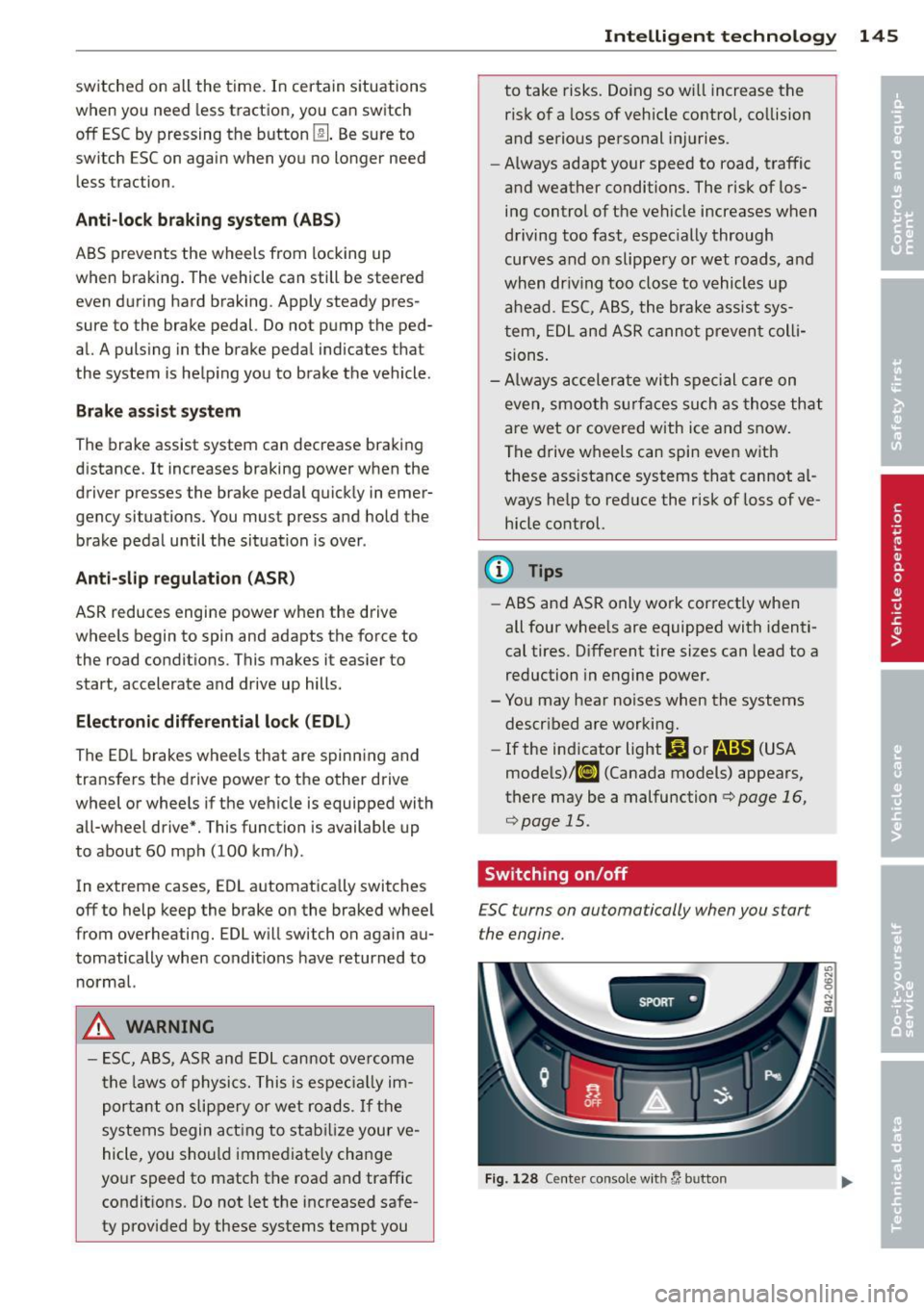
Switching on/off
£SC turns on au tomatically when you start
the engine.
-
SPORT •
Fig. 1 28 Cent er console w it h t b utton
Page 148 of 244

146 Intelligent technology
ESC sport mode
In ce rtain situat ions, it migh t make sense to
a llow some slip. For example :
- Rocking the vehicle to free it when it is stuck
- Driving in deep snow or on loose ground
- Driving with snow cha ins
Press the[!] button briefly¢
fig. 128 . The I
indicator light turns on and Sport control
Warning! Restricted stability
appears in the
driver information system display . Driving sta
b ili ty is limited in sport mode .
Switching ESC off
Press and hold the [!I button for three sec
onds . The ESC indicator light
ti turns on and
Stabilization program off appears in the dis
play. ASR is also sw itched
off when ESC is
switched
off .
Switching on
Press the[!] button aga in. The message Stabi
lization program on
appears briefly in the d is
play.
A WARNING
You should only switch the ESC off if your
driving ability and the traffic s ituation al
low. This could increase the risk of slip
ping.
- The stabilizing function is limited in ESC
sport mode. The driv ing whee ls could
spin and the vehicle could swerve, espe
cially on slick or slippery road surfaces.
- T here is no vehicle stabilization when
E SC is switched
off.
0) Tips
If there is a malfunction in the retractable
rear spo iler* or the Audi magnet ic r ide*, it
may not be possible to activate ESC spo rt
mode or normal mode may activate again
automatically.
Braking
General information
What affects braking efficiency?
New brake pads
During the first 250 miles (400 km), new
brake pads do not possess their full braking
effect, they have to be "broken in" first. The
distance can be ten times longer in vehicles
with ceramic brakes*. You can compensate for
th is slightly reduced braking power by push
ing harder on the brake pedal. Avoid heavy
braking loads during the break-in period.
Operating conditions and driving habits
The brakes on today's automobiles are still
subject to wear, depending largely on operat
ing condit ions and driving habits ¢.&, . On
vehicles that are either driven mostly in stop
and-go city traffic or are driven hard, the
brake pads should be checked by your author
ized Audi dea ler more often than specified in
the
Warranty & Maintenance booklet. Failure
to have your brake pads inspected can result
in reduced brake performance.
On steep slopes, you should use the braking
effect of the engine. This way, you prevent un
necessary wear on the brake system. If you
must use your brakes, do not hold the brakes
down cont inuously. Pump the brakes at inter
vals.
Moisture o r road salt
Under certain conditions, for example, when
driving through water or very heavy rain, or
even after washing your vehicle, the braking
effect can be reduced due to moisture (or in
freezing conditions ice) on the brake pads . A
few cautious brake applications should dry
off
the brake pads or remove any ice coatings .
When you are driving at higher speeds with
the windshield wipers on, the brake pads will briefly touch the brake discs in regular inter
vals so as to improve reaction time when brak
i ng on wet surfaces. You, the driver, will not
notice anything. .,.
Page 150 of 244
148 Intelligent technology
-If the brake booster is not working, for
example when towing your vehicle, or
because the brake booster has somehow
been damaged, the brake pedal must be
pressed considerably harder to make up
for the lack of booster assistance .
Rear spoiler
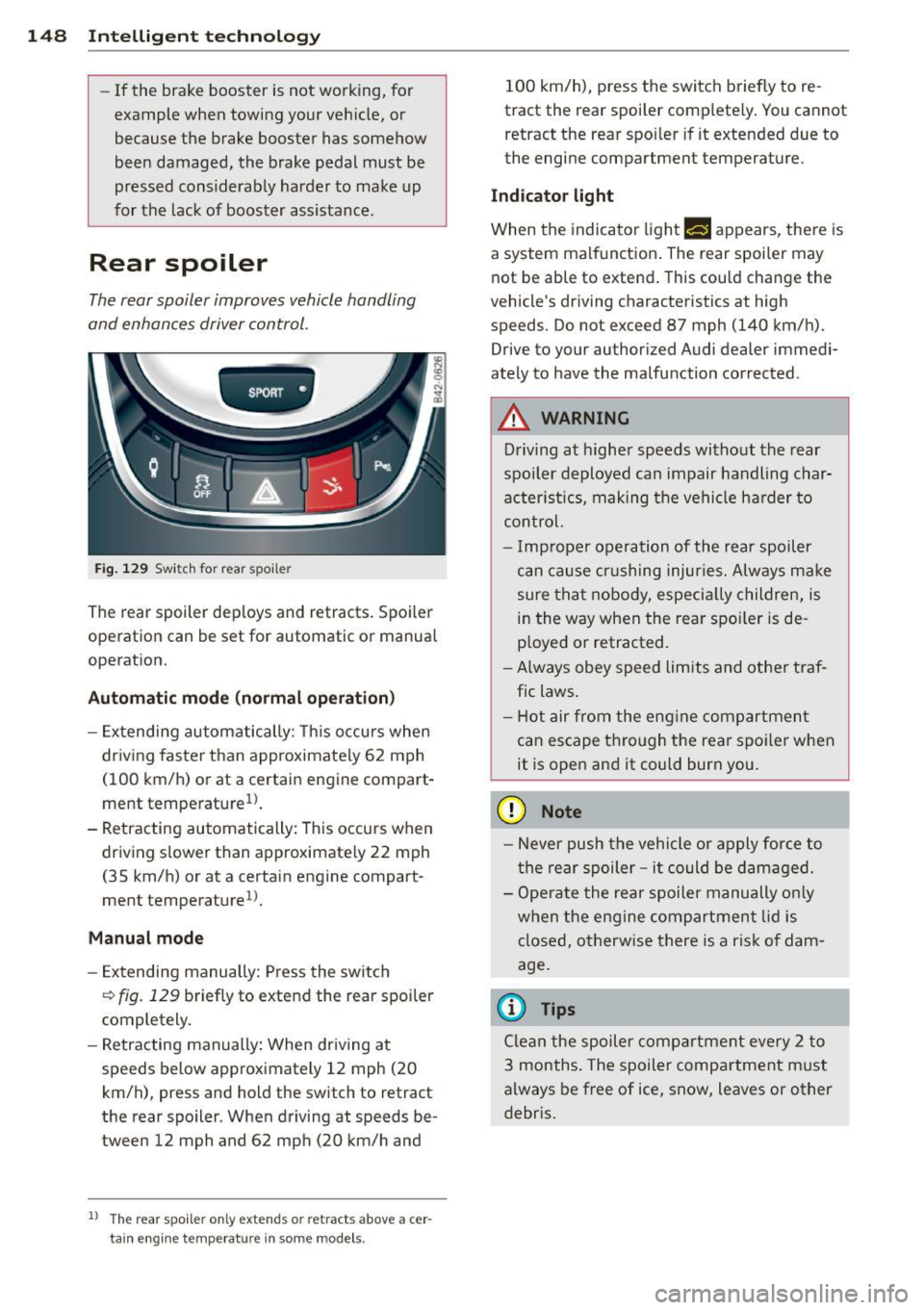
The rear spoiler improves vehicle handling
and enhances driver control.
SPORT •
Fig. 129 Switch for rea r sp o ile r
The rear spoiler deploys and retracts. Spoi ler
operation can be set for automatic or manual
operation.
Automatic mode (normal operation )
-Extending automatically: This occu rs when
driving faster than approximate ly 62 mph
(100 km/h) or at a certain engine compart
ment temperature
1> .
- Retracting automatically: This occurs when
driv ing s lower than approximately 22 mph
(35 km/h) or at a certain engine compart
ment temperature
1> .
Manual mode
- Extending manually: Press the switch
~ fig. 129 briefly to extend the rear spo iler
completely.
- Retracting manually: When dr iving at
speeds below approximately 12 mph (20
km/h), press and hold the switch to retract
the rear spoiler . When driving at speeds be
tween 12 mph and 62 mph (20 km/h and
l ) The rear s poiler o nly exten ds or ret racts a bove a cer
ta in eng in e te mp erat ure in s ome m odels.
100 km/h), press the switch briefly to re
tract the rear spoiler complete ly. You cannot
retract the rear spoiler if it extended due to
the engine compartment temperature .
Indicator light
When the indicato r light (.-) appears, there is
a system malfunction . The rear spoiler may
not be able to extend . This cou ld change the
vehicle's driving characteristics at high
speeds. Do not exceed 87 mph (140 km/h) .
Drive to your authorized Audi dealer immedi
ately to have the malfunction corrected .
A WARNING
Driving at higher speeds without the rear
spoiler deployed can impair handling char
acteristics, making the vehicle ha rder to
control.
- Imp roper operation of the rear spoiler
can cause crushing injuries. Always ma ke
sure that nobody, especia lly children, is
in the way when the rear spoi ler is de
p loyed or retracted.
- Always obey speed limits and other traf
fic laws .
- Ho t air from the eng ine compartment
can escape thro ugh the rear spoiler when
it is open and it could burn you.
(D Note
- Never push the vehicle or apply force to
t he rear spoiler -it could be damaged.
- Operate the rear spoiler manually only
when the eng ine compartment lid is
closed, otherwise there is a risk of dam
age .
(D Tips
Clean the spoiler compartment every 2 to
3 months. The spoiler compa rtment must
always be free of ice, snow, leaves or other
debris.
Page 159 of 244
Hand washing
When washing your veh icle by hand, fi rst soft
en the dirt with copious amounts of water and rinse it
off as b est you can.
Then clean the veh icle using a soft
s ponge , an
auto gl ove or a low -press ure wa sh bru sh .
Work from the top down -sta rting with the
roof . Use a
s h ampoo only for very stubborn
dirt.
Rinse the sponge or auto glove thorough ly at
fr equent intervals.
C lea n the wheels, doo r sill s and simi lar a reas
last . Use a separate sponge fo r th is.
_&. WARNING
- Car washes with conveyors can damage
the vehicle tires , which could cause the
ti re to lose pressure sudden ly while driv
ing and put you at risk for an accident.
Do not use car washes with conveyors.
- Switch
off the ignit ion when you wash
yo ur vehicle to avo id an accident.
- Protect yo ur hands and arms from sharp
metal edges when you clean the under
body, the ins ide of the whee l wells or the
wheel covers to avoid cutting yourself .
- When washing your vehicle in the winter:
Moist ure and ice in the brake system can
affect the brakes.
- Never wash tires with a jet that sprays
water in a direct stream . T hi s could cause
invisible damage to the tires and weaken
them, even if the spray is from a relative
ly long distance and for a short time.
Damaged and wea kened tires can fail
and cause a ccidents and pe rsonal inj ury.
0 Note
- Never dr ive your veh icle through any au
tomatic car wash that fails to p rov ide e i
the r suff icient clearance for your veh icle
or sufficient tra ck wid th fo r your tires .
Ris k of expensive damage to the veh icle's
u nderbody, tires, and rims!
- As descr ibed in you r Warra nty
& M ainte
nance booklet , damage or malf unct ion
Cleaning and protec tion 157
due to m isuse o f the vehicle or fai lure to
operate the vehicle in acco rdance with
the inst ruct ions of th is Owner's Manua l
wi ll not be covered under warranty.
- Fold the exte rior mirrors flat -there is a
r isk of damag ing the exterior m irrors .
Power folding exterior mirrors must not
be folded in or out by hand . Use the pow
er function!
- Do not wash the vehicle in d irect sun
light . You may damage the paint.
- Do not use sponges designed to remove
insects, rough k itchen sponges , or s imi
lar products . You risk damag ing the
pai nt s urface.
- Do not wash the vehicle using cleani ng
products that contain alcohol when the
e ng ine is ho t. This increases the risk of
damage to plast ic components, such as
c rack ing .
- You should remove deb ris (such as in
sects) from the headlight lenses on a
regu lar bas is, for example when re fuel
ing your vehicle. Never clean the head
lights with a dry cloth or sponge. Use a
wet cloth o r sponge . It is best to use
soapy water.
- Never clean t ires using a nozz le that
sprays water in a direct stream. Damage
can occur even with a relatively long
spraying distance and for a very short
t ime.
- To avoid damaging your veh icle, always
make sure that there is sufficient dis
tance between the spray head and soft
materials like rubbe r hoses, plast ic parts
and sound-deadening materials. Never
aim the spray head a t the same point for
a long time. This also app lies to cleani ng
head lights and pa inted b umpers . Re
member : the closer the nozz le is to the
surface of the material, the greater the
stress on the materia l.
@ For the sake of the environment
Wash yo ur vehicle on ly at spec ia lly de
signed facilities . They can prevent any dirty
water contaminated by oil from entering
Iii>-
•
•
Page 163 of 244
You should also clean the inside of the win
dow g lass at regular intervals.
The cloth or chamois used on paint s urfaces
contains wax res idue. Use a separate clo th or
chamo is to dry the window glass.
Cl eaning the rear window
Aud i recommends cleaning the window us ing
a soft cotto n cloth and water mixed with
cleaning solution or window cleaner
(1: 1 mix
ture) . To avoid streaks, do not wipe the win
dow dry with paper towels.
D o not use any clean ing so lutions that conta in
ammonia, acids , silicone or fluo ride or clean
e rs that are abrasive or cou ld cause scratches .
Do not use any alkaline cleaning solutions.
A WARNING
- The windshie ld must not be treated with
water-repellent materials. They can in
crease glare under poor visib ility condi
t ions such as wetness, darkness, or when
the sun is low on the horizon. In addi
t ion, they can cause the windshield wip
ers to chatter.
- Always read and heed all WARNINGS and
other information
r:::> page 156.
(D Note
-Never use warm or hot water to remove
snow and ice from windows and mirrors.
This could cause the glass to c rack.
- To prevent damage to the wires of the
rear defogger, do not place any adhesive
stickers on the inside of the rear window
ove r the wires.
- To he lp prevent di rt from scratching the
window, always scrape in a forward d i
r ection - pus hing the scraper away from
you - never back and fo rth.
Wheels
Regular care is required to preserve the deco
rative appearance of the wheels . Road sa lt
and b rake dust must be washed off regu larly
or the wheels wi ll be damaged.
Cleaning and protec tion 16 1
Use only specia l acid -free cleaning agents. You
can find proper wheel cleaner at authorized
Audi dealers and specia lty stores . Do not leave
the cleaner on the whee ls longer than speci
fied. Wheel cleaners containing acid can dam
age the surface of the w heel bo lts .
Pa int polish or other abrasive materials must
not be used when caring for wheels. If the
protective coat ing has been damaged, from
stones for example, touch up the damage as
soon as possible .
A WARNING
-Moisture and ice on brakes may affect
brak ing eff ic iency -
c:::> page 146, General
information.
T est the bra kes ca re fully af
ter each vehicle wash .
- Always read and heed a ll WAR NINGS and
the information¢
page 156.
Exhaust tail pipes
-
Road salt and other corrosive materials wi ll
damage the material in the exhaust tail pipes
if they are not cleaned regularly . Do not clea n
the tail pipes with wheel cleaner, pa int polish,
chrome polish or other abras ive cleaners.
Clean the tail pipes with car care products
that are suitable for stainless steel.
Your authorized Audi dea ler can provide clean
ing products that have been tested and ap
proved for your vehicle.
Care of interior
Radio-/Navigation* display
T he disp lay may be cleaned with a soft cloth
and commercially-avai lab le "LCD cleaner".
The cloth should be coated lightly with the
cleaning so lution when cleaning the disp lay.
Q) Note
To prevent scratches, only clean the dis
play when it is dry .
•
•
Page 185 of 244
container out of the reach of children. It
is a poison hazard.
@ Note
Do not add any type of radiator leak seal
ant to your vehicle's engine coolant. Add
ing radiator repair fluid may adversely af
fect the function and performance of your
cooling system and could result in damage
not covered by your New Vehicle Lim ited
Warranty.
Adding coolant
Before you check anything in the engine com
partment,
always read and heed all WARN
INGS q A in Working in the engine compart
ment on pag e 173.
"'Add coolant .
"'Twist the cap on again
tightly.
"'Tighten the cap (D q page 182, fig. 145
again.
Replacement engine coolant must conform to
exact specifications
q page 181, Coolant .
We recommend using only coolant additive
G12++, G13 or in an emergency G12 +. Do
not
use a different additive. In an emergency use
plain water until you can get the correct addi
tive and can restore the correct ratio. This
should be done as soon as possible.
If you have lost a considerable amount of
coolant, then you should add cold antifreeze
and cold water only when the engine is cold.
Always use
new engine coolant when refilling .
Do not fill coolant above the "max" mark. Ex
cess coolant will be forced out through the
pressure relief valve in the cap when the en
gine becomes hot.
A WARNING
- The cooling system is under pressure and
can get very hot. Reduce the risk of
scalding from hot coolant by following
these steps.
Checking and filling 183
- Turn off the engine and allow it to cool
down.
- Protect your face, hands and arms from
escaping fluid and steam by covering
the cap with a large, thick rag.
- Turn the cap slowly and very carefully
in a counter-clockwise direction while
applying light, downward pressure on
the top of the cap.
- To avoid being burned, do not spill an
tifreeze or coolant on the exhaust sys
tem or hot engine parts. Under certain
conditions, the ethylene glycol in en
gine coolant can catch fire .
- Antifreeze is poisonous. Always store an
tifreeze in its original container and well
out of the reach of children.
- If you drain the coolant, it must be
caught and safely stored in a proper con
tainer clearly marked "poison" .
Q) Note
- Coolant pollutes the environment and
could cause an engine fire . Ex cess cool
ant will be forced out through the pres
sure relief valve in the cap when the en
gine becomes hot.
- If, in an emergency, only water can be
added, the correct ratio between water
and antifreeze
q page 181 must be re
stored as soon as possible.
@ For the sake of the environment
Drained coolant should not be reused . Al
ways dispose of used coolant while observ
ing all environmental regulations.
Brake fluid
Have the brake fluid changed by an experi
enced t echnician.
Brake fluid absorbs moisture from the air. If
the water content in the brake fluid is too
high, corrosion in the brake system may result
afte r a period of time. The boiling point of the
brake fluid will also decrease considerably and
decrease braking performance. .,.. •
•
Page 196 of 244
194 Tire s and wheel s
that are stored . The system does not recog
nize the load cond ition of your vehicle.
See the il lustration ~
fig. 149 for the location
of the label on dr iver's side 8-pillar (color of
the actua l labe l and exact location on the ve
hicle wi LL vary slightly).
Note that the followi ng tab le is accurate at
the time o f go ing to press and is subject to
change. In the event of discrepancies, the tire pressure label on driver's s
ide 8 -pillar always
takes precedence .
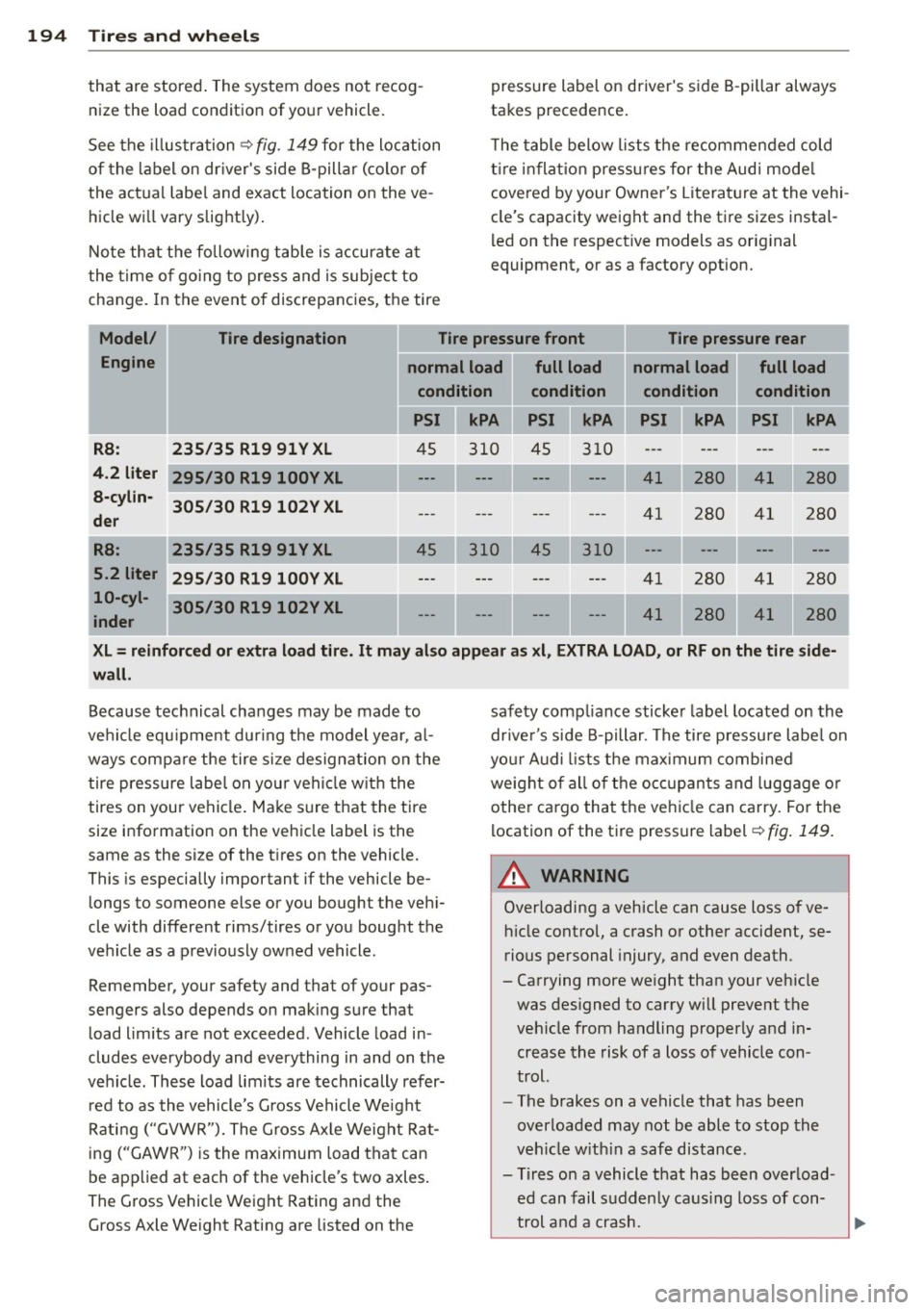
T he table below l ists t he recommended cold
t ire inflat ion pressu res for the Aud i mode l
covered by your Owner's Literat ure at the vehi
cle's capacity weight and the tir e sizes i nstal
l ed on the respective models as orig inal
equipment, or as a facto ry option.
I Model / \I Tire designation
Tire pressure front Tire pressure rear I
Engine
normal load full load normal load full load
condition condition condition condition
PSI II kPA PSI II kPA PSI ]I kPA
PSI II kPA
RS: 235/35 R19 91 Y XL 45
310 45 310
4 .2 liter
295 /30 R19 lOOY X L 280
8-c ylin-
305/30 R1 9 102V
XL
der 41
280 41
280
RS: 235/35 R19 91 Y XL 45
5.2 liter 295 /30 R19 l00Y XL 41 280 41
280
10-cyl-
305 /30 R19 102V XL
inder 41 280 41 280
--XL= reinforc ed or extra load tire. It may also a ppear as xl , EXTRA LOAD, or RF on the tire side·
wall.
Because tec hnical changes may be made to
ve hicle equ ipment dur ing the model yea r, a l
ways compare the tire size designation on the
tire pressure labe l on your vehicle w ith the
tires on your vehicle . Make s ure that the t ire
size information on the ve hicle label is the
same as the size of the tires on the vehicle.
This is especially important if the vehicle be
longs to someone else or you bough t the veh i
cle with different rims/tires or you bought the
ve hicle as a previously owned vehicle .
Remember, your safety and that of your pas
sengers also depends on mak ing sure that
load limits are not exceeded . Vehicle load in
cludes everybody and everything in and on the
vehicle. These load lim its are technically refer
r ed to as the vehicle 's Gross Vehicle We ight
Rating ("GVWR"). The G ross Ax le Weight Rat
ing ("GAWR") is the maximum load that can
be applied at each of the vehicle's two axles .
The Gross Vehicle Weight Rating and the
G ross Axle Weight Rating are listed on the safety compl
iance sticker label located on the
driver's side 8-pillar. The tire p ressure labe l on
yo ur Audi lists the max im um combined
weight of all o f the occ upants and luggage or
othe r ca rgo that the vehicle can carry. Fo r the
location of the tire pressure label
~ fig . 149.
A WARNING
Overloading a vehicle can cause loss of ve
h icle contro l, a crash or other accident, se
rious personal injury, and even death.
- Carrying more we ight than your veh icle
was designed to carry will prevent the
veh icle from handling properly a nd i n
crease the risk of a loss of vehicle con
trol.
- The brakes on a vehicle that has been
overloaded may not be able to stop the
veh icle w ith in a safe distance.
- Tires on a vehicle that has been overload
ed can fail suddenly ca using loss of con
trol and a crash.
Page 214 of 244
212 What do I do now?
Preliminary steps
Applies to vehicles: with T ire Mobility System
Some preliminary steps are necessary for tire
repair .
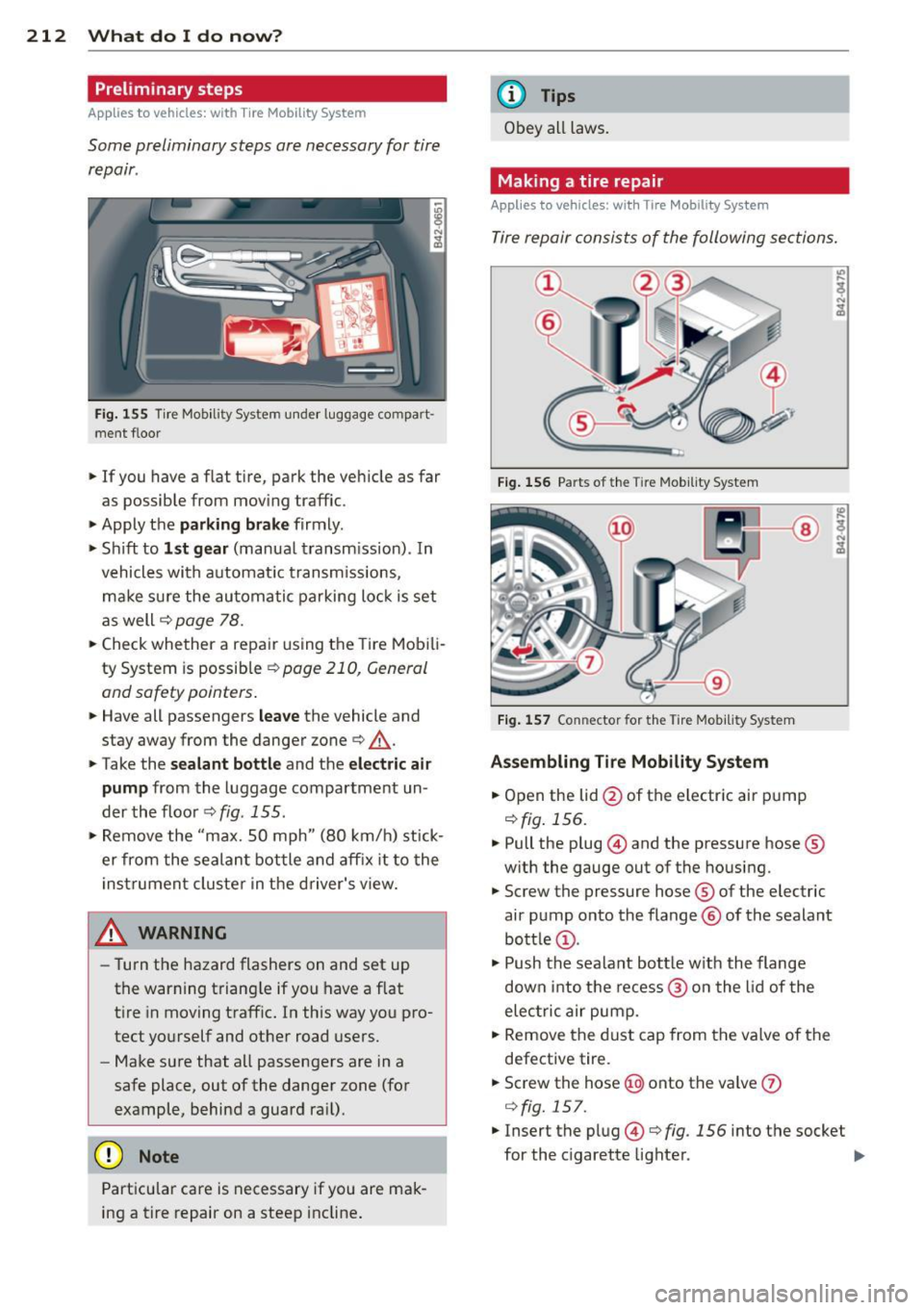
Fig. 155 Tire Mobili ty System under luggage co mpart
ment f loor
.,. If you have a flat tire, park the vehicle as far
as possible from mov ing traffic .
.,. Apply the
park ing brake firmly .
.,. Shift to
1st gear (manual transmission) . In
vehicles with a utomat ic transm iss ions,
make sure the automatic parking lock is set
as well
c::> page 78 .
.,. Check whether a repair using the Tire Mobili
ty System is possible
c::> page 210, General
and safety pointers .
.,. Have all passengers leave the vehicle and
stay away from the danger zone
c::> .&, .
.,. Take the sealant bottle and the electric air
pump from the luggage compartment un
der the floor
c::> fig. 155.
.,. Remove the "max. 50 mph" (80 km/h) stick
er from the sealant bottle and affix it to the
instrument cluster in the driver 's view.
A WARNING
- Turn the hazard flashers on and set up
the warning triangle if you have a flat
tire in moving traff ic. In this way you pro
tect you rs elf and other road users.
- Make sure that all passengers are in a
safe place, out of the danger zone (for
example, behind a guard ra il).
(D Note
Particular care is necessary if you are mak
ing a tire repair on a steep incline.
-
(D Tips
Obey all laws.
Making a tire repair
Applies to vehicles: with Tire Mobility System
Tire repair consists of the following sections.
Fig. 156 Parts of the Ti re Mobility System
Fig. 157 Conn ector for the Tire Mob i,lity System
Assembling Tire Mobility System
.,. Open the lid @of the electric air pump
c::> fig. 156 .
.,. Pull the plug© and the pressure hose ®
w ith the gauge out of the housing.
.,. Screw the pressure hose ® of the electric
air pump onto the flange @ of the sealant
bottle @.
.,. Push the sealant bott le w ith the flange
down into the recess @ on the lid of the
electric air pump.
.. Remove the dust cap from the valve of the
defective tire.
.. Screw the hose @onto the valve
(j)
c::>fig. 157.
.,. Insert the plug© c::> fig. 156 into the socket
for the cigarette lighter. .,,_