steering AUDI R8 SPYDER 2014 Owner's Manual
[x] Cancel search | Manufacturer: AUDI, Model Year: 2014, Model line: R8 SPYDER, Model: AUDI R8 SPYDER 2014Pages: 244, PDF Size: 61.06 MB
Page 114 of 244
112 Airbag system
angle of impact that will always trigger the
airbags, since the circumstances will vary con
siderably between one collision and another.
Important factors include, for example, the
nature (hard or soft) of the object which the
car hits, the angle of impact, vehicle speed,
etc. The front airbags will also not inflate in
side or rear collisions, or in roll-overs.
Always remember: Airbags will deploy only
once, and only in certain kinds of collisions .
Your safety belts are always there to offer pro
tection in those situations in which airbags
are not supposed to deploy , or when they have
already deployed; for example , when your ve
hicle strikes or is struck by another after the
first collision.
This is just one of the reasons why an airbag is
a supplementary restraint and is not a substi
tute for a safety belt. The airbag system
works most effectively when used with the
safety belts. Therefore, always properly wear
you r safety belts¢
page 103 .
A WARNING
Sitting too close to the steering wheel or
instrument panel will decrease the effec
tiveness of the airbags and will increase
the risk of personal injury in a collision .
- Never sit closer than 10 inches (25 cm)
to the steering wheel or instrument pan el.
- If you cannot sit more than 10 inches
(25 cm) from the steering wheel, investi
gate whether adaptive equipment may
be available to help you reach the pedals
and increase your seating distance from
the steering wheel.
- If you are unrestrained, leaning forward,
sitting sideways or out of position in any
way, your risk of injury is much higher.
- You will also receive serious injuries and
could even be killed if you are up against
the airbag or too close to it when it in
flates -even with an Advanced Airbag.
- To reduce the risk of injury when an air
bag inflates, always wear safety belts
properly
c::> page 106, Safety belts.
- Never let children ride unrestrained or
improperly restrained in the vehicle. Ad
just the front seats properly . If children
are not properly restrained, they may be
severely injured or killed when an airbag
inflates .
- Never ride with the backrest reclined.
- Always sit as far as possible from the
steering wheel or the instrument panel
¢ page 94, Proper occupant seating po
sitions .
-Always sit upright with your back against
the backrest of your seat.
- Never place your feet on the instrument
panel or on the seat. Always keep both
feet on the floor in front of the seat to
help prevent serious injuries to the legs
and hips if the airbag inflates.
- Never recline the front passenger's seat
to transport objects. Items can also
move into the area of the side airbag or
the front airbag during braking or in a
sudden maneuver. Objects near the air
bags can become projectiles and cause
injury when an airbag inflates.
A WARNING
-Airbags that have deployed in a crash must be replaced.
- Use only original equipment airbags ap
proved by Audi and installed by a trained
technician who has the necessary tools
and diagnostic equipment to properly re
place any airbag in your vehicle and as
sure system effectiveness in a crash .
- Never permit salvaged or recycled air
bags to be installed in your vehicle .
Child restraints on the front seat - some
important things to know
.,. Be sure to read the important information
and head the WARNINGS for important de
tails about children and Advanced Airbags
c::> page 132.
The airbag on the passenger side makes the
front seat a potentially dangerous place for a ..,_
Page 117 of 244
Front airbags
Description of front airbags
The airbag system can provide supplemental
protection to properly restrained front seat
occupants .
Fig. 117 Loca tion of driver airbag: in steering whee l
Fig. 118 Locatio n of front passe nger 's ai rb ag : in th e in
st rument panel
Your vehicle is equipped with an "Advanced
Airbag System" in compliance w ith United
States Federal Motor Vehicle Safety Standard
(FMVSS) 208 as app licable at the time your
veh icle was manufactured . The safety be lts
fo r the front seats have "pretensioners" that
h e lp to take s lack out of the belt system. The
pretensioners are also activated by the elec
tronic control unit for the airbag system.
The fron t safety belts a lso have load limiters
to help reduce the forces applied to the body
in a crash.
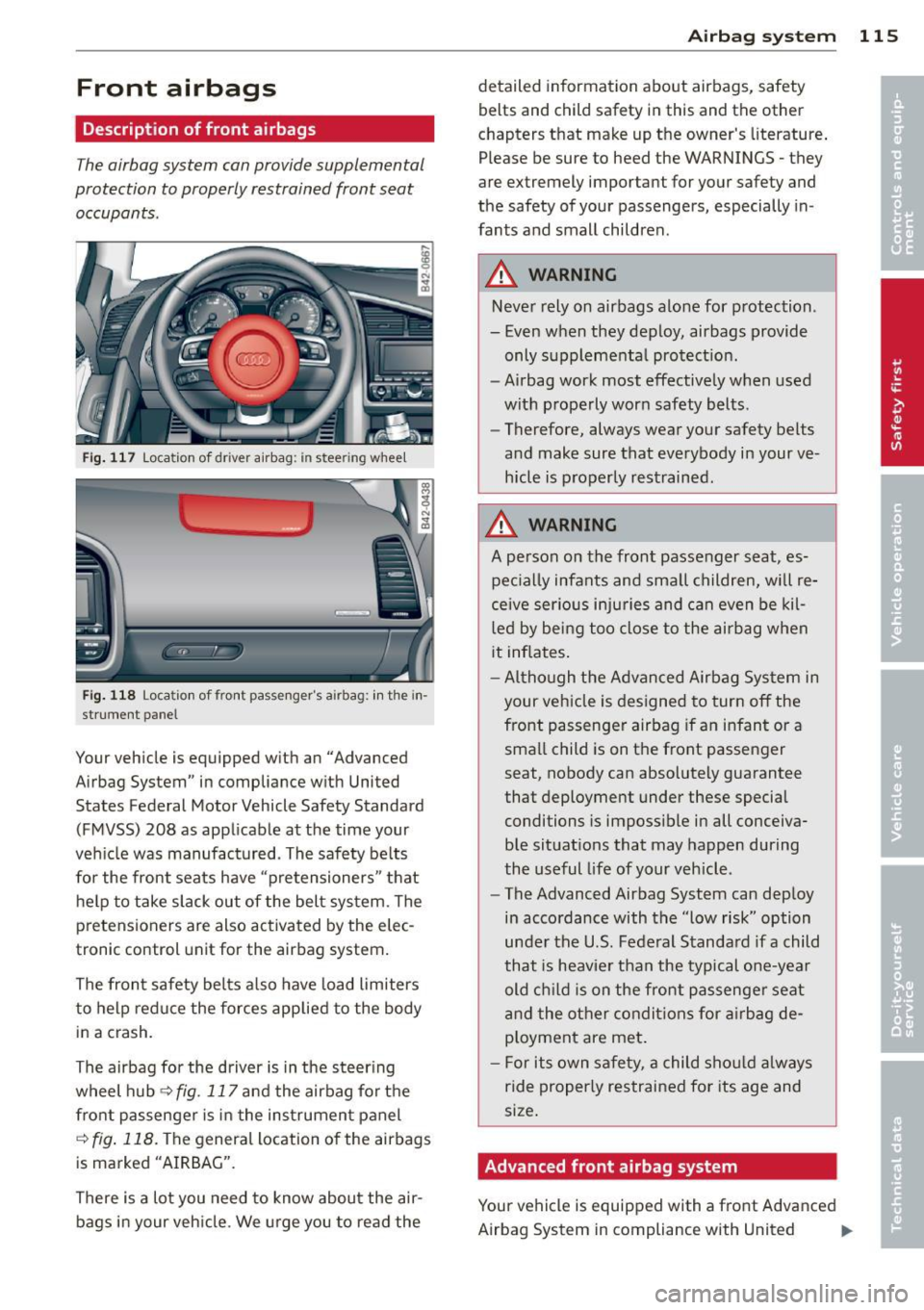
The airbag for the driver is in the steer ing
wheel hub¢
fig. 117 and the airbag for the
fro nt passenger is in the instrumen t panel
¢ fig . 118. The genera l location of the airbags
is marked "AIRBAG".
There is a lot you need to know about the air
b ags in your veh icle. We urge you to read the
A irba g sy stem 115
detailed information about airbags, safety
belts and child safety in this and the other
chapters t hat make up t he owner's literature .
Please be sure to heed the WARNINGS - they
are extremely important for your safety and
the safety of your passengers, especially in
fants and small child ren.
A WARNING ,.;;
Neve r rely on airbags alone for protection .
- Even when they deploy, airbags provide
only s upplementa l protect ion.
- Airbag work most effective ly when used
with properly wor n safety belts.
- Therefore, always wear your safety belts
and make sure that everybody in your ve
hicle is p roperly restrained.
A WARNING
A person on the front passenger seat, es
pec ia lly infants and sma ll children, will re
ceive serious i njuries and can even be kil
l ed by being too close to the ai rbag when
it inflates .
- Al tho ugh the A dvanced Airbag Sys tem in
your veh icle is designed to tur n off the
front passenger airbag if an infant or a
sma ll child is on t he front passenger
seat, nobody can absolutely guarantee
that deployment under these special
conditions is imposs ible in all conceiva
ble situat ions that may happen during
the useful life of your veh icle .
- The Advanced Airbag System can dep loy
in acco rdance with the "low risk" option
unde r the U .S. Fede ral Standa rd if a child
that is heav ie r than the typical one-year
old c hild is on the front pas senge r seat
and the other condi tions for airbag de
p loyment are met .
- For its own safe ty, a c hild sho uld always
ride proper ly restrained for its age and
size .
Advanced front airbag system
-
Your vehicle is equipped with a front Advanced
Airbag System in compliance with United
Ill>
Page 120 of 244

118 Airbag system
components is detected. The function of the
airbag indicator light is described in greater
detail below. Because the front passenger
seat contains important parts of the Ad
vanced Airbag System, you must take care to prevent it from being damaged . Damage to
the seat may prevent the Advanced Airbag for
the front passenger seat from doing its job in
a crash .
The front Advanced Airbag System
consists of the following:
-Crash sensors in the front of the vehicle that
measure vehicle acceleration/deceleration
to provide information to the Advanced Air bag System about the severity of the crash.
- An electronic control unit, with integrated
crash sensors for front and side impacts .
The control unit "decides " whether to fire
the front airbags based on the information received from the crash sensors. The control
unit also "decides" whether the safety belt
pre tensioners should be activated.
- An Advanced Ai rbag with gas generator for
the driver inside the steering wheel hub.
- An Advanced Airbag with gas generator in
side the inst rument panel for the front pas
senger.
- A weight-sensing mat under the upholstery
padding of the front passenger seat cushion
that measures the total weight on the seat.
The information registered is sent continu
ously to the electronic control unit to regu
late deployment of the front Advanced Air
bag on the passenger side.
- An airbag monitoring system and indicator
light in the instrument cluster
¢page 121.
- The PASSENGER AIR BAG OFF light comes
on and stays on in the center of the instru
ment panel ¢
page 122, fig. 120 and tells
you when the front Advanced Airbag on the passenger side has been turned off.
- A sensor below the safety belt latch for the
front seat passenger to measure the tension
on the safety belt. The tension on the safety
belt and the weight registered by the
weight-sensing mat help the control unit "decide" whether the front airbag for the front passenger seat should be turned off or
not
¢ page 112, Child restraints on the
front seat -some important things to
know.
- A sensor in the safety belt latch for the driv
er and for the front seat passenger that
senses whether that safety belt is latched or not and transmits this informa tion to the
electronic control unit .
.&_ WARNING
Damage to the front passenger seat can
prevent the front airbag from working
properly.
- Improper repair or disassembly of the
front passenger and driver seat will pre
vent the Advanced Airbag System from
functioning properly.
- Repairs to the front passenger seat must
be performed by qualified and properly
trained workshop personnel.
- Never remove the front passenger or
driver seat from the vehicle.
-Never remove the upholstery from the
front passenger seat.
- Never disassemble or remove parts from
the seat or disconnect wires from it.
- Never carry sharp objects in your pockets
or place them on the seat. If the weight
sensing mat in the passenger seat is
punctured it cannot work properly.
- Never carry things on your lap or carry
objects on the passenger seat. Such
items can increase the weight registered
by the weight-sensing mat and send the
wrong information to the airbag control
unit.
- Never store items under the front pas
senger seat. Parts of the Advanced Air
bag System under the passenger seat
could be damaged, preventing them and
the airbag system from working proper ly.
- Never place seat covers or replacement
upholstery that have not been specifical ly approved by Audi on the front seats .
- Seat covers can prevent the Advanced
-
Airbag System from recognizing child .,..
Page 123 of 244

-The inflating airba g will hit the child
safety seat or infant carrier wit h great
f o rce and w ill smash t he ch ild safety seat
and child aga inst the backrest, cente r
arm rest, d oor or roof.
- Never install a r earward facing child
sa fety seat on the front pass eng er s eat
unless the
PASSENGER AIR BAG OFF
light c omes on and stays on. If the PAS
S ENGER AIR BAG OFF
ligh t does no t
c o m e on and stay on, the inflating airbag
will hit the child safety seat or infant car
rier with great force and will smash the
child safety seat and child against the
backrest, door or roof. Have the airbag
system inspected immediately by your
authorized Audi dealer .
A WARNING
Objects between you and the a irbag will
increase the risk of injury in a crash by in
terfering with the way the airbag unfolds
or by being pushed into you as the a irbag
inflates.
- Never hold th ings in your hands or on
your lap when the vehicle is in use .
- Never transport items on or in the area
of the front passenge r seat. Objects
cou ld move into the area of the front air
bags dur ing braking or other s udden ma
neuver and become dangerous projec
ti les that can cause serious personal in
jury if the airbags inflate.
- Never place o r attach accessories or oth
er objects (such as cup ho lders, tele
phone brackets, large, heavy or b ulky ob
jects) on the doors, over or near the area
marked "AIRBAG" on the steering wheel,
instrument panel, seat backrests or be
tween those a reas and yourself. These
objects could cause injury in a crash, es
pecially when the airbags inflate.
- Never recline the front passenger's seat
to transport objects. Items can also
move in to the area of the side airbag or
the front airbag dur ing braking or in a
sudden maneuver . Objects near the air -
-
Airbag system 12 1
bags can become projectiles and cause
inju ry, partic ularly when the seat is re
clined.
A WARNING
The fine dust created when airbags deploy
can cause breathing prob lems for people
with a history of asthma or other breath
ing cond itions.
- To reduce the risk of breath ing problems,
those with asthma o r other respiratory
conditions shou ld get fresh air r ight
away by getting o ut of the veh icle or
open ing windows or doors.
- If you are in a collision in which airbags
deploy, was h your hands and fa ce with
mild soap and wate r before ea ting.
- Be ca reful not to get the dust into your
eyes, o r into any cuts or sc ratches .
- If the resid ue should get into your eyes,
f lush them w ith wate r.
Monitoring the
Advanced Airbag System
t!~ Airbag monitoring indicator light
Two separate indicators monitor the function
of the Advan ced Airbag System: the airbag
monitoring indi cator light and the
PASSEN
GER AIR BAG OFF
light.
T he Advanced A irbag System (including the
electron ic co ntro l unit, sensor circu its and sys
tem wir ing) is monitored con tinuously to
make sure that it is functioning properly
whenever the ignition is on. Each time you
turn on the ignition, the a irbag mon itoring in
dicator light
I will come on for a few seconds
(self diagnostics).
The sy stem mu st be in spected when th e
indicator light
I :
- does not come on when the ignition is
sw itched on,
- does not go out a few seconds after you
have switched on t he ignition, or
•
•
Page 126 of 244
124 Airbag sys te m
years and younger, a lways ride proper ly
restrained for their age and s ize.
- If you must install a rearward facing
child safety seat on the front passenger
seat because of exceptional circumstan
ces and the
P ASS ENGER AIR BAG OFF
light does not appear and stay on have
the a irbag system inspected by your Audi
dealer.
-A tight tether or other strap on a rear ward-fac ing child restra int attached to
the front passenger seat can put too much pressure on the weight-sens ing
mat in the seat and register mo re weight
than is actually on the seat. The heavier
weight registered can make the system
work as though an ad ult were on the seat
and dep loy the Advanced Airbag when it
must be suppressed caus ing serious or
even fatal injury to the child.
- If, in exceptional circumstances, you
must install a forward-facing child re
straint on the front passenger seat, a l
ways move the seat into its rearmost po
sit ion in the seat's fo re and aft adjust
ment range, as far away from the airbag
as possib le. The backrest m ust be adjus t
ed to an upr ight position. Make sure that
the
PASSENGER AIR BAG OFF light
comes on and stays on all the t ime when
ever the ignition is switched on.
A WARNING
- If the PASSENGER AIR BAG OFF light
does not go out when an adult is sitting
on the front passenge r seat afte r taking
the steps described above, have the air bag system inspected by your Audi deal
er before transpor ting anyone on the
front passenger se at.
(D Tips
If the weight-sensing mat in the front pas
senger seat detects an empty seat, the
front airbag on the passenge r side will be
turned off, and
PASSENGER AIR BAG OFF
w ill stay on.
-
Repair, care and disposal of the airbags
Pa rts of the airbag system are i nstalled at
many diffe rent p laces o n your Aud i. Insta llin g,
removi ng, servicing or repa iring a part in an
area of the veh icle can damage a part of an
airbag system and prevent that system from
working properly in a coll is ion.
T he re a re some important t hings yo u have to
know to make sure that the effectiveness o f
t h e system wi ll not be impaired and that dis
carded components do not cause injury or pol
l ute the environment.
A WARNING
Improper care, serv ic ing and repair proce
du res can increase the risk of personal in
j u ry and death by prevent ing an a irbag
from deploying when needed or dep loying
an a irbag une xpec tedly:
- Never cover, obst ruct, or change the
steer ing whee l horn pad or ai rbag cover
or the in st rument panel or mod ify them
in any way .
- Never attach any objects s uch as c up
holders or telephone mountings to the
sur faces covering the a irbag un its.
- For cle aning the horn pad or instr ument
panel, use only a soft, dry clo th or one
moistened with pla in water. Solvents o r
cleaners could damage the airbag cover
or change the st iffness or strength of the
material so that the airbag cannot de
p loy and protect properly.
- Never repair, adjust, or change any parts
of the a irbag system.
- All work on the steering wheel, instru
ment panel, front seats or e lectr ica l sys
tem (including the installation of audio
equ ipment, cellu lar telep hones and CB
radios, etc.) must be performed by a
qualified technic ian who has the training
and specia l equipment ne cessary.
- For any wo rk on the airbag system, we
strongly recommend that you see your
author ized Audi dealer or qualified work-
shop. ..,.
Page 128 of 244
126 Airbag system
with the safety belt buckles so that the sen
sors can send the correct information about
safety belt use to the electron ic control unit.
.&_ WARNING
Changing the vehicle 's s uspension includ
ing use of unapproved tire-rim combina
tions can change Advanced Airbag per
formance and increase the risk of serious personal inj ury in a c rash .
- Never install suspens ion components
that do not have the same performance
character istics as the components origi
nally insta lled on yo ur vehicle.
- Never use ti re-rim comb inat io ns that
have not been approved by A udi.
.&_ WARNING
-
Items stored between the safety belt
buckle and the center console can cause
the senso rs in the buckle to send the
wrong information to the electronic con
trol mod ule a nd prevent the Advanced A ir
bag System from work ing properly .
- Always make sure that nothing can inter-
fere with the safety belt buck les and that
they are not obstructed.
Knee airbags
Description of knee airbags
T he knee airbag system can provide supple
mental protection to properly restrained
front seat occupants .
Fig. 121 Driv er 's airbag
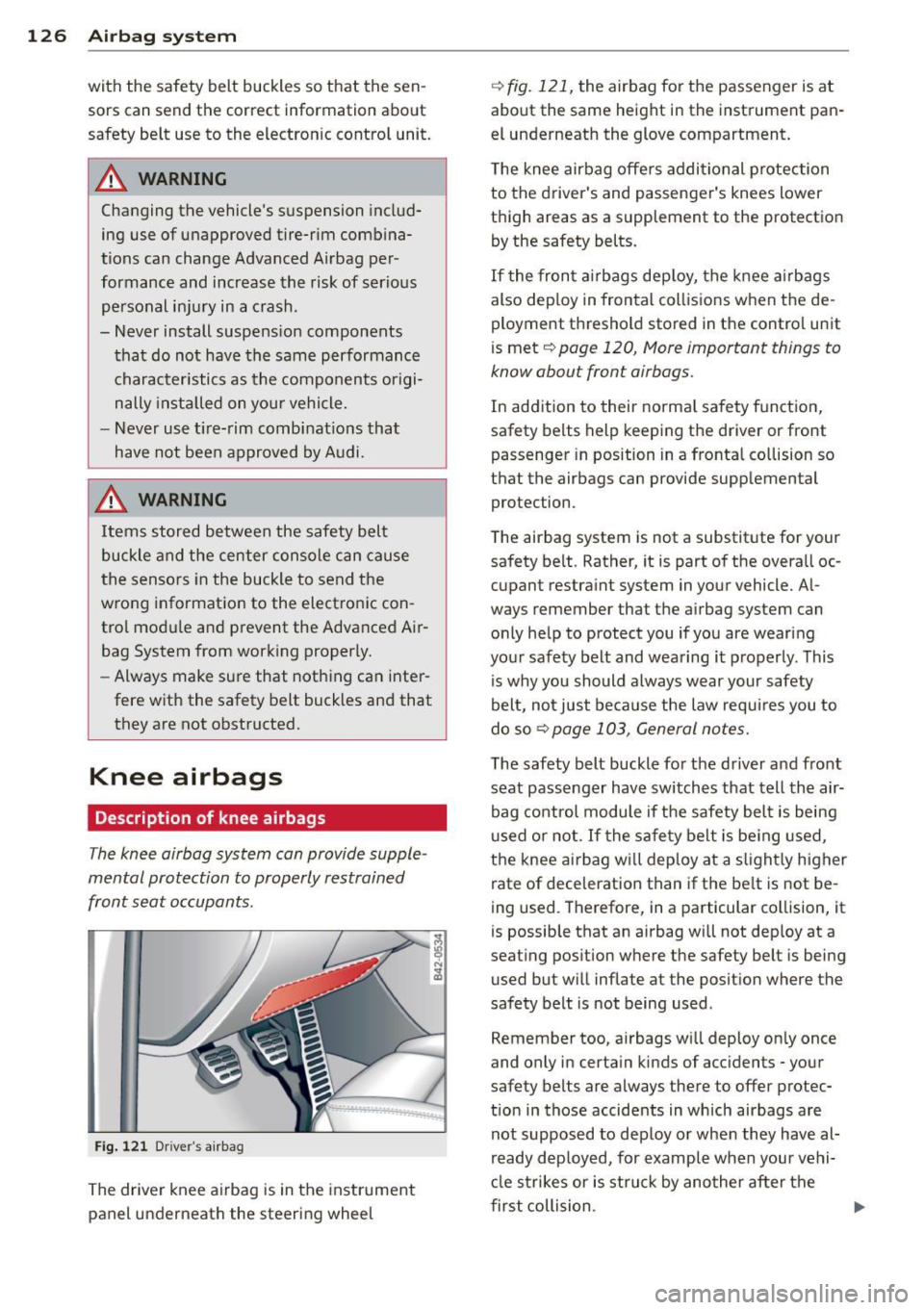
The drive r knee airbag is in the instrument
panel underneath the steering whee l
~ fig. 121, the airbag for the passenger is at
about the same height in the instrument pan
el underneath the glove compartment .
T he knee air bag offe rs addi tional p rotec tion
to the driver 's and passenger's knees lower
t h igh areas as a supplement to the protection
by the safety belts .
If the fron t airbags dep loy, the knee a irbags
also dep loy in frontal collisions w hen the de
ployment threshold stored in the control unit
is met ~
page 120, More important things to
know about front airbags .
In addition to their normal sa fety function,
safety belts help keeping the driver or front
passenger in position in a fronta l co llision so
that the airbags can provide supp lemental
protection .
T he airbag system is not a substitute for your
safety belt . Rather, it is part o f the overa ll oc
cupant restra int system in your vehicle. A l
ways remember tha t the a irbag system can
o nly he lp to protect you if you are wearing
you r safety belt and wea ring it properly . This
is why you should a lways wear your safety
belt, not jus t be cause the law requ ires you to
do so~
page 103 , General notes.
The safety belt buckle fo r th e driver and front
seat passenger have switch es that tell the air
bag control module if the safety bel t is being
u sed or not .
If the sa fe ty belt is be ing used ,
t h e knee a irbag w ill deploy at a s light ly h igher
rate of dece leration than if the be lt is not be
ing used . Therefore, in a particular co llision, it
is possib le that an airbag will not dep loy at a
seating pos ition where the safety belt is being
used but will inflate at the posit ion where the
safety belt is not being used .
Remember too, airbags w ill deploy on ly once
and only in certa in kinds of acc idents - your
safety belts are always there to offer protec
t io n in those accidents in which airbags are
not supposed to deploy o r whe n they have al
ready dep loyed, for example when your vehi
cl e s trikes or is st ru ck by ano ther after the
first collision . ..,.
Page 130 of 244

128 Airbag system
Important safety instructions on the
knee airbag system
Airbags are only supplemental restraints. Al
ways wear safety belts correctly and ride in a
proper seating position.
There is a lot that you and your passenger
must know and do to help the safety belts and
airbags to provide supplemental protection.
.&_ WARNING
An inflating knee airbag can cause serious injury. Wearing safety belts incorrectly and
improper seating positions increase the
risk of serious personal injury and death
whenever a vehicle is being used.
-
- The knee airbag system cannot protect
you properly if you are seated too close
to any of the airbag locations. When ad
justing their seat positions, it is impor
tant that both the driver and the front
passenger keep their upper bodies and
knees at the following min imum safe
distances:
- at least 10 inches (25 cm) between the
chest and the steering wheel/instru
ment panel.
- at least 4 inches (10 cm) between the
knees and the lower part of the instru
ment panel.
- The risk of personal injury increases if
you lean forward or to the side, or if the
seat is improperly positioned and you are
not wearing your safety belt. The risk in
creases even more should the airbag de
ploy.
- Always make sure that the knee airbag
can inflate without interference. Objects
between you and the airbag can increase
the risk of injury in an accident by inter
fering with the way the airbag dep loys or
by being pushed into you as the airbag
deploys .
- Never let anybody, especially children
or animals in the footwell in front of
the passenger seat.
If the airbag de- ploys, this can result in serious or fatal
injuries.
- No objects of any kind should be car
ried in the footwell area in front of the
driver's or passenger's seat. Bulky ob
jects (shopping bags, for example) can
hamper or prevent proper deployment
of the airbag . Small objects can be
thrown through the vehicle if the air bag deploys and injure you or your pas
sengers.
- Make sure there are no cracks, deep
scratches or other damage in the area of
the instrument panel where the knee air
bags are located.
- If children are incorrectly seated, their
risk of injury increases in a collision
~page 132, Child Safety.
Side airbags
Description of side airbags
The airbag system can provide supplemental
protection to properly restrained front seat
occupants.
Fig. 123 S ide a irbag location in the driver's seat
The side airbags are located in the sides of the
front seat backrests
q fig. 123 facing the
doors. They are identified by the word "AIR
BAG".
Th e side airbag system basically consists of:
-the electronic control module and external
side impact sensors
- the two side airbags located in the sides of
the front backrests
- the airbag warning light in the instrument
cluster .
Page 135 of 244

A WARNING
-=
If, in exceptional circumstances, you must
install a forward-facing child restraint on
the front passenger's seat:
- Always make sure the forward-facing
seat has been designed and certified by
its manufacturer for use on a front seat
with a passenger front and side airbag.
-Always follow the manufacturer's in
structions provided with the child safety
seat or carrier.
- Always move the passenger seat into its
rearmost position in the seat's fore and
aft adjustment range, as far away from
the airbag as possible before installing
the child restraint. The backrest must be
adjusted to an upright position.
- Always make sure that the
PASSENGER
AIR BAG OFF light comes on and stays
on all the time whenever the ignition is
switched on.
(D Tips
Always replace child restraints that were
installed in a vehicle during a crash. Dam
age to a child restraint that is not visible
could cause it to fail in another collision
situation.
Advanced front airbag system and children
Your vehicle is equipped with an "Advanced
Airbag System" in compliance with United
States Federal Motor Vehicle Safety Standard
(FMVSS) 208 as applicable at the time your
vehicle was manufactured.
The Advanced Airbag system in your vehicle
has been certified to meet the "low-risk " re
quirements for 3- and 6- year-old children on
the passenger side and small adults on the
driver side. The low risk deployment criteria
are intended to reduce the risk of injury
through interaction with the airbag that can
occur, for example, by being too close to the
steering wheel and instrument panel when
the airbag inflates. In addition, the system
Child Safety 133
has been certified to comply with the "sup
pression" requirements of the Safety Stand
ard, to turn off the front airbag for infants up
to 12 months who are restrained on the front passenger seat in child restraints that are list
ed in the Standard .
Even though your vehicle is equipped with an
Advanced Airbag system, a child should al
ways ride in the seat properly restrained for
its age and size . The airbag on the passenger
side makes the front seat a potentially dan
gerous place for a child to ride. The front seat
is not the safest place for a child in a forward
facing child safety seat .
It can be a very dan
gerous place for an infant or a larger child in a
rearward-facing seat.
Advanced Airbags and the weight
sensing mat in the front seat
The Advanced Airbag System in your vehicle
detects the presence of an infant or child in a
child restraint on the front passenger seat us
ing the weight-sensing mat in the seat cush
ion and the sensor below the safety belt latch
on the front passenger seat that measures the
tension on the safety belt.
The weight-sensing mat measures total
weight of the child and the child safety seat
and a child blanket on the front passenger
seat. The weight on the front passenger seat
is related to the design of the child restraint
and its "footprint", the size and shape of the
bottom of the child restraint as it sits on the
seat. The weight of a child restraint and its
"footprint" vary for different kinds of child re
straints and for the different models of the
same kind of child restraint offered by child restraint manufacturers.
The weight ranges for the individual types,
makes and models of child restraints that the
NHTSA has specified in the Safety Standard
together with the weight ranges of typical in
fants and typical 1 year-old child have been
stored in the control unit of the Advanced Air
bag System. When a child restraint is being
used on the front passenger seat with a
ll-
•
•
Page 146 of 244
144 Intelligent technology
Intelligent technology
Notice about data
recorded by vehicle
control modules
Your veh icle is not equipped with an Event Da
ta Recorde r (EDR), ins talled by some manu
facture rs fo r the express p urpose of capturing
data for retrieval after an accident or cras h
event . EDR's are sometimes ca lled "crash re
corders".
Some state laws restr ict the retr ieval or down
loading of data stored by EDR's that were in
stalled in a vehicle for the express purpose of retrieving data after an accident or crash
event without the owner's consent.
A ltho ugh yo ur vehicle is not equ ipped wit h an
EDR, it is equipped with a number of electron
ic control modules for various v ehicle systems
such as, for examp le, eng ine f unction, em is
sion control, as well as for the airbags and
sa fety belt s.
These electronic contro l modules also record
vehicle-re lated data during norma l vehicle op
erat ion for diagnostic and repa ir purposes.
T he recording capacity of the electronic con
trol modules is limited to data (no sound is re
corded) and only a small amount of data is ac
tually recorded ove r a ve ry limited pe riod of
time and stored when a sys tem faul t or o ther
cond ition is sensed by a cont ro l u nit. Some of
the data then stored may re late to vehicle
speed, direction, braking as we ll as restraint
system use and performance in the event of a
crash or other condit ion. Stored data can only
be read and downloaded w ith special equip
ment .
Electronic Stabilization
Control (ESC)
Description
ESC helps to improve road holding and vehicle
dynamics to help reduce the probability of
skidd ing and loss of ve hicle control. It works
only when the eng ine is running . ESC detects certain difficult driving situat
ions, including
when the vehicle is beginning to spin (yaw)
o ut of control and he lps you to get the veh icle
back under control by se lectively braking the
whee ls, and/or reducing eng ine power and
providing steer ing ass istance to he lp hold the
vehicle o n the dr iver's intended course . T he in
dicator light
G) in the inst rument cluster
blinks when ESC is ta king action to help yo u
control the veh icle.
ESC has limitations.
It is importa nt to remem
ber that ESC cannot overcome the laws of
physics. It wi ll not always be able to help out
under a ll cond it ions you may come up aga inst.
F or example, ESC may not always be able to
help you master situations where there is a
s u dden change in the coefficient of friction of
the road surface . When there is a section of
dry road that is sudden ly covered w ith water,
s lush or snow, ESC cannot perform the same
way it wou ld on the dry surface . If the ve hicle
hydroplanes (rides on a cushion of water in
stead of the road surface), ESC will not be
able to help you steer the vehicle because con
tact with the pavement has been in terrupted
and the vehicle cannot be braked or steered .
D uring fast cornering, particularly on winding
roads, ESC cannot always deal as effectively
with difficult driving situations as at lower
speeds.
Always adjust your speed and driving style to road , traffic and weather conditions. ESC can
not override the vehicle's physical limits, in
crease the available tract ion, or keep a ve hicle
on the road if road departure is a result of
driver inattent ion . Instead, ESC imp roves the
poss ib ility of keep ing the veh icle under con
t rol and on the road during extreme maneu
vers by using the d river 's steering inputs to
help keep the vehicle go ing in t he i nte nded di
rection . If you are t raveling at a speed tha t
ca uses you to run off the road before ESC can
provide any assistance, you may not experi
ence the benefits of ESC.
ESC includes and/o r works togethe r with the
anti- lock b rake system (ABS), brake assist sys-
tem and anti-slip reg ulation (ASR). ESC is .,..
Page 151 of 244
Power steering
When the engine is running, power steering
makes it easier for the driver to steer.
Power steering he lps the driver steer the vehi
cle with little physical effort .
If the engine is not runn ing, the power steer
ing system is also not wo rking. In this case,
you will find it extreme ly difficult to turn the
steering whee l.
If you t urn t he steering fully to the le ft or
right when the vehicle is stationary, you place
a very heavy load on t he power steering sys
tem . T urning the steering wheel fu lly to the
left or r ight will cause noise in the system . It
a lso reduces engine idle speed.
(D Note
Do not hold the steering turned fully to
the left or right for more than 10 seconds
when t he engine is running. There is a risk
of damage to the power steeri ng system .
@ Tips
-In the event of a power steering system
failure, or if the eng ine is not running
(while being towed), you wi ll st ill be able
to stee r the ve hicle . However, you will re
quire more effort to do so .
- If the power steer ing system has a leak
or is defective, you should immed iately
contact a qualif ied wo rkshop.
- The powe r stee ring system requires a
spec ial hyd raulic f luid. The powe r stee r
i ng fl uid reservo ir is lo cated in the en
g ine compar tment . Th e cor re ct hydra ulic
f lui d leve l is important for p ro per opera
tion o f the power steering sys tem . The
power steer ing fl uid leve l is checked ac
cord ing to the Aud i maintenance service
schedule.
Dry sump Lubrication
H igh lateral and long itud inal forces affect the
engine and the vehicle d uring sporty driving.
Ory sump lubr ication ensures that your eng ine
Int ellig ent technolog y 149
is supplied wi th oi l and properly lubricated
even under these conditions .
In a "no rma l" veh icle the o il pump sends the
o il from the o il p an t o the lubr ication points in
t h e engine. The oi l then ret urns to the o il pan .
In extreme situations , the oil p ump may draw
in a ir, which results in insufficient oi l pressure.
Wi th dr y sump lubri cat ion, the o il is not in the
oi l pan (it is "dry"), but in a separate oil tank.
While one p ump supplies t he e ngine with oil ,
a second pump suctions the oil out of the en
gine and returns it to the oil tank. Because the
o il tank is tall and narrow, oil pressure is con
stant even under extreme conditions .
In add ition, the oi l pan in vehicles with dry
sump l ubrication is noticeab ly shallower. This
allows the engine to be installed lower in the
vehicle , bring ing down the center of grav ity .
T his imp roves your ve hicle's handling .
Driving with your
quattro ®
With all-wheel drive, all four wheels are driv
en.
General information
With a ll-wheel d rive, powe r is distr ib uted to
al l four wheels. This happens autom atic ally
depen ding on your d riving s tyle and the ro ad
conditions a t the time . See also ¢
page 144.
The all-whee l dr ive concept is des igned for
high eng ine power. Your veh icle is except ion
al ly powe rf ul and h as ex cellen t driving charac
teristics both under normal driving cond itions
and on snow and ice . Always read and follow
safety precaut ions ¢&. .
Winter tires
When dr iving in the win ter, yo ur vehicle wi th
a ll- wheel d rive h as an advantage, even w it h
regular tires. In winter road conditions it may
be advisable to mount winter tires (or all-sea
son tires) for improved driveability and brak
ing : these tires must be mounted on
all four
wheels . See also¢ page 203, Winter tires. .,..
•
•