sensor AUDI R8 SPYDER 2015 Owner's Manual
[x] Cancel search | Manufacturer: AUDI, Model Year: 2015, Model line: R8 SPYDER, Model: AUDI R8 SPYDER 2015Pages: 232, PDF Size: 58.36 MB
Page 118 of 232
Airb ag syst em
observed. Your authorized Audi dealer is fa
miliar with these requirements and we recom
mend that you have your dealer perform this
service for you.
Other things that can affect Advanced
Airbag performance
Changing the vehicle's suspension system can
change the way that the Advanced Airbag System
pe rforms in a crash. For example, us ing t ire-rim
comb inat ions not approved by Audi, lowering the
vehicle, changing the stiffness of the suspension, including the springs, suspension struts, shock
absorbers etc. can change the forces that are measured by the airbag sensors and sent to the
electronic control unit. Some suspension changes
can, for example, increase the force levels meas
ured by the sensors and make the airbag system
deploy in crashes in which it wou ld not deploy if
the changes had not been made. Other kinds of
changes may reduce the force levels measured by
the sensors and prevent the airbag from deploy
ing when it should.
A WARNING
Changing the vehicle's s uspension including
use of unapproved t ire-rim comb inat ions can
change Advanced A irbag performance and in
crease the risk of ser ious persona l injury in a
crash .
- Never install suspension components that
do not have the same performance charac
te ristics as the components or iginally insta l
led on your veh icle.
- Never use tire-rim combinations that have not been approved by A udi.
A WARNING
Items stored between the safety belt buckle
and the center console can cause the senso rs
in the b uck le to send the wrong information
t o the electron ic contro l modu le and prevent
t he Advanced Airbag System from working
properly.
- Always make sure that nothing can interfere
with the safety be lt b uckles and that they
are not obstructed.
116
Knee airbags
Description of knee airbags
The knee airbag system can provide supplemen
tal protection to properly restrained front seat
occupants .
Fig. 119 D river 's airbag
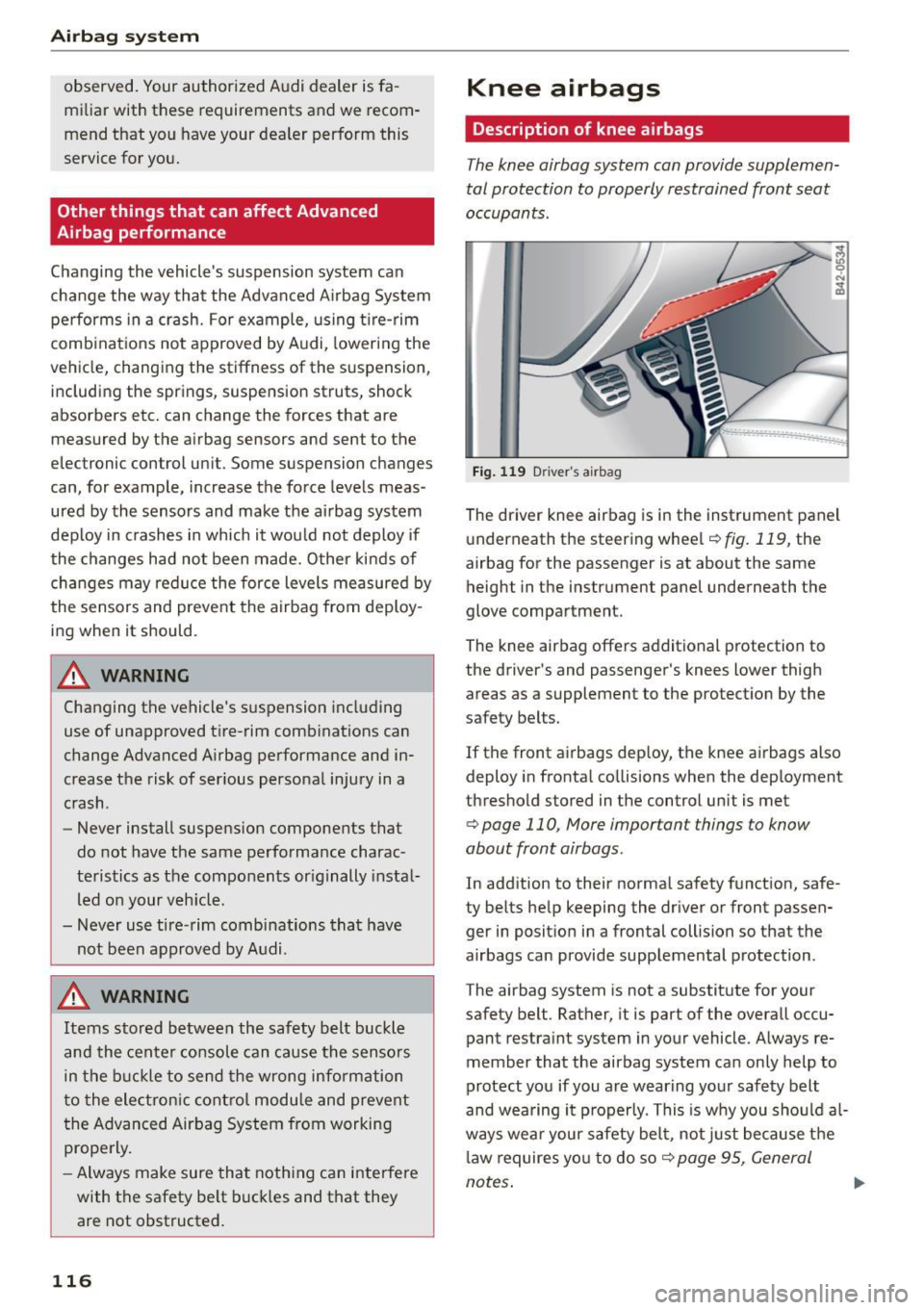
The driver knee airbag is in the instrument panel
u nderneath the steer ing whee l
~fig. 119, the
airbag for the passenger is at about the same height in the instrument panel underneath the
glove compartment.
The knee airbag offers additional protection to
the driver's and passenger's knees lower thigh
areas as a supplement to the protection by the
safety belts.
If the front a irbags dep loy, the knee a irbags also
deploy in fronta l co llisions when the dep loyment
threshold stored in the control unit is met
~ page 110 , More important things to know
about front airbags .
In addition to their normal safety function, safe
ty belts help keeping the driver or front passen ger in posit ion in a frontal collision so that the
airbags can provide supplemental protection .
The airbag system is not a substitute for your
safety belt . Rather, it is part of the overall occu
pant restra int system in your vehicle. A lways re
member that the airbag system can only help to
protect you if you are wearing your safety belt
and wea ring it p roperly. This is why you sho uld a l
ways wear your safety be lt, not just because the
l aw requires yo u to do so¢
page 95, General
notes .
llll-
Page 120 of 232
Airbag system
Important safety instructions on the knee
airbag system
Airbags are only supplemental restraints. Always
wear safety belts correctly and ride in a proper
seating position.
There is a lot that you and your passenger must
know and do to help the safety belts and airbags
to provide supplemental protection.
,8. WARNING
An inflating knee airbag can cause serious in
jury. Wearing safety belts incorrectly and im proper seating positions increase the risk of
serious personal injury and death whenever a
vehicle is being used.
- The knee airbag system cannot protect you
properly if you are seated too close to any of
the airbag locations. When adjusting their
seat positions, it is important that both the
driver and the front passenger keep their
upper bodies and knees at the following
minimum safe distances :
- at least 10 inches (25 cm) between the
chest and the steering wheel/instrument
panel.
- at least 4 inches (10 cm) between the
knees and the lower part of the instru
ment panel.
- The risk of personal injury increases if you
lean forward or to the side, or if the seat is
improperly positioned and you are not wear
ing your safety belt . The risk increases even
more should the airbag deploy .
- Always make sure that the knee airbag can
inflate without interference . Objects be
tween you and the airbag can increase the
risk of injury in an accident by interfering
with the way the airbag deploys or by being
pushed into you as the airbag deploys.
- Never let anybody, especially children or
animals in the footwell in front of the pas
senger seat .
If the airbag deploys , this can
result in serious or fatal injuries.
- No objects of any kind should be carried in
the footwell area in front of the driver's or
passenger's seat. Bulky objects (shopping
118
bags, for example) can hamper or prevent
proper deployment of the airbag. Small
objects can be thrown through the vehicle
if the airbag deploys and injure you or your
passengers.
- Make sure there are no cracks, deep scratch
es or other damage in the area of the instru
ment panel where the knee airbags are lo
cated .
- If children are incorrectly seated, their risk
of injury increases in a collision
r::-, page 122, Child Safety .
Side airbags
Description of side airbags
The airbag system can provide supplemental
protection to properly restrained front seat occu
pants.
Fig . 121 Sid e airb ag locatio n in the driver's seat
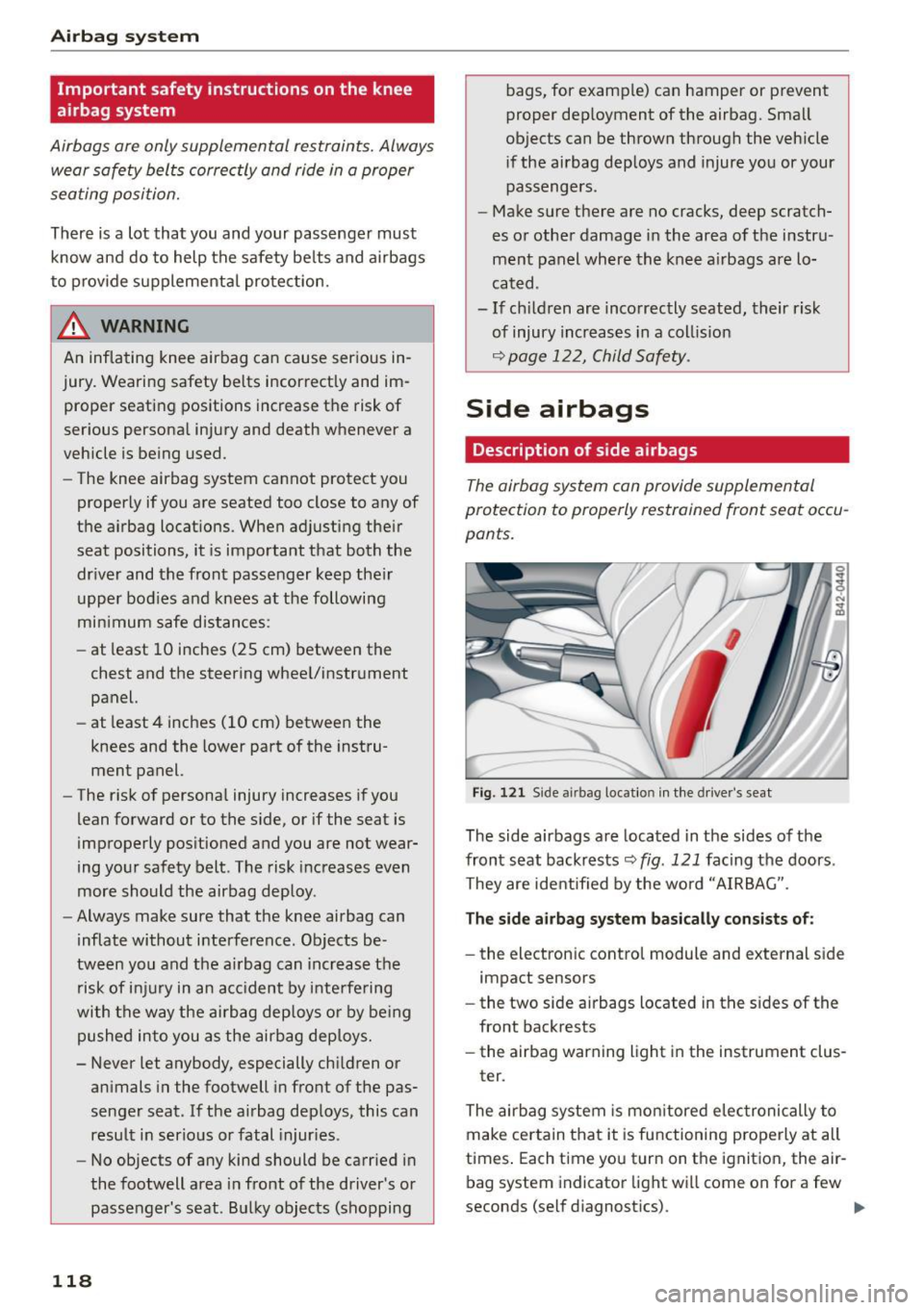
The side airbags are located in the sides of the
front seat backrests~
fig. 121 facing the doors .
They are identified by the word "AIRBAG" .
The side airbag system basically consists of:
-the ele ctronic control module and external sid e
i mpact sensors
- the two side airbags located in the sides of the
front backrests
- the airbag warning light in the instrument clus-
t e r.
The airbag system is monitored electronically to
make certain that it is functioning properly at all
times. Each time you turn on the ignition, the air
bag system indicator light will come on for a few
seconds (self diagnostics).
II>
Page 121 of 232
.... N
l'
N "1: rl I.O
"' N
"' ....
The side airbag system supplements the safety be lts and can he lp to reduce the risk of injury to
the dr iver's and front passenger's upper torso
and head injuries on the side of the vehicle that is
struck in a side collision. The airbag deploys in
side impacts and only when the vehicle accelera
tion registered by the control u nit is high enough .
If th is rate is below the reference value program
med into the control unit, the side airbags will
n ot be triggered , even though the car may be
badly damaged as a result of the co llision.
It is
not possib le to define an airbag triggering range
that will cover every possible angle of impact, since the c ircumstances will vary considerab ly be
tween one collis ion and another. Important fac
tors include, for example, the nature (hard or
soft) of the impact ing object, the angle of im
pact, vehicle speed, etc.
9 page 120 , Important
safety instructions on the side airbag system.
Aside from their normal safety function, safety
be lts work to help keep the driver or front pas
senger in pos it ion in the event of a s ide collision
so that the s ide a irbags can provide protect ion.
The airbag system is
not a substitute for your
safety belt . Rather, it is part of the overall occu
pant restrai nt system in your vehicle . Always re
member that th e side airbag system can only
he lp to p rotect you if yo u are wear ing your safety
be lt and wearing i t properly. This is ano ther rea
son why you shou ld always wear your sa fety
be lts, not just because the law requires you to do
so
9 page 95, General notes .
It is impor tan t to remember tha t while the sup
p lemental side a irbag sys tem is designed to re
duce the likelihood of serious inj uries, other inj u
ries, for examp le, swe lling, bruising, and minor
abrasions can also be associated with deployed
side airbags. Remember too, side airbags will de
p loy only once and only in certa in kinds of acci
dents -your safety belts are a lways there to offer
protection.
Vehicle damage, repair costs or even the lack of
ve hicle damage are not necessarily an indication
of over -sens itive or fa iled a irbag activa tion . In
some coll isions, both front and s ide airbags may
i nflate. Remember too, that airbags will deploy
only once and only in ce rtain kinds of collisions -
Airb ag system
you r safety belts are always the re to offer protec
tion in those accidents in which airbags are not
s u pposed to deploy or when they have a lready
deployed.
The side airbag system w ill not deploy:
- when the ignit io n i s tu rned off
- in side co llisions whe n the a ccelera tion meas-
ured by the sensor is too low
- in re ar-end collisions
- in rollovers .
In some types of accidents the front airbags and
s ide airbags may be triggered together.
A WARNING
-- Safety belts and the airbag system will only
provide p rotection when occupants are in
the proper seating position~
page 120.
-If the ai rbag ind icator light comes on when
the vehicle is be ing used, have the system
inspected immed iate ly by yo ur autho riz ed
Aud i dea le r. T he airbag may no t wo rk prop
erly when the vehicle acceleration in a side
coll is ion is high enough to activate the air
bag .
How supplemental side airbags work
Side airbags deploy instantly and can help re
duce the risk of upper torso injuries for occu
pants who ore properly restrained.
Fi g. 122 In flated s ide airbags on left s ide of ve hicle
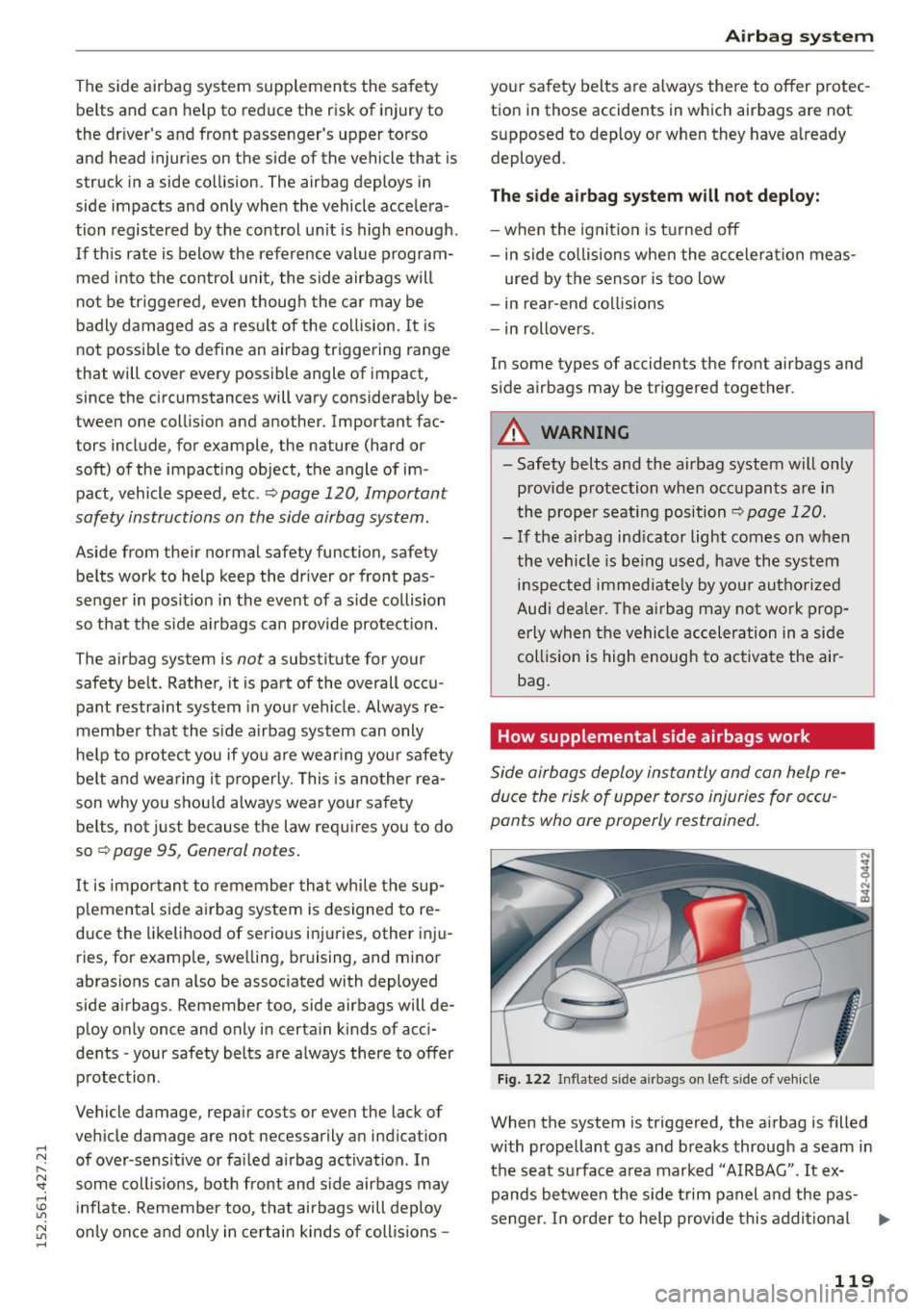
When the system is triggered, the a irbag is filled
with propellant gas and breaks through a seam in
the seat s urface area mark ed "A IRBAG" . It ex
pands be tween the side trim panel a nd the pas-
senger. In or der to help provide this addi tional .,.
119
Page 123 of 232
..... N
r-N "': ..... \!) ..,.,
N ..,., .....
- If children are seated improper ly, their risk
of injury increases in the case of an acc ident
Q page 122, Child Safety.
- Never attempt to modify any components of
the a irbag system in any way.
- In a side collision, side airbags will not func
t ion properly if sensors cannot correctly
measure increasing air pressure inside the
doors when air escapes through large r, un
closed openings in the doo r panel.
- Never drive w ith inter io r door trim pane ls
removed.
- Never drive when parts have been re
moved from the ins ide door panel and the
openings they leave have not been proper
ly closed.
- Never drive when loudspeakers in the
doors have been removed unless the
speaker holes have been properly closed.
- Always make certain that openings are
covered or filled if additional speakers or
other equ ipment is insta lled in the inside
door panels .
- Always have work on the doors done by an
author ized Audi dealer or qualif ied work
shop .
Airbag syste m
121
Page 125 of 232
..... N
r-N "': ..... \!) ..,.,
N ..,., .....
- Always make sure the forward-facing seat
has been designed and certified by its man
ufacturer for use on a front seat with a
passenger front and side airbag.
-Always follow the manufacturer's instruc
t ions provided with the child safety seat or
carrier.
-Always move the passenger seat into its
rearmost position in the seat's fore and aft
adjustment range, as far away from the air
bag as possib le befo re installing the child
restraint. The backrest must be ad justed to
an upr ight position.
- Always make sure that the
PASSENGER AIR
BAG OFF
lig ht comes on and stays on all the
t ime whe never the ignition is switched on.
(D Tips
Always rep lace child rest raints that were in
stalled in a vehicle dur ing a crash. Damage to
a child rest rain t that is not v is ible could cause
it to fail in another collision situ ation.
Advanced front airbag system and children
Your veh icle is equipped with an "Advanced Air
bag System" in compliance with U nited States
Federal Motor Vehicle Safety Standard (FMVSS)
208 as applicable at the time your vehicle was
manufactured.
The Advanced Airbag system in your ve hicle has
been ce rtified to meet the " low-risk" requ ire
ments for 3 -and 6-year-o ld children on the pas
senger side and small adults on the driver side.
The low risk deployment criteria are intended to
reduce the r isk of injury throug h interaction with
the airbag t hat can occur, for examp le, by being
too close to the s teer ing wheel and instrumen t
p a nel when the a irbag inflates. In ad di tion, the
sys tem has been cert ified to comply with the
"s uppression" requirements of the Safety Stand
ard, to turn off the front airbag for infa nts up to
12 months who are restra ined on the front pas
se nger seat in chi ld restraints that are listed in
the Standard.
Even tho ugh yo ur vehicle is equi pped with an Ad
vanced A irbag system, a ch ild should always ride
Child Sa fet y
in the seat properly restrained fo r its age and
size. The airbag on the passenger side makes the
f ront seat a potent ia lly dange ro us place for a
c h ild to ride. The front seat is not the safest place
for a ch ild in a forward-fac ing ch ild safety seat. It
can be a very dangerous place for an infant or a
la rger child in a rearward-fac ing seat.
Advanced Airbags and the weight-sensing
mat in the front seat
T he Advance d Airbag System in you r vehicle de
tects the presence of an infant or child in a child
rest raint on the front passenger seat using the
weight-sensing mat in the seat c ushion and the
sensor below the safety belt latch o n the front
passenger seat that measures the tension on the
safety belt.
The we ight-sensing mat measures total weight of
the child and the child safety seat and a ch ild
blanket on the front passenger seat. The we ight
o n the front passenger seat is related to the de
s ign of the child rest raint a nd its "footpr int", t he
s iz e and s hape of the bottom of the c hild re
str aint as i t si ts on the seat. The weight of a ch ild
restrain t and its "foo tpr in t" vary fo r different
ki nds of child res traints and fo r th e d iffe rent
models of the same kind of chi ld restraint offered
by chi ld restraint man ufact urers.
T he we igh t ranges for the individu al types, ma kes
and mode ls of chi ld res traints t hat the NHT SA
has spec ified in the Safety Standard toget her
with t he weig ht ranges of typica l infants and typ
ica l 1 year-old child have been stored in the con
trol unit of the Advanced Airbag System. When a
c h ild restra int is being used on the front passen
ger seat with a typical 1 year-old ch ild , the Ad
vanced Airbag Syste m compa res the we ight
measu red by the we ight sens ing mat with the in
f o rmat io n sto red in the e lec tronic con trol un it.
T he elec tronic cont ro l unit also reg iste rs the ten
s io n on the front passenger safety belt. The ten
s io n on the safety be lt fo r th e front passe nger
sea t w ill be di fferent for an adul t who is properly
u sing the safety be lt as compare d to the tension
o n the bel t when it is used to attach a child re
stra int to the seat . The sensor be low the latch for
1iJ11-
123
Page 126 of 232
Child Safety
the safety belt for the front seat passenge r
measures the tension on the be lt . T he inp ut from
this sensor is then used w ith the weight to "de
cide", whether there is a child restra int w ith a
t ypical 1 year-old child on the front passenger
seat and whether or not the airbag must be
turned off .
Child restraints and Advanced Airbags
Regardless of the chi ld restraint that you use,
make sure that it has been ce rtified to meet Un it
ed States Federal Motor Vehicle Safety Standards
and has been certified by its manufact urer for
use with an airbag. If in exceptional circ umstan
ces yo u must use it on the front passenger seat,
caref ully read all of the information on child safe
ty and Advanced Airbags and heed all of the ap
plicable WARNINGS . Make certain that the child
restraint is correctly recognized by the we ight
sensing mat ins ide the front passenger seat, that
the front passenger a irbag is tu rned off and that
the airbag status is a lways correctly signaled by
the
PASSENGER AIR BAG OFF light .
Many types and models of c hild restra ints have
been ava ilable ove r the years, new models a re in
troduced regu larly incorporat ing new and im
p roved des igns and o lder models are taken out o f
p rod uction. Child rest raints are not standardized.
Chi ld restraints of the same type typically have
d ifferent weights and sizes and different 'foot
prints,' the si ze and shape of the bottom of the
child restraint that sits on the seat, when they
are installed on a veh icle seat . These differences
make it v irtually impossible to certify compliance
with the requ irements for advanced ai rbags with
each and eve ry child rest raint that has ever been
sold in the past or will be sold ove r the course of
the useful life of your vehicle.
For this reason, the United States Nat iona l H igh
way Traffic Safety Admin istration has p ublished a
lis t of specific type , makes and models o f chi ld
restraints that m ust be used to certify comp li
ance of the Advanced Airbag System in your vehi
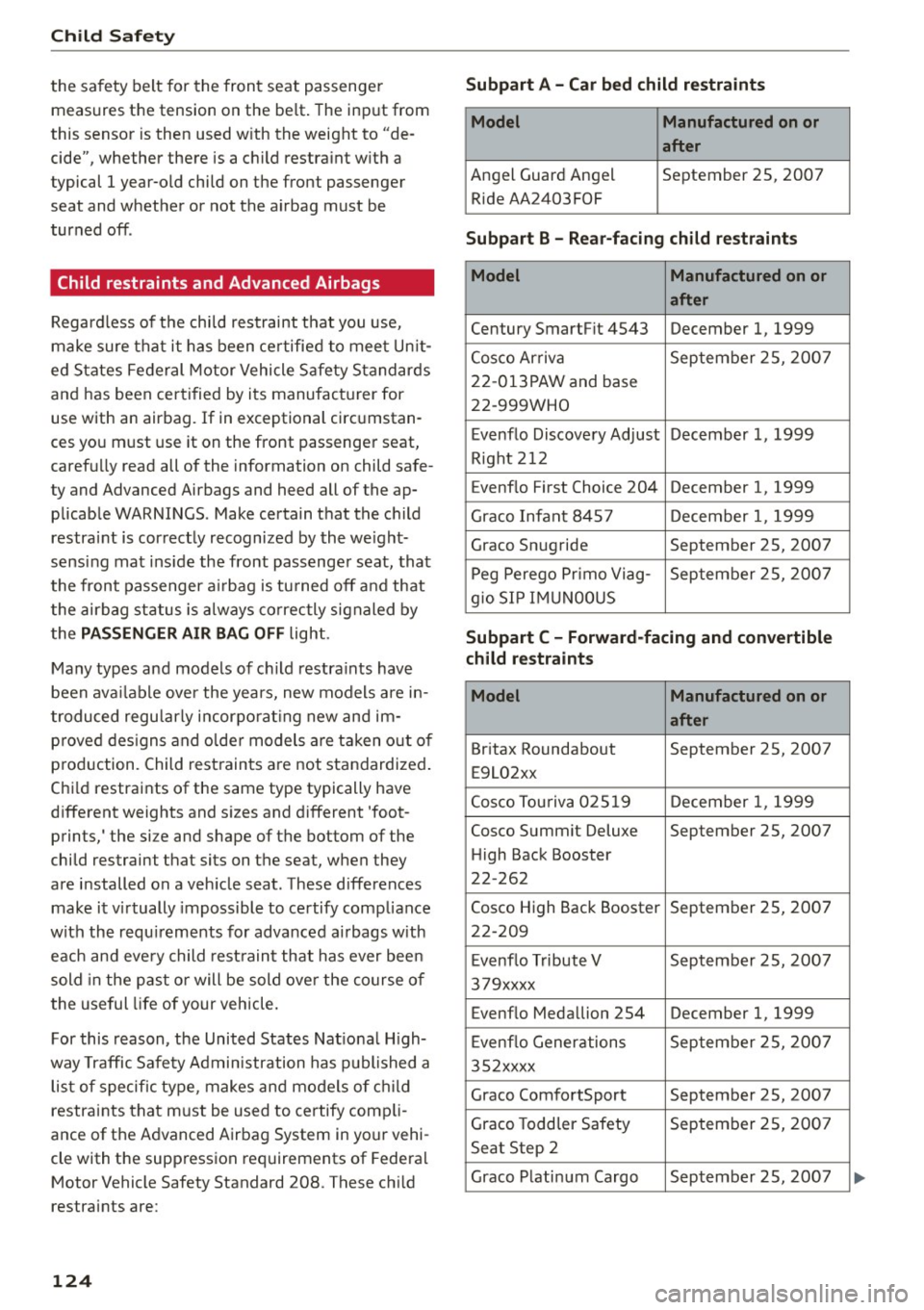
cle with the suppression requirements of Federal Motor Vehicle Safety Standard 208. These chi ld
restraints are:
124
Subpart A - Car b ed child restra ints
Model Manufactured on or
after
Angel Guard Angel September 25, 2007 Ride AA2403FOF
Subpart B -Rear -facing child restraint s
Model Manufactured on or
after
Century SmartFit 4543 December 1, 1999
Cosco Arriva September 25, 2007
22 -013PAW and base
22-999WHO
Evenflo Discovery Adjust December 1, 1999
Right 2 12
E venf lo First Choice 204 December 1, 1999
Graco Infant 8457 December 1, 1999
Graco Snug ride September 25, 2007
Peg Perego Pr imo Viag- September 25, 2007
gio SIP I MUNOOUS
Subpart C - Forward-facing and convertible
child re straint s
Model Manufactured on or
after
Britax Roundabout September 25, 2007
E9L02xx
Cosco Tou riva 025 19 December 1, 1999
Cosco Summit Deluxe September 25, 2007 H igh Back Booster
22 -262
Cosco High Back Booster September 25, 2007
22-209
Evenflo Tribute V September 25, 2007
379xxxx
Evenflo Meda llion 254 December 1, 1999
E venflo Generations September 25, 2007
352xxxx
Graco ComfortSport September 25, 2007
Graco Todd ler Safety
September 25, 200 7
Seat Step 2
Graco Platinum Cargo September 25, 2007
Page 142 of 232
Intelligent technology
Snow chain s
Where tire cha ins are mandatory on certai n
roads, this normally a lso applies to vehicles with
all-wheel drive
¢ page 194, Snow chains .
Replacing wheels /tires
Vehicles w ith all-whee l drive must a lways have
tires of the same si ze. Also avoid t ires with differ
ent tread depths. Fo r deta ils see page
¢ page 186, New tires and replacing tires and
wheels.
Off-Road driving?
Your Audi does not have enough ground clear
an ce to be used as an off-road veh icle.
It is there
fore best to avo id rough tracks and uneven ter
rain as m uch as possible . A lso re fer to
¢ page 142.
A WARNING
-Always adjust your driving to road and traf
fic cond itions. Do not let the extra safety af·
forded by all-whee l dr ive tempt you into tak
ing extra r isks .
- Althoug h the all-wheel dr ive is very effec
t ive, always remember that brak ing capac ity
is limited by tire tract ion. You should there
fore not dr ive at excessive speeds on icy o r
slippery road su rfaces.
- On wet road su rfaces, be careful not to drive
too fast because th e front whee ls cou ld be
gin to slide o n top of the water (aquap lan
ing).
If t his s hou ld o cc ur , you will have no
warning from a sudde n increase in engine
speed as with a front -whee l drive vehicle .
Always drive at speeds which are s uited to
the road conditions. -ris k of crash.
Energy management
Starting ability is optimized
Energy management controls the distribution of
electrical energy and thus optimizes the availa
bility of electrical energy for starting the engine.
If a vehicle w it h a conventional energy system is
not drive n for a long per iod of t ime, the battery
is discharged by idli ng cur rent consumers (e.g .
140
immob ili zer). In certain c ircumstances it can re
s ul t in the re being insufficient energy available to
start the eng ine.
I ntelligent energy managemen t in your veh icle
hand les the d istribution of electrical energy .
Starting ability is markedly improved and the life
of the battery is extended.
B asically, energy managemen t consis ts of
bat
tery diagnosi s, idling current management
and
dynamic energy management.
Battery diagnosis
Battery diagnosis continuously dete rm ines t he
st ate of the bat tery. Sensors dete rm ine battery
vo ltage, batte ry cur rent and battery tempera
ture . This de termines the current state of cha rge
and t he power of the battery.
Idling current management
Idli ng cur ren t management reduces energy con
sumption whi le the vehicle is s tanding. W it h the
i gni tion swi tched off, it contro ls the energy s up
ply to the various electrical components . Data
from battery d iagnosis is considered.
Depend ing o n the ba tte ry's st ate of ch arge, indi
vidual consumers are gradua lly tur ned o ff to pre
vent excessive discharge of the batte ry and thus
maintain starting capa bility .
Dynamic energy management
While t he ve hicle is being driven, dynamic e ne rgy
m anag eme nt dis trib utes the energy ge nerated
accord ing to the needs of the individ ua l compo
nents . It regu lates consumption, so that more
e lectrica l ene rgy is not be ing used than is being
generated and ens ures an optima l state of
c h arge for the battery.
(D Tips
- But even ene rgy management cannot neg
ate the lim its of physics. Cons ider that the
p ower and life of a batte ry are lim ited.
- If start ing ability is threa tened, you are in
formed by a warning ¢
page 141, Driver
notification in the instrument cluster dis
play.
Page 147 of 232
.....
Vehicle care and cleaning General information
Regular, proper care helps to maintain your vehi
cle's value.
It can a lso be a req uirement when
submitting warranty claims for corrosion damage
and paint defects on the body.
The required cleaning and care products can be
obtained from your authorized Audi dea ler or a
qualified workshop. Read and follow the instruc
tions for use on the packaging.
A WARNING
-Us ing clean ing and care products incorrectly
can be dangerous to your health.
- Always store cleaning and care products out
of reach of children to reduce the r isk of poi
soning.
@ For the sake of the environment
- Preferably use environmentally-friendly products when buying cleaning agents.
- Do not dispose of leftover cleaning and care
products with household trash.
Car washes
The longer deposits remain on the vehicle, the
more the surface can be damaged. High tempera
tures such as those caused by sunlight increase
the damaging effect .
Before washing, wet heavy deposits with plenty
of water.
Stubborn depos its such as bird droppings or tree
sap are best removed with plenty of water and a
microfiber cloth .
A lso, was h the underside of your vehicle once
road salt stops being used for the season.
Pressure washers
When washing your veh icles w ith a pressure
washer, always follow the operating instructions
"' provided with the pressure washer. This is espe-
r--
~ cially important in regard to the pressure and
; spraying distance . Do not aim the spray directly
~ at seals on side windows, doors, the engine com -,.... Vehicle care and cleaning
partment lid, the front lid
or the convertible top
or at tires, rubber hoses, insulating material
orsensors* or camera lenses *. Keep a distance of
at least 16 inches (40 cm).
Do not remove snow and ice with a pressure
washer .
Never use rotary nozzles or high pressure noz
zles.
The water temperature must not be above 140 °F
(60 °().
Automatic car washes
Spray off the veh icle before washing.
Make sure that the windows are closed and the
windshield wipers are off. Follow instructions
from the car wash operator, especially if there are
accessor ies attached to your vehicle .
If possible, use car washes that do not have
brushes .
Only use car washes where the vehicle remains
stationary and the washing equipment moves
around t he vehic le when washing and drying. Car
washes that move the vehicle through the car
wash using a chain are not recommended.
Washing by hand
Clean the vehicle starting from the top and work
ing down using a soft sponge or cleaning brush.
Use solvent-free cleaning prod ucts .
Washing vehicles with matte finish paint by
hand
To avoid damaging the paint when washing, first
remove dust and large particles from your vehi
cle. Insects, grease spots and fingerprints are
best removed with a spec ia l cleaner for matte
finish paint.
Apply the prod uct using a microfiber cloth . To
avo id damaging the paint surface, do not use too
much pressure.
Rinse the vehicle thoroughly with water. Then
c lean using a neutral shampoo and a soft micro
fiber cloth.
Rinse the vehi cle thoroughly again and let it air
dry. Remove any water residue using a sham my . .,.
145
Page 148 of 232
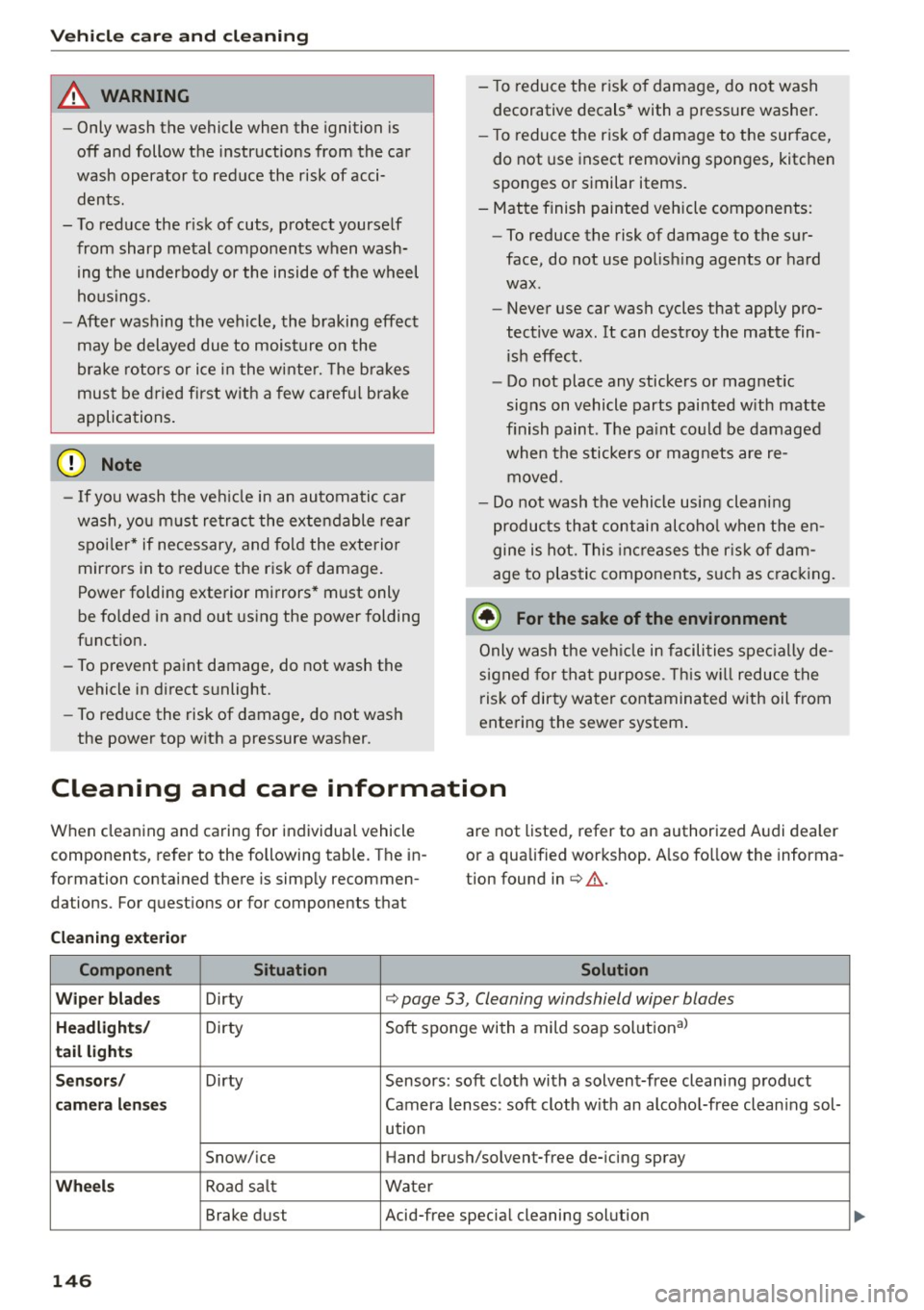
Vehicle care and cleaning
A WARNING
-Only wash the vehicle when the ignition is
off and follow the instructions from the car
wash operator to reduce the risk of acci
dents.
- To reduce the risk of cuts, protect yourself
from sharp metal components when wash ing the underbody or the inside of the wheel
housings.
- After washing the vehicle, the braking effect
may be delayed due to moisture on the
brake rotors or ice in the winter. The bra kes
must be dried first with a few caref ul brake
applications .
@ Note
-If you wash the ve hicle in an au tomatic car
wash, you must retract the extend able rear
spoi ler * if necessary, and fold the exterior
mirrors in to reduce the risk of damage .
Power folding exterior mirrors* must only
be fo lded in and out using the power folding
funct ion.
- To prevent paint damage, do not wash the
vehicle in direct sunlight.
- To red uce the risk of damage, do not wash
the power top with a pressure washer. -
To reduce the risk of damage, do not wash
decorative decals * with a pressure washer.
- T o reduce the risk of damage to the surface,
do not use insect remov ing sponges, kitchen
sponges or similar items.
- Matte finish painted vehicle components:
- To reduce the risk of damage to the sur-
face, do not use polish ing agents or hard
wax.
- Never use car wash cycles that apply pro
tective wax. It can destroy the matte fin ish effect .
- Do not place any stickers or magnet ic
signs on vehicle parts painted w ith matte
finish paint. The pa int could be damaged
when the stickers o r magnets are re
moved.
- Do not wash the vehicle using cleaning
products that contain alcohol when the en
gine is hot. This increases the risk of dam
age to plastic components, such as cracking.
@ For the sake of the environment
Only wash the vehicle in facilities spec ial ly de
signed for that purpose. This w ill reduce the
risk of dirty water contaminated with oil from
entering the sewer system .
Cleaning and care information
When cleaning and caring for individual vehicle
components, refer to the following table . The in
formation contained there is simp ly recommen
dations. For questions or for components that are not listed, refer to an authorized Audi dealer
or a qualified workshop. A
lso fo llow the informa
tion found in
¢ .&. .
Cleaning exterior
Component Situation Solution
Wiper blades
Dirty ¢ page 53, Cleaning windshield wiper blades
Headlights/ Dirty Soft sponge with a mild soap solutiona>
tail lights
Sensors
/
Dirty Sensors: soft cloth with a solvent-free cleaning product
camera lenses Camera lenses: soft cloth w ith an alcoho l-free clean ing sol-
ution
Snow/ice Hand brush/solvent-free de-icing spray
Wheels Road salt Water
Brake dust Acid-free special cleaning solution
146
...
Page 150 of 232
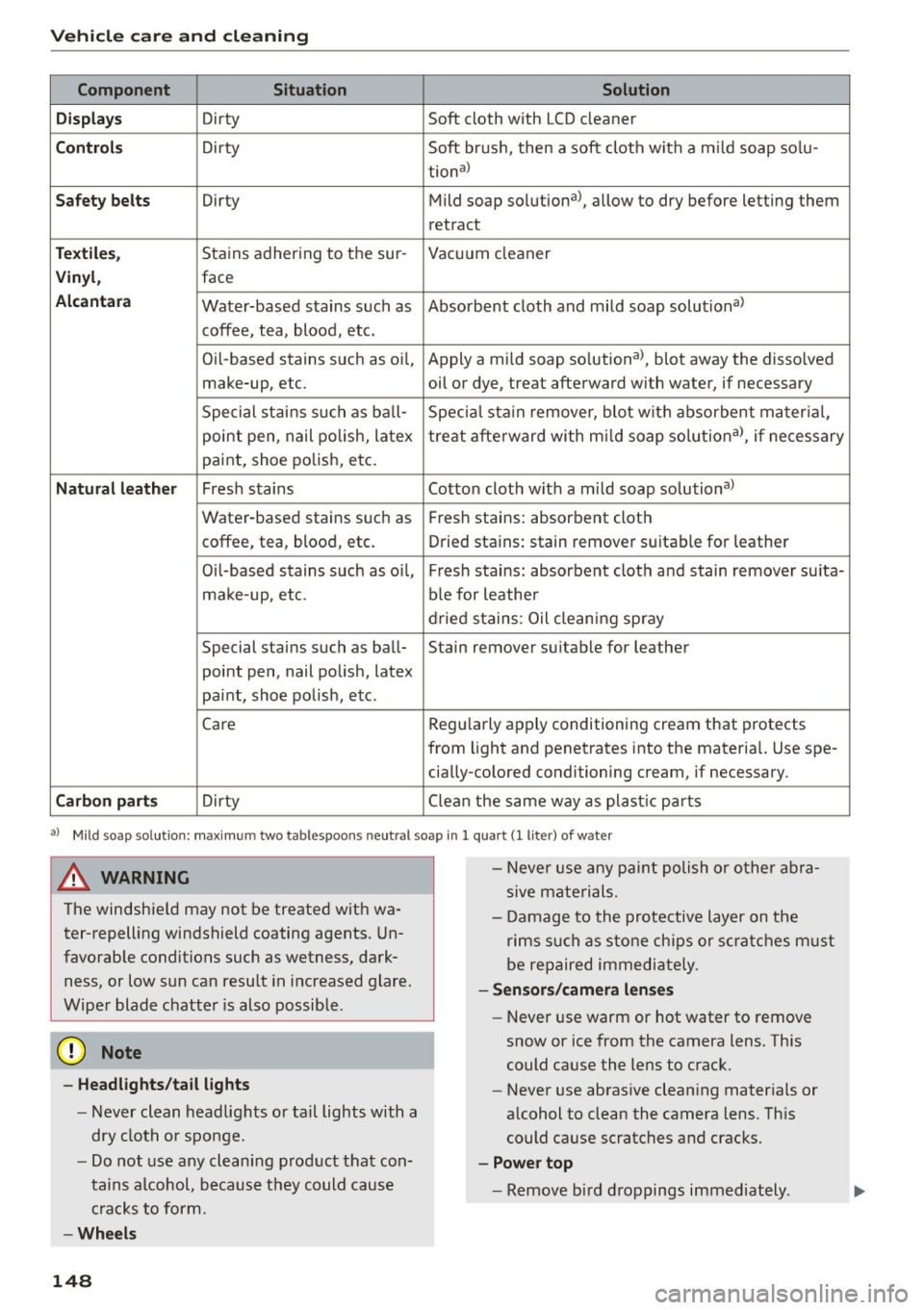
Vehicle care and cleaning
Component Situation Solution
Displays
Dirty Soft cloth with LCD cleaner
Controls Dirty Soft brush, then a soft cloth with a mild soap solu-
tional
Safety belts Dirty Mild soap solution a>, allow to dry before letting them
retr act
Textiles, Stains adhering to the sur- Vacuum cleaner
Vinyl, face
Alcantara Water-based stains such as Absorbent cloth and mild soap solutional
coffee, tea, blood, etc.
Oil-based stains such as o il, Apply a mi ld soap solutiona>, blot away the disso lved
make-up, etc. oil ori dye, treat afterward with water, if necessary
Special stains such as ball- Special stain remover, blot with absorbent material,
point pen, nail polish, latex treat afterward with mild soap solutional, if necessary
paint, shoe polish, etc.
Natural leather Fresh stains Cotton cloth with a mild soap solutional
Water-based stains such as
Fresh stains: absorbent cloth
coffee, tea, blood, etc. Dried stains: stain remover suitable for leather
Oil-based stains such as oil, Fresh stains: absorbent cloth and stain remover suita-
make-up, etc. ble for leather
dried stains: Oil cleaning spray
Special stains such as ball- Stain remover suitable for leather
point pen, nail polish, latex
paint, shoe polish, etc.
Care Reg
ula rly apply conditioning cream that protects
from light and penetrates into the materia l. Use spe-
cially-co lored conditioning cream, if necessary.
Carbon parts Dirty Clealil the same way as plastic parts
aJ Mild soap so lution: max im um two ta blespoo ns neut ral so ap in 1 quart (l lite r) of w ate r
A WARNING
Th e windshie ld may not be treated with wa
ter-repelling windshield coating agents. Un
favorable conditions such as wetness, dark
ness, or low sun ca n resu lt in increased glare.
Wiper blade chatter is also possible .
(D Note
-Headlights/tail lights
- Never clean headlights or tail lights with a
dry cloth or sponge.
- Do not use any cleaning product that con
tains alcohol, because they could cause
cracks to form.
-Wheels
148
-
- Never use any paint polish or other abra
sive materials.
- Damage to the protective layer on the
r ims such as stone chips or scratches must
be repaired immed iately.
-Sensors/camera lenses
- Never use warm or hot water to remove
snow or ice from the camera lens. This
could cause the lens to crack.
- Never use abrasive clean ing materials or
a lcohol to clean the camera lens. This
could cause scratches and cracks.
- Power top
- Remove bird droppings immediately .