warning lights AUDI R8 SPYDER 2015 Owner's Manual
[x] Cancel search | Manufacturer: AUDI, Model Year: 2015, Model line: R8 SPYDER, Model: AUDI R8 SPYDER 2015Pages: 232, PDF Size: 58.36 MB
Page 62 of 232
Seats and storag e
braking or in an accident -especially if the
airbag is dep loyed -these objects could in
jure any passengers ins ide the vehicle.
Glove compartment
The glove comportment is illuminated and con
be locked.
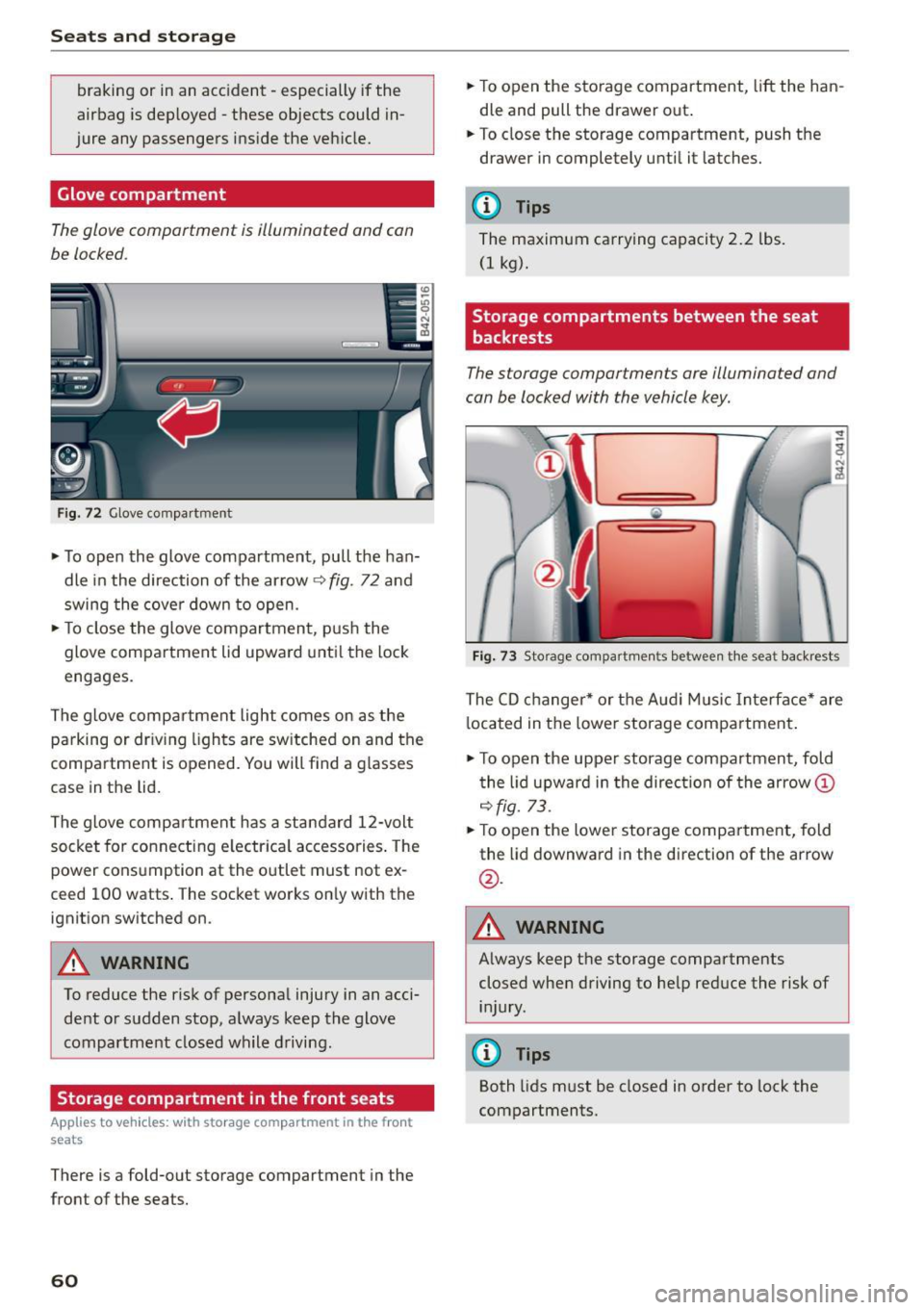
F ig. 72 Glove compartment
.,. To open the glove compartment, pull the han
dle in the direction of the arrow
9 fig. 72 and
swing the cove r down to open .
.,. To close the glove compartment, p us h the
glove compartment lid upward unti l the lock
engages.
The glove compartment light comes on as the parking or dr iving lights are switched on and the
compartment is opened. You will find a g lasses
case in the lid.
The glove compartment has a standard 12-volt socket for co nnecting e lectrica l accessories . The
power cons umption at the outlet must not ex
ceed 100 watts . The socket works on ly with the
ignition switched on.
A WARNING
To reduce the risk of personal injury in an acci
dent o r sudden stop, a lways keep the glove
compartment closed wh ile driving .
Storage compartment in the front seats
Applies to veh icles: w ith storage compartment in the front
seats
There is a fold-out storage compartment in the
front of the seats.
60
.,. To open the storage compartment, lift the han
dle and pull the drawer out .
.,. To close the storage compartment, push the
drawer in completely until it latches.
(D Tips
The maximum carrying capacity 2.2 lbs.
(1 kg).
Storage compartments between the seat
backrests
The storage comportments ore illuminated and
con be locked with the vehicle key.
Fi g. 73 Storage compart men ts betwee n th e seat backrests
The CD changer * or t he A ud i M usic Interface* are
l ocated in the lowe r storage compartment .
.,. To open the upper storage compartment, fold
t he lid upward in the direc tion of the arrow@
9fig. 73 .
.,. To open the lower storage compartment, fold
the lid downward in the direction of the arrow
@ .
A WARNING -
Always keep t he storage compartments
closed when driving to help reduce the risk of i n jury.
(D Tips
Both lids m ust be closed in order to lock the
compartments.
Page 76 of 232
Transmission
Transmission Manual transmission
Gearshift lever
Applies to vehicles: with manua l transmission
The clutch pedal must be depressed all the way
before you can start the engine .
The manual transmission in your Audi is equipped
with an
interlock-feature.
• Depress the clutch pedal all the way.
• Start the engine with the gearshift lever in Neu
tral and the clutch pedal depressed.
(D Note
Always depress the clutch pedal fully when
changing gears. Do not hold the vehicle on a
hill with the clutch pedal partially depressed.
This may cause premature clutch wear or
damage.
(D Tips
- Resting your hand on the gearshift lever
knob while driving will cause premature
wear in the transmission.
- The back-up lights go on when you shift into
Reverse with the ignition on.
Gearshift pattern (6-speed manual
transmission)
App lies to vehicles: with 6-speed manual transmission
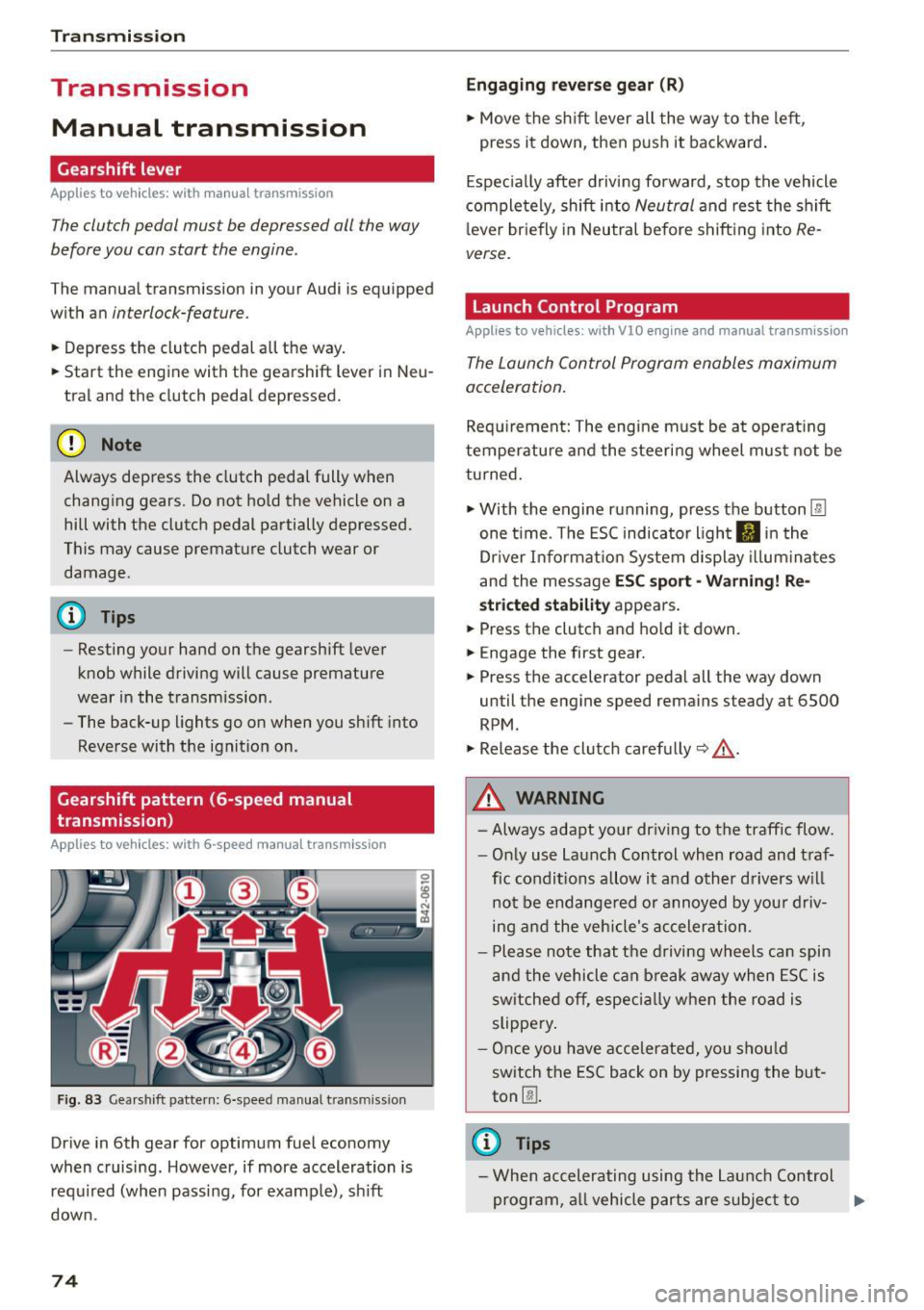
Fig. 83 Gearshift pattern: 6-speed manual transm iss ion
Drive in 6th gear for optimum fuel economy
when cruising. However, if more acceleration is
required (when passing, for examp le), sh ift
down.
74
Engaging reverse gear (R)
• Move the shift lever all the way to the left,
press it down, then push it backward.
Especially after driving forward, stop the vehicle
completely, shift into
Neutral and rest the shift
l ever briefly in Neutral before shifting into
Re
verse.
Launch Control Program
Applies to vehicles : wit h VlO engin e and manual t ra nsmissio n
The Launch Control Program enables maximum
acceleration.
Requirement: The engine must be at operat ing
temperature and the steering wheel must not be
turned.
• With the engine running, press the button
l:fil
one time. The ESC indicator light II in the
Dr iver Informat ion System display illum inat es
and the message
ESC sport -Warning! Re
stricted stability appears .
• Press the clutch and hold it down.
• Engage the first gear.
• Press the accelerator pedal all the way down
until the engine speed remains steady at 6500
RPM .
• Release the clutch carefully~,&. .
A WARNING
- Always adapt your driving to the traffic flow.
- Only use Launch Control when road and traf-
fic conditions allow it and other drivers will
not be endange red or annoyed by your driv
ing and the vehicle's acceleration .
- Please note that the driving wheels can spin
and the vehicle can break away when ESC is
sw itched off, especially when the road is
slippery .
- Once you have accelerated, you should
switch the ESC back on by pressing the but
ton
00 .
(D Tips
- When accelerating using the Launch Control
program, all vehicle parts are subject to .,..
Page 78 of 232
Transmi ssio n
rotation of the whee ls, then the time wi ll in
crease a ccording ly .
A WARNING
- If a gear is engaged when the vehicle is sta
tionary, the acce lerator must not be pressed
inadvertently under any circumstances. Oth
erwise the vehicle will immed iately start to
move - sometimes even if the park ing brake
is f irmly applied.
- Before you or other persons open the engine compartment l id and work on a running en
gine, select neutral pos it ion
N and firmly
apply the handbra ke. Always read and fol
low the app licab le warn ings¢
page 155,
Working in the engine compartment.
@ Tips
- If you accidenta lly shifted into N w hile d riv
i ng, you can engage a gear in the normal
way using the selecto r lever.
- An indicator light i s displayed if a malfunc
tion occurs while in S tronic. Refer to
~page 78.
Manual mode
App lies to veh icles: w ith 5 tro nic
S tronic allows the driver to shift gears man ua lly.
Starting from a stop
.,. Press and ho ld the brake pedal.
.. Move the selecto r leve r to the left.
.. Tap the se lec tor lever forwa rd
0 -
.. Re lease the brake pedal and press the accelera -
tor pedal ¢ .&,. .
Shifting
.,. To shift up, tap the selector lever fo rward 0 -
.,. To shift down, t ap the sele ctor lever to the re ar
o.
Stopp ing temporarily
.,. Press the brake pedal to prevent the vehicle
from moving, for examp le at traff ic lights .
Par king
.. Press and ho ld the brake pedal¢.&,. .
76
.. Activate the parking brake .
.. Turn off the ignition and remove the key .
Stopping on an incline
.,. Always keep the vehicle stat ionary using the
foot brake to prevent it from " rolling back"
¢ .&,. . D o not try to p revent the vehicle from
"ro lling back" when a gear is engaged by in
creasing engine speed.
.. Activate the parking brake.
Starting on a hill
.. With a gear engaged, remove your foot from
the brake, accelerate and slowly release the
parking brake.
When acce lera ting, S tronic sh ifts i nto the nex t
gear in gea rs 1, 2, 3, 4, 5 and 6 shor tly befo re
the maximum permissib le engine speed is
r eached.
If you have se lec ted a lower gear than the current
one, S tron ic w ill shift down only when the engine
will not be ove r-revved.
You can switch to a utomat ic operation at any
time
¢ page 77.
A WARNING
-
- Never leave your vehicle with the engine
ru nning while in gear. If you must leave yo ur
vehicle with the engine r unning, set the
parking brake firmly and engage neutral
N .
- With the engine r unning and a gear engag
ed, you have to ho ld the vehicle with the
foot brake .
- Do not accelerate when you sh ift gears with
the vehicle stationary and the engine run ning.
- Before driving down a steep slope, reduce
your speed and sh ift into a lower gear with S
tronic.
- Do not ride the bra kes or press the bra ke
pedal too often or too long. Constant brak
ing causes the brakes to overheat and sub
stantially reduces brak ing performance, in
creases braking d istance or causes comp lete
fa ilu re of the brake system. ..,.
Page 84 of 232
Parking syste m
Switching on /off
App lies to veh icles: w ith park ing system advanced
SPORT •
Fig. 93 Section of the cente r conso l-e : Park ass ist sw itch
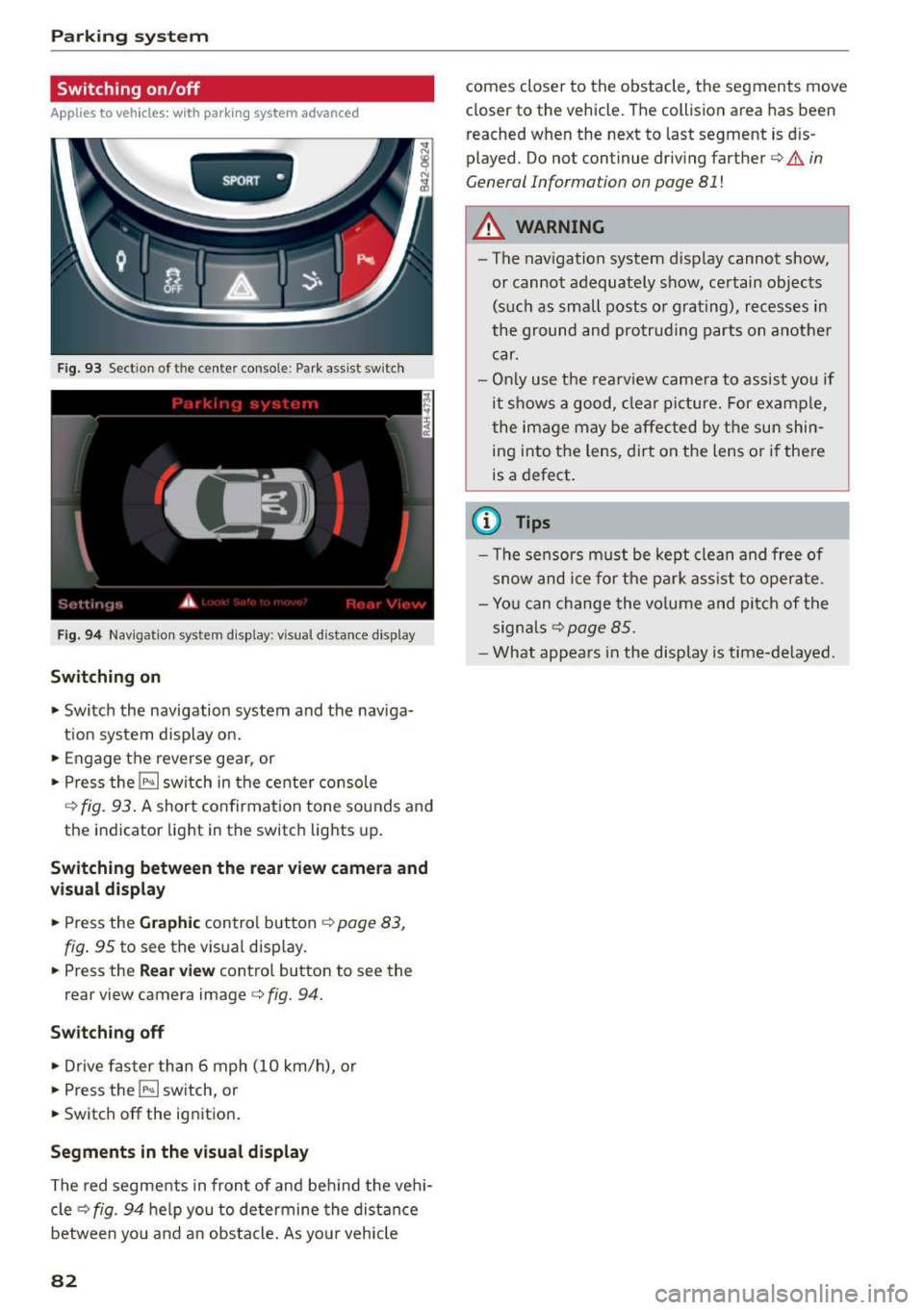
F ig . 94 Naviga tio n sys tem display : v isual distance display
Sw itching on
... Switch the navigation system and the nav iga
tion system display o n .
... Engage the reverse gea r, or
... Press the
!l¾ I switch in the center console
Q fig. 93. A short confirmation tone sounds and
the indicator light in the switch lights up.
Switching betwe en th e rear view c amera and
vi su al d isplay
... Press the Graphic control button ¢ page 83,
fig . 95
to see the visual disp lay .
... Press the
Rea r v iew contro l button to see the
rear view camera image¢
fig. 94.
Switch ing off
... Drive faster than 6 mph (10 km/h), or
... Press the
!P-<. I switch, or
... Switc h off the ignition .
Segments in the visual d isplay
The red segments in front of and be hind the vehi
cle¢
fig. 94 help you to determine the distance
between you and a n obstacle. As your vehicle
82
comes closer to the obstacle, the segments move
closer to the vehicle . The collision area has been
reached when the next to last segment is dis
played. Do not continue driving farther
Q & in
General Information on page 81
!
A WARNING
-The navigation system display cannot show,
or cannot adequately show, certain objects (such as small posts or grating), recesses in
the ground and protrud ing parts on another
car.
- Only use the rearv iew camera to assist you if
it s hows a good, clear pictu re. For examp le,
the image may be affected by t he sun shin
ing i nto the lens, dirt oh the lens or if there
is a defect .
(1) Tips
- The sensors m ust be kept clean and free of
snow and ice for the park ass ist to operate.
- Yo u can change the vo lume and pit ch of the
signa ls
Qpage 85.
-What appears in the display is time-delayed.
Page 88 of 232
Driving Sa fel y
Driving Safely
General notes
Safe driving habits
Please remember -safety first!
This chapter contains important information,
tips, instructions and warnings that you need to
read and observe for your own safety, the safety
of your passengers and others. We have summar
ized here what you need to know about safety
be lts, airbags, chi ld restraints as well as child
safety. Your safety is for us
priority number 1 . Al
ways observe the informat ion and warn ings in
t his section - for your own safety as well as for
that of your passengers.
The information i n this section applies to all
model ve rsions of your vehicle . Some of the fea
t ures des cribed in this sect ion may be standard
equipment on some models, or may be optional
eq uipment on others . If you are not sure, ask
your author ized Audi dealer.
A WARNING
-Make certain that you fo llow the instruc
t ions and heed the WARNINGS in this Man
ual. It is in your interest and in the interest
of your passengers .
- Always keep the complete owner's literature
in your Audi when you lend or se ll you r vehi
cle so that this important information will
always be ava ilable to the driver and passen
gers.
- Always keep the owner's literature handy so
that you can find it easily if you have ques
ti ons.
Safety equipment
The safety features are part of the occupant re
straint system and work together to help reduce
the risk of injury in a wide variety of occident si t
uations.
Your safety and the safety of yo ur passengers
should not be left to chance. Advances in tec h
nology have made a var iety of f eatures av ailable
to help re duce the r isk of inj ury in an accident.
86
The following is a listing o f just a few o f the safe
ty features in yo ur Audi:
- sophis tica ted s afety be lts for drive r and a ll pas-
senger sea ting pos itions,
- safety belt p rete nsio ners,
- front airbags,
- knee airbags,
- side airbags in the seats
- adjustab le head restraints,
- adjustab le steering column .
These ind iv idual safety featu res can wor k togeth
er as a sys tem to he lp pro tect you a nd your pas
sengers in a wide range of accidents . These fea
tures cannot work as a system if th ey are not al
ways proper ly adjusted and prope rly used!
Safety i s everyb ody' s re sponsibilit y!
Important things to do before driving
Safety is everybody's job! Vehicle and occupant
safety always depends on the informed and care
ful driver.
Fo r you r safety and the safety of your passen
gers,
before driving always:
.,. Make sure that all lights and signals are operat
ing correctly .
.,. Make sure that the tire pressu re is co rrect.
.,. Ma ke s ure that all w indows are clean and affo rd
good visibility to the outs ide.
.,. Secure a ll luggage and o ther items caref ully
r=;,page 59 .
.,. Make s ure that nothing can interfere with the
pedals.
.,. Adjust front seat, head restraint and mirrors
correctly for your height.
.,. Instruct passengers to adjust the head re
straints according to the ir height .
.,. Make su re to use the r ight child restraint cor
rec tly to p rotect ch ild ren
r=;, page 122, Child
Safety.
.,. Sit p roperly in your seat and ma ke su re that
your passengers do the same
c::> page 56, Gen
eral recommendations.
.,. Fasten your safety belt and wear it properly. A l
so instruct your passengers to fasten their safe
ty belts proper ly
c::> page 95 .
Page 148 of 232
Vehicle care and cleaning
A WARNING
-Only wash the vehicle when the ignition is
off and follow the instructions from the car
wash operator to reduce the risk of acci
dents.
- To reduce the risk of cuts, protect yourself
from sharp metal components when wash ing the underbody or the inside of the wheel
housings.
- After washing the vehicle, the braking effect
may be delayed due to moisture on the
brake rotors or ice in the winter. The bra kes
must be dried first with a few caref ul brake
applications .
@ Note
-If you wash the ve hicle in an au tomatic car
wash, you must retract the extend able rear
spoi ler * if necessary, and fold the exterior
mirrors in to reduce the risk of damage .
Power folding exterior mirrors* must only
be fo lded in and out using the power folding
funct ion.
- To prevent paint damage, do not wash the
vehicle in direct sunlight.
- To red uce the risk of damage, do not wash
the power top with a pressure washer. -
To reduce the risk of damage, do not wash
decorative decals * with a pressure washer.
- T o reduce the risk of damage to the surface,
do not use insect remov ing sponges, kitchen
sponges or similar items.
- Matte finish painted vehicle components:
- To reduce the risk of damage to the sur-
face, do not use polish ing agents or hard
wax.
- Never use car wash cycles that apply pro
tective wax. It can destroy the matte fin ish effect .
- Do not place any stickers or magnet ic
signs on vehicle parts painted w ith matte
finish paint. The pa int could be damaged
when the stickers o r magnets are re
moved.
- Do not wash the vehicle using cleaning
products that contain alcohol when the en
gine is hot. This increases the risk of dam
age to plastic components, such as cracking.
@ For the sake of the environment
Only wash the vehicle in facilities spec ial ly de
signed for that purpose. This w ill reduce the
risk of dirty water contaminated with oil from
entering the sewer system .
Cleaning and care information
When cleaning and caring for individual vehicle
components, refer to the following table . The in
formation contained there is simp ly recommen
dations. For questions or for components that are not listed, refer to an authorized Audi dealer
or a qualified workshop. A
lso fo llow the informa
tion found in
¢ .&. .
Cleaning exterior
Component Situation Solution
Wiper blades
Dirty ¢ page 53, Cleaning windshield wiper blades
Headlights/ Dirty Soft sponge with a mild soap solutiona>
tail lights
Sensors
/
Dirty Sensors: soft cloth with a solvent-free cleaning product
camera lenses Camera lenses: soft cloth w ith an alcoho l-free clean ing sol-
ution
Snow/ice Hand brush/solvent-free de-icing spray
Wheels Road salt Water
Brake dust Acid-free special cleaning solution
146
...
Page 150 of 232
Vehicle care and cleaning
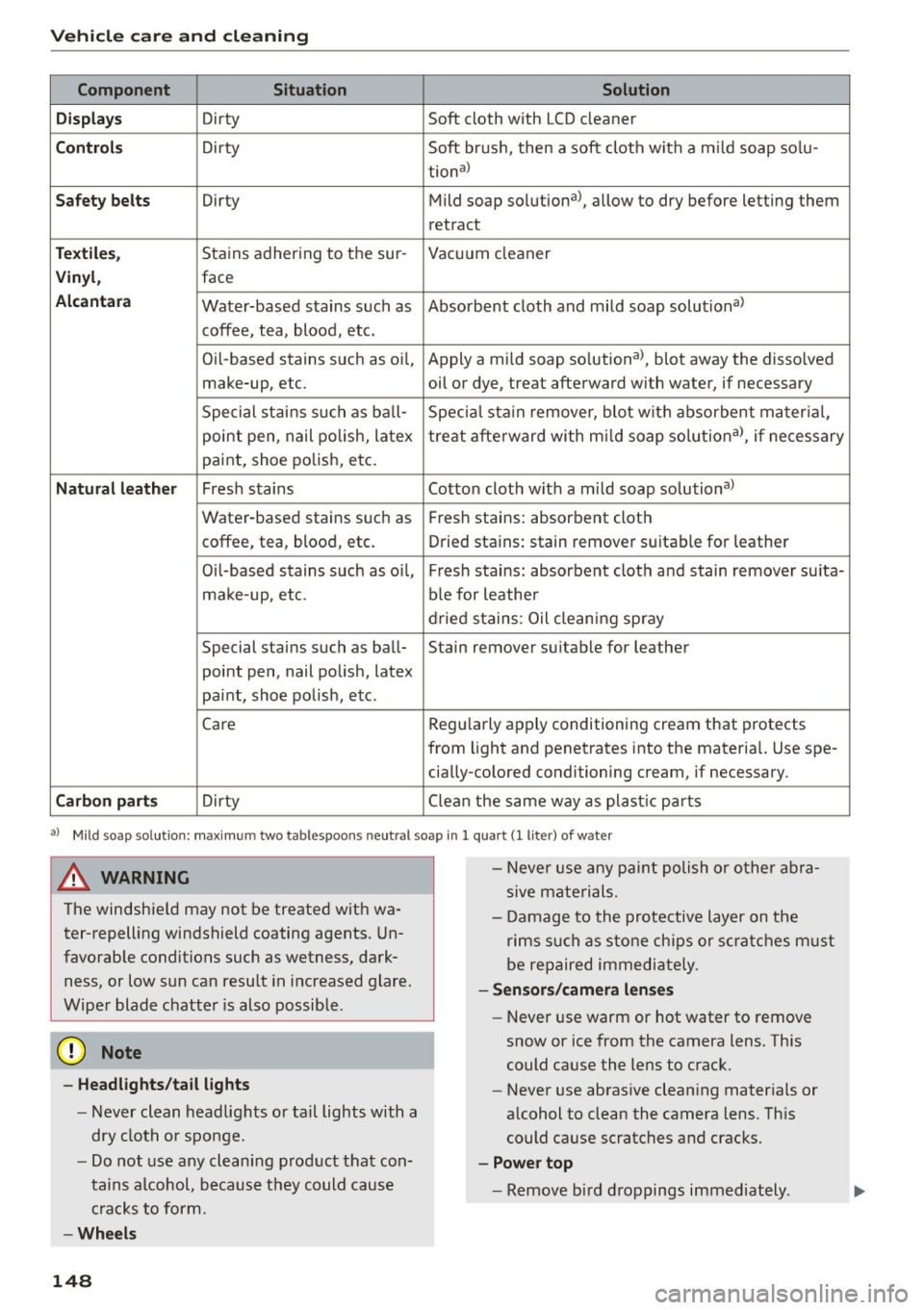
Component Situation Solution
Displays
Dirty Soft cloth with LCD cleaner
Controls Dirty Soft brush, then a soft cloth with a mild soap solu-
tional
Safety belts Dirty Mild soap solution a>, allow to dry before letting them
retr act
Textiles, Stains adhering to the sur- Vacuum cleaner
Vinyl, face
Alcantara Water-based stains such as Absorbent cloth and mild soap solutional
coffee, tea, blood, etc.
Oil-based stains such as o il, Apply a mi ld soap solutiona>, blot away the disso lved
make-up, etc. oil ori dye, treat afterward with water, if necessary
Special stains such as ball- Special stain remover, blot with absorbent material,
point pen, nail polish, latex treat afterward with mild soap solutional, if necessary
paint, shoe polish, etc.
Natural leather Fresh stains Cotton cloth with a mild soap solutional
Water-based stains such as
Fresh stains: absorbent cloth
coffee, tea, blood, etc. Dried stains: stain remover suitable for leather
Oil-based stains such as oil, Fresh stains: absorbent cloth and stain remover suita-
make-up, etc. ble for leather
dried stains: Oil cleaning spray
Special stains such as ball- Stain remover suitable for leather
point pen, nail polish, latex
paint, shoe polish, etc.
Care Reg
ula rly apply conditioning cream that protects
from light and penetrates into the materia l. Use spe-
cially-co lored conditioning cream, if necessary.
Carbon parts Dirty Clealil the same way as plastic parts
aJ Mild soap so lution: max im um two ta blespoo ns neut ral so ap in 1 quart (l lite r) of w ate r
A WARNING
Th e windshie ld may not be treated with wa
ter-repelling windshield coating agents. Un
favorable conditions such as wetness, dark
ness, or low sun ca n resu lt in increased glare.
Wiper blade chatter is also possible .
(D Note
-Headlights/tail lights
- Never clean headlights or tail lights with a
dry cloth or sponge.
- Do not use any cleaning product that con
tains alcohol, because they could cause
cracks to form.
-Wheels
148
-
- Never use any paint polish or other abra
sive materials.
- Damage to the protective layer on the
r ims such as stone chips or scratches must
be repaired immed iately.
-Sensors/camera lenses
- Never use warm or hot water to remove
snow or ice from the camera lens. This
could cause the lens to crack.
- Never use abrasive clean ing materials or
a lcohol to clean the camera lens. This
could cause scratches and cracks.
- Power top
- Remove bird droppings immediately .
Page 161 of 232
.... N
l'
N "1: .... I.O
"' N
"' ....
If the yellow engine oil level warning symbol in
the instrument cluster
Ell lights up, you should
check the oil leve l as soon as possible
¢ page 159. Top off the oil at your earliest con
venience
¢ page 160.
A WARNING
Before you check anything in the engine com
partment, always read and heed all WARN
INGS
¢&. in Working in the engine compart
ment on page 155.
(D Note
Dr iving with an insufficient oil level is like ly to
cause severe damage to the engine.
@ Tips
- The oil pressure warning display. is not
an indicator of the oil l evel. Do not rely on
it . Instead, check the oil l evel in your en
gine at regular interval s, pref erably each
time y ou refu el, and alway s before going
o n a long trip .
- If
you have the imp ression your e ngine co n
s u mes ex cess ive amo unts of o il, we re com
mend tha t you cons ult yo ur A udi dealer to
have the cause of your concern properly di
agnosed. Keep in mind that the accurate measurement of oil consumpt ion requires
great care and may take some time. Your
A udi dealer has instructions about how to
measure oil consumpt ion accurately.
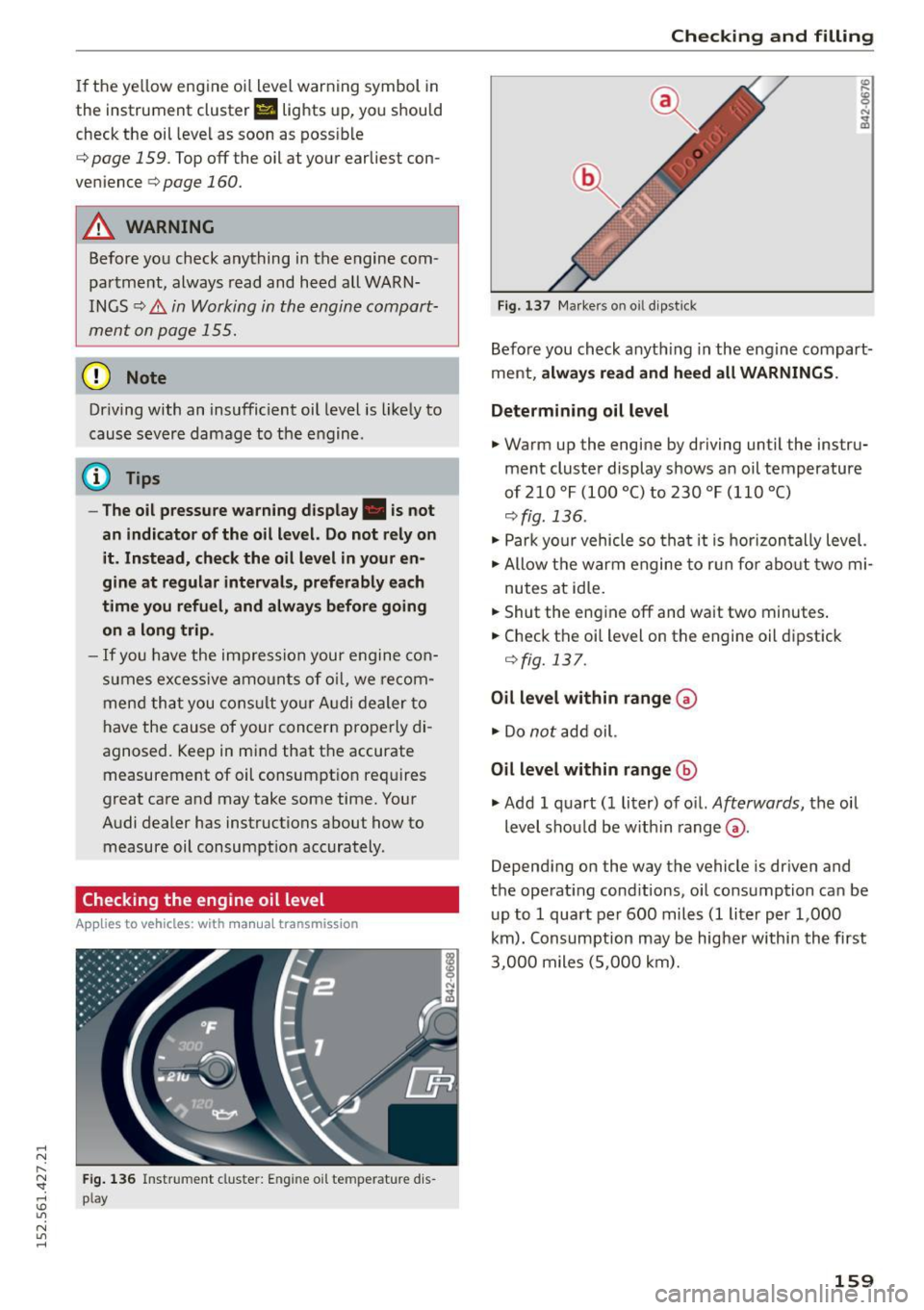
Checking the engine oil level
Ap plies to vehicles: with ma nual transmission
F ig . 1 36 Ins trument cluste r: Engine oil temperature dis
p lay
Chec king and filling
Fig. 137 Ma rke rs on oi l d ipst ick
Before you ch eck a nyth ing in the engine compart
ment,
alwa ys read and h eed all WARNINGS .
Determin ing
oil level
.,. Warm up the engine by driving until the instru
ment cluste r display shows an oil temperature
of 210 °F (100 °C) to 230 °F (110 °C)
¢ fig. 136 .
.,. Park your vehicle so tha t it is hor izon tally level.
.,. Allow t he warm engine to r un fo r abo ut two mi
nutes at idle.
.. Shut the engine off and wait two minutes .
.. Check the oil level on the engine oil dipst ick
¢fig. 137.
Oil level within range (v
.,. Do not add oil.
Oil level within range@
.,. Add 1 quart (1 liter) of o il. Afterwards, the oil
level shou ld be w ith in range
G) .
Depend ing on the way the vehicle is driven and
the operat ing cond itions, oil consumption ca n be
u p to 1 quart per 600 miles(! liter per 1,000
km). Consumption may be higher withi n th e first
3,0 00 miles (5,000 km) .
159
Page 167 of 232
..... N
r-N "': ..... \!) 1.1'1
N 1.1'1 .....
Have the battery checked when you take your ve
hicle in for service. You are well advised to re
place a battery that is older than 5 years .
Disconnecting the batt ery terminal s
Some vehicle funct ions (power w indow regula
tors , fo r example) are lost if the battery termi
na ls are disconnected. These functions have to be
re learned after the battery terminals are con
nected again. To prevent this , the batte ry shou ld
only be disconnected from the vehicle electrical
system when absolutely necessary for repairs.
V ehicl es not dri ven fo r lo ng p eriod s
If you do not drive your vehicle over a period of
several days or weeks , e lectrica l components are
gradually cut back or switched off. This reduces
energy consumption and maintains s tarting ca
pability over a longer period<=> page 140. Some
of the convenience funct ions may not operate ,
such as the inter ior lights or powe r seat ad just
ment. The convenience functions will be ava ilable
again when you switch on the ignition and start
the eng ine.
Wint er op erati on
During the winter months, battery capacity tends
to decrease as temperatures drop . This is because
more power is also consumed w hile start ing , and
the head lights, rear w indow defogger, etc., are
used more often.
Avoid unnecessary power consumption, part icu
l arly in city traffic o r when traveling only short
d ista nces . Let you r a utho rized Aud i dea le r check
the capacity of the vehicle battery before w inter
sets in <=> page 167. A well charged battery will
not on ly prevent starting prob lems when the
w eather is cold, but will also last longer.
R eplacing battery
The new battery mu st ha ve the same capacity,
voltage
(12 vo lts), amperage, construction and
p lug sealing, as the original battery . Specifica
tions are listed on the battery housing. Batteries
specia lly deve loped by Audi fulfill the mainte
nance, output, and safety requ irements .
Check ing and fillin g
When installing the battery, make sure the igni
tion and all electrica l consumers are switched off
<=> 0 .
We recommend that you use main tenance-free or
cycle -res istant /leak-p roof batteries according to
the standards TL
825 06 (from Apri l 2008) and
VW 7
50 73 (from Apr il 2010).
Replac ing the bat tery shou ld be carried by a
qualified workshop. Please fo llow the ins truc
tions on the battery cover .
(D Note
-All work on the battery req uires techn ica l
knowledge . Please contact an Audi dealer
ship or another authorized facility for ques
tions about the battery - danger of ac id
burns and explosion ha zard!
- The battery must not be opened! Do not try
to change the battery's liquid level, other
w ise detonating gas will escape from the
battery- exp losion hazard!
- The AGM battery in the luggage compart ment cannot leak, because the e lectrolyte
for this battery is absorbed into a special glass mat . This leak-proof battery must not
be replace with a convent ional battery.
- Make sure the ventilation hose on the side
of the battery is connected, otherwise
fumes or battery ac id can leak out.
- Battery holder and terminals always have to
be sec ured correctly .
- Before all work on the battery follow the
warnings be low <=>&. in Working on the bat
tery on page 166.
@ For the sake of the environment
Because of the prob lem of proper disposal of
a battery, we recommend your autho rized
Audi dealer change the battery for you . Bat
teries contain sulfur ic acid and lead and must
a lways be d isposed of properly in compliance
with all envi ronmental regula tions . Disposing
of vehicle batteries improperly is very danger
ous to the environment . Make sure that the
removed battery cannot overba lance, other
wise sulf uric ac id might escape!
165
Page 168 of 232
Checking and filling
(D Tips
If your vehicle is left standing for several
weeks at extremely low temperatures, the
ve
hicle battery should be removed and stored
where it will not freeze. This will prevent it
from being damaged and having to be re placed .
Working on the battery
Be especially careful when working on or near
the battery!
The battery is located in the luggage compart
ment behind a
cover. Before you work on or near
the battery ,
read and heed all WARNINGS c> &_.
Always heed the safety warnings, when working
on the vehicle battery or the vehicle electrical
system to prevent injury.
The following WARNINGS are very important
when working on the battery:
Always heed the following WARNING SYM-
BOLS and safety precautions when working on
the battery.
®
Always wear eye protection.
&
Battery acid contains sulfuric acid. Al·
ways wear gloves and eye protection.
@
No
- sparks
- flames
- smoking.
~
When a battery is charged, it produces
hydrogen gas which is explosive and
could cause personal injury.
®
Always keep the battery well out of reach
of children.
.&_ WARNING
Whenever working on the battery or on the
electrical system, there is the risk of injury,
accident and even fire. Read and heed the fol
lowing WARNINGS:
- Always wear eye protection. Do not let bat
tery acid or any lead particles get on your
166
skin or clothing. Shield your eyes. Explosive
gases can cause blindness or other injury.
- Battery acid contains sulfuric acid. Sulfuric
acid can cause blindness and severe burns.
-Always wear gloves and eye protection . Do
not tilt the battery because acid could leak
out of the ventilation openings.
- If you get battery acid in your eyes or on
your skin, immediately rinse with cold wa
ter for several minutes and get medical at
tention.
- If you should ingest any battery acid, seek
medical attention immediately.
- Do not expose the battery to an open flame,
electric sparks or an open light.
- Do not smoke.
- Do not interchange the positive and nega- tive cables.
- When working on the battery, be sure not to
short-circuit the terminals with tools or oth
er metal objects. This would cause the bat
tery to heat up very quickly, which could
lead to damage or explosion and personal
injury.
- When a battery is charged, it produces hy
drogen gas which is explosive and could
cause personal injury.
- Always keep the battery well out of the
reach of children.
- Before work is done on the electrical sys
tem, disconnect the negative ground cable.
- Before performing any work on the electri
cal system, switch off the engine and igni
tion as well as any electrical equipment. The
negative cable on the battery must be dis
connected. If you are just going to replace a
light bulb, then it is enough to switch off
the lights.
- Before disconnecting the battery, switch off
the anti-theft alarm system! Otherwise you
will set off the alarm.
- When disconnecting the battery, first dis
connect the negative cable and then the
positive cable.
- Before reconnecting the battery, make sure all electrical consumers are switched off. Re
connect the positive cable first and then the
~