weight AUDI R8 SPYDER 2015 Owner's Manual
[x] Cancel search | Manufacturer: AUDI, Model Year: 2015, Model line: R8 SPYDER, Model: AUDI R8 SPYDER 2015Pages: 232, PDF Size: 58.36 MB
Page 133 of 232
..... N
r-N "': ..... \!) ..,.,
N ..,., .....
with great force and will smash the child
safety seat and child against the backrest,
door or roof. Have the airbag system in
spected immediately by your Audi dealer.
- Improper installation of child restraints can
reduce their effectiveness or even prevent
them from providing any protection .
- An improperly installed child restraint can
interfere with the airbag as it deploys and
seriously injure or even kill the child.
- Always carefully follow the manufacturer's
instructions provided with the child safety
seat or carrier .
- Never place additional items on the seat
that can increase the total weight registered
by the weight-sensing mat and can cause in
jury in a crash.
A WARNING
Forward-facing child restraints:
-Always make sure the forward-facing seat
has been designed and certified by its man
ufacturer for use on a front seat with a pas
senger front and side airbag.
- Never put the forward-facing child restraint
up, against or very near the instrument pan
el.
-Always move the passenger seat into its
rearmost position in the seat's fore and aft
adjustment range, as far away from the air
bag as possible before installing the for
ward-facing child restraint. The backrest must be adjusted to an upright position.
- Make sure that the
PASSENGER AIR BAG
OFF
light comes on and stays on all the time
whenever the ignition is switched on.
A WARNING
Rearward-facing child restraints:
- A child in a rearward-facing child safety seat
installed on the front passenger seat will be
seriously injured and can be killed if the
front airbag inflates - even with an Ad
vanced Airbag System .
- The inflating airbag will hit the child safety
seat or infant carrier with great force and
Child Safety
will smash the child safety seat and child
against the backrest, door or roof.
- Always be especially careful if you must in
stall a rearward facing child safety seat on
the front passenger seat in exceptional cir
cumstances.
- A tight tether strap on a rearward-facing
child restraint attached to the front passen
ger seat can put too much pressure on the
weight -mat in the seat and register a heavi
er weight in the Advanced Airbag System .
The heavier weight registered can make the
system work as though an adult were on the
seat and deploy the Advanced Airbag when
it must be suppressed causing serious or
even fatal injury to the child.
- Make sure that the
PASSENGER AIR BAG
OFF
light comes on and stays on all the time
whenever the ignition is switched on.
- Never install a rearward facing child safety
seat on the front passenger seat unless the
PASSENGER AIR BAG OFF light comes on
and stays on. If the
PASSENGER AIR BAG
OFF
light does not come on and stay on
have the airbag system inspected immedi
ately by your Audi dealer .
Activating the convertible locking retractor
Use the conver tible locking re trac tor to secure a
child restraint.
Always h eed the child safety seat manufacturer's
instructions when installing a child restraint in
your vehicle. To ac tiva te the convertible locking
retractor:
.. Place the child restraint on a seat.
.. Slowly pull the belt
all the way out .
.. Route it around or through the child restraint
belt path
c:> ,&. .
.. Push the child safety seat down with your full
weight to get the safety belt really tight.
.,. Insert the belt tongue into the buckle for that
seating position.
.. Guide the safety belt back into the retractor un
til the belt lies flat and snug on the child safety
seat. ..,.
131
Page 171 of 232
.... N
Tires and wheels
Tires
General notes
Tires may be the least appreciat
ed and most abused parts of a
motor vehicle.
Tires may be the least appreciated
and most abused parts of a motor
veh ic le . Tires are, however, one of
the most important parts of ave
hicle, particularly considering the
comparatively small patch of rub
ber on each tire that assu res that
all-important contact between
you, your vehicle and the road .
Maintain ing the correct t ire pres
sure, making sure that your vehi
c le and its tires do not have to
carry more weight than they can
safe ly handle, avoiding damage
from road hazards and regularly inspecting tires for damage in
c luding cuts, slashes i rregular
wear and overall condition are the most important th ings that you
can do to help avo id sudden tire
failure including tread separation
and blowouts.
Avoiding damage
~ If you have to dr ive over a curb or ":
~ similar obstacle, drive very s lowly
N U'> .....
Tir es a nd whe els
and as close as possible at a right
ang le to the curb.
Always keep chemicals including
grease, oil, gasoline and brake
fluid off the tires. Inspect the tires regularly fo r
damage (cuts, cracks or blisters ,
etc.) . Remove any foreign bodies
embedded in the treads.
Storing tires
Mark tires when you remove them
to indicate the direction of rota
tion. This ensures you to be able
to mount them correctly when
you reinstall them.
When removed, the w heels or
tires sho uld be stored in a coo l,
dry and preferably dark place.
Store tires in a vertical position if
they are not mounted on rims, in
a horizon tal position if they are
mounted on rims .
New tires
New tires have to be broken in
¢,&.
The tread depth of new tires may
vary, according to the type and make of tire and the tread pa t
tern.
1 69
...
Page 173 of 232
(D Note
- Please note that summer and
winter t ires are designed for
the conditions that are typical in those seasons . Audi recom
mends using winter tires dur
ing the winter months . Low
temperatures significantly de
crease the elasticity of summ
er tires, which affects traction
and braking ability. If summer
tires are used in very cold tem peratures, cracks can form on
the tread bars, resulting in
Tires and wheels
permanent tire damage that
can cause loud driving noise
and unbalanced tires . Audi is
not responsible for this type
of damage.
- Burnished, polished or
chromed rims must not be
used in winter road condi
tions . The surface of the rims
does not have sufficient corro
sion protection for this and
could be permanently dam aged by road salt or similar
substances .
Glossary of tire and loading terminology
Accessory weight
means the combined weight (in
excess of those standard items
which may be replaced) of auto
matic transmission, power steer
ing, power brakes, power win
dows , powe r seats , radio , and
heater , to the extent that these
items a re available as factory-in
stalled equipment (whether in
stalled or not).
Aspect ratio
means the ratio of the height to
;:;: the width of the tire in percent .
" ~ Numbers of 55 or lower indicate a ...
~ low sidewall for improved steer -
"' ....
ing response and better overall
handling on dry pavement.
Bead
means the part of the tire that is
made of steel wires, wrapped or
reinforced by ply cords and that is
shaped to f it the rim .
Bead separation
means a breakdown of the bond
between components in the bead .
Cord
means the strands forming the
plies in the tire.
17 1
...
Page 174 of 232
Tires and wheels
Cold tire infl ation pre ssure
means the tire pressure recom
mended by the vehicle man ufac
turer for a tire of a designated
size that has not been driven fo r
more than a couple of miles (kilo
meters) at low speeds in the three
hour period before the tire pres
sure is measured or adjusted .
Curb weight
means the weight of a motor ve
hicle with standard equipment in
cluding the maximum capacity of
fuel, oil, and coolant, air condi
tioning and additiona l weight of
optional equipment.
E x tra load tire
means a tire designed to operate
at higher loads and at higher in
flation pressures than the corre sponding standard tire. Extra load
tires my be identified as "XL",
"xl ", "EXTRA LOAD", or "RF" on
the sidewall.
Gross Axle Weight Rating ("GAWR" )
means the load-carrying capacity
of a single axle system, measured
at the tire -ground interfaces.
1 72
Gross Vehicle Weight Rating
("GVWR")
means the maximum total loaded
weight of the vehicle.
Groove
means the space between two ad
jacent tread ribs.
Load rating (code )
means the maximum load that a
tire is rated to carry for a given in
flation pressure . You may not find
this information on all tires be
cause it is not required by law .
Maximum load rating
means the load rating for a tire at
the maximum permissible infla
tion pressure for that tire .
Maximum loaded vehicle
weight
means the sum of :
(a) Curb weight
(b) Accessory weight
(c) Vehicle capacity weight, and
(d) Production options weight
Ma ximum (permissible )
inflation pressure
means the maximum cold infla
tion pressure to which a tire may be inflated. A lso called "maxi-
mum inflation pressure ." .,.
Page 175 of 232
.... N
" N ": ... IO "? N U'> .....
Normal occupant weight
means 150 lbs. (68 kilograms)
times the number of occupants
seated in the vehicle up to the to
tal seating capacity of yo ur vehi
c le .
Occupant distribution
means distribution of occupants
in a vehicle.
Outer diameter
means the overall diameter of an
inflated new tire .
Overall width
means the linear distance be
tween the exteriors of the side
walls of an inflated tire, including elevations due to labeling, deco
rations, or protective bands or
ribs .
Ply
means a layer of rubber-coated
parallel cords .
Production options weight
means the combined weight of
those installed regular product ion
options weighing over 5 lbs. (2 .3
kg) in excess of those standard
items which they replace, not pre
viously considered in curb weight
or accessory weight, including
Tir es a nd whe els
heavy duty brakes, ride levelers,
heavy duty battery, and special
trim.
Radial ply tire
means a pneumatic tire in which
the ply cords that extend to the beads are laid at substantially
90
degrees to the centerline of the
tread.
Recommended inflation
pre ssure
see c::> page 172, Cold tire infla
tion pressure.
R einforced tire
means a tire designed to operate
at higher loads and at higher in
flation pressures than the corre
sponding standard tire. Rein
forced tires my be identified as
"X L", "xl", "EXTRA LOAD", or "RF"
on the sidewall.
Rim
means a metal support for a tire
or a tire and tube assembly upon
which the tire beads are seated.
Rim di ameter
means nominal diameter of the
bead seat. If you change your
1 73
Page 177 of 232
.... N
" N ": ... IO "? N
"' .....
brand loyalty and dealer recom
mendations. Under UTQG, tires
are graded by the tire manufac
turers in three areas: treadwear,
traction and temperature resist
ance . The UTQG information on
the tires, molded into the side
walls .
U.S. DOT Tire Identification
Number (TIN)
This is the tire's "serial number"
It beg ins with the letters "DOT"
and indicates that the tire meets
all federal standa rds. The next
two numbers or letters indicate
the plant where it was manufac
tured, and the last four numbers represent the week and year of
manufacture . For example,
DOT ... 221 3 ...
means that the tire was produced
in the 22nd week of 2013. The
other numbers are marketing co des that may or may not be used
by the tire manufacturer. This in
formation is used to contact con-
Tires and wheels
sumers if a tire defect requi res a
recal l.
Vehicle capacity weight
means the rated cargo and lug
gage load plus 150 lbs. (68 kilo
grams) times the vehic le's tota l
seating capac ity as listed on the
label located on the driver's side
B-pillar.
Vehicle ma ximum load on the
tire
means that load on an individual
tire that is determined by distrib
uting to each axle its share of the
maximum loaded vehicle weight
and div iding by two.
Vehicle normal load on the tire
means that load on an individual
tire that is determined by distrib uting to each axle its share of the
curb weight, accessory weight,
and normal occupant weight (dis
tributed in accordance with table
below ~
page 176) and dividing
by two. ,..
175
Page 178 of 232
Tires and wheels
Occupant loading and distribution for vehicle normal load for
various designated seating capacities
Designated seating Vehicle normal load, Normally loaded vehi-
capacity, number of occupants cle,
number of occupants occupant distribution
2 2 2 in front
Cold tire inflation pressure
Tire pressure affects the overall handling, performance and safety of
a vehicle.
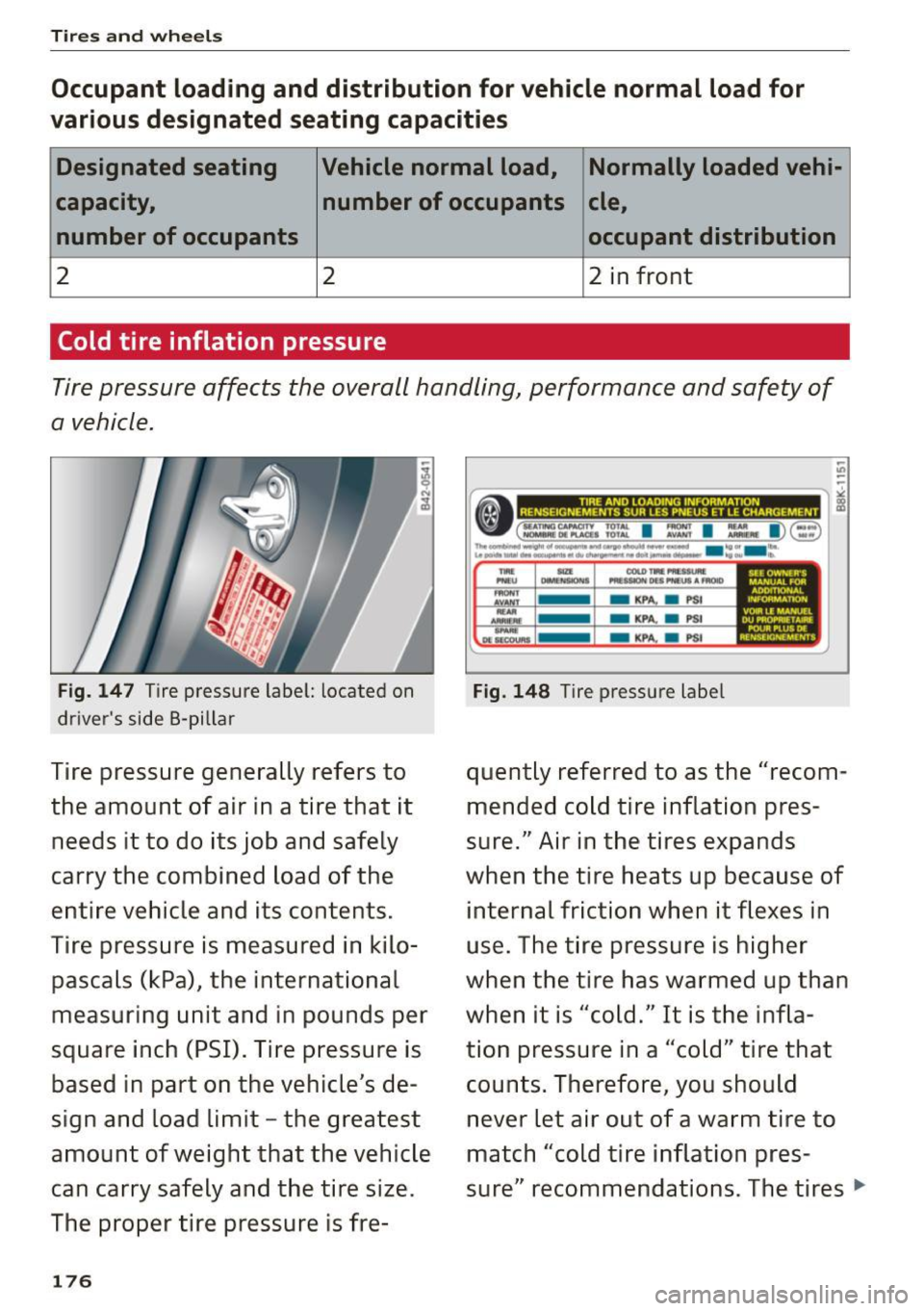
Fig . 147 Tire pressure label: located on
driver's side 8-pillar
Tire pressure generally refers to
the amount of air in a tire that it
needs it to do its job and safely
carry the combined load of the
entire vehicle and its contents.
Tire pressure is measured in kilo
pascals (kPa), the international
measuring unit and in pounds per
square inch (PSI). Tire pressure is
based in part on the vehicle's de
sign and load limit -the greatest
amount of weight that the vehicle
can carry safely and the tire size.
The proper tire pressure is fre-
176
-... PHIU OIMl(Hll()NI
"'"'"
Fig. 148 Tire pressure label
quently referred to as the "recom
mended cold tire inflation pres
sure." Air in the tires expands
when the tire heats up because of internal friction when it flexes in
use. The tire pressure is higher
when the tire has warmed up than
when it is "cold ." It is the infla-
tion pressure in a "cold" tire that
counts. Therefore , you should
never let air out of a warm tire to
match "cold tire inflation pres
sure" recommendations. The tires ""
Page 179 of 232
...
would then be underinflated a nd
could fail suddenly .
M ainta ining proper tire pressure
is one of the most important
things you can do to he lp avoid
s u dden tire fai lure . Under inflated
tires are a major cause of sudden
tire fa ilure . Keeping tires at the
r ight pressure is also important
for safe and responsive vehic le
handling, traction, braking and
load carrying.
Tire pressures are
particularly important when the
vehicle is be ing dr iven at higher
speeds, and then especially when
heavily loaded even within the
permissib le load-carrying capaci
ties approved for your vehicle .
The recommended tire pressures
for your Audi depend on the kind of tires on your vehicle and the
number of passengers and/or
amount of luggage you will be
transport ing .
The tire pressure label is located
on the driver's side 8-pillar . The
tire pressure label lists the recom mended cold tire inflation pres
s u res for the vehicle at its maxi
mum capacity weight and tires
~ that were on your vehicle at the
": ;;; time it was manufactured. "? N
"' ....
Tir es a nd whe els
If you wish to improve comfort
when operating the vehicle at
normal load (up to 2 occupants ),
you can adjust tire pressu res to
those specified for normal vehi
cle load . Before operating the ve
hicle at ma ximum load, you
must increa se the ti re pressures
to those specified for maximum
vehic le load
c:::> .&. .
Bear in mind that the tire pres
sure monitoring system can only monitor the tire pressures that
are stored. The system does not recognize the load condition of
your vehicle .
See the illustration
c:::> fig. 147 for
the location of the labe l on driv
er's side 8-pillar (color of the ac
tual label and exact location on
the vehicle will vary slightly).
Note that the following table is
accurate a t the time of going to
press and is subject to change . In
the event of discrepancies, the
tire pressure label on driver's side 8-pillar always takes precedence.
The table below lists the recom
mended cold tire inflation pres
sures for the Audi model covered by your Owner 's Literature at the
vehicle's capac ity weight and the .,.
177
Page 180 of 232
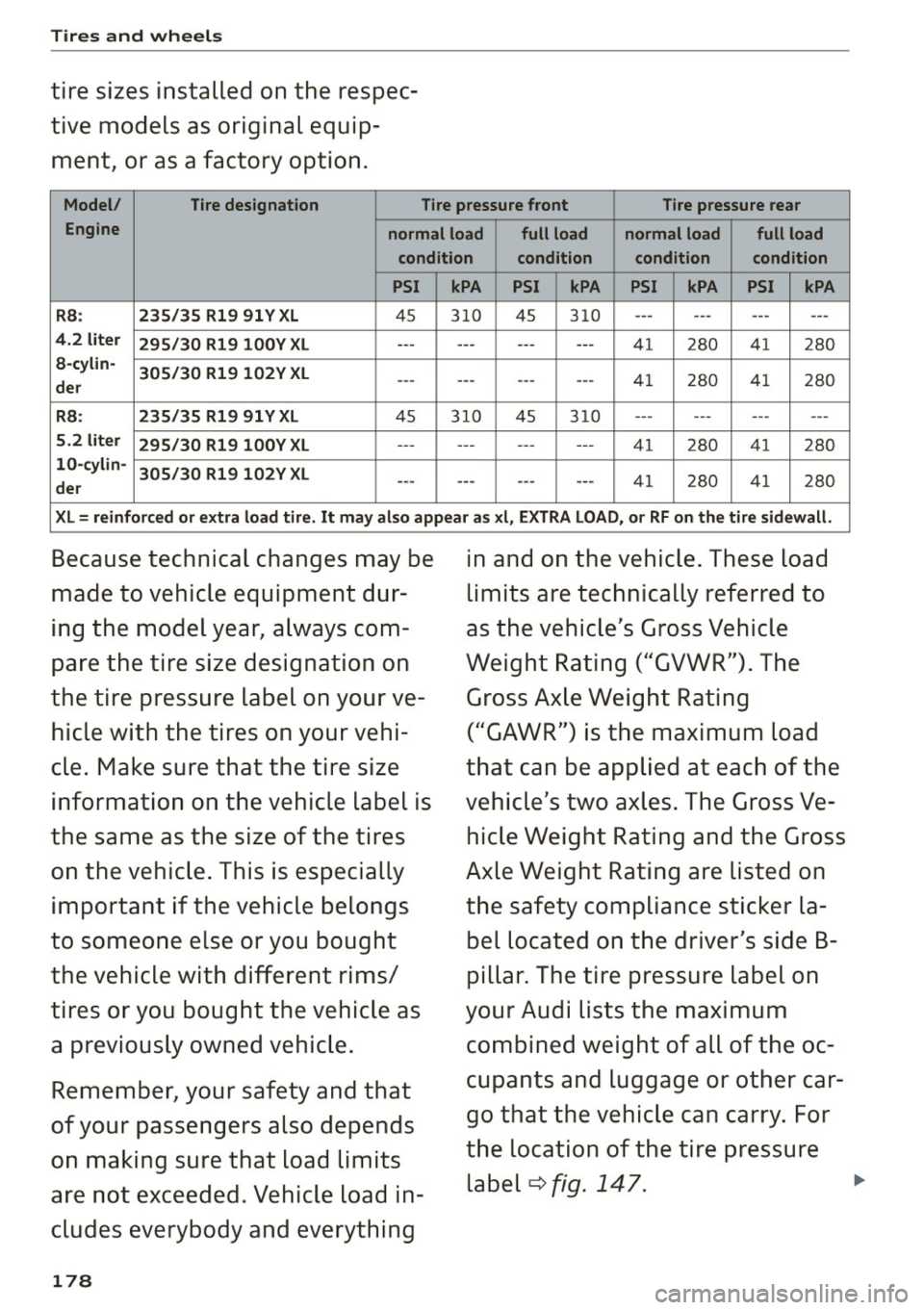
Tires and wheels
tire sizes installed on the respec
tive models as original equipment, or as a factory option.
Model/ Tire designation Tire pressure front Tire pressure rear
Engine normal load full load normal load full load
condition condition condition condition
PSI kPA PSI kPA PSI kPA PSI kPA
RS: 235/35 Rl9 91 Y XL 45 310 45 310 ------ ------
4.2 liter
295/30 Rl9 lOOY XL ------------41 280 41 280
S-cylin-
305/30 Rl9 102V XL
der
--- --- ------41
280 41 280
RS: 235/35 Rl9 91 Y XL 45 310 45 310 --------- ---
5.2 liter
295/30 Rl9 lOOY XL --------- ---41
280 41
280
10-cylin-
305/30 Rl9 102V XL
der
--- ------
---41 280 41 280
XL= reinforced or extra load tire. It may also appear as xl, EXTRA LOAD, or RF on the tire sidewall.
Because technical changes may be
made to vehicle equipment dur
ing the model year, always com
pare the tire size designation on
the tire pressure label on your ve hicle with the tires on your vehi
cle. Make sure that the tire size information on the vehicle label is
the same as the size of the tires on the vehicle. This is especially
important if the vehicle belongs
to someone else or you bought
the vehicle with different rims/
tires or you bought the vehicle as a previously owned vehicle.
Remember, your safety and that
of your passengers also depends
on making sure that load limits
are not exceeded. Vehicle load in
cludes everybody and everything
178
in and on the vehicle. These load
limits are technically referred to
as the vehicle's Gross Vehicle
Weight Rating ("GVWR"). The
Gross Axle Weight Rating ("GAWR") is the maximum load
that can be applied at each of the
vehicle's two axles. The Gross Ve hicle Weight Rating and the Gross
Axle Weight Rating are listed on
the safety compliance sticker la bel located on the driver's side B
pillar. The tire pressure label on
your Audi lists the maximum combined weight of all of the oc
cupants and luggage or other car
go that the vehicle can carry. For
the location of the tire pressure label ¢
fig. 147.
Page 181 of 232
.... N
" N ": ... IO "? N U'> .....
.&_ WARNING
Overloading a vehicle can cause loss of vehicle control, a crash
or other accident, serious per
sonal injury, and even death .
-Carrying more weight than your vehicle was designed to carry will prevent the vehicle
from handling properly and in crease the risk of a loss of ve
hicle control.
-The brakes on a vehicle that has been overloaded may not
be able to stop the vehicle
within a safe distance .
-Tires on a vehicle that has been overloaded can fail sud
denly causing loss of control
and a crash.
A WARNING
-
- Incorrect tire pressures and/or
underinflation can lead to a
serious or fatal accident.
-Incorrect tire pressures and/or underinflation cause increased
tire wear and can affect the
handling of the vehicle.
- Incorrect tire pressures and/or
underinflation can also lead to
sudden tire failure, including a blowout and sudden deflation,
causing loss of vehicle control.
Tires and wheels
Checking tire pressure
The correct tire pressure for the
tires originally installed on your
vehicle is listed on the tire pres
sure label located on driver 's side
8-pillar .
The recommended tire pressures
are on the tire pressure label and
in the table
c:::> page 176 , Cold tire
inflation pressure.
This means
that the pressure must be checked and adjusted when the
tire has not been driven for more
than a couple of m iles (kilome
ters) at low speeds during the
previous three hours. Air in the
tires expands when the t ire heats
up as a result of internal friction
as it flexes in use . The tire pres
sure is higher when the tire has
warmed up than when it is "cold".
It is the inflation pressure in a
"cold" tire that counts. Therefore,
you shou ld never let air out of a
warm tire to match "Cold tire in
flation pressure" recommenda
tions
c:::> page 176. The tires would
then be underinflated and could
fail suddenly.
The tire pressure label on your
Audi lists the recommended cold
tire inflation pressures for the
1 79