ignition AUDI R8 SPYDER 2015 Repair Manual
[x] Cancel search | Manufacturer: AUDI, Model Year: 2015, Model line: R8 SPYDER, Model: AUDI R8 SPYDER 2015Pages: 232, PDF Size: 58.36 MB
Page 157 of 232
.... N
l'
N "1: .... I.O
"' N
"' ....
Checking and filling Engine compartment lid
Releasing the engine compartment lid
The engine compartment lid is released from in
side the vehicle.
~
-------- .J;
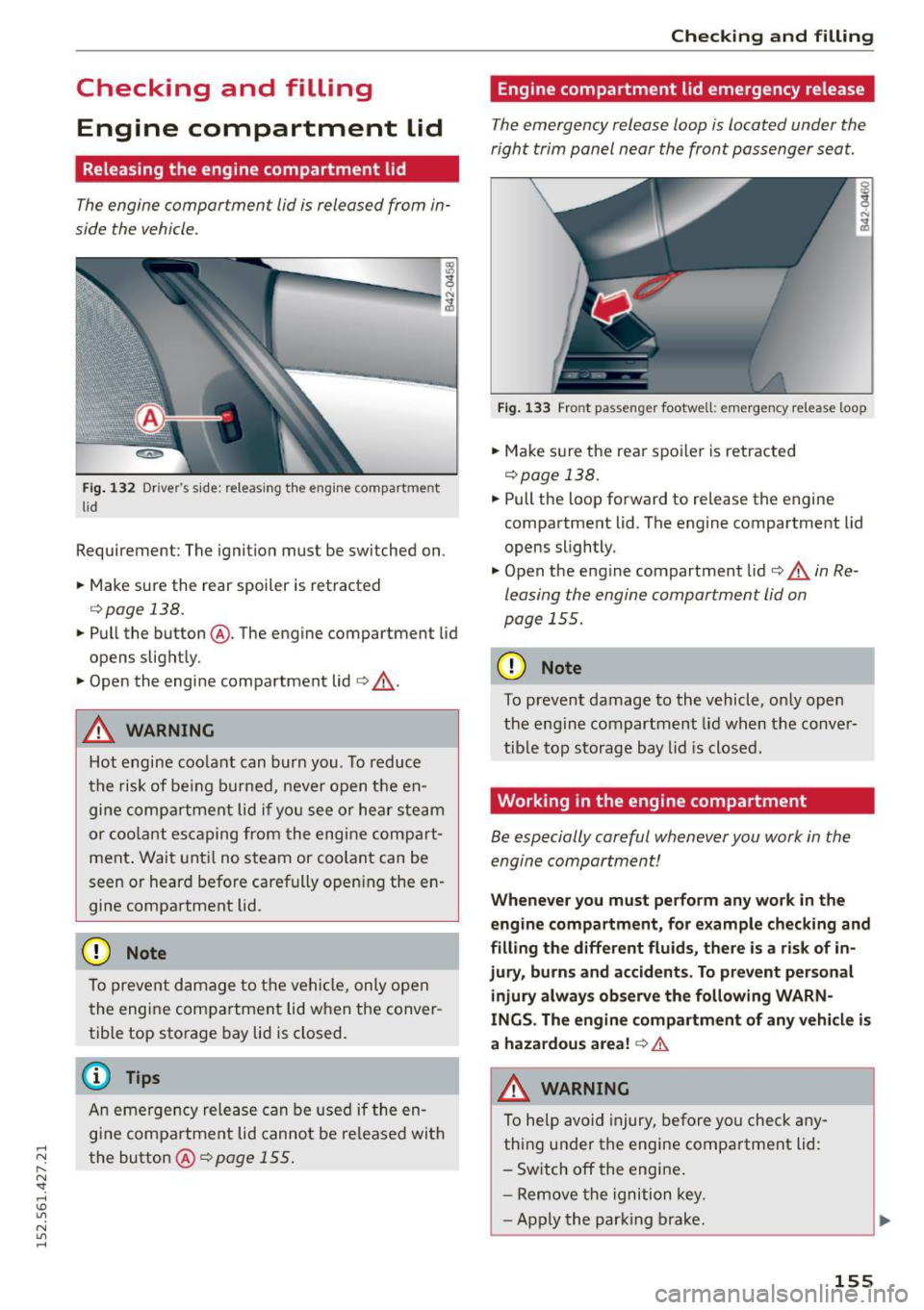
Fig. 132 Driver's side: releasing t he engine compartment
lid
Requirement: The ignition must be switched on .
" Make sure the rear spoiler is retracted
¢page 138.
"Pull the button @. The engine compartment lid
opens slight ly.
" Open the engi ne compartment lid¢_&, .
& WARNING
Hot engine coo lant can burn you. To reduce
t he risk of be ing burned, never open the en
gi ne comp artment lid i f yo u s ee or he ar s team
or cool an t es caping from the engine compart
ment . Wait unt il no steam or coo lant can be
seen or heard befo re carefully open ing the e n
gine compartment lid.
CD Note
To preve nt d amage to t he veh icle, only open
t he engine compartment lid when the conver
tible top storage bay lid is closed.
@ Tips
An emergency release can be use d if the en
gi ne compa rtment lid canno t be re leased with
the button @¢
page 155 .
-
Checking and filling
Engine compartment lid emergency release
The emergency release loop is located under the
right trim panel near the front passenger seat.
F ig . 1 33 Front passenger footwell: emerge ncy release loop
"Ma ke su re the rea r spoile r is retracted
¢page 138.
" Pull the loop forward to release the engine
compartment lid. The engine compartment lid
opens slightly.
" Open the engine compartment lid¢ &,
in Re
leasing the engine compartment lid on
page 155.
CD Note
To prevent damage to the vehicle, o nly open
the engine compartment lid when the conve r
tib le to p storage bay lid is closed.
Working in the engine compartment
Be especially careful whenever you work in the
engin e compartment!
Whenever you must perform any work in the
eng ine compartm ent, for example checking and
filling the differ ent fluid s, there is a ri sk of in
jury, burns and accident s. To prevent personal
injury alway s ob serve the following WARN
INGS . The engine compartment of any vehicle is
a hazardou s area !
c:> &.
,&. WARNING
To help avoid injury, be fore yo u check any
thing u nder the engine compartment lid:
- Sw itch off the engi ne .
- Remove the ignition key .
- Apply the par king brake.
-
155
Page 158 of 232
Checking and filling
-Move selector lever of S tronic to "N" (Neu
tral); put manual transmission in Neutral.
- Always let the engine cool down. Hot com
ponents will burn skin on contact .
- To reduce the risk of being burned, never
open the engine compartment lid if you see
or hear steam or coolant escaping from the
engine compartment. Wait until no steam
or coolant can be seen or heard before care
fully opening the engine compartment lid.
- Keep children away from the engine com
partment .
- Never spill fluids on hot engine compo
nents. They can cause a fire.
- Never open the coolant reservoir cap when
the engine is still warm . The coolant system
is pressurized and hot coolant could spray
out .
- Protect your face, hands and arm from
steam or hot engine coolant by placing a
thick rag over the cap when you open the coolant reservoir .
- Do not remove the engine cover under any
circumstances . This increases the risk of
burns.
- If work on the fuel system or the electrical
system is necessary :
- Always disconnect the battery.
- Never smoke or work near heaters or open
flames. Fluids in the engine compartment
could start a fire.
- Keep an approved fire extinguisher imme
diately available .
- To avoid electrical shock and personal injury
while the engine is running or being started,
never touch:
- Ignition cables
- Other components of the high voltage
electronic ignition system.
- If you must perform a check or repair with
the engine running:
- First, fully apply the parking brake, move
selector lever of S tronic to
"N" (Neutral);
put manual transmission in Neutral.
- Always use extreme caution to prevent
clothing, jewelry, or long hair from getting
caught in the radiator fan, V-belts or other
156
moving parts, or from contacting hot
parts. Tie back hair before starting, and
wear no clothing that will hang or droop into the engine.
- Minimize exposure to emission and chemi
cal hazards
¢ .&..
A WARNING
California Proposition 65 Warning:
- Engine exhaust, some of its constituents,
and certain vehicle components contain or
emit chemicals known to the State of Cali
fornia to cause cancer and birth defects and reproductive harm. In addition, certain flu
ids contained in vehicles and certain prod
ucts of component wear contain or emit
chemicals known to the State of California
to cause cancer and birth defects or other
reproductive harm.
- Battery posts, terminals and related acces
sories contain lead and lead compounds,
chemicals known to the State of California
to cause cancer and reproductive harms.
Wash hands after handling.
@ Note
When adding fluids, always make sure that
they are poured into the proper container or
filler opening, otherwise serious damage to
vehicle systems will occur.
@ For the sake of the environment
To detect leaks in time , inspect the vehicle
floor pan from underneath regularly. If you
see spots from oil or other vehicle fluids, have
your vehicle inspected by an authorized Audi
dealer .
· Closing the engine compartment lid
.. Make sure that the rear spoiler is retracted
¢page 138 .
.. Pull the engine compartment lid down until the
pressure from the struts is reduced.
.. Press the engine compartment lid closed
¢ _A . ..,
Page 164 of 232
Checking and filling
Do not reduce the concentration of the coo lant in
the summer by adding p lain water.
The propor·
tion of coolant additive must be at least 50%
but not more than 60%
to maintain antifreeze
protection and cooling efficiency .
If the coolant
frost protection is too low, the coolant could
freeze and damage the ve hicle heating and en
g ine cooling system .
For year-round driving, antifreeze is added at the
factory for temperatures down to:
- - 31 ° F ( -3 5 °C) USA
- - 40 °F ( - 40 °C) Canada .
If you must add coolant, use a mixture of water
and coolant additive. Mixing the coolant additive
with distilled water is recommended .
& WARNING
Before you check anything in the engine com
partment, always read and heed all WARN
INGS
<=> .&. in Working in the engine compart
ment on page 155.
(D Note
- Before winter sets in, have the coolant
checked to see if the coolant additive in your
vehicle is sufficient to meet the climate con
dit ions . This is especially important if you
live in a region where the winter is extreme
l y cold. If necessary, increase the proportion
of coolant add itive to 60%.
- When adding coolant addit ive to your cool
in g system, remember:
- We recommend using only coolant addi
tive G12++ or G13 for your vehicle. This
coolant additive is available at authorized
Audi dealers. Other types of antifreeze can
signif icant ly reduce corrosion protection.
The resulting corrosion can cause a loss of
coolant and serious engine damage.
- Do not add any type of radiator leak sealant
to your vehicle's engine coolant. Add ing ra
diator repair fluid may adversely affect the
funct ion and pe rformance of your cooling
system and could result in damage not cov
ered by you r New Vehicle Lim ited Warranty.
162
Checking the engine coolant level
Proceed carefully when checking the coolant .
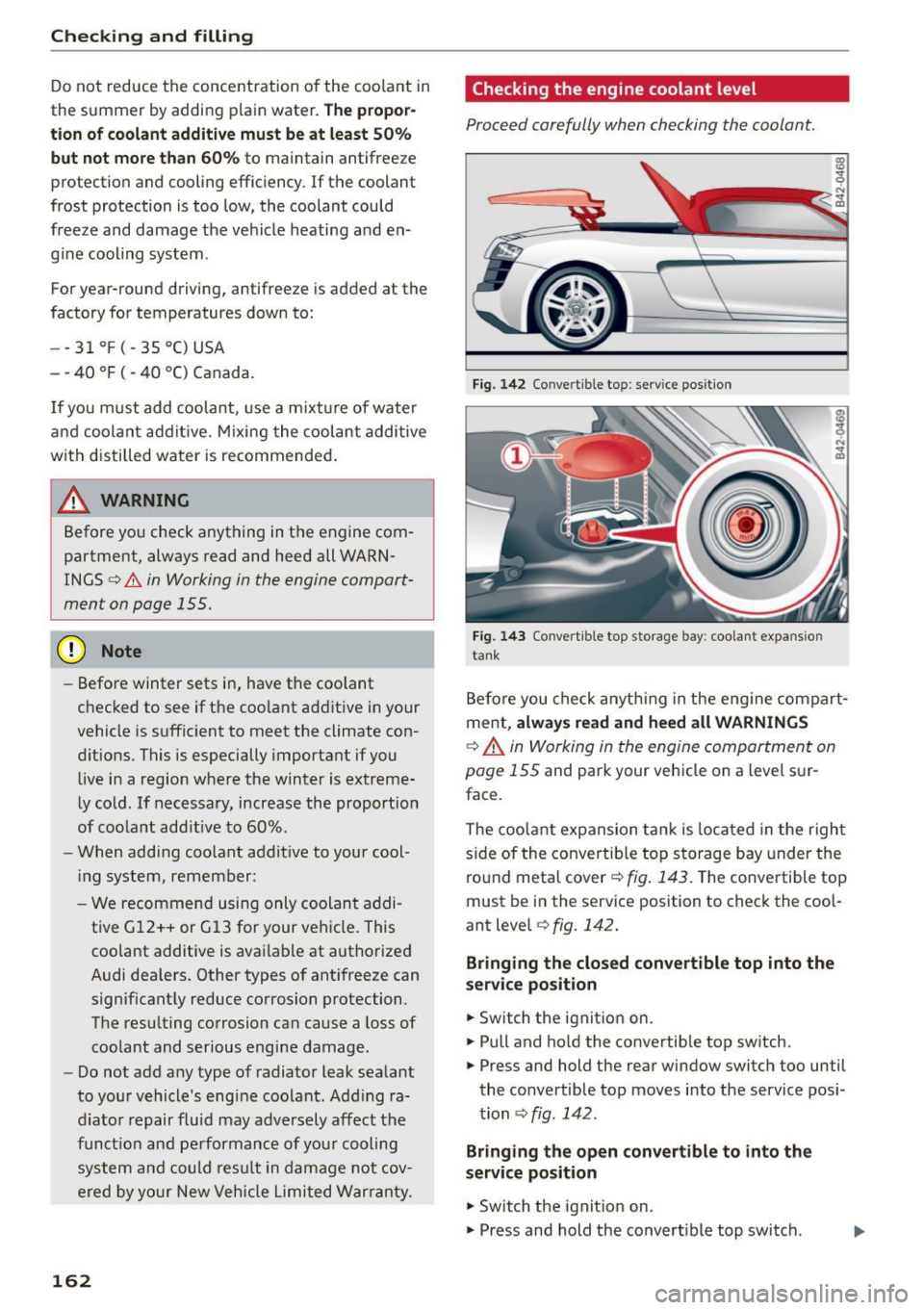
Fig. 142 Conve rtible top : serv ice pos it ion
Fig. 143 Co nve rtible top storage bay : coolant expa nsion
tank
Before you check anything in the eng ine compart
ment,
always read and heed all WARNINGS
c:> .&. in Working in the engine compartment on
page 155
and park your vehicle on a leve l su r
face.
The coolant expansion tank is loca ted in the right
s ide of the convertib le top storage bay under the
round metal cover
cf;, fig. 143. The convertible top
must be in the service position to check the cool
ant level
i=;, fig . 142.
Bringing the closed convertible top into the
service position
.,. Switch the ignition on.
.,. Pull and ho ld the convertib le top switch.
.,. Press and hold the rear window switch too until
the convertible top moves into the service posi
tion <=>
fig. 142.
Bringing the open convertible to into the
service position
.,. Switch the ignition on .
.,. Press and hold the convert ible top switch .
Page 165 of 232
..... N
r-N "': ..... \!) ..,.,
N ..,., .....
"' Press and ho ld the rear window switch too unti l
the convertible top moves into the service posi
t ion
r::!) fig. 142.
Opening th e cool ant e xp ansi on tank cov er
"' Stop the engine and allow it to coo l.
"' Switch the ignition off.
"' Carefu lly remove the bolts in the cover(!) using
a screwdriver and remove the cover. The cool
ant reservoir is located be low
c:> fig. 143 .
Check ing th e engine coolant l eve l
"' Place a rag or cloth on the cap of the coo lant
expansion tank and turn the cap
ca re full y to
the left (counter-clockwise)
c:> A .
"'Read the coo lant level inside the coolant expan
s ion tank
c:> fig . 143. With a co ld engine, it
must be above the "min" mark. W ith a hot en
gine, it can be a little above the ind icated
range .
To obtain an accurate read ing, the eng ine must
be switched off.
The expansion tank in your vehicle is equipped
with an electric coolant level sensor
r::!) page 14.
We still recommend you check the coolant level
from time to time .
Coolant lo ss
Coolant loss may indicate a leak in the cooling
system . In the event of coolant loss, the cooling
system should be inspected immediately by your
author iz ed Audi dealer. It is not enough merely
to add coolant.
In a
s e a led system, losses can occur only if the
boiling point of the coo lant is exceeded as a re
sult of overheat ing.
A WARNING
- The cooling system is under pressure. Do
not open the cap of the coolant expans ion
tank when the engine is hot. You risk being
sca lded.
-
- The coolant add itive, and therefore the cool
ant itself, is hazardous to health. Keep the
c oolant additive in the or igina l co ntainer out
of the re ach of children.
It is a poison haz
ard.
Ch eck ing and fillin g
(D Note
Do not add any type of radiator leak sea lant
to your vehicle's engine coolant . Add ing radia
tor repair fluid may adversely affect the func
tion and performance of your cooling system
and could result in damage not covered by
your New Veh icle Limited Warranty.
Adding coolant
Befo re you check a nyth ing in the eng ine compart
ment,
alwa ys read and he ed all WARNING S
r::!) A in Working in the engine compartment on
page 155.
"' Add coolant m ixed in the correct rat io
c:> page 161, Coolant.
"' Twist the cap on again tightly.
"'Tighten the cap(!) <::!)page 162, fig. 143 again .
Replacement engine coo lant must conform to ex
act specifications
c:> page 161, Coolant .
We recommend using only coolant add it ive Gl2+
+, G l3
or in an emergency Gl2 +. Do not use a
different additive. In an emergency use pla in wa
ter unt il you ca n get the correct add itive and can
restore the co rrect ratio . This should be done as
soon as possib le .
If you have los t a considerab le amount of cool
ant, then you shou ld add cold antifreeze and cold
water only when the engine is co ld .
Always use
new engine coo lant when refilling .
Do not fill coolant above the "max" mark. Excess
coolant will be forced out through the pressure
relief valve in the cap when the eng ine becomes
hot.
A WARNING
- The cooling system is under pressure and
can get very hot. Reduce the risk of scalding
from hot coolant by following these steps .
- Turn off the engine and allow it to cool
down .
- Protect your face, hands and arms from escaping fluid and steam by covering the
cap with a large, thick rag.
163
Page 167 of 232
..... N
r-N "': ..... \!) 1.1'1
N 1.1'1 .....
Have the battery checked when you take your ve
hicle in for service. You are well advised to re
place a battery that is older than 5 years .
Disconnecting the batt ery terminal s
Some vehicle funct ions (power w indow regula
tors , fo r example) are lost if the battery termi
na ls are disconnected. These functions have to be
re learned after the battery terminals are con
nected again. To prevent this , the batte ry shou ld
only be disconnected from the vehicle electrical
system when absolutely necessary for repairs.
V ehicl es not dri ven fo r lo ng p eriod s
If you do not drive your vehicle over a period of
several days or weeks , e lectrica l components are
gradually cut back or switched off. This reduces
energy consumption and maintains s tarting ca
pability over a longer period<=> page 140. Some
of the convenience funct ions may not operate ,
such as the inter ior lights or powe r seat ad just
ment. The convenience functions will be ava ilable
again when you switch on the ignition and start
the eng ine.
Wint er op erati on
During the winter months, battery capacity tends
to decrease as temperatures drop . This is because
more power is also consumed w hile start ing , and
the head lights, rear w indow defogger, etc., are
used more often.
Avoid unnecessary power consumption, part icu
l arly in city traffic o r when traveling only short
d ista nces . Let you r a utho rized Aud i dea le r check
the capacity of the vehicle battery before w inter
sets in <=> page 167. A well charged battery will
not on ly prevent starting prob lems when the
w eather is cold, but will also last longer.
R eplacing battery
The new battery mu st ha ve the same capacity,
voltage
(12 vo lts), amperage, construction and
p lug sealing, as the original battery . Specifica
tions are listed on the battery housing. Batteries
specia lly deve loped by Audi fulfill the mainte
nance, output, and safety requ irements .
Check ing and fillin g
When installing the battery, make sure the igni
tion and all electrica l consumers are switched off
<=> 0 .
We recommend that you use main tenance-free or
cycle -res istant /leak-p roof batteries according to
the standards TL
825 06 (from Apri l 2008) and
VW 7
50 73 (from Apr il 2010).
Replac ing the bat tery shou ld be carried by a
qualified workshop. Please fo llow the ins truc
tions on the battery cover .
(D Note
-All work on the battery req uires techn ica l
knowledge . Please contact an Audi dealer
ship or another authorized facility for ques
tions about the battery - danger of ac id
burns and explosion ha zard!
- The battery must not be opened! Do not try
to change the battery's liquid level, other
w ise detonating gas will escape from the
battery- exp losion hazard!
- The AGM battery in the luggage compart ment cannot leak, because the e lectrolyte
for this battery is absorbed into a special glass mat . This leak-proof battery must not
be replace with a convent ional battery.
- Make sure the ventilation hose on the side
of the battery is connected, otherwise
fumes or battery ac id can leak out.
- Battery holder and terminals always have to
be sec ured correctly .
- Before all work on the battery follow the
warnings be low <=>&. in Working on the bat
tery on page 166.
@ For the sake of the environment
Because of the prob lem of proper disposal of
a battery, we recommend your autho rized
Audi dealer change the battery for you . Bat
teries contain sulfur ic acid and lead and must
a lways be d isposed of properly in compliance
with all envi ronmental regula tions . Disposing
of vehicle batteries improperly is very danger
ous to the environment . Make sure that the
removed battery cannot overba lance, other
wise sulf uric ac id might escape!
165
Page 169 of 232
.... N
l'
N "1: .... I.O
"' N
"' ....
negative cable. Never interchange the ca
bles -this could start a fire!
- Never charge a frozen or a thawed-out bat
tery. It could explode! If a battery has fro
zen, then it must be replaced. A discharged
battery can freeze over at 32 °F (0 °C).
- Make sure the vent hose is always attached
to the opening on the side of the battery.
- Never use batteries which are damaged.
Danger of explosion! Always replace a dam
aged battery.
A WARNING
California Proposition 65 Warning:
- Battery posts, terminals and related acces
sories contain lead and lead compounds, chemicals known to the State of California
to cause cancer and reproductive problems.
Wash hands after handling .
(D Note
- Do not disconnect the vehicle battery when
the ignition is switched on or when the en
gine is running, otherwise, you will damage
electronic components in the electrical sys
tem.
- If your vehicle is going to stand for a long
period of time without being driven, protect
the battery from "freezing", otherwise it
will be damaged and will then have to be re
placed.
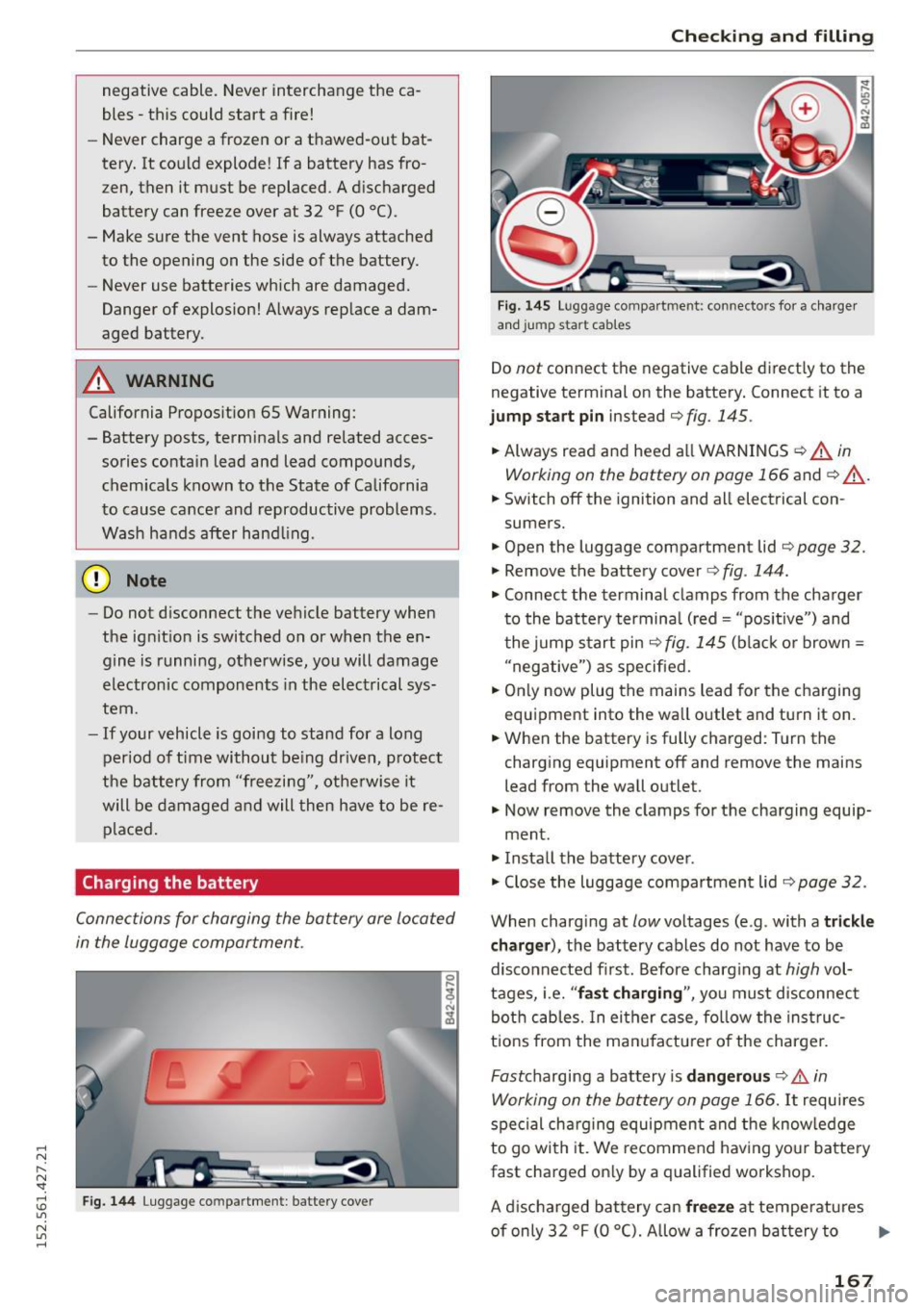
Charging the battery
Connections for charging the battery are located
in the luggage compartment.
--
• •
Fig. 144 Luggage compartment : ba tter y cover
Checking and filling
Fig. 145 Lug gage compar tment: connectors for a charg er
and jump start cables
Do not connect the negative cable directly to the
negative terminal on the battery. Connect it to a
jump start pin instead¢ fig. 145 .
• Always read and heed all WARNINGS ¢ A in
Working on the battery on page 166
and ¢&_ .
• Switch off the ignition and all electrical con-
sumers.
• Open the luggage compartment lid¢
page 32.
• Remove the battery cover¢ fig. 144.
.,. Connect the terminal clamps from the charger
to the battery terminal (red= "positive") and
the jump start pin ¢
fig. 145 (black or brown =
"neg ative") as specified.
• Only now plug the mains lead for the charging
equipment into the wall outlet and turn it on.
• When the battery is fully charged: Turn the
charg ing equipment off and remove the mains
lead from the wall outlet.
.,. Now remove the clamps for the charging equip-
ment .
.,. Install the battery cover .
.,. Close the luggage compartment lid ¢
page 32.
When charging at low voltages (e.g . with a trickle
charger),
the battery cables do not have to be
disconnected first. Before charging at
high vol
tages, i .e.
"fast charging", you must disconnect
both cables. In either case , follow the instruc
tions from the manufacturer of the charger.
Fastcharging a battery is
dangerous¢.&. in
Working on the battery on page 166.
It requires
special charging equipment and the knowledge
to go with it. We recommend having your battery
fast charged only by a qualified workshop.
A discharged battery can
freeze at temperatures
of only 32
°F (0 °C). Allow a frozen battery to ..,.
167
Page 200 of 232
Tires and wheels
and tires are compatible with the tire pres
sure monitoring system. Otherwise the sys
tem will register a malfunction and a fault message will be displayed. For more infor
mation, contact your authorized Audi deal
er.
- For Declaration of Compliance to United
States FCC and Industry Canada regulations
c:> page 218.
Programming a new set of tires
Applies to veh icles: w ith tire pressure monitoring syste m
When driving with a new set of tires, you can pro
gram them to the tire pressure monitoring sys
tem using the menu disp lay.
.,. Turn the ignition on .
.,. Select the menu:
Set> Tire pressure > Wheel
change.
.,. Confirm that you would like to begin the pro
gramming process . The message
Wheel sen
sors are being initialised. This may take a few
minutes ...
appears in the instrument cluster
display.
You can switch between programmed tire sets at
any time without reinitializing the system.
(D Tips
- If the programming process was not com
pleted successfully, the message
Wheel
sensors could not be initialised
appears in
the display and them indicator light
turns on. If this happens, repeat the proce
dure.
- Do not store the tire pressure if there are
snow chains on the tire.
TPMS Tire pressure monitoring system
malfunction
A malfunction can have various causes.
If the [I] warning light in the instrument cluster
flashes for approximately one minute and then
remains continuously illuminated and additional
ly
the m symbol appears in the display, the tire
pressure monitoring system is not available. The
198
text Tire pressure! System malfunction appears
in the display. This can have various causes.
- A wheel sensor or other component may have
fai led.
- During initialization the system has detected
more than 4 wheels on the vehicle, for example
while driving next to another car with a tire pressure monitoring system.
- Audi replacement parts were not used.
- If snow cha ins are being used, system function
can be compromised due to the shielding prop
erties of the chains .
- The tire pressure monitoring system may not
be available because of a rad io malfunction.
- Transmitters with the same frequency, such as
radio headphones in the vehicle or radio equip
ment, can cause a temporary disruption of the
system through excessive electromagnetic
fields .
- Eliminate the interference if you can and then
proceed as follows: Turn off the engine for 20
minutes. Then drive another 10 minutes.
If the
warning light comes on again, you should con
tact your authorized Audi dealer immediately
to have the problem corrected.
- Do not use commercially available tire sealants.
Otherwise, the electrical components of the
tire pressure monitoring system will no longer
work properly and the sensor for the tire pres
sure monitoring system will have to be replaced
by a qualified workshop.
Page 212 of 232

Fuses and bulbs
Fuses and bulbs
Electrical fuses
Replacing fuses
Fuses that have blown will have metal strips
that have burned through .
Fig. 164 Passenger's s ide wheel well: Foot rest with fuse
arrangement
The fuses are located in the footwell area on the
passenger's side behind a cover .
.. Switch the ignition and all e lectrica l equipment
off .
.. Check the following table to see which fuse be-
longs to the equipment .
.,. Remove the floor mat .
.,. Fo ld the foot rest back~
fig. 164 .
.,. Remove the clamp from the holder in the fuse
box .
.. Remove the fuse using the clamp and replace
the b lown fu se with an ident ica l new one .
.. Fo ld the foot rest down again .
Fuse color identification
Color Current in amps
B lack 1
Purple 3
Light b rown 5
Brown 7 .5
Red 10
B lue 15
Yellow 20
Whit e or transparent 25
Green 30
Ora nge 40
210
A WARNING
Do not repa ir fuses and never replace a blown
f u se w ith one that has a highe r amp rating.
This can cause damage to the electr ica l sys
t e m and a fire.
(D Note
If a new fuse blows again shortly after you
have installed it, have the electrical system
checked by an a uth orized Audi dea le r or a u
thoriz ed Audi Serv ice Facility .
@ Tips
-The followi ng table does not list fuse loca
t ions that are not used .
- Some of the equipment listed in the fo llow
ing tables applies on ly to certa in model ver
sions or certa in optiona l equipment .
Fuse assignment
Fig. 165 Pas senge r footwell: Fuse panel
Fuse panel @
No . Consumer
1 VOA interface
2 Heated windshield washer nozzle
Page 218 of 232
Consumer Information
scope of maintenance and repairs which can be
carried out by vehicle owners .
Also , sa fety and
en vironment al
concerns place very str ict limits
on the nature of repa irs and adjustments to en
g ine and transmission parts which an owner can
perform .
Maintenance, adjustments and repairs usually re
qu ire spec ia l tools, testing devices and other
equ ipment available to specially tra ined work
shop personnel in order to assure proper per
formance, reliab ility and safety of the vehicle and
its many systems .
Improper maintenance, adjustments and repairs
can impair the operation and reliability of your
veh icle and eve n void your vehicle warranty .
Therefore, proof of servicing in acco rdance with
the ma intenance sched ule may be a condition fo r
upho ld ing a possible wa rranty claim made w ith in
the wa rranty per iod .
Above all, operational safety can be adversely af
fected, creating unnecessary risks fo r you and
your p assengers .
If in doubt about any se rv ici ng, have it done by
your author ized Audi dealer or any other properly
equ ipped and qualified workshop. We st ro ngly
urge you to give yo ur au thori zed Audi dealer the
opport unity to perform all schedu led mainte
nance and necessary repairs. Your dealer has the
facilities, original parts and trained specialists to
keep yo ur vehicle runn ing proper ly.
Performing limited mainten ance yourself
The fo llow ing pages describe a lim ited number o f
p roced ures which can be performed on you r vehi
cle with ordinary tools, sho uld the need a rise and
trained personne l be unavailab le. Before per
forming any of these procedures, always thor
oughly read all of the applicable text and careful
ly follow the instructions g iven. A lways rigorously
observe the
WARNINGS prov ided .
Before you check anything in the engine com
partment , always read and heed all WARNINGS
c> & and c> & in Working in the engine compart
ment on page 155.
216
A WARNING
-
-Ser ious personal in jury may occur as a result
of improperly performed maintenance, ad
justments o r repai rs.
- Always be extremely careful when work ing
on the vehicle . Always follow commonly ac
cepted safety pract ices and general com
mo n sense. Never r is k pe rsonal i njury.
- Do not attempt any of the mainte nance,
checks or repairs described on the following
pages if you a re not fully familiar with these
or other procedures w it h respect to the ve hi
cle, or are unce rtain how to proceed .
- Do not do any work wi thout the proper tools
an d eq uipment. H ave the necessary work
done by your au thorized Audi dealer o r an
other prope rly equippe d an d qua lified work
shop .
- Always remove the ignition key befo re any
one gets under the vehicle.
- Always support your veh icle with safety
stands if it is necessary to work underneath
the vehicle. The jack * is not adequate for
this purpose and co uld collapse causing se
r ious personal in jury.
- If you must wor k unde rneath the vehicle
w it h the wheels on t he gro und, a lways make
sure the vehicle is on level ground, that the
wheels are a lways securely blocked and that
the engine cannot be started .
- Always make sure the transmission selector
lever is in "N" (N eutral) (5 tronic) or Neutral
(ma nual transm iss ion) and the hand brake is
fi rm ly applied.
@ For the sake of the environment
- Cha ng ing the engine settings will adve rsely
affect emiss ion levels. This is detrimental to
the environment a nd increases fuel con
s u mption.
- Always observe environmenta l reg ulations
when dispos ing of old engine oil, used brake
fluid, dirty eng ine coolan t, spent ba tter ies
or worn ou t tires.