engine overheat AUDI R8 SPYDER 2015 Owners Manual
[x] Cancel search | Manufacturer: AUDI, Model Year: 2015, Model line: R8 SPYDER, Model: AUDI R8 SPYDER 2015Pages: 232, PDF Size: 58.36 MB
Page 12 of 232
Instrum ent s a nd w arn ing /indi cator lights
-Never open the engine compartment lid if
you see or hear steam, or if you see engine coolant dripping from the engine compart
ment. You could burn yourself. Let the en
gine cool off first until you can no longer see
or hear steam or coo lant escaping .
CD Note
- Mount ing additional lights or accessories in
front of the a ir inlets reduces the cooling ef
fect of the rad iator. At h igh outside temper
atures or high engine load, the engine could
ove rheat.
- The front spo ile r has been designed to prop
erly distribute the cooling air when the veh i
cle is mov ing. If the spo iler is damaged, this
could reduce the cooling effect and the en
gine could then overheat. Ask your author
ized Audi dealer for assistance.
Fuel gauge
The fuel gauge works only when the ignition is
on. When the needle reaches the red area, the
warning light in the instrument cluster will illu
minate
c:> page 17 Ill Time to ref uel!
CD Note
Never run the tank completely dry! An irregu
lar supply of fuel can cause engine m isfiring
and fuel could enter into the exhaust system .
The catalytic converter cou ld then overheat
and be damaged.
10
Speedometer with odometer
The speedometer shows you the vehicle speed,
and the odometer shows you how many miles
(kilometers) you have driven.
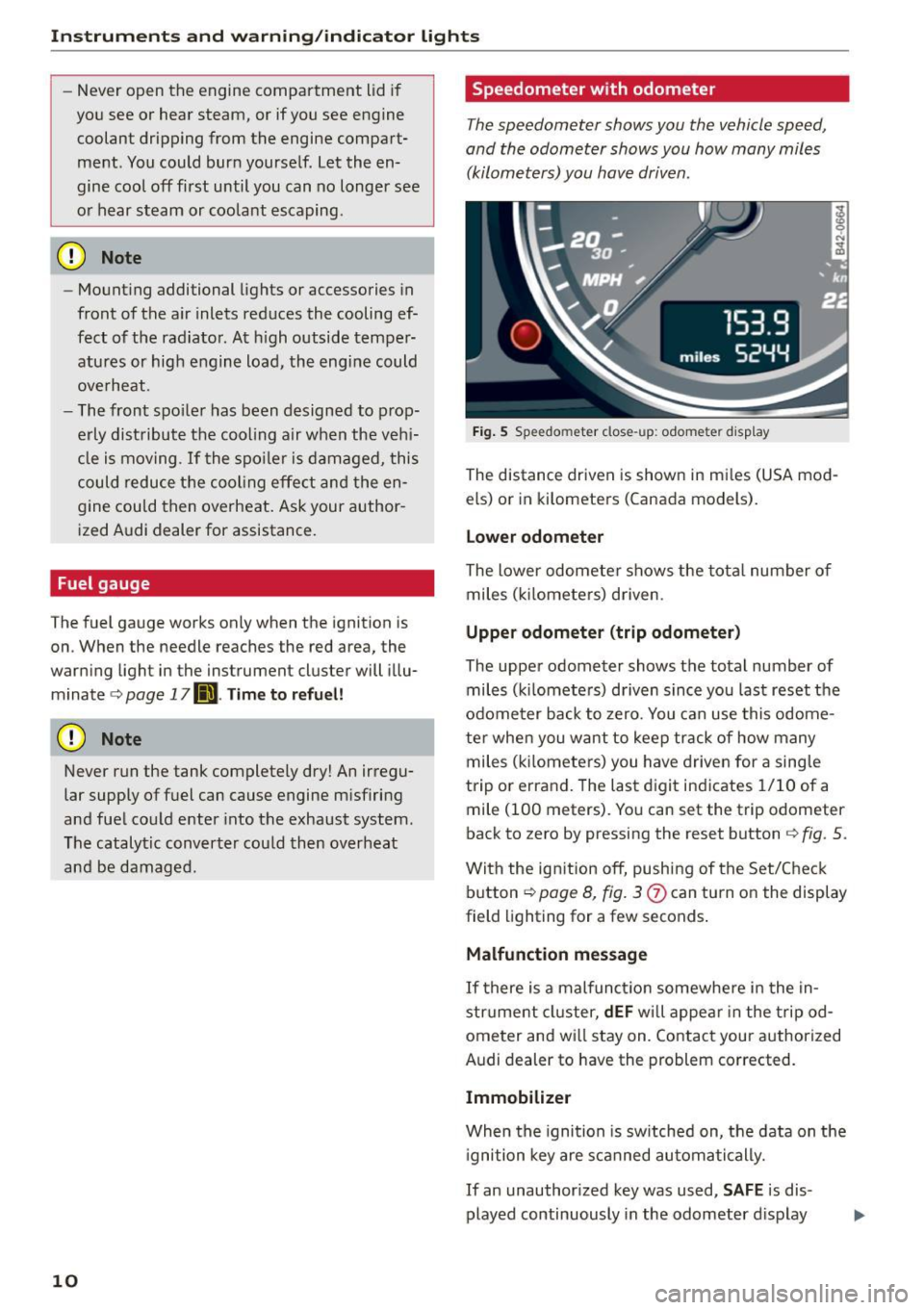
Fig. 5 Speedo meter close-up: odometer disp lay
The distance driven is shown in mi les (USA mod
els) or in kilometers (Canada models).
Lower odomet er
The lower odometer shows the tota l number of
miles ( kilometers) driven .
Upper odometer (trip odometer )
The upper odometer shows the total number of miles (k ilometers) driven since you last reset the
odome ter back to zero. You can use this odome
te r when you want to keep track of how many
miles (k ilomete rs) you have driven for a sing le
trip or errand. The last digit ind icates 1/10 of a
mile (100 meters). You can set the trip odometer
back to zero by pressing the reset button
c:> fig . 5 .
With the ig nition off, push ing of the Set/Check
button
c:> page 8, fig. 3
Malfunction messag e
If there is a malfunction somewhere in the in
strument cluster,
dEF wi ll appea r in the tripod
ometer and wi ll stay on. Contact your authorized
Audi dealer to have the problem corrected.
Immobilizer
When the ignition is sw itched on, the data on the
i gnition key are s canned automatically.
If an unauthor ized key was used,
S AF E is dis
played continuously in the odometer d isplay
Page 78 of 232
Transmi ssio n
rotation of the whee ls, then the time wi ll in
crease a ccording ly .
A WARNING
- If a gear is engaged when the vehicle is sta
tionary, the acce lerator must not be pressed
inadvertently under any circumstances. Oth
erwise the vehicle will immed iately start to
move - sometimes even if the park ing brake
is f irmly applied.
- Before you or other persons open the engine compartment l id and work on a running en
gine, select neutral pos it ion
N and firmly
apply the handbra ke. Always read and fol
low the app licab le warn ings¢
page 155,
Working in the engine compartment.
@ Tips
- If you accidenta lly shifted into N w hile d riv
i ng, you can engage a gear in the normal
way using the selecto r lever.
- An indicator light i s displayed if a malfunc
tion occurs while in S tronic. Refer to
~page 78.
Manual mode
App lies to veh icles: w ith 5 tro nic
S tronic allows the driver to shift gears man ua lly.
Starting from a stop
.,. Press and ho ld the brake pedal.
.. Move the selecto r leve r to the left.
.. Tap the se lec tor lever forwa rd
0 -
.. Re lease the brake pedal and press the accelera -
tor pedal ¢ .&,. .
Shifting
.,. To shift up, tap the selector lever fo rward 0 -
.,. To shift down, t ap the sele ctor lever to the re ar
o.
Stopp ing temporarily
.,. Press the brake pedal to prevent the vehicle
from moving, for examp le at traff ic lights .
Par king
.. Press and ho ld the brake pedal¢.&,. .
76
.. Activate the parking brake .
.. Turn off the ignition and remove the key .
Stopping on an incline
.,. Always keep the vehicle stat ionary using the
foot brake to prevent it from " rolling back"
¢ .&,. . D o not try to p revent the vehicle from
"ro lling back" when a gear is engaged by in
creasing engine speed.
.. Activate the parking brake.
Starting on a hill
.. With a gear engaged, remove your foot from
the brake, accelerate and slowly release the
parking brake.
When acce lera ting, S tronic sh ifts i nto the nex t
gear in gea rs 1, 2, 3, 4, 5 and 6 shor tly befo re
the maximum permissib le engine speed is
r eached.
If you have se lec ted a lower gear than the current
one, S tron ic w ill shift down only when the engine
will not be ove r-revved.
You can switch to a utomat ic operation at any
time
¢ page 77.
A WARNING
-
- Never leave your vehicle with the engine
ru nning while in gear. If you must leave yo ur
vehicle with the engine r unning, set the
parking brake firmly and engage neutral
N .
- With the engine r unning and a gear engag
ed, you have to ho ld the vehicle with the
foot brake .
- Do not accelerate when you sh ift gears with
the vehicle stationary and the engine run ning.
- Before driving down a steep slope, reduce
your speed and sh ift into a lower gear with S
tronic.
- Do not ride the bra kes or press the bra ke
pedal too often or too long. Constant brak
ing causes the brakes to overheat and sub
stantially reduces brak ing performance, in
creases braking d istance or causes comp lete
fa ilu re of the brake system. ..,.
Page 137 of 232
.... N
l'
N "1: .... I.O
"' N
"' ....
Anti-loc k br aking sy stem (ABS )
ABS prevents the wheels from locking up when
brak ing . T he vehicle can st ill be stee red even dur
ing hard braking. App ly steady pressure to the
brake peda l. Do not pump the peda l. A pulsing in
the brake pedal indicates that the system is help
ing you to brake the vehicle.
Brake assist sy ste m
The brake assist system can decrease braking dis
tance. It increases braking power when the dr iver
presses the brake pedal quick ly in emergency sit
uations. You must press and ho ld the brake pedal
until the situation is over.
Anti -slip regulation (ASR )
ASR reduces engine power when the drive whee ls
begin to spin and adapts the force to the road
conditions. This makes it easier to start, acceler
ate and dr ive up h ills.
Electronic diff erential lock (EDL )
The EDL brakes wheels that are spinning and
transfers the drive power to the other drive wheel or wheels if the vehicle is equipped w ith all-whee l
drive*. This function is available up to about 60
mph (100 km/h) .
I n extreme cases , EDL automatically switches off
to help keep the brake on the braked wheel from
overheating . EDL wi ll switch on again automati
cally when conditions have returned to normal.
A WARNING
- ESC, ABS, ASR and EDL cannot overcome the
laws of phys ics. Th is is especially important
on slippery or wet roads. If the syst ems be
gin act ing to stab ilize your vehicle, you
sho uld immediately cha nge your speed to
match the roa d and traffic con ditions. Do
not let the increased safety provided by
these systems tempt you to take risks . Do
ing so wi ll increase the risk of a loss of vehi
cle contro l, collis ion and serio us personal in
juries .
- Always adapt your speed to road, traffic and
weather cond it ions. The risk of losing con
tro l of the veh icle increases when driving
Int ellig ent t echnolo gy
too fast, especially through curves and on
slippery or wet roads, and when dr iving too
close to vehicles up ahead. ESC, ABS, the
brake assist system, EDL and ASR cannot
prevent coll is ions .
- Always accelerate with special care on even,
smooth surfaces such as those that are wet
or covered with ice and snow. The drive
wheels can spin even with these assistance sys tems that cannot always help to reduce
the risk of loss of veh icle control.
(D Tips
- ABS and ASR only wo rk correctly when all
four wheels are eq uipped with ident ical
tire s. Different tire s izes can lead to a reduc
t ion i n engine power.
- Yo u may hear noises when the systems de
sc ribed a re wo rking.
- If the ind icator light GJ or II (USA mod
els) ;tiJ (Canada models) appea rs, there
may be a malfunction~
page 15,
~ page 15.
Switching on/off
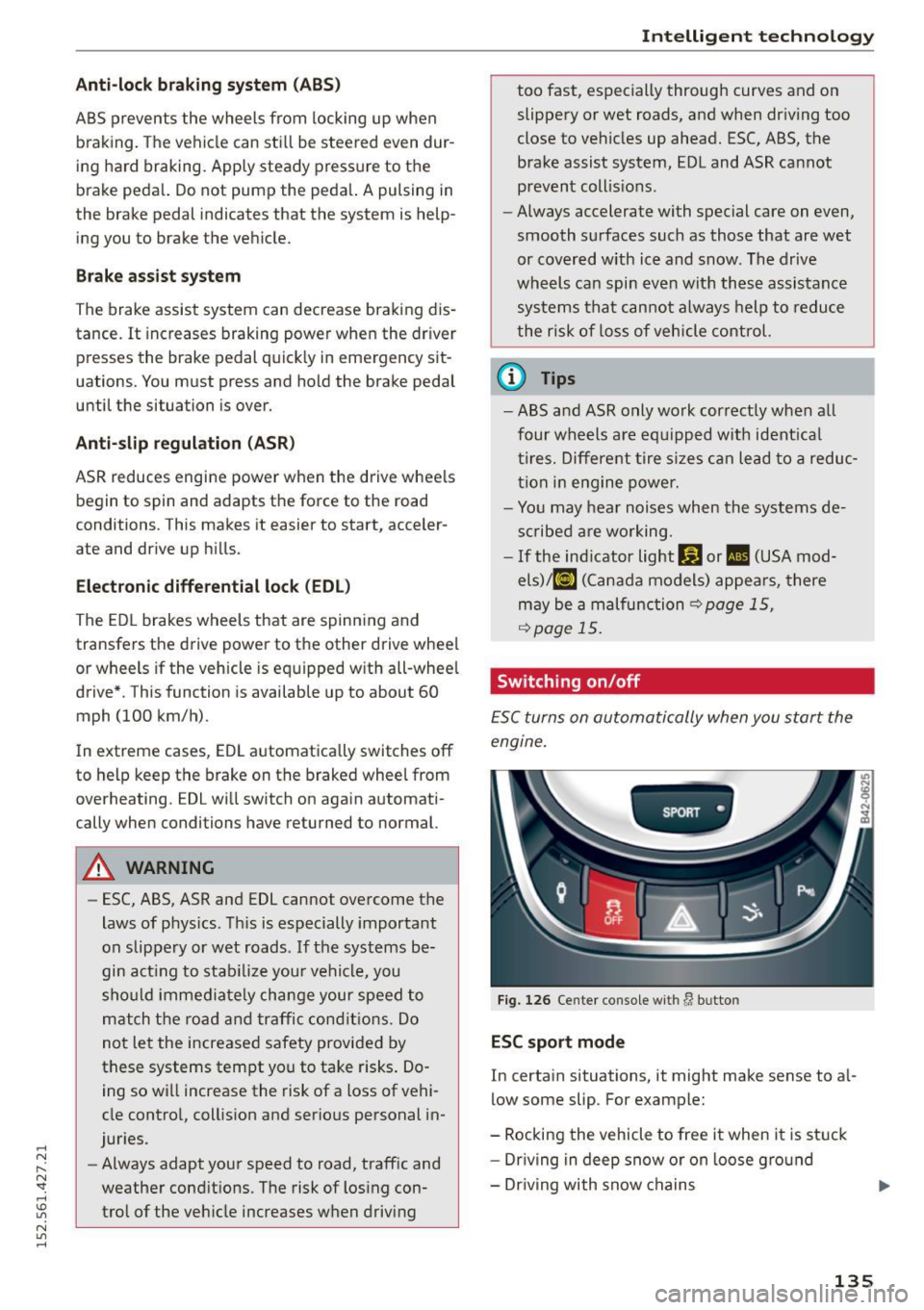
ESC turns on automatically when you start the
engine.
SPORT •
Fig . 12 6 Cente r co nsole wit h lJ bu tto n
ESC sport mode
In certain situations, it might make sense to a l
low some slip. For example:
- Rocking the vehicle to free it when it is st uck
- Driving in deep snow or on loose gro und
- Dr iving with snow chains
135
Page 139 of 232
..... N
r-N "': ..... \!) 1.1'1
N 1.1'1 .....
This can cause a temporary reduction in braking
force compared to dry brakes. You can compen
sate for this by pressing the brake pedal harder.
Cor ro sion
There may be a tendency for dirt to bui ld up on
the brake pads and corrosion to fo rm on the discs
if the car is not driven regularly or only for short
trips with little use of the brakes.
If the b rakes are not used frequently, or if corro
sion has formed on the discs, it is advisab le to
clean off the pads and discs by braking firmly a
few times from a moderately high speed
c:> &. .
Faults in the brake sy stem
If you should notice a sudden increase in brake
pedal travel, then one of the two brake circuits
may have fai led
c:> .&, .
Low brak e flu id le vel
Malfunct ions can occur in the brake system if the
brake fluid level is too low. The brake flu id leve l is
monitored e lectronically.
Br ake power assis t un it
T he brake power assist unit increases the pres
sure that you generate with the brake pedal.
It
works only when the eng ine is running .
Brak e lining wear sta tu s
Brake lining wear may be checked by visual in
spection of the condition of the brake pads
through the openings in the wheel. If necessary,
the wheel may be removed for this inspection
c:> page 203 .
.8, WARNING
-New brake pads don't have the best stop
ping power and must be "broken-in" during
the init ial 250 mi les ( 400 km) of normal city
driving. The break -in period can be consider
ably longer for vehicles with ceramic brake
rotors *. You can compensate for this by
pressing the brake pedal more firmly. This
also applies later when new pads are instal
led .
- You should perform brak ing maneuvers for
the purpose of clean ing the brake system
Int elli ge nt te chn olo gy
only if road conditions permit. Other road
users must not be put at r isk -you may
cause an accident!
- Before descending a steep grade, reduce
speed and sh ift transmission into a lower
gear or lower dr iving range. Do not ride the
brakes or hold the pedal down too long or
too often. This could cause the bra kes to get
hot and dimin ish braking effic iency .
- Do not "ride the brakes" by rest ing your foot
on the pedal when you do not intend to
brake. This may cause the brakes to over
heat, premat ure wear and increased stop
ping distance.
- Under certain cl imatic and operat ing condi
tions such as passing thro ugh water, dr iv ing
in heavy rain or after washing the vehicle,
the effectiveness of the brakes can be re
duced . In winter, ice can accumulate on the
brake pads, lin ings, discs and drums. Care
fully apply brakes for a test. Brakes will dry and ice coatings will be cleaned off after a
few careful brake applications.
- Driving for an extended period of t ime on
salt-covered roads without using your brakes can also affect braking efficiency .
Clean off accum ulated salt coating from
b rake discs and pads with a few cautious
brake applications.
- If you damage the front spoiler, or if you in
stall a different spoiler, be su re the air flow
to the front brakes is not obstructed . O ther
wise the brake system could overheat reduc
ing the effectiveness of the entire brake sys
tem .
- Fai lure of one brake circuit will impai r the
braking capability resu lting in an increased
stopping distance . Avoid driving the vehicle
and have it towed to the nearest Aud i dea ler
or qualif ied workshop.
- Never let the vehicle roll to a stop with the
engine shut off.
- If the brake booster is not working, for ex
ample when towing your veh icle, or because
the brake booster has somehow been dam
aged, the brake pedal must be pressed con
siderably harder to make up for the lack of booster assistance.
1 37
Page 145 of 232
..... N
r-N "': ..... \!) ..,.,
N ..,., .....
The exclusive use of unleaded fuel is critically im
portant for the life of the catalytic converter and
proper functioning of the engine.
A WARNING
- Do not park or operate the vehicle in areas where the hot exhaust system may come in contact with dry grass, brush, fuel spill or
other material which can cause a fire .
- Do not apply additional undercoating or
rustproofing on or near the exhaust mani
fold, exhaust pipes, catalytic converter or
heat shields. During driving, the substance
used for undercoating could overheat and
cause a fire.
([) Note
-Be aware that just one tank filling with lead
ed
fuel will already seriously degrade the
performance of the catalytic converter.
- Do not exceed the correct engine oil level
~page 160.
- Do not drive until the fuel tank becomes
completely empty. The engine could misfire.
Unburned fuel could also get into the ex
haust system and this could cause the cata
lytic converter to overheat.
- Do not turn off the ignition while the vehicle
is moving.
- Do not continue to operate your vehicle un
der these conditions, as otherwise fuel can
reach the catalytic converter. This could re
sult in overheating of the converter, requir
ing its replacement.
- To assure efficient operation of the Emission
Control System:
- Have your vehicle maintained properly and in accordance with the service recommen
dations in your Warranty
& Maintenance
booklet.
- Lack of proper maintenance as well as im
proper use of the vehicle will impair the
function of the emission control system
and could lead to damage.
Driving and environment
{® For the sake of the environment
Even when the Emission Control System is op
erating properly, the exhaust gas can have a
sulfur-like exhaust gas smell under some op
erating states. This depends on the sulfur
content of the fuel being used. Using a differ
ent brand of fuel may help, or filling the tank
with lead-free super grade gasoline .
Shutting down vehicle
If you would like your vehicle to remain inopera
tive for a longer period of time , contact an Audi
or other specialized dealer. They can advise you
on necessary precautions e.g. corrosion preven
tion, maintenance and storage. Pay attention to
additional information concerning the battery.
Refer to~
page 164.
Operation and
maintenance
Fuel economy, environmental impact, and wear
on your engine, brakes and tires largely depend
on three factors:
-your personal driving style
- operating conditions
- technical limitations
By having your vehicle regularly serviced by an
authorized Audi dealer helps to ensure that it runs properly and economically. The condition of
your vehicle not only affects its safety and ability
to hold its value, it also affects
fuel consump
tion.
The amount of oil used is related to engine load
and speed.
It is normal for the oil consumption of a new en
gine to reach its lowest value after a certain mile
age has been driven.
You must drive your vehicle about 3,000 miles (5,000 kilometers) before you can properly as
sess oil consumption .
This also applies to fuel consumption and engine output . .,,.
143
Page 163 of 232
-If your skin has come in contact with the en
gine oil, you must subsequently cleanse it
thoroughly.
0 Note
- The oil level must not be above range
¢ page 159, fig. 137 0-danger of convert
er or engine damage! Contact an authorized
Audi dealer to draw off oil, if necessary.
- Audi does not recommend the use of oil ad
ditives. They may damage the engine and
adversely affect your New Vehicle Warranty.
@ For the sake of the environment
- Under no circumstances can the oil come in
contact with the sewage network or the soil.
- Observe and follow legal regu lations when
disposing of empty oil containers.
Adding engine oil~
Applies to vehicles: with S tron ic
0 N
-N
~
"' a,
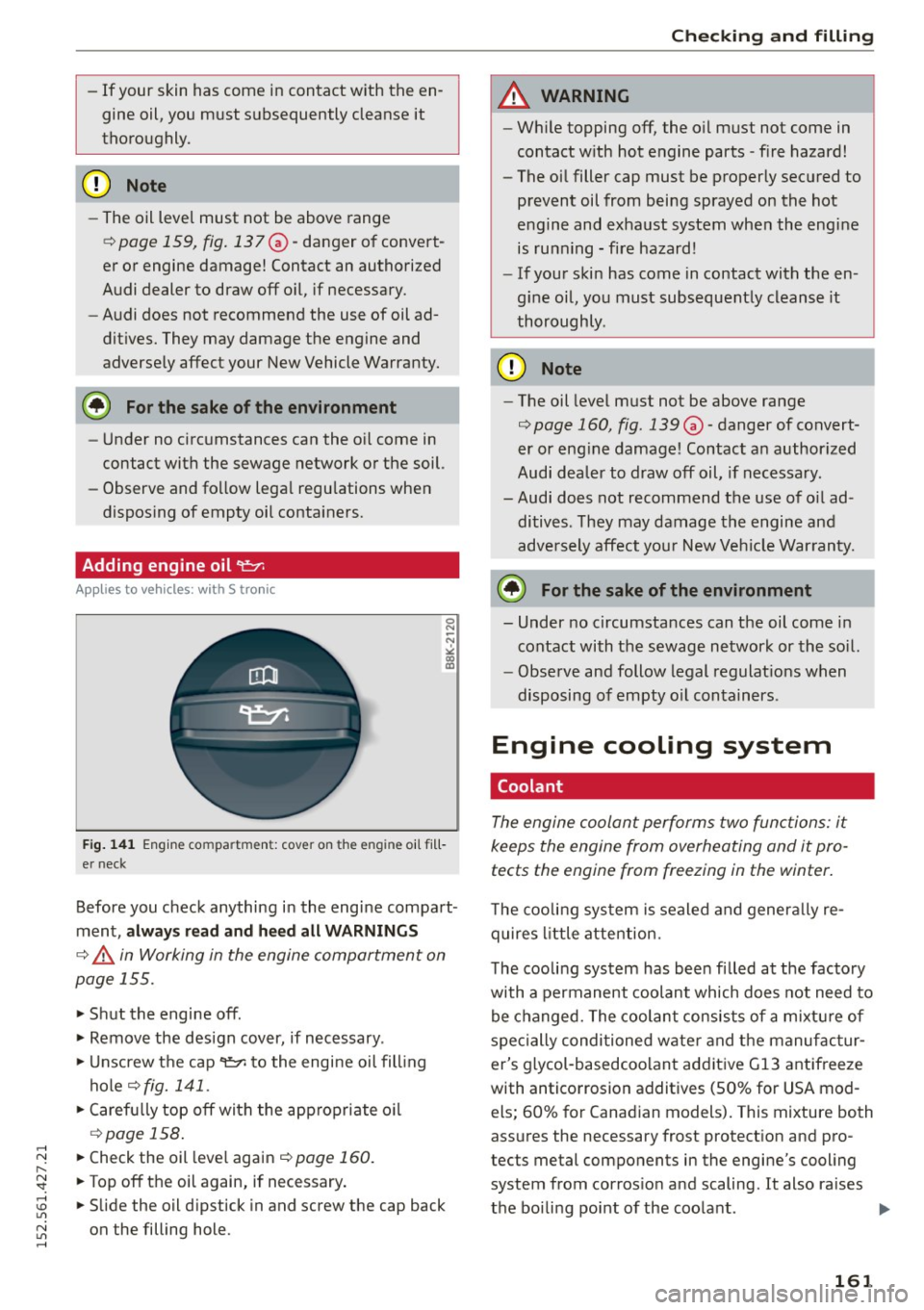
F ig . 141 Engin e co mp artm en t: cove r on t he engin e oil fi ll
er neck
Before you check anything in the engine compart
ment,
always read and heed all WARNINGS
¢.&. in Working in the engine compartment on
page 155.
.,. Shut the engine off .
.. Remove the design cover, if necessary .
.,. Unscrew the cap
'l=?1 to the engine oil fill ing
hole ¢
fig. 141 .
.. Carefully top off with the appropriate o il
¢page 158.
.. Check the oil level again ¢ page 160.
.. Top off the oil again, if necessary .
.. Slide the oil dipstick in and screw the cap back
on the filling hole.
Chec king and filling
A WARNING
- While topping off, the oil must not come in
contact with hot engine parts -fire hazard!
- The oil filler cap must be properly secured to
prevent oil from being sprayed on the hot
engine and exhaust system when the engine
is running -fire hazard!
- If your skin has come in contact with the en
g ine oil, you must subsequently cleanse it
thoroughly .
(D Note
-The oil level must not be above range
¢ page 160, fig . 139 0 -danger of convert
er or eng ine damage! Contact an author ized
Audi dea ler to draw off oil, if necessary.
- Audi does not recommend the use of oil ad
ditives . They may damage the engine and
adversely affect you r New Vehicle Warranty.
@ For the sake of the environment
- Under no circumstances can the oil come in
contact with the sewage network or the soil.
- Observe and follow legal regulations when
disposing of empty o il containers .
Engine cooling system
Coolant
The engine coolant performs two functions: it
keeps the engine from overheating and it pro
tects the engine from freezing in the winter.
T he coo ling system is sealed and genera lly re
quires little attention.
The cooling system has been filled at the factory
with a permanent coolant which does not need to
be changed. The coolant consists of a mixtu re of
specially conditioned wate r and the manufactur
er's glycol-basedcoolant additive Gl3 antifreeze
with anticorrosion additives (50% for USA mod els; 60% for Canadian models). This mixture both
assures the necessary frost protection and pro
tects metal components in the engine's cooling
system from corrosio n and scaling. It also ra ises
the boiling point of the coolant .
1111-
161
Page 165 of 232
..... N
r-N "': ..... \!) ..,.,
N ..,., .....
"' Press and ho ld the rear window switch too unti l
the convertible top moves into the service posi
t ion
r::!) fig. 142.
Opening th e cool ant e xp ansi on tank cov er
"' Stop the engine and allow it to coo l.
"' Switch the ignition off.
"' Carefu lly remove the bolts in the cover(!) using
a screwdriver and remove the cover. The cool
ant reservoir is located be low
c:> fig. 143 .
Check ing th e engine coolant l eve l
"' Place a rag or cloth on the cap of the coo lant
expansion tank and turn the cap
ca re full y to
the left (counter-clockwise)
c:> A .
"'Read the coo lant level inside the coolant expan
s ion tank
c:> fig . 143. With a co ld engine, it
must be above the "min" mark. W ith a hot en
gine, it can be a little above the ind icated
range .
To obtain an accurate read ing, the eng ine must
be switched off.
The expansion tank in your vehicle is equipped
with an electric coolant level sensor
r::!) page 14.
We still recommend you check the coolant level
from time to time .
Coolant lo ss
Coolant loss may indicate a leak in the cooling
system . In the event of coolant loss, the cooling
system should be inspected immediately by your
author iz ed Audi dealer. It is not enough merely
to add coolant.
In a
s e a led system, losses can occur only if the
boiling point of the coo lant is exceeded as a re
sult of overheat ing.
A WARNING
- The cooling system is under pressure. Do
not open the cap of the coolant expans ion
tank when the engine is hot. You risk being
sca lded.
-
- The coolant add itive, and therefore the cool
ant itself, is hazardous to health. Keep the
c oolant additive in the or igina l co ntainer out
of the re ach of children.
It is a poison haz
ard.
Ch eck ing and fillin g
(D Note
Do not add any type of radiator leak sea lant
to your vehicle's engine coolant . Add ing radia
tor repair fluid may adversely affect the func
tion and performance of your cooling system
and could result in damage not covered by
your New Veh icle Limited Warranty.
Adding coolant
Befo re you check a nyth ing in the eng ine compart
ment,
alwa ys read and he ed all WARNING S
r::!) A in Working in the engine compartment on
page 155.
"' Add coolant m ixed in the correct rat io
c:> page 161, Coolant.
"' Twist the cap on again tightly.
"'Tighten the cap(!) <::!)page 162, fig. 143 again .
Replacement engine coo lant must conform to ex
act specifications
c:> page 161, Coolant .
We recommend using only coolant add it ive Gl2+
+, G l3
or in an emergency Gl2 +. Do not use a
different additive. In an emergency use pla in wa
ter unt il you ca n get the correct add itive and can
restore the co rrect ratio . This should be done as
soon as possib le .
If you have los t a considerab le amount of cool
ant, then you shou ld add cold antifreeze and cold
water only when the engine is co ld .
Always use
new engine coo lant when refilling .
Do not fill coolant above the "max" mark. Excess
coolant will be forced out through the pressure
relief valve in the cap when the eng ine becomes
hot.
A WARNING
- The cooling system is under pressure and
can get very hot. Reduce the risk of scalding
from hot coolant by following these steps .
- Turn off the engine and allow it to cool
down .
- Protect your face, hands and arms from escaping fluid and steam by covering the
cap with a large, thick rag.
163