seat adjustment AUDI RS5 CABRIOLET 2013 User Guide
[x] Cancel search | Manufacturer: AUDI, Model Year: 2013, Model line: RS5 CABRIOLET, Model: AUDI RS5 CABRIOLET 2013Pages: 286, PDF Size: 71 MB
Page 168 of 286
166 Child Safety
belts, ¢page 137, Airbag system and
c:> page 158, Important things to know.
A WARNING
If exceptional circumstances require the
use of a forward-facing child restraint on
the front passenger's seat, the child's safe
ty and well-being require that the follow ing special precautions be taken :
- Make sure the forward -facing seat has
been designed and certified by its manu
facturer for use on a front seat with a
passenger front and side airbag.
-Always follow the manufacturer's in
structions provided with the child safety
seat or infant carrier.
- Always move the front passenger seat in
to the rearmost position of the passen
ger seat's fore and aft adjustment range,
and as far away from the airbag as possi
ble before installing the child restraint .
- Always make sure that nothing prevents
the front passenger's seat from being
moved to the rearmost position in its
fore and aft adjustment range.
- Always make sure the backrest is in an
upright position.
- Make sure that the
PASSENGER AIR BAG
OFF
light comes on and stays on all the
time whenever the ignition is switched on .
- If the light does not stay on, perform the
checks ¢
page 148, Monitoring the Ad ·
vanced Airbag System.
- Take the child restraint off the front pas
senger seat and install it properly at one
of the rear seat positions if the
PASSEN
GER AIR BAG OFF
light does not stay on
whenever the ignition is switched on .
Booster seats and safety belts
Properly used booster seats can help protect
children weighing between about 40 lbs . and
80 lbs . (18 kg and 36 kg) who are
less than 4
ft. 9 in. (57 inches/1.45 meters) tall.
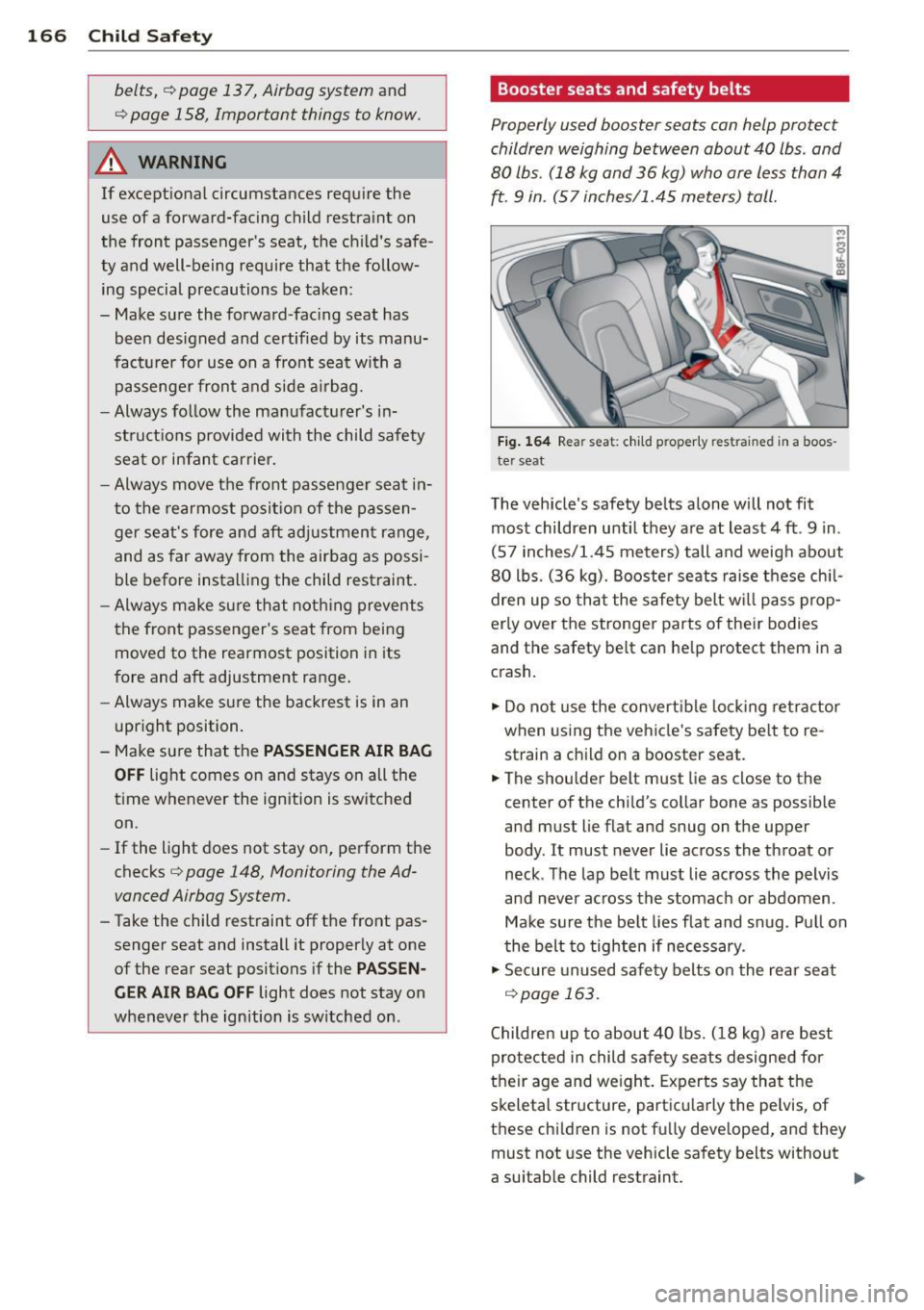
Fig. 164 Rea r seat : child p rop erly r estrained in a boo s
te r se at
The vehicle's safety belts alone will not fit
most children until they are at least 4
ft . 9 in .
(57 inches/1.45 meters) tall and weigh about
80 lbs.
(36 kg). Booster seats raise these chil
dren up so that the safety belt will pass prop
erly over the stronger parts of their bodies
and the safety belt can help protect them in a
crash.
.. Do not use the convertible locking retractor
when using the vehicle's safety belt to re strain a child on a booster seat.
.. The shoulder belt must lie as close to the
center of the child 's collar bone as possible
and mu st lie flat and snug on the upper
body.
It must never lie across the throat or
neck . The lap belt must lie across the pelvis
and never across the stomach or abdomen .
Make sure the belt lies flat and snug . Pull on
the belt to tighten if necessary .
.. Secure unused safety belts on the rear seat
c::>page 163.
Children up to about 40 lbs. (18 kg) are best
protected in child safety seats designed for
their age and weight. Experts say that the
skeletal structure, particularly the pelvis, of
these children is not fully developed, and they must not use the vehicle safety belts without
a suitable child res traint.
...
Page 171 of 286
child restraint on the front passenger's
seat in exceptional situations:
- Whenever a forward or rearward-facing
child restraint is installed on the front
passenger seat, the
PASSENGER AIR
BAG OFF
light must come on and stay on
whenever the ignition is switched on .
-If the PASSENGER AIR BAG OFF light
does not come on and stay on, perform
the checks described
~ page 148, Moni
toring the Advanced Airbag System .
- Take the child restraint off the front pas
senger seat and install it properly at one
of the rear seat positions if the
PASSEN·
GER AIR BAG OFF
light does not stay on
whenever the ignition is switched on.
- Improper installation of child restraints
can reduce their effectiveness or even
prevent them from providing any protec
tion.
- An improperly installed child restraint
can interfere with the airbag as it de
ploys and seriously injure or even kill the
<;hild.
- Always carefully follow the manufactur
er's instructions provided with the child
safety seat or carrier.
- Never place additional items on the seat
that can increase the total weight regis
tered by the weight-sensing mat and can cause injury in a crash.
_&. WARNING
Forward-facing child restraints:
- Always make sure the forward-facing
seat has been designed and certified by
its manufacturer for use on a front seat
with a passenger front and side airbag.
- Never put the forward-facing child re·
straint up, against or very near the in
strument panel.
- Always move the passenger seat into its
rearmost position in the seat's fore and
aft adjustment range, as far away from
the airbag as possible before installing
the forward-facing child restraint. The
Child Safety 169
backrest must be adjusted to an upright
position.
- Make sure that the
PASSENGER AIR BAG
OFF
light comes on and stays on all the
time whenever the ignition is switched
on .
_&. WARNING
"' Rearward-facing child restraints:
-A child in a rearward-facing child safety
seat installed on the front passenger
seat will be seriously injured and can be
killed if the front airbag inflates - even
with an Advanced Airbag System .
- The inflating airbag will hit the child
safety seat or infant carrier with great
force and will smash the child safety seat
and child against the backrest, center
armrest, door or roof.
-Always be especially careful if you must
install a rearward facing child safety seat
on the front passenger seat in exception
al circumstances.
-A tight tether strap on a rearward-facing
child restraint attached to the front pas
senger seat can put too much pressure
on the weight-mat in the seat and regis
ter a heavier weight in the Advanced Air bag System. The heavier weight regis
tered can make the system work as
though an adult were on the seat and de
ploy the Advanced Airbag when it must
be suppressed causing serious or even
fatal injury to the child.
- Make sure that the
PASSENGER AIR BAG
OFF
light comes on and stays on all the
time whenever the ignition is switched
on.
- If the PASSENGER AIR BAG OFF light
does not come on and stay on, immedi
ately install the rearward-facing child
safety seat in a rear seating position and
have the airbag system inspected by your
authorized Audi dealer. •
•
Page 220 of 286
218 Check ing and filling
Di sconnect ing the batt ery terminal s
Some vehicle functions (power window regu
l ators, for example) are lost if the battery ter
minals are disconnected . These functions have
to be re learned after the battery terminals are
connected again. To prevent this, the battery
should only be disconnected from the vehicle
electrical system when absolutely necessary
for repairs .
Vehicles not dri ven fo r lo ng period s
If you do not drive your vehicle over a period
of several days or weeks, electrical compo
nents are gradually cut back or switched off.
This reduces energy consumption and main
tains starting capab ility over a longer period
~ page 182.
Some of the conven ience functions may not
operate, such as the inter ior lights or the
power seat adjustment . The conven ience
functions will be ava ilable again when you
turn on the ignition and start the eng ine.
Winter operati on
During the winter months, battery capacity
tends to decrease as temperatures drop . This
is because more power is also consumed while
start ing, and the headlights, rear window de
fogger, etc., are used more often .
Avoid unnecessary power consumption, par
ticularly in c ity traffic or when traveling only
short d istances . Let you r authorized Audi
dealer check the capacity of the vehicle bat
tery before winte r sets in
~ page 219. A well
charged battery w ill not only prevent starting
prob lems when the weather is cold, but wi ll
a lso last longer .
(D Tips
If your vehicle is left standing for severa l
weeks at extremely low temperat ures, the
veh icle battery should be removed and
stored where it will not freeze. This w ill
prevent it from being damaged and hav ing
to be replaced.
Working on the battery
Be especially careful when working on or near
the battery.
The battery is located in the luggage compart ment under the floor. Before you check any
th ing in the luggage compartment,
read and
h ee d all WARNINGS
~ ,&,
Always heed the safet y warnings , when work
ing on the vehicle battery or the vehicle e lec
trical system to prevent injury.
The following WARNINGS are ve ry
i mportant wh en wor king on the battery :
Alway s heed the following WARNING S YM
BOLS and safety prec autions when working
on the battery .
® Always wear eye protection .
b.. Battery acid contains sulfuric acid . Al
~ ways wear gloves and e ye protect ion.
-No
~ -sparks
-flames
--
-smoking.
A When a battery i s charged , it produ ce s
~ hy drogen gas which is e xplosi ve and
could cau se pe rsonal injur y.
--Always keep the battery well out of
® reach of children .
_& WARNING
=
Whenever working on the battery or on
the electrical system, there is the risk of i njury, accident and even fire . Read and
heed the following WARNINGS:
- Always wear eye protection. Do not let
battery acid or any lead particles get on
your skin or clothing. Shield your eyes. Exp losive gases can cause blindness or
other injury . -
-Battery acid conta ins sulfuric acid. Sulfu
ric acid can cause blindness and severe
burns.
Page 278 of 286
276 Index
N
Natural leather ................ .... .
New tires and wheels
NH TSA
Contact ing
Number of seats
.. .. ..... .. .. .. .. .. .
0
198
233
126
129
Occupa nt seating posit ions .. .. .. .. .. . 119
Octane rating ............. .. .. .. ... 202
Odometer · ·. · · · .............. .... .. 12
OFF (automatic climate control) . . . . . . . . 70
Oi l
refertoEngineoil ........ .. .. 209,212
Oi l consumption ............ ... .... . 212
On-Board Diagnostic System (OBD) Data Link Connector (DLC) ...... .. .. .. 29
Malfunction Indicator Lamp (M IL) . . . . . 29
Open door or front lid warning . . . . . . . . . 24
Opening Power windows . . . . . . . . . . . . . . . . . . . . 39
Opening/closing at the lock cylinde r ........ .... .... .. 36
by remote contro l . . . . . . . . . . . . . . . . . . 34
with the central locking switch .... .. .. 35
with the convenience key ............. 35
Operate your vehicle econom ica lly and
minim ize pollution ......... .. .. .. .. . 186
Optional equipment Marked with an asterisk . . . . . . . . . . . . . . . 6
Outside mirrors
refer to E xter ior mirrors . . . . . . . . . . . . . 55
Outside temperature display ... .. .. .. .. 24
Owner's manual How the Owner's Manual is organized . . . 6
p
Paint
Touch-up . . . . . . . . . . . . . . . . . . . . . . . . . 194
Paint No. · · · . ................ ..... . 261
Park assist . ............... .. ...... . 107
Parking . .. .. ..................... .. 80
S tronic transmission ...... .. .. .... .. 87
Valet parking .. .... ...... .. .. .. .. .. 40 Parking brake
..... ................ .. 79
also refer to Electromechanical parking
brake · · ........................... 79
Parking system .. .. ............. .. .. 107
Cleaning sensors/camera ....... .... 193
Parking system plus ................ 107
Rear, with rear view camera ....... ... 108
Parking system (rear, with rear view cam-
era)
Parking model ............... .. .. 111
Parking mode 2 . ................. . 112
Safety precautions ................ . 109
Switching on/off . . . . . . . . . . . . . . . . . . 110
Switching rearviewcamera on/off .. .. 113
Parts replacement .................. 266
PASSENGER AIR BAG OFF light ........ 148
Passive safety system ................ 118
Pedals · · · · · · · · · · · · · · · · ............ 123
Physical principles of a frontal collision . 130
Polishing .......................... 193
Pollutant filter (automat ic AC system) .. . 69
Power seat adjustment . . . . . . . . . . . . . . . . . . . . 62
Power locking system ................. 31
Emergency locking ................ .. 36
Power windows .. ............. ..... 40
Rear lid
· · · · · · · · · · · · · · · · · · · · .. .. .. . 37
Se lective unlock feature
........ .. .. . 36
Settings .. ....................... . 36
Power steering
refer to Electro-mechanical power as-
sist .. .... .... .. ................. 180
Power top .. .. .. .. ............. .. .. . 42
Care and cleaning .............. .... 192
Closing ........................... 44
Convenience opening/clos ing ..... ... . 44
Emergency operation .............. .. 47
Error message ... ............. .... . 43
General information ........... .. .. . 42
Indicator light ... ....... ...... .. .. . 43
Malfunction · · · · · · · · · · · · ... ...... .. 43
Open ing ...... .. .......... ...... .. 44
Var iable power top storage bay ... .. .. . 45
Wind deflector . .. ............. .. .. . 46
Power window Convenience opening/clos ing ....... .. 40
Page 280 of 286

278 Index
Safety belt warning light
Safety compliance sticker ....... .. .. .
Safety equipment .......... .. .. .. .. .
Safety features for occupant restraint and 129
261
118
protection ... ................ ..... . 118
Safety guidelines Seats .. ... ................... ... .. 61
Safety instructions
Engine compartment ............... 207
for using child safety seats ..... .. ... 161
for using safety belts ...... .. .. .. .. . 132
Monitoring the Advanced Airbag Sys-
tem . .. .. .. ............. .. .. .. .. . 150
Seat adjustment
Head restraints ............... .... 121
Seat belts
refer to Safety belts ........ ... .... . 129
Seat heating . . . . . . . . . . . . . . . . . . . . . . . . 71
Upper cabin heating . . . . . . . . . . . . . . . . . 72
Seating capacity ............... .. ... 129
Seating position Driver . .. ................. .. .... . 119
Front passenger .......... .. .. .... . 120
H ow to adjust the front seats ... ..... 120
Incorrect seat position . . . . . . . . . . . . . . 122
Occupants .. ... .. ..... ......... .. . 119
Rear passengers ................... 121
Seat memory . . . . . . . . . . . . . . . . . . . . . . . 64
Seats Adjusting .. ................ ..... .. 62
Adjusting in the MMI ....... ..... .. .. 63
Convenience sid e view ....... .. .... .. 63
Driver's seat ....................... 61
Folding .. ................. .. .... .. 67
Front passenger's seat . . . . . . . . . . . . . . . 62
Head restraints . . . . . . . . . . . . . . . . . . . . 64
Number of seats . . . . . . . . . . . . . . . . . . 129
Power easy entry function . . . . . . . . . . . . 63
Safety guide lines ................... 61
Seat symmetry . . . . . . . . . . . . . . . . . . . . . 63
Seat ventilation . . . . . . . . . . . . . . . . . . . . . 71
Seat (upper cabin heating) . . . . . . . . . . . . . 72
Selective unlock feature ....... .. .. .. .. 36
Selector lever
Emergency release . . . . . . . . . . . . . . . . . . 91
S tronic transmission ...... .. .. .. .. . . 85
Selector lever display . . . . . . . . . . . . . . . . . 85 Selector lever
emergency release .... .. . 91
Service and disposal Safety belt pretensioner ........ .... 136
Service interval display . . . . . . . . . . . . . . . . 2 7
Service position
refer to Replacing wiper blades ... ... . 58
SET button ........ ............... .. 11
Side airbags Description ...... ............. .... 155
How they work . .. ................ . 156
side assist Adjusting the brightness ............ 103
Sensor range ..................... 101
Side assist
Activating and deactivating ....... ... 103
Cleaning sensors .................. 193
Description .... .. ............. .... 101
S ide marker lights . . . . . . . . . . . . . . . . . . . 52
Ski sack ............................ 68
Snow chains .... .. ............. .... 238
Soft top Care and cleaning . ............. .... 192
Sound system display . . . . . . . . . . . . . . . . . 24
Sources of information about child re-
straints and their use ................ 175
Speedometer . . . . . . . . . . . . . . . . . . . . . . . 12
Speed rating letter code .......... .... 234
Speed warning system ............ ... . 81
Sport differential .................. . 104
Indicator lamp . .. ................ .. 22
Sport mode (ESC) . . . . . . . . . . . . . . . . . . . 178
START ENG INE STOP button (conven ience
k ey) ....... .... .. ................ .. 78
START ENGINE STOP button (Convenience
key) . .. ... ... .. .. .... ...... ...... .. 77
Starting from rest .. ... .......... .. .. . 80
Starting the engine . . . . . . . . . . . . . . 74 , 77
Steering Locking the steering ................ 74
also refer to Electro-mecha nical power
ass ist .. .. .. .. .. ............. .. .. 180
Steering wheel Adjusting steering column ........... 74
Indicator light . . . . . . . . . . . . . . . . 18, 180
Steps for determining correct load limit . 230
Stopping the eng ine . . . . . . . . . . . . . . 76, 78