fuel AUDI RS5 CABRIOLET 2013 Owner's Manual
[x] Cancel search | Manufacturer: AUDI, Model Year: 2013, Model line: RS5 CABRIOLET, Model: AUDI RS5 CABRIOLET 2013Pages: 286, PDF Size: 71 MB
Page 206 of 286
204 Fuel suppl y and filli ng your fu el t ank
transport fue l to use for your lawn mower,
snow blower, etc., be very careful and al
ways observe local and state laws regard
ing the use, transportat ion and storage of
such fuel containers . Make certain the con
tainer meets industry standards (ANSI/
AS TM F852 -86) .
(D Note
Never drive your vehicle until the fuel tank
is completely empty. The irregular supply
of fuel can cause misfiring . Gasoline could
e nte r the exhaust system and damage t he
catalyt ic converter.
Refuelling
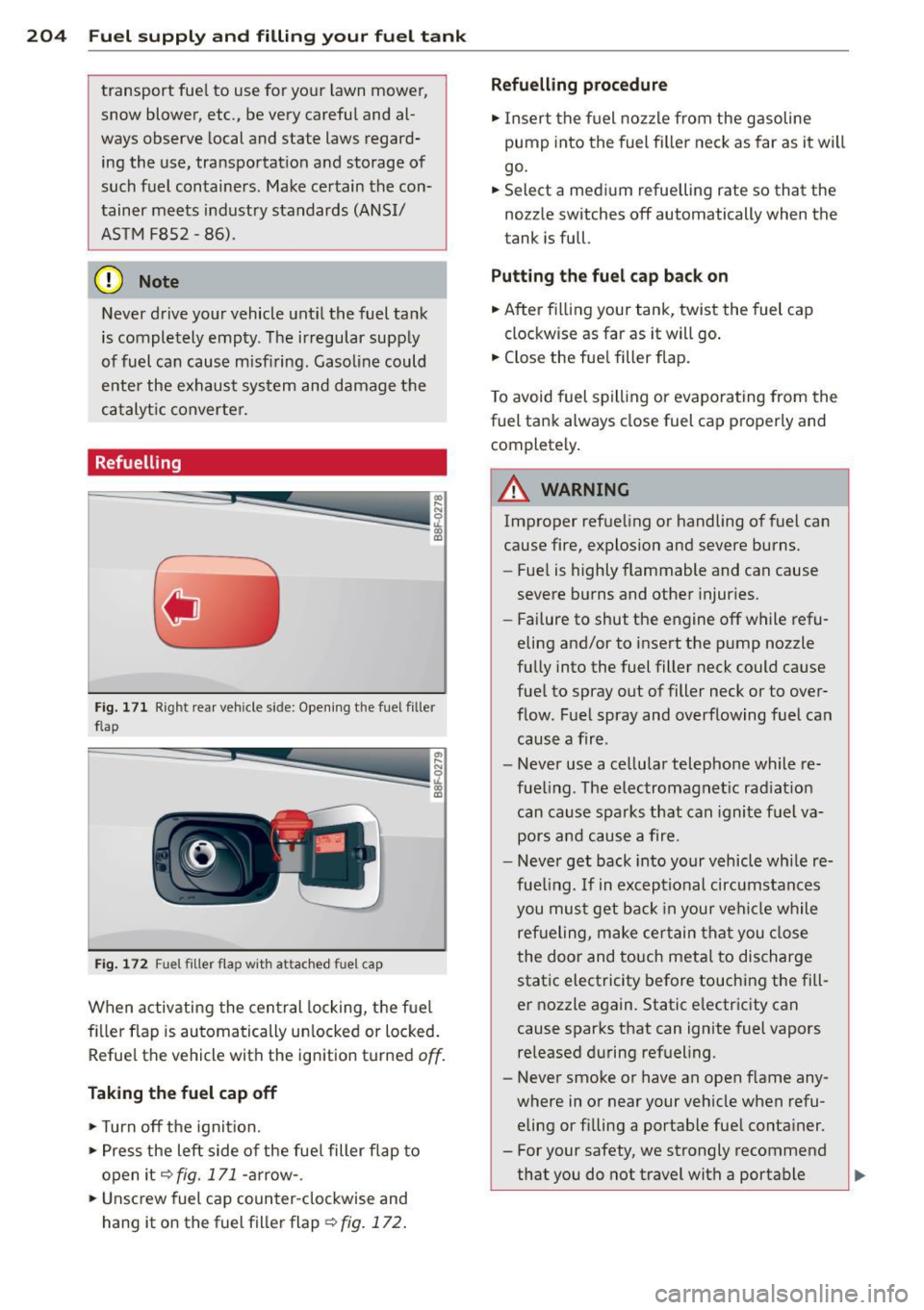
Fig. 171 Rig ht rea r veh icle s ide: Ope ning the fuel fille r
f lap
Fi g. 1 72 Fuel filler fla p with attached fuel c ap
When activating the central locking, the fuel
fi ller flap is automatically un locked or locked.
Refue l the vehicle with the ignition turned
off .
Taking th e fu el cap off
,.. Turn off the ignit ion.
,.. Press the left side of the fue l filler flap to
open it q fig .171-a rrow -.
"" Unsc rew fuel cap counter -clockwise and
hang it on the fuel filler flap
~ fig. 172 .
Refuell ing proc edur e
,.. Insert the fuel nozzle from the gasoline
pump into the fuel fille r neck as far as it will
go .
,.. Sele ct a med ium r efuelling rate so that the
no zz le switches off automatically when the
tank i s full.
Putting the fu el cap back on
,.. After fi lling your tank, twist the fuel cap
clockwise as far as it will go .
,.. Close the fue l fill er flap.
T o avoid fuel spilling or evaporating from the
fuel tank always close fuel cap properly and complete ly .
A WARNING
-
Improper refue ling or handling of fuel can
cause fire, explosion and severe burns.
- Fue l is highly flammable and can cause
severe burns and other injur ies.
- Failure to shut the engine off while refu
eling and/or to insert the pump nozzle
fully into the fuel filler neck could cause
fuel to spray out of filler neck or to over
flow . Fuel spray and overflowing fuel can
cause a fire .
- Never use a cellular telephone while re
fueling . The electromagnet ic rad iat ion
can cause sparks that can ignite fuel va
pors and cause a fire .
- Never get back into your vehicle white re
fueling .
If in exceptional circumstances
you mu st get back in your vehicle while
ref ueling, make ce rtain that you close
the door and touch metal to discharge static electricity before touching the fill
er nozzle again. Static e lectricity can
cause sparks that can ignite fuel vapors
released during ref ueling .
- Never smoke or have an open f lame any
where in or near your veh icle when refu
eling or filling a portab le fuel conta iner.
- For your safety, we strongly recommend
that you do not travel with a portable
Page 207 of 286

fuel container in your vehicle. The con
tainer, full or empty may leak and co uld
cause a fire, especially in a crash.
- If, under exceptional circumstances, yo u
must transport a portable fuel container,
please observe the following:
- Never fi ll a po rtable fue l container
while it is anywhe re in or on the vehicle
(for examp le, in the luggage compar t
ment, or on the tr unk). Static electric i
ty can bui ld up while fi lling and can ig
n ite fue l vapors causing a fire .
- Always p lace a portable fuel container
on the gro und before filling.
- Always keep the fi ller nozzle comp lete
ly inside the po rtable conta iner before
and during filling.
- If filling a portable container made of
metal, the filler nozz le must always be
in contact with the container. Th is w ill
he lp prevent static electricity from dis
charging and cause a fi re .
- Never sp ill fuel inside the vehicle or
luggage compartment. Fue l vapors are
h ighly f lammable .
- Always observe local and state/provin
cial laws regard ing the use, storage
and tra nsporta tion of fuel co ntainers .
- Make certai n the fuel container meets
industry standards (ANSI/ ASTM
F 8 52 -86) .
(D Note
If any f uel has spilled onto t he car, it
should be removed immediate ly to prevent
damage to the paint.
~ For the sake of the environment
As soon as the correctly operated nozzle sw itches off automatically fo r the fi rst
time, the tank is full. Do not try to add more fue l because fue l may spill out . In
add it io n, th e expans io n sp ace in the fuel
t ank will be fi lled -cau sin g the fue l to
over flow whe n it be come s w arm a nd pol
lu te the env iro nment.
Fu el suppl y and filli ng your fuel t ank 205
@ Tips
- Ru nning your eng ine whi le refue lli ng
may cause vapors to escape or even
cause fuel to sp ill out of the tank. T his
would then shut off the fuel nozzle be
f o re the ta nk is f ull.
- Do not refuel you r vehicle with the ign i
tion turned o n. The fuel gauge may oth
erwise not indicate the correct f uel level
after refuelling .
- The fue l filler flap of yo ur vehicle is not
locked when you lock t he ve hicle from
t he insid e.
Unlocking the fuel filler flap
by hand
You can open the fuel filler flap by hand if the
power locking system should fail .
Fig. 173 Lug gage compa rtm ent: ope ning th e side trim
Fig .1 74 Luggage co mpa rtme nt: Eme rgency ope ning
of fue l fil le r flap
The emergency opening mechanism is located
behind the right side trim panel in the lug
gage compartment .
Opening the side trim .,. Insert a tool such as a screwdriver
¢
page 243 or the emergency key into the
r ight side of the upper gap¢
fig. 173. .,.
Page 208 of 286

206 Fuel supply and filling your fuel tank
• Pry upward to re lease the trim .
Fuel filler door emergency release
.. Loos en the strap from its bracket and pull
on it~
fig. 174. You can now open t he fue l
filler flap as usu al¢
page 204.
Page 210 of 286

208 Check ing and filling
- To reduce the r isk of being burned, never
open the hood if you see or hear steam
or coolant escaping from the engine
compartment . Wait until no steam or
coolant can be seen or heard before care
fully opening the hood.
- Keep children away from the engine com
partment.
- Never spill flu ids on hot engine compo
nents . They can cause a fire.
- Never touch the radiator fan. The auxili
ary electr ic fan is temperature controlled
and can switch on suddenly.
- Never open the coolant reservoir cap
when the eng ine is still warm . The cool
ant system is pressur ized and hot coo l
ant could spray out.
- Protect your face, hands and arm from
steam o r hot eng ine coolant by placing a
thi ck rag over the cap when you open the
coolant reservoir .
- Do not remove the engine cover under
any c ircumstances. Th is increases the
risk of burns.
- If wo rk on the fuel system or the electri
c al system is necessa ry:
- Always disconnect the battery.
- Never smoke or work near heaters or
open flames . Fluids in the engine com
pa rtment cou ld start a fire.
- Keep an approved fire extinguisher im
mediately avai lable.
- To avoid electrical s hock and persona l in
jury while the engine is running or being
started, never touch:
- Ignition cables
- Othe r components of the high voltage
e lectronic ignition system.
- If you must perform a check or repa ir
with the engine running:
- First, fully apply the parking bra ke,
move se lector lever o f automat ic trans
missio n to "P" (Park). -
Always use extreme caution to p revent
clothing, jewel ry, or long hair from get
ting caught in the radiator fan, V-belts
or other moving parts, or from contact ing hot parts. Tie back hair before
starting, and do not wea r clothing that
will hang o r droop into t he engine.
- Mi nimize exposure to em ission and
chemical hazards~ &.
A WARNING
Ca lifo rnia Proposition 65 Wa rning:
- Eng ine exhaust, some of its const ituents,
and certain vehicle components contain
or emit chemicals know n to the State of
California to cause cancer and birt h de
fects and reproduc tive harm. In addition,
certain fl uids contained in vehicles and
certain products of component wear con
tain or emit chemicals known to the
State of California to cause cancer and b irth defects or other reproductive harm.
- Battery posts, terminals and related ac cessories conta in lead and lead com ·
pounds, chemicals known to the State of
California to cause cancer and reproduc
tive harms. Wash hands afte r handling .
(I) Note
When adding f lu ids, always make sure that
they are poured i nto the proper conta iner
or filler opening, otherwise serious dam
age to vehicle systems w ill occur.
@) For the sake of the environment
To detect leaks in time, inspect the vehicle
floor pan from underneath regularly. If
you see spots from oil or other veh icle flu
i ds, have yo ur vehicle inspected by a n au
thor ized Audi dea ler.
Page 213 of 286
temperatures stay below freezing point for l ong periods.
Detergent add itives in the o il w il l make fresh
oil look dark after the eng ine has been run
ning fo r a short time . This is norma l and is not
a reason to change the oi l more often than
recommended.
D am ag e or m alfun ction s due to lack of
ma intenanc e
It is essential that you change your oil at the
r ecommended inte rva ls using only engine o il
t hat complies with A udi oi l standard
VW 502 00 . Your Limited New Vehicle War
ranty does not cover damage or malfunctions
due to fa ilure to fo llow recommended mainte
nance and use requ irements as set forth in
the Audi Owner's Manual and Warranty
&
Maintenance book let . Your dealer will have to
deny warranty coverage u nless you present to
the dea ler p roof in the fo rm of Serv ice or Re
pa ir Orde rs that all s chedu led maintenance
was pe rformed in a t imely manner .
Engine oil consumption
The engine in your vehicle depends on an ade
quate amount of oil to lubricate and cool all
of its moving parts.
In o rder to provide effective lubrication and
cool ing of internal engine components, a ll in
ternal combustion eng ines consume a certa in
amo unt of o il. Oil consumption varies from
engine to engine and may change significantly
over the life of the engine. Typ ica lly, engines
with a specified break-in period (see
¢
page 184) consume more oil during the
break-in per iod than they consume after oil
consumption has stabilized .
Under normal conditions, the rate of oil con
sumpt ion depends on the quality and viscosity
of the oil, the RPM (revo lutions per m inute) at
which the engine is operated, the ambient
temperature and road condit ions. Furthe r fac
tors are the amount of o il d ilution from wate r
condensation or fuel residue and the ox ida
tion level of the oil. As any engine is s ubje ct to
Checkin g and fillin g 211
wear as mi leage builds up, the oil consump
tion may increase over time until replacement
of worn components may become necessary.
Wi th a ll these variab les coming into p lay, no
standard rate of oil consumpt ion can be es
tablished or specified. There is no alternative
to regular and frequent check ing of the o il lev
el, see
Note .
If the yellow engine oil leve l warning symbo l
1\1 in the instrument cluster lights up , you
shou ld check the oil leve l as soon as possib le
¢
page 212. Top off the oil at your earliest
convenience
¢ page 212.
A WARNING
Before you check anythi ng i n the engine
compartment, always read a nd heed all
WARNINGS¢ .&.
in Working in the engine
c ompartment on page 207.
(D Note
Driving w ith an insufficient o il level is like
ly to cause severe damage to the engine .
(D Tips
- The oil pressure warning display. is
not an indi cator of the oil le vel. Do not
rely on it . Instead, check the oil level in
your engine at regu lar intervals, pref
erably ea ch time you r efuel, and alway s
before going on a long trip .
-If you have the impression you r engi ne
c ons umes ex cess ive amoun ts of o il, we
recommend that you consul t an a uthor
ized Aud i dea ler to have the cause of
your concern properly diagnosed. Keep in mind that the accurate measurement of
oil consumption requ ires great care and
may take some t ime. An authorized Aud i
dealer has instructions about how to
measu re oil consumption accurately.
-
•
•
Page 225 of 286
-Never mount used tires on yo ur vehicle if
yo u are not sure of their "previous histo
ry." Old used tires may have been dam
aged even though the damage cannot be
seen that can lead to sudden tire failure
and loss of vehicle control.
- If you notice unusual vibration or if the
vehicle pulls to one side when d riving, al
ways stop as soon as it is safe to do so
and check the wheels and tires for dam
age .
(D Note
Please note that summe r and wi nte r tires
are designed for the cond itions that are
Glossary of tire and loading terminology
Accessory weight means the comb ined weight (in excess of
those sta ndard items which may be rep laced)
of au toma tic transmission, power steer ing ,
power brakes, power windows, power seats,
radio, and heater, to the extent that these
items are availab le as factory-installed equip
ment (whether installed or not) .
Aspect ratio
means the rat io o f the height to the w idth of
the tire in percent . Numbers of 55 or lower in
dicate a low sidewall for improved steering re
sponse and better overa ll handling on dry
pavement .
Bead
means the part of the t ire t hat is made o f
steel wires, wrapped or reinforced by ply cords
and that is shaped to fit the r im.
Bead separation
means a b reakdown of the bond between
components in the bead .
Cord means the strands forming the plies in the
tire.
Tire s an d wheel s 223
typica l in those seasons . Aud i recommends
using winter tires during the winter
months . Low temperatures signif icant ly
dec rease the e lasticity of summer t ires,
which affects tract ion and brak ing ability.
If summer t ires are used i n very co ld tem
peratures, cracks ca n form o n the tread
bars , res ulting in perma nen t tire damage
that can cause loud driving noise and un
bala nced ti re s. Audi i s not respon sible for
th is type of damage .
Cold tire inflation pressure
means the t ire p ress ure recommended by t he
vehicle manufacture r fo r a tire o f a des ignated
s ize t hat has not bee n driven for more than a
coup le o f miles (k ilometers) at low speeds in
the three hour period before the tire press ure
is m easured or adjusted.
Curb weight
me ans the we ight of a motor ve hicle with
st andard equipmen t incl ud ing the max imum
capacity of fuel, oi l, and coolant, air condi
tioning and additional weig ht of optiona l
equipment.
Extra load tire
means a t ire design to oper ate a t higher load s
and at higher inflation pressures than the cor
responding standa rd tire . Extra load tires may
be identified as "XL", "x l", "EXTRA LOAD", o r
"RF" on the sidewal l.
Gross Axle Weight Rating ("GAWR")
me ans the load-ca rry ing capac ity of a single
axle system , measured at the tire -ground in
te rfaces.
Gross Vehicle Weight Rating ( "GVWR ")
mea ns the maximum total loaded we ight of
the ve hicl e. .,..
•
•
Page 242 of 286

24 0 T ire s and wheel s
- Drive carefu lly on roads with potholes, deep
gullies or ridges. The impact from driving
through or over such obstacles can damage
your tires. Impact with a curb may also
cause damage to your tires.
- After any impact, immediately inspect your tires or have them inspected by the neares t
authorized Aud i dealer. Replace a damaged
t ire as soon as possible .
- Inspect your t ires every 2 ,000 miles (3,000
km) for damage and wear . Damage is not al
ways easy to see . Damage can lead to loss of
air and underinflation, wh ich could eventu
ally cause t ire failu re. If you be lieve that a
t ire may have been damaged, replace the
t ire as soon as poss ible.
- T hese tires may wea r more quick ly than oth
ers.
- Please also remember that, whi le these t ires
deliver respons ive handling, they may ride
less comfortably and make mo re no ise than
othe r choices.
Reduced perf ormance in winter /cold
sea son condit ion s
All ti res are des igned for certa in pu rposes.
The low aspect ratio, u ltra high performance
tires originally installed on your vehicle are in
tended for max imum dry and wet road per
formance and handling . They are not suitable
for cold, snowy or icy weather condit ions. If
you dr ive under those circumstances, you
should equip your vehicle with all-season or
winter tires, which offer better traction under
those cond it ions . We suggest you use the rec
ommended snow or all-season tires specified
for your vehicle, or their equ ivalent .
Refe r to
<=> page 23 7 for more deta iled infor
ma tion regarding w inter tires.
Tire pressure
monitoring system
(l) General notes
App lies to vehicles: with tire pressure monitoring system
Each tire shou ld be checked monthly when
cold and inflated to the inflat ion p ressu re rec- ommended by the vehicle manufacturer on
the ve hicle p lacard or tire inflation press ure
label. (If yo ur vehicle has tires of a d ifferent
s iz e than the si ze indicated on the veh icle
placard or tire inflation pressure label, you
should determine the proper tire inflation pressure for those tires) .
As an added safety feature, your veh icle has
been equipped with a tire pressure monitoring
system (TPMS) that illum inates a low tire
pressure telltale when one or more of you r
tires is significantly under-inflated . Acco rding
ly, when the low tire pressure telltale illumi
nates, yo u shou ld stop and check you r tires as
soon as possib le, and inflate them to the
proper pressure . Driving on a signi ficantly un
der-inflated tire causes the tire to overheat
and can lead to tire fa ilure. Under-inflation al
so reduces fuel effic iency and tire tread life,
and may affect the vehicle's handling and
stopp ing ability.
P lease note that the TPMS is not a substitute
for proper tire ma intenance, and it is the driv
er's responsibility to maintain correct tire
pressure, even if under-inflation has not
r eached the level to tr igger illuminat ion of the
T PMS low tire pressu re tellta le.
Your vehicle has also been equipped with a
TPMS ma lfunction indicator to ind icate when
the system is not operating prope rly. The
T PMS ma lfunction ind icator is comb ined w ith
the low t ire pressure telltale . Whe n the sys
tem detects a malfunc tion , the telltale will
flash fo r approxima tely one min ute and then
remain continuously i lluminated. This se
quence wi ll continue upon subsequent vehicle
start-ups as long as the malfunct ion exists .
When the malfunction indicato r is illum inat
ed , the system may not be ab le to detect or
signal low tire pressure as intended . TPMS
malfunctions may occur for a var iety of rea
sons, including the installation of replace
ment or alternate tires or wheels on the vehi
cle that prevent the TPMS from functioning
properly . Always check the TPMS malfunction
te lltale after rep lacing one or more tires o r
whee ls on your vehicle to ens ure that the
Page 254 of 286

252 Fuses a nd bulb s
No.
5 Sound actuator/exhaust
sound tun
ing
6 Headlight range control sys-
tern/cornering light
7 Headlight (cornering light)
Control modules (electro
-
mechanical parking brake,
8 shock absorber, quattro
I
sport, trailer hitch), DCDC
converter
9 Adaptive cru ise control
10 Shift gate
11 Side ass ist
12 Headlight range control,
parking system
13 Airbag
14 Rear wiper (allroad)
15 Auxi
liary fuse (instrument
panel)
16 Auxiliary fuse terminal 15
(engine area)
Fu
se pa nel@ (b ro w n)
2 Brake light sensor
3 Fuel pump
4
5 Left seat heating with/with-
out seat vent
ilat ion
6 E5C
7 Horn
-Front left door (window reg·
8 ulator, central locking, mir-
ror, switch, lighting)
9 Wiper moto r
1 0 ESC
Two-door models: rear left
window regu lator, Fo ur-door
11 mode
ls: rear left door (win-
dow regu lator, central lock-
ing, switch, lighting)
12 Rain and light sensor
Fu se panel © (red)
3 Lumbar support
Amps
5/ 15
5/7,5 7,5
5
5
5
5
5
5
15
10
40
5
25
5
15/30
5
15
30
30
25
30
5
10
No . Consumer
4 Dynamic steering
6
7
8
9
Interior lighting (Cabriolet)
Windshield washer system ,
headlight washer system
Vehicle electrical system
control module 1
Vehicle electrical system
control module 1 Left rear window regulator
motor (Cabriolet)/sunroof
10 Vehicle e
lectr ical system
con trol module 1
11 Right rear window regulator
(Cabriolet)/sun shade motor
12 Anti-theft alarm warning
system
Right cockpit fuse assignment
Amps
35
5
35
20
30
7,5/20
30
7,5/20
5
Fig. 202 R ight cockpi t: fuse pane l wit h plast ic cl ip
No. Con sumer Amps
F u se panel @ (black )
5 Steering column switch
5
module
7 Term
inal 15 diagnos tic con-
nector 5
•
....
Page 263 of 286

General information Explanation of
technical data
Som e of t he technical data listed in this man
ual requires further explanation .
The technical data for your vehicle is listed in
the charts starting on
Q page 263. This sec
tion provides general information, notes and
r estr ictions wh ich app ly to this data.
Vehicle identification
The key data is given on the vehicle identifi ca
tion number ( VIN) plate and the vehicle data
sti cker .
Fig. 212 Veh icle Ident ificat ion Num ber (VlN) p la te: lo
cation o n drive r"s side dash pa nel
Fi g. 2 13 The ve hicle ident ification label -in side the
l u ggage compartme nt
The Vehicle Identification Number (VlN)
is located on the d river's side so tha t it is v is i
b le from the outside throug h the windshield
Q fig . 212 . You can also d isplay the Vehicle
Identification N umber of your vehicle in the
radio or in the MM!*. Select: ICAR !function
button
> Vehicle ID number (VIN) or select :
I CA R
I function butto n > Car systems* control
button
> Servicing & checks > VIN number .
General inform ation 261
The vehicle identification label
is lo cated in the l uggage comp artment near
the battery.
T he label
~ fig. 213 shows th e fo llow ing vehi
cl e d ata :
(D Product ion cont ro l No .
@ Vehicle identific ation No.
@ Type code number
© Type designat ion/e ngine o utput in K ilo-
wat ts
® Engine and transm ission code letter
® Pa int No./lnterior
0 Option al eq uipmen t No.'s
Vehicle data 2 to 7 are a lso fo und in your War
ranty
& Mai nte nance bookle t.
The safety compliance sticker
is your assurance that your new vehicle com
plies wi th a ll applicable Fede ral Motor Vehicle
Safety S tandards which were in effect at the
tim e the ve hicle was manufactur ed . You ca n
find this sticke r o n the left doo r jamb.
It
sh ows the m onth and ye ar of pro duction and
t h e ve hicl e ident ifi cat io n number of yo ur vehi
cle (perfora tion) as well as the G ross Vehicle
Weight Rating (GVW R) and the Gross Axle
Weight Rating (GAWR) .
The high voltage warning label
is lo cated on the l ock ca rrie r.
The spark ignition system complies with
the Canadian standard ICES-002.
Weights
Gross Vehicle Weight Rating
T he Gro ss Vehicle Weigh t Rat ing (GVWR), and
the Gross Axle We igh t Ra tin g (GAWR) for
fron t and rear are listed on a sticker on the
l eft door jamb .
T he Gro ss Vehicle Weigh t Rat ing incl udes the
weig ht o f the bas ic vehicle plus f ull fuel t ank,
oi l and coo lant, p lus maximum load, which in
cludes passen ger we ight (150 lbs./68 kg per ..,.
Page 265 of 286
Data
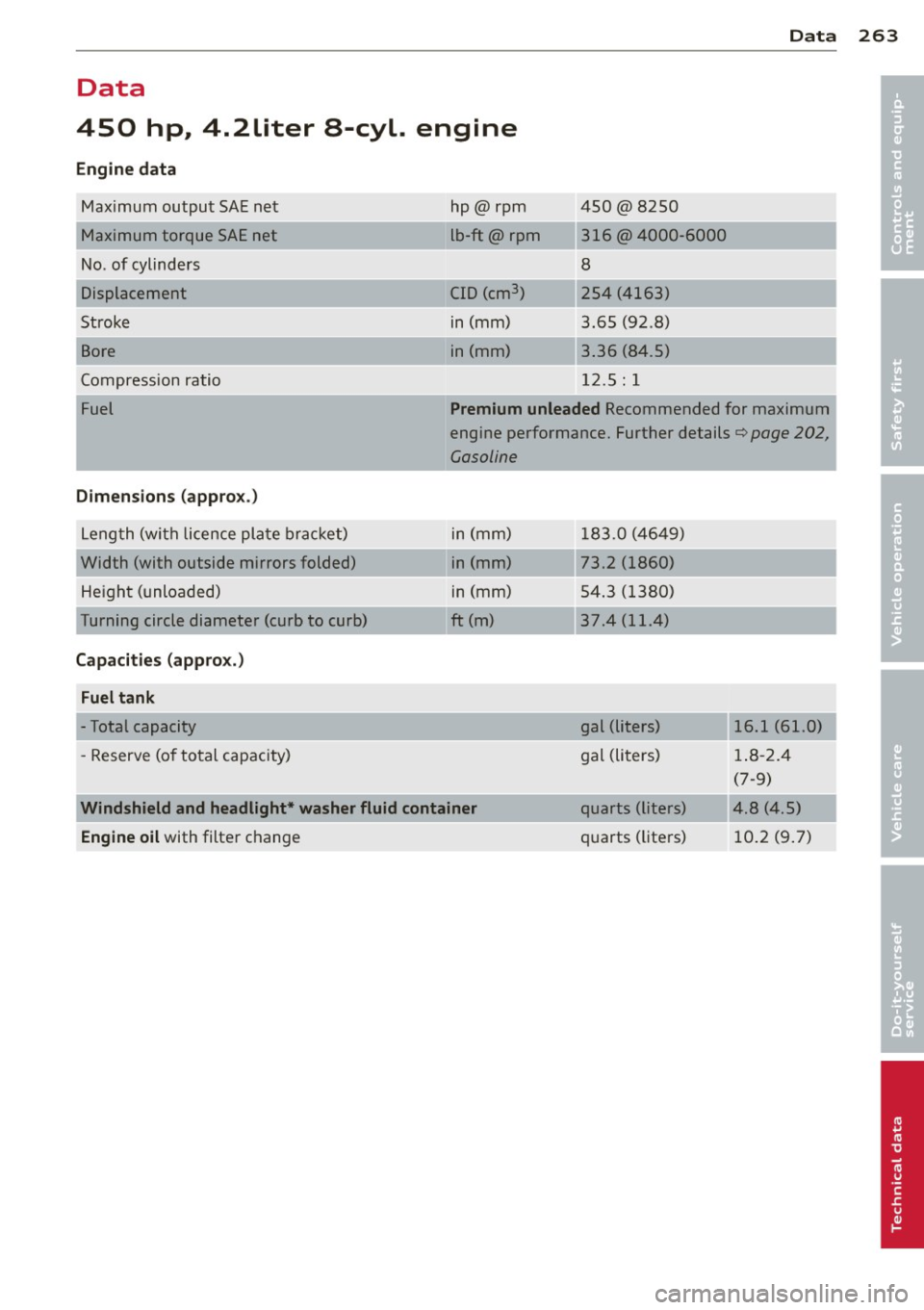
450 hp, 4.2Liter 8-cyl. engine
Engine data
Maximum output SAE net
Maximum torque SAE net
No. of cylinders
Displacement
Stroke
Bore
Compression ratio hp@rpm
lb-ft@rpm
C[D (cm
3
)
in (mm)
in (mm) 450 @8250
316 @4000-6000
8
254 (4163)
3.65 (92.8)
3 .36 (84.5)
12.5: 1
Data
Fuel Premium unleaded Recommended for maximum
engine performance. Further details
¢page 202,
Gasoline
Dimensions (approx.)
Length (with licence plate bracket)
Width (with outside mirrors folded) Height (unloaded)
Turning circle diameter (curb to curb)
Capacities (appro x.)
Fuel tank
- Total capacity
-Reserve (of total capacity) in (mm)
in (mm)
in (mm)
ft (m)
Windshield and headlight* washer fluid container
Engine oil
with filter change 183.0
(4649)
73.2 (1860)
54.3 (1380)
37.4 (11.4)
gal (liters) 16.1 (61.0)
gal (liters) 1.8-2.4
(7-9)
quarts (liters) 4.8 (4.5)
quarts (liters) 10.2 (9.7)
263
•
•