instrument panel AUDI RS5 CABRIOLET 2013 Owner's Manual
[x] Cancel search | Manufacturer: AUDI, Model Year: 2013, Model line: RS5 CABRIOLET, Model: AUDI RS5 CABRIOLET 2013Pages: 286, PDF Size: 71 MB
Page 199 of 286
dampened with dish detergent and water is recommended.
(D Note
- To avoid sc ratch ing the disp lay, yo u
shou ld never clean it dry.
- To preven t damage, ma ke s ure fl uids do
not enter the controls .
Aluminum trim
Use only neutral-pH products to remove spots
and depos its from alum inum s urfaces.
C hrome care products and alkaline cleaners
will attack alum inum surfaces and can dam
age them over time .
A WARNING
Always read and heed all WARNINGS and
other information ~
page 189.
Fabrics and fabric coverings
Fab rics and fabr ic coveri ngs (e.g . seats, doo r
tr im panels, etc.) should be cleaned at reg ula r
i nte rva ls wi th a vac uum cleaner . Thi s removes
sur face dirt particles which could become em
bedded in the fabr ic through use . Steam
cleane rs shou ld not be used, because the
steam tends to push the dirt deeper into the
fabric and lock it there.
Normal cleaning
Generally, we recommend using a soft sponge
or a lint-free microfiber cloth to the clean fab ric. Brushes should on ly be used for carpets
and floor mats, s ince other fabric surfaces
could be harmed by brushes.
Normal surface sta ins can be cleaned using a
commercia lly available foam cleaner. Spread
the foam on the surface of the fabric with a
soft sponge and work it in gently. Do not sat u
rate the fabric. Then pat the foam d ry using
absorbent, dry cloths (e .g . microfibe r cloth)
and vacuum it afte r it has dr ied comp lete ly .
Cleaning and protec tion 197
Cleaning sta ins
Stains caused by bever ages (e.g . coffee, fr uit
ju ice, etc.) can be treated with a mild deter
gent solution. Apply the detergent so lution
with a sponge. In the case of stubborn stains, a detergent paste can be applied directly to
the stain and worked into the fabric . After
wards, use copious amounts of clean water to
remove the rema ining deterge nt. Apply the
water wit h a damp cloth or sponge and pat
t h e fabric dry with an abso rbent, dry clot h.
Stai ns from choco late or makeup should have
detergent paste rubbed i nto them . After
wards, remove the soap w ith water (damp
sponge).
A lcohol can be used to treat stai ns from
grease, o il, lipstick or a ballpoint pen . M elted
grease or dye must be patted off using ab
sorbent mater ial. It may be necessa ry to re
t reat the areas with de tergent pas te and wa
te r.
In the case of gene ral soiling of the uphols
tery a nd cover material, we recommend hir ing
a speci alist t hat h as the eq uipment to clean
t h e se at cove rs and othe r fabr ic surfaces by
shampooing and spray extraction.
A WARNING
A lways read and heed all WARNINGS and
the information
~ page 189.
(D Tips
Open Ve lcro fas teners on yo ur clothing can
damage the seat cover . Please make sure
that Ve lcro fasteners are closed .
Plastic parts and instrument panel
Always use a clean cloth moistened in clear
water to clean these areas. For persistent d irt
use a n Aud i approved
solvent-free p lastic
clea ner/protectant .
•
•
Page 200 of 286
198 Cleaning and protection
8_ WARNING
Solvents can change the properties of
some plastics and make it harder for the
airbag to deploy.
-
-Never clean the instrument panel or the
surface of airbag modules with cleaning
products that contain solvents .
- Products containing solvents will make
the surface of this part porous.
- Serious injuries can result if plastic parts
come loose when the airbag is deployed.
- Always read and heed all WARNINGS and
other information ¢
page 189.
(D Note
Cleaning agents containing solvents will
attack the material and can change the
way it behaves.
Natural leather
App lies to vehicles: with natura l leather
Audi makes great efforts to maintain the
properties, natural look and feel of interior
leather.
General
We offer many different types of leather on
our vehicles. Most are different types of nappa
leather, which has a smooth surface and
comes in various colors.
The intensity of the color determines the visu al characteristics and appearance. If the sur
face of the leather has a typical natural look,
then the leather is a nappa leather that has
been left in a relatively natural condition. This
leather offers particularly good comfort and
breathes well. Fine veins, closed grains, insect
bites, skin folds , and subtle variations in color
remain visible. These characteristics demon
strate that the material is natural.
Natural nappa leather is not covered by a col
or finish.
It is therefore more sensitive to soil
ing and wear, which is something you need to
consider if children, animals or other factors
might prove to be particularly hard on the
leather. By contrast, leather types that are covered by
a colored finish layer are more durable.
This
has a positive effect on the leather's resist
ance to wear and soiling in daily use. On the
other hand, the typical characteristics of natu
ral leather are barely or not apparent . Howev
er, this does not mean that the leather itself
is of inferior quality .
Care and handling
Because of the exclusive nature of the types of
leather that Audi uses and their unique prop
erties (such as sensitivity to oils, grease, soil
ing, etc.), you will need to be somewhat care
ful with these leathers, and a certain type of care is required . For example , dark clothing
materials can discolor leather seats (especial
ly if such clothing is damp and was not dyed
correctly). Dust and dirt particles in pores,
folds, and seams can have an abrasive effect
and can damage the leather surface as well as
weaken seams.
The leather should be cleaned regularly as
needed. After having been used for a relatively
long time, your leather seats will acquire a
rich aged finish. This is a characteristic of nat
ural leather and a sign of true quality.
In order to maintain the value of this natural
product over the life of your vehicle, you
should follow the recommendations below:
(D Note
- To keep your leather from bleaching out,
do not allow it to be exposed to bright
sunlight for long periods of time. If you
have to leave the vehicle parked outside
for long periods, cover the leather to
protect it from direct exposure to sun
light.
- Sharp objects on clothing, such as zip
pers, rivets or sharp pieces on belts can
leave permanent scratches or scrape
marks on the surface of the leather.
(D Tips
-After each time you clean the leather and
at regular intervals, use a leather
1111>
Page 209 of 286

Checking and filling Engine hood
Releasing and opening the engine hood
The engine hood is released from inside the
vehicle .
Fig. 175 Dr iver's side footwell: eng ine hood release
lever
F ig . 176 Re lease lever un der the engine hood
Before opening the engine hood, make sure
that the windshield wipers are flat against the
windshield. Otherwise, they could damage the
paint on the hood.
.. Pull the release lever on the left under the
instrument panel in the direction of the ar
row
<::)fig. 175.
.. Raise the hood slightly Q &.
.. Press the rocker switch under the hood up
ward
c::> fig . 176 . This re leases the catch .
.,. Open the hood.
& WARNING
Hot engine coo lant can burn you.
- To redu ce the r isk of being burned, never
open the hood if yo u see or hear steam
or coolant escaping from the engine
compartment. Wait until no steam or
Checkin g and fillin g 207
coolant can be seen or heard before care
fully opening the hood.
Closing the engine hood
.. Pull the hood down until the pressure from
the struts is reduced .
.. Let the hood
drop down and latch in place .
Do not try to push it shut; it may fail to en
gage
c::> &, .
_&. WARNING
-
A hood that is not comple tely latched
could fly up and b lock your view while dr iv
ing.
- When you close the engine hood, chec k it
to make sure the safety catch has p rope r
ly engaged . The hood sho uld be flush
with the surrounding vehicle body parts .
-If you notice while driv ing that the hood
is not secured properly, stop at once and
close it.
Working in the engine compartment
Be especially careful whenever you work in the engine compartment .
Whenever yo u mu st p erform an y w or k in th e
eng ine compa rtment, for example checking
and filling differ ent fluid s, there i s a ri sk of
injury , burn s and accide nts. To prevent per
sonal injury al ways obser ve the foll owing
WARNINGS . The eng ine compa rtment of an y
v ehicle is a hazardous are a
QA .
_&. WARNING
To help avoid injury, before you check any
thing under the hood:
- Turn off the engine.
- Remove the ignition key.
- Apply the parking brake .
- Move selector lever of automatic trans -
mission to "P" (Park).
- Always le t the engine cool down . Hot
components wi ll bur n skin on contact .
Page 254 of 286

252 Fuses a nd bulb s
No.
5 Sound actuator/exhaust
sound tun
ing
6 Headlight range control sys-
tern/cornering light
7 Headlight (cornering light)
Control modules (electro
-
mechanical parking brake,
8 shock absorber, quattro
I
sport, trailer hitch), DCDC
converter
9 Adaptive cru ise control
10 Shift gate
11 Side ass ist
12 Headlight range control,
parking system
13 Airbag
14 Rear wiper (allroad)
15 Auxi
liary fuse (instrument
panel)
16 Auxiliary fuse terminal 15
(engine area)
Fu
se pa nel@ (b ro w n)
2 Brake light sensor
3 Fuel pump
4
5 Left seat heating with/with-
out seat vent
ilat ion
6 E5C
7 Horn
-Front left door (window reg·
8 ulator, central locking, mir-
ror, switch, lighting)
9 Wiper moto r
1 0 ESC
Two-door models: rear left
window regu lator, Fo ur-door
11 mode
ls: rear left door (win-
dow regu lator, central lock-
ing, switch, lighting)
12 Rain and light sensor
Fu se panel © (red)
3 Lumbar support
Amps
5/ 15
5/7,5 7,5
5
5
5
5
5
5
15
10
40
5
25
5
15/30
5
15
30
30
25
30
5
10
No . Consumer
4 Dynamic steering
6
7
8
9
Interior lighting (Cabriolet)
Windshield washer system ,
headlight washer system
Vehicle electrical system
control module 1
Vehicle electrical system
control module 1 Left rear window regulator
motor (Cabriolet)/sunroof
10 Vehicle e
lectr ical system
con trol module 1
11 Right rear window regulator
(Cabriolet)/sun shade motor
12 Anti-theft alarm warning
system
Right cockpit fuse assignment
Amps
35
5
35
20
30
7,5/20
30
7,5/20
5
Fig. 202 R ight cockpi t: fuse pane l wit h plast ic cl ip
No. Con sumer Amps
F u se panel @ (black )
5 Steering column switch
5
module
7 Term
inal 15 diagnos tic con-
nector 5
•
....
Page 255 of 286
--No. Consumer Amps
I a
Gateway (Databus diagnos-
5 tic interface)
I
9 Supplementary heater
Fuse panel ® (brown )
1 CD/DVD playe r
2
Wi-Fi
3 MMI/Radio
4 Instrument cluster
5 Gateway (instrument cluster
control module)
6 Ignition lock
7 Light switch
8
Climate cont
rol system
blower
9 Steering column lock
10 Climate control system
11 Terminal 30 diagnostic con-
nector
-
12 Steering column switch
module
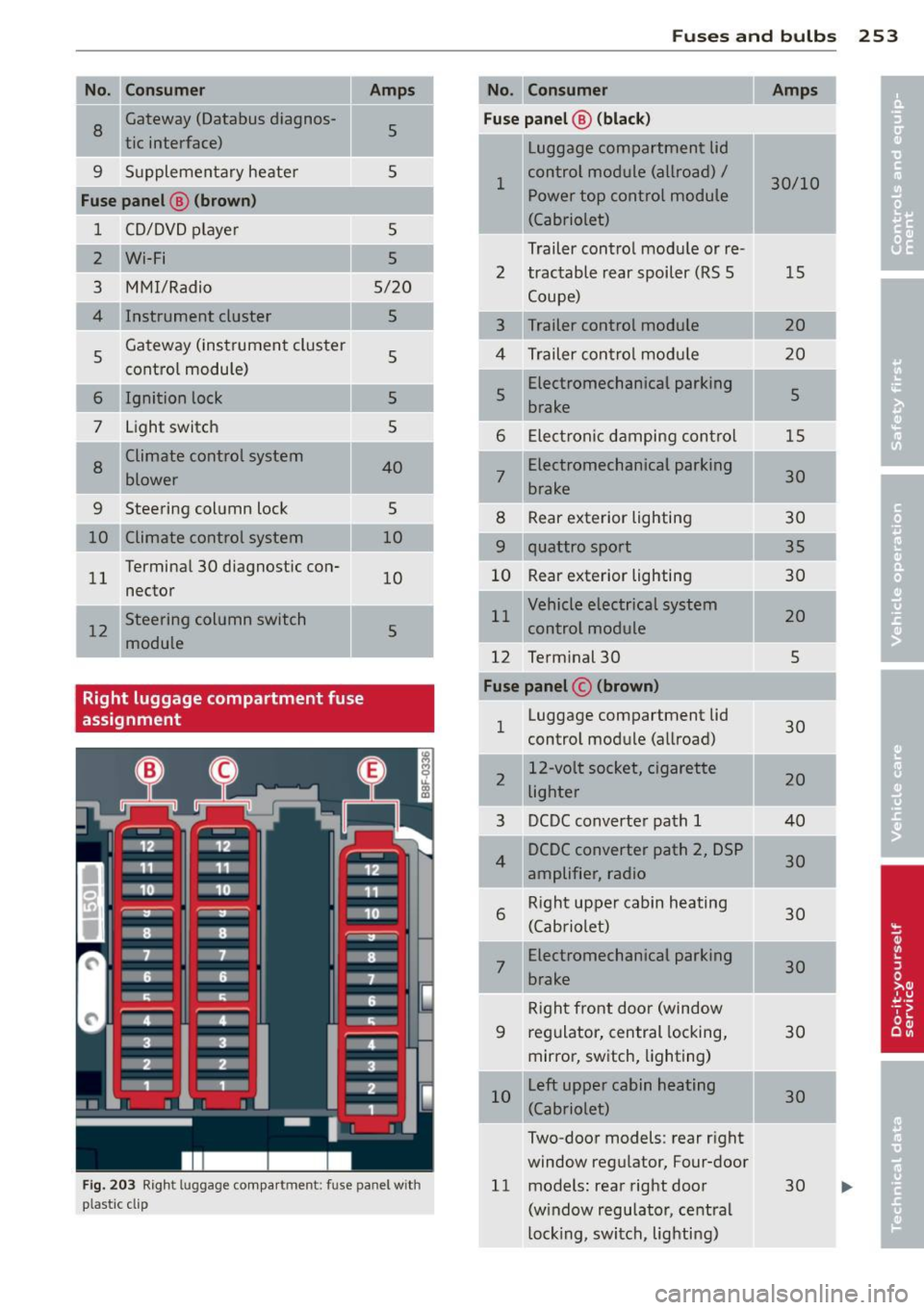
Right luggage compartment fuse
assignment
5
5
5
5/20
5
5
5
5
40
5
10
10
5
F ig. 203 R igh t lu ggage compar tmen t: fu se pan el w ith
pla stic cl ip
-
Fu se s and bulb s 253
No . Consumer Amps
Fuse panel @ (blac k)
Luggage compartment lid
1 control module (all
road) /
30/10
Power top control module
(Cabriolet)
Trailer con trol modu le or re-
2 tractable rear spoiler (RS 5 15
Coupe)
3 Trailer control module 20
4 Trailer contro l modu le 20
5 Electromechanical parking
5
brake
6 E lectron ic damping con trol 1 5
7
Electromechanical parking
30
brake
8 Rear exterior lighting 30
9 quattro sport
35
10 Rear exterior lighting
30
11 Vehicle electrical system
20
con trol module
12 Term inal 30
5
Fuse panel © (brown )
1 Luggage compartment lid
30
control module (allroad)
-.
2 12-volt
socket, cigarette
20
lighter
3 DCDC converte
r path 1 40
4 DCDC converter path
2, DSP
30
amplifie r, radio
6
Right upper cabin heating
30
(Cabriolet)
7
Electromechanical parking
30
brake
R ig ht front door (window
9 regulator, central locking,
30
mirror, switch, lighting)
10 L
eft upper cabin heating
30
(Cabriole t)
Two-door models : rear r ight
window regu lator, Four-door
11 models : rear right door
30
(w indow regulato r, ce ntra l
l ock ing, switch , lighti ng)