service AUDI RS5 CABRIOLET 2013 Owner's Manual
[x] Cancel search | Manufacturer: AUDI, Model Year: 2013, Model line: RS5 CABRIOLET, Model: AUDI RS5 CABRIOLET 2013Pages: 286, PDF Size: 71 MB
Page 188 of 286
186 Driving and en vironm ent
-Be aware that just one tank fi lling with
le a ded fuel will already seriously de
grade the performance of the catalytic
converter.
- Do not exceed the correct engine oil leve l
qpage 212.
-Do not drive until the fuel tank becomes
completely empty. The eng ine could mis
fire. Unburned fuel could also get into
the exhaust system and this could cause
t h e catalyt ic converte r to overheat.
- Do not turn off the ignition while the ve
hicle is moving.
- Do not continue to operate your vehicle
under these conditions, as otherw ise fuel
can reach the catalytic converter. This
could result in overheat ing of the co n
ve rter, req uiring its repla ceme nt.
- To assure efficient operation of the Emis
s ion Control System:
- Have your veh icle maintained properly
and in accordance with the service rec
ommendations in your Warranty
&
Ma intenance booklet.
- Lack o f proper maintenance as well as
improper use of the vehicle will impa ir
the funct ion of the emission control
system and cou ld lead to damage.
@) For the sake of the environment
Even when the Emission Control System is
operati ng properly, the exhaust gas can
have a sulfur-like exhaust gas smell under
some operating sta tes. This depends on
t he s ulfur content of the fue l being used .
Using a differe nt brand of fuel may help,
or filling the t ank w it h lead-free super
grade gaso line .
Operate your vehicle
economically and
minimize pollution
General
Your personal style of driving will determine
the economy of your vehicle, as well as ex
haust and noise levels.
F uel economy, environmenta l impact, and
wear on your engine, brakes and tires largely
depend on three factors:
- your personal driving s tyle
- oper ating conditions
- technical limitat ions
If you ant ic ipate what you need to do next and
drive economica lly, you can easily cut your
fuel consumpt ion by 10-15 percent . This sec
t ion w ill give you some tips on how you can
help the env ironment and your po cketbook.
@ Tips
The consumption estimates as published
by ENVIRON MENTAL PROTEC TION AG ENCY
( EP A) and Transpo rt Canada may no t corre
s pon d to your actual consump tion on the
r oad, which will va ry depending upon vehi
cle load and speed, road and weather con
dit ions, trip length, etc.
Drive smoothly and keep a lookout
ahead
Vehicles use the most fuel when they ore ac
celerating.
.,. Avoid unnecessary accelerating and brak ing.
Vehicles use the mos t fu el when they are ac
ce le rat ing. If yo u ant icipate what is going to
happen next, you will need to brake less and,
t hu s, acce le rate less . Let the vehicle coast
whenever possible -for examp le when you see
t h at the next traff ic light is red.
Page 189 of 286
Avoid full throttle
Driving at moderate speeds saves fuel and
improves your mileage.
""Try and keep well below your car's maximum
speed.
Accelerating gently reduces fuel consump
tion, engine wear, and does not disturb the
environment.
Fu el consumption, exhaust emissions and en
g ine noise increase disproportionately at high
speeds. If you drive at approximately three
quarters of top speed, fuel consumption will
be reduced by one half. Never drive faster
than the posted speed limit and weather con
ditions permit .
Reducing unnecessary idling
Even when your car is just idling it burns up
fuel.
""Shut the engine off when you are not driving
the vehicle.
"" Do not warm up the vehicle by letting the
engine run at idle .
It makes sense to shut
off the engine in traff ic
jams, when waiting for trains to pass at ra il
road crossings, or at traffic lights that have
l ong wa its on red. Turning the engine
off for
just
30-40 seconds saves more fue l than is
burned starting the engine again .
It takes a long time for the engine to warm up
fully when it is running at idle. However, wear
and noxious emissions are especially high
when the engine is warming up. So you should
drive away as soon as you start the engine and
avoid running at high rpms while the engine is
still warming up.
(D Note
Do not leave engine idling unattended af
ter starting . If warning lights should come
on to indicate improper operation, they
would go unheeded. Extended idling also
produces heat, which cou ld result in over-
Driving and environment 187
'
heating or othe r damage to the vehicle or
other property.
Regular maintenance
A badly tuned engine unnecessarily wastes a
lot of fuel.
""H ave your veh icle serviced at regular inter-
vals.
By having your vehicle regu larly serviced by an
au thorized Aud i dea ler helps to ensure that it
runs properly and economic all y. The condition
of your veh icle not on ly affects its safety and
ability to hold its va lue, it a lso affects
fuel
consumption .
Check your oil each time you fill your tank.
The amount of o il used is related to engine
load and speed.
It is normal for the oil consumption of a new
engine to reach its lowest value after a certain
mileage has been driven.
You must drive your vehicle about 3,000 miles
(5,000 kilometers) before you can properly
assess oil consumpt ion.
This also app lies to fue l consumption and en
gine output.
(U) Note
- Have your vehicle maintained properly
and in accordance with the service rec
ommendations in your Warranty
& Main
tenance booklet. Lack of proper mainte
nance as well as improper use of the ve
hicle will impair the function of the
emission control system and could lead
to damage.
- Do not alter or remove any component of
the Emission Control System unless ap
proved by the manufacturer.
- Do not alter or remove any device, such
as heat shields, switches, ignition wires,
valves, which are designed to protect
your vehicle's Emission Control System
and other important vehicle compo
nents .
•
•
Page 205 of 286

-Blend must contain not more than 15%
MTBE.
Seasonally adjusted gasoline
Many gasoline grades are blended to perform
espec ially we ll for winter or summer driving.
During seasonal change-over, we suggest that
you fill up at busy gas stat ions where the sea
sonal adjustment is more likely to be made in
time .
(D Note
-Methanol fuels which do not meet these
requirements may cause corrosion and
damage to plastic and rubber compo
nents in the fuel system .
- Do not use fue ls that fail to meet the
specified criter ia in this chapter.
- If you are unable to determine whether
or not a particular fue l blend meets the
specifications, ask your service station or
its fuel supp lier.
- Do not use fuel for which the contents
cannot be identified.
- Fuel system damage and performance
problems resulting from the use of fuels
different from those specified are not
the responsibility of Audi and are not
covered under the New Vehicle or the Emission Control System Warranties.
- If you experience a loss of fuel economy
or driveability and performance prob l ems due to the use of one of these fuel
blends, we recommend that you switch
to unblended fuel.
Gasoline additives
A major concern among many auto manufac
turers is carbon deposit build- up caused by
the type of gasoline you use.
Although gasoline grades differ from one manufacturer to another , they have certain
things in common. All gasoline grades contain
substances that can cause deposits to collect
on vital engine parts, such as fuel injectors
and intake valves. Although most gasoline brands include additives to keep engine and
Fuel supply and filling your fuel tank 203
fuel systems clean, they are not equally effec
tive .
A udi recommends using TOP TIER Detergent
Gasoline. For more info rmation on TOP TIER
Detergent Gasoline, please go to the official
website (www.toptiergas.com).
After an extended period of using inadeq uate
fuels, built-up carbon deposits can rob yo ur
engine of peak performance.
Q) Note
Damage or malf unct ion due to poor fue l
quality is not covered by the Aud i New Ve
hicle Limited Warranty.
Fuel tank
Fuel filler neck
The fuel filler neck is located on the right rear
side panel behind the fuel fille r flap.
If the power locking system should fail, you
can still open the flap manually -for deta iled
instruct ions see¢
page 205 .
You can find the fuel tank capacity of your ve
hicle in
Technical Data ¢ page 263.
The label on the inside of the fuel fi ller flap
tells you the correct fue l for your vehicle. For
more information about fuel specifications,
see ¢
page 202.
Your vehicle fue l tank has an on -board refue l
li ng vapor recovery system. This feature helps
to prevent fuel vapors from escaping from the
tank and pollut ing the environment while you
refuel your vehicle . In order to fill the tank
properly while protecting the environment,
please fo llow this refueling procedure careful
ly.
_&. WARNING
Under normal operating conditions, never
carry additional fuel containers in your car.
Gas canisters and other containers used to
transport f uel can be dangero us. Such con
tainers, full or empty, may leak and could
cause a fire in a collision. If you must
•
•
Page 215 of 286
@ For the sake of the environment
-Under no circ umstances can the oil come
i n contact w ith the sewage network or
the soil.
- Observe and follow lega l regu lations
when disposing of empty oil containers.
Changing the engine oil
We r ecommend that hove your oil changed by
on authorized Audi dealer or a qualified serv
ice station .
Before you check anything i n the engine com
pa rtment,
alwa ys read and heed all WARN
INGS c:> &. in Working in the engine comport
men t on page 207.
The engine oil must be changed according to
the intervals specified in your Warranty
&
Maintenance book let . T his is very important
because the l ubricating proper ties of oil di
minish gradua lly dur ing no rmal veh icle use.
Under some circ umstances the engine o il
should be changed more frequently . Change
oil more often if you drive most ly short dis
tances, operate the vehicle in dusty areas or
under predominantly stop-and -go traff ic con
d itions, or have your ve hicle where tempera
tures remain below free zing fo r extended pe
ri ods.
Detergent addi tives in the o il w ill make fresh
oil look dark after the eng ine has been run
n ing fo r a short time. This is norma l and is not
a reason to change the o il mo re often tha n
recommen ded.
Because of the problem of prope r disposal,
a long w ith the special tools and necessary ex
p e rti se require d, we strong ly recommend tha t
you have you r o il change d by an author ized
Audi dealer or a q ualified service sta tion.
If you choo se to change your oil yourself ,
please note the following importa nt informa
tion :
Checkin g and fillin g 213
A WARNING
To reduce the risk of personal inj ury if you
must change the eng ine oil in your vehicle
yourself:
- Wear eye protect io n.
- To reduce the risk of burns from hot en- gi ne oil, let the engi ne cool down to the
touch.
- When removing the o il dra in p lug with
your fi ngers, stay as far away as possible.
Always keep you r fo rearm parallel to the
grou nd to help p revent hot o il from run
ning down yo ur arm.
- Dra in the oil into a containe r designed
for this purpose, one la rge enough to
hold at least the tota l am ou nt of oi l in
your eng ine .
- E ngine oil is poisonous . Keep it we ll out
of the rea ch of childre n.
- Con tinuous contact wit h used eng ine o il
is harmful to yo ur ski n. A lways p rote ct
your skin by w ashing oil off tho ro ughly
wit h soap and wate r.
@ Note
N eve r mix oil addi tiv es with yo ur engine
oi l. These additives can damage your e n
g ine and adver se ly affec t yo u r A udi L imit
ed New Veh icle Warran ty.
@ For the sake of the environment
- B efore changi ng your oil, first make su re
yo u k now where yo u can prope rly dispose
o f t he used oil.
- Always dispose of used eng ine o il proper
ly. Do not dump it on garden soil, wood
ed are as, into open streams o r down
sewage drains .
- Re cy cl e used engine oil by taking i t to a
used engi ne oil col lect ion facility in your
area, or contact a service station .
•
•
Page 231 of 286

-Read the requir ed tire pressure from the tire
pressure label. The tire pressure label is lo
cated on the driver's side B-pillar. The tire
pressure label lists the recommended cold
t ire inf lation pressures for the vehicle at its
maximum capacity weight and the tires that
were on your vehicle at the time it was man
ufactured . For recommended tire pressures
for normal load conditions, please see chap
ter ~
page 226.
- Turn the valve stem cap counter-clockwise
to remove it from the tire valve.
- Place the air pressure gauge on the valve .
- The tire pressures should only be checked
and adjusted when the tires are cold . The
slightly raised pressures of warm tires must
not be reduced.
- Adjust the tire pressure to the load you are
carry ing.
- Reinstall the valve stem cap on the valve .
When should I check the tire pressure?
The correct tire pressure is especially impor
tant at high speeds. The pressure should
therefore be checked at least once a month
and always before starting a journey .
When should I adjust the tire pressures?
Adjust the tire pressure to the load you are
carry ing. After changing a wheel
or replacing
wheels you have to adjust the tire pressures
on all wheels. In addition, you must then initi
alize the new tire pressures in the tire pres
sure monitoring system*~
page 240.
A WARNING
Incorrect tire pressures and/or underinfla
tion can lead sudden tire failure, loss of
control, collision, serious personal injury
or even death.
- When the
[9] warning symbol appears in
the instrument cluster, stop and inspect
the tires.
- Incorrect tire pressure and/or underinfla
tion can cause increased tire wear and
can affect the handling of the vehicle and
stopping ability.
Tires and wheels 229
- Incorrect tire pressures and/or underin
flation can also lead to sudden tire fail
ure, including a blowout and sudden de
flation, causing loss of vehicle control.
- The driver is responsib le for the correct
tire pressures for all tires on the vehicle.
The applicable pressure values are locat
ed on a sticker on the driver's side B-pil lar.
- Only when all tires on the vehicle are fil
led to the correct pressure, the tire pres
sure monitoring system* can work cor
rectly.
- The use of incorrect tire pressure values
can lead to accidents or other damage.
Therefore it is essential that the driver
observe the specified tire pressure values
for the tires and the correct pressures for
the function of the tire pressure monitor ing system*.
- Always inflate tires to the recommended
and correct tire pressure before driving
off.
- Driving with underinflated tires bend
more, letting them get too hot resulting
in tread separation, sudden tire failure
and loss of control.
- Excessive speed and/overloading can
cause heat build-up, sudden tire failure
and loss of control.
- If the tire pressure is too low or too high,
the t ires will wear prematurely and the
vehicle will not handle well.
- If the tire is not flat and you do not have
to change a wheel immediately , drive at
reduced speed to the nearest service sta
tion to check the tire pressure and add
air as required.
(D Note
Driving without valve stem caps can cause
damage to the tire valves. To prevent this,
always make sure that factory installed
valve stem caps on all wheels are securely
mounted on the valve.
•
•
Page 234 of 286

232 Tires and wheels
Tire service life
The service life of tires depends on a lot of
different things including proper installation
and balancing, correct tire pressure and driv
ing style.
F ig. 1 87 Tire tread: tre ad wea r ind icators (TWI)
_____ __,.J)
F ig. 1 88 Rotat ing t ires for more ev en wea r
Tread Wear Indicator (TWI)
The o rigi na l t ires on your veh icle have
1/16 inch (1.6 mm) high "wear indicators"
c::> fig . 187 running across the tread. Depend
i ng on the make, there will be six to eight of
them evenly p laced around the t ire. Marks on
the tire sidewa ll (for example "TWI" or other
symbols) indicate the positions of the tread
wear ind icators . Worn t ires must be replaced .
Different fig ures may apply in o ther countries
c::> & .
Tire p ressure
Incorrect tire pressure causes premature wear
a nd can cause sudden t ire blow-out. For t his
reason, tire pressure must be checked at least
once a month
c::> page 228 .
Driving style
Driving fast aro und curves, heavy acce leration
and hard braking increase tire wear.
Rotating tires for more even wear
F or all four tires on your ve hicl e to h ave the
same service life, we recommen d that t he
front and rear t ires are rotated according to
the tire manufact urer's suggested tire rota
tion intervals. Please remember the follow ing :
- Tire rotation intervals may differ from the
vehicle service inte rva ls o utlined in your
Ma intenance and Warranty Book let .
- The longer one tire is used in one location
on the vehicle, the more it wears at certain
points; therefore, we recommend that you
follow the tire manufact urer's suggested
tire rotation intervals .
- Vehi cles w ith front-wheel dr ive experience
more tread wear on the fro nt w heels com
pa red to all wheel d rive (quattro ®).
- Please rotate tires as shown
c::> fig. 188.
-Extra care must be taken when rotating di-
rection-specific tires
c::> page 250 .
Wheel balancing
The wheels on new ve hicles are balanced .
However, various situations during everyday
driving can cause them to become unba l
anced, re sulting in vibrat ions you can usually
feel through the steer ing wheel.
Un balanced whee ls must be rebalanced to
avo id excessive wear on steering, suspension
and t ires. A whee l m ust also be reba lanced
when a new tire is insta lled.
Incorrect wheel alignment
Incor rect w heel alig nment can cause exces
sive tire wear, impairing the safety of the veh i
cle . If tires show excessive wear, have the
whee l alignment checked by an aut hori zed
Audi dealer or qualif ied workshop .
All wheel drive
Vehicles with q uattro ® mus t always have tires
of the same size, construction and tread type .
For details see
c::> page 181. ..,.
Page 258 of 286
256 Emergency situations
@ Tips
The discharged battery must be properly
connected to the vehicle's electrical sys
tem. When jump starting or charging the
battery, never connect the negative
ground cable to the battery negative post
because the batte ry manager system must
be able to detect the battery 's state of
charge. Always connect the negative
ground cab le to the negative ground post
of the battery manager control unit.
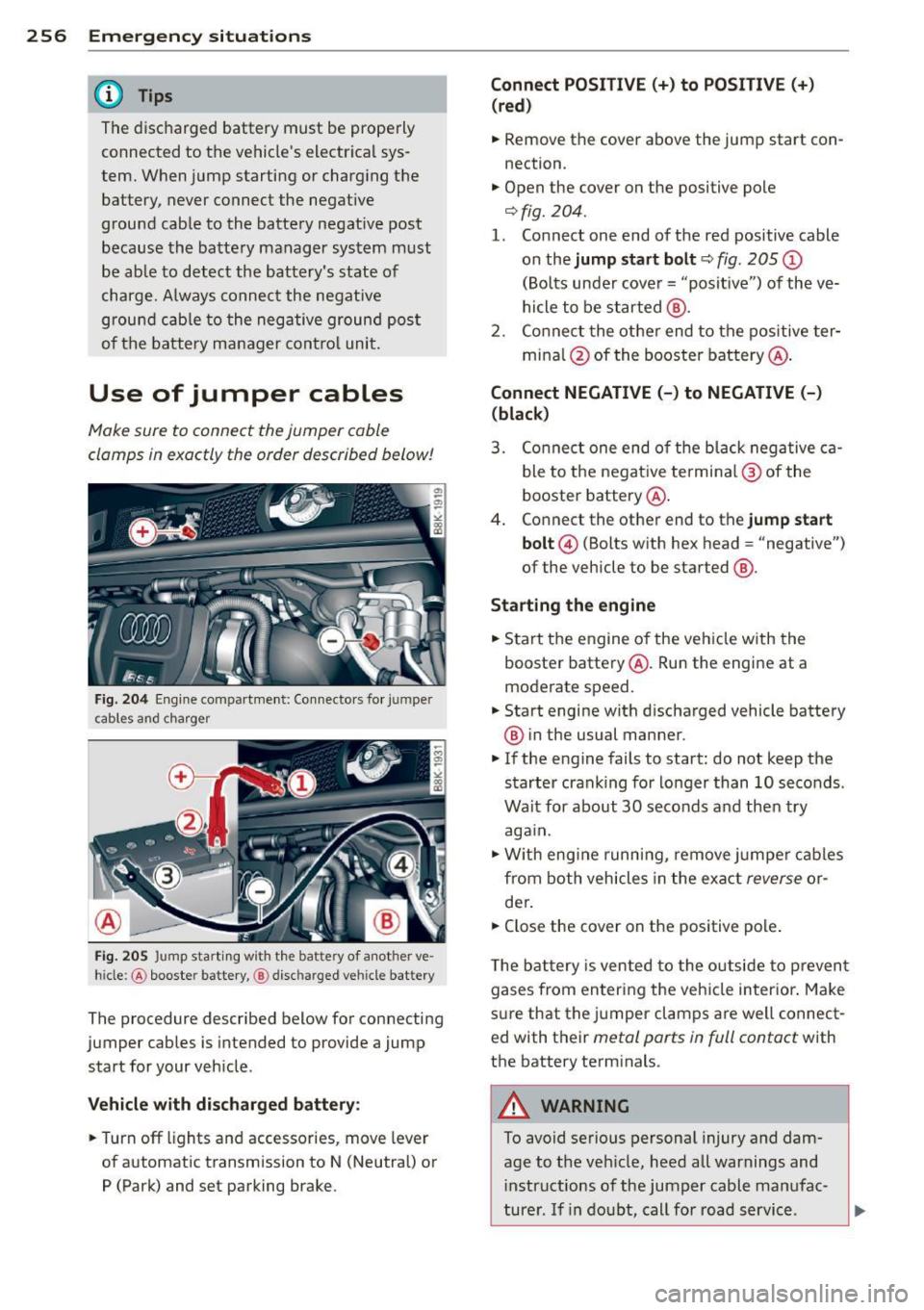
Use of jumper cables
Make sure to connect the jumper cable
clamps in exactly the order described below!
Fig. 204 Engine compartment: Connectors fo r jum per
cables and charger
Fig. 205 Jump sta rting wi th the battery of anot her ve ·
h ide :@ booster battery, @ disc harged vehicle battery
The procedure described below for connecting
jumper cables is intended to provide a jump
start for your vehicle .
Vehicle with discharged battery:
.. Turn off lights and accessories, move lever
of automatic transmission to N (Neutral) or
P (Park) and set parking brake .
Connect POSITIVE(+) to POSITIVE(+)
(red)
.. Remove the cover above the jump start con
nection .
.. Open the cover on the positive pole
¢fig. 204 .
1. Connect one end of the red positive cable
on the
jump start bolt c::> fig. 205 @
(Bolts under cover= "positive") of the ve
hicle to be started @.
2. Connect the other end to the positive ter-
minal @of the booster battery@.
Connect NEGATIVE (-) to NEGATIVE (-)
(black)
3. Connect one end of the b lack negative ca
ble to the negative terminal @of the
booster battery @.
4. Connect the other end to the
jump start
bolt @
(Bolts with hex head= "negative")
of the vehicle to be started @.
Starting the engine
.. Start the engine of the vehicle with the
booster battery@. Run the engine at a
moderate speed.
.. Start engine with discharged vehicle battery
@ in the usual manner .
.. If the engine fails to start: do not keep the
starter cranking for longer than 10 seconds .
Wait for about 30 seconds and then try
again .
.. With eng ine running, remove jumper cables
from both vehicles in the exact
reverse or
der .
.. Close the cover on the positive pole .
T he battery is vented to the outside to prevent
gases from entering the vehicle interior . Make
sure that the jumper clamps are well connect
ed with their
metal parts in full contact with
the battery terminals.
A WARNING
--
To avoid serious personal injury and dam
age to the veh icle, heed all warnings and
instructions of the jumper cable manufac-
turer . If in doubt, call for road service . ..,.
Page 266 of 286
264 Consumer Information
Consumer Information
Warranty coverages
You r Audi i s covered by the following war
ranties:
- New Vehicle Limited Warranty
- Limited Warranty Against Corrosion Perfo-
ration
- Emissions Control System Warranty
- Emissions Performance Warranty
- California Emissions Control Warranty (USA
vehicles only)
- California Emissions Performance Warranty
(USA vehicles only)
Detailed information regarding your warran
ties can be found in your
Warranty & Mainte
nance booklet .
Operating your vehicle
outside the U.S.A. or
Canada
Government regu lations in the United States
and Canada require that automobiles meet
specific emission regulations and safety
standards. Therefore, veh icles built for the
U.S.A . and Canada differ from vehicles sold in
other countries .
If you p lan to take your vehicle outside the
continental limits of the United States or Can
ada, there is the possibility that:
- unleaded fuels for vehicles with cata lytic
converter may not be available;
- fuel may have a considerably lowe r octane
rating. Improper fuel may cause engine
damage ;
- service may be inadequate due to lack of
proper service facilities, tools or testing
equipment ;
- replacement pa rts may not be readily availa
ble.
- Navigation systems for vehicles built for the
U.S.A. and Canada will not necessar ily work
in Europe, and may not work in other coun
tries outside of North America.
(D Note
Audi cannot be responsible for mechanical
damage that could result from inadequate
fuel, service or parts availability.
Audi Service Repair Manuals and Literature
Audi Official Factory Service Manuals and Lit
erature are published as soon as possible after
model introduction. Service manuals and lit
erature are available to order from the Audi
T echnical Literature Ordering Center at:
www.audi.techliterature.com
Maintenance
General
Your vehicle has been designed to help keep
maintenance requirements to a minimum.
However, a certain amount of regular mainte
nance is still necessary to assure your vehicle's
s afety, economy and rel iability. For detailed
vehicle maintenance consult your Warranty &
Maintenance booklet.
Under difficult operating conditions, for ex
ample at extremely low outside temperatures,
i n very dusty regions , when towing a trailer
very frequently, etc., some service work
should be performed between the intervals
specified. This applies particularly to:
- oil changes, and
- cleaning or replacing the air filter .
(® For the sake of the environment
By regularly maintaining your vehicle, you
help make sure that emission standards
are maintained, thus minimizing adverse
effects on the environment.
Important considerations for you and
your vehicle
The increasing use of electronics, sophisticat
ed fuel injection and emission contro l sys-
tems, and the genera lly increasing technical
liJJ,
Page 280 of 286

278 Index
Safety belt warning light
Safety compliance sticker ....... .. .. .
Safety equipment .......... .. .. .. .. .
Safety features for occupant restraint and 129
261
118
protection ... ................ ..... . 118
Safety guidelines Seats .. ... ................... ... .. 61
Safety instructions
Engine compartment ............... 207
for using child safety seats ..... .. ... 161
for using safety belts ...... .. .. .. .. . 132
Monitoring the Advanced Airbag Sys-
tem . .. .. .. ............. .. .. .. .. . 150
Seat adjustment
Head restraints ............... .... 121
Seat belts
refer to Safety belts ........ ... .... . 129
Seat heating . . . . . . . . . . . . . . . . . . . . . . . . 71
Upper cabin heating . . . . . . . . . . . . . . . . . 72
Seating capacity ............... .. ... 129
Seating position Driver . .. ................. .. .... . 119
Front passenger .......... .. .. .... . 120
H ow to adjust the front seats ... ..... 120
Incorrect seat position . . . . . . . . . . . . . . 122
Occupants .. ... .. ..... ......... .. . 119
Rear passengers ................... 121
Seat memory . . . . . . . . . . . . . . . . . . . . . . . 64
Seats Adjusting .. ................ ..... .. 62
Adjusting in the MMI ....... ..... .. .. 63
Convenience sid e view ....... .. .... .. 63
Driver's seat ....................... 61
Folding .. ................. .. .... .. 67
Front passenger's seat . . . . . . . . . . . . . . . 62
Head restraints . . . . . . . . . . . . . . . . . . . . 64
Number of seats . . . . . . . . . . . . . . . . . . 129
Power easy entry function . . . . . . . . . . . . 63
Safety guide lines ................... 61
Seat symmetry . . . . . . . . . . . . . . . . . . . . . 63
Seat ventilation . . . . . . . . . . . . . . . . . . . . . 71
Seat (upper cabin heating) . . . . . . . . . . . . . 72
Selective unlock feature ....... .. .. .. .. 36
Selector lever
Emergency release . . . . . . . . . . . . . . . . . . 91
S tronic transmission ...... .. .. .. .. . . 85
Selector lever display . . . . . . . . . . . . . . . . . 85 Selector lever
emergency release .... .. . 91
Service and disposal Safety belt pretensioner ........ .... 136
Service interval display . . . . . . . . . . . . . . . . 2 7
Service position
refer to Replacing wiper blades ... ... . 58
SET button ........ ............... .. 11
Side airbags Description ...... ............. .... 155
How they work . .. ................ . 156
side assist Adjusting the brightness ............ 103
Sensor range ..................... 101
Side assist
Activating and deactivating ....... ... 103
Cleaning sensors .................. 193
Description .... .. ............. .... 101
S ide marker lights . . . . . . . . . . . . . . . . . . . 52
Ski sack ............................ 68
Snow chains .... .. ............. .... 238
Soft top Care and cleaning . ............. .... 192
Sound system display . . . . . . . . . . . . . . . . . 24
Sources of information about child re-
straints and their use ................ 175
Speedometer . . . . . . . . . . . . . . . . . . . . . . . 12
Speed rating letter code .......... .... 234
Speed warning system ............ ... . 81
Sport differential .................. . 104
Indicator lamp . .. ................ .. 22
Sport mode (ESC) . . . . . . . . . . . . . . . . . . . 178
START ENG INE STOP button (conven ience
k ey) ....... .... .. ................ .. 78
START ENGINE STOP button (Convenience
key) . .. ... ... .. .. .... ...... ...... .. 77
Starting from rest .. ... .......... .. .. . 80
Starting the engine . . . . . . . . . . . . . . 74 , 77
Steering Locking the steering ................ 74
also refer to Electro-mecha nical power
ass ist .. .. .. .. .. ............. .. .. 180
Steering wheel Adjusting steering column ........... 74
Indicator light . . . . . . . . . . . . . . . . 18, 180
Steps for determining correct load limit . 230
Stopping the eng ine . . . . . . . . . . . . . . 76, 78
Page 281 of 286

_______________________________ I~ n~ d:::: e~x 279
Storage
S tron ic ...
.. .. .... .. .... ... .. .. .... 66
85
S tron ic transm ission
Automatic S hift Lock (ASL) . .. .. .. .. .. 86
Driving information . . . . . . . . . . . . . . . . . 87
Emergency mode . . . . . . . . . . . . . . . . . . . 90
Emergency release . . . . . . . . . . . . . . . . . . 91
Kick-dow n . . . . . . . . . . . . . . . . . . . . . . . . . 89
L aunch Cont ro l Program . . . . . . . . . . . . . 90
Selec tor lever pos it ion . . . . . . . . . . . . . . . 85
tiptronic . . . . . . . . . . . . . . . . . . . . . . . . . . 89
Sun visors
Symbo ls ·
· · · · · · · · · · · · · · · · ...... ... 57
refer to Warning/ind icator lights .. .. .. 13
T
Tachometer . . . . . . . . . . . . . . . . . . . . . . . . . 11
Technical mod ificat ions .............. 267
The first 1,000 miles (1,500 km) and after-
wards ............................. 184
Tie-downs . . . . . . . . . . . . . . . . . . . . . 68, 125
tiptronic S t ron ic tr ansm ission ................ 89
T ire mobility system ................. 243
Tire pressure ... .... .... ... .. .. .. ... 228
Tire pressure monitor ing system
L f . oss o arr pressure ............... .
M alf unc tion
............. .... .. ...
Resett ing ti re p ressu res . ... .. .. .. .. .
Tire repair kit .............. ...... . .
T ires . ... .... .. .. .. .. .... .. . .. .... .
Low aspect ratio tires .............. .
Service life
. ............. .... .. .. .
Speed rating letter code ....... .. .. .
Tire manufacturing date ........... .
Tire pressure monitoring system .... .
T ire spe cifica tions ........ .. .. .. .. .
Tread depth ............. .... .. .. .
Uniform tire q uality grading . ....... .
Winte r tires
.... .. .... ... .. .. .. ...
T ires and vehicle load limits ......... . .
Tires and wheels
Checking tire pressure ............. .
Cold tire in flat ion pressure ......... .
o· . rmensrons ...................... .
Gene ral notes .... .. ..... ... .. .. .. . 24
1
24 1
24 2
243
222
239 232
234
234
2 4 0
234
23 2
236 237
230
228
226
233
22 2 G
lossary of tire and loading terminolo-
gy .. ... .. .. .. .... . ... ...... ... .. 223
New t ires and wheels . .. ..... ... .. .. 233
Rep lacing ... .. .. ................. 234
Snow chains . .. .. .... ............. 238
Tires and veh icle load limits ........ . 230
Wheel bolts ... .. .. . .. .... ...... .. 239
Winter tires ...................... 237
Tire service life .. .. .... ........... .. 232
T oo l kit ........................... 243
T orn or frayed safety belts ............ 132
T o uch-up paint
T owing
F ron t eye let 194
2 58
Rear eyelet .. .. .. .. .. .. ...... ... .. 258
Tow truck procedures . .. ..... ... .. .. 257
TPMS Tire pressu re mo nitoring system ... .. 241
Transmission .. .. .. ................. . 85
S tronic ...... .... ................. 85
T ransmission malfunction ( indicator light) 90
T ransport Canada ......... .......... 126
Travel mode . . . . . . . . . . . . . . . . . . . . . . . . 54
T read Wear Ind icator (TWI)
232
T rip compute r
Fuel consumpt ion ................ .. 25
Mileage ... .. .. .. ... ............ ... 25
S ingle -trip memory ............ .. .. . 25
T ota l- t rip memory ............. .... . 25
T . d rip o ometer ....................... 12
Trunk
refer to Luggage compartment... 67, 124
T ru nk escape h andle ............. .. .. . 38
Trunk lid
refer to Rear lid . . . . . . . . . . . . . . . . . . . . 3 7
T . l urn srgna s ... .. ...... ............. . 53
Warning/ind icator lights ........ .. .. . 22
u
Undercoating 196
Un fastening safety belts ............. 135
U ni directional tires .................. 222
U nif orm tire quality grading ... ... .. .. 236
Unl ocking
Rea r lid . .. .. .. .. .. ............... . 37
•
•