brake AUDI RS5 CABRIOLET 2013 Workshop Manual
[x] Cancel search | Manufacturer: AUDI, Model Year: 2013, Model line: RS5 CABRIOLET, Model: AUDI RS5 CABRIOLET 2013Pages: 286, PDF Size: 71 MB
Page 219 of 286
If the brake fluid level falls considerably be
l ow the "MIN" mark, the brake warning/indi
cator light (U.S . mode ls:
1111 . Canad ian
models: .) will come on
¢ page 15. Do not
continue to operate the vehicle. The complete brake system should be thoroughly checked
by an authorized Audi dealer or qualified
workshop and the cause co rrected . If the
b rake fluid level is too low, the brake warn ing/
in dicator light w ill illuminate. Contact an a u
thor ized Audi dealer
imm ediatel y.
@ Tips
The brake fluid rese rvoir is located unde r
neath the cover.
Changing brake fluid
Hove the broke fluid changed by on experi
enced technician .
Brake fluid absorbs moistu re from the a ir. If
the water content in the brake fluid is too
hi gh , corrosion in the b rake system may resul t
after a per iod of t ime . The bo iling po int of t he
b rake fluid w ill also decrease considerably and
decrease braking performance.
Therefore, the brake flu id must be changed
e ver y two year s. Always use new b rake fluid
which conforms to Federal Motor Vehicle
Standard "FMVSS 116 DOT 4".
The brake flu id rese rvoi r ca n be difficult to
r eac h, therefore , we recommend th at yo u
h ave the brake f luid changed by yo ur autho r
ized
Audi dealer . Your deale r has the correct
too ls, the right brake fluid and the know -how
to do th is for you.
A WARNING
- Brake fluid is po isonous . It must be stor
ed only in the closed orig inal container
out of the reac h of children!
- Brake fa ilure can result from old or inap
propr iate brake fluid . Observe these pre
caut ions:
- Use on ly bra ke fluid that meets SAE
specification
J 1 7 03 and conforms to
Checkin g and fillin g 217
Federa l Moto r Ve hicle Standard 1 16 .
Always check with your authorized Audi
dealer to make sure you are using the correct brake fluid . The correct type of
brake flu id is also ind icated on the
brake f luid rese rvoir .
- The brake fluid must be new . Heavy use
of the brakes ca n cause a vapo r lock if
the b rake fluid is left i n the system too
l ong. This can se riou sly affect the effi
c iency of the brakes as well as your
safe ty . T his co uld resu lt in an accident.
(D Note
B ra ke fluid wi ll damage the paint o f you r
vehicle.
@ For the sake of the environment
Because of the p rob lem of proper disposal
of bra ke fluid as well as the spec ial too ls
r equired and the necessary expertise, we
r ecomme nd th at yo u have the br ake fl uid
changed by yo ur autho rized Aud i dea le r.
Battery
General information
Un der normal operating cond itions , the bat
te ry in you r Audi does not need any ma inte
nance . With
high outside temperatures o r
long da ily d rives we recommend that you have
t h e e lectrolyte leve l chec ked by an au thori zed
A udi dealer or qualified workshop . The elec
trolyte leve l should also be checked each time
the batte ry is charged
¢ page 219.
Have the battery checked when yo u take your
vehicle in for se rvice. You are well advised to
replace a battery that is older than 5 years.
Wi th cer tain types of airbag deployment, the
ba ttery is disconnected from the veh icle elec
trical system for safety reasons¢.&
in Re
pair, core and disposal of the airbags on
page 151.
~
•
•
Page 225 of 286
-Never mount used tires on yo ur vehicle if
yo u are not sure of their "previous histo
ry." Old used tires may have been dam
aged even though the damage cannot be
seen that can lead to sudden tire failure
and loss of vehicle control.
- If you notice unusual vibration or if the
vehicle pulls to one side when d riving, al
ways stop as soon as it is safe to do so
and check the wheels and tires for dam
age .
(D Note
Please note that summe r and wi nte r tires
are designed for the cond itions that are
Glossary of tire and loading terminology
Accessory weight means the comb ined weight (in excess of
those sta ndard items which may be rep laced)
of au toma tic transmission, power steer ing ,
power brakes, power windows, power seats,
radio, and heater, to the extent that these
items are availab le as factory-installed equip
ment (whether installed or not) .
Aspect ratio
means the rat io o f the height to the w idth of
the tire in percent . Numbers of 55 or lower in
dicate a low sidewall for improved steering re
sponse and better overa ll handling on dry
pavement .
Bead
means the part of the t ire t hat is made o f
steel wires, wrapped or reinforced by ply cords
and that is shaped to fit the r im.
Bead separation
means a b reakdown of the bond between
components in the bead .
Cord means the strands forming the plies in the
tire.
Tire s an d wheel s 223
typica l in those seasons . Aud i recommends
using winter tires during the winter
months . Low temperatures signif icant ly
dec rease the e lasticity of summer t ires,
which affects tract ion and brak ing ability.
If summer t ires are used i n very co ld tem
peratures, cracks ca n form o n the tread
bars , res ulting in perma nen t tire damage
that can cause loud driving noise and un
bala nced ti re s. Audi i s not respon sible for
th is type of damage .
Cold tire inflation pressure
means the t ire p ress ure recommended by t he
vehicle manufacture r fo r a tire o f a des ignated
s ize t hat has not bee n driven for more than a
coup le o f miles (k ilometers) at low speeds in
the three hour period before the tire press ure
is m easured or adjusted.
Curb weight
me ans the we ight of a motor ve hicle with
st andard equipmen t incl ud ing the max imum
capacity of fuel, oi l, and coolant, air condi
tioning and additional weig ht of optiona l
equipment.
Extra load tire
means a t ire design to oper ate a t higher load s
and at higher inflation pressures than the cor
responding standa rd tire . Extra load tires may
be identified as "XL", "x l", "EXTRA LOAD", o r
"RF" on the sidewal l.
Gross Axle Weight Rating ("GAWR")
me ans the load-ca rry ing capac ity of a single
axle system , measured at the tire -ground in
te rfaces.
Gross Vehicle Weight Rating ( "GVWR ")
mea ns the maximum total loaded we ight of
the ve hicl e. .,..
•
•
Page 226 of 286
224 Tires and wheels
Groove
means the space between two adjacent tread
ribs .
Load rating (code)
means the maximum load that a tire is rated
to carry for a given inflation pressure. You
may not find this informat ion on all tires be
cause it is not req uired by law.
Maximum load rating
means the load rating for a t ire at the max i
mum permissible inflation pressure for that
tire.
Maximum loaded vehicle weight
means the sum of:
(a) Curb weight
(b) Accessory weight
(c) Vehicle capacity we ight, and
(d) Production options weight
Maximum (permissible) inflation pressure
means the maximum cold inflation pressure
to which a tire may be inflated. Also called
"maximum inflation pressure ."
Normal occupant weight
means 150 lbs. (68 kilograms) times the
number of occupants seated in the vehicle up
to the total seating capacity of your vehicle .
Occupant distribution
means distribution of occupants in a vehicle.
Outer diameter
means the overa ll diameter of an inflated new
tire.
Overall width
means the linear distance between the exteri
ors of the sidewalls of an inflated tire, includ
ing elevations due to labeling, decorations, or
protective bands o r ribs .
Ply
means a layer of rubber-coated parallel cords.
Production options weight
means the combined weight of those insta lled
regular production options weighing over 5
lb s. (2 .3 kg) in excess of those standard items
which they replace, not previously considered
in curb weight or accessory we ight, including
heavy duty brakes, ride levelers, heavy duty
battery, and special trim.
Radial ply tire
means a pneumat ic tire in which the ply cords
that extend to the beads are laid at substan
t ia lly 90 degrees to the center line of the
tread .
Recommended inflation pressure
see<=> page 223, Cold tire inflation pressure.
Reinforced tire
means a t ire design to operate at higher loads
and at h igher inflation pressures than the cor
responding standa rd tire. Reinforced tires
may be identified as "XL" "xl" "EXTRA LOAD"
' ' '
or "RF" on the sidewa ll.
Rim
means a metal support for a tire or a tire and
tube assembly upon which the tire beads are
seated.
Rim diameter
means nom inal diameter of the bead seat. If
you change your wheel s ize, you will have to
purchase new tires to match the new rim di
ameter.
Rim size designation
means r im diameter and width .
Rim width
means nominal distance between rim flanges.
Sidewall
means that portion of a tire between the
t read and bead.
Page 229 of 286
Tires an d wheel s 22 7
you have stored. The system does not recog
nize the load condition of your vehicle.
The effectiveness of the ti re pressu re monitor
ing sys tem* will be impaired if you store nor
mal load pressures but then operate the vehi
cle at its maximum load¢,& .
See the illustration ¢
fig. 185 for the location
of the label on dr iver's side B-pillar (co lor of
the actual labe l and exact location on the ve
hicle wi ll vary slig htly) .
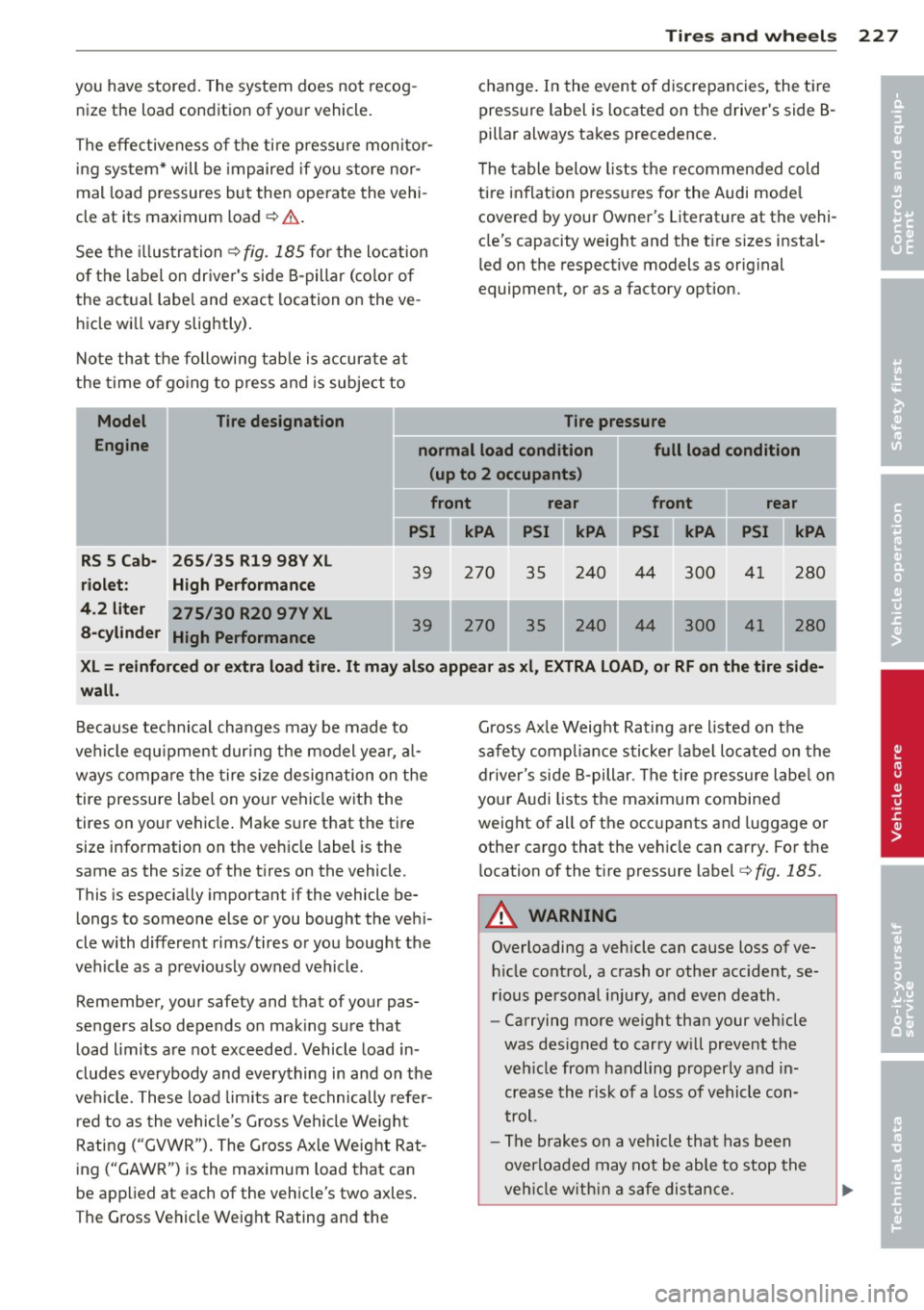
Note that the fo llowing tab le is accurate a t
the t ime o f go ing to press and is subject to
Tire designation
change. In the event of discrepancies, the ti re
pressure label is located on the driver's side B
pillar always takes precedence .
T he table below lists the recommended cold
ti re inflation pressures for the Audi mode l
covered by your Owner's Literat ure at the vehi
cle's capacity weight and the t ire sizes instal
l ed on the respective models as orig inal
equipment, or as a factory option.
Tire pressure
Model
Engine normal load condition full load condition
(up to 2 occupants)
front rear front rear
PSI
kAA ~I kAA ~I kAA ~I kAA
RS 5 Cab- 265 /35 R19 98V X L
riol et: High Performan ce
39 270 35 240 44 300 41
280
4.2 liter 275 /30 R20 97V XL
a -cyl inder
270 35 240 44 300 4 1 280
XL= reinf orc ed or extra lo ad tire. It ma y al so appear a s xl , EXTRA LOAD, or RF on the tire side
w all .
Because tec hnical changes may be made to
ve hicl e equ ipment dur ing the model yea r, a l
ways compare the tire s ize designation on the
tire pressure label on your vehicle w ith the
tires on your vehicle . Make s ure that the tire
size information on the vehicle label is the
same as the s ize of the t ires on the vehicle.
This is especially important if the vehicle be
longs to someone else or you bought the veh i
cle with different rims/tires or you bought the
veh icle as a previously owned vehicle.
Remember, your safety and that of your pas
sengers also depends on mak ing sure that
load limits are not exceeded . Vehicle load in
cludes everybody and everything in and on the
ve hicl e. These load limits are technically refer
r ed to as the vehicle's G ross Vehicle We ight
Rating ("GVWR"). The Gross Ax le Weight Rat
ing ("GAWR") is the maximum load that can
be applied at each of the vehicle's two axles .
The Gross Vehicle We ight Rating and the G
ross Ax le Weig ht Rating are listed on the
sa fe ty comp liance sticke r label lo cated on the
dr iver's side B-pillar . The tire pressu re labe l on
your A udi lists the maximum combined
weight of all of the occ upants and luggage o r
other cargo that the veh icle can carry. For the
location of the t ire pressure label ¢
fig. 185.
A WARNING
-Overloading a vehicle can cause loss of ve-
h icle contro l, a crash or other accide nt, se
rious personal injury, and even death.
- Carrying more we ight than your veh icle
was des igned to carry will prevent the
veh icle from handling properly a nd in
crease the risk of a loss of vehicle con
trol.
- The brakes on a vehicle that has been
overloaded may not be able to stop the
veh icle w ith in a safe distance.
•
•
Page 232 of 286
230 Tire s and wheel s
@ For the sa ke of the environment
Underinflated tires will a lso increase the
fue l consumption.
Tires and vehicle load limits
There are limits to the amount of load or
weight that any vehicle and any t ire can carry.
A vehicle that is overloaded w ill not handle
well and is more difficult to stop. Overload ing
can not only lead to loss of vehicle control, but can also damage important pa rts of the
vehicle and can lead to s udden tire failure, in
cluding a blowout and sudden deflation that
can cause the vehicle to crash.
Your safety and that of your passenge rs a lso
depends on making s ure that load limi ts are
not exceeded . Vehicle load includes everybody
and everything in and on the vehicle. These
load limits are technica lly referred to as the
vehicle's
Gross Veh icle We ight R ating
("GVWR").
The "GVWR" includes the weight of the basic
vehicle, all factory installed accessories, a full
tank of f uel, oi l, coo lant and other fluids pl us
maximum load. The maximum load includes
the number of passengers that the vehicle is intended to carry ("seating capacity") with an
assumed weight of 150 lbs . (68 kg) for each
passenger at a des ignated seat ing pos ition
and the tota l we ight of any l uggage in the ve
h icle. If you tow a trailer, the weight o f the
trai ler hitch and the tong ue weight of the
loaded trailer must be included as part of the
vehicle load.
The
Gro ss Axl e W eight Rating ("GAWR") is
the maximum load that can be app lied at each
of the vehicle's two axles.
The G ross Vehicle Weight Rating and the
Gross Axle Weigh t Rating are listed on the
safety compliance sticker labe l located on the
driver's side B-pi llar . Audi has 4 seati ng posi
tions, 2 in the front and 2 in the rear for tota l
seating capacity of 4 . Each seating position
has a seat belt¢
page 129, Safety belts.
T he fact that there is an upper limit to yo ur
vehicle's G ross Vehicle Weight Rating means
that the total weight of whatever is being car ried in the vehicle ( includ ing the weight of a
trailer hitch and the tongue weight of the
loaded tra iler) is lim ited . The more passen
gers in the vehicle or passengers who are
heavier than the standard we ights assumed
mea n tha t less we ight can be carried as lug
gage.
T he t ire pressure label on your Aud i also lists
the max imum combined weig ht of a ll of the
occupants and luggage or other cargo that
the vehi cle can carry . For the location of the
label¢
page 226, fig. 185.
.&, WARNING ~ -
Overloading a vehicle can cause loss of ve
h icle contro l, a crash or other accident, se
rious personal injury, and even death.
- Ca rrying more weight than your vehicle
was des igned to carry wi ll prevent the
vehicle from handling properly and in
crease the risk of the loss of vehicle con
trol.
- The brakes on a vehicle that has been
overloaded may not be able to stop the
veh icle w ith in a safe distance.
- Tires on a vehicle that has been overload
ed can fail suddenly, including a blowout
and sudden deflation, causing loss of
control and a crash .
- Always make sure that the total load be
ing transported -including the weight of
a trailer hitch and the tongue we ight of a
loaded trailer - does not ma ke the vehi
cle heavier than the vehicle's G ross Vehi
cle Weight Rating.
Determining correct load limit
U se th e exa mple b elow to ca l
c ulat e th e total w eight of the
Page 235 of 286
A WARNING
Sudden tire failure can lead to loss of con
trol, a crash and serious personal injury!
- Never drive a vehicle when the tread on
any tire is worn down to the wear indica
tors.
- Worn tires are a safety hazard, they do
not grip well on wet roads and increase
your risk of "hydroplaning" and loss of
control.
- Always keep chemicals that can cause
tire damage, such as grease, oil, gasoline
and brake fluid away from t ires.
- Tires age even if they are not be ing used
and can fail suddenly, especially at high
speeds . Tir es that are more than 6 years
old can only be used in an emergency
and then with special care and at lower
speeds.
- Never mount used tires on your vehicle if
you are not sure of their" previous histo
ry ." Old used tires may have been dam
aged even though the damage cannot be
seen that can lead to sudden tire failure
and loss of vehicle control.
Tires and wheels 233
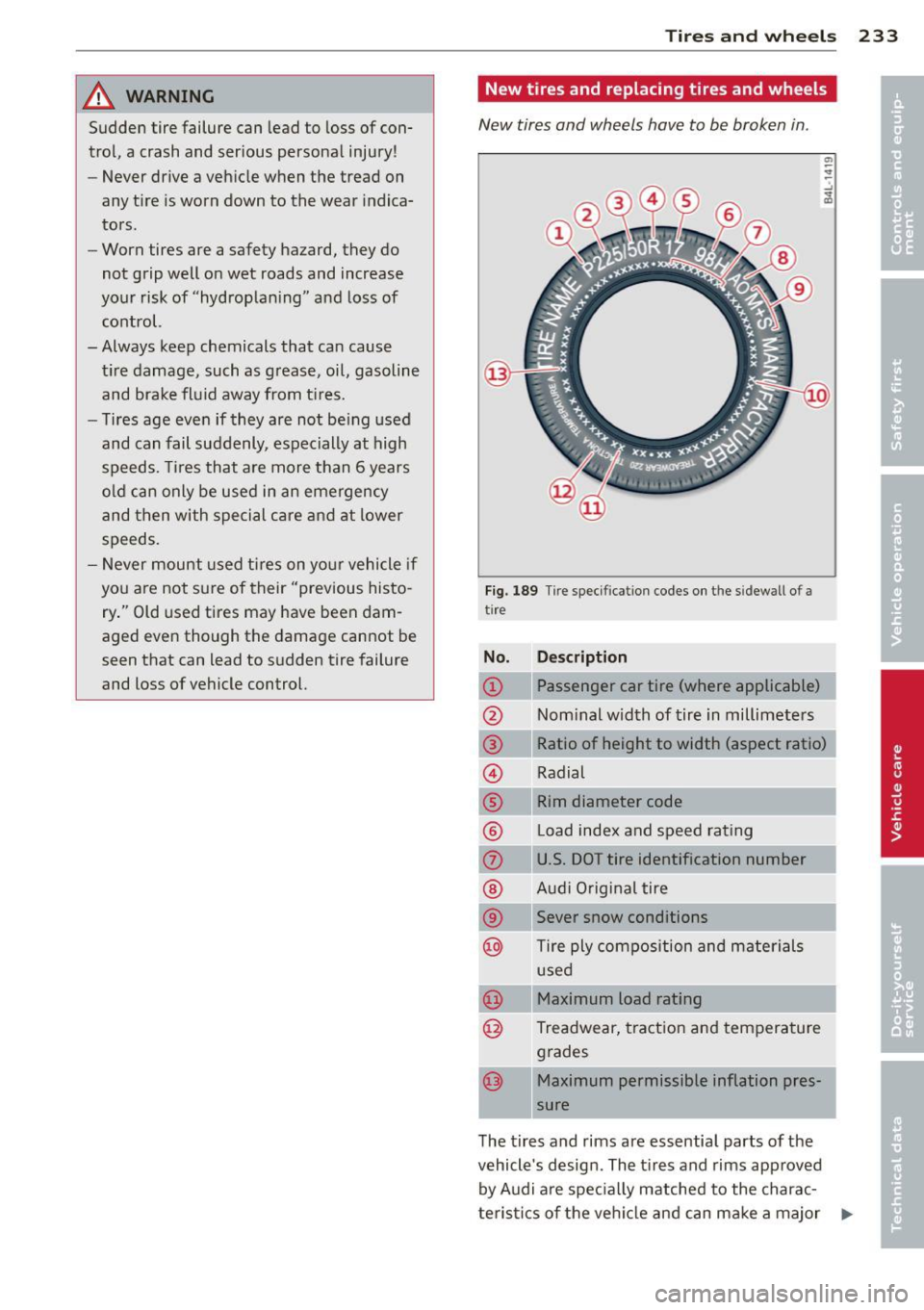
New tires and replacing tires and wheels
New tires and wheels have to be broken in .
Fig. 189 Tir e specificat ion codes on t he s idewall o f a
tire
No. Description
CD Passenger car tire (where applicable)
@ Nominal width of tire in millimeters
® Ratio of height to width (aspect ratio)
© Radial
® Rim diameter code
® Load index and speed rat ing
(f) U.S. DOT tire identification number
® Audi Original tire
® Sever snow conditions
@ Tire ply composition and materials
used
@ Maximum load rating
@ Treadwear, traction and temperature
grades
@ Maximum permissible inflation pres-
sure
The tires and rims are essential parts of the
vehicle's design . The ti res and rims approved
by Audi are spec ially matched to the charac
teristics of the vehicle and can make a major .,.
•
Page 238 of 286
236 Tire s and whee ls
vehicle handling and can lead to a loss of
control.
- If the replacement tire is not the same as
the tires that are mounted on the vehicle
- for example with winter tires - only use
the replacement t ire for a short period of
t ime and dr ive with extra care . Refit the
normal road wheel as soon as safely pos
sible.
- Never drive faste r than the maximum
speed for which the tires on your veh icle
are rated because ti res that are driven
faster than their rated speed can fail
sudden ly.
- Overloading t ires cause heat build-up,
sudden tire failure, including a blowo ut
and sudden deflation and loss of control.
- T emperature grades app ly to tires that
are properly inflated and not over or un
derinflated.
- For technical reasons it is not a lways
possible to use wheels from othe r
vehicles -in some cases not even wheels
from the same vehicle model.
- If you install wheel trim discs on the ve hicle whee ls, make sure that the air f low
to the brakes is not blocked . Reduced air
flow to the brakes can them to overheat, increasing stopping distances and caus
ing a collision .
- Run flat tires may only be used on
vehicles that were equipped w ith them
at the factory . The vehicle must have a
chassis des igned for run flat t ires and a
factory-installed t ire pressure monitor
ing system* that indicates a loss of ti re
pressure. Incorrec t use of run flat tires
can lead to vehicle damage or accidents .
Check with an authorized Audi dea ler or
tire spec ialist to see if your vehicle can be
equipped with run flat tires . If run flat
tires are used, they must be installed on
all four wheels. M ixing tire types is not
permitted .
(D Note
-For technica l reasons, it is not genera lly
possible to use the wheel r ims from oth- er vehicles.
This can hold true for wheels
of the same vehicle type.
- If a rep lacement tire is different from
the tires that you have mounted on your
vehicle (for example winter tires or wide profile tires), then use the rep lacement
tire for a short period of time only and dr ive with extra care. Replace the flat tire
w ith the tire match ing the others on your
vehicle as soon as possible.
- Never drive without the valve stem cap .
The valves could get damaged .
® For the sake of the environment
D ispose of o ld tires in accordance with the
local requirements .
Uniform tire quality grading
-Tread wear
- Traction AA A B C
- Tempe rature ABC
Quality grades can be found where applicab le
on the t ire s ide wall between tread shou ld er
and maximum section width c> page 233,
fig. 189 .
For exampl e: Tread wear 200 , Traction AA,
Temperature A.
All passenger car t ires must conform to Feder
al Safety Requirements in addition to these
grades.
Tread wear
T he tread wear grade is a comparative rating
based on the wear rate of the t ire when tested
u nder controlled conditions on a specified
government test course .
For example, a tire graded 1S0 would wear
one and one ha lf (11/2) times as well on the
gover nment course as a t ire graded 100 .
The relative performance of tires depends upon the actual conditions of their use, how
ever, and may depa rt s ignificantly from the
norm due to va ria tions in d riving hab its, serv
ice practices and differences in road character-
istics and climate.
ll-
Page 241 of 286
Wheel bolts
Wheel bolts must always be tightened to the
correct torque .
The design of wheel bolts is matched to the
factory installed r ims. If differen t rims are fit
ted, the correct wheel bolts with the right l ength and correctly shaped bolt heads must
be used. This ensures that wheels are fitted
securely and that the brake system functions
correctly .
In certain circumstances, you may not use
wheel bo lts from a different vehicle -eve n if it
i s the same model
¢ page 266.
_&. WARNING
Improperly tig htened or maintained whee l
bolts can become loose ca using loss of
contro l, a co llision and serious persona l in
jury.
- Always keep the wheel bolts and the threads in the wheel hubs clean so the
whee l bolts can turn easily and be prop
erly t ightened.
- Never grease or oil the wheel bo lts and
the threads in the wheel hubs. They can become loose wh ile driving if greased or
o iled, even if tightened to the specif ied
torque .
- Only use wheel bolts that belong to the
rim being installed.
- Never use different whee ls bolts on your
vehicle .
-Always maintain the correct tighten ing
torque for the wheel bo lts to reduce the
risk of a wheel loss . If the tightening tor
que of the wheel bolts is too low, they
can loosen and come out when the vehi
cl e is moving.
If the tightening torque is
too high, the whee l bolts and threads
can be damaged and the wheel can be
come loose.
Q;) Note
The spec ified torque fo r the wheel bo lts is
90 ft lbs. (120 Nm) with a tolerance of
± 7,4 ft lbs.(± 10 Nm). Torque wheel bo lts
Tire s an d wheel s 239
diagonally. After changing a wheel, the
torque m ust be checked as soon as possi
ble with a torque wrench -preferably by an
a uthori zed Audi dea ler or qualified work
shop.
Low aspect ratio tires
Your Aud i is factory -equ ipped w ith low aspect
ratio tires . These tires have been tho roughly
tested and been se lected specifically fo r your
model for their superb perfo rmance, road fee l
and hand ling under a var iety o f driving cond i
tions. Ask your authorized Audi dealer for
more details .
T he low aspect ratio of these t ires is ind icated
by a numeral of
55 or l ess in the tire's s ize
designation. The numera l rep resents the ra tio
of the tire's sidewa ll height in relation to its
tread width expressed in percentage . Conven
tiona l tires have a he ight/w idth ratio of 60 or
more.
T he performance of low-a spe ct- ra tio tire s is
p ar tic ul ar ly se nsi tiv e to i mprop er i nfl ation
pre ssure. It is the refo re important that low
a spect ratio t ires are inflated to the specified
pr ess ure and that th e inflation pr essur e is
r e gula rly ch ecked and maintain ed. Tir e pre s
s ure s should b e check ed at l east once a
m onth and alwa ys befo re a long trip
¢ page 228, Checking tire pressure.
What you c an do to avo id tire and rim
damage
Low aspect ratio tires can be damaged mo re
easily by impact w ith potholes, curbs, g ull ies
o r ridges on the road, pa rticularly if the tire is
u nderinflated.
In orde r to minimize the occurrence of impact
damage to the tires of your vehicle, we recom
mend that you observe the following p reca u
tions:
- Always ma inta in recommended inflation
pressu res. Check your tire pressure eve ry
2,000 miles (3,000 km) and add air if neces-
sary . .., •
•
Page 248 of 286

24 6 What do I do no w?
• Engage the par king br ake to prevent your
vehicle from rolling unintentionally
c> _&..
• Move the sel ector le ver to the P po sition.
• Take the jack c> page 243 out of the luggage
compartment.
A WARNING
You or your passengers could be injured
wh ile cha nging a wheel if you do not fol
low these safety precautions:
- If you have a flat t i re, move a safe dis
tance off the road . Turn off the engine,
tu rn the emergen cy flashers on and use
other wa rning dev ices to alert other mo
torists.
- Make su re that passengers wait i n a safe
pla ce away from the vehicle and well
away from the road and traff ic.
- T o help prevent the veh icle from mov ing
sudden ly and possibly slipping off the
jack, a lways fully set the parking brake
and block the whee l diagona lly opposite
the whee l being changed with the fo ld
ing chocks or other objects. When one
front whee l is lifted off the ground, plac
ing the Automat ic Transmiss ion in "P"
(Pa rk) w ill
not prevent the vehicle from
moving.
- Before you change a wheel, be sure the ground is level and firm . If necessary,
use a sturdy board unde r the jack.
- Always store the vehicle tool kit, the
jack* and the replaced tire in the luggage
compartment
c> page 124.
(D Note
If you are chang ing the wheel on a steep
incline, use a rock or similar object to
b loc k the opposite wheel to prevent the
veh icle from mov ing.
Obey all laws.
-
Changing a wheel
When you change a wheel, follow these
quence described below step-by-step and in
exactly that order .
l. Remove the wheel bolt caps* . For more
details see also
c> page 247, Wheels with
wheel bolt caps.
2. Loosen the wh eel bolts c>page 247.
3. Locate the p roper mounting point fo r the
ja ck a nd align the jack below that point
c>page248 .
4. Lift the car with the jack c> page 248 .
5. Remove the wheel with the flat tire and
then insta ll the other wheel
c> page 249.
6. Tighten all wheel bolts lightly.
7.
Lower the vehicle with the jack .
8. Use the wheel bolt w rench and
firmly
t ighten all wheel bolts in a crisscross pat
te rn
c> page 247.
9. Replace the wheel bolt cap s*.
A WARNING
Always read and fo llow all WARN INGS and
informat ion c> .&. in Raising the vehicle on
page 248
and c> page 250 .
After changing a wheel
A wheel change is not comple te without the
doing the following .
• Always store the vehicle tool kit, the jack*,
and the rep laced tire in the luggage com
partment
c> page 124.
• As soon as possib le, have the t ightening
torque s
on all whee l bolts checked with a
torque wrench. The correct tightening tor
que is 90 ft lbs. (120 Nm).
• Have the flat tire
re plac ed as soon as possi
ble.
(D Tips
- If you not ice that the wheel bolts are
corroded and difficult to turn while
chang ing a tire, they should be replaced
before you check the tightening torque .
Page 250 of 286

248 What do I do now?
down on the end of the wheel bolt
wrench with
one foot only . As you do so,
hold on to the car to keep your balance
and take care not to slip.
Raising the vehicle
The vehicle must be li~ed with the jack first
before the wheel can be removed.
Fig. 196 Sill panels: mark ings
Fig. 197 Sill: posit ion ing t he veh icle jack
The location of the jack point is indicated by
an indentat io n on the underside of the vehicle
~ fig. 196 .
• Activate the parking brake to prevent the
vehicle from rolling unintentionally.
• Move the selector lever to posit ion P.
• Find the
marking on the si ll that is nearest
the wheel that w ill be changed
<=>fig. 196 .
Behind the marking, there is a lifting point
on the sill for the vehicle jack.
• Turn the
vehicle jack located under the lift
ing point on the si ll to raise the jack until
the jaw
r::> fig. 19 7 @ covers the notch on
the vehicle<=> &<=>CD .
• Align the vehicle jack so the jaw@ covers
the notch and the base p late @ is flat on
the floor . The base plate@ must be
vertical
under the lifting point @. •
Install the rod on the vehicle jack : Insert the
rod into the opening on the handwheel. Turn
the rod left or r ight to secure it.
• Continue raising the jack with the rod unt il
the wheel lifts off the ground slightly.
Position the vehicle jack
only under the desig
nated lifting points on the si ll
<=>fig. 196.
There is exactly one location for each wheel.
The jack must not be positioned at any other
location <=> .&. <=>CD .
Soft ground under the jack can cause the ve
hicle to slip off the jack. Always place the jack
on firm ground. Use a flat, stable support if
necessary. Use a non -slip surface such as a
rubber mat on a
slippery surface such as tile .
.&, WARNING
-You or your passengers could be inju red
while changing a wheel if you do not fo l
low these safety precautions:
- Position the vehicle jack only at the designated lifting points and align the
jack. Otherwise, the vehicle jack could
slip and cause an injury if it does not
have sufficient hold on the vehicle.
-A soft or unstable surface under the jack may cause the vehicle to slip off
the jack. Always provide a firm base for
the jack on the ground. If ne cessa ry,
us e a sturdy board under the jack.
- On hard, slippery su rface (such as tiles)
u se a rubber mat or similar to prevent
the jack from slipping.
- To help prevent injury to yourself and
your passengers:
- Do not raise the vehicle until you are
sure the jack is securely engaged.
- Passengers must not remain in the ve
hicle when it is jacked up.
- Make sure that passengers wait in a
safe place away from the veh icle and
well away from t he road and traffic.
- Make sure jack position is correct, ad
ju st as necessary and then continue to
raise the jack. .,_