seat adjustment AUDI RS5 CABRIOLET 2015 Owners Manual
[x] Cancel search | Manufacturer: AUDI, Model Year: 2015, Model line: RS5 CABRIOLET, Model: AUDI RS5 CABRIOLET 2015Pages: 284, PDF Size: 69.56 MB
Page 62 of 284
60 Seats and stor age
Seats and storage
General recommen
dations
Why is your seat adjustment so
important?
The safety belts and the airbag system can
only provide maximum protection if the front
seats are correctly adjusted.
There are various ways of adjusting the front
seats to provide safe and comfortable support
for the driver and the front passenger. Adjust
you r seat prope rly so that :
- you can easily and quickly reach all the
switches and controls in the instrument
panel
-your body is properly supported thus reduc
ing physical stress and fatigue
- the safety be lts and airbag system can offer
maximum protection
¢ page 131.
In the following sections, you will see exactly
how you can best adjust your seats .
There are special regulations and instructions
for installing a child safety seat on the front
passenger's seat. Always follow the informa
tion regarding child safety provided in
¢ page 152, Child Safety.
WARNING
Refer to¢ page 112, Driving Safely for
important information, tips, suggestions
and warnings that you should read and fol
low for your own safety and the safety of
your passengers.
A WARNING
, -
Incorrect seating position of the driver and
all other passengers can result in serious
personal injury .
- Always keep your feet on the floor when
the vehicle is in motion -never put your
feet on top of the instrument panel, out of the w indow or on top of the seat cush
ion. This applies especially to the passen- gers
. If your seating position is incorrect,
you increase the risk of injury in the case
of sudden braking or an accident. If the
airbag inflates and the seating position is incorrect, this could result in personal
injury or even death.
- It is important for both the driver and front passenger to keep a distance of at
least 10 inches (25 cm) between them
selves and the steering wheel and/or in
strument panel.
If you're sitting any
closer than this, the airbag system can
not protect you properly. In addition, the
front seats and head restraints must be
adjusted to your body height so that they
can give you maximum protection.
- Always try to keep as much distance as
possible between yourself and the steer
ing wheel or instrument panel.
- Do not adjust the driver's or front pas
senger 's seat while the vehicle is moving.
Your seat may move unexpectedly, caus
ing sudden loss of veh icle control and
personal injury. If you adjust your seat
while the veh icle is moving, you are out
of posit ion.
Driver's seat
The correct seat position is important for safe
and relaxed driving .
We recommend that you adjust the driver's
seat in the following manner :
.. Adjust the seat in fore and aft direction so
that you can easily push the pedals to the
floor wh ile keeping your knees slightly bent
o &. in Why is your seat adjustment so im
portant? on page
60 .
.,. Adjust the seatback so that when you sit
w ith your back against the seatback , you can
still grasp the top of the steering wheel.
.. Applies to vehicles with adjustable head re
straints: Adjust the head restraint so the up
per edge is as even as possible with the top
of your head. If that is not possible, try to
adjust the head restraint so that it is as .,.
Page 63 of 284

"' N
a: LL co
rl I.O
"' rl
"' rl
close to this position as possible
¢page 63.
A WARNING
Never place any objects in the driver's foot
well. An object could get into the pedal
area and interfere with pedal function. In
case of sudden braking or an accident, you
would not be able to brake or accelerate .
Front passenger's seat
Always move the front passenger seat into
the rearmost position .
To avoid contact with the airbag while it is de
ploying, do not sit any closer to the instru
ment panel than necessary and always wear
the three-point safety belt provided adjusted
correctly . We recommend that you adjust the
passenger's seat in the following manner:
.,. Bring the backrest up to an (almost) upright
position.
Do not ride with the seat reclined .
.,. Applies to vehicles with adjustable head re
stra ints: Adjust the head restraint so the up
per edge is as even as possible with the top
of your head. If that is not possible, try to
adjust the head restraint so that it is as
close to this position as possible
¢ page 63.
.,. Place your feet on the floor in front of the
passenger's seat .
Front seats
Power seat adjustment
Fig. 68 Front seats: power seat adjustment
Seats and storage 61
Controls
@-Adjusting the lumbar support*: press the
button in the corresponding position ¢
.&..
@ -Moving the seat up/down: press the but
ton up/down ¢ ,&. .
®-Moving the seat forward/back: press the
button forward/back¢ ,&..
©-Adjusting the backrest angle : press the
button forward/back ¢,&. .
©-Raising/lowering* the head restraints:
press the button up/down¢,&. .
@ -Lengthening/shortening the upper thigh
support* :
lift the handle. A spring moves the
front seat cushion forward ¢
.&..
A WARNING
--
- Never adjust the driver's or front pas
senger's seat while the vehicle is moving.
If you do this while the veh icle is moving,
you will be out of position. Always adjust
the dr iver's or front passenger's seat
when the vehicle is not mov ing.
- Be careful when adjusting the seat
he ight. Check to see that no one is in the
way, or ser ious injury could result!
- Because the seats can be electrically ad
justed with the ignition off or with the
ignit ion key removed, never leave chil
dren unattended in the vehicle. Unsuper
vised use of the electric seat adjust
ments may cause serious injury.
- To reduce the risk of injury in the case of
sudden braking or accident, front pas
sengers must never ride in a moving ve
hicle with the backrest reclined. Safety
belts and the airbag system only offer
maximum protection when the backrest
is upr ight and the safety belts are prop
erly positioned on the body. The more
the backrest is reclined, the greater the
risk of persona l injury from an incorrect
seating position and improperly posi
tioned safety belts.
Page 64 of 284
62 Seats and storage
Power easy entry function
The easy entry function makes it easier for
the rear passengers to enter and leave the ve
hicle .
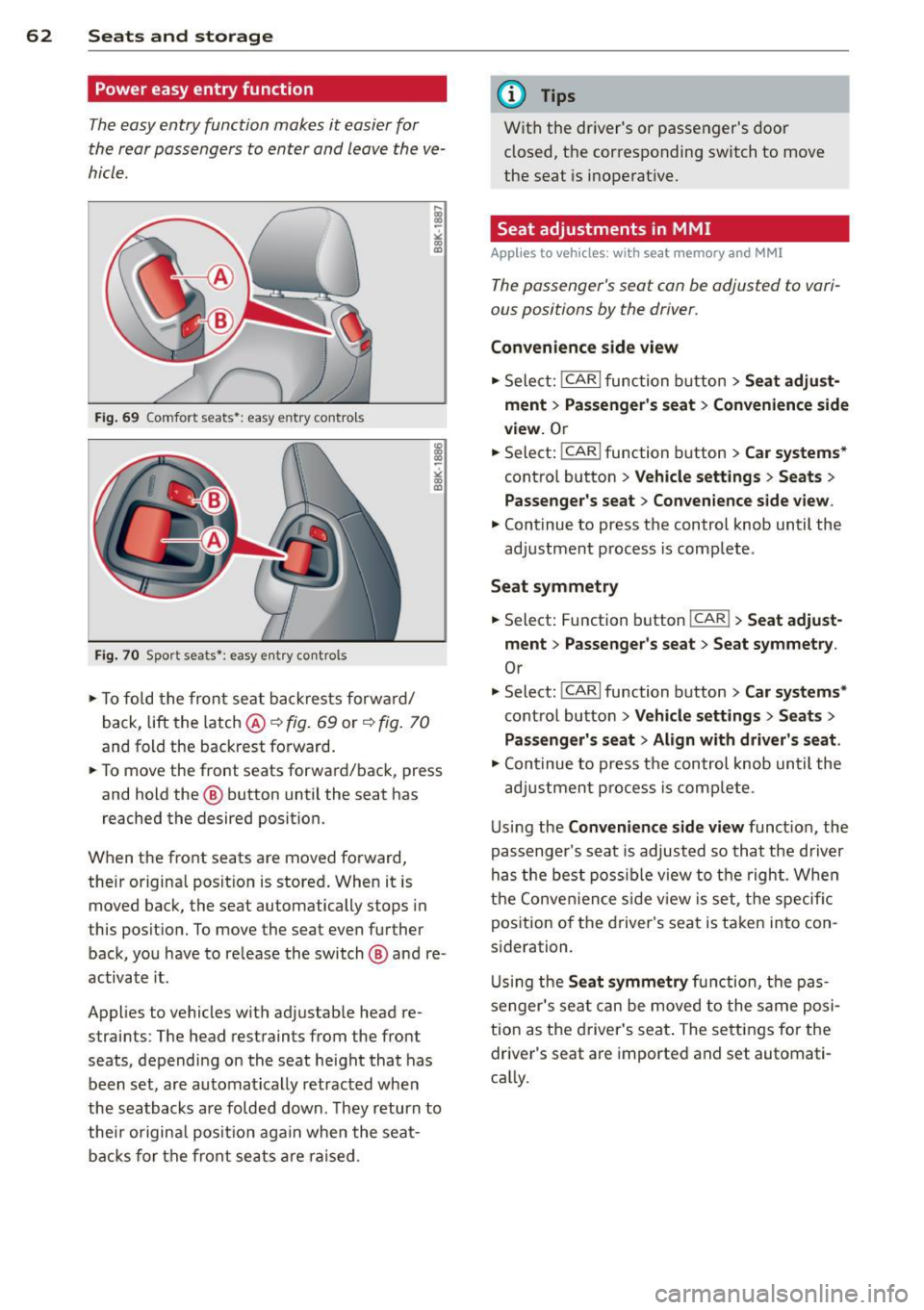
Fig. 69 Comfort seats•: easy entry contro ls
Fi g. 70 Spor t seats •: easy e ntry contro ls
• To fold the fron t seat backrests forwa rd/
back,
lift the latch @~ fig. 69 or~ fig. 70
and fold the backrest forward.
• To move the front seats forward/back, press
and hold the @ button until the seat has
reached the desired position.
When the front seats are moved forward,
their original pos it ion is stored . When it is
moved back, the seat automatically stops in
this position. To move the seat even further back, you have to re lease the switch @ and re
activate it.
Applies to vehicles w it h ad justab le head re
straints : The head restraints from the front
seats, depending on the seat height that has
been set, are automatically retracted when
the seatbacks are folded down . They return to
thei r o rigina l posit io n aga in when the sea t
bac ks for the front seats a re raised .
(D Tips
With the driver's or passenger's door
closed, the corresponding switch to move
the seat is inoperat ive.
Seat adjustments in MMI
Appl ies to vehicles: with seat memory and MMI
The passenger's seat can be adjusted to vari
ous positions by the driver.
Conven ience side view
• Select: !CAR I function button > Seat adju st
ment
> P ass enger' s se at > Con venience side
view.
O r
- -• Select: I CAR I function button > Ca r systems *
control button > Ve hicle s ettings > Seats >
Passenger 's seat > Convenience side view .
• Continue to press the control knob until the
adjustment process is complete.
Seat symmetry
• Select: Function button !CAR !> Seat adjust
ment > Passenger's seat > Seat s ymmetry .
Or
• Select: !CARI function button> Car systems *
control button > Vehicle s ettings > Se ats >
Pa sseng er's s eat > Align with driv er's seat.
• Cont inue to press the control knob until the
adj ustment p rocess is comp lete.
U sing the
Con veni ence side view funct ion, the
passenger 's seat is adjusted so that the driver
has the best poss ible view to the righ t. Whe n
the Conve nience s ide v iew is set, the specific
position of the driver's seat is taken into con
sideration.
U si ng the
Seat symm etry function, the pas
senger's seat can be moved to the same po si
tion as the driver 's seat . The settings for the
driver's seat are imported and set automati
ca lly.
Page 65 of 284
"' N
a: LL co
rl I.O
"' rl
"' rl
Center armrest
The center armrest can be adjusted to several
levels .
Fig. 71 Armrest between t he drive r's/front passenger's
seats.
Adjusting the center armrest
.. To adjust the angle, raise the armrest from
the starting position
r=:> fig. 71 detent by de
tent.
.. To bring the armrest back into the starting
pos ition, raise it out of the top detent and
fold it back down.
The arm rest can slide forward and back .
Head restraints
Front head restraints
Applies to vehicles: with ad justable head restraints
Head restraints that are adjusted according
to body size, along with the seat belt, offer
effective protection.
....
::::=;~~-..:.:::::~ I
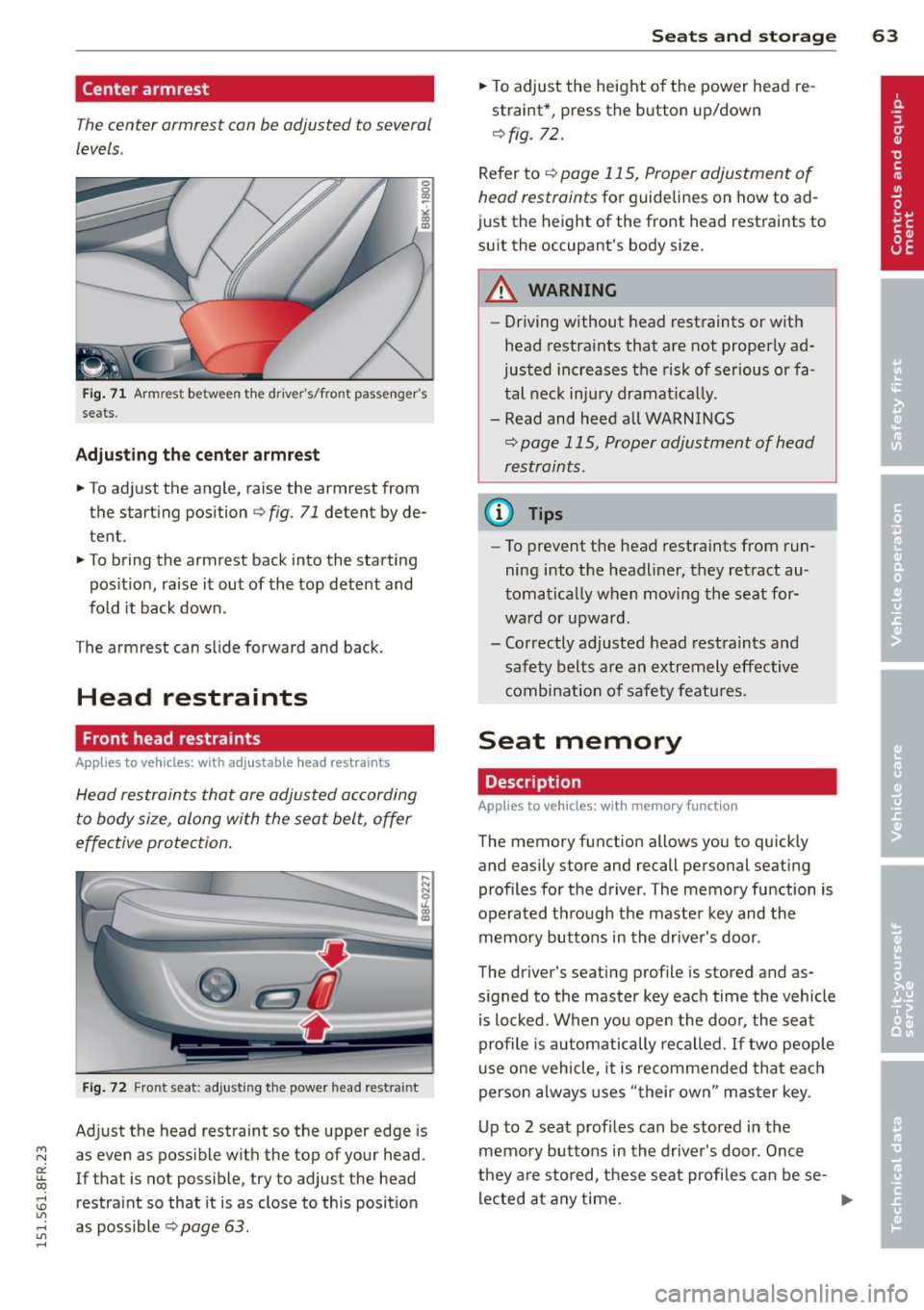
Fig . 72 Fro nt seat: adjusting the power head restra int
Adjust the head restraint so the upper edge is
as even as possible with the top of your head.
If that is not possible, try to adjust the head
restra int so that it is as close to this position
as poss ible r=:>
page 63 .
Seats and storage 63
.. To adjust the height of the power head re
straint*, press the button up/down
<=:> fig. 72.
Refer to <=:> page 115, Proper adjustment of
head restraints
for guidelines on how to ad
just the height of the front head restraints to
suit the occupant's body size.
A WARNING
- Driving without head restraints or with
head restraints that are not properly ad
justed increases the risk of serious or fa
tal neck injury dramat ically.
- Read and heed all WARNINGS
<=:> page 115, Proper adjustment of head
restraints .
@ Tips
-To prevent the head restraints from run
ning into the headliner, they retract au
tomatically when moving the seat for
ward or upward.
- Correctly adjusted head restraints and
safety belts are an extremely effective
combinat ion of safety features.
Seat memory
Description
App lies to vehicles: wit h memo ry function
-
The memory fun ction allows you to quickly
and easily store and recall personal seating
profiles for the driver. The memory function is
operated t hrough the master key and the
memory buttons in the driver's door .
The driver's seating profile is stored and as
signed to the master key each time the vehicle
is locked. When you open the door, the seat
profile is automatically recalled . If two peop le
use one vehicle, it is recommended that each
person always uses "their own " master key.
Up to 2 seat profiles can be stored in the
memory buttons in the driver's door . Once
they a re stored, these seat profiles can be se-
lected at any time.
IJII,-
Page 66 of 284

64 Seats and storage
In addition to the driver 's seat settings, you
can also store and access the exterior mirror
ad justment settings* using the remote con
trol key or memory button.
Remote control key
Applies to vehicles: with seat memory
To assign the driver's seat settings to the re
mote contro l key when locking the vehicle, the
function must be activated in the radio or
MMI*
• Se lect :
I CAR I funct ion button> Seat adj ust
ment
> Dri ver's se at > Remote c ontrol k ey >
on .Or
• Se lect :
,..,I Cc-cAc-cRc-, 1 funct ion button > Car system s*
control button > Vehicle setting s > Seats >
Driv er' s s eat > Remot e cont rol key > On .
(D Tips
If you do not want another d river's set
tings to be assigned to the remote key,
sw itch off the memory function us ing the
rad io or MMI* or the
!ON/OFF I button
c:::>page 64.
Memory buttons
App lies to vehicles: with seat memory
Fig. 73 Driver 's door: memory functio n buttons
The memo ry but tons are located in the dr iv
e r's door .
Switching the memory function on /off
• Press the ION/O FF I button to switch the
memo ry fu nction on/off. The word
OFF
li ghts up when the memory funct io n is
swit ched off. Seat profi les are neither stored
nor recalled .
Storing a s eat p rofile
• Press the ISET I button. When the word SET
lights up, the memory is ready to store set
tings.
• Press a memory button
dII or [Ii) briefly . A
tone confirms that the settings were stored.
Acces sing a seat profile
• If the driver's door is open and the ignition
is switched off, press the memory button.
• If the driver's door is closed or the ignition is
switched on, press and ho ld the memory
button until the seat adjustment is com
plete .
A WARNING
-For safety reasons ., the seat setting can
only be recalled when the vehicle is sta
tionary -ot herwise you ris k having an ac
cident.
- I n an emergency the recall proced ure can
be cancelled by p ressing the
ION/OFF I
sw itch or by tapping the memory bu t
ton s.
Ashtray
Fig. 7 4 Center console : ashtray
Opening /cl osi ng
• To open the ashtray, slide the cover up
c:::> fig. 74.
• To close the ashtray, press down on the cov
er.
Emptying the ashtray
• To remove the insert, s lide the latch to the
right
c:::> fig. 74 -arrow- . ..,_
Page 117 of 284

"' N
a: LL co
rl I.O
"' rl
"' rl
-Passengers must always sit in an upright
posit ion and never lean against or place
any part of their body too close to the
area where the airbags are located .
- Passengers who are unbelted, out of po
sition or too close to the airbag can be
seriously injured by an airbag as it un
folds with great force in the blink of an
eye .
- Always make sure that there are at least 10 inches (25 cm) between the front
passenge r's breastbone and the instru
ment pane l.
- Ea ch passenger must always sit on a seat
of the ir own and properly fasten and
wear the safety bel t be long ing to that
seat .
- Before driv ing, a lways adj ust the front
passenger seat and head restra int prop
er ly .
- Always keep your feet on the f loor in
front of the seat . Never rest them on the
seat, instrument panel, out of the win
dow, etc . The airbag system and safety
belt w ill not be ab le to protect you prop
er ly and can even increase the risk of in
jury in a crash .
- Never drive with the backrest reclined or tilted far back! The farther the backrests
are ti lted back, the greater the risk of in
jury due to incorrect positioning of the
safety belt and improper seating posi
t io n.
- Children must always ride in child safety
seats
c::> page 152 . Special precautions
apply when installing a child safety seat
o n t he front pas senge r sea t
c::> page 131.
Proper seating positions for passengers
in rear seats
Rear seat passengers must sit upright with
both feet on the floor consistent with their
physical size and be properly restrained whenever the vehicle is in use.
To reduce the risk of injury caused by an incor
rect seat ing pos ition in the event of a sudden
braking maneuver or an accident, your pas-
Dr ivin g Sa fely 115
sengers on the rear bench seat must always
observe the following:
'" Make su re that the seatba ck is secure ly
la tched in the up right position
c::> page 66.
'" Keep both feet flat in the footwell in front of
the rear seat.
'" Fasten and wear safety belts proper ly
c::> page 126 .
'"Make sure that children are always properly
restrai ned in a child restraint that is appro
pr iate for the ir s ize and age
c::> page 152.
.&, WARNING
Passengers who are imp roperly seated on
the rea r seat can be seriously i njured in a
crash.
- Each passenge r must always si t on a seat
of their own and properly fasten and
wear the safety belt belonging to that
seat.
- Safety belts only offer maximum protec
tion when the sea tback is sec urely latch
ed in the upright position and the safety
be lts are properly positioned on the
body. By not sitting upright, a rear seat
passenger increases the risk of personal
inj ury from improperly positioned safety
be lts!
Proper adjustment of head restraints
App lies to vehicles: with adjustable head restraints
Correctly adjusted head restraints are an im
portant part of your vehicle's occupant re
straint system and can help to reduce the risk
of injuries in accident situations .
Fig . 1 32 Head restra int: vi ewed from the front
Page 133 of 284

M N
er
u..
co ,...., \!) 1.1'1 ,...., 1.1'1 ,....,
Airbag system Important things to know
Importance of wearing safety belts and
sitting properly
Airbags are only supplemental restrain ts . For
airbags to do their job , occupants m ust al
ways properly wear their safety belts and be
in a proper seating position.
F or your safety and the safety of your passen
gers, before driving off, always:
"" Adjust the dr iver's sea t and steeri ng wheel
p roperly
¢ page 113,
"" Adjust the front passenger's seat properly
¢ page 61,
""Wear safety be lts properly ¢ page 126,
"" Always properly use the proper child re-
stra int to protect ch ildren
r::::> page 152.
In a collision airbags must inflat e within th e
blink of an eye and with considerable force .
The supplementa l airbags can cause injuries if
the dr iver or the front seat passenger is not
seated properly . T herefore in order to help the
a irbag to do its job, it is important, both as a
driver and as a passenge r to s it properly at all
times.
By keep ing room between your body and the
steer ing whee l and the front of the passenge r
compartment, the airbag can inflate fully and
comp lete ly and provide supp lemen tal protec
tion in ce rtain frontal collisions
r::::> page 113,
Proper occupant seating positions .
For deta ils
on the operation of the seat adjustment con
trols
¢ page 61.
It's espe cially important that children a re
p roperly restrained
r::::> page 15 2.
There is a lot that the d river and the passen
gers ca n and must do to help the individua l
safety features ins talled in your A ud i work to
gether as a system.
P rope r seat ing pos ition is important so that
the front airbag on the dr iver s ide ca n do its
job. If yo u have a physical impa irment or con-
A irbag system 13 1
dition that prevents yo u from sitting properly
o n the driver seat with the safety belt properly
fastened and reach ing the peda ls, spec ial
modifications to yo ur vehicle may be necessa
ry.
Contact your a uthorized Audi dea ler, or call
Audi C ustome r Re lations at 1-800 -822-2834 .
When the airbag system dep loys, a gas gene r
ator will fi ll the ai rbags, break open the pad
ded covers, and inf late between t he steering
whee l and the dr iver and between the instru
ment panel and the front passenger. The air
bags will deflate immediately after deploy
ment so that the front occupa nts can see
t hr ough the w indshield aga in witho ut inter
ruption .
All of th is takes place in the blink of an eye, so
fast that many people don't even realize that
the a irbags have deployed . The airbags also
inflate wi th a g reat dea l of force and noth ing
shou ld be in their way when they deploy.
Fron t airbags in combin ation wi th properly
worn safety belts slow down and lim it the oc
cupan t's forward movement. Together they
help to prevent the driver and front seat pas
senger from hitting parts of the inside the ve hicle while reducing the forces acting on the
occupant dur ing the crash. In this way they
help to reduce t he risk of injury to the head
and upper body i n the c rash . A irbags do not
protect the a rms o r the lower parts of the
body .
Both front a irbags w ill not inflate in all fronta l
collisions . The t riggering of the a irbag system
depends on the vehicle dece le rat ion rate
ca used by the co llision and registered by the
ele ctron ic co ntro l unit. If thi s rate is below
t he reference value programmed into the con
trol unit, the airbags will not be trigge red,
even though the car may be bad ly damaged as
a resu lt of the co llision . Veh icle damage, re
pair costs or even the lack of ve hicle damage
is no t necessarily an indication of whether an
airbag s hou ld inflate o r not .
It is not possib le to define a range of vehicle
speeds that w ill cover every possib le kind and ..,.
•
•
Page 155 of 284

-If you must install a rearward facing
child safety seat on the front passenger
seat in exceptional circumstances and
the
PASSENGER AIR BAG OFF light does
not come on and stay on, immediately
install the rearward-facing child safety
seat in a rear seating position and have
the airbag system inspected immediately by your authorized Audi dealer.
,& WARNING
If, in exceptional circumstances, you must
install a forward-facing child restraint on
the front passenger's seat:
- Always make sure the forward-facing
seat has been designed and certified by
its manufacturer for use on a front seat
with a passenger front and side airbag.
- Always follow the manufacturer's in
structions provided with the child safety
seat or carrier.
- Always move the passenger seat into its
rearmost position in the seat's fore and
aft adjustment range, as far away from
the airbag as possible before installing
the child restraint. The backrest must be adjusted to an upright position .
- Always make sure that the
PASSENGER
AIR BAG OFF
light comes on and stays
on all the time whenever the ignition is
switched on.
@ Tips
Always replace child restraints that were
installed in a vehicle during a crash. Dam
age to a child restraint that is not visible
could cause it to fail in another collision
situation.
Advanced front airbag system and children
Your vehicle is equipped with a front "Ad
vanced Airbag System" in compliance with
M N United States Federal Motor Vehicle Safety er
~ Standard (FMVSS) 208 as applicable at the ,....,
~ time your vehicle was manufactured .
,....,
"' ,....,
Child Safety 153
The Advanced Airbag system in your vehicle
has been certified to meet the "low-risk" re
quirements for 3- and 6-year old children on
the passenger side and small adults on the driver side. The low risk deployment criteria
are intended to reduce the risk of injury
through interaction with the airbag that can
occur, for example, by being too close to the
steering wheel and instrument panel when
the airbag inflates. In addition, the system
has been certified to comply with the "sup
pression" requirements of the Safety Stand
ard, to turn off the front airbag for infants up
to 12 months who are restrained on the front passenger seat in child restraints that are list
ed in the Standard.
Even though your vehicle is equipped with an
Advanced Airbag system, all children, espe
cially those 12 years and younger, should al
ways ride in the back seat properly restrained
for their age and size . The airbag on the pas
senger side makes the front seat a potentially
dangerous place for a child to ride . The front
seat is not the safest place for a child in a for
ward-facing child safety seat. It can be a very
dangerous place for an infant or a larger child
in a rearward-facing seat.
Advanced Airbags and the weight
sensing mat in the front seat
The Advanced Airbag System in your vehicle
detects the presence of an infant or child in a
child restraint on the front passenger seat us
ing the weight-sensing mat in the seat cush
ion and the sensor below the safety belt latch
on the front passenger seat that measures the
tension on the safety belt.
The weight-sensing mat measures total
weight of the child and the child safety seat
and a child blanket on the front passenger
seat. The weight on the front passenger seat
is related to the design of the child restraint
and its "footprint", the size and shape of the
bottom of the child restraint as it sits on the
seat. The weight of a child restraint and its "footprint" vary for different kinds of child re -
straints and for the different models of the ..,. •
•
Page 158 of 284

156 Child Safety
&_ WARNING
Not using a child safety seat, using the
wrong child safety seat or improperly in
stalling a child restraint increases the risk
of serious personal injury and death .
-All vehicle occupants and especially chil
dren must always be restrained properly
whenever riding in a vehicle.
-
- An unrestrained or improperly restrain
ed child can be injured or killed by be
ing thrown against the inside of the ve
hicle or by being ejected from it during
a sudden maneuver or impact .
- An unrestrained or improperly restrain
ed child is at much greater risk of injury
or death by being struck by an inflating
airbag.
- Commercially available child safety seats
are required to comply with U.S. Federal
Motor Vehicle Safety Standard (FMVSS)
213 (in Canada CMVSS 213).
- When buying a child restraint, select
one that fits your child and the vehicle.
- Only use child restraint systems that
fully contact the flat portion of the
seat cushion. The child restraint must not tip or lean to either side. Audi does
not recommend using child safety
seats that rest on legs or tube -like
frames . They do not provide adequate
contact with the seat.
-Always heed all legal requirements per
taining to the installation and use of
child safety seats and carefully follow
the instructions provided by the manu
facturer of the seat you are using.
- Never allow children under 57 inches
(1.45 meters) to wear a normal safety
belt. They must always be restrained by a
proper child restraint system. Otherwise,
they could sustain injuries to the abdo
men and neck areas during sudden brak
ing maneuvers or accidents.
- Never let more than one child occupy a
child safety seat . -
Never let babies or older children ride in
a vehicle while sitting on the lap of an
other passenger .
- Holding a child in your arms is never a
substitute for a child restraint system.
- The strongest person could not hold
the child with the forces that exist in
an accident. The child will strike the in
terior of the vehicle and can also be
struck by the passenger.
- The child and the passenger can also
injure each other in an accident.
- Never install rearward-facing child safety
seats or infant carriers on the front pas
senger seat. A child will be seriously in
jured and can be killed when the passen
ger airbag inflates -even with an Ad
vanced Airbag System .
- The inflating airbag will hit the child
safety seat or infant carrier with great
force and will smash the child safety
seat and child against the backrest,
center arm rest, door or roof.
= Always install rearward-facing child
safety seats or infant carriers on the
rear seat.
- Forward-facing child safety seats instal
led on the front passenger's seat can in
terfere with the airbag when it inflates and cause serious injury to the child. Al
ways install forward-facing child safety seats on the rear seat .
- If exceptional circumstances require the
use of a forward-facing child restraint on
the front passenger's seat, the child's
safety and well-being require that the
following special precautions be taken:
- Make sure the forward-facing seat has
been designed and certified by its man
ufacturer for use on a front seat with a
passenger front and side airbag.
- Always carefully follow the manufac
turer's instructions provided with the
child safety seat or carrier.
- Always move the front passenger seat
into the rearmost position of the pas-
senger seat's fore and aft adjustment
~
Page 159 of 284

"' N
a: LL co
rl I.O
"' ,....,
"' rl
range, and as far away from the airbag
as poss ible before instal ling the child
restraint.
- Always make sure that nothing pre
vents the front passenger's seat from be ing moved to the rearmost position
i n its fore and aft adjustment range.
- Always make sure that the backrest is
in the upr ight position.
- Always buckle the child safety seat firmly
in place even if a child is not sitting in it.
A loose ch ild safety seat can fly around
dur ing a sudden stop or in a coll is ion .
- Always read and heed all WARNINGS
whenever using a child restrained in ave
hicle is being used
c:::;,page 123, Safety
belts,
c:::;, page 131, Airbag system and
¢ page 152, Child Safety.
.8, WARNING
To reduce t he risk of serious injury, make
sure tha t t he
PASSENGER AIR BAG OFF
light comes on and stays on whenever a
child rest raint is installed o n the front pas
senger seat and the ignition is switched
on.
- Take the child restraint off the front pas
senger seat and install it proper ly at one
of the rear seat positions if the
PASSEN
GER AIR BAG OFF
light does not stay on.
- Have the airbag system inspected by your authorized Aud i dealer immediate
ly.
Secure unused safety belts on the rear
seat
F ig. 157 Schematic overview: kee p un used safety be lts
away fro m children in child safety seats. @-oute r rear
safety be lt
.
Child S afety 15 7
If a child safety seat is used on the rea r bench,
especially with LATCH universal lower ancho
rages, the unused safety belts
must be se
cured so that the child in the child restraint
cannot reach them
c:::;, &,.
- Guide the safety belt webbing @behind the
head restra int o f the seat where the child re
straint is installed ¢
fig. 157. When doing
so, do not engage the convertib le locking re
tractor ! You should not hear a "clicking"
sound when wind ing up the safety belt.
- Let the belt retractor wi nd up the safety belt
webbing.
.8, WARNING
A child in a chi ld safety seat installed with
the LA TCH lower a nc ho rages or with the
stan dard safety be lt or a child in a boos ter
se at o n the rea r seat co uld play with un
used rea r seat safety belts and become en
tang led . This cou ld cause t he chi ld ser ious
personal injury and even death.
-A lways secure unused rear seat sa fe ty
be lts out of reach of children in child
seats such as by proper ly rout ing them
around the head restraint of the seat
where the ch ild restraint is installed.
- Never activate the convertible locking re
tracto r when routing the safety belts
around the head restraints.