towing AUDI RS5 CABRIOLET 2015 Owners Manual
[x] Cancel search | Manufacturer: AUDI, Model Year: 2015, Model line: RS5 CABRIOLET, Model: AUDI RS5 CABRIOLET 2015Pages: 284, PDF Size: 69.56 MB
Page 5 of 284
M N
er
u..
co ,...., \!) 1.1'1 ,...., 1.1'1 ,....,
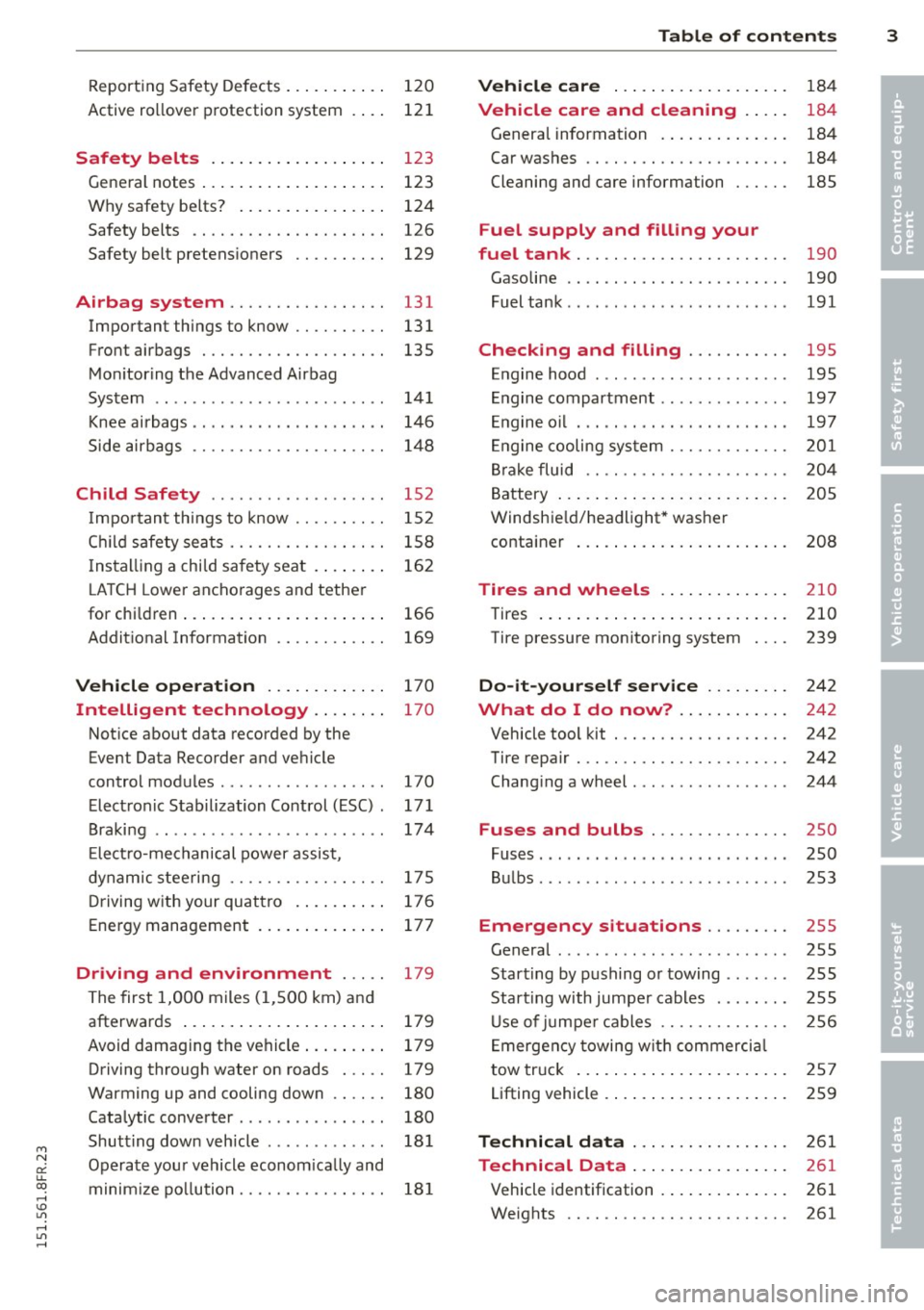
Reporting Safety Defects . . . . . . . . . . . 120
Active ro llover protection system 121
Safety belts . . . . . . . . . . . . . . . . . . . 123
General notes ..... .... ... .. .. .. . .
Why safety be lts? ..... ... .. .. .. . .
Safety belts ............. .... .. . .
Safety belt pretens ioners .. .. .. .. . .
Airbag system ............. .. . .
Important things to know .. .. .. .. . .
Front airbags ............ .... .. . .
Mon itoring the Advanced Airbag
System ...... .............. ... . .
Knee ai rbags .... .... ... .. .. .. .. . .
Side airbags .. ........... .. .. .. . .
Child Safety ... .. ...... .. .. .. . .
Impor tant th ings to know .. .. .. .. . .
C hi ld safety se ats ......... .... .. . .
I ns tall ing a chi ld sa fety seat . ...... .
L A TCH Lower anchorages and tethe r
for chi ld ren ..... .. .... ... .. .. .. . .
Addit ional Information
Vehicle operat ion ..... .. .. .. . .
Intelligent technology .. .. .. . .
Not ice about data recorded by the
Event Data Recorder and ve hicle
control modules ............... .. .
Elect ronic S tabilization Control (ESC) .
B raki ng .. ... ............. ... ... .
E lect ro-me chanical power assis t,
dynam ic steering ......... .... .. . .
D riving w ith your quat tro . ... .. ... .
E nergy management ... ... .. .. .. . .
Driving and environment ... ..
The first 1,000 miles (1 ,5 00 km) and
afterwar ds ..... .. .... ... .. .. .. . .
Avoid damaging the vehicle ... .. .. . .
Driving through water on roads . .. . .
Warming up and cooling down .. .. . . 123
124
126
129
131 131
135
14 1
146
1 4 8
152
152
1 58
16 2
166
169
170
170
170
17 1
174
175
176 177
179 179
179
179
180
Cata lytic converter . . . . . . . . . . . . . . . . 180
Shutt ing down veh icle . . . . . . . . . . . . . 181
Operate you r vehicle econom ica lly and
minim ize po llution. . . . . . . . . . . . . . . . 18 1
Table of contents 3
Vehicle care . . . . . . . . . . . . . . . . . . .
184
Vehicle care and cleaning . . . . . 184
Genera l information . . . . . . . . . . . . . . 184
Car washes . . . . . . . . . . . . . . . . . . . . . . 184
Cleaning and care information . . . . . . 185
Fuel supply and filling your
fuel tank . . . . . . . . . . . . . . . . . . . . . . .
190
Gasoline . . . . . . . . . . . . . . . . . . . . . . . . 190
Fuel tank . . . . . . . . . . . . . . . . . . . . . . . . 191
Checking and filling . . . . . . . . . . . 195
E n gine hood . . . . . . . . . . . . . . . . . . . . . 195
Engine compartment . . . . . . . . . . . . . . 197
E ngine oil . . . . . . . . . . . . . . . . . . . . . . . 197
En gine cooling sy stem . . . . . . . . . . . . . 201
Br ake fluid . . . . . . . . . . . . . . . . . . . . . . 20 4
Battery . . . . . . . . . . . . . . . . . . . . . . . . . 205
Windshie ld/headlight* washer
container . . . . . . . . . . . . . . . . . . . . . . . 208
Tires and wheels . . . . . . . . . . . . . . 2 10
Tires . . . . . . . . . . . . . . . . . . . . . . . . . . . 210
Tire pressure monitoring system 239
Do-it-yourself service . . . . . . . . . 242
What do I do now? . . . . . . . . . . . . 24 2
Vehicle tool kit . . . . . . . . . . . . . . . . . . . 242
Tire repair . . . . . . . . . . . . . . . . . . . . . . . 242
Chang ing a wheel . . . . . . . . . . . . . . . . . 244
Fuses and bulbs . . . . . . . . . . . . . . . 250
Fuses . . . . . . . . . . . . . . . . . . . . . . . . . . . 250
Bul bs. . . . . . . . . . . . . . . . . . . . . . . . . . . 253
Emergency situations . . . . . . . . . 255
General . . . . . . . . . . . . . . . . . . . . . . . . . 255
Star ting by pushing o r towing . . . . . . . 255
Start ing with jumper cables . . . . . . . . 255
U se of j umpe r cables . . . . . . . . . . . . . . 256
E mergen cy towing wit h commercia l
tow truck . . . . . . . . . . . . . . . . . . . . . . . 257
Lifting vehicle . . . . . . . . . . . . . . . . . . . . 259
Technical data . . . . . . . . . . . . . . . . . 261
Technical Data . . . . . . . . . . . . . . . . . 261
Vehicle identification . . . . . . . . . . . . . . 261
Weights . . . . . . . . . . . . . . . . . . . . . . . . 261
•
•
Page 68 of 284

66 Seats and st o rage
- Use only soft cups in the cupholder. Hard
cups and g lasses can ca use in jury in an
accident.
- Never use the cupholder or adapter as an
ashtray -risk of fire.
(D Note
On ly drink containers with lids should be
carried in the cupho lder. Liqu id could sp ill
out and damage your vehicle's e lectronic
equipment or stain the upholstery, etc.
Glove compartment
The glove comportment is illuminated and
can be locked .
Fig . 78 Glove compa rtment
.. To open the glove compartment, pu ll the
hand le in the direct io n of the arrow¢
fig. 78
and swi ng the cover down to open.
.. To close the glove compartment, pus h the
glove compartment lid upward until the lock
engages.
The glove compa rtment can be locked using
the mechanical key¢
page 32.
On the r ight side in the glove compartment is
a holder wi th the key body into which the
emergency key must be cl ipped to be able to
start the vehicle .
A WARNING
To reduce the risk of persona l injury in an
accident or sudden stop, always keep the
glove compartment closed wh ile driving.
Luggage compartment
General information
A WARNING ~
Read and follow the important safety pre-
cautions on ¢
page 118, Stowing lug
gage.
Enlarging the luggage compartment
The backrests con be folded forward either
separately or together.
F ig . 7 9 Luggage compartment: release lever
Folding th e backrest fo rwar d
.. Pull the release lever in the direction of the
arrow to fold the backrest forward .
Folding th e back res t b ack int o the upright
po sition
.. Fold the backrest back up again until it
latches securely¢ _&..
A WARNING
--The backrest must be securely latched in
position so that no items contained in
the luggage compa rtment can s lide fo r
ward upon sudden braking.
- Always check whether the la tc h is fully
engaged by pulling the seatback for
ward.
- Never a llow safety belts to become dam
a ged by be ing caugh t in door or seat
hardware.
- Torn or frayed safety belts can tear and
d a maged be lt hardware can break i n a
crash. Inspect the belts periodically .
Page 69 of 284

"' N
a: LL co
rl I.O
"' rl
"' rl
Belts showing damage to webbing, bind
ings, buckles, or retractors must be re
placed.
(D Note
Slide the belt guide on the outside safety
be lt all the way up before fo lding the back
rest back forward. Make sure the seat belt
is not pinched or damaged when the rear
seat backrest if folded back. Other objects
should be removed from the rear seat
bench to protect the seatback from dam
age.
Tie-downs
The luggage compartment is equipped with
four tie-down rings to secure luggage and
other items.
Fig. 80 Luggage compartment: t ie -dow ns
.,. Secure objects using elastic cords attached
to the tie-downs
c::> fig. 80.
.,. Read and heed all WARNINGS c:!;>poge 118,
Stowing luggage.
Seats and storage 67
Securing the ski sack
Applies to vehicles: with ski sack
Long objects such as skis or snowboards con
be transported in the ski sock.
Fig. 81 Luggage compartment: Secur ing the sk i sac k
Fig . 82 Rear bench seat: sec uring the sk i sack
.,. Fold both backrests fo rward c:!;> page 66 .
.,. Slide the ski sack from the lu ggage com
partment through the opening
c::> A with
the zipper at the rear.
.. To secure the ski sack in the luggage com
partment, hang the hooks ®
c:!;> fig. 81 in
the rear tie-downs .
.,. Tighten the strap @
c:!;> fig. 82 on the ski
sack to prevent the objects in the sack from
sliding.
A WARNING
-
- The ski sack is intended only for the
transportation of skis and other light ob
jects . To reduce the risk of serious per
sonal injury, never transport heavy or
pointed objects in the ski sack.
- When braking rapidly or during an acci
dent, the load could be displaced and
cause injury to occupants.
- Sharp edges on the load must be covered
for protection. Always fasten the belt ..,_
Page 70 of 284

68 Seats and stor age
tightly around the sack and its contents
¢ fig. 82.
-For safety reasons, do not t ransport
more than two pairs of skis in the ski
sack.
- You m ust sec ure the ski sack with t he
strap after loading.
- Make su re that all objects you are trans
porting with the backrests folded for
ward are secured. Otherwise they could slide aro und during sudden braking ma
neuvers and cause injuries.
(D Tips
- Never stow the sk i sack away when it is
still wet or damp (for example, snow melt ing from sk is) . Allow it to dry com
plete ly before stowing it away.
- When transporting skis or snowboards,
tighte n the securing strap between the
bindings .
- Position skis in the ski sack w ith the
po inted ends fac ing t he front and ski
po les w ith the pointed ends facing th e
rear.
Page 120 of 284

118 Driving Safely
the pedals or the ability to control the
vehicle.
- Never place or install floor mats or other
floor coverings on top of already instal
led floor mats. Additional floor mats and
other coverings will reduce the size of
the pedal area and interfere with the
pedals.
- Always properly reinstall and secure floor
mats that have been taken out for clean
ing.
- Always make sure that objects cannot
fall into the driver footwell while the ve
hicle is moving. Objects can become
trapped under the brake pedal and accel
erator pedal causing a loss of vehicle
control.
Stowing luggage
Loading the luggage compartment
All luggage and other objects must be prop
erly stowed and secured in the luggage com
portment.
Fig. 133 Safe load pos itio nin g: place heavy objects as
low a nd as fa r forward as possible.
-M N 0 u.
l:l
Loose items in the luggage compartment can
shift suddenly, changing vehicle handling
characteristics . Loose items can also increase
the risk o f serious personal injury in a sudden
vehicle maneuver or in a collision .
... Distribute the load evenly in the luggage
compartment .
... Always place and properly secure heavy
items in the luggage compartment as low
and as far forward as possible
cc> fig . 133 .
... Secure luggage using the tie-downs provid
ed
c:> poge 67.
... Make sure that the rear seatback is securely
latched in place.
A WARNING ,..__
Improperly stored luggage or other items
can fly through the vehicle causing serious
personal injury in the event of hard brak
ing or an accident. To help reduce the risk
of serious personal injury:
-Always put objects, for example, luggage
or other heavy items in the luggage com
partment.
- Always secure objects in the luggage
compartment using the tie-down eyelets
and suitable straps.
A WARNING
Heavy loads will influence the way your ve
hicle handles. To help reduce the risk of a
loss of control leading to serious personal
injury:
-Always keep in mind when transporting
heavy objects, that a change in the cen
ter of gravity can also cause changes in
vehicle handling:
- Always distribute the load as evenly as
possible.
- Place heavy objects as far forward in
the luggage compartment as possible.
- Never exceed the Gross Axle Weight Rat
ing or the Gross Vehicle Weight Rating
specified on the safety compliance stick
er on the left door jamb. Exceeding per
missible weight standards can cause the
vehicle to slide and handle differently .
- Please observe information on safe driv
ing
~ page 112.
A WARNING
To help prevent poisonous exhaust gas
from being drawn into the vehicle, always
keep the rear lid closed while driving.
- Never transport objects larger than
those fitting completely into the luggage
~
Page 173 of 284

M N
a! u.. co ,...., \!) ..,.,
,...., ..,., ,....,
@ Tips
Your vehicle may be equipped with Audi
connect. Your use of certain Aud i connect
features req uires wireless serv ices that are
provided by a third party wireless telecom
municat ions provider. For details regard
ing how information obtained through
Aud i connect is collected, processed,
transmitted, used, and shared, please see
your contra ct w ith the wire less telecom
municat ions provider and the "About A udi
connect" tab in your vehicle's MMI*:
!MENU ! button> Audi connect > About
Audi con nect .
Electronic Stabilization
Control (ESC)
Description
ESC helps to improve road holding and vehicle
dynamics to help reduce the probability of
skidd ing and loss of veh icle control. It works
only when the eng ine is running. ESC detects
certain difficult driv ing situations, including
when the vehicle is beginning to spin (yaw) out of cont ro l and he lps you to get the vehicle
back under control by select ively b rak ing the
wheels, and/or red ucing engine power and
p roviding steering assistance to help hold the
ve hicle on the driver's intended course . The in
dicator light
DJ in the instrument cluster
blinks when ESC is taking action to help you
control the vehicle.
ESC has limitations.
It is important to remem
ber that ESC cannot overcome the laws of
phys ics. It will not a lways be able to help out
under all conditions you may come up against.
For example, ESC may not always be able to
help you master situat ions where there is a
sudden change in the coefficient of fr iction of
the road surface. When there is a sect io n of
d ry road that is s udden ly cove red with water,
slush o r snow, ESC canno t perform the same
way it would on the dry su rface.
If the vehicle
hydroplanes (rides on a c ush ion of water in
stead of the road surface), ESC wi ll not be
ab le to he lp you steer the veh icle because con-
Int ellig ent technolog y 171
tact with the pavement has been interrupted
and the vehicle cannot be braked or steered .
D uring fast corner ing, particular ly on wind ing
roads, ESC cannot always deal as effectively
with difficult dr iv ing s ituations than at lower
speeds. When towing a trailer, ESC is not able
to help you regain control as it would if you
were not tow ing a trailer.
Always adjust your speed and driving style to road, traffic and weather conditions . ESC can
not override the vehicle's physical lim its, in
crease the availab le tract ion, or keep a veh icle
o n the road if road departu re is a result of
driver ina ttent io n. Instead , ESC imp roves the
poss ibility of keep ing the vehicle under con
trol and on the road during extreme maneu
vers by using the driver's steering i nputs to
help keep the vehicle go ing in the intended di
rect ion. If you are traveling at a speed that
causes you to run off the road before ESC can
provide any assistance, you may not experi
ence the benefits of ESC.
ESC is switched on all the time. In certain sit
uat ions when you need less traction, you can
switch off ASR by pressing the butto n
[ill
~ page 173, fig. 166 or~ page 173,
fig. 167. Be sure to sw itch ASR on aga in when
you no lo nger need less traction.
The following systems are integrated in the
ESC:
Anti-lock bra king sy stem (ABS )
ABS prevents the whee ls from locking up
when brak ing. T he vehicle can st ill be steered
even dur ing hard braking. App ly steady pres
su re to the brake peda l. Do not pump the ped
al. A pulsing in the brake pedal ind icates that
the system is helping you to brake the veh icle .
Brake assi st system
The brake ass ist system can decrease braking
distance. It increases brak ing power when the
drive r presses the brake peda l quickly in emer
gency s ituations. You must press and hold the
brake pedal unti l the s ituation is over. In
vehicles with adaptive c ruise control*, the
brake assis t system is more sensitive if the
•
•
Page 229 of 284

"' N
a: LL co
rl I.O
"' rl
"' rl
3. Subtract the combined weight of the driver and passengers from
"XXX" kilo
grams or
"XXX" pounds
shown on the sticker
.:::> page 217, fig. 182.
4. The resulting figure equals
the available amount of car go and luggage load capaci
ty . For example, if the
"XXX"
amount equals 1400 lbs.
and there will be five 150
lbs . passengers in your vehi
cle, the amount of available
cargo and luggage load ca
pacity is 650 lbs. (1400-750
(5
X 150) = 650 lbs.)
5. Determine the combined weight of luggage and cargo being loaded on the vehicle.
That weight may not safely
exceed the available cargo
and luggage load capacity
calculated in Step 4.
6. If your vehicle will be towing
a trailer, load from your trail
er will be transferred to your
vehicle. Consult this manual
to determine how this re
duces the available cargo
and luggage load capacity of
your vehicle .
Tires and wheels 227
.,.Check the tire sidewall
(.:::> page 230, fig. 186) to de
termine the designated load
rating for a specific tire.
Tire service life
The service life of tires depends
on a lot of different things in
cluding proper installation and
balancing, correct tire pressure
and driving style.
Fig. 184 Tire tread : tread wea r ind i
cators (TW I)
____ Jj
Fig. 185 Rotat ing ti res fo r more even
wear
Tread Wear Indicator (TWI)
The original tires on your vehi
cle have 1/16 inch (1.6 mm) high "wear indicators"
¢ fig. 184 running across the
Page 257 of 284

M N
er
u..
co ,...., \!) 1.1"1 ,...., 1.1"1 ,....,
Emergency situations
General
This chapter is intended for trained emer
gency crews and working personnel who have the necessary tools and equipment to
perform these operations.
Starting by pushing or
towing
(D Note
Vehicles with an automatic transmission
cannot be started by pushing or towing.
Starting with jumper
cables
If necessary, the engine can be started by
connecting it to the battery of another vehi
cle.
If the engine should fail to start because of a
discharged or weak battery, the battery can be
connected to the battery of
another vehicle,
using a
pair of jumper cables to start the en
gine.
Jumper cables
Use only jumper cables of sufficiently
largecross section to carry the starter current
safely. Refer to the manufacturer's specifica
tions.
Use only jumper cables with
insulated termi
nal clamps which are distinctly marked:
plus(+) cable in most cases colored red
minus(-) cable
in most cases colored black .
A WARNING
Batteries contain electricity, acid, and gas.
Any of these can cause very serious or fatal
injury. Follow the instructions below for
safe handling of your vehicle's battery.
- Always shield your eyes and avoid lean
ing over the battery whenever possible.
Emergency situations 255
-A discharged battery can freeze at tem
peratures just below 32 °F (0 °C). Before
connecting a jumper cable, you must
thaw the frozen battery completely, oth
erwise it could explode.
- Do not allow battery acid to contact eyes
or skin . Flush any contacted area with
water immediately .
- Improper use of a booster battery to
start a vehicle may cause an explosion.
- Vehicle batteries generate explosive gas
es. Keep sparks, flame and lighted ciga
rettes away from batteries.
- Do not try to jump start any vehicle with
a low acid level in the battery.
- The voltage of the booster battery must
also have a 12-Volt rating. The capacity
(Ah) of the booster battery should not be
lower than that of the discharged bat
tery. Use of batteries of different voltage
or substantially different "Ah" rating
may cause an explosion and personal in
jury.
- Never charge a frozen battery. Gas trap
ped in the ice may cause an explosion.
- Never charge or use a battery that has
been frozen. The battery case may have
be weakened.
- Use of batteries of different voltage or
substantially different capacity (Ah) rat
ing may cause an explosion and injury.
The ca pa city (Ah) of the booster battery
should not be lower than that of the dis
charged battery.
- Before you check anything in the engine
compartment, always read and heed all
WARNINGS
c::;,page 195.
(D Note
-Applying a higher voltage booster bat
tery will cause expensive damage to sen
sitive electronic components, such as
control units, relays, radio, etc.
- There must be no electrical contact be tween the vehicles as otherwise current
could already start to flow as soon as the
positive(+) terminals are connected. ..,. •
•
Page 259 of 284

M N
er
u..
co ,...., \!) 1.1'1 ,...., 1.1'1 ,....,
-Jumper cables must be long enough so
that the vehicles do not t ouch.
- W hen connecting jumper ca bles, make
sure that they cannot get caught in any
moving parts in the eng ine compart
ment.
- Do not bend over the batteries - danger
of chemical burns!
- The battery ce ll locking screws must be
t ightened securely .
- Before you check anything in the engine
compartment, always read and heed all
WARNINGS ¢
page 195.
Improper hook-up of jumper cables can ru
in the generator.
- Always connect POSITIVE( +) to POSI
TIVE(+), and NEGATIVE( -) to NEGATIVE
( - ) ground post of the battery manager
control unit.
- Check that all screw plugs on the battery
ce lls are screwed in firmly . If not, tighten
plugs p rior to connecting clamp on nega
tive battery terminal.
- Please note that the procedure for con
necting a jumper cable as described
above applies spec ifically to the case of
your vehicle be ing jump started. When
you are givi ng a jump start to another ve
hicle, do
not connect the negat ive( -) ca
ble to the negat ive( -) term inal on the
discharged battery @¢
fig. 202. In
stead, securely connect the negative(- )
cable to e ither a solid metal component
that is firmly bolted to the engine block
or to the engine block itse lf. If the bat
tery that is being charged does not vent
to the outside, escaping battery gas
could ignite and explode!
Em erg en cy si tuation s 257
Emergency towing
with commercial tow
truck
General hints
Your Audi requires special handling for tow
ing.
T he following information is to be used by
commercial tow t ruck operators who know
how to operate their equipment safely.
- Never tow your Audi , towing will cause
damage to the engine a nd transmi ssion.
- Never wrap th e safet y chain s or winch c a
ble s around th e brak e lin es.
- To prevent unne ce ss ary dam age, your Aud i
mu st be t ransp orted with a flat bed truck .
- To load th e vehi cle on to the fl at bed , use
the t owing loop found in the vehicle t ool s
and atta ch to the front or rear anch o rage
r=:> page 258 and ¢page 258 .
A WARNING
A vehicle being towed is not safe for pas
sengers. Never allow anyone to ride in a
vehicle be ing towed, for any reason.
-
•
•
Page 260 of 284

258 Emergency situations
Front towing loop
Do not install the front towing loop until it is
needed.
Fig. 203 Front bumper: removing th e cove r cap
Fig. 204 Fron t bumper: screw ing in t he tow ing loop
The towing loop fits into the threaded hole lo
cated on the right side of the front bumper
and covered by a small cover when not in use.
... Remove the towing loop from the vehicle
toolkit
c::> page 242 .
... Take hold of the bottom edge of the cover
cap and pull it out of the bumper
c::>fig. 203.
... Screw the towing loop tight ly into the
threaded hole as far as it will go
c::> fig. 204
and tighten it with the wheel wrench .
When it is no longer needed, unscrew the
towing loop and put it back into the vehicle
too lkit. Be sure to have the towing loop stored
in the vehicle at all times.
A WARNING
If the towing loop is not screwed in as far
as it will go, the thread can pull out when
the vehicle is towed -potential risk of an
accident.
Rear towing loop
Do not install the rear towing loop until it is
needed .
Fig. 205 Rear bumper: cove r
Fig . 206 Rea r bumper: S crew ing in tow ing loop
.. 0 0 ,.,. ., IX)
"'
"' a, IX)
On the right side of the rear bumper there is a
threaded hole for the towing loop. The
threaded hole is protected by a cover.
... Remove the towing loop from the vehicle
toolkit
c::> page 242.
... Press the cover in by applying short strong
pressure to the bottom part to release it
from the bumper
c::> fig. 205.
... Screw the towing loop tightly into the
threaded hole as far as it will go
c::> fig. 206
and tighten it with the wheel wrench.
Unscrew the towing loop again after use and
install the cover in the bumper. Install the
cover in the bumper. Return the towing loop
to the toolkit . Be su re to have the towing loop
stored in the vehicle at all times .
A WARNING
-
If the towing loop is not screwed in as far
as it will go, the thread can pull out when
the vehicle is towed -potential r isk of an
accident.