Engine oil AUDI RS5 COUPE 2015 User Guide
[x] Cancel search | Manufacturer: AUDI, Model Year: 2015, Model line: RS5 COUPE, Model: AUDI RS5 COUPE 2015Pages: 254, PDF Size: 64.12 MB
Page 74 of 254
Driving
Sw itching the ignition on /off
If you would like to switch the ignition o n wit h
out starting the engine, fo llow these steps:
• Inse rt the key into the ignition lock.
• Press the key brief ly
wi thout p ress ing the b rake
pedal.
• To sw itch the ignition off , press the key again.
When starting the engine, major e lectr ica l loads
are sw itched off temporar ily.
You ca n only remove the key with the ignition
sw itched off .
If the engine should not start immedia tely , the
starti ng process is automatically stopped after a
short time . Repeat sta rting procedure .
A WARNING
-Never allow the engine to run in confined
spaces - dange r of asp hyxiation.
- Never remove the ignition key from the ign i
t ion loo k while the vehicle is moving . Other
wise, the steering lock cou ld sudden ly en
gage and you would not be able to steer the
vehicle.
- Always ta ke the key with yo u wheneve r you
leave your vehi cle. Otherwise, the engine
could be started or electrical eq uipment
s uch as the power windows cou ld be operat
ed . T his can lead to ser ious injury.
- Never leave ch ildren or persons requiring as
sistance unattended in the vehicle. The
doors can be locked using the remote trans
mitter, preventing peop le from escap ing
from the vehicle on their own in the event of an emergency . Depending on the time of
year, people inside the vehicle can be ex posed to very high o r very low tempe ra
t ur es.
([) Note
Avoid high engine rpm, full throttle and heavy
eng ine loads until the eng ine has reached op
erati ng temperature - otherwise you risk en
gine dam age.
72
-
@) For the sake of the env ironment
Do not let the engine run while pa rked to
warm up. Begin dr iv ing immediately. Th is re
d uces unnecessary em iss ions .
@ Tips
-If the key cannot be removed from the igni
t ion lock, you have to pu ll the mechan ica l
key out of the master key in order to be able
to lock the vehicle
c::, page 33.
- After starting a co ld engine, there may be a
br ief per iod of increased noise because the
oil pressure must first build up in the hy
draulic valve adjusters. This is norma l and
not a cause fo r concern .
- If you leave the veh icle with the ignition
switched on, the ig nition w ill switch off af
ter a ce rtain period of t ime . Pleas e note tha t
ele ct rical eq uipme nt such as e xterior lights
w ill switch off a s well when that hap pens.
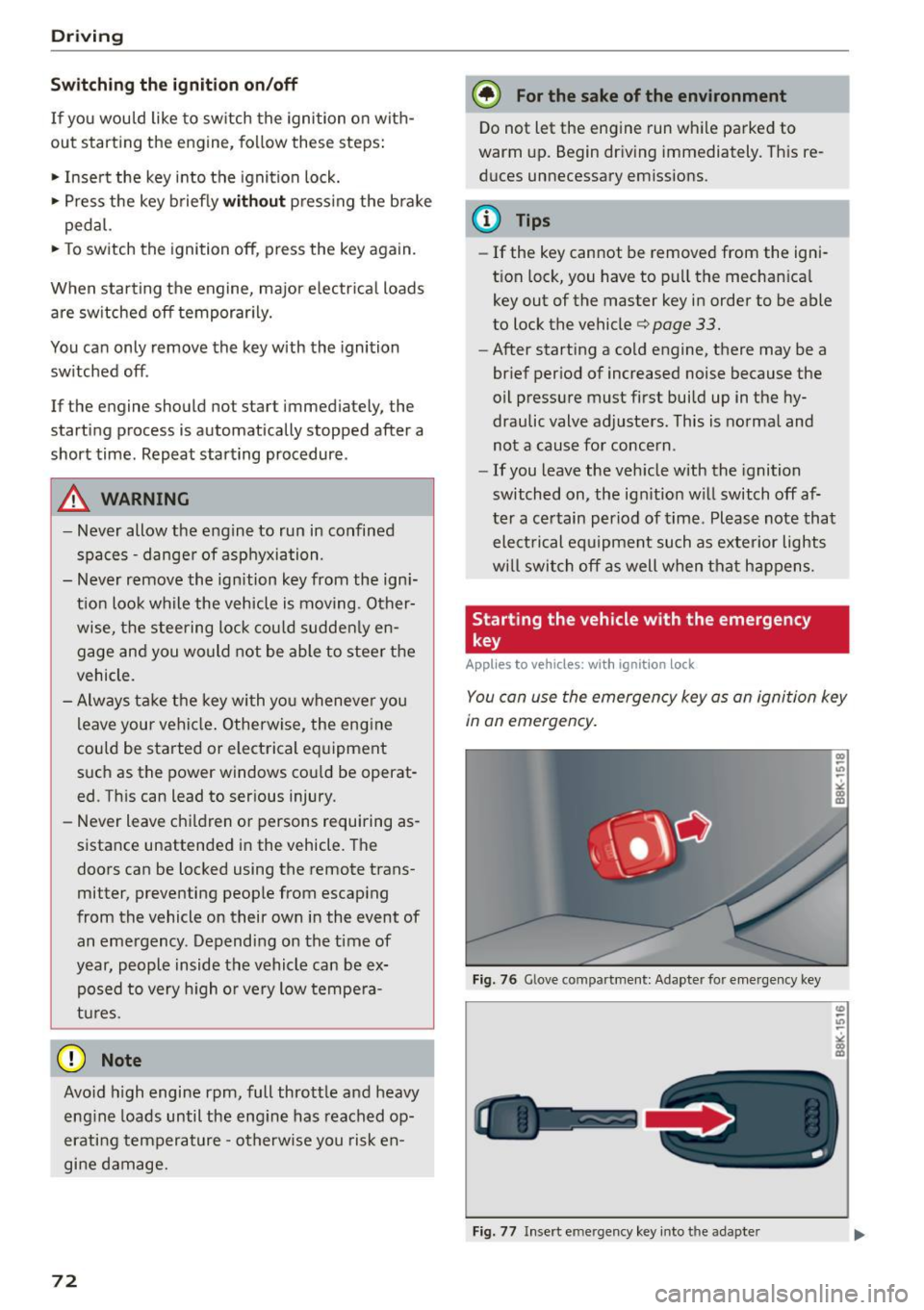
Starting the vehicle with the emergency
key
Applies to vehicles: with ignition lock
You can use the emergen cy key as an igni tion key
in an emergency.
F ig. 76 Glove co mp art men t: Adapte r fo r em erge ncy key
Fi g. 77 Insert e merg ency key into t he ad ap ter
Page 76 of 254

Driving
"'Press on the I START ENGINE STOPI button
¢ fig. 78 -the engine wi ll start.
Switching the ignition on /off
If you would like to sw itch the ignition on with
out start ing the e ng ine, fo llow these steps:
"' Press the
!START ENGINE STOPI button with -
out pressing the brake pedal.
"'T o sw itch the ignition off, press the but to n
again.
If the engine sho uld not start immed iately, the
starting p rocess is a utomat ically stopped after a
short time. Repeat sta rting procedure.
When starting the engine, major e lectr ica l loads
are sw itched off temporar ily .
After a cold engine is started, there may be a brief period of increased noise because oil pres
sure must first build up in the hydraulic valve ad
justers. This is normal and not a cause for con
cern.
_& WARNING
- Never allow t he engine to ru n in co nfine d
spaces -dange r of asp hyxiation.
- Never turn off the engine unti l the vehicle
h as come to a comp lete stop.
- Always ta ke t he key with yo u w heneve r you
leave your vehi cle. Otherw ise, the eng ine
c ou ld be started or ele ct rical eq uipment
s u ch as the power w indows co uld be operat
ed. This can lead to serious injury.
- Never leave ch ild ren o r persons requ iring as
sistance unattended in the vehicle. The doo rs can be locked using the remote trans
mitter, preventing peop le from escap ing
from the vehicle on their own in the event of
an emergency. Depending on the time of
year, people inside the vehicle can be ex
posed to very high o r ve ry low tempe ra-
tu res.
(D Note
- Avoid high eng ine rpm, fu ll throttle and
heavy engine loads until the engine has
r eached operating tempe rat ure - otherwise
you r isk eng ine damage.
74
-
@ For the sake of the environment
Do not let the engine run while pa rked to
warm up. Begin dr iv ing immediately. Th is re
d uces unnecessary em issions.
(!} Tips
- After starting a col d en gine, t here may be a
br ie f per iod of increased noise because the
oil pressure must first bui ld up in the hy
draulic valve adjusters. This is norma l and
not a cause for concern.
- If you leave the veh icle with the ignition
switched on, the ig nition w ill switch off af
ter a ce rtain period of time. Please note that
e lect rical equipment such as exte rior lights
wi ll switch off as well when that happens.
Switching engine off
App lies to vehicles: wi th convenience key
"' Br ing your vehi cle to a comple te stop.
"' Move the se lector lever to the P o r N pos ition.
"' Press the
I START ENGINE STOP ! button
c::> page 73, fig. 78 .
Steering lock
The steer ing lo cks w hen yo u tur n the eng ine off
u sing the
I START ENGINE STOP I button a nd open
the d river's doo r. The loc ked steering helps pre
vent ve hicle theft .
Emergency off
If necessary, the e ngine can be switched off with
the se lec to r lever in the R or D/S posi tions. The
engine s tops if you press a nd ho ld the
I START ENGI NE STOP I button at speeds below
6 mph (10 km/ h) and press the brake peda l.
_& WARNING
-Never turn off the engine before the vehicle
has come to a complete stop. The full func
tion of the brake booster and the power
steer ing is not guaranteed. You must use
more force to turn or b rake if necessary. Be
caus e you cannot stee r and brake as you
usually wo uld, this cou ld lead to crashes
a nd se rio us in juries.
~
Page 174 of 254
Smart Technolog y
-Manua l retraction: At speeds up to about
10 mph (20 km/h) , retract the rear spoiler by
pressing and holding the switch. At speeds be
tween 10 mph (20 km/h) and 75 mph (120 km/h), retract the rear spoiler by tapping
on the switch
Ind icat or light
- Rear sp oile r: sy st em m alfu ncti on
The rear spoiler may not have extended due to a
malfunct ion . This cou ld change the vehicle's driv
ing characteristics at high speeds . Do not drive at
speeds above 85 mph (140 km/h) . Drive to the
nearest authorized Audi dealer or qualified repair
facility to have the malfunction corrected.
A WARNING
Dr iv ing at higher speeds w ithout the rear
spoiler deployed can impa ir handling charac
teristics, mak ing the veh icle harder to co ntrol.
- Always make sure that the spoiler is de-
ployed when driving at speeds over 85 mph
(140 km/h) . If the rear spoiler warn ing/ indi
c ator light in t he instrument cluster comes
on, the rear spoi ler may not have deployed .
- Never dr ive at speeds highe r than 85 mph
(140 km/ h) if the spoiler is not deployed.
Have the spo iler inspected as soon as possi
ble by an author ized Audi dealer or qualif ied
workshop.
- Always obey speed limi ts and o ther traffic
laws .
A WARNING ,.__.__
Improper ope ration of the rear spoiler can
cause crushing injuries .
- Always make sure that nobody, espec ia lly
children, is in the way when the rear spo iler
is deployed or retracted .
(D Note
Never push the vehicle or apply fo rce to the
rea r spo ile r - i t cou ld be damaged.
(D Tips
Clean the spo ile r compartment every 2 to 3
months. The spoiler compartment m ust al-
172
-
ways be free of ice, snow, leaves or other de bris .
Braking
What affects braking efficiency?
New brake pads
During the first 250 miles (400 km), new brake
pads do not possess their full braking e ffect, they
have to be "broken in" first¢.&. . The break -in pe
riod can be considerably longe r for vehicles with
ceramic brake rotors*. You can compensate for
th is slightly reduced braking power by pushing
harder on the brake pedal. Avoid heavy braking
loads during the b reak-in period.
Op era ting condition s and dri ving h abit s
The brakes on today's automobiles are still sub
j ect to wear, depending largely on operating con
dit ions and driving habits ¢.&, . On vehicles that
are either dr iven most ly in stop-and-go city traf
fic or are driven hard, the brake pads should be
checked by yo ur autho rized Aud i dealer more of
ten than specified in the
Warranty & Mainte·
nan ce bookl et.
Fail ure to have you r brake pads
i nspected c an resu lt in red uced b rake pe rform
ance.
On steep slopes, you shou ld use the braking ef
fect of the engine. This way, you prevent unnec
essary wear on the bra ke system. If yo u must use
you r brakes, do not hold the brakes down contin
u ously. Pump the brakes at intervals .
Operating noise
Noises may occur when brakin g depending on the
speed, braking force and ou ts ide cond itions su ch
as tempera ture and hum idity.
Due to the nature of the materials used in ceram
i c bra ke roto rs*, noises may become mo re appa
r ent at low speeds.
Effect of water and road salt
In certa in situations, for examp le after driv ing
through water, in heavy rain, after overnight con
densation or after washing your car , the braking
effect can be redu ced by moistu re or ice on the
1111>
Page 176 of 254
Smart Technolog y
-If y ou dama ge the front spo iler, or if you in
sta ll a di fferent spoile r, be sure the air flow
to the front brakes is not obstructed . Other
wise the brake system co uld overheat reduc
ing the effectiveness o f the enti re brake sys
tem .
- Failure of one brake c ircuit will impair the
braking capab ility r esult ing in a n increased
stopp ing distance. Avoid driving the veh icle
and have it towed to the nearest au thorized
Audi de aler or qualified workshop.
- Never let the vehicle ro ll to a stop with the
engine shut off .
-If the brake booster is not work ing, the
brake pedal must be pressed considerably
harder to make up for the lack of booste r as
sistance .
Electro-mechanical
power assist, dynamic
steering
The electro-mechanical power assist helps the
driver when steering .
Power steering adapts electronically based on
the vehicle speed .
Indicator lights and me ss a ges
• Steering defe cti ve! Do not dri ve vehicle!
If th is indicator light tu rns on and stays on and
this message appears, the power steering may
have fa iled .
D o
n ot co ntinue driving. See yo ur authorized
Audi dealer or a qua lified repair fac ility for assis
tance.
l;r-ij Dynamic steering : System fault! You can
c on tinu e drivin g
If the indicator light tu rns on and the message
appears, the steer ing may be more difficult to
move or mo re sensitive than usual. The steer ing
wheel may a lso be at an ang le when dr iv ing
straight.
Drive s low ly to your author ized Audi dealer or
qua lified wor kshop to have the malfunction cor
rected.
174
':r-ij Dynamic stee ring: initializing
If this drive r message appears and the indicator
li gh t is flashing on the instr ument pane l, dynam
i c s teer ing* is being rein itia lized. After sta rting
the engine, the steering wheel w ill move slightly.
Re-initialization might be necessary if the steer
i ng whee l was moved hard to the left and right
while the vehicle was not moving. The display goes out as soon as initialization is comp lete.
A WARNING
H ave the dynamic steering* system malfunc
tion repaired as soon as possible by an author ized A udi dealer or qualified wo rkshop -risk
of accident!
@ Tips
- If the . or ':rfl indicator light only stays on
for a sho rt time, you may cont inue driving.
- The dynamic steering* stab ility systems are
not availab le in the event of a system mal
function.
- For add itiona l information on dynamic
steering*, refer to~ page 101.
Driving with your quattro
With all-wheel drive, all four wheels are driven .
General information
With all-wheel drive, power is distributed to all
four wheels . This happens automatically depend
i ng on your driving style and the road conditions
at the t ime . See also ~ page 169.
A center d ifferential distributes the driving power
variably to the front and rear axle. It works to
gether w ith select ive whee l torque control, which
activates w hen d rivi ng throug h curves
~ page 170 . With the spo rt diffe rential*, power
dist ribution to the rear wheels is variab le and can
be adjusted with drive select~ page 101.
The all-whee l dr ive concept is des igned for hig h
engine power . Yo ur vehicle is exceptiona lly pow
e rfu l and has excellen t drivi ng cha racte rist ics
both unde r normal d riving condi tions and o n
snow and ice . Always read and follow sa fe ty pre-
ca utions ~& .
1111>
Page 179 of 254

M N
0:: loo ,...., \!) 1.1"1
N 1.1"1 ,....,
Driving and the
environment
Breaking in
New engine
The engine needs to be run-in during the first
1,000 miles (1,500 km).
For the first 600 miles (1,000 kilometers ):
"' Do not use full throttle .
"' Do not drive at engine speeds that are more
than
2/3 of the max imum permitted RPM .
From 600 to 1,000 miles (1,000 to 1,500
kilometers):
"' Speeds can gradually be increased to the maxi
mum perm issible road or engine speed.
During and after break-in period
"'Do not rev the engine up to high speeds when it
is cold. This applies whether the transmission is
in N (Neutral) or in gear .
After the break-in period
"'Do not exceed maximum engine speed under
any circumstances.
"'U pshift into the next higher gear
before reach
ing the red area at the end of the tachometer
scale
c=> page 10.
During the first few hours of driving, the engine's
internal friction is higher than later when all the
moving parts have been broken in. How well this
break-in process is done depends to a considera
ble extent on the way the vehicle is driven during
the first 1,000 miles (1,500 kilometers).
(D Note
Extremely high engine speeds are automati
cally reduced. However, these rpm limits are
p rog rammed for an engine wel l run- in, not a
new engine.
@) For the sake of the environment
Do not dr ive with unnecessarily high eng ine
speeds -upshifting early saves fuel, reduces
noise and protects the environment.
Driving and the environment
New tires
If your vehicle is running on new tires, drive very
carefully for the fi rst 350 m iles (500 kilometers)
after fitting .
New tires tend to be slippery and must also
be "broken-in". Be sure to remember this dur
ing the first
350 miles (500 kilometers).
Brake gently. Avoid following closely behind
other vehicles or other situations that might
require sudden, hard brak ing .
Avoid damaging the
vehicle
When you are d riving on poor roads, or over
curbs, steep ramps, etc., ma ke certain that low
lying parts such as spoilers and exhaust system
parts do not bottom out and get damaged.
T his is espec ially true for veh icles with low-s lung
chassis (sports chassis)* and fully loaded
vehicles.
Driving through water on
roads
Note the following to avoid vehicle damage when
driving through water, for example on f looded
roads:
- The water must not be any higher than the bot
tom of the vehicle body.
- Do not drive faster than walking speed.
A WARNING
= -
After driving through water, mud, slush, etc.,
the brakes may be s low to take effect because
of wet brake rotors and pads. Dry the brakes
first by braking carefully to restore the full braking effect.
(D Note
Vehicle components such as the engine,
transmission, suspension or electrical system
can be severely damaged by driving through
water . ""
177
Page 180 of 254
Driving and th e environment
(D Tips
-Check the depth of the water before driving
through it.
- Do not stop the veh icle, drive in reverse or
switch the engine
off when driving through
water.
- Keep in mind that oncoming vehicles may
create waves that raise the water level and
make it too deep for your vehicle to dr ive
through safely.
- Avoid driving through sa lt water because it
can cause corrosion.
Warming up and cooling down
By carefully warming up and cooling down your
veh icle, you can help ensure that it is not over
stressed unnecessar ily du ring sporty dr iv ing.
When warming up, the vehicle is driven at a max imum engine speed of 6000 RPM in order to ra ise
the engine oil temperature to a m inimum of
140 °F (60 °C). T he tires also only reach their full
road holding capab ility once they have wa rmed
up.
The cooling fan can continue to run in your vehi
cle after the eng ine is switched
off. However,
d riving the vehicle to cool it dow n is part icu larly
important. During sporty d riving, the engine and
brakes , the exhaust system, and the transmission
all become extremely hot. Before you park the
vehicle, you should drive it for a few mi les/kilo
meters at light load in the low rpm range to al
low it to cool down.
Catalytic converter
It is very important that your emission control
system (catalytic converter) is functioning prop erly to ensure that your vehicle is running in on
environmentally sound manner .
.. Always use lead -free gasoline c::> page 183,
Fuel supply.
.. Never ru n the tank down a ll the way to empty.
.. Neve r pu t too m uch motor oil in your engine
c::> page 191, 't:::?: Adding engine oil .
178
.. Never try to push -or tow-start your vehicle .
The catalytic converte r is an effi cient "clean-up"
device b uilt into the exha ust system of the veh i
cle. The cata lytic conve rter burns many o f the
po llutants in the exhaust gas before they are re
l eased into the atmosphere.
The exclusive use of unleaded fue l is c ritically im
po rtant for the life of the catalytic conver ter and
proper functioning of the engine .
A WARNING
-The temperature of the exhaust system is
high, both when driving and after stopping
the engine.
- Never touch the exhaust tail pipes once they
have become hot. Th is could resu lt in burns.
- Do not park or operate the vehicle in areas
where the hot exha ust system may come in
contact with dry grass, brush, fuel spill or
other material which can cause a fire.
- Do not apply additional undercoating or rustproof ing on or near the exhaust mani
fold, exhaust pipes, catalytic converter or
heat shields. During dr iving, the substance
used for unde rcoat ing could overheat and
cau se a fire.
@ Note
- Be aware that just one tank fill ing with lead
ed
fuel w ill al ready ser iously degrade the
performance of the catalytic converter.
- Do not exceed the correct engine oil level
c::>poge 191.
-Do not drive until the fue l tank becomes
completely empty . T he engine cou ld m isfire .
Unburned fu el could also get into the ex
haus t sys tem a nd this could cause the cata
lyt ic converte r to overheat.
- Do not turn
off the ignition while the vehicle
is
moving.
- Do not continue to operate your veh icle un
der these condi tions, as otherwise f uel can
re ach the cat aly tic converter. This could re
s u lt in ove rheat ing of the c onve rter, requ ir
ing its replacement .
- T o assure efficient oper ation of the Emission
~
Cont ro l System: ..,_
Page 182 of 254
Driving and th e environment
It makes sense to shut off the engine in traffic
jams, when waiting for trains to pass at rai lroad
crossings, or at traff ic lights that have long waits
on red. Turning the eng ine off for just 30-40 sec
onds saves more fuel than is burned starting the
engine again .
It takes a long time for the engine to warm up
fully when it is running at idle. However, wear
and nox ious em issions are especially h igh when
the engine is warm ing up. So you should dr ive
away as soon as you start the engine and avoid running at high rpms while the engine is still
warming up.
{[) Note
Do not leave engine idling unattended after
starting. If warning lights should come on to
indicate improper operation, they would go
unheeded. Extended id ling a lso produces
heat, wh ich co uld resu lt in overheating or ot h
er damage to the vehicle or other property .
Regular maintenance
A badly tuned engine unnecessarily wastes a lot
of fuel.
~ Have you r vehicle se rv iced at regular i nte rva ls.
By having your vehicle regularly serviced by an
author ized Audi dealer helps to ensure that it
r u ns p roperly and economically. The condition of
your veh icle not only affe cts its safety and ability
to hold its va lue, i t also affects
fue l con sump
tion.
Ch eck your oil each tim e you fill your tank .
The amount of oil used is related to engine load
and speed .
It is normal for the oil consumption of a new en
g ine to reach its lowest value after a certain mile
age has been driven.
You must drive yo ur vehicle about 3,000 miles
(5,000 ki lometers) before you can properly as
sess o il consumption .
This a lso applies to fuel consumption and engine
output .
180
(D Note
-Have your veh icle ma intained properly and
in accordance with the service recommenda
tions in your Warranty
& Maintenance book
let. Lack of proper maintenance as well as
improper use of the vehicle will impair the
function of the emission control system and cou ld lead to damage .
- Do not alter or remove any component of the Emission Control System unless ap
proved by the manufacturer.
- Do not alter or remove any device, such as
heat shields, sw itches, ignit ion wires,
valves, which a re des igned to p rotect your
vehicle's Emission Control System and other
impo rtant vehicle components.
Fewer short trips
Fuel consumption will always be relatively high
on short trips.
~ Tr y to avoid dr iv ing sho rt distances w ith a co ld
eng ine .
The eng ine and cata lytic converter have to reach
their opt imal
op erat ing temperature to reduce
fuel consumpt io n and noxious em issions effec
tive ly.
Just after starting, a co ld eng ine in a mid -s ize car
o nly achieves a fuel economy of 6-8 m iles per
gallon (30-40 l/100 km). After about a half a
mile, fuel economy climbs to 12 mpg ( 20 l/100
k m). After about
2.5 mi les ( 4 km) , the eng ine is
at i ts p roper operating tempera ture and fuel
economy has reached a normal level. So you can
see that yo u should avo id short trips whenever
poss ib le.
The
outside temperature is also cr itical in th is re
gard. Your car cons umes more fuel in the winter
than in the summer.
Page 190 of 254
Checking and Filling
compartment. Wait until no steam or cool
ant can be seen or heard before carefully
opening the hood.
- Keep children away from the engine com
partment.
- Never spill fluids on hot engine compo
nents. They can cause a fire.
- Never touch the radiator fan. The auxiliary
electric fan is temperature controlled and
can switch on suddenly.
- Never open the coolant reservoir cap when
the engine is still warm . The coolant system
is pressurized and hot coolant could spray
out .
- Protect your face, hands and arm from
steam or hot engine coolant by placing a
thick rag over the cap when you open the coolant reservoir .
- Do not remove the engine cover under any
circumstances . This increases the risk of
burns .
- If work on the fuel system or the electrical
system is necessary :
= Always disconnect the battery.
- Never smoke or work near heaters or open
flames. Fluids in the engine compartment
could start a fire.
- Keep an approved fire extinguisher imme
diately available.
- To avoid electrical shock and personal injury
while the engine is running or being started,
never touch:
- Ignition cables
- Other components of the high voltage
electronic ignition system.
- If you must perform a check or repair with
the engine running:
- First, fully apply the parking brake, move
selector lever of automatic transmission
to "P" (Park) .
- Always use extreme caution to prevent
clothing, jewelry, or long hair from getting
188
caught in the radiator fan, V-belts or other
moving parts, or from contacting hot
parts. Tie back hair before starting, and do
not wear clothing that will hang or droop
into the engine.
- Minimize exposure to emission and chemi
cal hazards
¢ A .
A WARNING
California Proposition 65 Warning:
- Engine exhaust, some of its constituents,
and certain vehicle components contain or
emit chemicals known to the State of Cali
fornia to cause cancer and birth defects and
reproductive harm. In addition, certain flu
ids contained in vehicles and certain prod
ucts of component wear contain or emit
chemicals known to the State of California
to cause cancer and birth defects or other
reproductive harm.
- Battery posts, terminals and related acces
sories contain lead and lead compounds,
chemicals known to the State of California
to cause cancer and reproductive harms.
Wash hands after handling.
([) Note
When adding fluids, always make sure that
they are poured into the proper container or
filler opening, otherwise serious damage to
vehicle systems will occur.
@ For the sake of the environment
To detect leaks in time, inspect the vehicle
floor pan from underneath regularly. If you
see spots from oil or other vehicle fluids, have
your vehicle inspected by an authorized Audi dealer .
Page 191 of 254
"' N
0:: I-co
rl I.O
"' N
"' rl
Check in g and Fillin g
Engine compartment
Engine compartment
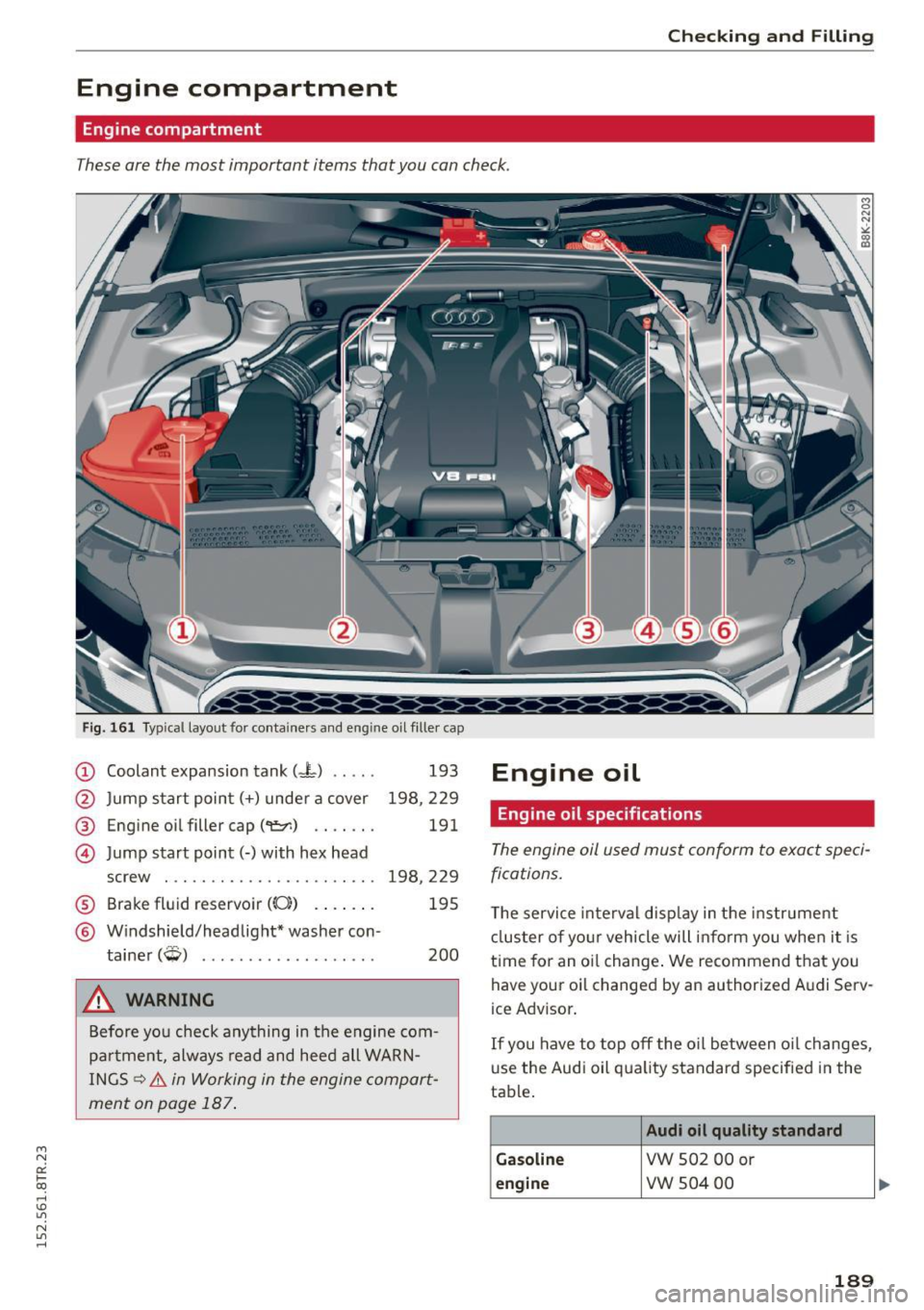
These are the most important items that you can check.
Fig. 161 Typical layout for containers and eng ine oil filler cap
(D Coolant expansion tank (.J-) .. .. .
@ Jump start point(+) under a cover
@ Engine oil filler cap(~) .... .. .
@ Jump start point(-) with hex head
screw . ............... ...... .
® Brake fluid reservoir ((0) .. .. .. .
@ Windshield/headlight* washer con-
tainer
(Q) .................. .
&, WARNING
193
198,229
191
198,229 195
200
Before you check anything in the engine com
pa rtment, always read and heed all WARN
INGS
~ .&. in Working in the engine compart
ment on page 187 .
Engine oil
Engine oil specifications
The engine oil used must conform to exact speci
fications.
T he service interval disp lay in the instr ument
cluster of your vehicle will inform you when it is
time for an oi l change. We recommend that you
have your oil changed by an authorized A udi Serv
ice Advisor .
If you have to top off the o il between o il changes,
use the Audi oil qua lity standard specified in the
table .
Audi oil quality standard
G as oline
VW S02 00 or
eng ine vw 504 00
1 8 9
Page 192 of 254
Checking and F ill in g
Using the proper engine o il is important for the
functionality and service life of the engine. Your
engine was factory-fi lled w ith a high-quality o il
which can usually be used throughout the ent ire
year.
@) Note
Your L imited New Vehicle Warranty does not
cover damage or malfunctions due to failure
to follow recommended ma intenance and use
requ irements as set forth in the Audi Ow ne r's
Manual and Wa rranty
& Ma intenance booklet .
- Use only a high quality eng ine oil t hat ex-
pressly comp lies w ith the Audi o il quality
standard specified for your vehicle's e ngine .
Using a ny other oil can cause se rious engine
damage.
- Do not mix any lubricants o r othe r addit ives
i nto the engine oil. Doing so can cause en
g ine damage.
(D Tips
If you need to add oil and there is none availa
ble that meets the Audi o il quality standard
y o ur eng ine requires, you m ay add a total of
no more than 0.5 quart/li ter o f a h igh-quali ty
"synthet ic"oil that meets the fo llowing speci
fications .
- V ehicles wi th gasoline engine: AC EA A3 o r
API SM with a viscosity grade of SAE 0W- 30,
SAE SW -30 or SAE SW-40 .
- Fo r more informa tion abo ut engine oi l that
has been approved for your vehicle, please
contact either you r a uthorized Aud i dea ler
or Audi Customer Relations at
1 (800) 822-2834 or visit o ur web site at
www .aud iusa.com or www .aud icanada .ca .
Engine oil consumption
The engine in your vehicle depends on an ade
quate amount of oil to lubricate and cool all of
its moving parts .
In order to provide effective lubrication and cool
i n g of in ternal engine components, all interna l
combustion engines consume a certai n amount
of oil. O il consumption var ies from engine to en
g ine and may change significant ly ove r the life of
190
the engine. Typically, eng ines with a specif ied
break-in period (see
¢ page 177) consume mo re
o il dur ing the b reak -in per iod than they consume
after oil consumption has stabili zed.
U nder normal cond itions , the rate of oi l con
s u mption depends on t he qu ality and viscosity of
the oil, the RPM (revolutions per minute) at
which the engine is operated, the ambient tem
perature and road condit ions. Further factors are
the amount of o il di lution from water condensa
tion or fuel residue and the ox idat ion level of the
o il. As any engine is s ubject to wear as mileage
builds up, t he oil consump tion may inc rease ove r
t ime unt il rep lacement of wo rn component s may
become necessary.
With a ll these va riab les coming into p lay, no
sta ndard ra te of oil consumpt ion can be estab
li shed or spe cified . There i s no altern ative to reg
u la r and freq uent checking o f the oil leve l, see
Note .
If the yellow e ngine oi l leve l wa rning symbo l El
in the instr ument cluster lights up, yo u should
chec k the o il level as soon as possible
¢ page 191 . Top off the oil at your ear liest con
venience ¢page 191.
A WARNING
Before you chec k anything in the eng ine com
partment, always read and heed a ll WARN
INGS¢ .&. in Working in the engine compart
ment on page 187 .
@ Note
Driving with an insufficient oi l level is likely to
cause severe damage to the engine.
(D Tips
- The oil pressu re warning display. is not
an indicator of the oil level. Do not rely on
it . Instead, check the oil level in your en
gine at regular intervals, preferably each
time you refuel, and always before going on a long trip.
- If you have the impression yo ur engine con
sumes excessive amounts of oil, we r ecom-
mend that yo u consult an au tho rized Audi .,.