sensor AUDI RS5 COUPE 2015 Owner's Guide
[x] Cancel search | Manufacturer: AUDI, Model Year: 2015, Model line: RS5 COUPE, Model: AUDI RS5 COUPE 2015Pages: 254, PDF Size: 64.12 MB
Page 153 of 254

M N
0:: loo ,...., \!) er,
N er, ,....,
exceptional circumstances and the PASSEN
GER AIR BAG OFF
light does not come on
and stay on, immediately install the rear
ward-facing child safety seat in a rear seat
ing position and have the airbag system in
spected immediately by your authorized
Audi dealer.
A WARNING
If, in exceptional circumstances, you must in
stall a forward-facing child restraint on the
front passenger's seat:
- Always make sure the forward-facing seat
has been designed and certified by its man
ufacturer for use on a front seat with a pas
senger front and side airbag.
- Always follow the manufacturer's instruc
tions provided with the child safety seat or carrier.
- Always
move the passenger seat into its
rearmost position in the seat's fore and aft
adjustment range, as far away from the air
bag as possible before installing the child
restraint. The backrest must be adjusted to
an upright position.
- Always make sure that the
PASSENGER AIR
BAG OFF
light comes on and stays on all the
time whenever the ignition is switched on.
Always replace child restraints that were in
stalled in a vehicle during a crash. Damage to
a child restraint that is not visible could cause
it to fail in another collision situation.
Advanced front airbag system and children
Your vehicle is equipped with a front "Advanced
Airbag System" in compliance with United States
Federal Motor Vehicle Safety Standard (FMVSS)
208 as applicable at the time your vehicle was
manufactured.
The Advanced Airbag system in your vehicle has
been certified to meet the "low-risk" require
ments for 3- and 6-year old children on the pas
senger side and small adults on the driver side.
The low risk deployment criteria are intended to
Child safety
reduce the risk of injury through interaction with
the airbag that can occur, for example, by being
too close to the steering wheel and instrument
panel when the ai rbag inflates. In addition, the
system has been certified to comply with the "suppression" requirements of the Safety Stand
ard, to turn off the front airbag for infants up to
12 months who are restrained on the front pas
senger seat in child restraints that are listed in
the Standard.
Even though your vehicle is equipped with an Ad
vanced Airbag system, all children, especially
those 12 years and younger, should always ride in
the back seat properly restrained for their age
and size. The airbag on the passenger side makes
the front seat a potentially dangerous place for a
child to ride. The front seat is not the safest place
for a child in a forward-facing child safety seat. It
can be a
very dangerous place for an infant or a
larger child in a rearward-facing seat.
Advanced Airbags and the weight-sensing
mat in the front seat
The Advanced Airbag System in your vehicle de
tects the presence of an infant or child in a child
restraint on the front passenger seat using the
weight-sensing mat in the seat cushion and the sensor below the safety belt latch on the front
passenger seat that measures the tension on the
safety belt .
The weight-sensing mat measures total weight of
the child and the child safety seat and a child blanket on the front passenger seat. The weight
on the front passenger seat is related to the de
sign of the child restraint and its "footprint", the
size and shape of the bottom of the child re
straint as it sits on the seat. The weight of a child
restraint and its "footprint" vary for different
kinds of child restraints and for the different
models of the same kind of child restraint offered
by child restraint manufacturers.
The weight ranges for the individual types, makes
and models of child restraints that the NHTSA
has specified in the Safety Standard together
with the weight ranges of typical infants and typ-
ical 1 year-old child have been stored in the ...,
151
Page 154 of 254

Child safety
control unit of the Advanced Airbag System .
When a chi ld restraint is being used on the front
passenger seat with a typical 1 year-o ld chi ld, the
Advanced Airbag System compares the weight measured by the weight sensing mat with the in
formation stored in the electron ic control unit .
The electronic control unit a lso registers the ten
sion on the front passenger safety be lt. The ten
sion on the safety belt for the front passenger
seat will be d ifferent for an adult w ho is properly
using the safety belt as compared to the tens ion
on the belt when it is used to attach a child re
s traint to the seat. The senso r below the latch fo r
t he sa fety belt for the fron t se at passenge r
meas ures the tension on the be lt . T he inp ut from
this sensor is then used with the weight to "de
cide", whether there is a c hild restraint with a
typical 1 year -old chi ld on the front passenger
seat and whether or not the airbag must be
t urned off .
Child restraints and Advanced Airbags
Regardless of the child restraint that you use,
make sure that it has been ce rtified to meet Un it
ed States Fede ral Motor Vehicle Safety Standards
and h as been ce rtified by its manufac turer for
use w ith an airbag . A lways be sure tha t the child
restraint is p roperly ins talled at one of the rear
seating positions . If i n exceptiona l circumstances
you must use it on the front passenger seat, care fully read all of the informat ion on child safety
and Advanced Airbags and heed all of the appli
cable WARNINGS . Make certain that the ch ild re
straint is correctly recognized by the weight-sens
ing mat inside the front passenger seat, that the
front passenge r airbag is t urned
off and t hat the
air bag s tatus is a lways cor re ctly s ignaled by the
PASSENGER AIR BAG OFF li ght .
M any types and models of child restra ints have
been ava ilable ove r the yea rs, new models a re in
t roduced regu larly incorporat ing new and im
p rove d des igns and o lder models are taken out o f
prod uction. Child restraints are not standardized .
Ch ild restrai nts of the same type typically have
d ifferent weights and s izes and different 'foot
prints,' the si ze and shape of the bottom of the
chi ld restraint that sits on the seat, w hen they
152 are
insta lled on a vehicle seat. These differences
make it virtua lly impossib le to certify compliance
with the requirements for advanced airbags with
each and every chi ld restraint that has ever been
sold in the past or will be sold over the course of
the usefu l life of your vehicle.
Fo r th is reason, the United States National High
way Traffic Safety Adm inistrat ion has published a
li st of specific type, makes and models of child
restraints that must be used to cert ify compli
ance of the Advanced Airbag System in your veh i
cle w ith the s uppression requirem ents of Federal
Motor Veh icle Safety S tanda rd 208. These child
rest rain ts are:
Subpart A -Car bed child restra ints
Model Manufactured on or
after
Angel Guar d Angel Septe mber 2S, 200 7
Ride AA 2403FO F
Subpart B - Rear-facing child restraints
Model Manufactured on or
after
Century Smart Fit 4 S4 3 December 1, 1999
Cosco Arriva September 2S, 2007
22-013PAW and bas e
22-999WHO
E venflo Discove ry Ad -December 1, 1999
just R ight 212
E ven flo Firs t Choi ce De cembe r 1, 1999
2 04
Graco Infant 84S7 December 1, 1999
Graco Sn ug ride Se
ptember 2S, 2 007
Peg Perego Pr imo Viag- September 2S, 2007
gio SIP I MUNOOUS
Subpart C -Forward-facing and convertible
child restraints
Model Manufactured on or
after
B ritax Round about September 2S, 200 7
E 9 L0 2xx
Cosco Tou riva 02Sl9 December 1, 1999
Page 177 of 254

M N
0:: loo ,...., \!) 1.1'1
N 1.1'1 ,....,
Winter tires
When driving in the w inter, your vehicle w ith all
wheel drive has an advantage, even with regular
tires. In winter road conditions it may be advisa
ble to mount winter tires (or all-season tires) for
improved driveability and braking: these tires
must be mounted on
all four wheels. See also
c:> page 211, Winter tires .
Tire chains
Where tire chains are mandatory on certain
roads, th is normally also applies to vehicles with
all-wheel drive
c:> page 211, Snow chains.
Replacing wheels/tires
Vehicles w ith all-wheel drive must a lways have
tires of the same size . Also avoid tires with differ
ent tread depths. For details see page
c:> page 203, New tires or wheels.
Off-Road driving?
Your Audi does not have enough ground clear
ance to be used as an off-road vehicle. It is there
fore best to avoid rough tracks and uneven ter
rain as much as possible . Also refer to
c:>page 177.
A WARNING
Always adjust your driving to road and traffic
conditions. Do not let the extra safety afford
ed by all-wheel drive tempt you into tak ing
extra risks .
- Although the all-wheel drive is very effec
tive, always remember that braking capac ity
is limited by tire traction. You should there
fore not drive at excessive speeds on icy or
slippery road surfaces.
- On wet road surfaces, be careful not to drive
too fast because the front wheels could be
gin to slide on top of the water (aquaplan
ing). If this should occur, you will have no
warning from a sudden increase in engine speed as with a front-whee l drive vehicle .
Always drive at speeds which are suited to
the road conditions -risk of crash .
Smart Technology
Energy management
Starting ability is optimized
Energy management controls the distribution of
electrical energy and thus optimizes the availa
bility of electrical energy for starting the engine.
If a vehicle with a conventional energy system is
not driven for a long period of time, the battery
is d ischarged by idling current consumers (e.g .
immobilizer). In certain circumstances it can re
su lt in there being insufficient energy available to
sta rt the eng ine .
Intelligent energy management in your vehicle
hand les the distribution of electrical energy .
Starting ability is markedly improved and the life
of the battery is extended.
Basically, energy management consists of
bat
tery diagnosis , idling current management
and
dynamic energy management .
Battery diagnosis
Battery diagnosis continuously determines the
state of the battery . Sensors determine battery
voltage, battery current and battery tempera
ture . T his determines the current state of charge
and the power of the battery.
Idling current management
Idling current management reduces energy con
sumption while the vehicle is standing . With the
ignition switched off, it controls the energy sup
ply to the various electrical components. Data
from battery d iagnosis is considered.
Depend ing on the battery's state of charge, indi
vidual consumers are gradually turned off to pre
vent excessive discha rge of the batte ry and thus
mainta in starting capability.
Dynamic energy management
While the vehicle is being driven, dynamic energy
manageme nt distr ibutes the energy gene rated
accord ing to the needs of the individual compo
nents.
It regu lates consumption, so that more
elect rical energy is not being used than is be ing
generated and ensures an optima l state of
charge for the battery. ..,.
175
Page 183 of 254
Care and cleaning
General information
Regular, proper care helps to maintain your vehi
cle's value. It can a lso be a req uirement when
submitting warranty claims for corrosion damage
and paint defects on the body.
The necessary care products can be obtained
from your a uthorized Audi dea ler . Read and fol
l ow the instructions for use on the packaging .
A WARNING
- Using cleaning and care products incorrectly
can be dangerous to your health.
- Always store cleaning and care products out of reach of children to reduce the r isk of po i
soning .
@) For the sake of the environment
-Preferably use environmentally-friendly
products when b uying cleaning agents.
- Do not dispose of leftover cleaning and care
products with h ousehold tras h.
Car washes
The longer that deposits remain on the vehicle ,
the more the s urface may be damaged . H igh
temperatures s uch as those caused by s unlight
increase the damaging effect.
Before washing, rinse off heavy deposits with
p lenty of water.
S tu bbor n depos its s uch a s bird dropp ings o r tree
sap are best removed w ith plenty of wa ter and a
microfiber cloth .
A lso, was h the unde rs ide of your vehi cle once
ro ad salt s tops be ing use d fo r t he season .
Pressure washers
When washing your ve hicles w ith a pressure
washer, always follow the operating instructions p rov ided with t he p ress ure washer. This is espe-
"' "' cially importan t in reg ard to the p ress ure and 0::
~ sp ray ing dist ance. Do not aim the spray direc tly
~ at seals on side windows, doors, the hood, the 1.1"1
~ rear lid or the sunroof * or at tires, rubber hoses, ,....,
Care and cleaning
insulat ing mater ia l, sensors * or camera lenses *.
Keep a distance of at least 16 inches (40 cm) .
D o no t remove snow and ice with a pressu re
washe r.
Never use rotary nozzles or high pressure noz
zles.
The water temperature must not be above 140 °F
(60 °C) .
Automat ic car washes
Sp ray off the ve hicle before washing .
Make sure tha t the w indows and roo f* are close d
and the windshield wipers are off . Follow inst ruc
tions from the car wash operator, especially if
there are accessor ies attached to your vehicle.
If possible, use car washes th at do not h ave
brushes.
Only use car washes whe re the vehicle rem ains
stationa ry and the w ashing eq uipmen t moves
aro und the veh icle when w ash ing and dry ing . Car
washes that move the vehicle thro ugh the car
wash using a c hain are n ot recommende d.
Washing by hand
Clean the ve hicl e s tarting fro m the top and work
i ng down using a soft sponge or cleaning b rush .
U se solven t-free cleani ng p ro du cts .
Washing vehicles with matte finish paint by
hand
To avoid d amaging the paint whe n was hing, first
r emove dus t and la rge particles from yo ur vehi
cle . Insects, g rease s pots and finge rprints are
best removed with a spec ial cleaner for matte
finish paint.
Apply t he p rod uct us ing a micro fiber cloth . To
avoi d damaging the paint surface, do not use too
much pressure.
Rinse the ve hicl e thoro ughly with water. Then
clean usi ng a neutra l shampoo and a soft mic ro
fi ber cloth .
Rinse the ve hicle thoro ughly again and le t it air
dry. Remove any wate r residue using a s ham my. .,.
181
Page 196 of 254
Checking and Filling
"' Place a thick rag over th e coolant expansion
tank and
carefully turn the cap counter-clock
wise
¢ ,& .
"'Read the engine coolant level inside the coolan t
expansion tank
¢ fig . 164, ¢page 189,
fig. 16 1.
With a cold engine , the coolant level
should be between the ' 'MIN" and "MAX " mark
ings
¢ fig . 165 -arrows- . When the engine is
warm, the level may be slightly above the
"MAX" marking.
"'Add coolant mixed in the correct ratio, if neces
sary ¢
page 192 . Coolant may be a maximum
of 1 mm above the MAX marking.
"' Twist the cap on again
tightly .
The location of the coolant expansion tank can be
seen in the engine compartment illustration
¢ page 189.
To obtain an accurate reading , the engine must
be switched off.
The expansion tank in your vehicle is equipped
with an electric coolant level sensor.
When the coolant level is too low, the warning
light in the Auto-Check System¢
page 17 will
blink until you add coolant and the level has been
restored to normal. Even though there is an elec
tric coolant level sensor, we still recommend you
check the coolant level from time to time.
Coolant loss
Coolant loss may indicate a leak in the cooling
system. In the event of coolant loss, the cooling
system should be inspected immediately by your
authorized Audi dealer. It is not enough merely
to add coolant.
In a
sealed system, losses can occur only if the
boiling point of the coolant is exceeded as a re
sult of overheating.
Adding coolant
Replacement engine coolant must conform to ex
act specifications ¢
page 192, Coolant.
We recommend using only coolant additive Gl2+
+ , G l3
or in an emergency Gl2+ . Do not use a
different additive . In an emergency use plain wa
ter until you can get the correct additive and can
194
restore the correct ratio. This should be done as
soon as possible.
If you have lost a considerable amount of cool
ant, then you should add cold antifreeze and cold
water only when the engine is cold.
Always use
new engine coolant when refilling.
Do not fill coolant above the "MAX" mark. Excess
coolant will be forced out through the pressure
relief valve in the cap when the engine becomes
hot.
,&_ WARNING
- The cooling system is under pressure and
can get very hot. Reduce the risk of scalding
from hot coolant by following these steps.
- Turn off the engine and allow it to cool
down .
- Protect your face, hands and arms from
escaping fluid and steam by covering the
cap with a large, thick rag .
- Turn the cap slowly and very carefully in a
counter-clockwise direction while applying
light, downward pressure on the top of
the cap .
- To avoid being burned, do not spill anti
freeze or coolant on the exhaust system or
hot engine parts. Under certain condi
tions, the ethylene glycol in engine cool
ant can catch fire.
- Antifreeze is poisonous. Always store anti
freeze in its original container and well out
of the reach of children.
- If you drain the coolant, it must be caught
and safely stored in a proper container
clearly marked "poison".
(D Note
- Do not add any type of radiator leak sealant
to your vehicle's engine coolant. Adding ra
diator repair fluid may adversely affect the
function and performance of your cooling
system and could result in damage not cov
ered by your New Vehicle Limited Warranty.
- Coolant pollutes the environment and could
-
cause an engine fire. Excess coolant will be .,.
Page 216 of 254

Wheels
Your vehicle has also been equipped with a TPMS
malfunction indicator to indicate when the sys
tem is not operating properly. The TPMS mal
function indicator is combined with the low tire
pressure telltale. When the system detects a
malfunction, the telltale will flash for approxi
mately one minute and then remain continuously
illuminated . This sequence will continue upon
subsequent veh icle start-ups as long as the mal
function ex ists.
When the malfunct ion indicator is illuminated,
the system may not be able to detect or signal low tire pressure as intended. TPMS malfunctions
may occur for a variety of reasons, incl uding the
installation of rep lacement or a lternate tires or
wheels on the vehicle that prevent the TPMS
from functioning properly. Always check the
TPMS malfunction tellta le after replacing one or
more tires or wheels on your vehicle to ensure
that the replacement or alternate tires and
wheels allow the TPMS to continue to function properly.
If the Tire Pressure Monitoring System
indicator appears
A pp lies to veh icles: w ith tire pressure moni toring sys te m
The tire pressure indicator in the instrument
cluster informs you if the tire pressure is too low
or if there is a system malfunction.
Fig. 173 In stru ment cluste r: indicator light with message
Using the ABS sensors, the tire pressure monitor
ing system compares the tire tread circumference
and vibration characteristics of the individual
tires . If the pressure changes in one or more
tires, this is indicated in the instrument cluster
d isp lay w ith an ind icator light
RE and a message.
214
If only one tire is affected, the location of that
tire will be indicated .
The tire pressures must be stored in the Infotain
ment system again each time the pressures
change (switching between partial and full load
pressure) or after changing or rep lacing a tire on
your vehicle ¢
page 215. The tire pressure moni
toring system on ly monitors the tire pressure you
have stored. Refer to the tire pressure label for
the recommended tire pressure for your vehicle
¢ page 206, fig. 172 .
Tire tread circumference and vibration character
istics can change and cause a tire pressure warn
ing if:
- the t ire pressure in one or more tires is too low .
- the tire has structural damage.
- the tir e was replaced or the tire pressure was
changed and it was not stored
¢ page 215.
Indicator lights
RE loss of pressure in at least one tire¢&. .
Check the tires and replace or r epair if necessary .
Check/correct the pressures of all four tires and
store the press ure again in the Infotainment sys
tem
¢ page 215.
mn:J (T ire Pr essure Mon itoring System) Tire pres
sure: System malfunction!. If@m
appears after
switching the ignition on or while driving and the
RE indicator light in the instrument cluster
blinks for approximately one minute and then
stays on, there is system malfunction. Try to
store the correct tire pressures
¢ page 215. If
the indicator light does turn off or turns on aga in
after a short period of time, drive to your author
i zed Audi dealer or qualified repair facility imme
diately to have the ma lfunct ion corrected.
,&. WARNING
- If the tire pressure ind icator appears in the
display, reduce yo ur speed immediately and
avoid any hard steering or braking maneu
vers. Stop as soon as possible and check the
tires and their pressure .
- The driver is responsible for maintaining the
correct tire pressure. You must check the
tire pressure regu larly. .,..
Page 225 of 254
M N
0:: loo ,...., \!) 1.1"1
N 1.1"1 ,....,
Tires with unidirectional tread design
Tires with unidirectional tread design must be
mounted with their tread pattern pointed in the
right direction.
Using a replacement tire with a tread pattern
intended for use in a specific direction
When using a replacement tire with a tread pat·
tern intended for use in a specific direction,
please note the following:
- The direction of rotation is marked by an
arrow
on the side of the tire .
-If the replacement tire has to be installed i n
the inco rrect direction, use the tire only tempo·
rarily since the tire will not be able to achieve
its optimum performance characteristics with
regard to aquaplaning, noise and wear.
- We recommend that you pay particular atten·
tion to this fact during wet weather and that
you adjust your speed to match road condi
tions .
- Replace the flat tire with a new one and have it
installed on your vehicle as soon as possible to
restore the handling advantages of a unidirec
t ional tire.
Notes on wheel changing
Please read the information ¢ page 203, New
tires or wheels
if you are going to use a replace
ment tire which is different from the t ires on your
vehicle.
After you change a tire:
- Check the tire pressure on the replacement
tire immediately after installation.
- Have the wheel bolt tightening torque
checked with a torque wrench as soon as pos
sible by your authorized Audi dealer or quali
fied workshop.
- With steel and alloy wheel rims, the wheel
bolts are correctly tightened at a torque of 90
ft lbs . (120 Nm).
- If you notice that the wheel bolts are corroded
and difficult to turn while changing a tire,
they should be replaced before you check the
tightening torque.
Emergency assistance
- Replace the flat tire with a new one and have
it installed on your vehicle as soon as possi
ble. Remount the wheel cover.
Until then, drive with extra care and at reduced
speeds.
_& WARNING
- If you are going to equip your vehicle with
tires or rims which differ from those which
were factory installed, then be sure to read
the information¢
page 203, New tires or
wheels.
- Always make sure the damaged wheel or
even a flat tire and the jack and tool kit are properly secured in the luggage com part·
ment and are not loose in the passenger
compartment.
- In an accident or sudden maneuver they
could fly forward, injuring anyone in the ve·
hide.
-Always store damaged wheel, jack and tools
securely in the luggage compartment. 0th·
erwise, in an accident or sudden maneuver
they could fly forward, causing injury to pas
sengers in the vehicle.
(D Note
Do not use commercially available tire seal·
ants. Otherwise, the electrical components of
the tire pressure monitoring system* will no
longer work properly and the sensor for the
tire pressure monitoring system* will have to b e replaced by qualified workshop.
.
223
Page 227 of 254
"' N
0:: loo
rl I.O
"' N
"' rl
Fu se pa nel @ (black )
No. Consumer
1 Dynamic steering
2 Electron ic Stabilization Control (module)
A/C system pressure sensor, electrome-
chanical parking brake, HomeLink, auto-
3 mat
ic dimming interior rear view mirror,
air quality/outside air sensor, Electron ic
Stabilization Control (button)
s Sound actuator
6 Headlight range control/headl
ight (corner-
ing light)
7 Headlight (cornering light)
Control modu les (electromechanical park-
8 ing brake, shock absorber, q uattro sport),
DCDC converte r
9 Adaptive
cruise control
10 Shift gate/clutch sensor
11 Side assist
1 2 Headlight range cont ro l, parking system
13 Airbag
14 Rear
wiper (a llroad)
15 Auxiliary fuse (instrument panel)
16 Auxiliary
fuse termina l 15 (engine area)
Fuse p anel @ (brown )
No. C onsumer
2 Brake light sensor
3 Fuel pump
4 Clutch sensor
5
Left seat heating with/without seat venti-
lation
6 Electronic Stabilization Control (electric)
7 Ho rn
8
Front left door (window regulator, central
locking, mirror, switch, lighting)
9 Windshield wiper motor
10 Electronic Stabilization Control (valves) Fu
ses a nd bulb s
No. Consumer
Two-door mode ls: rear left window regula-
11 tor; Four-door
models: rear left door (win-
dow regulator, central locking, switch,
light ing)
12 Rain and l
ight sensor
Fuse panel © (r e d )
No . Con sumer
3 Lumbar support
4 Dynamic steering
5 Inter
ior l ight ing (Cabriolet)
6 Windshie
ld washer system, headlight
washer system
7 Vehicle electrica l system control module 1
8 Vehicle electr ica l system control module 1
9 Left rear
window regulator motor (Ca brio-
let)/su nroof
10 Vehicle electr ica l system co ntrol module 1
11 Right rear
window regulator (Cabriolet)/
sun shade motor
12 Anti-theft
alarm warning system
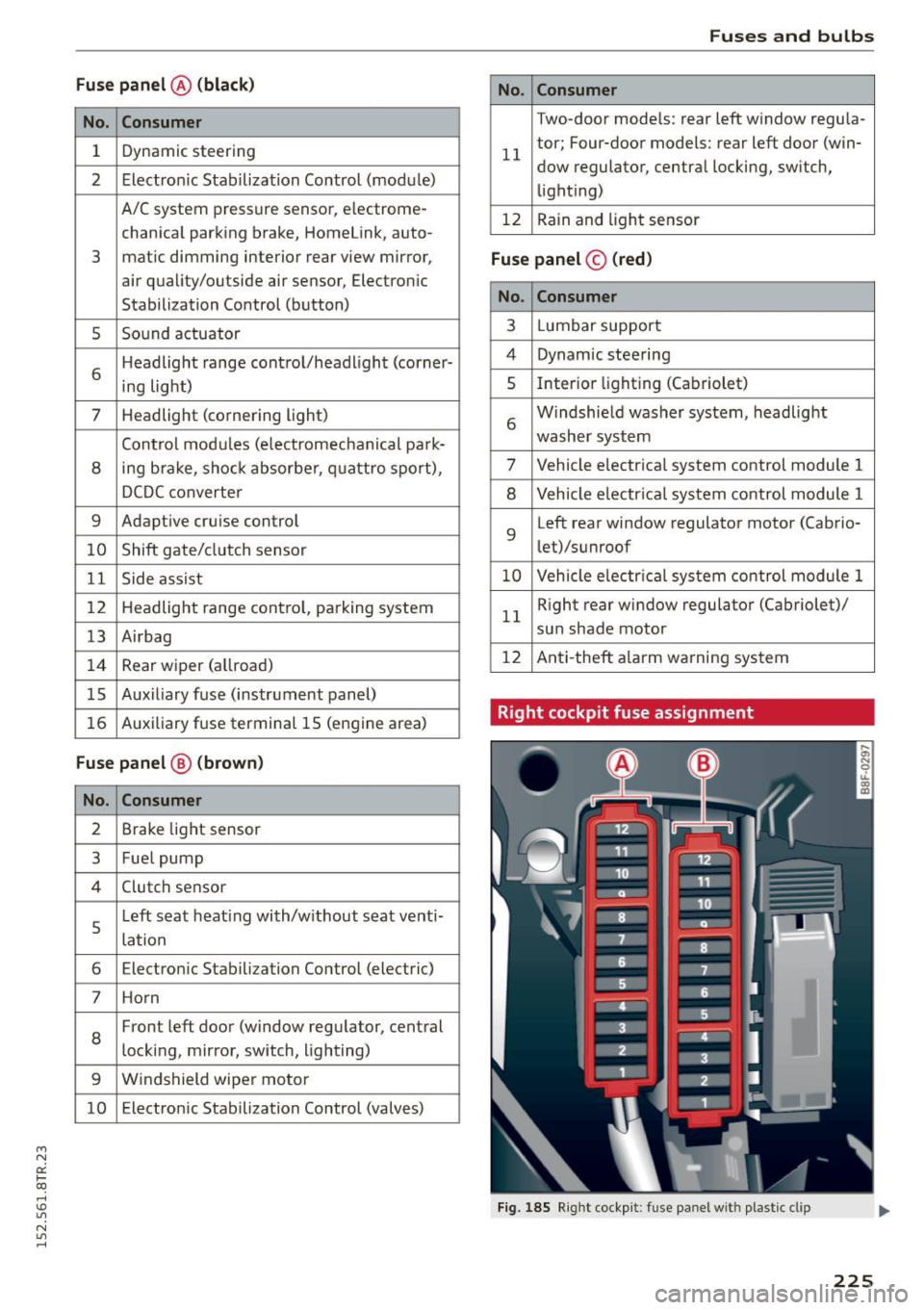
Right cockpit fuse assignment
Fig. 185 Right cockpit: fu se panel with plastic cl ip
225
Page 245 of 254

M N
0:: loo ,...., \!) 1.1'1
N 1.1'1 ,....,
Electromechanical parking brake
Emergency braking . . . . . . . . . . . . . . . . . . . 77
Indicator light . . . . . . . . . . . . . . . . . . . . . . . 7 5
Parking . . . . . . . . . . . . . . . . . . . . . . . . . . . . . 76
Releasing and closing . . . . . . . . . . . . . . . . . 75
Starting assist . . . . . . . . . . . . . . . . . . . . . . . 76
Starting from rest . . . . . . . . . . . . . . . . . . . . 76
Warning/indicator lights . . . . . . . . . . . . . . . 16
Electronic differential lock
Warning/indicator lights . . . . . . . . . . . . . . . 18
Electronic Differential Lock . . . . . . . . . . . . . 169
E lect ronic different ial lock (EDL)
Warn ing/ indicator lights . . . . . . . . . . . . . . . 18
Electronic immobilizer . . . . . . . . . . . . . . . 12, 36
Electronic power control
(EPC) warning/indicator light . . . . . . . . . . . 20
Electronic stabilization control
Sport mode . . . . . . . . . . . . . . . . . . . . . . . . 170
Electro nic Stabilization Control . . . . . . . . . . 169
E lectronic Stabilization Control (ESC)
Warning/indicator lights . . . . . . . . . . . . . . . 18
Emergency actuation
Doors . . . . . . . . . . . . . . . . . . . . . . . . . . . . . . 35
I gnition key . . . . . . . . . . . . . . . . . . . . . . . . . 33
Panoram ic tilting sunroof . . . . . . . . . . . . . . 39
Sun shade (roof) . . . . . . . . . . . . . . . . . . . . . 39
Emergency braking . . . . . . . . . . . . . . . . . . . . . 77
Emergency flasher . . . . . . . . . . . . . . . . . . . . . 45
Warning/indicator lights . . . . . . . . . . . . . . . 22
Emergency key . . . . . . . . . . . . . . . . . . . . . . . . 31
Starting engine . . . . . . . . . . . . . . . . . . . . . . 72
E mergency operation
Emergency braking function (parking brake) .7.7
Emergency sta rting . . . . . . . . . . . . . . . . . . . 228
Energy management . . . . . . . . . . . . . . . . . . 17 5
Battery power . . . . . . . . . . . . . . . . . . . . . . . 16
Driver notification . . . . . . . . . . . . . . . . . . . . 16
E ng ine
Compartment. . . . . . . . . . . . . . . . . . . . . . . 189
Coolant . . . . . . . . . . . . . . . . . . . . . . . . . . . . 192
Hood . . . . . . . . . . . . . . . . . . . . . . . . . . . . . . 187
Starting . .. .... ............. .. .. . 71, 73
Starting with jumper cables . . . . . . . . . . . 228
Stopping . . . . . . . . . . . . . . . . . . . . . . . . . 73, 74
Engine compartment . . . . . . . . . . . . . . . . . . 189
Safety instructions . . . . . . . . . . . . . . . . . . . 187
Working the engine compartment . . . . . . 187
Index
Engin e coolant
In dicato r light . . . . . . . . . . . . . . . . . . . . . . . 17
Engine coolant system . . . . . . . . . . . . . . . . . 192
Adding coolant. .. ............. .. .. .. 193
Checking coolant level . . . . . . . . . . . . . . . . 193
Checking the engine coo lant level. . . . . . . 193
Radiator fan . . . . . . . . . . . . . . . . . . . . . . . . 195
Engine coolant temperature
Temperature gauge . . . . . . . . . . . . . . . . . . . 10
Engine hood Closing . . . . . . . . . . . . . . . . . . . . . . . . . . . . 187
How to release the hood . . . . . . . . . . . . . . 187
Engine oil . . . . . . . . . . . . . . . . . . . . . . . . . . . 189
Adding . . . . . . . . . . . . . . . . . . . . . . . . . . . . 191
Additives. . . . . . . . . . . . . . . . . . . . . . . . . . . 191
Changing . . . . . . . . . . . . . . . . . . . . . . . . . . 192
Check oil level . . . . . . . . . . . . . . . . . . . . . . 191
Consumption . . . . . . . . . . . . . . . . . . . . . . . 191
Indicator light . .. ............. .... 17 , 20
Oil consumpt ion . . . . . . . . . . . . . . . . . . . . . 190
Pressure malfunction . . . . . . . . . . . . . . . . . . 16
Sensor defective . . . . . . . . . . . . . . . . . . . . . . 20
Specification and viscosity . . . . . . . . . . . . . 189
temperature indicator . . . . . . . . . . . . . . . . . 26
Engine speed limitation . . . . . . . . . . . . . . . . . 20
E nvironment
Catalytic converter . . . . . . . . . . . . . . . . . . . 178
Disposing of your vehicle battery ....... 199
Driving at high speeds . . . . . . . . . . . . . . . . 179
Fuel ............................... 185
Leaks under your vehicle . . . . . . . . . . . . . . 187
Letting the vehicle stand and warm up . . . 179
Proper disposal of drained brake fluid . . . 196
Proper disposal of drained engine coolant 193
Proper disposal of drained engine oil 191,192
Recycling used engine oil.......... .. . . 191
Roof rack . . . . . . . . . . . . . . . . . . . . . . . . . . . 62
Unleaded fuel . . . . . . . . . . . . . . . . . . . . . . . 183
What should I do with an old battery? . . . 199
EPC
refer to Electronic power control . . . . . . . . 20
Event Data Recorder (EDR) . . . . . . . . . . . . . . 168
Expansion tank . . . . . . . . . . . . . . . . . . . . . . . 193
Exterior lighting . . . . . . . . . . . . . . . . . . . . . . . 43
243
Page 247 of 254
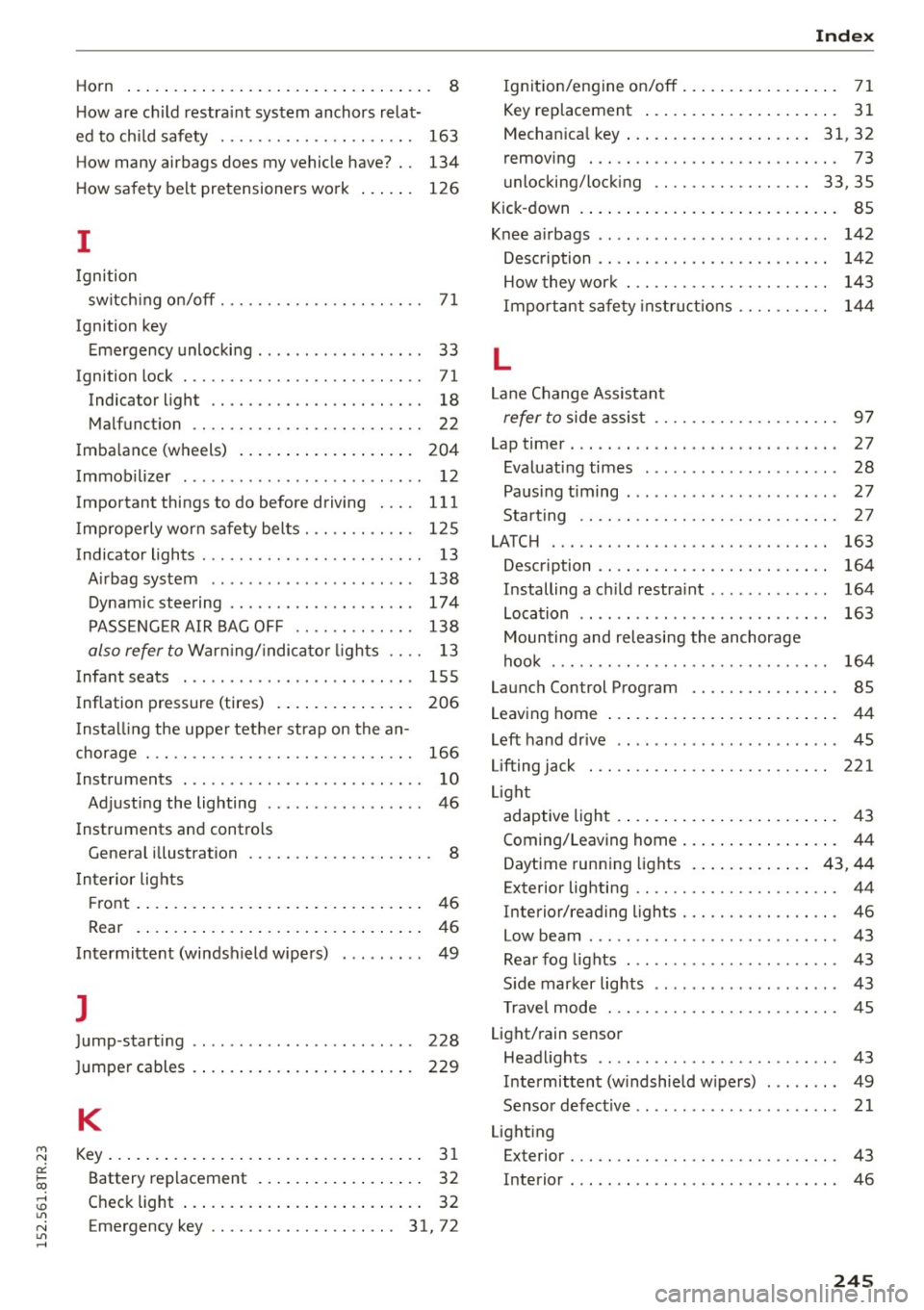
M N
0:: loo ,...., \!) ..,.,
N ..,., ,....,
Horn . . . . . . . . . . . . . . . . . . . . . . . . . . . . . . . . . 8
H ow are child restra int system anchors rela t-
ed to ch ild safety . . . . . . . . . . . . . . . . . . . . .
163
How many airbags does my vehicle have? . . 134
H ow sa fety be lt pretensioners work 12 6
I
Ignition
switch ing on/o ff.......... .... .. ......
7 1
Ignition key
Emergency unlocki ng . . . . . . . . . . . . . . . . . . 33
Ignition lock . . . . . . . . . . . . . . . . . . . . . . . . . .
71
Indicator light . . . . . . . . . . . . . . . . . . . . . . . 18
Malfunct ion . . . . . . . . . . . . . . . . . . . . . . . . . 22
Imba lance (w heels) . . . . . . . . . . . . . . . . . . . 204
Immobilizer . . . . . . . . . . . . . . . . . . . . . . . . . . 12
Important things to do before driving . . . . 111
Imp roperly wor n sa fety be lts. . . . . . . . . . . . 125
Indicator lights . . . . . . . . . . . . . . . . . . . . . . . . 13
A' b 1r ag system . . . . . . . . . . . . . . . . . . . . . . 138
Dynamic stee ring . . . . . . . . . . . . . . . . . . . . 17 4
P ASSENG ER AIR BAG OFF . . . . . . . . . . . . .
138
al so refer to War ning/ indica to r lig hts . . . . 1 3
Infant seats . . . . . . . . . . . . . . . . . . . . . . . . . 155
Inflation pressure (tires) . . . . . . . . . . . . . . . 206
Instal ling the uppe r tethe r st rap on the an-
chor age . .. .. .... ............. .. .. .. .
166
10
Instruments ..... .... ... .. .. .. .. .. ... .
Adjust ing the lighting . . . . . . . . . . . . . . . . . 46
Instruments an d contro ls
General i llustration . . . . . . . . . . . . . . . . . . . . 8
I n ter ior lights
Fr ont . . . . . . . . . . . . . . . . . . . . . . . . . . . . . . .
4 6
Rear . . . . . . . . . . . . . . . . . . . . . . . . . . . . . . . 46
Intermittent (windsh ield wipe rs) . . . . . . . . . 49
]
Jump -starting 228
J umpe r cables . . . . . . . . . . . . . . . . . . . . . . . . 229
K
Key ... .. .. .. .. .... .. .... ... .. .. .... .. 3 1
Battery rep lacement . . . . . . . . . . . . . . . . . . 32
C heck light . . . . . . . . . . . . . . . . . . . . . . . . . . 32
Emergency key . . . . . . . . . . . . . . . . . . . . 31, 72
Index
Ignit ion/engine on/off . . . . . . . . . . . . . . . . . 71
Key rep lacement . . . . . . . . . . . . . . . . . . . . . 31
Mechan ica l key ... ... .. ..... ... .. .. 31 , 32
removing . . . . . . . . . . . . . . . . . . . . . . . . . . . 73
unlocking/lock ing . . . . . . . . . . . . . . . . .
33, 35
Ki ck -down . . . . . . . . . . . . . . . . . . . . . . . . . . . . 85
K . b nee air ags . . . . . . . . . . . . . . . . . . . . . . . . . 142
D .. escriptron .. .. .. ... .......... .. .. . .
How they wor k ... ............. ..... . 142
143
Important sa fe ty instru ctions . . . . . . . . . . 144
L
Lane Change Assista nt
refer to side assis t . . . . . . . . . . . . . . . . . . . . 97
Lap timer. . . . . . . . . . . . . . . . . . . . . . . . . . . . . 27
Evaluating times . . . . . . . . . . . . . . . . . . . . .
28
p .
t· . ausrng ,ming . . . . . . . . . . . . . . . . . . . . . . . 27
Sta rt ing . . . . . . . . . . . . . . . . . . . . . . . . . . . . 27
LATCH . . . . . . . . . . . . . . . . . . . . . . . . . . . . . .
163
Description . . . . . . . . . . . . . . . . . . . . . . . . . 164
In stalling a c hild restra int . . . . . . . . . . . . . 164
Location . . . . . . . . . . . . . . . . . . . . . . . . . . . 163
Mounting and releasing the anchorage
hoo k . . . . . . . . . . . . . . . . . . . . . . . . . . . . . .
164
Launc h Control Program . . . . . . . . . . . . . . . . 85
Leaving home
Left hand drive 44
45
Lifting jack .
. . . . . . . . . . . . . . . . . . . . . . . . . 221
Li ght
adaptive light . . . . . . . . . . . . . . . . . . . . . . . .
43
Coming/Leaving home . . . . . . . . . . . . . . . . . 44
Daytime runn ing lights . . . . . . . . . . . . .
43, 44
Exterior lighting . . . . . . . . . . . . . . . . . . . . . . 44
Interior/reading lights . . . . . . . . . . . . . . . . . 46
Low beam ... .. .. .. ... .. ... ..... .. .. . 43
Rea r fog lights . . . . . . . . . . . . . . . . . . . . . . . 43
Side marker lights . . . . . . . . . . . . . . . . . . . . 43
Trave l mode . . . . . . . . . . . . . . . . . . . . . . . . . 45
Light/rain sensor
Head lights . . . . . . . . . . . . . . . . . . . . . . . . . .
43
In termittent (w indshield w ipers) . . . . . . . . 49
Senso r defective . . . . . . . . . . . . . . . . . . . . . .
21
Light ing
Exterior . . . . . . . . . . . . . . . . . . . . . . . . . . . . .
43
In terior . . . . . . . . . . . . . . . . . . . . . . . . . . . . . 46
245