remove seats AUDI RS5 COUPE 2015 Owners Manual
[x] Cancel search | Manufacturer: AUDI, Model Year: 2015, Model line: RS5 COUPE, Model: AUDI RS5 COUPE 2015Pages: 254, PDF Size: 64.12 MB
Page 56 of 254
Seats and storag e
sudden braking or an accident, yo u wo uld not
be able to brake or accelerate.
Front passenger's seat
Always move the front passenger seat into the rearmost position.
To avo id contact w it h the airbag wh ile i t is de
p loying, do not sit any closer to the inst rument
panel than necessary and always wear the three
point safety belt provided adjusted correctly. We
recommend that you adjust the passenger's seat in the following manner:
.,. Bring the backrest up to an (a lmost) upright
position .
Do not ride with the seat reclined .
.,. Applies to vehicles with adjustable head re
straints: Adjust the head restra int so the upper
edge is as even as poss ible with the top of your
head. If that is not possib le, try to adjust the
head restraint so that it is as close to this posi
tion as possible ¢
page 56.
.,. Place your feet on the floor in fron t of the pas
senger 's seat.
Front seats
Power seat adjustment
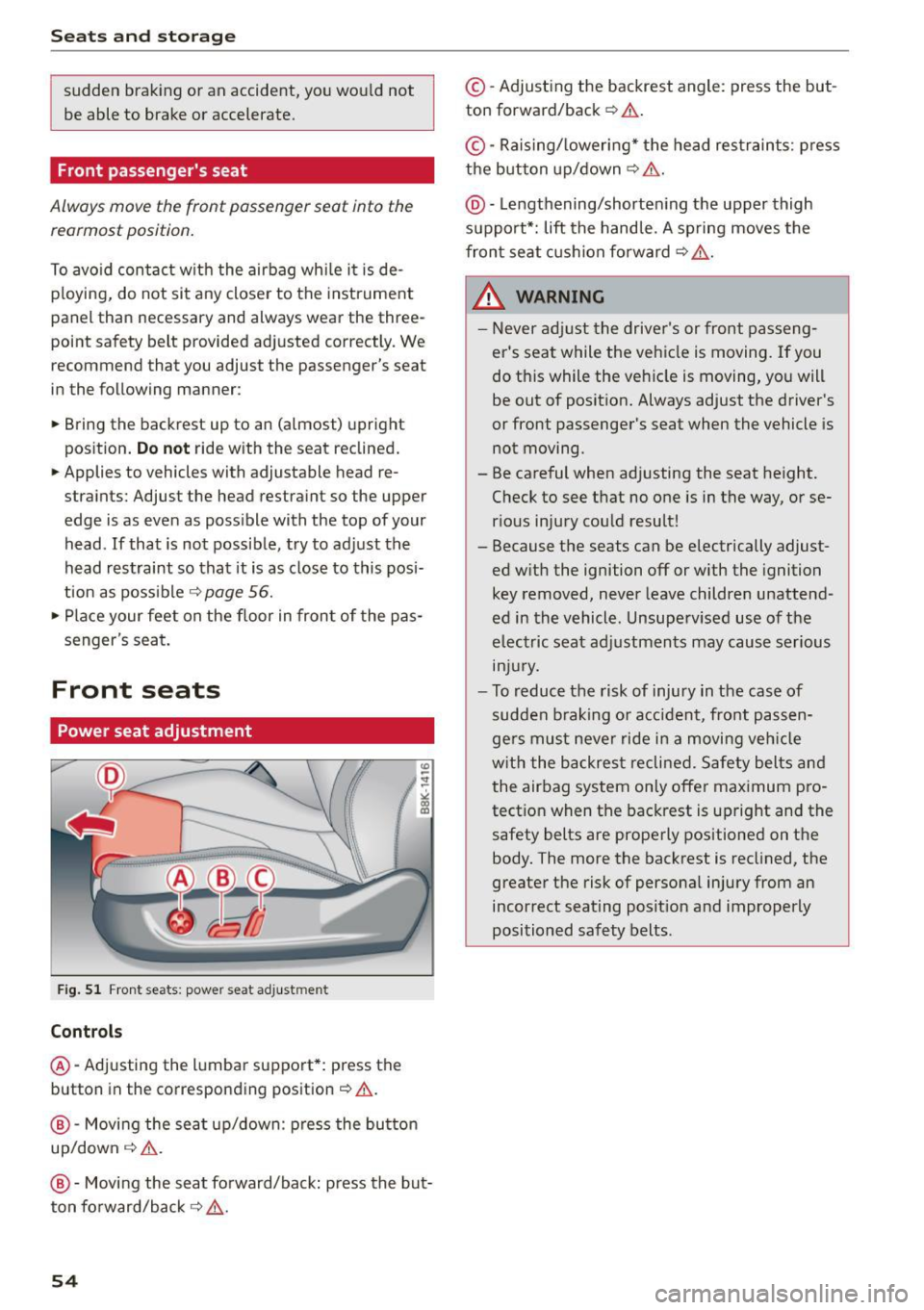
F ig . 5 1 Front seats : power seat ad justm ent
Controls
@ -Adjusting the l umbar support*: press the
button in the corresponding position~.& .
@-Movi ng the sea t up/down : press the bu tton
up/down
~ & .
@ -Movi ng the seat fo rward/back: press the but
ton fo rward/back
~ ,1,. .
54
©-Adjusting the backrest angle: press the but
ton forward/back ¢.& .
©-Raising/ lowering* the head res traints: p ress
the button up/down~ &.
@ -Lengthening/shorte ning the upper thigh
support*: lift the hand le. A sp ring moves the
fron t seat c ushion fo rward ¢
,&..
& WARNING -
-Never ad just the driver's or front passeng
er's seat while the vehicle is moving. If you
do this while the veh icle is moving, yo u will
be out of posit ion. Always adjust the driver 's
or front passenger's seat when the vehicle is
not moving .
- Be careful when adjusting the seat height. Check to see that no one is in the way, or se
r ious injury cou ld result!
- Because the seats can be electrically adjust ed w ith the ignition off or with the ignition
key removed, never leave children unattend
ed in the vehicle. Unsuperv ise d use of the
electric seat adj ustments may cause serious
m Ju ry.
- To reduce the risk of injury in the case of
sudden b raking or accident, fro nt passen
ge rs must neve r ride in a moving veh icle
w ith the backres t reclined. Safety belts and
the air bag system on ly offer ma ximum pro
tect ion when the bac krest is upright and the
safety belts are properly positioned on t he
body. The more the backrest is recl ined, the
greater the risk of persona l injury from an
incorrect seating posit ion and improperly
positioned safety belts.
Page 59 of 254
M N
0:: loo ,...., \!) 1.1'1
N 1.1'1 ,....,
Adjusting the head restr aint s
"'To move the head restraint up, hold it at the
sides with bot h hands and slide it upward until
yo u feel it click into place¢
A.
"'To move the head restraint down, press the
button ®¢
fig. 56 and slide the head restraint
downward.
R emoving th e head re straint s
"' Fold the backrest forward ¢ page 63.
"'Move the head restraint upward as far as it can
go.
"' Press the release @¢
fig. 57 with the mechan
ical key¢
page 32 and the button ® ¢ fig. 56.
Pull the head restraint out of the backrest at
the same time¢,& .
Install ing the head rest raint s
"'Slide the posts on the head restraint down into
the gu ides until you feel the posts click into
place.
"' Press the button®¢
fig. 56 and slide the head
restraint all the way down . You should not be
able to pull the head restraint out of the back
rest.
So that the driver can have a better v iew to the
rear, the head restra ints should be pushed down
completely when the rea r seats are not occupied .
_& WARNING
-Read and heed all WARNINGS¢ page 114,
Proper adjustment of head restraints.
- Only remove the rear seat head restraints
when necessa ry in order to install a chi ld
seat
¢ page 158. Install the head restra int
again immediate ly once the child seat is re
moved . Driving without head restraints or
with head restraints that are not properly adjusted increases the risk of serious or fa
tal neck injury dramatically.
- Vehicles with a pass through in the center console have seat ing for four. The long cen
ter console between the two rear seats is
not a seat ing pos ition. Therefo re, a safety
belt is not provided.
S eat s and stor age
{!) Tips
Correct ly adjusted head restraints and safety
belts are an extremely effective combination
of safety features.
Memory function
Description
Appl ies to vehicles: wi th memo ry fu nct io n
The memory f unct ion allows you to quickly and
easily store and recall personal seating profiles
for the driver . The memory function is operated
t h rough the master key and the memo ry buttons
in the driver 's door.
T he driver's seating p rofile is stored and assigned
to the master key each time the vehicle is locked.
When you open the door, the seat profile is auto matically reca lled. If two people use one vehicle,
it is recommended that each person always uses
"their own" ma ster key.
Up to 2 seat profi les can be stored in the memory
buttons in the driver's door. Once they are stored,
these seat profiles can be selected at any time.
In addition to the driver's seat settings, you can
also store and access the exterior mirror adjust
ment settings* using the remote contro l key or
memory bu tton.
Remote control key
App lies to vehicles: wit h seat memory
To assign the dr iver 's seat settings to the remote
control key when locking the veh icle, the function
must be activated in the radio or MMI*
"' Select:
!CAR I function button> Seat adjust-
ment > Driv er's seat > Remot e con trol k ey
>
on.Or
"' Select :
~ ,c~ A~R~I function button> Car sy stems *
contro l butto n > Vehicle s etting s> Seat s>
Driver 's seat > Remote control key > On .
(D Tips
If you do not want anothe r drive r's sett ings to
be assigned to the remote key, switch
off the
memory function usin g the rad io or MMI * or
the
ION/OF F I button ¢ page 58.
57
Page 60 of 254
Seats and storage
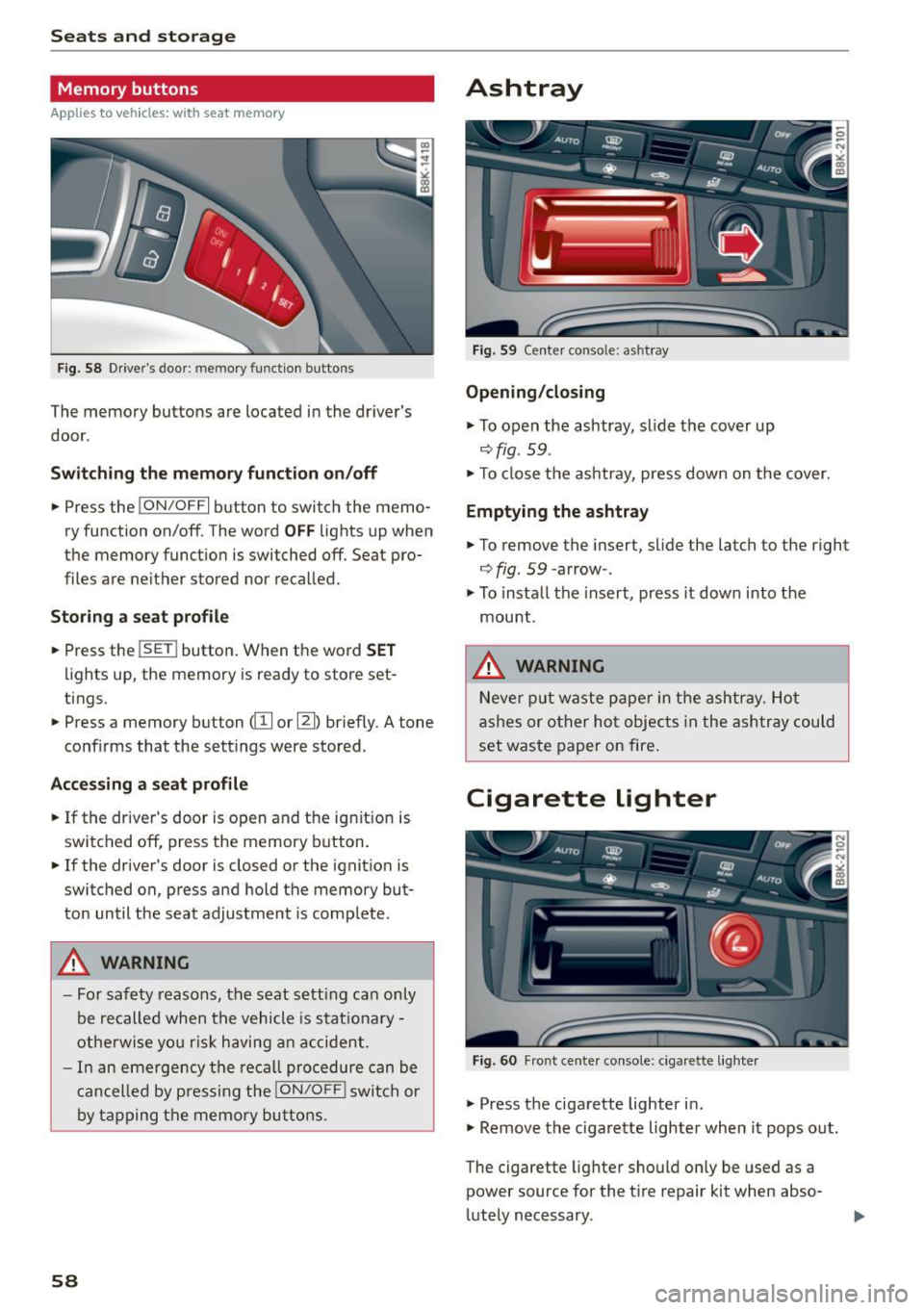
Memory button s
Applies to vehicles: with seat memory
Fig. 58 Drive r's door : me mory function buttons
The memo ry buttons are located in the driver's
door .
Switching the memory function on/off
• Press the !ON/O FF I button to switch the memo
ry function on/off. The word
OFF lights up when
the memo ry function is switched off . Seat pro
files are neither stored nor recalled.
Storing a seat profile
• Press the !SE T! button. When the word SET
lights up, the memory is ready to store set
tings.
• Press a memory button
([I I or ~) briefly . A tone
confirms that the sett ings were stored.
Accessing a seat profile
• If the driver's door is open and the ig nit ion is
switch ed off, press the memory button.
• If the driver's door is closed or the ignition is
switched on, press and hold the memory but
ton until the seat adjustment is comp lete .
.&_ WARNING
- For safety reasons, the seat sett ing can only
be recalled when the vehicle is stat ionary -
otherwise you risk having an accident .
- In an emergency the recall procedure can be
cancelled by pressing the
!ON/OFF I switch or
by tapping the memory buttons.
58
Ashtray
Fig. 59 Center console: as htray
Opening/closing
• To open the ashtray, slide the cover up
Qfig . 59 .
• To close the ashtray, press down on the cover.
Emptying the ashtray
• To remove the insert, slide the latch to the right
Qfig. 59 -arrow -.
• To install the insert, press it down into the
mount .
.&_ WARNING
-
Never put waste paper in the ashtray. Hot
ashes or other hot objects in the ashtray could
set was te paper on fire .
Cigarette lighter
Fig. 60 Front center console: cig arette lighter
• Press the cigarette lighter in .
• Remove the cigarette lighter when it pops out.
The cigarette lighter should only be used as a
power source for the t ire repair kit when abso
lutely necessary .
Page 61 of 254
"' N
0:: loo
rl I.O
"' N
"' rl
_& WARNING
The cigarette lighter only works when the ignition is switched on. Incorrect usage can lead
to serious injuries or burns . For this reason,
children should never be left unattended in
the vehicle because this increases the risk of
injury .
Storing
General overview
_& WARNING
-Always remove objects from the instrument
panel. Any items not put away could slide
around inside the vehicle while driving or
when accelerating or when applying the
brakes or when driving around a corner .
- When you are driving make sure that any
thing you may have placed in the center con
sole or other storage locations cannot fall
out into the footwells. In case of sudden
braking you would not be able to brake or
accelerate.
-Any pieces of clothing that you have hung up must not interfere with the driver's view.
The coat hooks are designed only for light
weight clothing . Never hang any clothing
with hard, pointed or heavy objects in the pockets on the coat hooks. During sudden
braking or in an accident - especially if the
airbag is deployed - these objects could in
jure any passengers inside the vehicle.
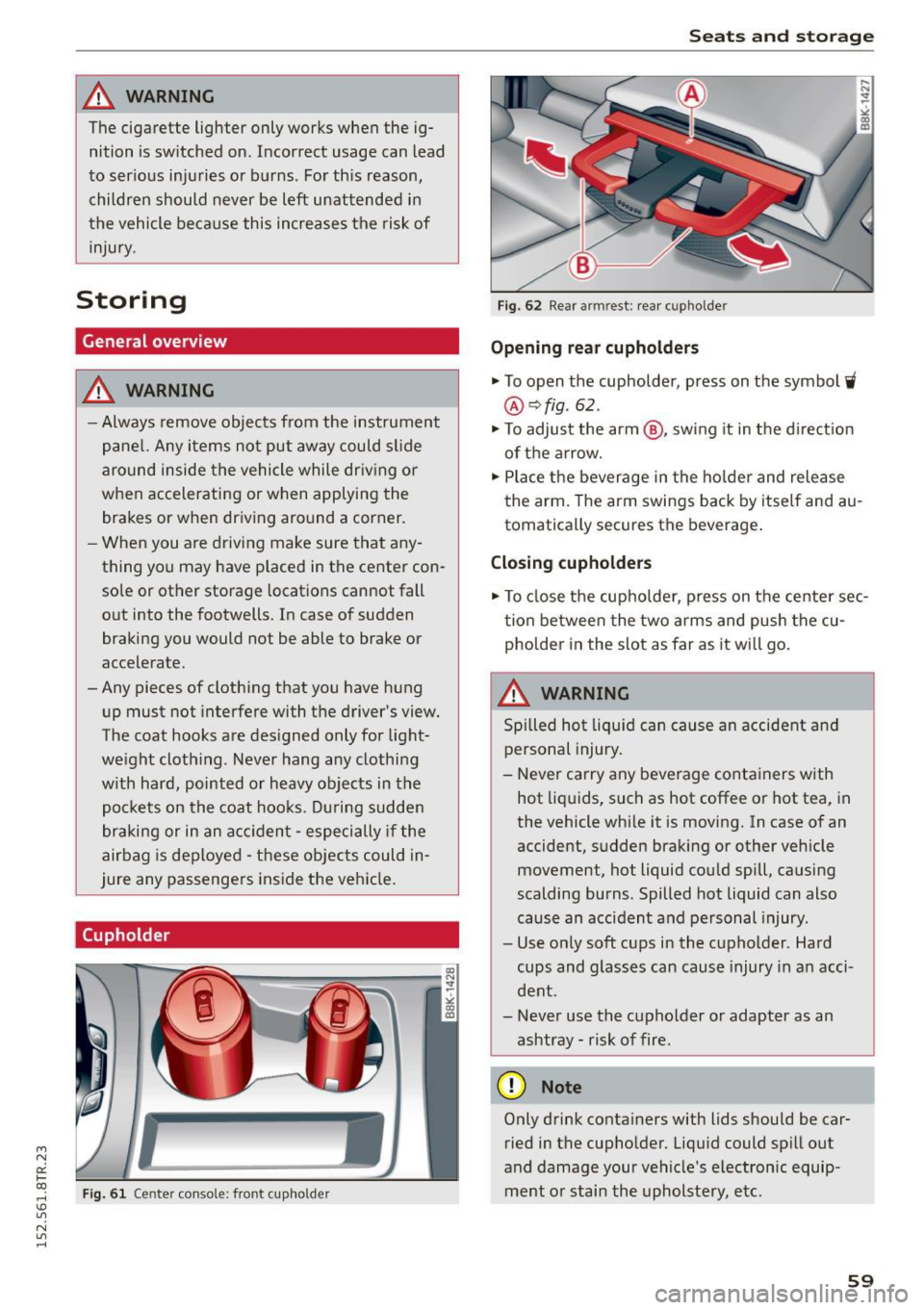
Cupholder
Fig. 61 Cen te r con sole: fron t cupho ld er
Seats and storage
Fig. 62 Rear armrest: rear cup hol der
Opening rear cupholders
.,. To open the cupholder, press on the symbol W
@ ¢fig . 62 .
.,. To adjust the arm @, swing it in the direction
of the arrow.
.,. Place the beverage in the holder and release
the arm. The arm swings back by itself and au
tomatically secures th e be verage .
Closing cupholders
.,. To close the cupholder , press on the center sec
tion between the two arms and push the cu
pholder in the slot as far as it wi ll go.
A WARNING
Spilled hot liquid can cause an accident and
personal injury.
- Never carry any beverage containers with
hot liquids, such as hot coffee or hot tea, in
the vehicle while it is moving. In case of an
accident, sudden braking or other vehicle movement, hot Liquid could spill, causing
scalding burns. Spilled hot Liquid can also
cause an accident and personal injury.
- Use only soft cups in the cupholder . Hard
cups and glasses can cause injury in an acci
dent .
- Never use the cupholder or adapter as an
ashtray- risk of fire .
(D Note
Only drink containers with lids should be car
ried in the cupholder . Liquid could spill out
and damage your vehicle's electronic equip
ment or stain the upholstery, etc.
-
59
Page 62 of 254
Seats and storage
Glove compartment
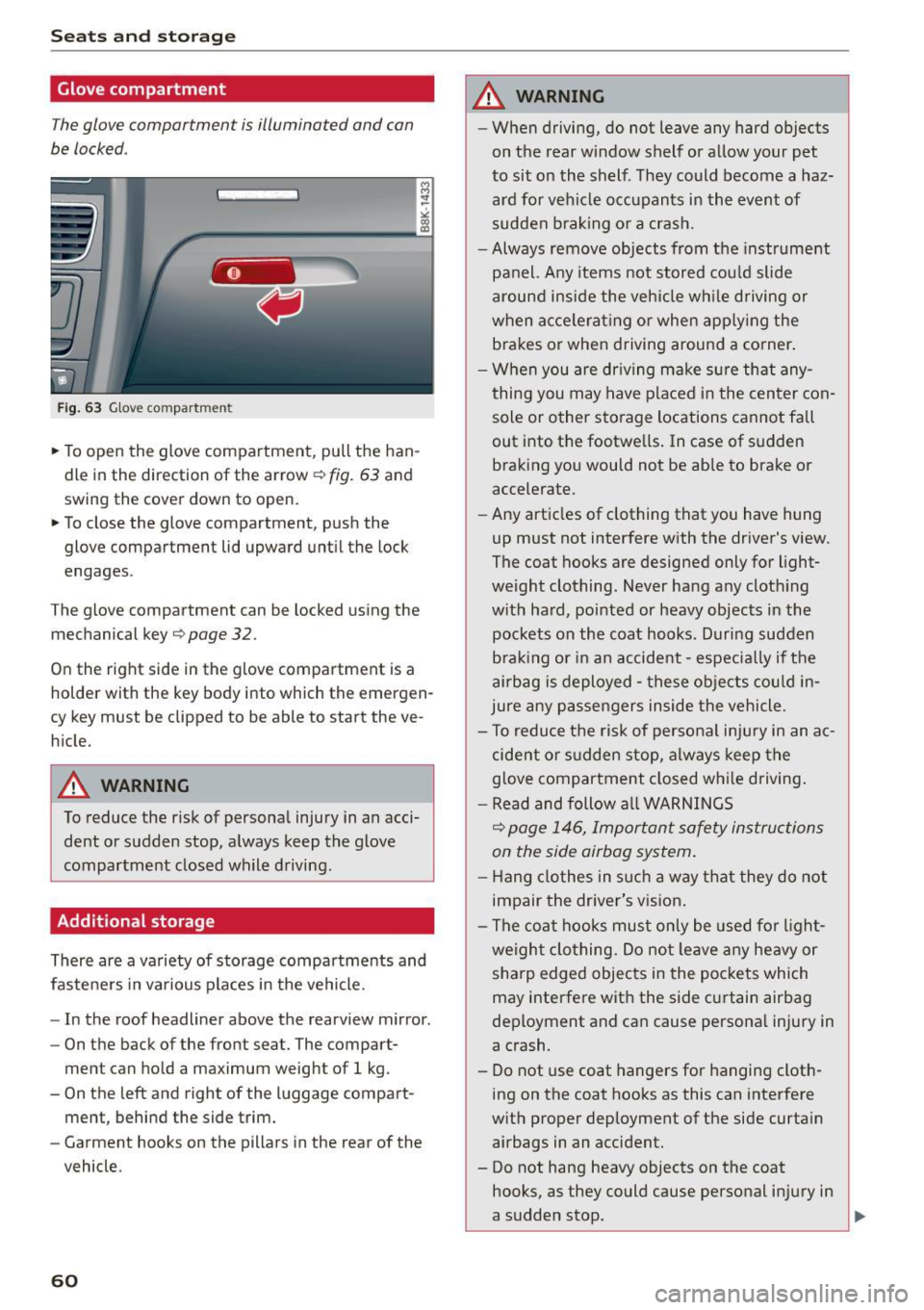
The glove compartment is illuminated and can
be locked .
Fig. 63 Glove compart ment
.. To open the glove compartment, pull the han
dle in the direction of the arrow
~fig. 63 and
swing the cover down to open.
.. To close the glove compartment, push the
glove compartment lid upward until the lock
engages .
The glove compartment can be locked using the
mechanical key
¢ page 32.
On the right side in the glove compartment is a
holder with the key body into which the emergen
cy key must be clipped to be able to start the ve
hicle.
A WARNING
To reduce the risk of personal injury in an acci dent or sudden stop, always keep the glove
compartment closed while driving.
Additional storage
There are a variety of storage compartments and
fasteners in various places in the vehicle.
- In the roof headliner above the rearview mirror .
- On the back of the front seat. The compart-
ment can hold a maximum weight of 1 kg.
- On the left and right of the luggage compart
ment, behind the side trim.
- Garment hooks on the pillars in the rear of the
vehicle.
60
A WARNING , -
- When driving, do not leave any hard objects
on the rear window shelf or allow your pet
to sit on the shelf . They could become a haz
ard for vehicle occupants in the event of
sudden braking or a crash.
-Always remove objects from the instrument
panel. Any items not stored could slide
around inside the vehicle while driving or
when accelerating or when applying the brakes or when driving around a corner.
- When you are driving make sure that any
thing you may have placed in the center con
sole or other storage locations cannot fall
out into the footwells. In case of sudden braking you would not be able to brake or
accelerate .
- Any articles of clothing that you have hung
up must not interfere with the driver's view .
The coat hooks are designed only for light
weight clothing. Never hang any clothing
with hard, pointed or heavy objects in the pockets on the coat hooks. During sudden
braking or in an accident -especially if the
airbag is deployed -these objects could in
jure any passengers inside the vehicle.
- To reduce the risk of personal inju ry in an ac
cident or sudden stop, always keep the
glove compartment closed while driving.
- Read and follow all WARNINGS
¢ page 146, Important safety instructions
on the side airbag system.
- Hang clothes in such a way that they do not
impair the driver's vision.
- The coat hooks must only be used for light
weight clothing. Do not leave any heavy or
sharp edged objects in the pockets which
may interfere with the side curtain airbag
deployment and can cause personal injury in
a crash.
- Do not use coat hangers for hanging cloth
ing on the coat hooks as this can interfere
with proper deployment of the side curtain airbags in an accident.
- Do not hang heavy objects on the coat
hooks, as they could cause personal injury in
a sudden stop .
~
Page 63 of 254
"' N
0:: loo
rl I.O
"' N
"' rl
-Always keep the compartment above the
rearview mirror closed while driving to re
duce the risk of injury in the event of sudden
braking maneuvers or a collision .
CJ) Note
Objects located on the rear shelf that rub
against the rear window could damage the
heating wires for the rear window defogger.
@ Tips
-A vent slot is located between the shelf and
the rear window. Do not block the vent with
any items you may place on the rear window
shelf.
- Do not place bulky items on the rear window
shelf as they could restrict or block the driv
er's vision in the rear view mirror .
Roof rack
Description and mounting locations
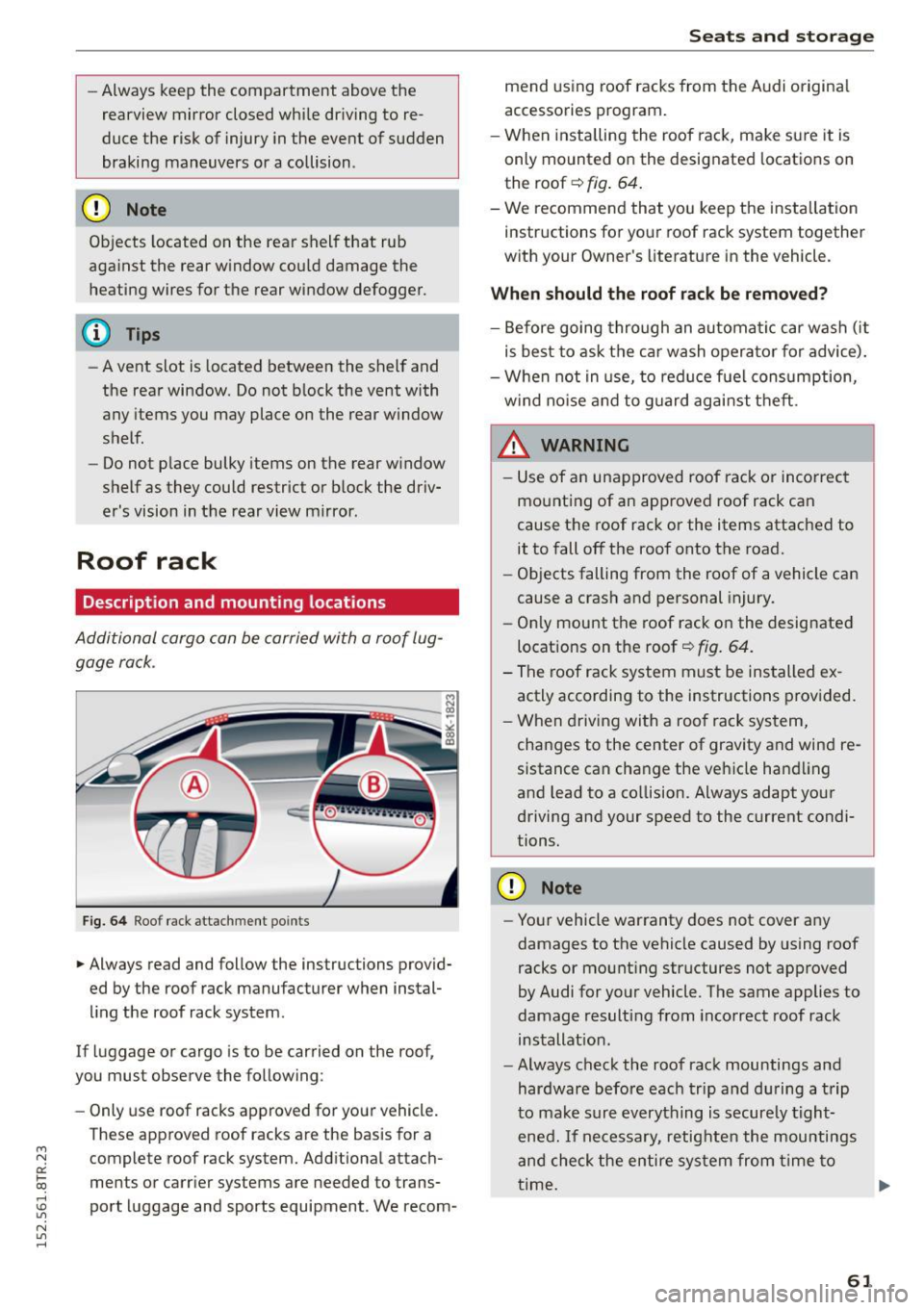
Additional cargo can be carried with a roof lug
gage rock .
Fig. 64 Roof rack attachment points
• Always read and follow the instructions provid
ed by the roof rack manufacturer when instal
ling the roof rack system .
If luggage or cargo is to be carried on the roof,
you must observe the following :
- Only use roof racks approved for your vehicle.
These approved roof racks are the basis for a complete roof rack system. Additional attach
ments or carrier systems are needed to trans
port luggage and sports equipment . We recom-
Seats and storage
mend using roof racks from the Audi original
accessories program.
- When installing the roof rack, make sure it is
only mounted on the designated locations on
the roof
c::> fig. 64.
- We recommend that you keep the installation
instructions for your roof rack system together
with your Owner's literature in the vehicle.
When should the roof rack be removed?
-Before going through an automatic car wash (it
is best to ask the car wash operator for advice).
- When not in use, to reduce fuel consumption,
wind noise and to guard against theft .
_& WARNING ,_____ -
- Use of an unapproved roof rack or incorrect
mounting of an approved roof rack can
cause the roof rack or the items attached to it to fall off the roof onto the road.
- Objects falling from the roof of a vehicle can
cause a crash and personal injury.
- Only mount the roof rack on the designated
locations on the roof
c::> fig . 64.
- The roof rack system must be installed ex
actly according to the instructions provided.
- When driving with a roof rack system,
changes to the center of gravity and wind re
sistance can change the vehicle handling
and lead to a co llision. Always adapt your
driving and your speed to the current condi
tions.
(D Note
- Your vehicle warranty does not cover any
damages to the vehicle caused by using roof
racks or mounting structures not approved
by Audi for your vehicle. The same applies to
damage resulting from incorrect roof rack
installation.
- Always check the roof rack mountings and
hardware before each trip and during a trip
to make sure everything is securely tight
ened. If necessary, retighten the mountings
and check the entire system from time to
time. ..,.
61
Page 65 of 254
"'
Enlarging the luggage compartment
Applies to vehicles: with fold ing rear seatback
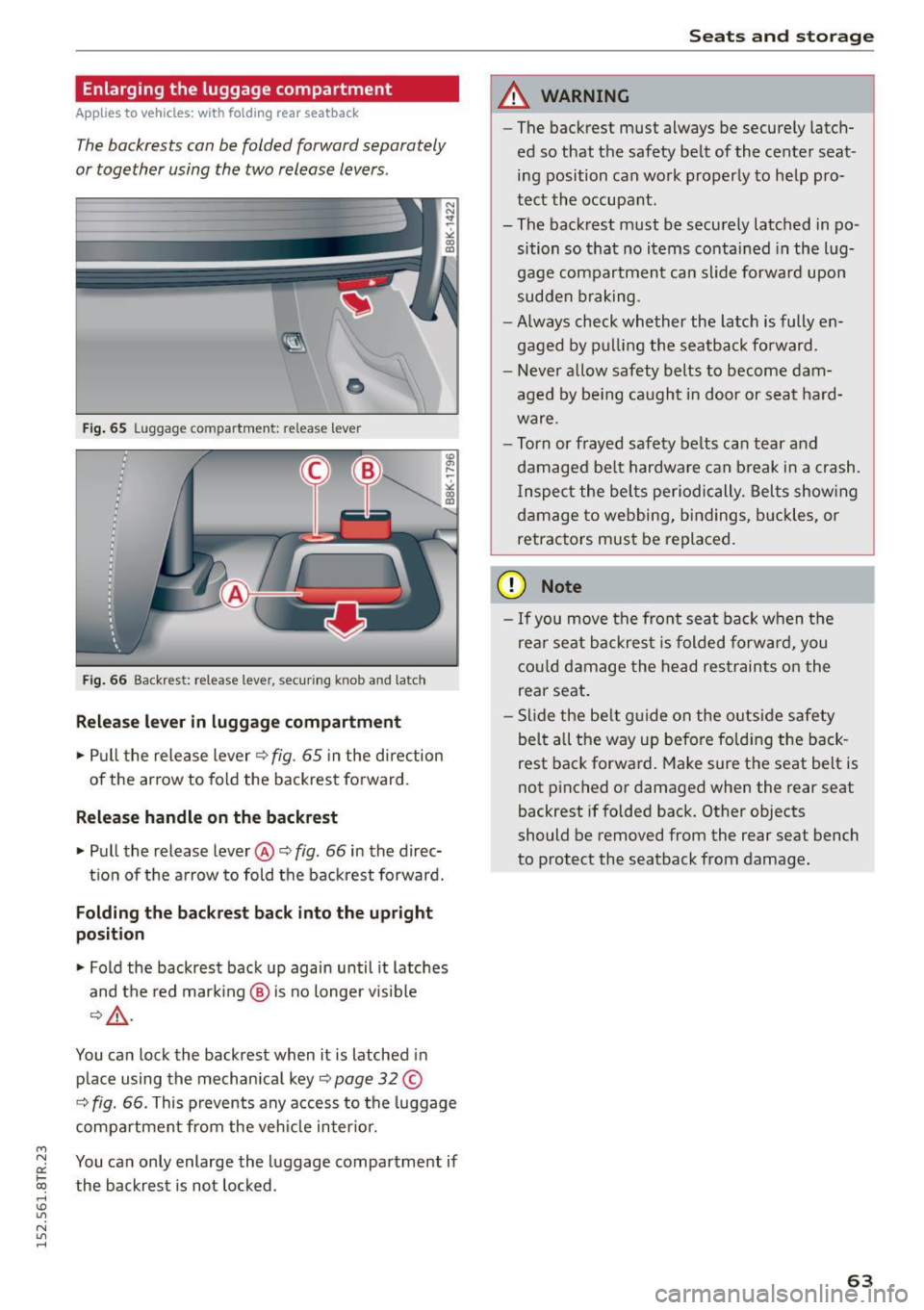
The backrests can be folded forward separately
or together using the two release levers.
Fi g. 65 Luggage compartment: release lever
F ig. 66 Backrest: release lever, sec uring knob and latch
Release lever in luggage compartment
• Pull the release lever Q fig. 65 in the direction
of the arrow to fold the backrest forward.
Release handle on the backrest
• Pull the release lever@~ fig. 66 in the direc-
t io n of the arrow to fold the back rest forward.
Folding the backres t back into the upright
position
• Fold the backrest back up again until it latches
and the red mar king @ is no longer v isible
Q ,&. .
You can lock the backrest when it is latched in
p lace using the mechan ica l key
~page 32 ©
Q fig. 66. This prevents any acces s to the luggage
compartment from the veh icle in ter ior.
~ You can only enlarge the luggage compartment if
txi the backrest is not locked. rl I.O
"' N
"' rl
Seats and storage
A WARNING
-
-The backrest must always be secure ly latch-
ed so that the safety be lt of the center seat
ing position can wo rk properly to help pro
t e ct the occupant.
- The backrest must be securely latched in po
sition so that no items conta ined in the Lug
gage compartment can slide forward upon
sudden b rak ing.
- Always check whether the latch is fully en
gaged by p ulling the seatback fo rward.
- Never allow safety b elts to become dam
aged by be ing caught in door or seat ha rd
ware.
- Torn or frayed safety belts ca n tear qnd
damaged be lt hardware can b reak i n a crash.
I nspect the bel ts periodically. Belts show ing
damage to webbing, bind ings, b uckles, or
retractors mus t be replaced.
(D Note
- If you move the front seat back when t he
rea r seat b ackres t is folded forwa rd, you
co uld damage the head restraints on the
rear seat.
- Slide the be lt g uide on the o utside safety
bel t all the way up befo re fo ld ing the back
rest bac k forwa rd . Make sure the seat belt is
not pinched or damaged when the rear seat
backrest if folded back. Other objects
should be removed from the rear seat bench
to protect the seatback from damage.
63
Page 125 of 254

"' N
0:: I-C() rl I.O
"' N
"' rl
_& WARNING
Not wearing safety belts or wearing them im
properly increases the risk of serious personal
injury and death. Safety belts can work only
when used correctly .
- Always fasten your safety belts correctly be
fore driving off and make sure al l passen
gers are correctly restrained.
- For maximum protection, safety belts must
always be pos itioned properly on the body.
- Never strap more than one person, includ
ing small ch ildren, into any belt.
- Never place a safety belt over a child sitting
on your lap .
- Always keep feet in the footwell in front of
the seat while the vehicle is being driven.
- Never let any person ride with their feet on
the instrument panel or sticking out the
window or on the seat .
- Never remove a safety belt while the vehicle
is moving . Doing so will increase your risk of
being injured or killed.
- Never wear belts twisted.
- Never wear belts over rigid or breakable ob-
jects in or on your clothing, such as eye
glasses, pens, keys, etc., as these may cause
injury .
- Never allow safety belts to become dam
aged by being caught in door or seat hard
ware.
- Do not wear the shoulder part of the belt
under your arm or otherwise out of position.
- Several layers of heavy clothing may inter
fere with correct positioning of belts and re duce the overall effectiveness of the system .
- Always keep belt buckles free of anything
that may prevent the buckle from latching
securely.
- Never use comfort clips or devices that cre
ate slack in the shoulder be lt. However, spe
cial clips may be required for the proper use
of some child restraint systems.
- Torn or frayed safety belts can tear, and
damaged belt hardware can break in an acc i
dent. Inspect belts regularly. If webb ing,
bind ings, buckles, or retracto rs are dam-
Safety belts
aged, have belts replaced by an authorized
Audi dealer .
- Safety belts that have been worn and loaded
in an accident must be replaced with the
correct replacement safety belt by an au
thorized Audi dealer. Replacement may be
necessary even if damage cannot be clearly
seen. Anchorages that were loaded must al
so be inspected.
- Never remove, modify , d isassemble, o r try
to repair the safety belts yourself .
-Always keep the belts clean. Dirty belts may not work properly and can impair the func
tion of the inertia reel
Q page 181 .
Safety belts
Fastening safety belts
Safety first -everybody buckle up!
Fig. 127 Be lt buck le and to ngue on t he drive r's seat
To provide maximum protection, safety belt s
must always be positioned correctly on the wear
er 's body.
... Adjust the front seat and head restraint proper
ly
r::> page 53 , Seats and storage.
... Make sure the seatback of the rear sea t bench is
in an upr ight position and securely latched in
place before using the belt
Q _& .
.. Hold the belt by the tongue and pull it evenly
across the chest and pelvis
Q _&.
... Insert the tongue into the correct buckle of
your seat until you hear it latch securely
Qfig. 127.
... Pull on the belt to make sure that it is securely
latched in the buckle.
Iii>
123
Page 126 of 254

Safety belts
Autom atic safet y belt retractors
Every safety belt is eq uipped w ith an automatic
be lt retractor on the shou lder belt. This feature
locks the belt when the be lt is pulled o ut fast,
during hard brak ing and in an accident . The belt
may also lock when you drive up or down a steep
hill or through a sharp curve. During normal driv
ing the belt lets you move freely.
S afety belt p rete n sioner s
The safety be lts are equipped with a belt preten
sioner that helps to t ighten the safety belt and
remove s lack when the pretensioner is activated.
The function of the pretensioner is monitored by
a warning light
r:::') page 19.
Converti ble lock ing r etra ctor
Every safety belt except the one on the driver
seat is equipped with a convertib le locking retrac
tor that
must be used when the safety belt is
used to attach a child safety seat. Be sure to read
the important informat ion about this feature
r=;,page 159.
.&_ WARNING
Improperly positioned safety belts can cause
serious injury in an accident¢
page 124,
Safety belt posi tion.
- Safety belts offer optimum protection only
when the seatback is upright and belts are
properly positioned on the body.
- Never attac h the safety belt to the buc kle
for ano ther seat. At taching the belt to the
wrong buckle will reduce safety be lt effec
tiveness and can cause serious persona l in
jury.
- A passenger who is not properly restrained
can be seriously in jured by the safety belt it
self when it moves from the stronger parts of the body into critical areas like the abdo
men.
-Always lock the convert ible lock ing retractor
when you are securing a child safety seat in
the vehicle¢
page 161.
124
Safety belt position
Correct belt position is the key to getting maxi
mum protection from safety belts.
Fig . 12 8 Safety belt posit ion
Standard features o n your vehicle help you ad just
the position of the safety belt to match your body
size.
- he ight-adjustable fron t seats.
.&_ WARNING
Improperly posit ioned safety be lts can cause
serious personal injury in an accident.
- The shou lder belt should Lie as close to the
center of the collar bone as possib le and
should fit well on the body . Ho ld the belt
above the latch tongue and pull it evenly
across the chest so t hat it sits as low as pos
sible on the pe lvis and there is no pressure
on the abdomen. The belt should always fit
snug ly
r:::;, fig. 128. Pull on the belt to tighten
if necessary.
- The lap be lt po rtion of the safety belt must
be positioned as low as poss ible across pel
vis and never ove r the abdomen.
Make sure
t he belt lies flat and snug
r=;, fig. 128. P ull on
t he belt to tighten if necessary.
- A loose-fit ting safety belt can ca use serio us
in ju ries by s hifting its position on your body
from the st rong bones to more v ulnerable,
soft tissue and cause serious injury.
- Always rea d an d heed al l WAR NINGS and
other important information
r=;,page 122.
Page 137 of 254

M N
0:: loo ,...., \!) 1.1'1
N 1.1'1 ,....,
detail below . Because the front passenger seat
contains important parts of the Advanced Airbag
System, yo u must take care to prevent it from be
ing damaged. Damage to the seat may prevent
the Advanced Airbag for the front passenger seat
from do ing its job in a crash .
The front Ad vanced Airb ag S ystem con sis ts
of the following :
-Crash sensors in the front of the vehicle that
measure veh icle acceleration/deceleration to
provide information to the Advanced Airbag
System about the severity of the crash .
- An electronic control unit, with integrated
crash sensors for front and side impacts . The
control unit "decides" whether to fire the front
airbags based on the information received from
the crash sensors . T he control un it also "de
cides" whether the safety be lt pretensioners
sho uld be activated.
- An Advanced Airbag with gas generator and
control valve for the driver inside the steering
whee l hub.
- An Advanced Airbag with gas generator and
control valve inside the instrument panel for
t h e front passenger.
- A weig ht-sensing mat under the upholstery
padding of the front passenger seat cushion
that meas ures the tota l weight on the seat. The
information registered is sent contin uous ly to
the electronic control unit to regulate deploy
ment of the front Advanced Airbag on the pas
senger side.
- An airbag monitoring system and indicator
light in the instrument cluster
¢ page 138.
-A sensor in each front seat registers the dis
tance between the respect ive seat and the
steering wheel or instrument panel. The infor
mation registered is sent cont inuously to the
elect ron ic cont ro l unit to regulate deployment
of the front Advanced Airbags.
- T he
PASSENGER AIR BAG OFF light comes on
and stays on in the center of the i nstrument
pane l¢
page 138, fig . 134 and tells you when
the front Advanced Ai rbag on the passenger
side has been turned
off .
-A sensor below the safety belt la tch fo r the
front seat passenge r to measure the tension on
Airbag syste m
the sa fe ty belt. The tens ion on the safety be lt
and the weight registered by the weight -sens
ing mat he lp the control unit "decide" whether
the front a irbag for the front passenger seat
should be turned
off or not¢ page 129, Child
restraints on the front seat- some important
things to know.
- A sensor in the safety belt latch for the driver
and for the front seat passenger that senses
whether that safety belt is latched or not and
transm its this informat ion to the elect ro nic
cont ro l unit.
A WARNING
D amage to the fron t passenger seat can pre
vent the fron t air bag from working prope rly.
- Imp roper repai r or d isassembly of the front
passenger and driver sea t will prevent the
Advanced Airbag System from functioning properly .
- Repairs to the front passenge r seat must be
performed by qualified and p roperly trained
workshop personne l.
- Never remove the front passenger or driver seat from the vehicle .
- Never remove the upho lstery from the front
passenger seat.
- Never d isassemble o r remove par ts from the
seat or disconnect w ires from it.
- Never carry sh arp objects in yo ur po ckets or
p la ce them on t he seat.
If the weight-sens
ing mat in the passenger seat is punctu red
it cannot work properly .
- Never carry things on yo ur lap or carry ob
jects on the passenger seat. S uch items can
increase the we ight registe red by the
weight-sensing mat and send the wrong in
formation to the airbag control unit.
- Never store items under the front passenger
seat . Parts of the Advanced Airbag System
under the passenger seat could be dam
aged, p reventing them and the airbag sys
tem from wo rking prope rly.
- Never p lace seat covers or rep lacement up
holstery that have not been specifically ap
p roved by Aud i on the front seats.
- Seat cove rs can prevent the Advanced Air
bag Sys tem from recogniz ing child
1 3 5