warning AUDI RS7 SPORTBACK 2014 Owners Manual
[x] Cancel search | Manufacturer: AUDI, Model Year: 2014, Model line: RS7 SPORTBACK, Model: AUDI RS7 SPORTBACK 2014Pages: 292, PDF Size: 73.56 MB
Page 235 of 292
Tires an d wheel s 233
you have stored. The system does not recog
nize the load condition of your vehicle.
The effectiveness of the ti re pressu re monitor
ing sys tem w ill be impaired if you store no r
mal load pressures but then operate the vehi
cle at its maximum load¢,& .
See the illustration ¢
fig. 195 for the location
of the label on dr iver's side B-pillar (color of
the actual labe l and exact location on the ve
hicle wi ll vary slig htly) .
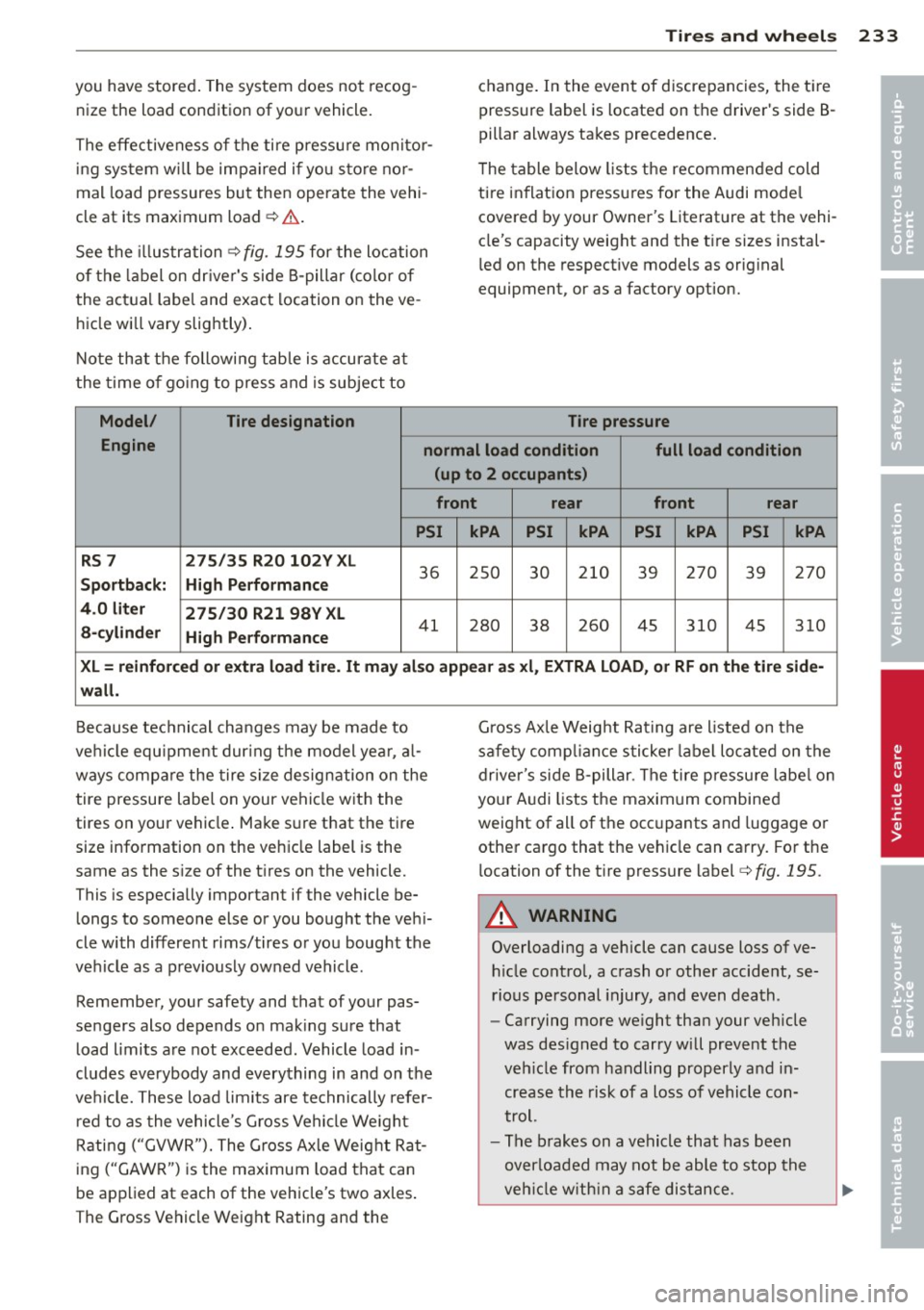
Note that the fo llowing tab le is accurate at
the t ime o f go ing to press and is subject to
Model/ Tire de
signation
c h ange. In the event of discrepancies, the ti re
pressure label is located on the driver's side B
pillar always takes precedence .
T he table below lists the recommended cold
ti re inflat ion pressures for the Audi mode l
covered by your Owner's Literat ure at the vehi
cle's capacity weight and the t ire sizes instal
l ed on the respective models as orig inal
equipment, or as a factory option.
Tire pressure
Engine normal load condition full load condition
(up to 2 occupants )
front r ear front rear
PSI kPA PSI kPA PSI kPA PSI kPA
RS 7 275/35 R20 102V XL
36 2S0 30 210 39 270 39 270 Sportback: High P erformanc e
4.0 lit er
275 /30 R21 98V XL
a -cy linder
High Performance
41 280 38 260 45 310 4S 3 10
X L = r einfor ced or extra load tir e. It ma y al so appear a s xl , EXTRA LOAD, or RF on th e tire side -
w all.
Because tec hnical changes may be made to
ve hicl e equ ipment dur ing the model yea r, a l
ways compare the tire s ize designation on the
tire pressure label on your vehicle with the
tires on your vehicle . Make s ure that the tire
size information on the vehicle label is the
same as the s ize of the t ires on the vehicle.
This is especially important if the vehicle be
longs to someone else or you bought the veh i
cle with different rims/tires or you bought the
veh icle as a previously owned vehicle.
Remember, your safety and that of your pas
sengers also depends on mak ing sure that
load limits are not exceeded . Vehicle load in
cludes everybody and everything in and on the
ve hicl e. These load limits are technically refer
r ed to as the vehicle's G ross Vehicle We ight
Rating ("GVWR"). The Gross Ax le Weight Rat
ing ("GAWR") is the maximum load that can
be applied at each of the vehicle's two axles .
The Gross Vehicle We ight Rating and the G
ross Ax le Weig ht Rating are listed on the
sa fety comp liance sticke r label lo cated on the
driver's side B-pillar . The tire pressu re labe l on
your A udi lists the maximum combined
weight of all of the occ upants and luggage o r
other cargo that the veh icle can carry. For the
location of the t ire pressure label ¢
fig. 195.
A WARNING
-Overloading a vehicle can cause loss of ve-
h icle contro l, a crash or other accide nt, se
rious personal injury, and even death.
- Carrying more we ight than your veh icle
was des igned to carry will prevent the
veh icle from handling properly a nd in
crease the risk of a loss of vehicle con
trol.
- The brakes on a vehicle that has been
overloaded may not be able to stop the
veh icle w ith in a safe distance.
•
•
Page 236 of 292
234 Tire s and wheel s
-Tires on a vehicle that has been overload
ed can fail suddenly causing loss of con
trol and a crash.
- Always make sure that the tota l load be
ing transported does not make the vehi
cle heavier than the veh icle's Gross Vehi
cle Weight Rating.
A WARNING
- Incorrect tire pressures and/or underin flation can lead to a serious or fatal acci
dent .
- Incorrect tire pressures and/or underin
flation cause increased tire wear and can affect the handling of the vehicle.
- Incorrect tire pressures and/or underin
flation can also lead to sudden tire fa il
ure, including a blowout and sudden de
flation, causing loss of vehicle control.
Checking tire pressure
-
The correct tire pressure for the tires original
ly installed on your vehicle is listed on the tire
pressure label located on driver's side 8-pil
lar.
The recommended t ire pressures are on the
tire pressure label and in the tab le
~ page 232, Cold tire inflation pressure . This
means that the pressure must be checked and
adjusted when the tire has not been driven for
more than a couple of mi les (kilometers) at
low speeds during the previous three hours.
Air in the tires expands when the tire heats up
as a result of internal fr iction as it flexes in
use . The tire pressure is higher when the tire
has warmed up than when it is "cold."
It is the inflat ion pressure in a "cold" tire that
counts. Therefore , you should never let air out
of a warm t ire to match "Cold tire inflation
pressure" recommendations
~ page 232. The
tires would then be under inflated and cou ld
fail suddenly.
The tire p ressure label on your Audi l ists the
recommended cold t ire inflat ion pressures at
maximum capacity for the new, original equipment tires that were on your vehicle at
the time it was manufactured. For the loca
t ion of the labe l
~pag e 232, fig. 195.
Most tires lose air naturally over t ime . They
can a lso lose some air if you drive over a pot
ho le or hit a curb while parking. It is usually
not possible to see whether the rad ial tires
used today are underinflated just by looking
at them.
Therefore , be sure to check tire pressures at
l east once a month and always before going
on a long trip. Make sure to take the number
of people and the amount of luggage into ac
count when adjusting tire pressure for a trip -
even one that you would not consider to be
"long ." See ~
page 235, Tires and vehicle
load limits
for more important info rmation .
Always use an accurate tire pressure gauge
whe n checking and adjusting inflat ion p res
sures . Check al l of the tires . If the pressure in
any ti re is too high when the tire is "cold," let
air o ut of the tire slowly with the edge of the
t ire gauge and keep checking the pressure un
ti l you reach the pressure that is correct for
the load (passengers and luggage) and kind of
driving you plan to do.
If the pressure in any ti re is too low, note the
difference between the pressure in the co ld
tire and the pressure you need and add the air
that you need to reach the correct pressure for
the vehicle load (passengers and luggage) for
the tires on your vehicle as listed on the on
your vehicle and in this manual and the kind
of driving you plan to do.
Ne ver ex cee d th e ma ximu m in fl ation pr es
sure l isted on th e tir e side wall for any re a
son .
Remember that the vehicle manufacturer, not
the tire manufacturer, determines the correct
t ire pressure for the tires on your vehicle.
It is important to check the tire pressure when
the tires are co ld.
- Read the required tire pressure from the t ire
pressure labe l. The tire pressure label is lo -
cated on the driver's side B-pillar .
liJJ>
Page 237 of 292
-Turn the valv e stem cap counter-clockwise
to remove it from the tire valve.
- Place the air pressure gauge on the valve.
- The tire pressures should only be checked
and adjus ted when the tires are cold . The
s li ght ly raised p ressures of warm tires must
not be reduced .
- Adjust the tire pressure to the load you are
carrying .
- Re insta ll the va lve stem cap on the valve.
When should I che ck the tire pres sur e?
The correct tire pressure is espec ially impor
tant at high speeds. The pressure should
therefo re be checked at least once a month
and a lways before start ing a journey.
When should I adjust the tire p re ssure s?
Adjust the tire pressure to the load you are
carry ing . After changing a wheel
o r replacing
wheels you have to adjust the tire pressures
on all wheels. In addition , you must then
store the new ti re pressu res in the t ire pres
sure monitoring system
r::!.> page 246 .
A WARNING
Incorrect tire pressures and/or underinf la
tion can lead sudden tire failure, loss of contro l, collision, serious persona l injury
or even death.
- When the warning symbo l
[ti] appears in
the instrument cl uster, stop and inspect
the tires.
- Incorrect tire pressure and/or underinfla
t ion can cause increased tire wear and
can affect the handling of the veh icle and
stopp ing ability .
- Incorrect tire pressures and/or underin
flation can also lead to sudden tire fa il
ure, including a blowout and sudden de
flation, causing loss of vehicle control.
- The driver is responsible for the correct
tir e pressures fo r all t ires on the vehicle .
T he applicable pressu re va lues are locat
ed on a stic ker on the drive r's side B-pil
lar .
- Only when a ll t ires on the vehicle are fi l
led to t he cor rect pressure, the ti re p res-
Tire s an d wheel s 235
sure monitor ing system can work cor
rectly.
- The use of incorrect tire pressure va lues
can lead to acc idents or other damage.
Therefore it is essential that the driver
observe the spec ified t ire pressure values
for the tires and the correct pressures for
the function of the t i re p ress ure monito r
ing system .
- Always inf late t ires to the recommended
a nd correct t ire p ress ure before dr iv ing
off.
- Driving with unde rinflated tires bend
mo re, lett ing t hem get too hot resulti ng
in tread separation, s udden tire failure
and loss of cont ro l.
- Excess ive speed and/overloadi ng can
cause heat b uild- up, sudden tire failure
a nd loss of cont rol.
- If the tire pressure is too low or too high,
the t ires will wear prema turely and the
veh icle w ill not handle well.
- If the tire is not fla t and you do not have
to ch ange a wheel immedia tely, drive a t
red uced speed to the nearest service sta
tion to check the t ire p ress ure and add
air as requi red.
(D Note
Dr iving w it h out valve stem c aps can c ause
damage to the tire valves . To prevent this,
a lways make sure that factory insta lled
va lve stem caps on all whee ls are sec urely
mounted on the valve .
@ For the sake of the env ironment
Un derinflated tires wi ll also increase the
fuel consumption .
Tires and vehicle load limits
There are limits to the amount of load or
weight that any vehicle and any tire can carry.
A vehicle that is overloaded will not handle
well and is mo re d iff icult to stop. Overloading
can not o nly lead to loss of vehicle control,
but can also damage important parts of the
vehicle and c an le ad to sudden tire fa ilu re, .,..
•
•
Page 238 of 292
236 Tire s and whee ls
including a blowout and sudden deflation that
can cause the vehicle to crash.
Your safety and that of your passenge rs a lso
depends on making s ure that load limits are
not exceeded. Vehicle load includes everybody
and everything in and on the vehicle. These
load limits are techn ically referred to as the
vehicle's
Gr oss Veh icl e W eight R ating
("GVWR").
The "GVWR" includes the weight of the basic
ve hicle, all factory installed accessories, a full
tank of fuel, oil, coolant and other fluids plus
maximum load. The maximum load includes
the number of passengers that the vehicle is
i ntended to carry ("seating capacity") with a n
assumed weight of 150 lbs (68 kg) for each
passenger at a des ignated seat ing pos ition
and the tota l we ight of any luggage in the ve
h icle.
The
Gro ss Axle Weight Rating ("GAWR") is
the maximum load that can be app lied at each
of the vehicle's two axles .
The G ross Vehicle Weight Rating and the
Gross Axle Weight Rating are listed on the
safety compliance st icker labe l located on the
driver 's side B-p illar. Your A udi has 4 seating
positions, 2 in the front and 2 in the rear for
total seating capacity of 4. Each seating posi
tion has a safety belt
9 page 133, Safety
belts.
The fact that there is an upper limit to your
vehicle's Gross Vehicle Weight Rating means
that the tota l weight of whatever is being car
ried in the vehicle is limited. The more passen
gers in the veh icle or passengers who are
heav ier than the standard weights assumed
mean that less weight can be carried as lug
gage.
The tire pressure label on your Audi also lists
the maximum combined weight of all of the
occupants and luggage or other cargo that
the veh icle can carry . For the location of the
l abe l
9page 232, fig. 195.
A WARNING
Overloading a vehicle can cause loss of ve
h icle contro l, a crash or other accident, se
rious personal injury, and even death.
- Carrying more we ight than your veh icle
was des igned to carry will prevent the
veh icle from handling properly and in
crease the risk of the loss of vehicle con
trol.
- The brakes on a vehicle that has been
overloaded may not be able to stop the
veh icle w ith in a safe distance.
- Tires on a vehicle that has been overload
ed can fail suddenly, including a blowout
and sudden deflation, causing loss of
control and a crash.
- Always make sure that the total lo ad be
ing transpor ted does not make the veh i
cle heavier than the vehicle's Gross Vehi
cle Weight Rating.
Determining correct load limit
U se the exa mple belo w to ca l
c ula te the t otal weight of the
p ass engers a nd lu ggage or oth
e r thin gs that yo u plan to tran s
p o rt so t hat yo u can make sur e
th at yo ur vehi cle w ill n ot be
ove rloa ded.
Steps for Determining
Correct Load Limit
1. Lo cate th e statement "THE
COMBINED WEIGH T OF Q C-
CU PANT S A ND CARGO
SHOULD NE VER E XCEED XXX
KG OR XXX LBS" on your ve
hicle 's placard (tire inflation
11>
Page 240 of 292
238 Tires and wheels
symbols) indicate the positions of the tread
wear indicators. Worn tires must be replaced. Different figures may apply in other countries
c::> & .
Tire pressure
Incorrect tire p ressure causes premature wear
and can cause sudden tire blow-out. For this
reason, tire pressure must be checked at least
once a month
c::> page 234.
Driving style
Driving fast around curves, heavy acceleration
and hard braking increase tire wear.
Rotating tires for more even wear
For all four tir es on your vehicle to have the
same se rv ice life, we recommend that the
front and rear tires are rotated according to
the tire manufacturer's suggested tire rota
tion intervals. Please remember the follow
ing:
- T ire rotation inte rva ls may differ from the
vehicle serv ice intervals outlined in your
Warranty
& Maintenance booklet.
- T he longer one tire is used in one location
on the vehicle, the more it wears at certa in
points; therefore, we recommend that you
follow the tire manufacturer's suggested
tire rotation intervals.
- Vehicles with front-wheel drive experience
more tread wear on the front whee ls com
pared to all-whee l drive (quattro).
- Please rotate ti res as shown
c::> fig. 198.
-Extra care must be taken when rotating di-
rection-specific tires
c::> page 2 59.
Wheel balancing
The wheels on new vehicles are balanced .
Ho wever, various situations during everyday
driving can cause them to become unbal
anced, resu lting in vibrations you can usually
feel through the steering wheel.
Unba lanced wheels must be rebalanced to
avoid excessive wea r on steering, suspension
and tires . A wheel must a lso be rebalanced
when a new tire is installed. Incorrect wheel alignment
Incorrect
wheel alignment can cause exces
sive tire wear, impairing the safety of the vehi
cle. If tires show excessive wear, have the
wheel alignment checked by an a uthorized
Audi dealer or qualified workshop.
All-wheel drive
Vehicles with quattro must always have tires
of the same size, construction and tread type.
For details see
c::>page 195.
_8 WARNING
-Sudden tire fa ilure can lead to loss of con-
trol, a crash and serious personal injury!
- Never drive a vehicle when the tread on
any tire is worn down to the wear indica
tors.
- Worn t ires are a safety hazard, they do
not grip well on wet roads and increase
your risk of "hydroplaning" and loss of
control.
- Always keep chemicals that can cause
tire damage, such as grease, o il, gasoline
and brake fluid away from tires.
- Tires age even if they are not being used
and can fai l suddenly, especially at high
speeds. Tires that are more than 6 yea rs
old can only be used in an emergency
and then w ith specia l care and at lower
speeds.
- Never mount used tires on your veh icle if
you are not sure of their "previous histo
ry." O ld used tires may have been dam
aged even though the damage cannot be
seen that can lead to sudden tire fai lure
and loss of vehicle control.
Page 243 of 292
manufacturers also must indicate the materi
als in the tire, which include steel, nylon, pol
yester, and others.
M ax imum Load R atin g
This numbe r indicates the maximum load in
kilograms and pounds that can be carried by
the tire.
Tire qualit y gra ding for treadw ear,
t ract ion , and temp erature r esistanc e
Tread wear , traction and temperature g rades
¢ page 242.
Maximum Permissible Inflation Pressur e
This number is the greatest amount of air
pressure that sho uld ever be put in the ti re
under normal driving conditions.
_& WARNING ,...__._
- Using incorrect or unmatched tires and/
or whee ls or improper tire and whee l
combinations can lead to loss of contro l,
co llision and serious persona l injury.
- Always use tires, rims and wheel bo lts
that meet the specifications of original
factory-installed tires or other combina t ions that have been spec ifically ap
proved by the vehicle manufacturer.
- Tires age even if they are not being used
and can fail suddenly, especially at high
speeds . Tires that are more than 6 years
old can only be used in an emergency
and then with special care and at lower
speeds .
- Never mount used tires on your vehicle if
you are not su re of their "previous histo
ry." Old used ti res may have been dam
aged even though the damage cannot be
seen that can lead to s udden tire failure
and loss of vehicle control.
- All four wheels must be fitted with radia l
tires of the same type, size (rolling cir c u mference) and the same tread pattern.
Driving with different tires red uces veh i
cle handling and can lead to a loss of
control.
Tire s an d wheel s 241
-If the replacement tire is not the same as
the t ires that are mounted on the veh icle
- for example with winter tires - only use
the replacement tire for a short per iod of
time and drive with extra care . Refit the
normal road whee l as soon as safely pos
sible.
- Never drive faster than the max imum
speed for which the tires on you r vehicle
a re rated because tires that are dr iven
faster than thei r rated speed ca n fa il
suddenly .
- Ove rloading tires ca use heat build-up,
sudden tire fa ilure, including a blowou t
and sudden deflation and loss of cont ro l.
- Temperature grades apply to ti res that
are properly inflated and not over or un
derinf lated .
- F or technical reasons it is not always
possible to use whee ls from other
vehicles -in some cases not even whee ls
from the same veh icle mode l.
- If you install wheel trim discs on the ve
hicle wheels, make sure that the air flow
to the brakes is not b locked. Reduced air
flow to the brakes can them to overheat, increas ing stopping d istances and caus
ing a co llision.
- Run flat tires may only be used on
veh icles that were equipped with them
at the factory . The veh icle must have a
chassis designed for run flat tires . Incor
rect use of ru n flat ti res can lead to vehi
cle damage or accide nts. Che ck with an
author ized Audi dealer or tire spe cialist
to see if your vehicle can be eq uipped
with run flat tires . If run flat tires are
used, they must be installed on all four
wheels. Mixing tire types is not permit
ted.
@ Note
- For technical reasons, it is not generally
possible to use the wheel rims from oth
er veh icles. Th is can hold tr ue for wheels
of the same vehicle type. .,..
•
•
Page 244 of 292
24 2 T ire s and wheel s
-If a replacement tire is different from
the tires that you have mounted on your
vehicle (for example winter tires or wide profile tires), then use the replacement
tire for a short period of time only and
drive w ith extra care. Replace the flat tire
with the tire matching the others on your
vehicle as soon as poss ible.
- Never dr ive without the valve stem cap .
The valves could get damaged.
@ For the sake of the environment
Dispose of old t ires in accordance with the
local requ irements.
Uniform tire quality grading
- Tread wear
- Traction AA A BC
- Temperature ABC
Quality grades can be found where applicable
on the tire side wa ll between tread shou lder
and max imum section width
¢ page 239,
fig. 199.
For example: Tread wear 200 , Traction AA,
Temperature A.
All passenge r car tires must confo rm to Feder
a l Safety Requirements in addition to these
grades .
Tread wear
The tread wear grade is a comparative rating
based on the wear rate of the tire when tested
u nder cont rolled conditions on a spec ified
government test course .
For example, a t ire graded 1S0 wou ld wear
one and one half (11/ 2) t imes as well on the
gove rnment course as a tire graded 100.
The relat ive perfo rmance of t ires depends
upon the a ctua l conditions of their use, how
ever, and may depart sign ifican tly from the
n orm due to var iat ions in dr iving habits, serv
ice practices and differences in road cha racte r
istics and climate .
Traction
The traction grades, from highest to lowest,
are AA, A, Band
C. Those grades represent the
ti re's ability to stop on wet pavement as
measured under contro lled conditions on
specified government test surfaces of aspha lt
and concrete. A t ire marked C may have poor
traction performance ¢.&,. .
Temperature
The temperature grades are A (the highest),
B, and C, representing the tire's resistance to
the generation of heat and its ab ility to dissi
pate heat when tested under controlled condi
t ions on a specif ied indoo r laboratory test
wheel.
Sustained h igh temperature can cause the
mater ial of the tire to degenerate and reduce
t ire life, and excessive temperature ca n lead
to sudden tire failure
~ .&,. .
The grade C corresponds to a level of perform
ance which all passenger car tires must meet
under the Federal Motor Vehicle Safety Stand
ard No. 109 . Grades Band A represent h igher
levels of performance on the laborato ry test
whee l than the minimum requ ired by law.
_& WARNING
The t raction grade assigned to t his tire is
based on s traight-ahead braking trac tion
tests, and does not include accelerat ion,
cornering, hydroplaning or peak t raction
cha racte rist i cs.
A WARNING "--
The temperature grade for this tire is es-
tablished for a tire that is properly inflated
and not overloaded. Excess ive speed, un
derinflation, or excess ive load ing, either
separately or in combinat ion, can cause
heat bui ldup and possib le tire failure.
-
Page 245 of 292
Winter tires
Winter tires can improve vehicle handling on
snow and ice . At temperatures below 45 °F
(7 °C) we r ecommend changing to winter
tires.
In some heavy s now areas, local governments
may require true winter or "snow " tires, those
with ve ry deeply cut tread. These t ires shou ld
only be used in pa irs and be insta lled on all
fou r wheels. Ma ke sure yo u pu rchase snow
tires that are the same size and construction
type as the other tires on your vehicle .
Your veh icle is equipped w it h all-wheel drive,
this will improve tra ct io n du ring w inte r driv
ing, even with the s tandard tires. However, we
strongly recommend that yo u always eq uip a ll
four whee ls on your vehicle with cor rectly fit
ted w inter tires or all-se ason tires, when w in
te r r oad conditions are expected . This also im
proves the vehicle's braking performance and
reduces stopping distances .
Summe r tires provide less grip on ice and
snow.
W inter t ires (snow t ires) must a lways be fitted
on all four whee ls .
Ask yo ur autho rized Aud i dea ler o r qualified
wo rkshop fo r permi tted
winter tire siz es . Use
on ly radia l winter tires.
W inte r tir es lose the ir effectiveness when the
tread is worn down to a depth of 0.15 7 inch
(4 mm) .
Only drive with wi nter tires under winter con
d it ions . Summer tires hand le better when
there is no snow or ice on the roads and the
temperature is above 45 °F ( 7 °C).
I f you have a flat tire, see notes on replace
men t wheel ¢
page 239.
Please always remember that w inter tires may
h ave a lower speed rating than the t ires origi
n a lly installed on your veh icle at the t ime it
was manufactured. Plea se see ~
page 240,
Speed rating (letter code)
for a List ing of the
speed rat ing letter codes and t he maxim um
speed at w hic h the tir es can be driven.
Tire s an d wheel s 243
The speed rating letter code(¢ page 231) is
o n the side wall of the tire~
page 239 .
A WARNING
Winter t ires have maximum speed limits
that may be lower than your vehicle's max
imum speed. Always know the max imum
speed before driv ing off . Never drive faster
than the speed permitted for yo ur specific
winter tires . This wi ll ca use damage to the
tires leadi ng to an accident and ser ious
personal injury to you and your passen
gers .
A WARNING ,._.__
Driving faster than the maximum speed
for which the winter tires on your vehicle
were designed can cause tire fail ure in
cluding a blowout and sudden deflation, loss of contro l, crashes and ser ious per
sonal injuries. Have worn or damaged tires
replaced immediately .
- Wi nter tires have maximum speed rating
that may be lower than your vehicle 's
maximum speed .
- Never drive faster than the speed for
which the w inter or othe r tires installed
on you r vehicle a re rated .
A WARNING
Always a djust yo ur dr iv ing to the road and
traffic cond it ions . Never let the good ac
celer atio n of the winter t ires and al l-wheel
d rive tempt yo u into ta king ext ra risks. Al
ways remember:
- W hen braking, an all-wheel drive veh icle
handles in the same way as a front drive
vehicle .
- Drive c arefully and reduce your speed on
icy and slippery roads, even w inter t ires
cannot help under black ice conditions .
@ For the sake of the environment
Use summer tires when weather condi
tions permi t. T hey are qu iete r, do not wear
as quickly and reduce fuel consumpt ion .
•
•
-
Page 246 of 292
24 4 T ire s and wheel s
Snow chains
Snow chains may be fitted on ly to the front
wheels, and only to certain tire sizes. Ask your
authorized Audi dealer on whic h tire sizes
snow chains can be used.
I f you are going to use snow chains , then you
must install them on the front wheels at
l east.
The snow chains must have low-profile links
and must not be thicker than 0.4 inch (10 ,5 mm), including the lock .
Remove wheel center covers and tr im discs
before putting snow cha ins on your vehicle
c:;, Q) _ For safety reasons cover caps must the n
be fitted over the whee l bolts. These are ava il
ab le from authorized Audi dea lers.
A WARNING
Using the wrong snow chains for yo ur vehi
cle or installing them incorrectly can in
crease the risk of loss of control leading to
ser ious personal inj ury.
- Snow chains are ava ilable in different
sizes. Always make sure to follow the in
struct ions provided by the snow chain
manufacturer .
- When driving w ith snow chains never
dr ive faster than the speed permitted for
your specific snow cha ins.
- Always observe local regulat ions .
([) Note
-Remove snow cha ins before driving on
roads not covered with snow to avoid
damaging t ires and wear ing the snow
chains down unnecessar ily.
- Snow chains, wh ich come into d irect con
tact with the wheel rim, can scratch or
damage it . Therefore, make sure that the
snow chains are suitab ly covered . Check
the position of the snow chains after
driving a few yards and correct if neces
sa ry. Follow the i nstructions from the
snow cha in manufacture r when doing so.
- If the Adaptive Air Suspension* should
malfunction, do no t mo unt or use snow chains because the vehicle will be ex
treme ly low. If you do drive with snow
chains on while the vehicle is at this lev
el, the snow cha ins might severely dam
age the whee lhouse and other parts of
the vehicle .
(D Tips
Where snow chains are mandatory on cer
tain roads, th is normally a lso applies to
vehicles with all-wheel drive.
Wheel bolts
Wheel bol ts mus t alway s be tightened to the
correc t torque.
The design of wheel bolts is matched to the
factory installed rims . If different r ims are fit
ted, the correct wheel bol ts with the righ t
length and correct ly shaped bolt heads must
be used . T his ensures that wheels are fitted
securely and that the b rake system functions
co rrect ly.
In certa in circumstances, you may not use
wheel bolts from a different veh icle -even if it
is the same model
c:;, page 275 .
A WARNING
Imp rope rly t ightened or ma inta ined wheel
bo lts can become loose c ausing loss of
control, a col lision and serio us pe rsonal i n
jury .
- Always keep the wheel bo lts and the
threads in the wheel hubs clean so the
wheel bo lts can turn easily and be prop
erly tightened.
- Never g rease or oil the wheel bolts and
the threads in t he wheel hubs . They can
become loose while driv ing if greased or
oiled, even if t ightened to the specified
torque.
- On ly use wheel bolts that belong to the
rim being installed .
- Never use different wheels bolts on yo ur
veh icle.
- Always maintain the correct t ightening
torque for the whee l bolts to reduce the
Page 248 of 292
246 Tires and wheels
Refer to ¢page 243 for mo re detailed infor
mation regarding winter tires .
Tire pressure
monitoring system
(D General notes
Each tire, including the spare (if provided) ,
should be checked monthly when cold and in
flated to the inflation pressure recommended by the vehicle manufacturer on the vehicle
placard or tire inflation pressure label. (If your
vehicle has tires of a different size than the
size indicated on the vehicle placard or tire in
flation pressure label, you shou ld determine
the proper tire inflation pressure for those
tires).
As an added safety feature, your vehicle has
been equipped with a tire pressure monitor ing
system (TPMS) that illuminates a low tire
p ressure telltale when one or more of your
tires is significantly under-inflated. According
ly, when the low tire pressure telltale illumi
nates, you should stop and check your tires as
soon as possible, and inflate them to the proper pressure. Driving on a significantly un
der-inflated tire causes the tire to overheat
and can lead to tire failure . Under -inflation al
so reduces fuel efficiency and tire tread life,
and may affect the vehicle's handling and
stopping ab ility.
Please note that the TPMS is not a subst itute
for proper tire maintenance, and it is the driv
e r's responsib ility to ma inta in correct tire
pressure, even if under-inflation has not
reached the level to trigger illumination of the
TPMS low tire pressure telltale.
Your veh icle has also been equ ipped w ith a
TPMS malfunction indicator to indicate when
the system is not operating properly. The
TPMS malfunction indicator is combined with
the low tire pressure telltale . When the sys
tem detects a malfunction, the te lltale will
flash for approximately one minute and then remain continuously illuminated. This se- quence will continue upon subsequent vehicle
start-ups as
long as the malfunction exists.
When the malfunction indicator is illum inat
ed, the system may not be ab le to detect or
signal low tire pressure as intended . TPMS
malfunctions may occur for a variety of rea
sons, including the installation of replace
ment or alternate tires or wheels on the vehi
cle that prevent the TPMS from functioning
properly. Always check the TPMS malfunction
telltale after replacing one or more tires or
wheels on your vehicle to ensure that the re
placement o r alternate ti res and wheels allow
the TPM S to cont inue to function properly.
Description
The tire pressure monitoring system monitors
the pressure in the four tires when driving.
The system uses sensors that measure the
temperature and pressure in the tires. Theda
ta is sent from these sensors to the control
module by radio frequency.
The tire pressure monitoring system shows
the current pressures and temperatures of the
tires in the Infotainment system
¢page 247.
It also compares the current tire pressures
with the stored pressures and gives a warning in the driver information system if the tire
pressure is different from what is stored
¢ page 247.
The system does not detect if the stored tire
pressures match the recommended tire pres
sures. You must resave the tire pressures
¢page 248:
- eve ry time the tire p ressu res change, for ex
ample when the load in the vehicle changes,
- after replacing a t ire, or
- if wheels w ith new wheel sensors are used .
_&. WARNING
-The tire pressu re monitoring sys tem as
sists the driver in monitoring tire pres
sures. The driver is responsible for having
the tires inflated to the correct pressure. ..,.