height AUDI RS7 SPORTBACK 2014 User Guide
[x] Cancel search | Manufacturer: AUDI, Model Year: 2014, Model line: RS7 SPORTBACK, Model: AUDI RS7 SPORTBACK 2014Pages: 292, PDF Size: 73.56 MB
Page 161 of 292
experience, informat ion a nd specia l
too ls necessary to perform the work
safely.
- If the veh icle or the circuit interrupter
is scrapped, all applicable safety pre
cautions must be followed.
@ For the sake of the environment
Undep loyed airbag modu les and preten
sioners might be classified as Perchlorate Material - special handling may apply, see
www.dtsc.ca .gov/hazardouswaste/per
chlorate. When the vehicle or parts of the
restraint system including airbag modules
and safety belts w ith pretens ioners are
scrapped, all applicable laws and regula
tions must be observed. Your author ized
Aud i dea ler is familiar with these requi re
ments an d we recommend that yo u have
your dea ler perform this se rvice for you .
Other things that can affect Advanced
Airbag performance
Changing the vehicle's suspension system can
change the way that the Advanced A irbag Sys
tem pe rforms in a crash. For example, us ing
tire -r im combinations not app rove d by Aud i,
l owering the vehicle, changing the stiffness o f
the suspension, incl uding the springs, s uspen
sion struts, shock absorbers etc. can change
the forces that a re measured by the airbag
sensors and sent to the elect ronic control
u ni t. Some suspension changes can, for exam
p le, increase the force levels measured by the
se nsors and make the airbag system deploy in
crashes in wh ich it would not dep loy if the
changes had not been made . Ot her k inds of
change s may reduce the force levels meas
u red by the sensors and prevent the a irbag
from deploying when it shou ld .
The sensors in the safety belt buckle fo r the
d river and front passenger sea t tell the elec
tronic control module if the safety belt is
l atched or not . If the safety belt is be ing used,
the front airbag will dep loy at a slightly high
er rate of vehicle deceleration than if the safe
ty belt is not being used. Therefore, in a pa r-
A irba g sy stem 159
ticular coll is io n, it is possible t hat an airbag
w ill not deploy at a seating position where the
safety belt is be ing used b ut w ill inflate at the
position where the safety belt is not be ing
used . It is important that nothing interfere
with the safety be lt buckles so that the sen
sors can send the cor rect info rmation about
safe ty be lt use to the electronic control un it .
A WARNING .
Changing the vehicle's suspension includ
i ng use of unapp roved tire-r im combin a
tions can cha nge Advanced Airbag per
formance and increase the risk of se rious
personal injury in a crash.
- Never install s uspension componen ts
that do not have the same performance characteristics as the components origi
na lly installed on your vehicle.
- Never use tire -rim combinations that
have not been approved by Audi .
Knee airbags
Description of knee airbags
Applies to vehicles: wit h knee airbags
The knee airbag system can provide supple
mental protection to properly restrained
front seat occupants .
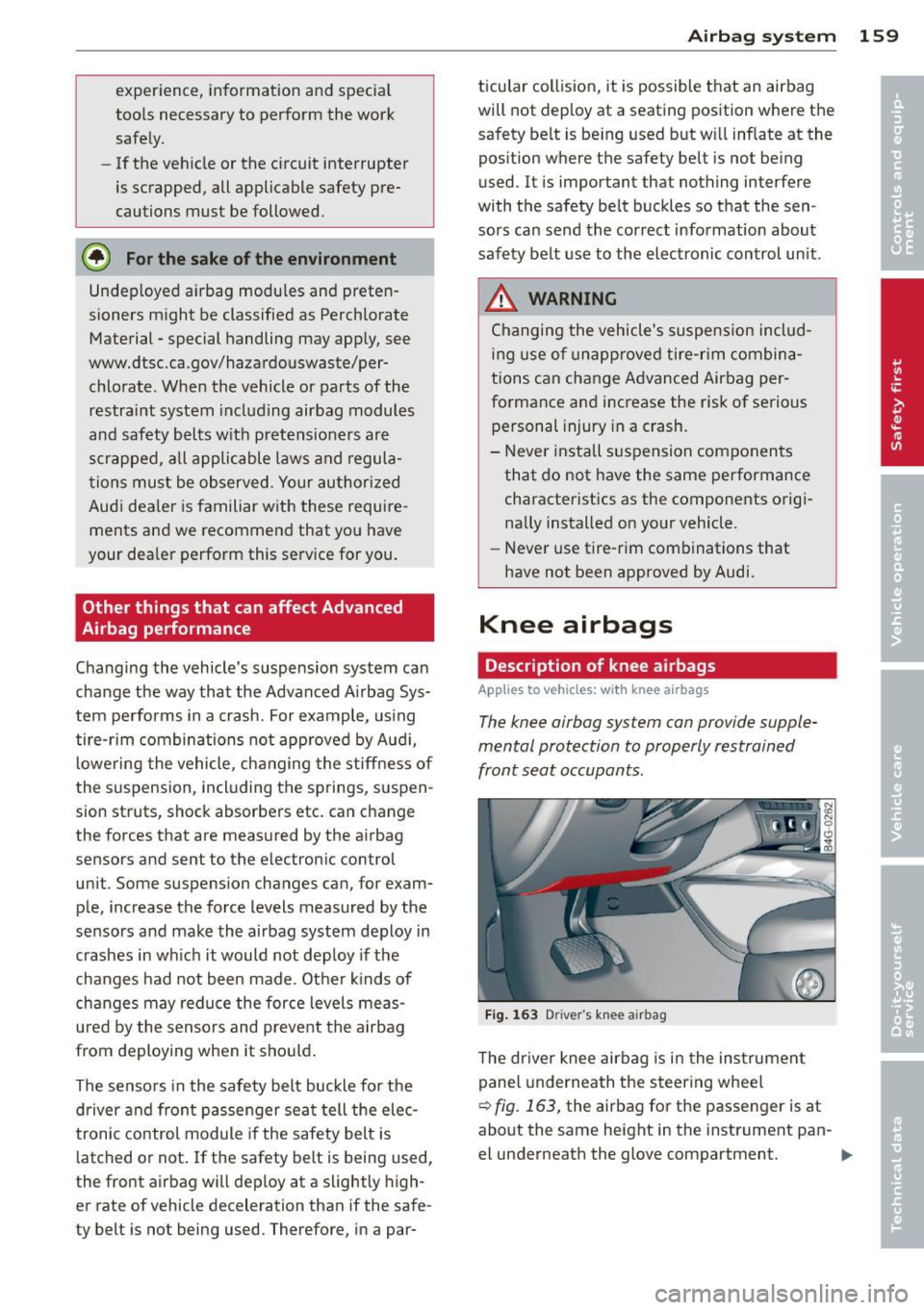
Fig. 1 63 Driver 's k nee airbag
T he driver knee airbag is in the ins trumen t
pane l underneath the steering wheel
r:::> fig. 163, the airbag for t he passenger is at
about the same height in the instrument pan-
el underneath the glove compartment. ..,.
Page 179 of 292
-Always follow the manufacturer's in
struct ions provided with the child safety
seat or infant carrier.
- Always move the front passenger seat in
to the rearmost position of t he passen
ger seat's fore and aft adjustment range,
and as far away from the airbag as possi
ble before installing the child restraint.
- Always make sure that noth ing prevents
the front passenger's seat from being moved to the rearmost position in its
fore and aft adjustment range.
- Always make sure the backrest is in an
upr ight position .
- Never place or use any electrical device (such as a laptop, CD player , electron ic
games dev ice, power inverter or seat
heater for child seats) on the front pas
senger seat if the device is conne cted to
the 12-vo lt socket or the cigarette light
er socket.
- If a seat heater has been retrofitted or
otherwise added to the front passenger
seat, never install any child restraint sys
tem on this seat.
- Make su re that there are no wet objects
(such as a wet towel) and no water or
other liquids on the front passenger seat
cushion.
- Never place obj ects on the seat (such as
a laptop, CD player, electronic games de
vice , power inverter or seat heater for
child seats). These may influence the
electrical capacitance measu red by the
capacit ive passeng er detection system
and can a lso fly aro und in an accident
and cau se se riou s person al injury.
- Make sure that the
PASSENGER AIR BAG
OFF
lig ht comes on and s tays on all the
t ime whenever the ignition is switched
on .
- If the
PASSENGER AIR BAG OFF light
does not come on and s tay on, immedi
ately install the forwa rd-facing child seat
at a seating position on the rear seat and
have the a irbag system inspected by your
authorized Audi dealer . Child S
afety 177
- Ta ke the chi ld restraint off the front pas
senger seat and install it properly at one
of the rear seat positions if the
PASSEN
GER AIR BAG OFF
light does not stay on
whenever the ignit ion is switched on.
Booster seats and safety belts
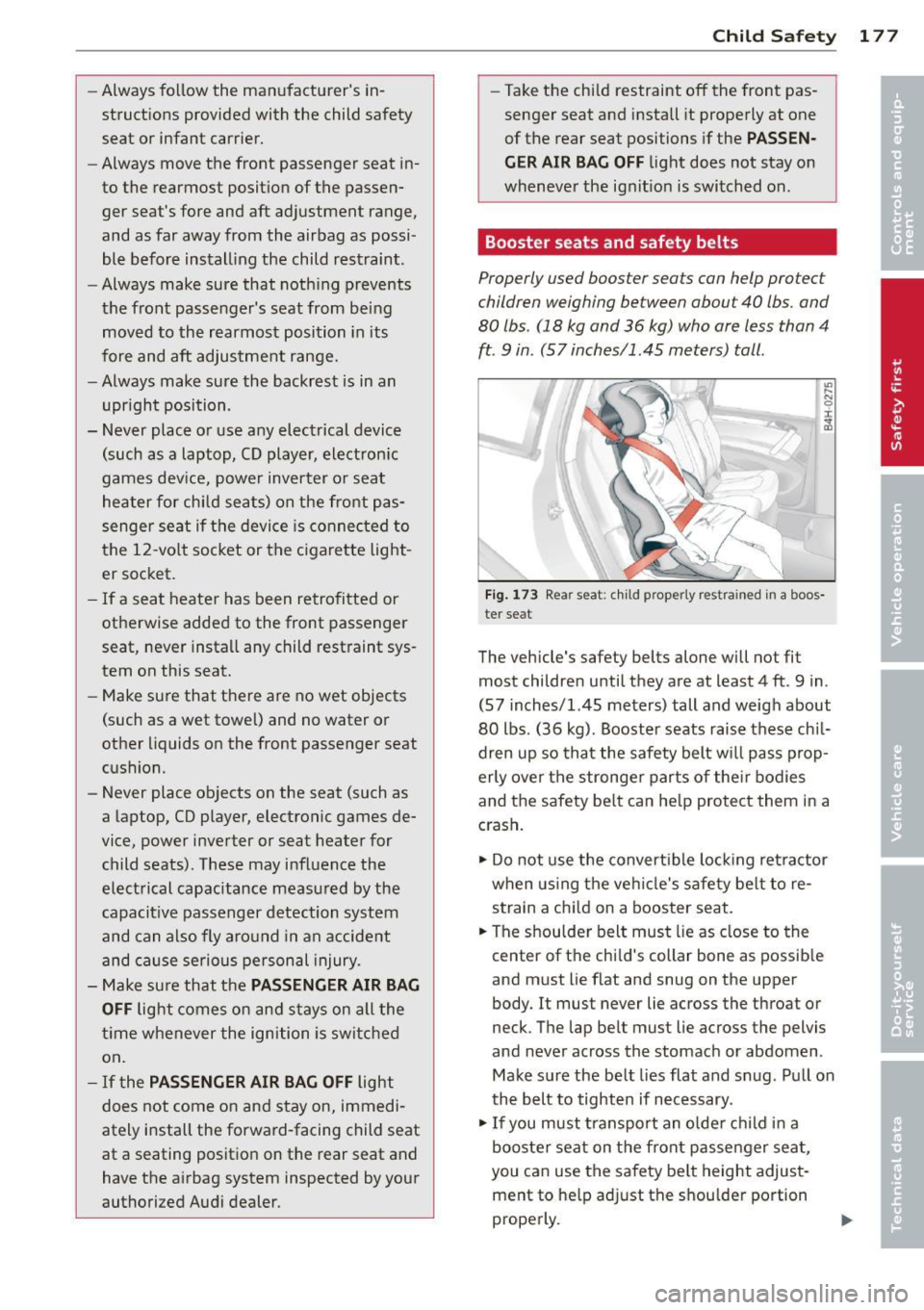
Properly used booster seats can help protect
children weighing between about 40 lbs. and
80 lbs . (18 kg and 36 kg) who are less than 4
ft. 9 in . (57 inches/1 .45 meters) tall.
In .... N 0 ±
~
Fi g. 1 73 Rea r seat: c hild p roperly res trained in a boos
ter seat
The vehicle's safety belts alone w ill not fit
most children until they are at least 4
ft. 9 in .
(57 inches/1.45 me ters) tall and weigh about
80 lbs . (36 kg) . Booster seats rais e these chi l
dren up so tha t the safety belt w ill pass p rop
erly over the stronge r parts of the ir bodies
and the safety be lt can he lp protect them in a
crash .
.,. Do not use the convert ible lo cki ng ret ra ctor
when using the ve hicl e's s afety be lt to re
s train a ch ild on a booster seat.
... The shoulde r belt must lie as close to the
center of the ch ild's collar bone as possib le
and must lie flat and snug on the upper
body. It must never lie across the throat or
neck . The lap be lt must lie across the pelvis
and never across the stomac h or abdomen .
Make s ure the belt lies flat and sn ug. Pull on
t h e belt to tight en if necessary.
.,. If you must t ransport an o lde r ch ild i n a
booste r seat on t he front passenger sea t,
you can use the safety be lt height adjus t
ment to he lp ad just the shou lder portion
prope rly.
Iii>-
Page 231 of 292
-Never mount used tires on yo ur vehicle if
yo u are not sure of their "previous histo
ry." Old used tires may have been dam
aged even though the damage cannot be
seen that can lead to sudden tire failure
and loss of vehicle control.
- If you notice unusual vibration or if the
vehicle pulls to one side when d riving, al
ways stop as soon as it is safe to do so
and check the wheels and tires for dam
age .
(D Note
Please note that summe r and wi nte r tires
are designed for the cond itions that are
Glossary of tire and loading terminology
Accessory weight means the comb ined weight (in excess of
those sta ndard items which may be rep laced)
of au toma tic transmission, power steer ing ,
power brakes, power windows, power seats,
radio, and heater, to the extent that these
items are availab le as factory-installed equip
ment (whether installed or not) .
Aspect ratio
means the rat io o f the height to the w idth of
the tire in percent . Numbers of 55 or lower in
dicate a low sidewall for improved steering re
sponse and better overa ll handling on dry
pavement .
Bead
means the part of the t ire t hat is made o f
steel wires, wrapped or reinforced by ply cords
and that is shaped to fit the r im.
Bead separation
means a b reakdown of the bond between
components in the bead .
Cord means the strands forming the plies in the
tire.
Tire s an d wheel s 229
typica l in those seasons . Aud i recommends
using winter tires during the winter
months . Low temperatures signif icant ly
dec rease the e lasticity of summer t ires,
which affects tract ion and brak ing ability.
If summer t ires are used i n very co ld tem
peratures, cracks ca n form o n the tread
bars , res ulting in perma nen t tire damage
that can cause loud driving noise and un
bala nced ti re s. Audi i s not respon sible for
th is type of damage .
Cold tire inflation pressure
means the t ire p ress ure recommended by t he
vehicle manufacture r fo r a tire o f a des ignated
s ize t hat has not bee n driven for more than a
coup le o f miles (k ilometers) at low speeds in
the three hour period before the tire press ure
is m easured or adjusted.
Curb weight
me ans the we ight of a motor ve hicle with
st andard equipmen t incl ud ing the max imum
capacity of fuel, oi l, and coolant, air condi
tioning and additional weig ht of optiona l
equipment.
Extra load tire
means a t ire design to oper ate a t higher load s
and at higher inflation pressures than the cor
responding standa rd tire . Extra load tires may
be identified as "XL", "x l", "EXTRA LOAD", o r
"RF" on the sidewal l.
Gross Axle Weight Rating ("GAWR")
me ans the load-ca rry ing capac ity of a single
axle system , measured at the tire -ground in
te rfaces.
Gross Vehicle Weight Rating ( "GVWR ")
mea ns the maximum total loaded we ight of
the ve hicl e. .,..
•
•
Page 241 of 292
New tires and replacing tires and wheels
New tires and wheels have to be broken in.
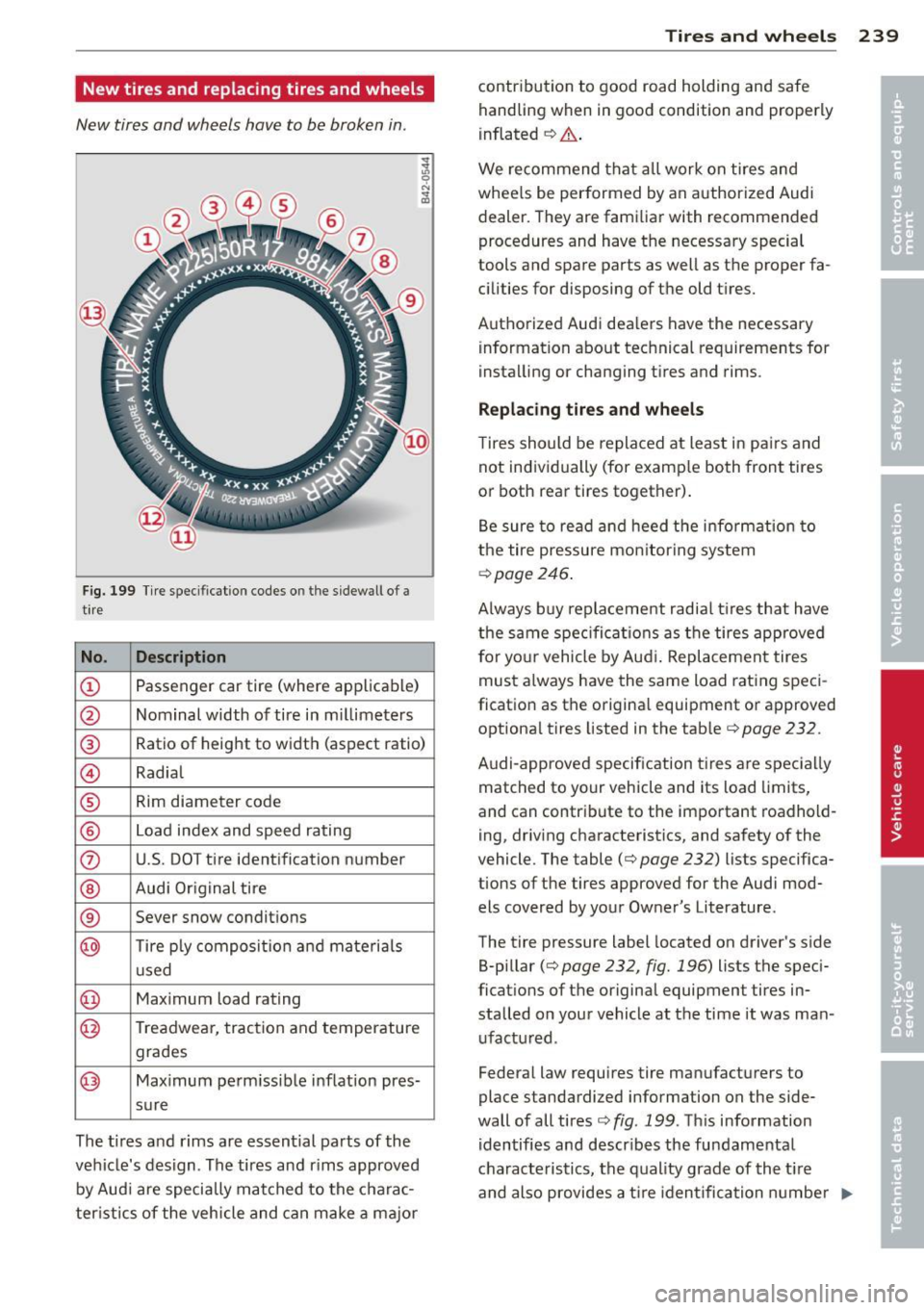
Fig. 199 Tir e speci fication codes on the s idewall of a
t ire
No . Description
CD Passenger car tire (where applicable)
@ Nominal width of tire in m illimeters
® Ratio of height to width (aspect ratio)
@ Radia l
® Rim diameter code
® Load index and speed rating
0 U.S. DOT tire identification number
® Audi Or iginal tire
® Sever snow condit ions
@ T ire p ly composi tion a nd materia ls
used
@ Max imum load rat ing
@ T readwear, traction and temperature
grades
@ Max imum pe rm iss ible inflation pres-
sure
The t ires and rims are essential parts of the
vehicle's design . The tires and r ims approved
by Aud i are specia lly matched to the charac
ter istics of the veh icle and can make a majo r
Tires and wheels 239
contribution to good road holding and safe
handling when in good condition and properly
inflated
~ .&. .
We recommend that a ll work on tires and
whee ls be per formed by an authorized Audi
dealer. They are familiar with recommended procedures and have the necessary special
tools and spare parts as well as the proper fa
cilities for disposing of the old t ires.
Authorized Audi dea lers have the necessary
information about technical requirements for
i nstalling or changing tires and rims .
Replacing tires and wheels
Tires should be replaced at least in pa irs and
not individually (for examp le both front tires
or both rear tires together) .
Be sure to read and heed the info rmation to
the tire pressure mo nitoring system
¢ page 246.
Always b uy replacement radia l tires that have
the same spe cifica tions as t he tires app rove d
for yo ur vehicle by Audi . Replacement tires
must a lways have the same load rating speci
ficatio n as the origina l equipment or approved
optiona l tires listed in the table¢
page 232 .
Audi-approved specif ication t ires a re spec ial ly
matched to your vehicle and its load limits,
and can contr ibute to the impo rtant roadho ld
ing, driv ing characteristics, and sa fety of the
vehicle. The table(¢
page 232) lists specifica
tions of the tires approved for the Audi mod
els covered by your Owner's Literature.
The tire pressure label located on driver's s ide
B-pillar (¢
page 232, fig. 196) lists the speci
ficat ions of the original equipment tires in
stalled on you r vehicle at the time it was man
ufactu red .
Federal law requires tire manufacturers to
place standardized information on the side
wall of all tires¢
fig. 199. This information
i dentifies and descr ibes the fundamenta l
c haracteristics, the q uality grade of the t ire
and also provides a t ire identification numbe r
IJi,,-
Page 242 of 292
240 Tires and wheels
for safety standard certification and in case of
a recall.
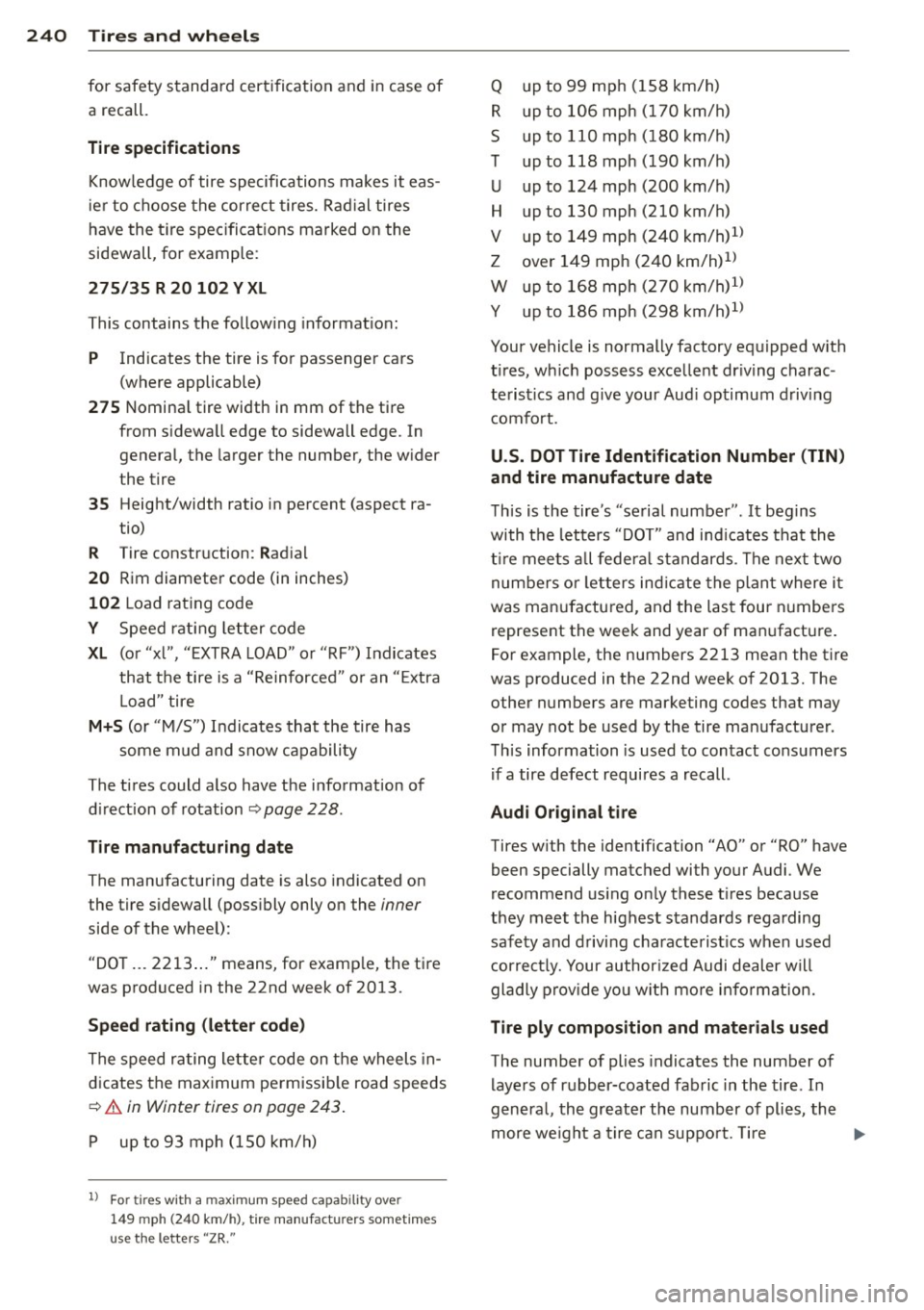
Tire specifications
Knowledge of tire specifications makes it eas
ier to choose the correct tires. Radial tires
have the tire spec ifications marked on the
sidewall, for example:
275/35 R 20 102 Y XL
This contains the follow ing informat ion :
P Indicates the tire is for passenger cars
(where applicable)
275 Nominal tire width in mm of the tire
from sidewall edge to sidewall edge. In
general, the larger the number, the w ider
the tire
35 Height/width ratio in percent (aspect ra-
tio)
R Tire construction: Radia l
20 Rim diameter code (in inches)
102 Load rating code
Y Speed rat ing letter code
XL (or "xl", "EXTRA LOAD" or "RF") Indicates
that the tire is a "Reinforced " or an " Extra
L oad" tire
M+S (or "M/S") Indicates that the tire has
some mud and snow capability
The tires could also have the information of
d irection of rotation¢ page 228.
Tire manufacturing date
The manufacturing date is also indicated on
the tire s idewall (possibly only on the inner
side of the wheel):
"DO T ... 2213 ... " means, for examp le, the tire
was produced in the 22nd week of 2013.
Speed rating (letter code)
The speed rating letter code on the wheels in
dicates the maximum permissib le road speeds
¢ .&. in Winter tires on page 243.
P up to 93 mph (150 km/h)
ll For tires wit h a max imum speed capabil ity over
149 mph (240 km/h), tire manufactu rers somet im es
use the letters "ZR."
Q up to 99 mph (158 km/h)
R up to 106 mph ( 170 km/h)
s up to 110 mph ( 180 km/h)
T up to 118 mph ( 190 km/h)
u up to 124 mph (200 km/h)
H up to 130 mph (210 km/h)
V up to 149 mph (240 km/h)1l
z over 149 mph (240 km/h)1>
w up to 168 mph (270 km/h)1l
y up to 186 mph (298 km/h)1
)
Your vehicle is normally factory equipped w ith
t ir es, w hich possess excellent dr iving charac
teristics and g ive your Aud i optimum driving
comfort .
U.S. DOT Tire Identification Number (TIN)
and tire manufacture date
This is the tire's "serial number". It begins
with the letters "DOT" and ind icates that the
t ir e meets all federal standards . The next two
numbers or l etters ind icate the plant where it
was manufactu red, and the last four numbers
represent the week and year of man ufacture.
For example, the numbers 2213 mean the tire
was produced in the 22nd week of 2013. The
other numbers are marketing codes that may
or may not be used by the tire manufacturer.
This information is used to contact consumers
if a tire defect requires a recall.
Audi Original tire
Tires w ith the identification "AO" or "RO" have
been specially matched with your Audi. We
recommend using only these tires because
they meet the highest standards regarding
safety and driving characterist ics when used
correctly. Your authorized Audi dealer will
gladly provide you with more inf ormation.
Tire ply composition and materials used
The number of plies indicates the number of
layers of rubber-coated fabric in the tire. In
genera l, the greater the number of pl ies, the
more weight a tire can support. T ire
Page 247 of 292
risk of a wheel loss . If the tightening tor
que of the wheel bolts is too low, they
can loosen and come out when the vehi
cle is moving. If the tightening torque is
too high, the whee l bolts and threads
can be damaged and the wheel can be
c ome loose.
(D Note
The spec ified torque for the wheel bo lts is
90 ft lb (120 Nm) w ith a tolerance of ± 7,4
ft lb(± 10 Nm) . Torque wheel bo lts d iago
na lly . After chang ing a wheel, the torque
m ust be che cked as soon as possib le w it h a
t orque wrenc h -preferab ly by an a utho r
ized Audi dealer or qualified workshop.
Low aspect ratio tires
Your Audi is factory-equipp ed with low aspect
ratio t ires. These t ires have been thorough ly
tested and been selected spec ifically for your
model for the ir superb performance, road feel
and handling unde r a va riety of driving condi
tions. Ask your a uthorized Aud i dea le r fo r
mo re deta ils.
T he low aspect ratio of these tires is indicated
by a nume ral of
55 or less in the tire's size
des ignation . T he numeral represents the rat io
of the ti re's sidewall height in relat io n t o its
tread wid th expressed in per cen tage . C o nven
tional t ires have a height/width ra tio of 60 or
mo re.
Th e performan ce of low -aspe ct-ratio tir es is
parti cularl y se nsitive to improper inflation
pressure . It is therefore impor tant that low
a s pect ratio tire s are inflated to the specified
pressure and that the inflation pre ssure is
regularly checked and maintained. Ti re pres
sures should be checked at least once a
month and always before a long trip
c::> page 234, Checking tire pressure .
What you can do to avoid tire and rim
damage
Low aspect ratio tires can be damaged more
eas ily by impact with potho les, curbs, gu llies
Tire s an d wheel s 245
or r idges on the road, partic ularly if the tire is
u nderinflated.
In orde r to minimize t he occ urren ce of impact
dam age to the tires o f your vehi cle, we recom
mend that you observe the following p reca u
tions:
- Always ma int ain re commended inflation
pressu res . Check your tire pressu re eve ry
2,000 miles ( 3,000 km) and add air if neces
sary.
- Dr ive ca re fu lly on roads with potholes, deep
gullies o r ridges. The impact from driving
through or over such obstacles can damage
your tires. Impact with a curb may also cause damage to your tires .
- After any impact, immed iate ly inspect your
tires or have them inspected by the nearest
au thor ized Audi dealer. Replace a damaged
tire as soon as possible .
- Inspect your tires every 2,000 m iles (3,000
km) for damage and wear. Damage is no t al
ways easy to see . Damage can lead to loss of
air a nd under inflat ion, which could eventu
ally cause tire failure .
If you believe that a
t ire may have been damaged, rep lace the
t ire as soon as possib le.
- These tires may wear more quickly tha n oth
ers.
- Please also remember that, while these tires
de live r respon sive handling, they may ride
less comfo rtably and m ake more noise tha n
other choi ces .
Reduced performance in winter /cold
season conditions
A ll ti res are designed for cer ta in p urposes.
T he low aspect ratio, ult ra h igh performance
tires originally installed on your vehicle are i n
tended for maxim um dry and wet road per
f ormance and handling. They are not suitable
for cold , snowy or icy weather condi tions. If
you drive under those circumstances, you
shou ld equ ip your vehicle w it h all -season or
winter tires, which offer bette r traction under
those conditions. We suggest you use the rec
ommended snow o r all-season t ires specified
f o r yo ur vehicle , or t hei r equivalent . .,..
•
•
Page 259 of 292
Position the vehicle jack o nl y under the desig
nated lifting points on the sill
¢ fig . 210.
There is exactly one location for each wheel.
The jack must not be positioned at any other
location¢ 8_¢Q) .
An
un sta bl e s urf a ce under the jack can cause
the vehicle to slip off the jack. Always provide
a firm base for the jack on the ground. If nec
essary place a sturdy board or s imilar support
u nder the jack . On
hard, slippery su rf ac es
(such as tiles) use a rubber mat or sim ila r to
prevent the jack from sli pping ¢&. .
A WARNING
-You or your passengers could be injured
wh ile chang ing a whee l if you do not fol
low these safety precautions:
- Position the vehicle jack only at the
des ignated lifting points and align the
jack . Otherwise, the vehicle jack could
slip and cause an injury if it does not
have sufficient ho ld on the vehi cle.
- A soft or unstab le surface under the
jack may cause the vehicle to slip off the jack. A lways provide a firm base for
the jack on the gro und. If necessary,
use a sturdy board under the jack.
- On ha rd, slippery surfa ce (such as tile s)
use a rubbe r mat o r similar to prevent
the jack from slipping.
- T o help prevent injury to yourself and
yo ur passenge rs:
- Do not raise the vehicle unti l you are
sure the jack is securely engaged.
- Passengers must not remain in the ve hicle when it is jacked up.
- Make sure that passengers wait in a
safe place away from the vehicle and
well away from the road and traffic .
- Make sure jack position is correct, ad just as necessary and then continue to ra ise the jack.
- Changes in temperature or load can af
fect the height of the vehicle.
What do I d o now ? 257
(D Note
Do not lift the vehicle by the sil l. Position
the veh icle jack only at the designated lift
i ng po ints on the sill. Otherwise, your vehi
cle will be damaged.
{!) Tips
The vehicle jack mode* switches off auto
matically at speeds above 6 mp h (10 km/
h).
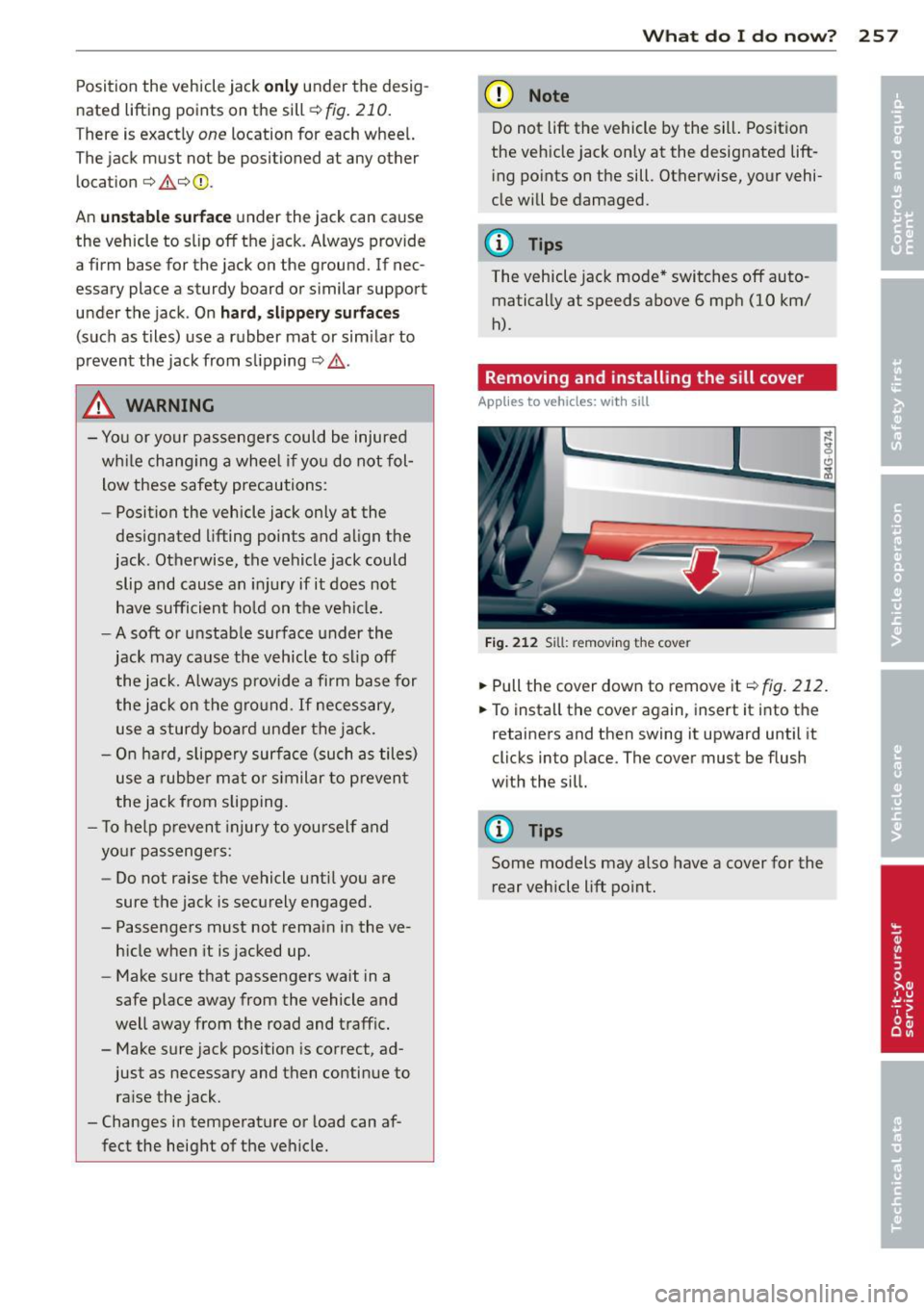
Removing and installing the sill cover
App lies to vehicles: with sill
Fi g. 212 Sill: remov ing the cove r
... Pull the cover down to remove it ~fig. 212.
... To insta ll the cover again, insert it into the
retainers and then swing it upward until it
clicks into p lace. The cover must be flush
w ith the sill.
(D Tips
Some models may also have a cover for the
rear vehicle lift point.
Page 273 of 292
Gross Axle Weight Rating
The Gross Axle Weight Rating is the maximum
l oad that can be applied at each axle of the
vehicle
c::> &. .
Vehicle capacity weight
The vehicle capac ity we ight (max. load) is list
ed eithe r on the driver's side B-pillar or inside
the fuel filler flap.
& WARNING
- The actual Gross Axle Weight Rating at
the front and rear axles shou ld not ex
ceed the perm iss ible weights, and their
combination must not exceed the Gross
Vehicle Weight Rat ing.
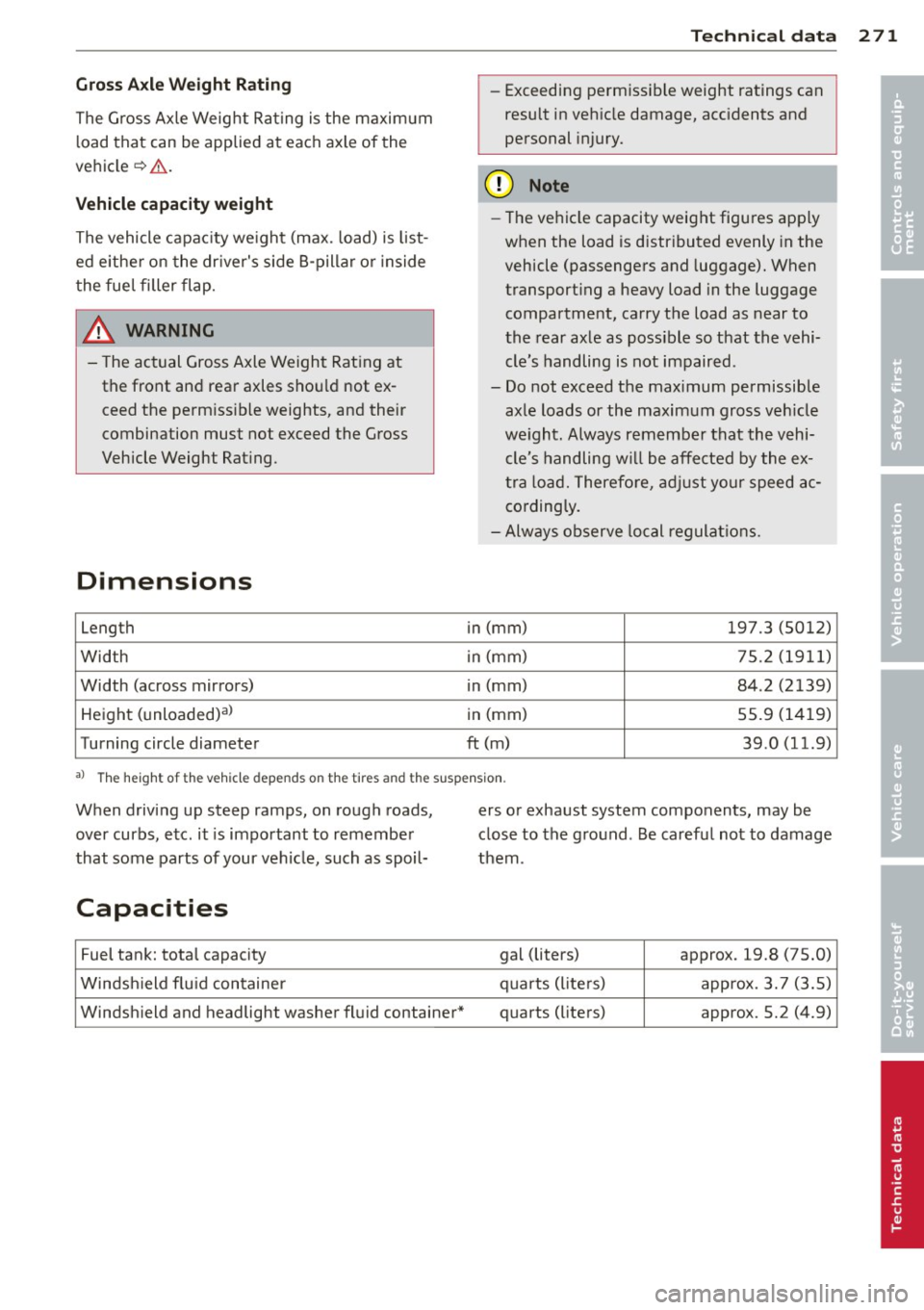
Dimensions
Length
Width
Width (across mirrors) Height (unloaded)al
Turning circle diameter
-
Techn ical data 2 71
- Exceeding perm iss ible weight ratings can
result in vehicle damage, acc idents and
personal injury.
([) Note
-The vehicle capacity weight figures apply
when the load is d istr ibuted evenly in the
vehicle (passengers and luggage). When
transport ing a heavy load in the luggage
compartment, carry the load as near to
the rear axle as poss ible so that the vehi
cle's handling is not impaired.
- Do not exceed the maximum permissible
axle loads or the maximum gross veh icle
we ight. Always remember that the vehi
cle's handling will be affected by the ex
tra load. Therefore, adjust your speed ac
cordingly.
- Always observe local regulations .
in (mm)
197.3 (5012)
in (mm) 7S.2 (1911)
in (mm)
84.2 (2139)
in (mm) S5.9 (1419)
ft (m)
39.0 (11.9)
•
•
al The heig h t of t he ve hicle depends on the tires and the s uspe nsio n.
When driving up steep ramps, on rough roads,
over curbs, etc. it is important to remember
that some parts of your vehicle, such as spoil-
Capacities
Fuel tank: total capacity
Windsh ield fluid container
Windshield and headlight washer fluid container* ers or exhaust
system components, may be
close to the ground. Be careful not to damage
them .
gal (liters) approx. 19.8 (75.0)
quarts (liters) approx. 3.7 (3.5)
quarts (liters) approx. 5.2 (4.9)
Page 287 of 292
Rear light Defective
.. .... .. .... ... .. .. .. .... 2 1
Rear she lf . . . . . . . . . . . . . . . . . . . . . . . . . . 64
Rear spoiler .. .. ........... .. .. .. ... 192
Rear view camera
refer to Parking systems ... .. .. 111,112
Rear view mir ro r . . . . . . . . . . . . . . . . . . . . . 51
Rear window heating (automat ic climate
control) . . . . . . . . . . . . . . . . . . . . . . . . . . . . 71
Recirculation mode (automatic climate
contro l) . . . . . . . . . . . . . . . . . . . . . . . . . . . . 70
Refue lling 210
Remote control Garage door opener (Homel ink) . .. .. . 121
Unlock ing and locking ........ .... ... 35
Repair manua ls ... ...... ... .. .. .. ... 273
Repa irs
A irbag system ........... .... .. ... 1 58
Replacing Bulbs .. .. .. .. ........ ... .. ... ... . 263
Fuses .. ... ... ................ .... 260
T ires and whee ls ......... .. .. .. .. . 239
W indshield wiper blades ... .. .. .. .. .. 49
Report ing Safety Defects ........ ... .. 131
Reset b utton . . . . . . . . . . . . . . . . . . . . . . . . 26
Retractor .. .. .... .. .... .... . .. .. .. . 136
Revers ible mat ............ .... .. .... 67
R ims
C leaning ... .... .. .... ... .. .. .. ... 204
Roof rack . . . . . . . . . . . . . . . . . . . . . . . . . . . 62
L oading .. .. ............. .... .. .. .. 63
Roof weight . . . . . . . . . . . . . . . . . . . . . . . 63
s
SAFE .. .... ... ................ ... ' . 26
Safe driving hab its ......... .. .. .. .. . 123
Safety belt posi tio n ........ .. .. .. .. . 13 7
Safety belt he igh t ad justmen t .. .. .. . 139
Safety belts worn by p regnant women . 138
Safety belt pretens ioner ..... .. .. .. .. . 139
Service and disposal ...... .. .. .. .. . 140
Safety belt pretens ioners
Pre sense 187
Index 285
Safety be lts ... .... .. . .. .. ..... ... .. 136
Cleaning . ... .. .... . ... ...... ... .. 205
Danger to passengers who do not wear a
safety belt .. .. .. ................. 134
Fastening . . . . . . . . . . . . . . . . . . . . . . . . 136
Height adj ustment .. .............. . 139
Improperly worn ... . .. .. .. ... ... .. 139
Not worn . . . . . . . . . . . . . . . . . . . . . . . . 134
Safety be lt pos ition . ........... .... 13 7
S afety i nstr uctions .... ......... .. .. 136
Securing child safe ty seats ... ... .. .. 179
Spec ia l considerations for pregnant
women ... .. .. .... . ... ...... ... . . 138
U nfastening . .. .. ................. 138
Warning/ind icator light ........... .. 133
Warning light .. .. .... ............. . 16
WhyYOUMUS Twearthem .......... 133
Wor n properly ... .. . .. .. .. ... ... .. 135
Safety be lt tens ioner
drive select .. .. .. .. .. ........... .. . 96
Safety be lt warning ligh t ......... .. .. 133
Safety compliance stic ker ........... . 270
Safety eq uipment .... . .. ..... ... .. .. 123
Safety featu res for oc cupan t rest ra int and
pro tection .. .. .. .. .. .. ........... .. 123
Safety gu idelines
Seat adjustment . . . . . . . . . . . . . . . . . . . . 53
Safety instr uctions
Engine compartment ........... .. .. 213
for side curtain airbags ......... .. .. 166
for using child safety seats ......... . 172
for using safe ty belts .......... .... . 136
Moni to ring the Advanced Airbag Sys-
tem ...... .. .. .. ... ............ .. 15 7
Safety systems Warning/ind icator lights .. .. ... ... .. . 18
Seat adjustment Controls . . . . . . . . . . . . . . . . . . . . . . . . . . 54
Driver's seat . . . . . . . . . . . . . . . . . . . . . . . 53
Front passenger 's seat . . . . . . . . . . . . . . . 54
Front seats . . . . . . . . . . . . . . . . . . . . . . . . 53
Head restrai nts . . . . . . . . . . . . . . . 56, 127
Safety gu idelines . .. .......... .... .. 53
Seat belts WhyYOUMUSTwearthem ........ .. 133
Seat covers Cleaning . ... .. .... . ... ...... ... .. 206
•
•