remove seats AUDI RS7 SPORTBACK 2014 User Guide
[x] Cancel search | Manufacturer: AUDI, Model Year: 2014, Model line: RS7 SPORTBACK, Model: AUDI RS7 SPORTBACK 2014Pages: 292, PDF Size: 73.56 MB
Page 180 of 292
178 Child Saf ety
• Secure unused safety belts on the rear seat
r::!;> page 174 .
Children up to at least 8 years old (over 40 lbs
or 18 kg) are best protected in chi ld safety
seats designed for their age and weight . Ex
perts say that the ske leta l structure, particu
larly the pelvis, of these chi ldren is not fully
developed, and they must not use the vehicle
safety belts w ithout a su itab le child restraint .
It is us ually best to put these children in ap
propriate booster seats. Be sure the booster
seat meets all applicab le safety standards.
Booster seats raise the seating position of the
child and reposition bot h the lap and sho ulder
parts of the safety belt so that they pass
across the child 's body in the right places. The
routing of the belt over the chi ld 's body is very
important for the ch ild's protection, whethe r
or not a booster seat is used . Children age 12
and under must always ride in the rear seat.
Ch ildren who are at least 4
ft . 9 in. (S7 in
ches/1.4S meters) tall can generally use the
vehicle's three po int lap and shoulder be lts .
Neve r use the lap belt portion of the veh icle's
safety be lt alone to restrain any child, rega rd
l ess of how b ig the child is. Always remembe r
that c hildren do not have the pronounced pe l
vic st ructure required for the proper function
of lap belt portion of the vehicle's three point lap and shoulder be lts. The child's safety ab
solutely requires that a lap be lt portion of the
safety belt be fastened snugly and as low as
possib le around the pelvis . Never let the lap
be lt po rtion of the safety belt pass over the
chi ld's stomach or abdomen.
In a crash, airbags must inflate within a blink
of an eye and with cons iderab le force . In order
to do its job, the airbag needs room to inflate
so t hat it will be there to p rotect the occupant
as the occupa nt moves forw ard into the air
bag.
A vehicle occupant who is out of position and
too close to the airbag gets in the way of an
i n flat ing a irb ag. When an occupant is too
close, he or she w ill be str uck violen tly and will
receive se rious or possib ly even fatal in
jury .
In orde r fo r the ai rb ag to offer protect ion, i t is
i mpor tan t t hat a ll vehicle occup ants, espe cial
ly any children, who m ust be in the front seat
because of exceptiona l circumstances , be
proper ly restrained and as fa r away from the
airbag as possible . By keeping room between
the child's body and the front of the passen
ger compartment, the airbag can inflate com
pletely and prov ide supplemental protection
in ce rtain frontal coll isions .
.8. WARNING
Not using a booste r seat, using the boos
ter seat imp roperly, in co rrectly installing a
b oos ter seat or using the vehicle sa fe ty
belt imp roperly increases the risk of seri
ous persona l injury and death in a collision
or other emergency situat ion. To he lp re
d uce the risk of serio us personal injury
and/or death:
- The shou lder belt must lie as close to the
center of the ch ild's collar bone as possi
b le and must lie flat and snug on the up
per body . It must neve r lie across the
throat or neck . The lap belt must lie
across the pe lvis and neve r acr oss t he
s tomach o r abdomen.
M ake sure t hat the
be lt lies flat and snug. P ull on the bel t to
tighten if necessary.
- Failure to p roperly ro ute s afe ty belts
over a child's body wi ll ca use seve re inj u
ries in an accident o r other emergency
situation
¢ page 133 .
-The rear side o f the child sa fety seat
should be pos itioned as close as possib le
to the backrest on the vehicle seat.
- For ad justab le head restraints: adjust or
remove the rea r seat head restra int if it
is difficult to install the child seat with
the head restraint in place
c:> page 57. In
stall the head restraint again immed iate
ly once the child seat is removed . Dr iv ing
without head restraints o r with head re-
.
straints that are not p roperly adjus ted Ii),
Page 185 of 292
@ Tips
-In Canada, the terms "top tether" with
"lower universal anchorages" (or "lower
universal anchorage bars") are used to
describe the system.
- In other countries, the term "ISO FIX" is
used to describe the lower anchorages.
Location
Fig . 174 Schematic overview: LA T CH ancho rage point
locations
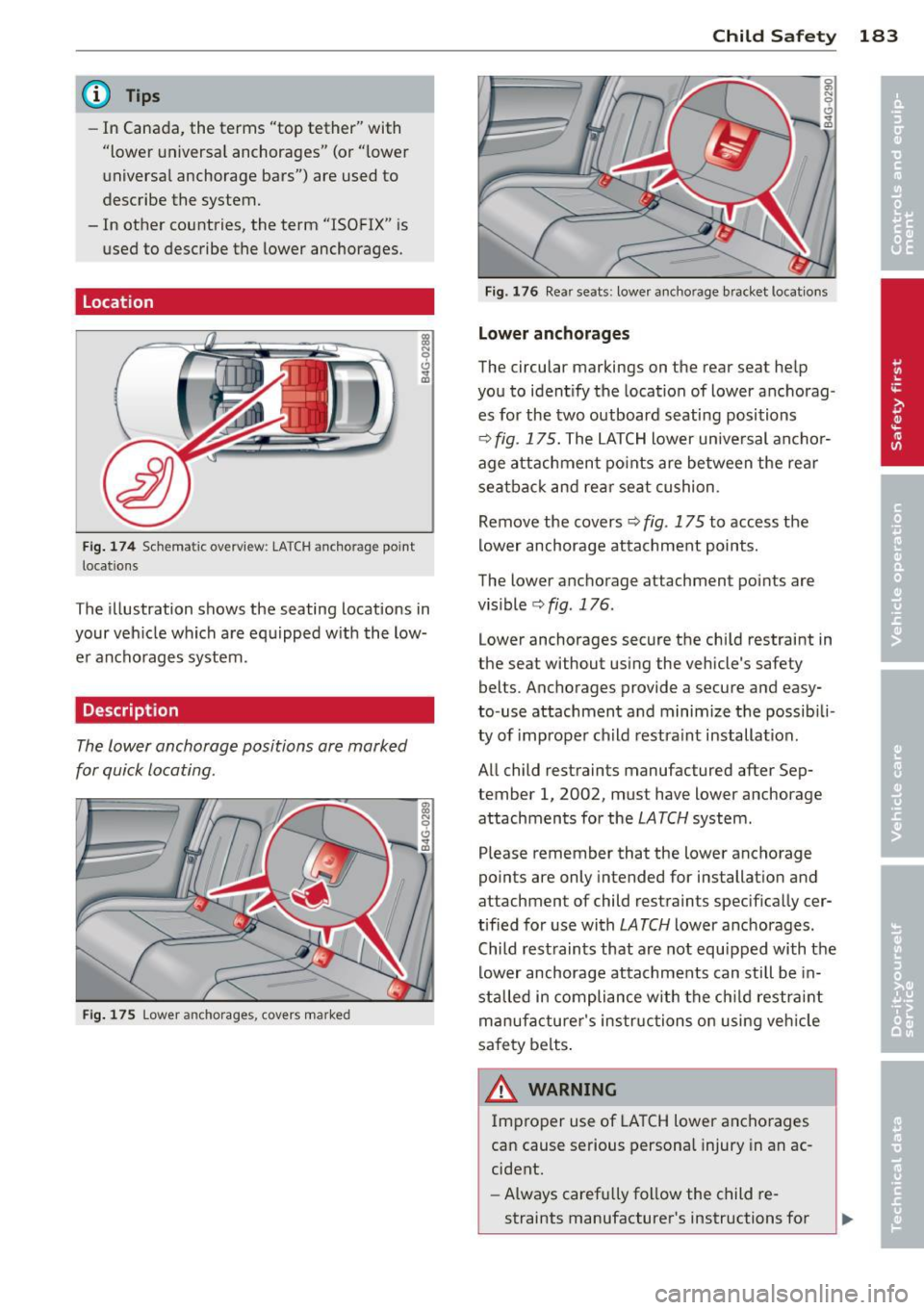
The illustration shows the seating locations in
your veh icle which are equipped w ith the low
e r anchorages system .
Description
The lower anchorage positions are marked
for quick locating .
Fig. 175 Lower anchorages , covers marked
Child Safety 183
Fig. 176 Rea r seats: lower anchorage bra cket locat ions
Lower anchorages
The circular markings on the rear seat help
you to ident ify the location of lower anchorag
es for the two outboard seating positions
¢ fig. 175. The LATCH lower unive rsal anchor
age attachment points are between the rear
seatback and rear seat cushion .
Remove the covers¢
fig. 175 to access the
lower anchorage attachment points.
The lower anchorage attachment points are
vis ible ¢
fig . 176.
Lower anchorages secure the chi ld restraint in
the seat without using the vehicle's safety
belts. Anchorages provide a secure and easy
to-use attachment and minimize the possib ili
ty of improper child restraint installation.
All child restraints manufactured after Sep
tember 1, 2002, must have lower anchorage
attachments for the
LATCH system.
Please remember that the lower anchorage
points are only intended for installation and
attachment of child restraints specifically cer
tified for use with
LATCH lower anchorages .
Child rest raints that are not equipped with the
lower anchorage attachments can still be in
stalled in compliance with the child restraint
manufacturer's instructions on using veh icle
safety belts.
A WARNING ~
Improper use of LATCH Lower anchorages
can cause serious personal injury in an ac
cident.
- Always carefully follow the child re
straints manufacturer's instructions for