weight AUDI RS7 SPORTBACK 2014 User Guide
[x] Cancel search | Manufacturer: AUDI, Model Year: 2014, Model line: RS7 SPORTBACK, Model: AUDI RS7 SPORTBACK 2014Pages: 292, PDF Size: 73.56 MB
Page 151 of 292
If the total electrical capacitance registered
on the front passenger seat is more than that
of a typ ica l 1 year-old, but less than the
weight of a small adult, the front airbag on the passenger side may deploy (the
PA SSEN
G ER AIR BA G OFF
light does not come on) .
For example, th e air bag m ay depl oy if :
-a small child that is heavier than a typical 1
year-o ld child is on the front passenger seat
(regardless of whether the child is in one of
the chi ld seats listed
¢ page 170),
-a chi ld who has outgrown child restraints is
on the front passenger seat.
I f the front passenger airbag is turned
off, the
PA SSENGER AIR BA G OFF light in the center
of the instrument panel wi ll come on and stay
on.
If the front passenger airbag deploys, the
F ederal Standard requires the a irbag to meet
the " low risk" deployment criteria to help re
d uce the risk of injury through interaction
with the airbag. "Low risk" deployment occurs
in those crashes that take place at lower de
celerations as defined in the electronic control
un it
o page 154 .
Alwa ys rem ember: Even though your vehicle
is equipped with Advanced Airbags, the safest
place for children is properly restrained on the
back seat. Please be sure to read the impor
tant information in the sect ions that follow
and be sure to heed a ll of the WARNINGS.
A WARNING
To reduce the risk of injury when an airbag
inf lates, a lways wear safety belts properly.
- If you are unres trained, lean ing fo rward,
sitting sideways or out of position in any
way, your risk of inj ury is much highe r.
- You w ill also receive serio us inju ries and
cou ld even be killed if you are up against
the a irbag or too close to it when it in
flates -even with an Advanced Airbag
¢ page 142 .
Airbag system 149
A WARNING
A child in a rearward-fac ing ch ild seat in
stalled on the front passenger seat will be
seriously inju red and can be killed if the
front airbag inflates -even w ith an Ad
vanced A irbag System .
- Although the Advanced Airbag System in
your veh icle is designed to turn
off the
front airbag when a rearward-facing child res traint has been installe d on the
front passenger seat, nobody can abso
lutely guarantee that dep loyment is im
possible in all conceivable situations that
may happen dur ing the usefu l life of your
veh icle.
- The inflating airbag will h it the ch ild seat
or infant carrier with great force and will
smash the child seat and child against
the backrest, center armrest, door, or roof.
- Always install rearward-facing chi ld re
straints on the rear seat .
- If you must install a rearward fac ing
child seat on the front passenger seat because of exceptional circumstances
and the
PASSENGER AIR BAG OFF light
does not come on and stay on, immed i
ately in sta ll the rear-fa cing child seat in a
rea r seat ing pos ition and have the airbag
system inspected by your Audi dealer.
A WARNING ,-
If, in except iona l circumstances, you must
install a forward-facing child restraint on
the front passenger's seat:
- Always make sure the forward-facing
seat has been designed and certified by
its manufacturer for use on a front seat
with a passenger front and s ide a irbag.
- Never put the forward-facing child re
straint up against or very near the instru ment panel.
- Always move the passenger seat into its rearmost position in the seat's fore and
aft adjustment range, as far away from
the airbag as possible, before installing
the forward-fac ing ch ild restra int . Th e •
-
•
Page 159 of 292

cushion with his or her back up against the
backrest and the backrest is not reclined,
- the adult is not taking weight off the seat by
holding on to the passenger assist handle
above the front passenger door or support
ing their we ight on the armrest,
- the safety be lt is being properly worn and
that there is not a lot of slack in the safety
belt webbing,
- there are no aftermarket seat covers or
cushions or other things (such as blankets)
on the front passenger seat that might
cause the capacitive passenger detection
system to miscalculate electrical capac i
tance.
Important safety instructions on
monitoring the Advanced Airbag System
A WARNING
- If the status of the Adva need A irbag Sys
tem has changed wh ile the vehicle is
moving, the
PASSENGER AIR BAG OFF
light b links for about 5 seconds to catch
the driver's attent ion. If this happens, al
ways stop as soon as it is safe to do so
and check the steps described above.
- If the PASSENGER AIR BAG OFF light
does not go off when an adu lt who is not
very small is sitting on the front passen
ger seat after taking the steps described
above, make sure the adult is properly
seated and restrained at one of the rear
seating pos it ions. Have the airbag sys
tem inspected by your authorized Audi
dealer before transpo rting anyone on the
front passenger seat.
A WARNING
An airbag system that is not funct ioning
prope rly cannot provide supplemental p ro
t e ction in a fron tal crash.
- If the airbag indicato r light ~page 18
comes when the vehicle is be ing used,
h ave the system inspected immedi ately
by you r autho rized Aud i dea ler . It is pos
sible that the airba g will inflate when it
A irbag system 157
is not supposed to, or will not inflate
when it should.
A WARNING
If the front airbag inflates, a child without
a child restraint, or in a rearward-facing
chi ld safety seat, or in a forward-facing
chi ld restraint that has not been proper ly
install ed w ill be seriou sly injur ed and can
be killed.
- Even tho ugh yo ur vehicle is equipped
wit h an Advanced A irbag System, make
certain that all children, espec ial ly 12
ye ars and younger, always ride on the
back seat properly rest rained for their
age an d size .
- Always install forward o r rear-facing
child seats on the rear sea t - even with
an Advanced Ai rba g System.
- If you must install a rearwa rd -fa cing
child seat on the front passenger seat because of exceptional circumstances
and the
PASSENGER AIR BAG OFF light
does not appear and stay on, immediate
ly install the rear-facing child seat in a
rear seat ing pos itio n and have the airbag
system inspected by you r Audi dealer.
- If, in exceptiona l circumstances, you
must ins tall a forward-fac ing ch ild re
s traint on the front passenger seat, al
ways move the sea t into its rearmos t po
sition in the seat 's fore and aft adjust
men t range, as fa r away from the a irbag
as possi ble . The backrest must be adjust
ed to an upright pos ition. Make su re that
the
PASSENGER AIR BAG OFF light
comes on and stays on all the time when
ever the ignit ion is switched on.
A WARNING
-
- If the PASSENGER AIR BAG OFF light
does not go out w hen an ad ult is sitting
on the front passenger seat after taking
the steps described above, make su re the
adu lt is prope rly seated and restra ined at
one o f the rea r seat ing pos itions. .,.
•
•
Page 166 of 292
164 Airbag system
Important safety instructions on the
side airbag system
Airbags are only supplemental restraints. Al
ways properly wear safety belts and ride in a
proper seating position.
There is a lot that you and your passengers
must know and act accordingly to help the
safety belts and airbags do their job to pro
vide supplemental protection.
& WARNING
An inflating side airbag can cause serious
or fatal injury. Improperly wearing safety
belts and improper seating positions in
crease the risk of serious personal injury
and death whenever a vehicle is being
used.
- In order to reduce the risk of injury when
the supplemental side airbag inflates:
- Always sit in an upright position and
never lean against the area where the
supplemental side airbag is located.
- Never let a child or anyone else rest
their head against the side trim panel
in the area where the supplemental
side airbag inflates.
-Always make sure that safety belts are worn correctly,
- Do not let anyone sitting in the front
seat put their hand or any other parts
of their body out of the window.
-Always make sure that the side airbag can inflate without interference.
- Never install seat covers or replace
ment upholstery over the front seat
backs that have not been specifically
approved by Audi.
- Never use additional seat cushions that
cover the areas where the side airbags
deploy.
- Damage to the original seat covers or
to the seam in the area of the side air
bag module must always be repaired
immediately by an authorized Audi
dealer. -
Objects between you and the airbag can
increase the risk of injury in an accident
by interfering with the way the airbag
unfolds or by being pushed into you as
the airbag inflates.
- Never place or attach accessories or
other objects (such as cup holders, tel
ephone brackets, or even large, bulky
objects) on the doors, over or near the
area marked "AIRBAG" on the seat backrests.
- Such objects and accessories can be come dangerous projectiles and cause
injury when the supplemental side air
bag deploys.
- Never carry any objects or pets in the
deployment space between them and
the airbags or allow children or other passengers to travel in this position.
-Always use the built-in coat hooks only for lightweight clothing. Never leave any
heavy or sharp-edged objects in the
pockets that may interfere with side air
bag deployment and can cause personal
injury in an accident.
- Always prevent the side airbags from be
ing damaged by heavy objects knocking
against or hitting the sides of the seat
backs.
- The airbag system can only be triggered
once. If the airbag has been triggered,
the system must be replaced by an au
thorized Audi dealership.
- Damage (cracks, deep scratches etc.) to
the original seat covers or to the seam in
the area of the side airbag module must always be repaired immediately by an au
thorized Audi dealer.
- If children are seated improperly, their
risk of injury increases in the case of an
accident
~ page 168, Child Safety .
-Never attempt to modify any compo
nents of the airbag system in any way .
- In a side collision, side airbags will not
function properly if sensors cannot cor rectly measure increasing air pressure in-
side the doors when air escapes through ..,.
Page 169 of 292
-Always make sure that the side curtain
airbags can inflate without interference .
- Use the built-in coat hooks only for light
weight clothing. Never leave any heavy or
sharp-edged objects in the pockets that
may interfere with airbag deployment
and can cause personal injury in a colli
sion.
- Never use hangers to hang clothes on
the hooks.
- Only use factory-installed sun shades or,
if shades installed after the vehicle
leaves the factory, use only genuine Audi
sun shades.
- Never swing the sun visors over to the
side windows if things such as pens, ga
rage door openers, hands-free speakers,
etc. are attached to the sun visors. They
could come loose and cause serious in
jury if the side curtain airbag inflates.
- A deploying airbag inflates in a fraction
of a second and with great force.
- Never attach objects to the cover or in
the deployment zone of a side curtain
airbag.
- The airbag deployment zones must be
kept clear at all times. Make sure there
are no objects, pets, or other persons in
the space between any vehicle occupant
and any airbag at any time.
- Do not attach any accessories to the
doors.
A WARNING
-The airbag system can deploy only once.
If the airbag has been triggered, the sys
tem must be replaced by an authorized
Audi dealer or qualified workshop.
- Always have work involving the side cur
tain airbag system, removal and installa
tion of the airbag components, or other
repairs performed by a qualified dealer
ship. Otherwise the airbag system may
not work correctly .
- Never attempt to modify any compo
nents of the airbag system in any way.
Airbag system 167
•
•
Page 170 of 292
168 Child Saf ety
Child Safety
Important things to
know
Introduction
The rear seat is generally the safest place in a
collision.
The physical principles of what happens when
your veh icle is in a crash app ly also to chi ldren
~ page 134, What happens to occupants not
wearing safety belts?.
But unlike adults and
teenagers, their muscles and bones are not
fu lly developed. In many respects children are
at greater risk of serious injury in crashes than
adults.
Because children's bodies are not fully deve l
oped, they require restraint systems especial
ly designed for their size, weight, and body
structure. Many countries and all states of the
United States and provinces of Canada have
laws requiring the use of approved child re
straint systems for infants and small ch ildren.
In a fronta l crash at a speed of 20 -35 mph
(30-56 km/h) the forces acting on a 13-pound
(6 kg) infant w ill be more than 20 t imes the
weight of the child. This means the weight of
the child would suddenly be more than 260 pounds (120 kg). Under these conditions,
only an appropriate ch ild restraint properly
used can reduce the risk of ser ious injury.
Child restraints, like adult safety belts, must
be used properly to be effective. Used improp
erly, they can increase the risk of serious in
jury in an accident.
Consult the child safety seat manufacturer's instructions in order to be sure the seat is
right for your ch ild's size ~
page 172, Impor
tant safety instructions for using child safety
seats.
Please be sure to read and heed all of
the important information and WARNINGS
about child safety, Advanced A irbags, and the
installation of child restraints in this chapter .
There is a lot you need to know about the Ad
vanced Airbags in your vehicle and how they
work when infants and children in child re- straints are on the front passenger seat
. Be
cause of the large amount of important infor
mation, we cannot repeat it all here . We urge
you to read the detailed information in th is
owner's manual about airbags and the Ad
vanced Airbag System in your vehicle and the
very important information about transport
ing children on the front passenger seat.
Please be sure to heed the WARNINGS -they
are extremely important for your safety and
the safety of your passengers, especially in
fants and small children.
A WARNING
-Accident statistics have shown that chil
dren are generally safer in the rear seat
area than in the front seating position.
Always restrain any child age 12 and un
der in the rear.
- All vehicle occupants and especially chil
dren must be restrained properly when
ever riding in a vehicle. An unrestrained
or improperly restrained chi ld could be
injured by str iking the i nterior or by be
ing ejected from the vehicle during a
sudden maneuver or impact. An unre
strained or improperly restrained chi ld is
also at greater risk of injury or death
through contact with an inflating airbag.
- A suitable chi ld restraint properly instal
led and used at one of the rear seating positions provides the highest degree of
protection for infants and small children
in most accident situations.
A WARNING ,_
Children on the front seat of any car even
with Advanced Airbags can be ser iously in
jured or even killed when an airbag in
flates. A child in a rearward-facing child
safety seat installed on the front passen
ger seat will be seriously injured and can
be killed if the front airbag inflates.
- The inflating airbag will hit the child
safety seat or infant carrier with great
force and will smash the child safety seat and child against the backrest, center
armrest, or door.
II>-
Page 174 of 292
172 Child Safety
-Have the airbag system inspected by
your authorized Audi dealer immediate
ly.
The child seats listed in categories A to C have been statically tested by Audi only for
the Advanced Airbag function.
Important safety instructions for using
child safety seats
Correc t use of child safety seats substantially
reduces the risk of injury in an accident!
As the driver, you are responsible for the safe
ty of everybody in the vehicle, especially chil
dren :
• Always use the right child safety seat for
each child and always use it properly
r:::;, page 174.
• Always carefully follow the child safety seat
manufacturer's instructions on how to route
the safety belt properly through the child
safety seat.
• When using the vehicle safety belt to install
a child safety seat, you must first activate
the convertible locking retractor on the
safety belt to prevent the child safety seat
from moving
r:;, page 179.
• Push the child safety seat down with your
full weight to get the safety belt really tight so that the seat cannot move forward or
sideways more than one inch (2.5 cm) .
• Secure unused safety belts on the rear seat
r:;,page 174.
Always remember: Even though your vehicle is
equipped with an Advanced Airbag system, all
children , especially those 12 years and young
er, should always ride in the back seat proper
ly restrained for their age and size.
.&_ WARNING
Not using a child safety seat, using the
wrong child safety seat or improperly in stalling a child restraint increases the risk
of serious personal injury and death .
-
-All vehicle occupants and especially chil
dren must always be restrained properly
whenever riding in a vehicle.
- An unrestrained or improperly restrain
ed child can be injured or killed by be
ing thrown against the inside of the ve
hicle or by being ejected from it during
a sudden maneuver or impact.
- An unrestrained or improperly restrain
ed child is at much greater risk of injury
or death by being struck by an inflating
airbag.
- Commercially available child safety seats
are required to comply with U.S. Federal
Motor Vehicle Safety Standard (FMVSS)
213 (in Canada CMVSS 213).
- When buying a child restraint, select
one that fits your child and the vehicle.
- Only use child restraint systems that
fully contact the flat portion of the
seat cushion . The child restraint must
not tip or lean to either side. Audi does
not recommend using child safety
seats that rest on legs or tube -like
frames. They do not provide adequate
contact with the seat.
- Always heed all legal requirements per
taining to the installation and use of
child safety seats and carefully follow
the instructions provided by the manu
facturer of the seat you are using .
- Never allow children under 57 inches
(1.45 meters) to wear a normal safety
belt . They must always be restrained by a
proper child restraint system. Otherwise,
they could sustain injuries to the abdo
men and neck areas during sudden brak
ing maneuvers or accidents.
- Never let more than one child occupy a
child safety seat.
- Never let babies or older children ride in
a vehicle while sitting on the lap of an
other passenger.
- Holding a child in your arms is never a
substitute for a child restraint system .
- The strongest person could not hold
the child with the forces that exist in
Page 176 of 292
17 4 Child Safety
Secure unused safety belts on the rear
seat
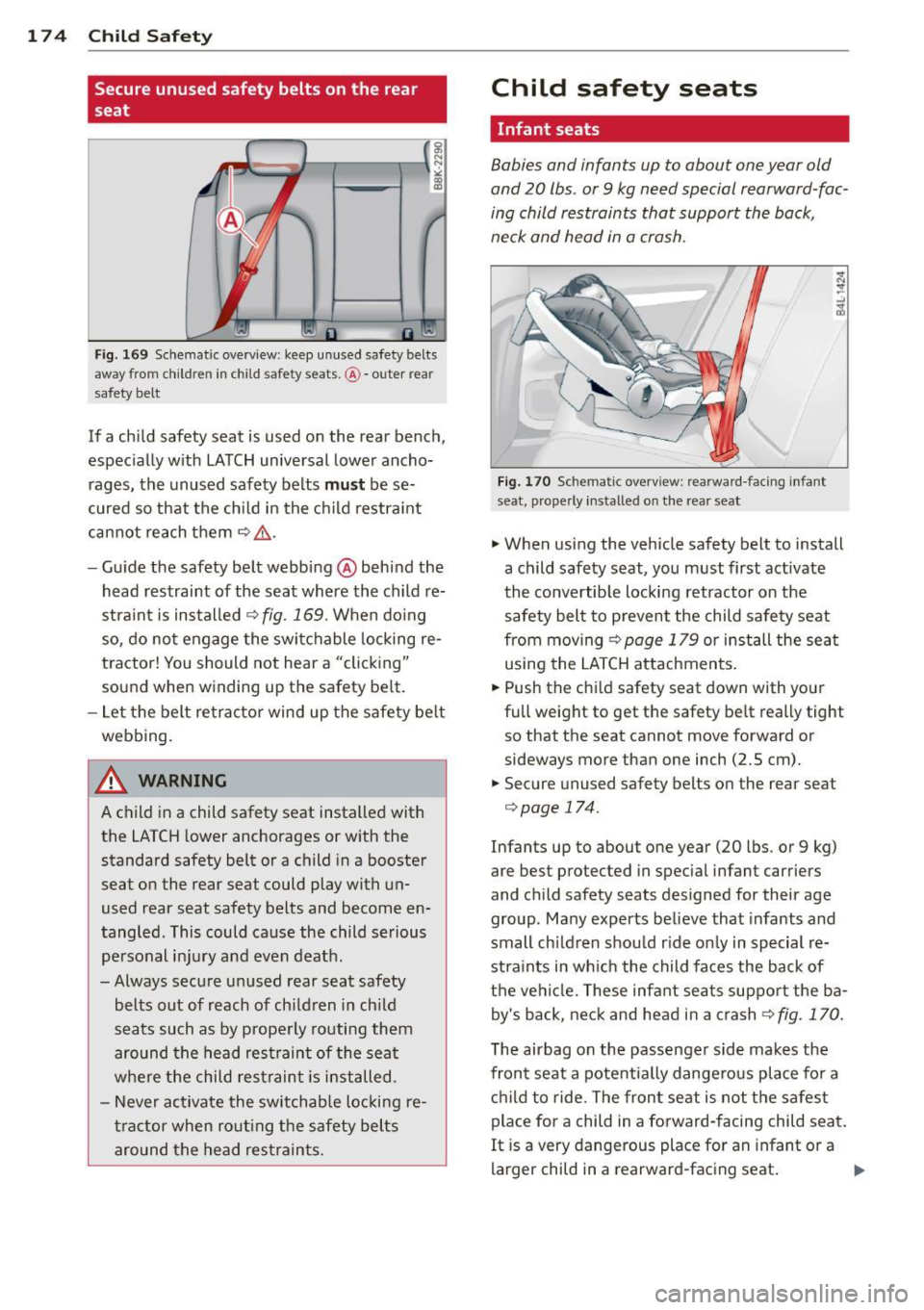
F ig. 169 Schematic overview: keep unused safety belts
away from children in child safety seats.@-outer rear
safety belt
If a ch ild safety seat is used on the rear bench,
espec ially w ith LATCH unive rsal lower ancho
rages, the unused safety belts
mu st be se
cured so that the ch ild in the child restra in t
cannot reach them
r::;, ,&. .
-Gui de the safety belt webbing @behind the
head restraint of the seat where the child re
stra in t is ins talled
r::;, fig. 169 . When do ing
so, do not engage the switchable locking re
t ractor! You should not hear a "clicking"
sound when winding up the safety be lt.
- Let the belt re tracto r wind up the safety be lt
webbing .
~ WARNING
A child in a child safety seat installed with
the LATCH lower anchorages or w ith the
standard safety belt or a child in a booster
seat on the rear seat could play with un
used rear seat safety belts and become en
tangled . This could cause the child se rious
personal in jury and even deat h.
-Always secure unused rear seat safety belts out of reach of ch ildren in ch ild
seats such as by prope rly routing them
around the head res traint of the seat
where the child res traint is installed.
- N ever activate the sw itchab le lo cking re
tr actor when ro uting the safety belts
around the head rest raints.
Child safety seats
Infant seats
Babies and infants up to about one year old
and 20 lbs . or
9 kg need special rearward-fac
ing child restraints that support the back,
neck and head in a crash.
Fig . 1 70 Schem atic overview: rearward-fac ing infant
seat, properly installed on th e rear seat
.,. When using the vehicle safety belt to install
a child safety seat, you must first activate
the convertib le locking retractor on the
safety belt to p revent the child safety seat
from mov ing
c:;,page 179 or install the seat
using the LATCH attachmen ts .
.,.. Push the chi ld safety seat down with yo ur
full weight to get the safety belt really tight
so that the seat cannot move forward or
sideways more than one inch (2.5 cm).
.,. Secure unused safety belts on the rear seat
c:;,page 174.
Infants up to about one yea r (20 lbs. or 9 kg)
are best protected in spec ial infant carriers
and child safety seats designed for their age
group . Many experts be lieve that infants and
small ch ild ren shou ld ride on ly in sp ecial re
stra ints in wh ich the child faces the back of
t h e ve hicle. These infa nt sea ts sup port the ba
by 's back, ne ck and head in a c rash
r::;, fig. 1 70 .
The airbag on the passenger side makes the
fron t seat a pote ntia lly dange ro us place for a
c hi ld to ride. The fron t se at i s not the safest
place for a child in a forward-facing child sea t.
It is a very dange rous place fo r an infant or a
larger child in a rearward-fac ing seat .
llll>-
Page 178 of 292
176 Child Safety
the convertible locking feature on the safety
belt to prevent the child safety seat from
moving ¢
page 179 or install the seat using
the LATCH attachments .
.,. Push the child safe ty seat down with your
full weight to get the safety belt really tight so that the seat cannot move forward or
sideways more than one inch (2.5 cm)
¢ page 179.
.,. If the child safety seat is equipped with a
tether strap, attach it to the tether anchors
¢page 185.
.,. Secure unused safety belts on the rear seat
¢ page 174.
A toddler or child is usually too large for an in
fant restraint if it is more than one year old
and weighs more than 20 lbs. (9 kg).
Toddlers and children who are older than one
year up to about 4 years old and weigh more
than 20 lbs (9 kg) up to 40 lbs. (18 kg) must
always be properly restrained in a child safety
seat certified for their size and weight
¢fig. 171 and ¢fig. 172.
The airbag on the passenger side makes the
front seat a potentially dangerous place for a
child to ride . The front seat is not the safest
place for a child in a forward-facing child safe
ty seat. It is a very dangerous place for an in
fant or a larger child in a rearward-facing seat.
A WARNING
Not using a child safety seat, using the
wrong child safety seat or improperly in
stalling a child restraint increases the risk
of serious personal injury and death in a
collision or other emergency situation.
- Children on the front seat of any car,
even with Advanced Airbags, can be seri
ously injured or even killed when an air
bag inflates. A child in a rearward-facing
child safety seat installed on the front
passenger seat will be seriously injured
and can be killed if the front airbag in
flates -even with an Advanced Airbag
System . -
The inflating airbag will hit the child
safety seat or infant carrier with great
force and will smash the child safety seat and child against the backrest, center
arm rest, door or roof .
- Always install rear-facing child safety
seats on the rear seat .
- If you must install a rearward facing
child safety seat on the front passenger
seat because of exceptional circumstan
ces and the
PASSENGER AIR BAG OFF
light does not come on and stay on, im
mediately install the rear-facing child
safety seat in a rear seating position and
have the airbag system inspected by your
Audi dealer.
- The rear side of the child safety seat
should be positioned as close as possible
to the backrest on the vehicle seat.
- For adjustable head restraints: adjust or remove the rear seat head restraint if it
is difficult to install the child seat with
the head restraint in place
¢ page 57. In
stall the head restraint again immediate
ly once the child seat is removed. Driving
without head restraints or with head re straints that are not properly adjusted increases the risk of serious or fatal neck
injury dramatically.
- Always read and heed all WARNINGS
whenever using a child restrained in ave
hicle is being used
¢page 133, Safety
belts,
¢ page 142, Airbag system and
¢ page 168, Important things to know.
A WARNING ~ -
If exceptional circumstances require the
use of a forward-facing child restraint on
the front passenger's seat, the child's safe
ty and well-being require that the follow ing special precautions be taken:
- Make sure the forward-facing seat has
been designed and certified by its manu
facturer for use on a front seat with a passenger front and side airbag .
Page 180 of 292
178 Child Saf ety
• Secure unused safety belts on the rear seat
r::!;> page 174 .
Children up to at least 8 years old (over 40 lbs
or 18 kg) are best protected in chi ld safety
seats designed for their age and weight . Ex
perts say that the ske leta l structure, particu
larly the pelvis, of these chi ldren is not fully
developed, and they must not use the vehicle
safety belts w ithout a su itab le child restraint .
It is us ually best to put these children in ap
propriate booster seats. Be sure the booster
seat meets all applicab le safety standards.
Booster seats raise the seating position of the
child and reposition bot h the lap and sho ulder
parts of the safety belt so that they pass
across the child 's body in the right places. The
routing of the belt over the chi ld 's body is very
important for the ch ild's protection, whethe r
or not a booster seat is used . Children age 12
and under must always ride in the rear seat.
Ch ildren who are at least 4
ft . 9 in. (S7 in
ches/1.4S meters) tall can generally use the
vehicle's three po int lap and shoulder be lts .
Neve r use the lap belt portion of the veh icle's
safety be lt alone to restrain any child, rega rd
l ess of how b ig the child is. Always remembe r
that c hildren do not have the pronounced pe l
vic st ructure required for the proper function
of lap belt portion of the vehicle's three point lap and shoulder be lts. The child's safety ab
solutely requires that a lap be lt portion of the
safety belt be fastened snugly and as low as
possib le around the pelvis . Never let the lap
be lt po rtion of the safety belt pass over the
chi ld's stomach or abdomen.
In a crash, airbags must inflate within a blink
of an eye and with cons iderab le force . In order
to do its job, the airbag needs room to inflate
so t hat it will be there to p rotect the occupant
as the occupa nt moves forw ard into the air
bag.
A vehicle occupant who is out of position and
too close to the airbag gets in the way of an
i n flat ing a irb ag. When an occupant is too
close, he or she w ill be str uck violen tly and will
receive se rious or possib ly even fatal in
jury .
In orde r fo r the ai rb ag to offer protect ion, i t is
i mpor tan t t hat a ll vehicle occup ants, espe cial
ly any children, who m ust be in the front seat
because of exceptiona l circumstances , be
proper ly restrained and as fa r away from the
airbag as possible . By keeping room between
the child's body and the front of the passen
ger compartment, the airbag can inflate com
pletely and prov ide supplemental protection
in ce rtain frontal coll isions .
.8. WARNING
Not using a booste r seat, using the boos
ter seat imp roperly, in co rrectly installing a
b oos ter seat or using the vehicle sa fe ty
belt imp roperly increases the risk of seri
ous persona l injury and death in a collision
or other emergency situat ion. To he lp re
d uce the risk of serio us personal injury
and/or death:
- The shou lder belt must lie as close to the
center of the ch ild's collar bone as possi
b le and must lie flat and snug on the up
per body . It must neve r lie across the
throat or neck . The lap belt must lie
across the pe lvis and neve r acr oss t he
s tomach o r abdomen.
M ake sure t hat the
be lt lies flat and snug. P ull on the bel t to
tighten if necessary.
- Failure to p roperly ro ute s afe ty belts
over a child's body wi ll ca use seve re inj u
ries in an accident o r other emergency
situation
¢ page 133 .
-The rear side o f the child sa fety seat
should be pos itioned as close as possib le
to the backrest on the vehicle seat.
- For ad justab le head restraints: adjust or
remove the rea r seat head restra int if it
is difficult to install the child seat with
the head restraint in place
c:> page 57. In
stall the head restraint again immed iate
ly once the child seat is removed . Dr iv ing
without head restraints o r with head re-
.
straints that are not p roperly adjus ted Ii),
Page 183 of 292
-Make sure that the PA SSENGER AIR BA G
OFF
light comes on and stays on all the
t ime whenever the ignition is switched
on.
- If the
PA SS ENGER AIR BAG OFF light
does not come on and stay on, immedi
ately install the rear -facing child safety
seat in a rear seating position and have
the a irbag system inspected by your Audi
dealer.
Activating the convertible locking retractor
Use the convertible locking retractor to se
cure a child restraint .
Always heed the child safety seat manufactur
e r's instructions when install ing a ch ild re
straint in you r vehicle. To activate the conver
tible locking retractor:
.,. Place the child rest raint on a seat, prefera
bly on the rear seat.
.,. Slow ly pull the be lt
a ll th e wa y out .
.,. Route it around or through the chi ld re
straint be lt path ¢.&_ .
.,. Push the child safety seat down with your
full weight to get the safety belt rea lly tight.
.,. Insert the belt tongue into the buckle for
that seating position .
.,. Gu ide the safety belt back into the retractor
until the belt lies flat and snug on the child
safety seat .
.,. You should hear a "clicking " noise as the
belt w inds bac k into the ine rtia reel. Test the
convertible locking retractor by pulling on
the belt . You should no longer be able to
pull the belt out of the retractor . The con
vertib le locking retractor is now activated.
.,. Make sure that the red re lease button is fac
ing away from the chi ld restraint so that it
can be unbuckled qu ickly .
.,. Pull on the belt to make sure the safety belt
is p roperly t ight and fastened so t hat the
seat cannot move fo rward or sideways mo re
than one inch (2.5 cm).
Child Sa fet y 181
A WARNING
Using the wrong child restraint or an im
properly installed chi ld restraint can cause
serious pe rsonal injury or death in a c rash .
- Always make sure that the safety belt re-
tractor is loc ked when insta lling a child
safety seat. An unlocked safety belt re
tracto r cannot hold the child safety seat
in place dur ing no rma l dr iving o r in a
crash.
- Always buckle the child sa fety seat firmly
in place even if a ch ild is not si tt ing in it.
A loose child safe ty seat can fly around
during a s udden stop or in a crash .
- Always ma ke sure the seat backrest to
which the child res traint is installed is in
an upright position and securely latched
into place and cannot fold forward. Oth
erwise, the seatback with the child safety
seat attached to it could fly forward in
the event of an accident o r other emer
gency situation.
- Always read and heed all WARNINGS
whenever us ing a child restrained in ave
hicle is being used ¢
page 168. Special
precautions apply when insta lling a child
safety seat on the front passenger seat
¢ page 144, Child restraints on the front
seat -some important things to know.
-
Deactivating the convertible locking
retractor
The conv ertibl e locking retractor for child r e
straints will be deactivated automatically when the belt is wound all the way back into
the retractor.
.,. Press the red b utton on the safety belt buck
le . Th e belt tong ue will pop out of t he b uck
le .
.,. Guide the s afety belt all the way back into
i t s s towed position .
A lways let the safety be lt retract completely
into its stowed position. The safety belt can
now be used as an ordinary safety belt w ith
out the convertible locking retractor fo r child
restraints.
•
•