service AUDI RS7 SPORTBACK 2014 Owner's Manual
[x] Cancel search | Manufacturer: AUDI, Model Year: 2014, Model line: RS7 SPORTBACK, Model: AUDI RS7 SPORTBACK 2014Pages: 292, PDF Size: 73.56 MB
Page 204 of 292
202 Driving and en vir onm ent
You must drive your vehicle about 3,000 miles
(5,000 kilometers) before you can properly
assess o il consumption.
This a lso applies to fuel consumption and en
gine output.
0 Note
- Have yo ur vehicle maintained properly
and in accordance with the service rec
ommendations in your Warranty
& Main
tenance booklet. Lack of proper mainte
nance as well as improper use of the ve
hicle will impair the funct ion of the
emission control system and could lead
to damage .
- Do not alter or remove any component of
the Emi ssion Control System unless ap
proved by the manufacturer .
- Do not alter or remove any dev ice, such
as heat shields, switches, ignition wires,
valves, wh ich are designed to protect
your vehicle's Emiss ion Control System
and othe r important veh icle compo
nen ts.
Fewer short trips
Fuel consumption will always be relatively
high on short trips .
.. Try to avo id driving short d istances with a
co ld eng ine .
The engine and ca talytic conver ter have to
reach their optimal
op erating temp eratur e to
reduce fuel consumption and noxious emis
sions effect ively.
Jus t after s tarting, a cold engine in a mid-size
car only achieves a fuel economy of 6 -8 miles
per gallon (30-40 l/100 km) . After about a
ha lf a m ile, fue l economy climbs to 12 mpg
(20 l/100 km). Afte r abo ut
2 .5 m iles (4 km),
the eng ine is at its proper ope rat ing tempera
ture and fue l economy has reached a norma l
l eve l. So you can see that you should avoid
short trips whenever possib le . T
he
ou tsid e tempe rature is also critical in this
regard . Your car consumes more fue l in the
winter than in the summer.
Page 211 of 292
-Blend must contain not more than 15%
MTBE.
Seasonally adjusted gasoline
Many gasoline grades are blended to perform
espec ially we ll for winter or summer driving.
During seasonal change-over, we suggest that
you fill up at busy gas stat ions where the sea
sonal adjustment is more likely to be made in
time .
(D Note
-Methanol fuels which do not meet these
requirements may cause corrosion and
damage to plastic and rubber compo
nents in the fuel system .
- Do not use fue ls that fail to meet the
specified criter ia in this chapter.
- If you are unable to determine whether
or not a particular fue l blend meets the
specifications, ask your service station or
its fuel supp lier.
- Do not use fuel for which the contents
cannot be identified.
- Fuel system damage and performance
problems resulting from the use of fuels
different from those specified are not
the responsibility of Audi and are not
covered under the New Vehicle or the Emission Control System Warranties.
- If you experience a loss of fuel economy
or driveability and performance prob l ems due to the use of one of these fuel
blends, we recommend that you switch
to unblended fuel.
Gasoline additives
A major concern among many auto manufac
turers is carbon deposit build- up caused by
the type of gasoline you use.
Although gasoline grades differ from one manufacturer to another , they have certain
things in common. All gasoline grades contain
substances that can cause deposits to collect
on vital engine parts, such as fuel injectors
and intake valves. Although most gasoline brands include additives to keep engine and
Fuel supply and filling your fuel tank 209
fuel systems clean, they are not equally effec
tive .
A udi recommends using TOP TIER Detergent
Gasoline. For more info rmation on TOP TIER
Detergent Gasoline, please go to the official
website (www.toptiergas.com).
After an extended period of using inadeq uate
fuels, carbon deposit build-ups can rob your
engine of peak performance.
Q) Note
Damage or malf unct ion due to poor fue l
quality is not covered by the Aud i New Ve
hicle Limited Warranty.
Fuel tank
Fuel filler neck
The fuel filler neck is located on the right rear
side panel behind the fuel fille r flap.
If the power locking system should fail, you
can still open the flap manually -for deta iled
instruct ions see
c::;, page 211 .
You can find the fuel tank capacity of your ve
hicle in
c::;,page271.
The label on the inside of the fuel fi ller flap
tells you the correct fue l for your vehicle. For
more information about fuel specifications,
see
c::;, page 208.
Your vehicle fue l tank has an on board refuel
li ng vapor recovery system. This feature helps
to prevent fuel vapors from escaping from the
tank and polluting the environment while you refuel your vehicle . In order to fill the tank
properly while protecting the environment,
please fo llow this refueling procedure careful
ly.
_&. WARNING
Under normal operating conditions, never
carry additional fuel containers in your car.
Gas canisters and other containers used to
transport f uel can be dangero us. Such con
tainers, full or empty, may leak and could
cause a fire in a collision. If you must
•
•
Page 221 of 292
and adve rsely affect you r New V ehicle
Wa rrant y.
@) For the sake of the environment
-Under no ci rc u mstances can the o il come
in contact with the sewage network or
the soil.
- Observe and follow lega l regu lations
when disposing of empty oil containers .
Changing the engine oil
We recommend that have your oil changed by
an authorized Audi dealer or a qualified serv
ice station.
Before you check anything in the engine com
partment,
a lways rea d and he ed all WARN
INGS
~ &. in Working in the engine compart
ment on page 213.
The engine oil must be changed according to
the intervals specified in your Warranty
&
Maintenance book let. This is very important
because the lubricating properties of oil di
minish gradually during normal vehicle use.
Under some circumstances the engine oil
should be changed more frequently. Change
oil more often if you drive most ly short dis
tances, operate the vehicle in dusty areas or
under predominantly stop-and-go traffic con
ditions, or have your vehicle where tempera
tures remain below freezing for extended pe
riods.
Detergent additives in the oil w ill make fresh
oil look dark after the engine has been run
n ing for a short time. This is normal and is not
a reason to change the oil more often than recommended.
Because of the problem of proper disposa l,
along with the special tools and necessary ex
pertise required, we strongly recommend that
you have your oi l changed by an authorized
Au di de ale r or a qual ified servi ce station.
If y ou c hoose to c ha ng e y our o il yo urse lf,
please note the following important informa
tion :
Checkin g and fillin g 219
A WARNING
To reduce the risk of personal injury if you
must change the eng ine oil in your vehicle
yourself:
- Wear eye protect ion.
- To reduce the risk of burns from hot en-
gine oil, let the engine cool down to the
touch.
- When removing the o il dra in p lug with
your fingers, stay as far away as possible.
Always keep your forearm parallel to the
ground to help p revent hot oil from run
ning down you r arm.
- Dra in the oil into a container designed
for this purpose, one large enough to hold at least the tota l amount of oi l in
your eng ine .
- Engine oil is poisonous. Keep it well out
of the reach of children.
- Continuous contact wit h used eng ine o il
is harmful to your s kin. A lways protect
your skin by washing oil off tho ro ughly
with soap and water.
@ Note
Never mix oil additives with your engine
oil. These additives can damage your en
g ine and adversely affec t your Aud i Lim it
ed New Vehicle Warranty.
@ For the sake of the environment
- Before changing your oil, first make su re
you know where you can properly dispose
o f the used oil.
- Always dispose of used eng ine oi l proper
ly. Do not dump it on garden soil, wood
ed areas, into open streams or down
sewage drains .
- Recycle used engine oil by taking it to a
used engine oil collect ion facility in your
area, or contact a service station.
•
•
Page 226 of 292
224 Check ing and filling
Have the battery checked when you take your
vehicle in for service. You are well advised to replace a battery that is older than 5 years .
W ith certa in types o f airbag deployment, the
battery is disconnected from the vehicle elec
trica l system for safety reasons¢
& in Re
pair, core and disposal of the airbags on
page 158.
Disconn ecting the battery terminal s
Some vehicle functions (power w indow regu
l ators, for example) are lost if the battery ter
minals are disconnected . These functions have
to be re learned after the battery terminals are
connected again. To prevent this, the battery
should only be disconnected from the vehicle
e lectrical system when absolutely necessary
for repairs .
Vehicles not driven for l ong period s
If you do not drive your vehicle over a period
of several days or weeks, electrical compo
nents are gradually cut back or switched off.
This reduces energy consumption and main
tains starting capab il ity over a longer period
¢
page 195. Some of the convenience func
tions may not operate, s uch as the inte rior
lights or power seat adjus tment. The conven
ience f unctions will be available again when
you switch on the ignition and start the en gine.
Winter operation
D uring the winter months, ba tte ry capaci ty
tends to decrease as tempe rat ures d rop . This
is because more powe r is also consumed while
starting , and the headlights, rear window de
fogger, etc., are used more often.
Avoid unnecessary power consumption, par
ticular ly in c ity traffic or when t raveling on ly
short distances. Let you r authorized Audi
dea ler check the capacity of the vehicle bat
tery before winter sets in
¢ page 226. A we ll
charged battery w ill not only prevent starting
prob lems when the weather is cold , but w ill
also last longer .
(D Tips
If your vehicle is left standing for seve ral
weeks at extremely low temperatures, the
vehicle battery sho uld be removed and
stored where it w ill not freeze . This will
prevent it from be ing damaged and having
to be replaced .
Working on the battery
Be especially careful when working on or near
the battery.
The battery is located in the luggage compart
ment under the floor. Before you check any
t hi ng in the luggage compartment,
read and
heed all WARNINGS
¢ ,& .
Always heed the safety warnings , when work
ing on the vehicle battery or the vehicle e lec
trical system to prevent inju ry.
The following WARNINGS are very
important when working on the battery :
Al ways heed the follo wing WARNING SYM -
BOLS and safety precautions when working
on the battery .
®
Always wear eye prote cti on.
&
Battery acid contains sulfuric acid.
Always wear glove s and eye protec-
tion.
@
No
- spa rks
- flames
- smoking.
£
When a battery i s charged, it produ-
ce s hydrogen gas which is e xplosi ve
and could cau se personal injury.
@
Alwa ys k eep the battery well out of
rea ch of children .
_&. WARNING ~
Whenever working on t he battery o r on
the electrical system, there is the risk of
i njury, accident and even fire . Read and
heed the following WARNINGS:
-
Page 237 of 292
-Turn the valv e stem cap counter-clockwise
to remove it from the tire valve.
- Place the air pressure gauge on the valve.
- The tire pressures should only be checked
and adjus ted when the tires are cold . The
s li ght ly raised p ressures of warm tires must
not be reduced .
- Adjust the tire pressure to the load you are
carrying .
- Re insta ll the va lve stem cap on the valve.
When should I che ck the tire pres sur e?
The correct tire pressure is espec ially impor
tant at high speeds. The pressure should
therefo re be checked at least once a month
and a lways before start ing a journey.
When should I adjust the tire p re ssure s?
Adjust the tire pressure to the load you are
carry ing . After changing a wheel
o r replacing
wheels you have to adjust the tire pressures
on all wheels. In addition , you must then
store the new ti re pressu res in the t ire pres
sure monitoring system
r::!.> page 246 .
A WARNING
Incorrect tire pressures and/or underinf la
tion can lead sudden tire failure, loss of contro l, collision, serious persona l injury
or even death.
- When the warning symbo l
[ti] appears in
the instrument cl uster, stop and inspect
the tires.
- Incorrect tire pressure and/or underinfla
t ion can cause increased tire wear and
can affect the handling of the veh icle and
stopp ing ability .
- Incorrect tire pressures and/or underin
flation can also lead to sudden tire fa il
ure, including a blowout and sudden de
flation, causing loss of vehicle control.
- The driver is responsible for the correct
tir e pressures fo r all t ires on the vehicle .
T he applicable pressu re va lues are locat
ed on a stic ker on the drive r's side B-pil
lar .
- Only when a ll t ires on the vehicle are fi l
led to t he cor rect pressure, the ti re p res-
Tire s an d wheel s 235
sure monitor ing system can work cor
rectly.
- The use of incorrect tire pressure va lues
can lead to acc idents or other damage.
Therefore it is essential that the driver
observe the spec ified t ire pressure values
for the tires and the correct pressures for
the function of the t i re p ress ure monito r
ing system .
- Always inf late t ires to the recommended
a nd correct t ire p ress ure before dr iv ing
off.
- Driving with unde rinflated tires bend
mo re, lett ing t hem get too hot resulti ng
in tread separation, s udden tire failure
and loss of cont ro l.
- Excess ive speed and/overloadi ng can
cause heat b uild- up, sudden tire failure
a nd loss of cont rol.
- If the tire pressure is too low or too high,
the t ires will wear prema turely and the
veh icle w ill not handle well.
- If the tire is not fla t and you do not have
to ch ange a wheel immedia tely, drive a t
red uced speed to the nearest service sta
tion to check the t ire p ress ure and add
air as requi red.
(D Note
Dr iving w it h out valve stem c aps can c ause
damage to the tire valves . To prevent this,
a lways make sure that factory insta lled
va lve stem caps on all whee ls are sec urely
mounted on the valve .
@ For the sake of the env ironment
Un derinflated tires wi ll also increase the
fuel consumption .
Tires and vehicle load limits
There are limits to the amount of load or
weight that any vehicle and any tire can carry.
A vehicle that is overloaded will not handle
well and is mo re d iff icult to stop. Overloading
can not o nly lead to loss of vehicle control,
but can also damage important parts of the
vehicle and c an le ad to sudden tire fa ilu re, .,..
•
•
Page 239 of 292
pressure label) c> page 232,
fig. 195.
2. Determine the combined
weight of the driver and passengers that will be riding in
your vehicle.
3. Subtract the combined
weight of the driver and pas s engers from
"XXX" kilo
grams or
"XXX" pounds
s hown on the sti cker
c> page 232 , fig. 195.
4. The resulting figure equals
the available amount of car go and luggage load capa ci
ty . For example , if the
"XXX"
amount equals 1400 lbs .
and there will be five 150 lbs. passengers in your vehi
cle, the amount of available
cargo and luggage load ca
pacity is 650 lbs. (1400-750
(5
X 150) = 650 lbs.)
5. Determine the combined weight of luggage and cargo
being loaded on the vehicle.
That weight may not safely exceed the available cargo
and luggage load capacity
calculated in Step 4.
6. If your vehicle will be towing
a trailer, load from your trail
er will be transferred to your
Tires and wheels 237
vehicle . Consult this manual
to determine how this re
duce s the available cargo
and luggage load capacity of
your vehicle .
.,..Check the tire sidewall
(¢ page 239, fig. 199) to de
termine the designated load rating for a specific tire.
Tire service life
The servic e lif e of tires dep ends on a lot of
d ifferen t things inclu ding p roper ins tall ation
a n d ba lanc in g, corre ct ti re press ure and dr iv
ing style .
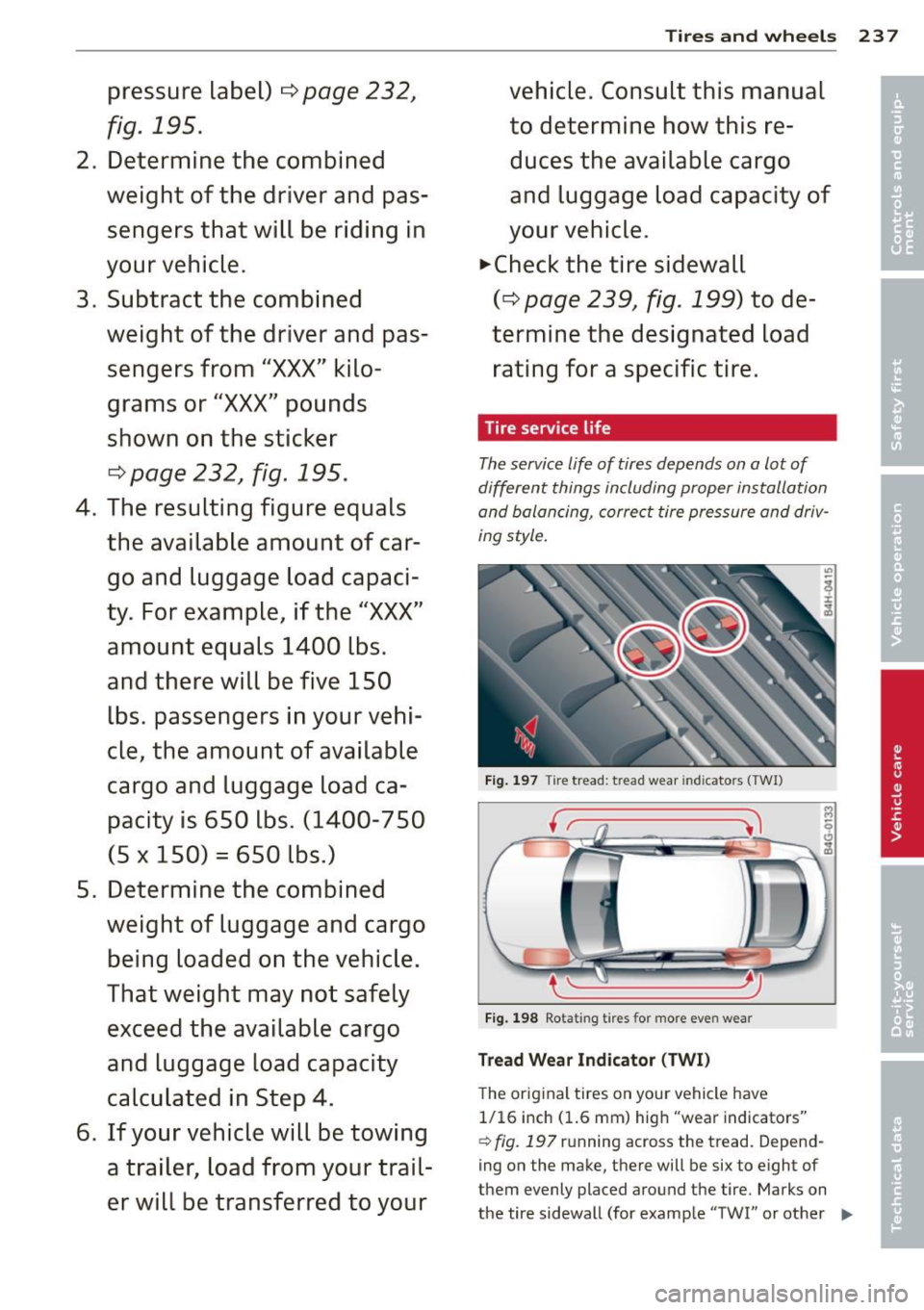
Fig. 197 Tire trea d: tread wea r in dicators (TWI)
,.............,------,,
-=---::;:-r-
Fig. 198 Rotat ing tires for more even wear
Tread Wear Indicator (TWI)
The or iginal tires on you r vehicle h ave
1/ 16 inch ( 1.6 mm) hi gh "wear indicato rs"
r::!> fig. 197 run ning acr oss the tread. Depen d-
ing on the mak e, th ere will be si x to eight of
t h em evenly placed a ro und t he tire. Marks on
the tire sidewall (for e xamp le ''TWI" or ot her
Ill>
Page 267 of 292
@ Tips
The disc harged battery must be properly
connected to the vehicle's electrical sys
tem. When jump starting or charg ing the
battery, never connect the negative
ground cable to the batte ry negat ive post
because the ba tte ry manager system must
be ab le to detect the battery's state of
charge. Always connect the negative
g round cab le to the negative ground pos t
of t he battery manager cont ro l unit.
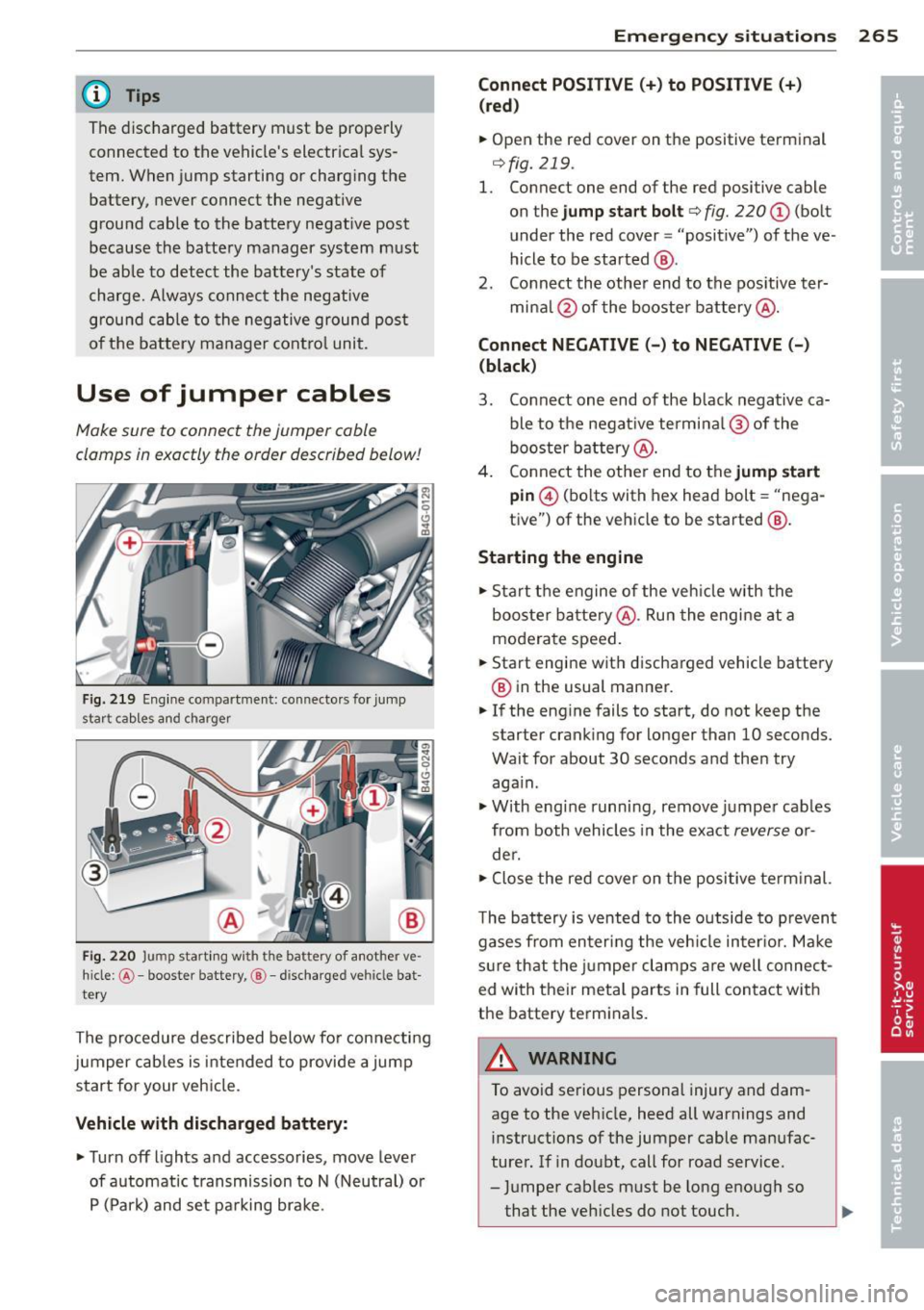
Use of jumper cables
Make sure to connect the jumper coble
clomps in exactly the order described b elow!
Fi g. 21 9 Eng ine co mpar tment: connecto rs for jum p
s tar t cab les and ch arg er
F ig. 220 Jump start in g w ith t he ba ttery of a not her ve ·
hi cle :
@-booster battery, ®-disc harged ve hicle bat
te ry
The procedure des cribed below fo r connecti ng
jumper cables is intended to provide a jump
start for your veh icle.
Vehicle with discharged battery :
• Turnoff lights and accessories, move lever
of automatic t ransmission to N (Neu tral) o r
P ( Par k) and set pa rking brake .
Emergenc y situ ation s 265
Connect POSI TIVE(+) to POSITIVE(+)
(red )
• Open the red cov er on the posit ive te rminal
¢ fig. 219 .
1. Connect one end of the red positive cable
on the jump sta rt bolt
¢ fig. 220 (D (bolt
under the red cover = "positive") of the ve
hicle to be started @.
2 . Connect th e othe r end to the pos itive ter-
mi na l@ of the booster battery @.
Connect NEGATIVE( -) to NEGATIVE(-)
(black )
3. Connect one end of the black negative ca ble to the negat ive termi na l@ of the
booster b attery @.
4. Connect the othe r end to the jump start
pin @ (bo lts w ith hex head bolt = "nega
tive") of the vehicle to be started @.
Starting the engine • Sta rt the e ngine of the veh icle w ith the
booste r ba tte ry @ . Ru n the engi ne at a
modera te speed.
• Start engine w it h discha rged vehicle battery
@ in the usual manner.
• If the eng ine fails to start, do not keep the
starter c ranking for longer than 10 seconds.
Wait for about 30 seco nds a nd the n try
aga in .
• With eng ine runni ng,
remove ju mpe r cab les
from both vehicles in the exact
reverse o r
de r.
• Close the re d
cover on the positive te rm inal.
T he battery is v ented to th e outside to p rev ent
gases from en ter ing the veh icle in ter io r. Ma ke
s ur e th at the jumper clamps are well connec t
ed with their meta l parts in full con ta ct w ith
the battery term inals.
,8. WARNING
To avoid se rious personal injury and dam
age to the veh icle, heed all warnings and
instructions of the jumper cable man ufac
ture r. If in doubt, call for road service .
- Ju mpe r cables m ust be long enough so
that the veh icles d o not touch.
-
Page 275 of 292
Consumer Information
Warranty coverages
Your Audi is covered by the following war
ranties :
-New Vehicle Limited Warranty
- Limited Warranty Against Corrosion Perfo-
ration
- Emissions Control System Warranty
- Emissions Performance Warranty
- California Emissions Control Warranty (USA
vehicles only)
- California Emissions Performance Warranty
(USA vehicles only)
Detailed information regarding yo ur warran
ties can be found in your
Warranty & Mainte
nance booklet .
Operating your vehicle
outside the U.S.A. or
Canada
Government regulations in the United States
and Canada require that automobiles meet
specific emission regulations and safety
standards. Therefore, veh icles built for the
U.S.A. and Canada differ from vehicles sold in
other countries .
I f you p lan to take your vehicle outside the
continental limits of the United States or Can
ada, there is the possibility that:
- unleaded fuels for vehicles with cata lytic
converter may not be available;
- fuel may have a considerably lower octane
rating . Improper fuel may cause engine
damage;
- service may be inadequate due to lack of
proper service facilities, tools or testing
equipment;
- replacement parts may not be readily availa
ble.
- Navigation systems for vehicles built for the
U.S.A. and Canada will not necessari ly work
in Europe, and may not work in other coun
tries outside North America .
Consumer Information 273
@ Note
Audi cannot be responsible for mechanical
damage that could result from inadequate
fuel, serv ice or parts availab ility.
Audi Service Repair
Manuals and Literature
Audi Offic ial Factory Service Manuals and Lit
erature are published as soon as possible after
model introduct ion. Service manuals and lit
erat ure are available to order from the Audi
T echnical Literature Ordering Center at:
www.audi.techliterature.com
Maintenance
' General
Your vehicle has been designed to help keep
maintenance requirements to a m inimum.
However, a certain amount of regular mainte
nance is still necessary to assure your vehicle's
safety, economy and reliability . For detailed
vehicle maintenance consult your Warranty &
Maintenance booklet.
Under difficult operating conditions , for ex
ample at extremely low outside temperatures,
in very dusty regions, etc., some service work
shou ld be pe rformed between the intervals
specified. This applies particularly to:
- oil changes, and
- cleaning or replacing the air fi lter.
@ For the sake of the environment
By regu larly maintaining your veh icle, you
help make sure that emission standards
are maintained, thus min imizing adverse
effects on the environment.
Important considerations for you and
your vehicle
T he increasing use of electron ics, soph isticat
ed fuel injection and emission control sys
tems, and the genera lly increasing technica l
complexity of today's automobiles, have ..,_
•
•
Page 287 of 292
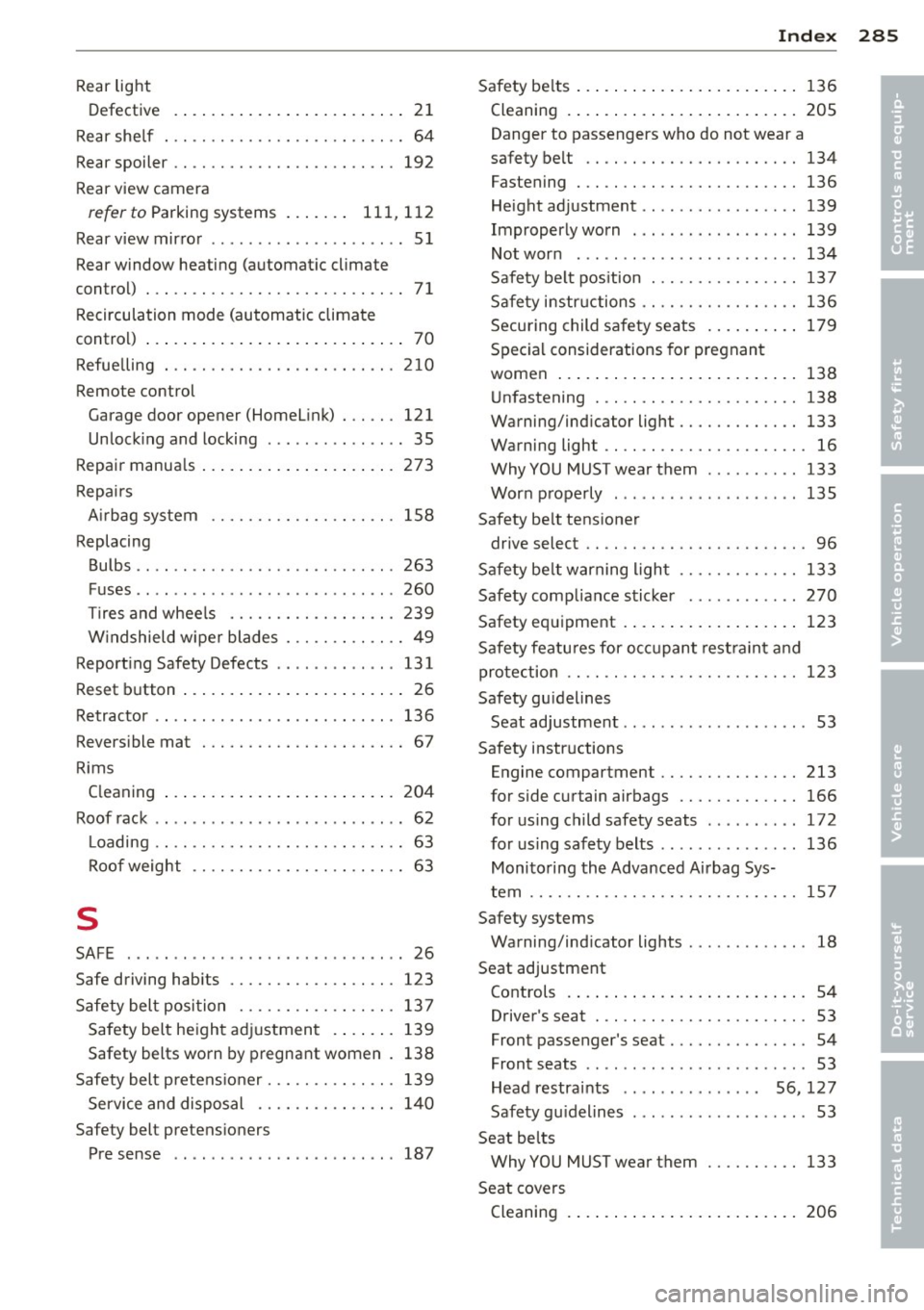
Rear light Defective
.. .... .. .... ... .. .. .. .... 2 1
Rear she lf . . . . . . . . . . . . . . . . . . . . . . . . . . 64
Rear spoiler .. .. ........... .. .. .. ... 192
Rear view camera
refer to Parking systems ... .. .. 111,112
Rear view mir ro r . . . . . . . . . . . . . . . . . . . . . 51
Rear window heating (automat ic climate
control) . . . . . . . . . . . . . . . . . . . . . . . . . . . . 71
Recirculation mode (automatic climate
contro l) . . . . . . . . . . . . . . . . . . . . . . . . . . . . 70
Refue lling 210
Remote control Garage door opener (Homel ink) . .. .. . 121
Unlock ing and locking ........ .... ... 35
Repair manua ls ... ...... ... .. .. .. ... 273
Repa irs
A irbag system ........... .... .. ... 1 58
Replacing Bulbs .. .. .. .. ........ ... .. ... ... . 263
Fuses .. ... ... ................ .... 260
T ires and whee ls ......... .. .. .. .. . 239
W indshield wiper blades ... .. .. .. .. .. 49
Report ing Safety Defects ........ ... .. 131
Reset b utton . . . . . . . . . . . . . . . . . . . . . . . . 26
Retractor .. .. .... .. .... .... . .. .. .. . 136
Revers ible mat ............ .... .. .... 67
R ims
C leaning ... .... .. .... ... .. .. .. ... 204
Roof rack . . . . . . . . . . . . . . . . . . . . . . . . . . . 62
L oading .. .. ............. .... .. .. .. 63
Roof weight . . . . . . . . . . . . . . . . . . . . . . . 63
s
SAFE .. .... ... ................ ... ' . 26
Safe driving hab its ......... .. .. .. .. . 123
Safety belt posi tio n ........ .. .. .. .. . 13 7
Safety belt he igh t ad justmen t .. .. .. . 139
Safety belts worn by p regnant women . 138
Safety belt pretens ioner ..... .. .. .. .. . 139
Service and disposal ...... .. .. .. .. . 140
Safety belt pretens ioners
Pre sense 187
Index 285
Safety be lts ... .... .. . .. .. ..... ... .. 136
Cleaning . ... .. .... . ... ...... ... .. 205
Danger to passengers who do not wear a
safety belt .. .. .. ................. 134
Fastening . . . . . . . . . . . . . . . . . . . . . . . . 136
Height adj ustment .. .............. . 139
Improperly worn ... . .. .. .. ... ... .. 139
Not worn . . . . . . . . . . . . . . . . . . . . . . . . 134
Safety be lt pos ition . ........... .... 13 7
S afety i nstr uctions .... ......... .. .. 136
Securing child safe ty seats ... ... .. .. 179
Spec ia l considerations for pregnant
women ... .. .. .... . ... ...... ... . . 138
U nfastening . .. .. ................. 138
Warning/ind icator light ........... .. 133
Warning light .. .. .... ............. . 16
WhyYOUMUS Twearthem .......... 133
Wor n properly ... .. . .. .. .. ... ... .. 135
Safety be lt tens ioner
drive select .. .. .. .. .. ........... .. . 96
Safety be lt warning ligh t ......... .. .. 133
Safety compliance stic ker ........... . 270
Safety eq uipment .... . .. ..... ... .. .. 123
Safety featu res for oc cupan t rest ra int and
pro tection .. .. .. .. .. .. ........... .. 123
Safety gu idelines
Seat adjustment . . . . . . . . . . . . . . . . . . . . 53
Safety instr uctions
Engine compartment ........... .. .. 213
for side curtain airbags ......... .. .. 166
for using child safety seats ......... . 172
for using safe ty belts .......... .... . 136
Moni to ring the Advanced Airbag Sys-
tem ...... .. .. .. ... ............ .. 15 7
Safety systems Warning/ind icator lights .. .. ... ... .. . 18
Seat adjustment Controls . . . . . . . . . . . . . . . . . . . . . . . . . . 54
Driver's seat . . . . . . . . . . . . . . . . . . . . . . . 53
Front passenger 's seat . . . . . . . . . . . . . . . 54
Front seats . . . . . . . . . . . . . . . . . . . . . . . . 53
Head restrai nts . . . . . . . . . . . . . . . 56, 127
Safety gu idelines . .. .......... .... .. 53
Seat belts WhyYOUMUSTwearthem ........ .. 133
Seat covers Cleaning . ... .. .... . ... ...... ... .. 206
•
•
Page 288 of 292
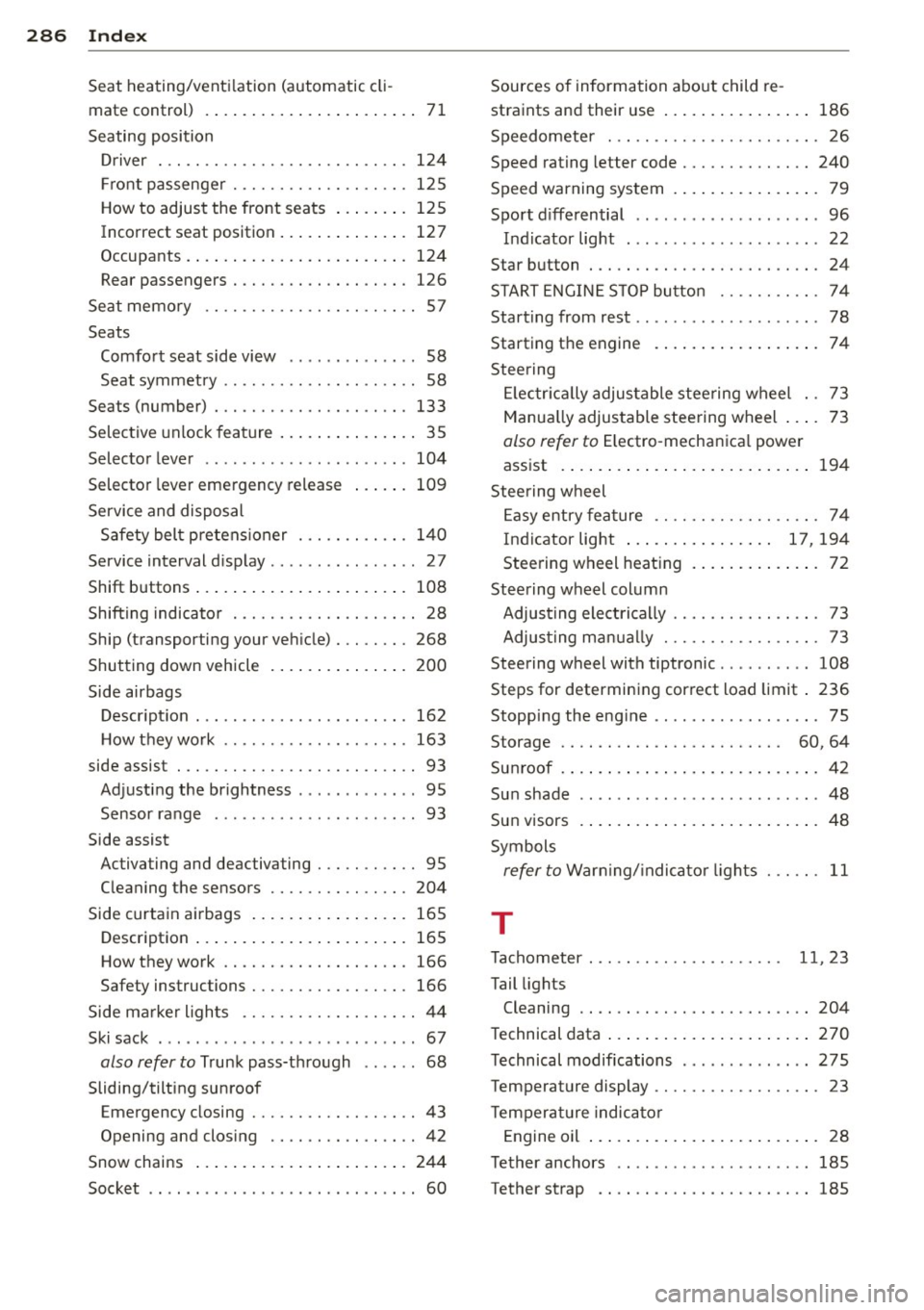
28 6 Index
Seat heating/venti lation (automatic cli-
mate control) . . . . . . . . . . . . . . . . . . . . . . . 71
Seating position Dr iver . .. .. ............. .. .. .. .. . 124
Fr ont passenger .......... .. .. .... . 125
How to adjust the front seats . . . . . . . . 125
Incorrect seat position ... .. .. .. .... . 127
Occupants . ... . .. ..... ... .. .. .... . 124
Rear passengers . . . . . . . . . . . . . . . . . . . 126
Seat memo ry ........... .. .. .. .. .. .. 57
Seats Comfort seat side view . . . . . . . . . . . . . . 58
Seat symmetry . . . . . . . . . . . . . . . . . . . . . 58
Seats (number) . ........... .. .. .... . 133
Selective unlock feature ... .. .. .. .. .. . . 35
Selector lever ... .... .... .. .. .. .. .. . 104
Selector lever eme rgency release ..... . 109
Service and disposal Safety belt pretens ioner ... .. .. .... . 140
Service interval d isplay ....... ... .. .... 27
Shift buttons .... . ...... ... .. .. .... . 108
Shifting indicator . . . . . . . . . . . . . . . . . . . . 28
Ship (transporting your ve hicle) . .. ..... 268
Shutting down vehicle . ... .. .. ... ... . 200
Side airbags Descr ipt ion . ... . ...... ... .. .. .. .. . 162
H ow they work ......... .. .. .. .. .. . 163
side assist . . . . . . . . . . . . . . . . . . . . . . . . . . 93
Adjusting the brightness ....... .. .... 95
Sensor range .. .... ...... .. .. .. .. .. 93
Side assist Activating and deactivating . .. .. .. .. . . 95
C leaning the sensors ...... .. .. .. .. . 204
Side curtain airbags ..... ... .. .. .... . 165
Description .... .. ..... ... .. .. .... . 165
How they work ........... .. .. .... . 166
Safety instructions ........ .. .. .. .. . 166
Side marker ligh ts ......... .... .... .. 44
Ski sack ... .. ................ ... ... . 67
also refer to Trunk pass-through .. .. .. 68
Sliding/tilting sunroof Emergency closing ........ .. .. .... .. 43
Opening and clos ing .. .. .. .... .. .. . . 42
Snow chains .... . ...... ... .. .. .... . 244
Socket .. .. .. ................ ... ... . 60 Sources of information abo
ut child re-
straints and their use .... ..... ... .. .. 186
Speedometer . . . . . . . . . . . . . . . . . . . . . . . 26
Speed rating letter code .......... .... 240
Speed warning system . .. ..... ... .. .. . 79
Sport d ifferential .. ..... ........... .. 96
Indicator light ... ..... ........... .. 22
Star button . . . . . . . . . . . . . . . . . . . . . . . . . 24
START ENG INE S TO P bu tton ...... .... . 74
Starting from rest . . . . . . . . . . . . . . . . . . . . 78
Starting the engine . .... ..... ... .. .. . 74
Stee ring
El ectr ically adjustable stee ring wheel . . 73
Manua lly adjustable steering wheel ... . 73
also refer to Electro -mecha nica l powe r
ass ist . ... .... .. .. ... ..... ... .. .. 194
Stee ring wheel
E asy entry fea ture ... .......... .. .. . 7 4
Indicator light . . . . . . . . . . . . . . . . 17,194
Stee ring w heel heating . ..... .... . .. . 72
Stee ring wheel column
Adjusting electri cally . . . . . . . . . . . . . . . . 73
Adjus ting ma nually ............ .. .. . 73
Steering wheel with tiptronic .......... 108
Steps for determin ing correct load limit . 236
Stopping the eng ine .. .. ...... ... .. .. . 75
Storage . . . . . . . . . . . . . . . . . . . . . . . . 60, 64
Sunroof . ... .. .. .. .. ... ..... ... .. .. . 42
Sun shade ...... .. .. ... ....... .... .. 48
Sun visors . ..... .. .. ... ..... ... .. .. . 48
Symbols
refer to War ning/ indica to r li ghts . .. .. . 11
T
Tacho meter . . . . . . . . . . . . . . . . . . . . . 11, 23
Tail lights Cleaning .. .. ... ... ... ..... ... .. .. 204
T echnical data ..... .. ... ..... ... .. .. 270
T echnical modifications .............. 275
Temperature display ............. .... . 23
T empera ture indica tor
Engine oil . . . . . . . . . . . . . . . . . . . . . . . . . 28
T ether anchors . ... ... .. .. ... ..... .. 185
Tether strap .. .. .. ............. .. .. 185