tow AUDI RS7 SPORTBACK 2014 Owner's Guide
[x] Cancel search | Manufacturer: AUDI, Model Year: 2014, Model line: RS7 SPORTBACK, Model: AUDI RS7 SPORTBACK 2014Pages: 292, PDF Size: 73.56 MB
Page 184 of 292
182 Child Saf ety
If the convertible locking retracto r shou ld be
activated inadvertently, the safety belt must be unfastened and guided completely back in
to its stowed pos ition to deactivate th is fea
ture. If the convertible locking retractor is not
deactivated, the safety belt will gradually be
come tighter a nd uncomfortable to wear.
A WARNING
Improperly insta lled child safety seats in
crease the risk of ser ious personal inju ry
and death in a collision.
- Never unfasten the safety belt to deacti
vate the convert ible lo ck ing ret ractor for
child rest rain ts while the veh icle is mov
ing. You would not be restrained and
cou ld be ser iously injured in an accident.
- Always read and heed all WARNINGS
whenever using a child rest rained in ave
hicle is being used
¢page 168. Special
precautions apply when installing a ch ild
safety seat on the front passenger seat
¢ page 144, Child restraints on the front
seat -some important things to know.
LATCH Lower
anchorages and tethers
for children
Child Restraint System anchors and how
are they related to child safety
To provide a s imp ler and more prac ticable way
to attach the chi ld restraint on the vehicle
seat, Federa l reg ulations require specia l lower
anchorages in vehicles and devices on new
child restraints to attach to the vehicle ancho
rages.
The combination of the tether anchorages and
the lower anchorages is now generally called
the
LATCH system for " Lower Anchorages and
T ethers for Children."
F orward-facing child rest raints manufactured
after September 1, 1999, are required by U .S .
federal regulations to comply with new child head movement performance requirements. T
hese new performance req uirements make a
tethe r necessary on most new child seats.
Installing a c hild restra int tha t requires a top
tether wi thou t one can seriously impa ir the
performance of the chi ld restra int and its abil
ity to protect the child in a collision . Insta lling
a chi ld restraint that req uires a top tether
without the top tether may be a violat ion of
state law.
Child restraint manufacturers offer LA TCH
lower anchorages on their child seats w ith
hook-on or push-on connectors attached to
adjustable straps.
In addition to the LATCH lower anchorages,
these chi ld restraint systems usua lly require
the use of tether straps to he lp keep the chi ld
restraint firmly in place.
A WARNING ,.__ -
Improper installat ion of child restra ints
will increase the r isk of injury and death in
a crash.
- Always follow the instructions provided
by the manufacture r of the child re
straint you intend to install in your ve hi
cle.
- Never install a chi ld restrai nt without a
p roperly attached top tether strap if the
child res tra int m anufa cture r's instruc
tions require the top tether st rap to be
used .
- I mp roper use of child restraint LA TC H
lowe r ancho rage poin ts can lead to injury
in a co llision. The LATCH lower anchorage
points are designed to withstand on ly
those loads imposed by correctly fitted
child restraints.
- Never mo unt two child restraint systems
on one LATCH lower anchorage point.
- Never secure or attach any luggage or
other item to the LATCH lower anchorag
es.
Page 196 of 292
194 Intelligent technology
overheat, premature wear and increased
stopping distance.
- Under certain climatic and operating
condit ions such as passing through wa
ter, driving in heavy ra in or after wash ing
the vehicle, the effect iveness of the
brakes can be reduced. In winter, ice ca n
accumulate on the brake pads, linings ,
discs and d rums . Carefully apply brakes
for a test . B rakes wi ll dry a nd ice coat
ings will be cleaned off after a few c are
f ul brake app lications .
- Driv ing fo r an ex tende d pe riod of time on
salt-covere d roads w ithout us ing yo ur
brakes can also affect braking efficiency.
Clean off accumulated salt coating from
brake discs and pads w ith a few caref ul
brake applicat ions.
- If you damage the front spoiler, or if you
install a different spoiler, be sure the air
flow to the front brakes is not obstruct ed. Otherwise the brake system could
overheat reducing the effectiveness of
the ent ire brake system .
- Failure of one brake c ircuit will impair
the braking capability res ulting in an in
creased stopp ing distance. Avoid driv ing
the vehicle and have it towed to t he near
est Au di dea le r o r q ualified w ork sh o p.
- Never let the vehicle ro ll to a stop w ith
the e ngine shu t off.
- If the brake booster is not working, the
bra ke pedal must be p ressed conside ra
bly harder to make up for the la ck of
booster assistance.
Electro-mechanical
power assist, dynamic
steering
The electro-mechanical power assist helps
the driver when steering .
Power steering adapts electronically based on
the vehicle speed .
Indicator lights and messages
• Steering defective! Stop the vehicle
If this indicato r light turns on and stays on
and t his message appears, the power steering
may have failed.
D o
not con tinue dr iv ing . See your author ized
Audi dealer or other qualified repair facility
for assistance .
'I-lj Steering: Sy stem fault You can continue
driving
If the indicato r light turns on and the mes
sage appea rs, the stee ring may be more diffi
cul t to move o r more sens itive th an usua l. The
stee ring wheel may a lso be at an ang le when
driving straight .
D rive slowly to you r authorized Aud i dea le r or
qualified wo rkshop to have the ma lf u nct ion
corre cted.
(:rij Dynamic st eering: Initializing
If this driver message appears and the indica
tor light is f lashing on the instrument panel,
dynam ic steer ing* is being rei nitia lized . Afte r
sta rting the engine, the stee ring wheel will
move s ligh tly. Re- ini tiali zation mig ht be ne c
essa ry if the stee ring wheel w as moved h ard
to the left and r ight wh ile the vehicle was not
moving . The display goes out as soon as initi
alization is complete.
D rive slowly to you r authorized Audi de aler or
qualified wo rkshop to have the ma lf u nct ion
corrected.
_& WARNING
Have t he dynamic stee ring * system mal
f u nction repa ired as soon as possible by an
a uthorized Audi dea ler or qua lified wor k
shop - risk of acc ident !
(D Tips
If the . or (:rij indicator light on ly stays
on for a short time, yo u may continue driv
i ng.
- The dynamic steering * stab ility systems
are not avai lab le in the event of a system
ma lf u nction.
- For add itiona l information on dynamic
steering *, refer to
c> page 96.
Page 201 of 292
Avoid damaging the
vehicle
When you are driving on poor roads, or over
curbs, steep ramps, etc., make certain that
low-lying parts such as spoilers and exhaust
system parts do not bottom out and get dam
aged.
T his is especially true for vehicles with low
slung chassis (sports chassis) * and fully load
ed veh icles .
Driving through water
on roads
Note the following to avoid vehicle damage
when driving through water, for example on
flooded roads:
- T he water must not be any h igher than the
bottom of the veh icle body.
- Do not d rive faster than wa lking speed.
..&, WARNING
After driving through wate r, m ud, slush,
etc., the brakes may be slow to take effect
because o f wet brake rotors and pads . Dry
the brakes first by braking carefully to re
store the full braking effect.
(D Note
- Vehicle components such as the eng ine,
transmission, suspension or e lectrical
system can be severely damaged by driv ing through water.
- Check the depth o f the water before driv
ing through it.
- Do not s top the veh icle, drive in reverse
or switc h the engine off when driving
through water.
- Keep in mind that oncoming vehicles may create waves that raise the water
level and make it too deep for your vehi
cle to drive through safely.
- Avoid driving thro ugh sa lt water because
it can ca use corrosion.
-
Dri vin g and en vironm ent 199
Warming up and
cooling down
By carefully warming up and cooling down
your vehicle, you can help ensure that it is not
overstressed unnecessar ily during sporty dr iv
ing.
When warming up, the vehicle is dr iven at a
maximum engine speed of 6000 RPM in order
to raise the engine o il temperature to a mini
mum of 140
°F (60 °() . The t ires a lso on ly
reach the ir full road holdi ng capabi lity once
they have warmed up.
The cooli ng fan can cont inue to run in your ve
hicle after the engine is switched off . Howev
er, driving the veh icle to coo l it down is pa rti c
ul arly important. Dur ing spo rty driving , the
engine and b rakes, the exhaust system, and
the transmission a ll become extremely hot.
Before you park the vehicle, you should drive
it for a few miles/kilometers at light load in
the low rpm range to allow it to cool down .
Catalytic converter
App lies to vehicles: wi th gaso line e ngi ne
It is very important that your emission con
trol system (catalytic converter) is function
ing properly to ensure that your vehicle is run
ning in an environmentally sound manner.
"' Always use lead-free gasoline c:> page 208,
Fuel supply .
"' Never run the tank down all the way to emp
ty.
"' Never put too much mo to r o il in yo ur eng ine
c:> page 218, Adding engine oil "t:::r..
"' Never try to push -or tow -start you r vehicle .
T he catalytic co nve rter is an efficient "clean
u p" dev ice bui lt into t he exhaus t system of
the ve hicle . The cata lytic converter bu rns
many of the pollutants in the exha ust gas be
fore they are re leased into the atmosphere.
T he exclus ive use of unleaded fuel is c ritical ly
i mportant for the life of the catalyt ic convert -
er and proper functioning of the engine .
Iii>
•
•
Page 239 of 292
pressure label) c> page 232,
fig. 195.
2. Determine the combined
weight of the driver and passengers that will be riding in
your vehicle.
3. Subtract the combined
weight of the driver and pas s engers from
"XXX" kilo
grams or
"XXX" pounds
s hown on the sti cker
c> page 232 , fig. 195.
4. The resulting figure equals
the available amount of car go and luggage load capa ci
ty . For example , if the
"XXX"
amount equals 1400 lbs .
and there will be five 150 lbs. passengers in your vehi
cle, the amount of available
cargo and luggage load ca
pacity is 650 lbs. (1400-750
(5
X 150) = 650 lbs.)
5. Determine the combined weight of luggage and cargo
being loaded on the vehicle.
That weight may not safely exceed the available cargo
and luggage load capacity
calculated in Step 4.
6. If your vehicle will be towing
a trailer, load from your trail
er will be transferred to your
Tires and wheels 237
vehicle . Consult this manual
to determine how this re
duce s the available cargo
and luggage load capacity of
your vehicle .
.,..Check the tire sidewall
(¢ page 239, fig. 199) to de
termine the designated load rating for a specific tire.
Tire service life
The servic e lif e of tires dep ends on a lot of
d ifferen t things inclu ding p roper ins tall ation
a n d ba lanc in g, corre ct ti re press ure and dr iv
ing style .
Fig. 197 Tire trea d: tread wea r in dicators (TWI)
,.............,------,,
-=---::;:-r-
Fig. 198 Rotat ing tires for more even wear
Tread Wear Indicator (TWI)
The or iginal tires on you r vehicle h ave
1/ 16 inch ( 1.6 mm) hi gh "wear indicato rs"
r::!> fig. 197 run ning acr oss the tread. Depen d-
ing on the mak e, th ere will be si x to eight of
t h em evenly placed a ro und t he tire. Marks on
the tire sidewall (for e xamp le ''TWI" or ot her
Ill>
Page 252 of 292
250 What do I do now?
What do I do now?
Emergency warning
triangle
App lies to vehicles: with emerge ncy warning triangle
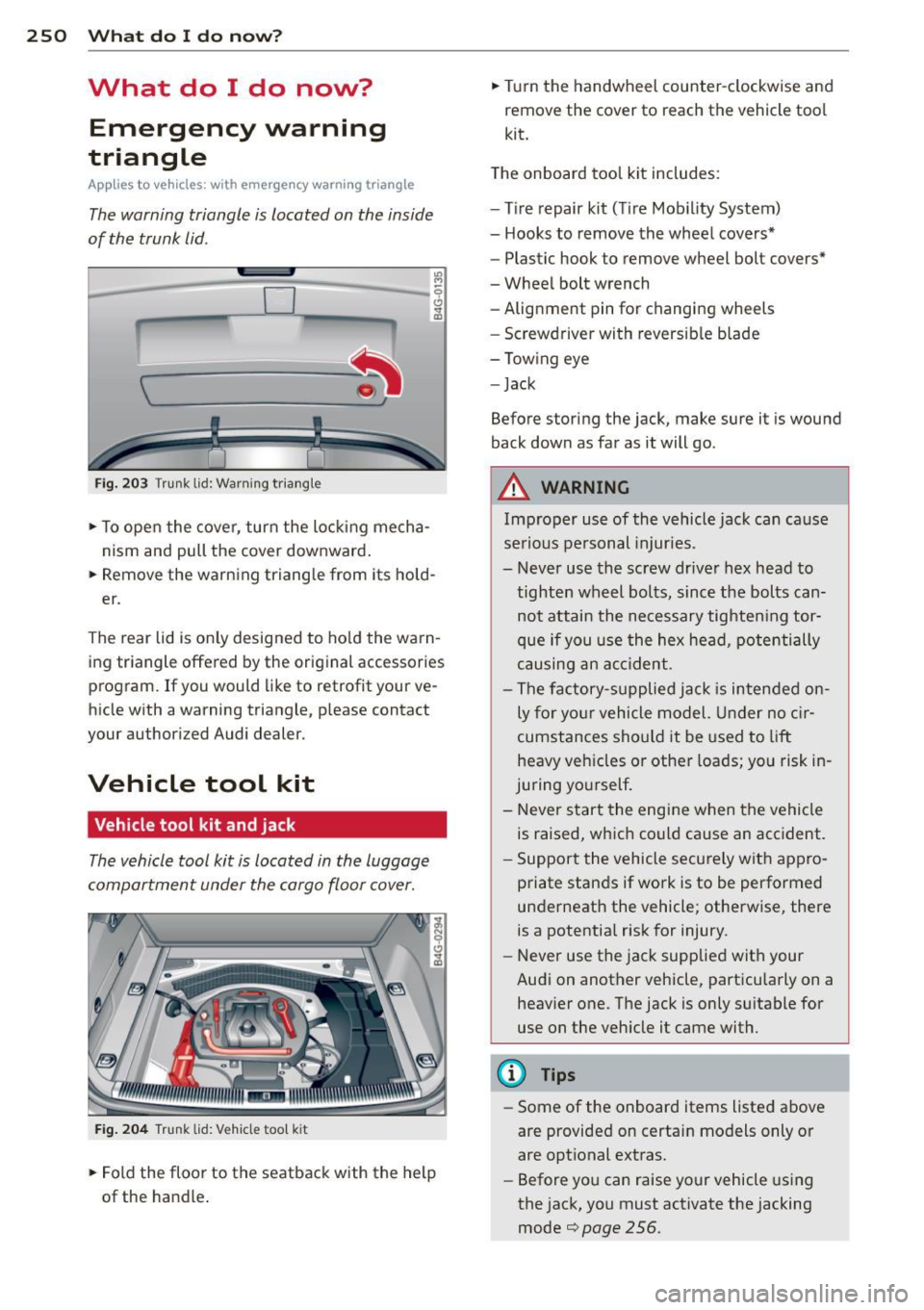
The warning triangle is located on the inside
of the trunk lid .
-
"' M ~ 0 6
~ ~
Fig. 203 Trunk lid: Warning triang le
.,. To open the cover, turn the locking mecha
nism and pull the cover downward .
" m
.,. Remove the warning triang le from its hold
er .
The rear lid is only designed to hold the warn
ing triangle offered by the original accessories
program. If you would like to retrofit your ve
hicle with a warning triangle, p lease contact
your authorized Audi dealer.
Vehicle tool kit
Vehicle tool kit and jack
The vehicle tool kit is located in the luggage
compartment under the cargo floor cover.
Fig. 204 Trunk lid: V ehicl e too l kit
.,. Fold the floor to the seatback with the help
of the handle . .,.
Turn the handwheel counter-clockwise and
remove the cover to reach the veh icle tool
kit.
T he onboard tool kit includes :
- Tire repair kit (Tire Mobility System)
- Hooks to remove the wheel covers*
- Plastic hook to remove wheel bolt covers*
- Wheel bolt wrench
- Alignment pin for changing wheels
- Screwd river with reversible bla de
-Towing eye
-J ack
Before storing the jack, make sure it is wound
back down as far as it will go .
A WARNING
Improper use of the vehicle jack can cause
serious personal injuries.
- Never use the screw driver hex head to
tighten wheel bolts, since the bolts can
not attain the necessary tighten ing tor
que if you use the hex head, potentially
causing an accident .
- The factory-supplied jack is intended on
ly for your vehicle model. Under no cir
cumstances should it be used to lift
heavy veh icles or other loads; you risk in
juring yourself.
- Never start the engine when the vehicle
is raised, which could cause an acc ident.
- Support the vehicle securely with appro
priate stands if work is to be performed
underneath the vehicle; otherwise, there
is a potential risk for injury.
- Never use the jack supplied with your
Audi on another vehicle, particularly on a
heav ier one. The jack is only suitable for
use on the veh icle it came with.
@ Tips
- Some of the onboard items listed above
are provided on certain models only or
are optional extras .
- Before you can raise your vehicle using
the jack, you must activate the jacking
mode¢
page 256 .
Page 266 of 292
264 Emergency situations
Emergency situations
General
This chapter is intended for trained emer
gency crews and working personnel who
have the necessary tools and equipment to
perform these ope rations.
Starting by pushing or
towing
Q;) Note
Vehicles w ith an automatic transmission
cannot be started by pus hing o r tow ing.
Starting with jumper
cables
If necessary, the engine can be started by
connecting it to the battery of another vehi
cle.
If the engine should fail to start because of a
discharged or weak battery, the battery can be
connected to the battery of
another veh icle,
using a
pair of jumpe r cables to start the en
g ine .
Jumper cables
Use only jumper cables of sufficiently large
cross section to carry the starter current safe
ly. Refer to the manufacturer's specif ications.
Use only jumper cables with
insulated termi
na l clamps which are distinctly marked:
plus(+) cable in most cases colored red
minu s(-) cable
in most cases colored black .
A WARNING
Batteries contain electricity, acid, and gas.
Any of these can cause very serious or fatal
inju ry. Follow the instructions below for
safe handling of your veh icle's battery.
- Always shield you r eyes and avoid lean
ing over the battery whenever possible.
- A discharged battery can freeze at tem
peratures just be low 32 °F (0 °C). Before connecting a
jumper cable, you must
thaw the frozen battery complete ly, oth
erwise it could explode.
- Do not allow battery acid to contact eyes
or skin. Flush any contacted area with
water immediately.
- Improper use of a booster battery to start a vehicle may cause an explosion.
- Vehicle batteries generate explosive gas
es. Keep sparks, flame and lighted ciga
rettes away from batteries.
- Do not try to jump start any vehicle with a low acid level in the battery.
- The vo ltage of the booster battery must
also have a 12-volt rating. The capacity
(Ah) of the booster battery should not be
lower than that of the discharged bat
tery . Use of batteries of d ifferent voltage
or substantially different "Ah" rating
may cause an exp losion and personal in
jury.
- Never charge a frozen batte ry. Gas trap
ped in the ice may cause an explosion.
- Never charge or use a battery that has
been frozen. The battery case may have
be weakened.
- Use of batter ies of different voltage or
substantially different capacity (Ah) rat
ing may cause an exp losion and injury.
The capacity (Ah) of the booster battery
should not be lower than that of the dis
charged battery.
- Before you check anything in the engine
compartment, always read and heed a ll
WARNINGS¢
page 213.
(D Note
- App lying a higher voltage booster bat
tery will cause expensive damage to sen
sitive electronic components, such as
control units, relays, radio, etc.
- Th ere must be no electrical contact be
tween the vehicles as otherwise current cou ld already start to f low as soon as the
positive(+) terminals are connected. .,.
Page 268 of 292
266 Emergency situations
-When connecting jumper cables, make
sure that they cannot get caught in any
moving parts in the engine compart
ment .
- Before you check anything in the engine
compartment, always read and heed all
WARNINGS
<=) page 213.
(D Note
Improper hook-up of jumper cables can ru
in the generator.
- Always connect POSITIVE( +) to POSI
TIVE(+), and NEGATIVE(-) to NEGATIVE
( - ) ground post of the battery manager
control unit .
- Check that all screw plugs on the battery
cells are screwed in firmly . If not, tighten
plugs prior to connecting clamp on nega
tive battery terminal.
- Please note that the procedure for con
necting a jumper cable as described
above applies specifically to the case of
your vehicle being jump started. When
you are giving a jump start to another ve
hicle, do
not connect the negat ive( -) ca
ble to the negative( -) terminal on the
discharged battery ©
Q fig. 220. In
stead, securely connect the negative( -)
cable to either a solid metal component
that is firmly bolted to the engine block
or to the engine block itself. If the bat
tery that is being charged does not vent
to the outside, escaping battery gas
could ignite and explode!
Emergency towing
with commercial tow
truck
General hints
Your Audi requires special handling for tow
tng .
The following information is to be used by
commercia l tow truck operators who know
how to operate their equipment safely.
-Never tow your Audi. Towing will cause
damage to the engine and transmission .
- Never wrap the safety chains or winch ca
bles around the brake lines.
- To prevent unne cessary damage, your Audi
must be transported with a flat bed truck.
- To load the vehicle on to the flat bed, use
the towing loop found in the vehicle tools
and attach to the front or rear anchorage
r=) page 266 and ¢ page 267.
.&_ WARNING
=
A vehicle being towed is not safe for pas-
sengers. Never allow anyone to ride in a
vehicle be ing towed, for any reason.
Front towing loop
Only install the front towing loop when it is
needed.
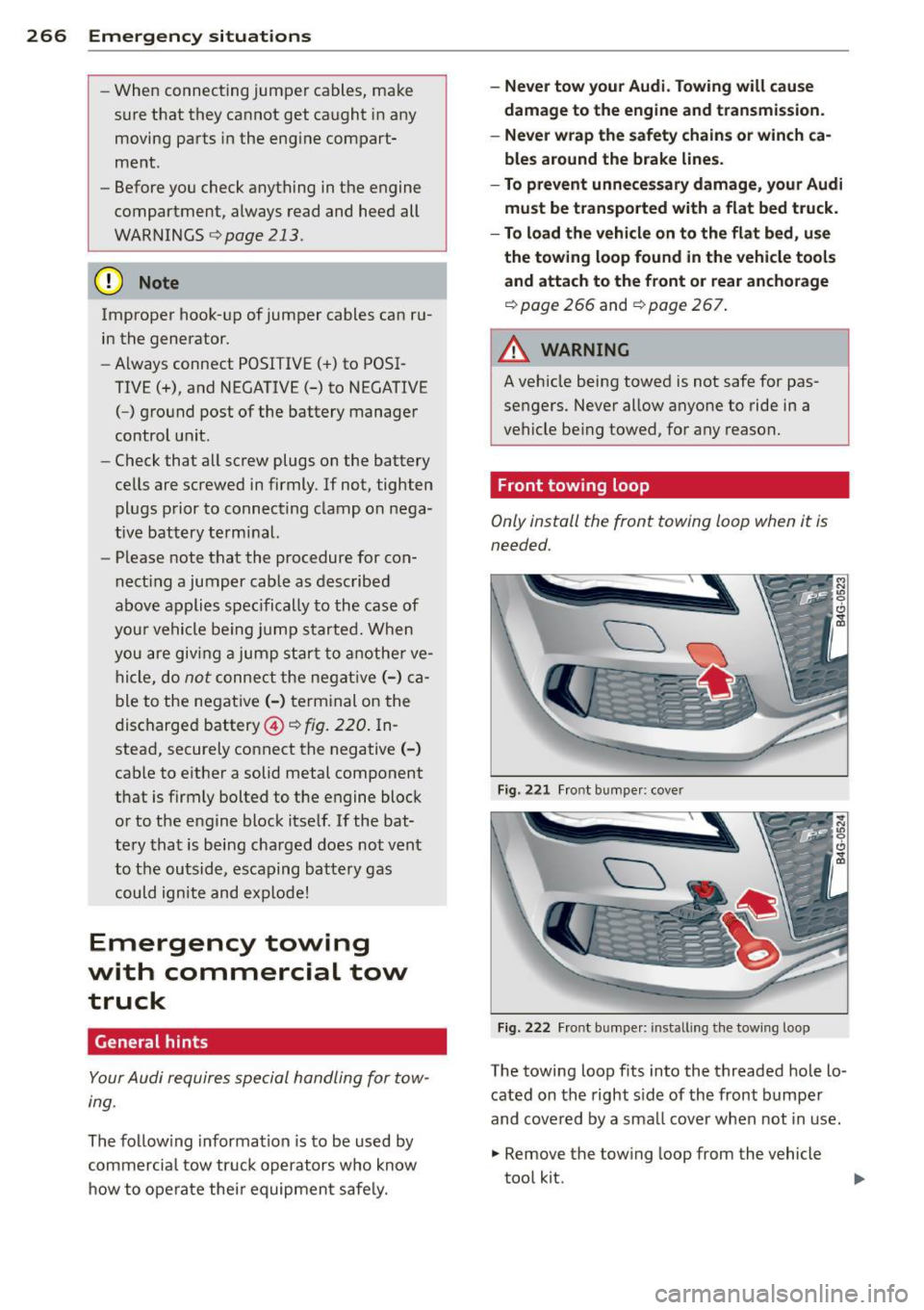
Fig. 221 Front bumpe r: cove r
Fig. 222 Front bumper: installing the towing loop
-
The towing loop fits into the threaded hole lo
cated on the right side of the front bumper
and covered by a smal l cover when not in use.
.,. Remove the towing loop from the vehicle
tool kit.
Page 269 of 292
.. Press the cover in by applying short strong
pressure to the bottom part to release it
from the bumper
¢ fig. 221 .
.. Screw the towing loop in the threaded open-
ing and tighten it until it stops
¢fig. 222.
Remove the towing loop when you are done
using it and place it back in the vehicle tool
kit. Install the cover in the bumper. Always
keep the towing loop in the vehicle.
A WARNING
If you do not screw the tow ing loop com
pletely, it could come out of the threaded
hole while the vehicle is being towed cau s
ing damage to the vehicle and possib le se
r ious personal inju ry.
Rear towing loop
Only install the rear towing loop when it is
needed.
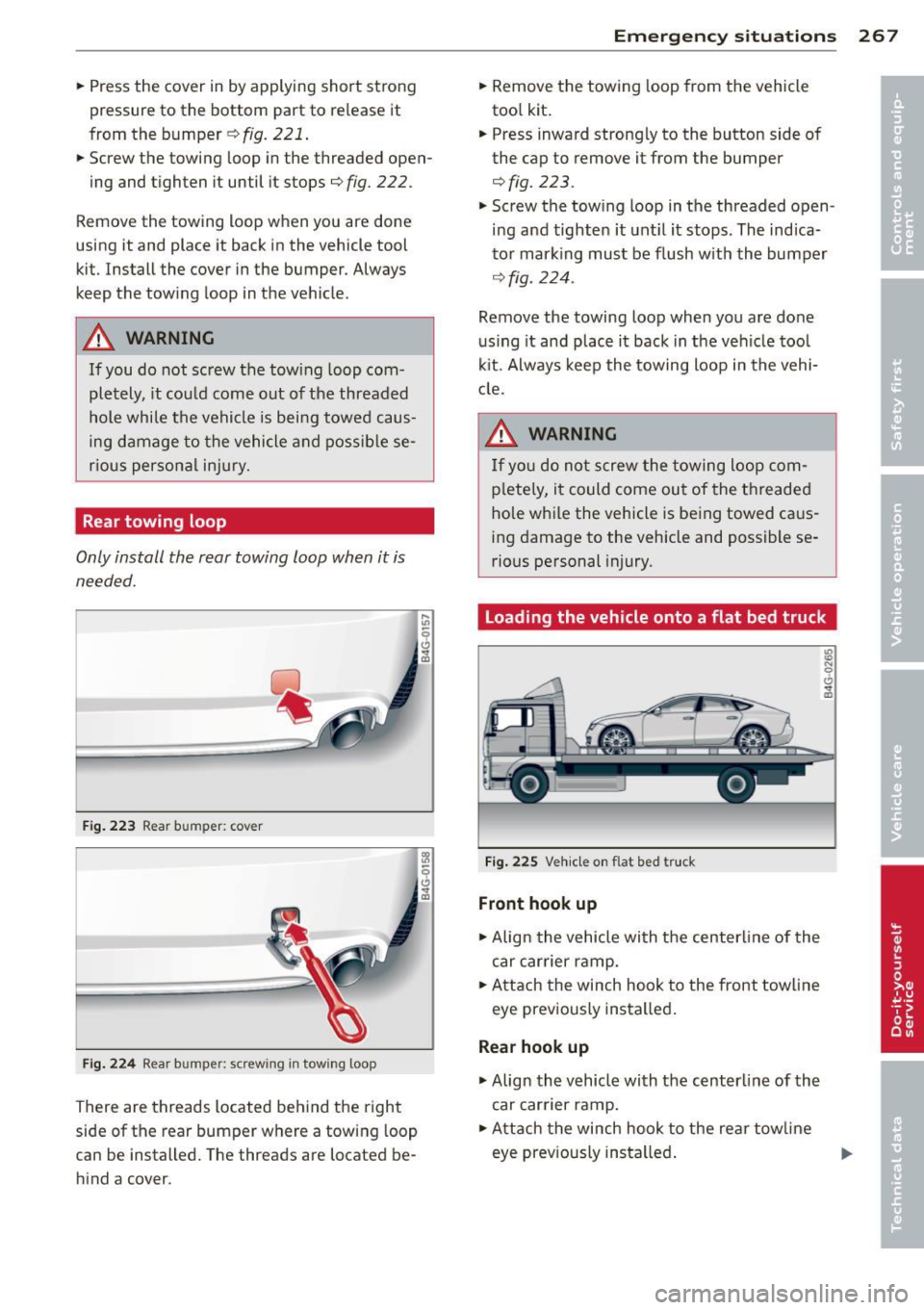
F ig. 223 Rear bumper: cover
Fi g. 2 24 Rear bumper: screwing in towing loop
There are threads located behind the right
side of the rear bumper where a towing loop
can be installed. The threads are located be
hind a cover.
Emergenc y situ ation s 267
.. Remove the tow ing loop from the vehicle
too l kit .
.. Press inward strongly to the button side of
the cap to remove it from the bumper
¢fig. 223.
.. Screw the towing loop in the threaded open
ing and tighten it unt il it stops. The indica
to r mark ing must be flush w ith th e bumper
¢fig. 224.
Remove the towing loop when you are done
using it and place it back in the veh icle too l
ki t. Always keep the towing loop in the vehi
cle.
A WARNING
If yo u do not screw the towing loop com
p letely , it co uld come out of the t hreaded
hole while the vehicle is being towed caus
ing damage to the vehicle and possible se
rious pe rsonal injury.
loading the vehicle onto a flat bed truck
Fi g. 225 Vehicle on flat bed tru ck
Front hook up
.. Align the vehicle with t he centerline of the
car car rier ramp .
.,. Attach the winch hook to the front towline
eye prev iously insta lled .
Rear hook up
.,. Align the vehicle with the center line of the
car carrier ramp .
.. Attach the winch hook to the re ar tow line
eye prev ious ly insta lled .
u,
Page 270 of 292
268 Emergency situations
@ Tips
Check carefully to make sure the hook-up
is secure before moving the car up the flat
bed truck ramp.
Vehicle transport
Whenever you have your vehicle transported,
be sure to note the following:
(D Note
Mount the tie-down chains/cables over the
running surface (circumference) of the
tires. Never secure the vehicle by the axle,
the suspension struts or the front or rear
towline eye. For technical reasons, the
pressure in the suspension struts may
change during the transport and this will
adversely affect vehicle handling.
Lifting vehicle
Lifting with workshop hoist and with
floor jack
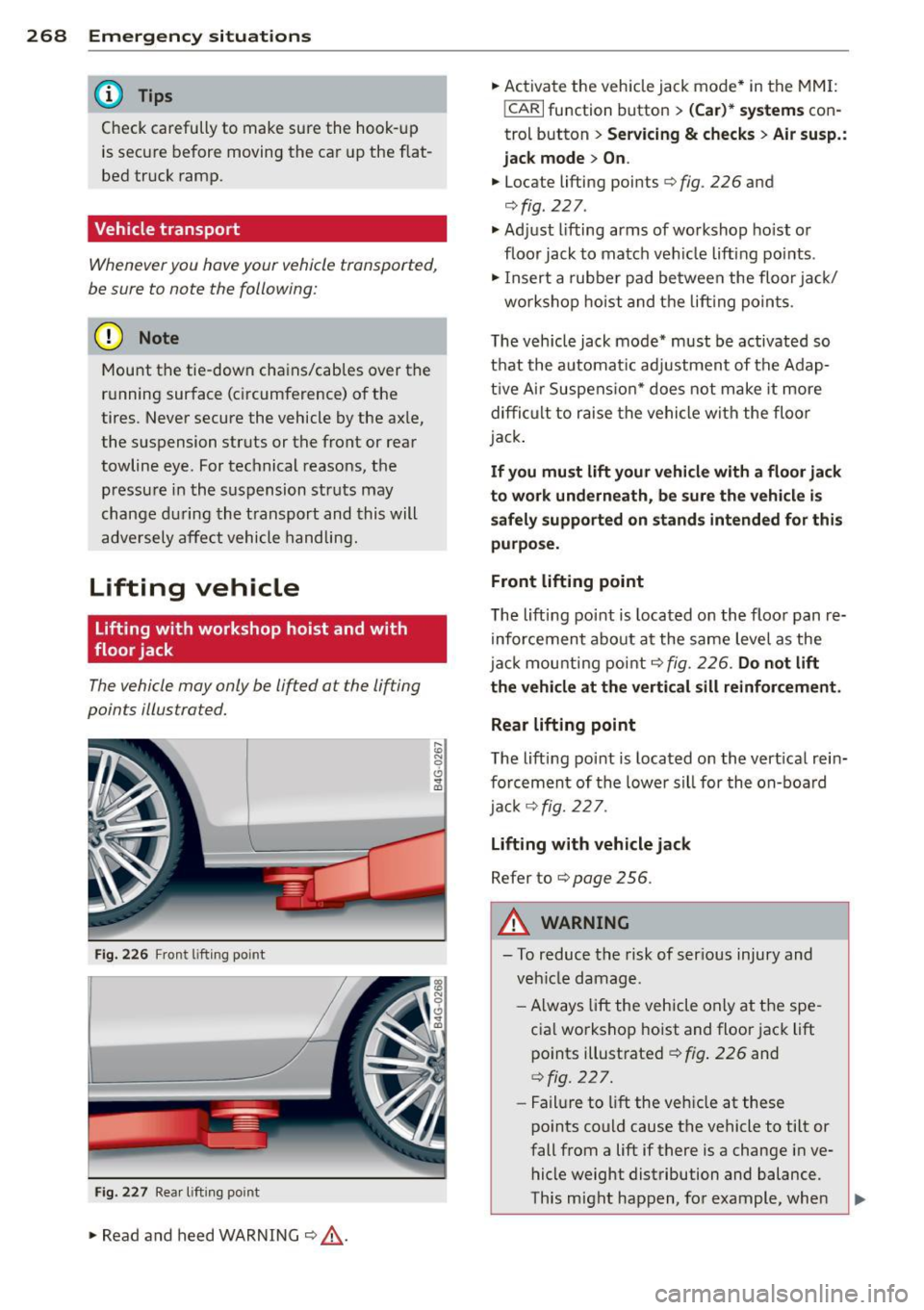
The vehicle may only be lifted at the lifting
points illustrated.
Fig. 226 Front lift in g po int
Fig. 227 Rear lifti ng point
.,. Read and heed WARNING¢&, .
~ N 0 6 .., (0
... Activate the vehicle jack mode* in the MMI:
!CARI function button > (Car)* systems con
trol button>
Servicing & checks> Air susp.:
jack mode > On.
... Locate lifting points ¢ fig . 226 and
¢fig . 227 .
.,. Adjust lifting arms of workshop hoist or
floor jack to match veh icle lifting points .
.,. Insert a rubber pad between the floor jack/
workshop hoist and the lifting points .
The vehicle jack mode* must be activated so
that the automat ic adjustment of the Adap
tive Ai r Suspens ion* does not make it more
difficult to raise the vehicle with the floor
jack .
If you must lift your vehicle with a floor jack
to work underneath, be sure the vehicle is
safely supported on stands intended for this
purpose.
Front lifting point
The lifting point is located on the floor pan re
inforcement about at the same level as the
jack mounting point
¢fig. 226. Do not lift
the vehicle at the vertical sill reinforcement .
Rear lifting point
The lifting point is located on the vert ical rein
forcement of the lower sill for the on-board
jack
c!;> fig. 2 2 7.
Lifting with vehicle jack
Refer to¢ page 256 .
A WARNING
-To reduce the risk of ser ious injury and
veh icle damage.
- Always lift the vehicle only at the spe
cial workshop hoist and floor jack lift
points illustrated¢
fig. 226 and
¢ fig. 227.
-Failure to lift the veh icle at these
points could cause the vehicle to tilt or
fall from a lift if there is a change in ve
hicle weight distribution and balance.
This might happen, for example, when
-
Page 282 of 292
280 Index
Defrosting (windows)
automatic climate control . ... ... ... .. 71
Determining correct load limit ... .... . 236
Dimensions ................. .. .... . 271
Dimming the rearview mirror . ..... .. .. 51
Displays Cleaning . .. .......... ...... ... .. . 205
Distance . . . . . . . . . . . . . . . . . . . . . . . . . . . 24
Door/rear lid warning . . . . . . . . . . . . . . . . . 23
Doors Power child safety lock ........ .. .... 40
Driver information system Boost ... .. ............. .. .. .. ... . 28
CD/radio display . . . . . . . . . . . . . . . . . . . . 23
Door/rear lid warning . . . . . . . . . . . . . . . 23
Efficiency program . ........... .. .. .. 25
En gin e oi l tempe rature display .. .. .. . . 28
E xterior tempe rature display . .. .. .. . . 23
On -board computer . . . . . . . . . . . . . . . . . 24
Shifting indicator . . . . . . . . . . . . . . . . . . . 28
Driver seating position . . . . . . . . . . . . . . . 124
drive select ................. .. .... .. 96
adaptive air suspension/sport ... ...... 96
Adaptive dampers . . . . . . . . . . . . . . . . . . 96
Curve light . . . . . . . . . . . . . . . . . . . . . . . . 96
Engine sound .. .... ...... .. .. .. .. .. 96
Safety belt tensioner . . . . . . . . . . . . . . . . 96
Sport different ial . . . . . . . . . . . . . . . . . . . 96
Driving safely . . . . . . . . . . . . . . . . . . . . . . 123
Driving through water .......... .. ... 199
Driving time ............... ... .. .. .. 24
Duplicate key ............... .. .... .. 32
Dust filter
r e fer to Pollutant filter . . . . . . . . . . . . . . 69
Dynamic steering .......... .. .. .. .. . 194
E
Easy entry feature . . . . . . . . . . . . . . . . . . . . 7 4
Efficiency program . . . . . . . . . . . . . . . . . . . 25
Fu el economy messages . . . . . . . . . . . . . 25
Other equipment . . . . . . . . . . . . . . . . . . . 25
E lectrical accessories (sockets) . . . . . . . . . 60
Electro-mechanical power assist .. .. .. . 194
Electromechanical parking brake
Emergency braking . . . . . . . . . . . . . . . . . 78
Operation . . . . . . . . . . . . . . . . . . . . . . . . . 77 Parking ...
.... .. ............. ..... 78
Releasing and closing ............... 77
Starting assist . . . . . . . . . . . . . . . . . . . . . 78
Starting from rest . . . . . . . . . . . . . . . . . . 78
Warning/indicator lights ........ .... . 15
Electronic differential lock
Warning/indicator lights ............ . 18
Electronic differential lock (ED L) . . . . . . . 189
Warning/indicator lights ............ . 19
Elec tronic immobilizer . . . . . . . . . . . . 26, 33
E lectronic power control (EPC)
warning/indicator light .............. 20
Electronic Stabilization Control (ESC) . .. 189
Warning/indicator lights .......... .. . 18
Emergency actuation Doors ...... .. .. .. ...... ..... .. .. . 38
Power sunroof . .. ................ .. 43
Rear lid ....... .. ............. .... . 40
Emergency braking .............. .... . 78
Emergency flasher . . . . . . . . . . . . . . . . . . . 45
Warning/indicator lights ............. 22
Emergency release
Selector lever .... ............. .... 109
Emergency starting ............. ....
264
Emergency towing ................. . 266
Emergency warning triangle .......... 250
Energy management ............ .... 195
Engine Compartment .... ............. .... 215
Coolant ....... .. .. ............ ... 220
starting ....... .. .. .............. .. 74
Starting with jumper cables ....... .. 264
Stopping .. .... .. ............. .... . 75
Engine compartment ................ 215 Closing the hood .............. .... 214
Opening the hood ................ . 213
Safety instructions ............. .... 213
Working in the engine compartment .. 213
Engine coolant .... ................ . 220
Adding coolant ... ................ . 221
Checking the engine coo lant level ..... 220
Expansion tank ... ............. .. .. 220
Malfunction symbol . . . . . . . . . . . . . . . . . 15
Radiator fan ...... .............. .. 222
Temperature gauge ......... ...... .. 10