lock AUDI RS7 SPORTBACK 2014 Repair Manual
[x] Cancel search | Manufacturer: AUDI, Model Year: 2014, Model line: RS7 SPORTBACK, Model: AUDI RS7 SPORTBACK 2014Pages: 292, PDF Size: 73.56 MB
Page 224 of 292
222 Checking and filling
pressure relief valve in the cap when the en
gine becomes hot.
.&_ WARNING
- The cooling system is under pressure and
can get
very hot. Reduce the risk of
sca lding from hot coolant by following
these steps .
- Turn off the eng ine and a llow it to cool
down.
- Protect your face, hands and arms from
escap ing flu id and steam by cover ing
the cap with a large , thick rag .
- Tu rn the cap slowly and
very carefully
in a counter -clockwise direction while
applying light, downward pressure on
the top of the cap .
- To avo id being burned, do not sp ill an
tifreeze or coolant on the exhaust sys
tem or hot engine parts. Under certain
conditions, the ethylene glycol in en
g ine coolant can catch fire.
- Antifreeze is poisonous. Always store an
t ifreeze in its original container and well
out of the reach of children.
- If you drain the coolant, it must be
caught and safely stored in a proper con
ta iner clearly marked "poison".
(D Note
- Coolant po llutes the environment and
could cause an engine fire. Excess coo l
ant will be forced out through the pres
sure relief valve i n the cap when the en
gine becomes hot .
- If, in an emergency, only water can be
added, the correct ratio between wate r
and antifreeze ~
page 220 must be re
stored as soon as possib le.
@) For the sake of the environment
Dra ined coolant should not be reused . Al
ways dispose of used coolant while
observ
ing all environmental regulations .
Radiator fan
The radiator fan switches on automatically by
itself .
An auxilia ry electric r adiator fan switches on
and off depending on coolan t tempera ture
and other vehicle operat ing condit ions .
After you switch the engine off, the aux iliary
fan can continue running for up to 10 minutes
- even w ith the ignition off . It can even swi tch
on aga in later by itself
c> .&. , if
- the temperature of the engine coo lant rises
due to the heat build-up from the engine in
the engine compartmen t, or
- the engine compartment heats up because
the vehicle is parked in intense sunlight.
.&_ WARNING ,_
- To reduce the risk of personal injury nev
er touch the radiator fan .
- The auxiliary electric fan is temperature
controlled and can sw itch on suddenly
even when the engine is not running .
- The auxiliary radiator fan sw itches on au
tomatically when the engine coo lant
reac hes a certain t emperature and wi ll
continue to run until the coolant temper
a ture drops.
Brake fluid
Checking brake fluid level
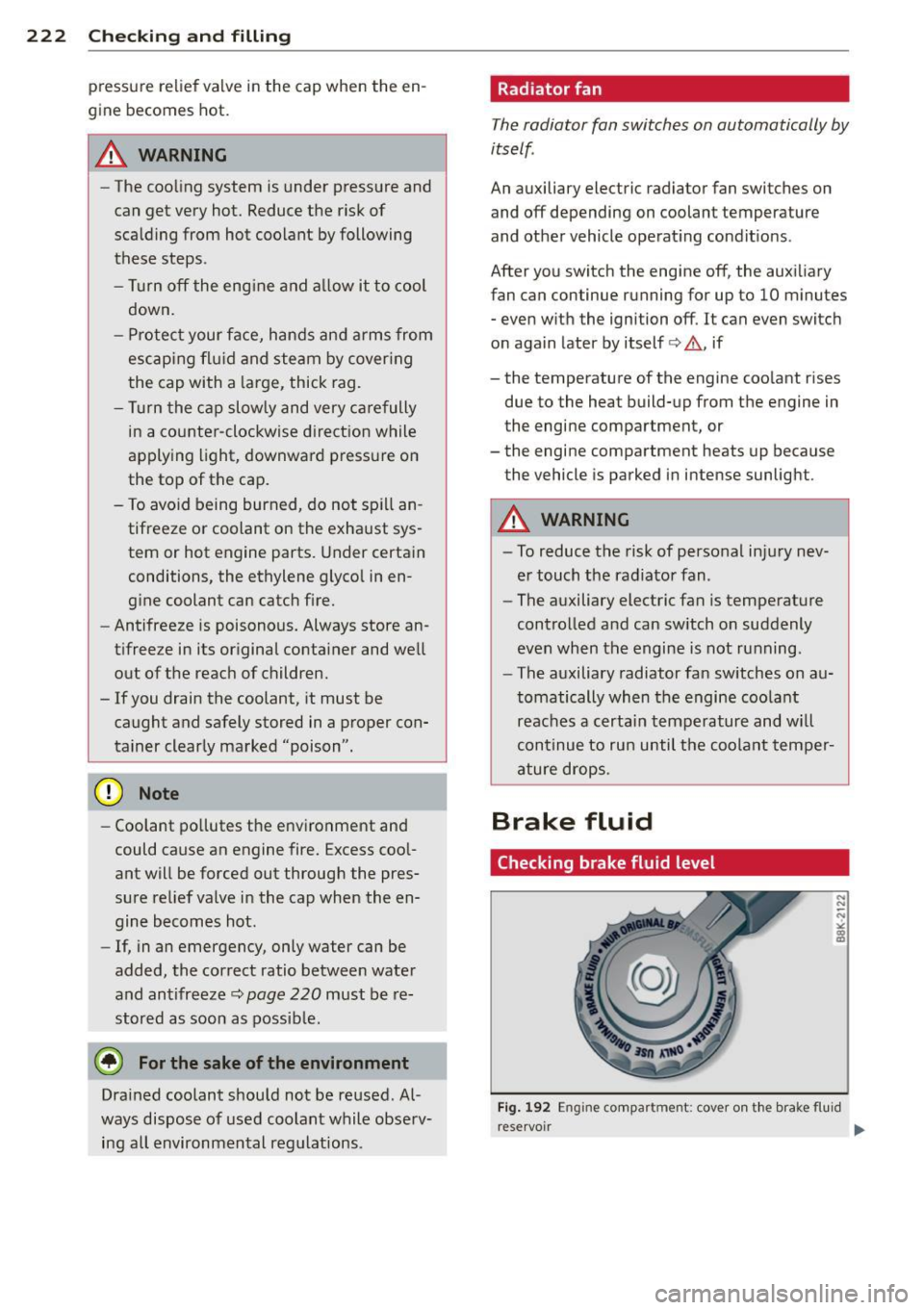
Fi g. 19 2 Engin e compart ment: cover on t he bra ke fluid
re servoir
Ill>
Page 225 of 292
Before you check anything in the engine com
partment,
always r ead and heed all W ARN
ING S ~ A in Working in the engine compart
ment on page 213.
.. Read the brake fluid level from the brake
fluid reservoir ¢
fig. 192, ~ page 215,
fig . 188.
The brake fluid level must be be
tween the "MIN" and "MAX" markings.
The location of the brake fl uid reservoir can be
seen in the engine compartment illustration
¢page 215.
The fluid level may drop slightly after some
time due to the automatic adjustment of the brake pads . This is not cause for alarm .
If the brake fluid level falls considerably be
l ow the "MIN" mark, the brake wa rning/indi
cator light
1111 (U .S . models)/ . (Canadian
models) will come on
~ page 14. Do not con
tinue to operate the vehicle. The comp lete
brake system shou ld be thoroughly checked
by an authorized Audi dealer or other quali
f ied fac ility and the cause corrected . If the
b rake fluid level is too low, the brake warn ing/
i ndicator light w ill illuminate . Contact an au
thor ized Audi dealer
imm ediately .
Changing brake fluid
Have the brake fluid changed by an experi
enced technician .
Brake fluid absorbs moisture from the a ir . If
the water content in the brake fluid is too
hi gh, cor rosion in the brake system may result
after a per iod of t ime . The bo iling po int of the
b rake fluid w ill also decrease considerab ly and
decrease braking performance.
Therefore, the brake flu id must be changed
ev ery two ye ars. A lways use new b rake fluid
which confo rms to Federal Motor Vehicle
Standard "FMVSS
116 DO T 4".
The brake flu id rese rvoi r ca n be difficult to
r each, therefo re , we recommend that yo u
h ave the brake fl uid changed by you r autho r
i zed
Audi de aler . Your dea le r has the correct
Checkin g and fillin g 223
tools, the right brake fl uid and the know -how
to do this for you .
A WARNING
-Brake flu id is poisonous. It must be stor
ed only in the closed or iginal container
out of the reach of children!
- Brake failure can resu lt from o ld or inap
propriate brake f lu id. Observe these pre
cautions:
- Use only b rake fluid tha t meets SA E
spe cificat ion
J 17 03 and conforms to
Federa l Moto r Ve hicl e Standard
116.
Always check with your authorized Audi
dealer to make sure yo u are using the
correct brake fluid. The correct type of
brake f luid is also ind icated on the
brake f luid reservoir .
- The brake fluid must be new. Heavy use
of the brakes ca n cause a vapor lock if
the brake fluid is left i n the system too
long. This can se riously affect the effi
c iency of the b rakes as well as your
safety , T his could result in an accident.
(!) Note
Brake fluid will damage the paint of your
vehicle.
@) For the sake of the environment
Because of the prob lem of proper disposal
of brake fluid as well as the spec ial too ls
r equired and the necessary expertise, we
r ecommend that you have th e brake flu id
changed by you r autho rized Aud i dea le r.
Battery
General information
Under normal operating cond itions, the bat
tery in your Audi does not need any ma inte
nance . With
high outside temperatu res or
lo ng da ily drives we recommend that you have
the e lectrolyte leve l che cked by a se rv ice fa
c il ity. The ele ctroly te leve l should also be
chec ked each t ime the battery is cha rged
~ page 226 . Iii>
•
•
Page 237 of 292
-Turn the valv e stem cap counter-clockwise
to remove it from the tire valve.
- Place the air pressure gauge on the valve.
- The tire pressures should only be checked
and adjus ted when the tires are cold . The
s li ght ly raised p ressures of warm tires must
not be reduced .
- Adjust the tire pressure to the load you are
carrying .
- Re insta ll the va lve stem cap on the valve.
When should I che ck the tire pres sur e?
The correct tire pressure is espec ially impor
tant at high speeds. The pressure should
therefo re be checked at least once a month
and a lways before start ing a journey.
When should I adjust the tire p re ssure s?
Adjust the tire pressure to the load you are
carry ing . After changing a wheel
o r replacing
wheels you have to adjust the tire pressures
on all wheels. In addition , you must then
store the new ti re pressu res in the t ire pres
sure monitoring system
r::!.> page 246 .
A WARNING
Incorrect tire pressures and/or underinf la
tion can lead sudden tire failure, loss of contro l, collision, serious persona l injury
or even death.
- When the warning symbo l
[ti] appears in
the instrument cl uster, stop and inspect
the tires.
- Incorrect tire pressure and/or underinfla
t ion can cause increased tire wear and
can affect the handling of the veh icle and
stopp ing ability .
- Incorrect tire pressures and/or underin
flation can also lead to sudden tire fa il
ure, including a blowout and sudden de
flation, causing loss of vehicle control.
- The driver is responsible for the correct
tir e pressures fo r all t ires on the vehicle .
T he applicable pressu re va lues are locat
ed on a stic ker on the drive r's side B-pil
lar .
- Only when a ll t ires on the vehicle are fi l
led to t he cor rect pressure, the ti re p res-
Tire s an d wheel s 235
sure monitor ing system can work cor
rectly.
- The use of incorrect tire pressure va lues
can lead to acc idents or other damage.
Therefore it is essential that the driver
observe the spec ified t ire pressure values
for the tires and the correct pressures for
the function of the t i re p ress ure monito r
ing system .
- Always inf late t ires to the recommended
a nd correct t ire p ress ure before dr iv ing
off.
- Driving with unde rinflated tires bend
mo re, lett ing t hem get too hot resulti ng
in tread separation, s udden tire failure
and loss of cont ro l.
- Excess ive speed and/overloadi ng can
cause heat b uild- up, sudden tire failure
a nd loss of cont rol.
- If the tire pressure is too low or too high,
the t ires will wear prema turely and the
veh icle w ill not handle well.
- If the tire is not fla t and you do not have
to ch ange a wheel immedia tely, drive a t
red uced speed to the nearest service sta
tion to check the t ire p ress ure and add
air as requi red.
(D Note
Dr iving w it h out valve stem c aps can c ause
damage to the tire valves . To prevent this,
a lways make sure that factory insta lled
va lve stem caps on all whee ls are sec urely
mounted on the valve .
@ For the sake of the env ironment
Un derinflated tires wi ll also increase the
fuel consumption .
Tires and vehicle load limits
There are limits to the amount of load or
weight that any vehicle and any tire can carry.
A vehicle that is overloaded will not handle
well and is mo re d iff icult to stop. Overloading
can not o nly lead to loss of vehicle control,
but can also damage important parts of the
vehicle and c an le ad to sudden tire fa ilu re, .,..
•
•
Page 243 of 292
manufacturers also must indicate the materi
als in the tire, which include steel, nylon, pol
yester, and others.
M ax imum Load R atin g
This numbe r indicates the maximum load in
kilograms and pounds that can be carried by
the tire.
Tire qualit y gra ding for treadw ear,
t ract ion , and temp erature r esistanc e
Tread wear , traction and temperature g rades
¢ page 242.
Maximum Permissible Inflation Pressur e
This number is the greatest amount of air
pressure that sho uld ever be put in the ti re
under normal driving conditions.
_& WARNING ,...__._
- Using incorrect or unmatched tires and/
or whee ls or improper tire and whee l
combinations can lead to loss of contro l,
co llision and serious persona l injury.
- Always use tires, rims and wheel bo lts
that meet the specifications of original
factory-installed tires or other combina t ions that have been spec ifically ap
proved by the vehicle manufacturer.
- Tires age even if they are not being used
and can fail suddenly, especially at high
speeds . Tires that are more than 6 years
old can only be used in an emergency
and then with special care and at lower
speeds .
- Never mount used tires on your vehicle if
you are not su re of their "previous histo
ry." Old used ti res may have been dam
aged even though the damage cannot be
seen that can lead to s udden tire failure
and loss of vehicle control.
- All four wheels must be fitted with radia l
tires of the same type, size (rolling cir c u mference) and the same tread pattern.
Driving with different tires red uces veh i
cle handling and can lead to a loss of
control.
Tire s an d wheel s 241
-If the replacement tire is not the same as
the t ires that are mounted on the veh icle
- for example with winter tires - only use
the replacement tire for a short per iod of
time and drive with extra care . Refit the
normal road whee l as soon as safely pos
sible.
- Never drive faster than the max imum
speed for which the tires on you r vehicle
a re rated because tires that are dr iven
faster than thei r rated speed ca n fa il
suddenly .
- Ove rloading tires ca use heat build-up,
sudden tire fa ilure, including a blowou t
and sudden deflation and loss of cont ro l.
- Temperature grades apply to ti res that
are properly inflated and not over or un
derinf lated .
- F or technical reasons it is not always
possible to use whee ls from other
vehicles -in some cases not even whee ls
from the same veh icle mode l.
- If you install wheel trim discs on the ve
hicle wheels, make sure that the air flow
to the brakes is not b locked. Reduced air
flow to the brakes can them to overheat, increas ing stopping d istances and caus
ing a co llision.
- Run flat tires may only be used on
veh icles that were equipped with them
at the factory . The veh icle must have a
chassis designed for run flat tires . Incor
rect use of ru n flat ti res can lead to vehi
cle damage or accide nts. Che ck with an
author ized Audi dealer or tire spe cialist
to see if your vehicle can be eq uipped
with run flat tires . If run flat tires are
used, they must be installed on all four
wheels. Mixing tire types is not permit
ted.
@ Note
- For technical reasons, it is not generally
possible to use the wheel rims from oth
er veh icles. Th is can hold tr ue for wheels
of the same vehicle type. .,..
•
•
Page 246 of 292
24 4 T ire s and wheel s
Snow chains
Snow chains may be fitted on ly to the front
wheels, and only to certain tire sizes. Ask your
authorized Audi dealer on whic h tire sizes
snow chains can be used.
I f you are going to use snow chains , then you
must install them on the front wheels at
l east.
The snow chains must have low-profile links
and must not be thicker than 0.4 inch (10 ,5 mm), including the lock .
Remove wheel center covers and tr im discs
before putting snow cha ins on your vehicle
c:;, Q) _ For safety reasons cover caps must the n
be fitted over the whee l bolts. These are ava il
ab le from authorized Audi dea lers.
A WARNING
Using the wrong snow chains for yo ur vehi
cle or installing them incorrectly can in
crease the risk of loss of control leading to
ser ious personal inj ury.
- Snow chains are ava ilable in different
sizes. Always make sure to follow the in
struct ions provided by the snow chain
manufacturer .
- When driving w ith snow chains never
dr ive faster than the speed permitted for
your specific snow cha ins.
- Always observe local regulat ions .
([) Note
-Remove snow cha ins before driving on
roads not covered with snow to avoid
damaging t ires and wear ing the snow
chains down unnecessar ily.
- Snow chains, wh ich come into d irect con
tact with the wheel rim, can scratch or
damage it . Therefore, make sure that the
snow chains are suitab ly covered . Check
the position of the snow chains after
driving a few yards and correct if neces
sa ry. Follow the i nstructions from the
snow cha in manufacture r when doing so.
- If the Adaptive Air Suspension* should
malfunction, do no t mo unt or use snow chains because the vehicle will be ex
treme ly low. If you do drive with snow
chains on while the vehicle is at this lev
el, the snow cha ins might severely dam
age the whee lhouse and other parts of
the vehicle .
(D Tips
Where snow chains are mandatory on cer
tain roads, th is normally a lso applies to
vehicles with all-wheel drive.
Wheel bolts
Wheel bol ts mus t alway s be tightened to the
correc t torque.
The design of wheel bolts is matched to the
factory installed rims . If different r ims are fit
ted, the correct wheel bol ts with the righ t
length and correct ly shaped bolt heads must
be used . T his ensures that wheels are fitted
securely and that the b rake system functions
co rrect ly.
In certa in circumstances, you may not use
wheel bolts from a different veh icle -even if it
is the same model
c:;, page 275 .
A WARNING
Imp rope rly t ightened or ma inta ined wheel
bo lts can become loose c ausing loss of
control, a col lision and serio us pe rsonal i n
jury .
- Always keep the wheel bo lts and the
threads in the wheel hubs clean so the
wheel bo lts can turn easily and be prop
erly tightened.
- Never g rease or oil the wheel bolts and
the threads in t he wheel hubs . They can
become loose while driv ing if greased or
oiled, even if t ightened to the specified
torque.
- On ly use wheel bolts that belong to the
rim being installed .
- Never use different wheels bolts on yo ur
veh icle.
- Always maintain the correct t ightening
torque for the whee l bolts to reduce the
Page 252 of 292
250 What do I do now?
What do I do now?
Emergency warning
triangle
App lies to vehicles: with emerge ncy warning triangle
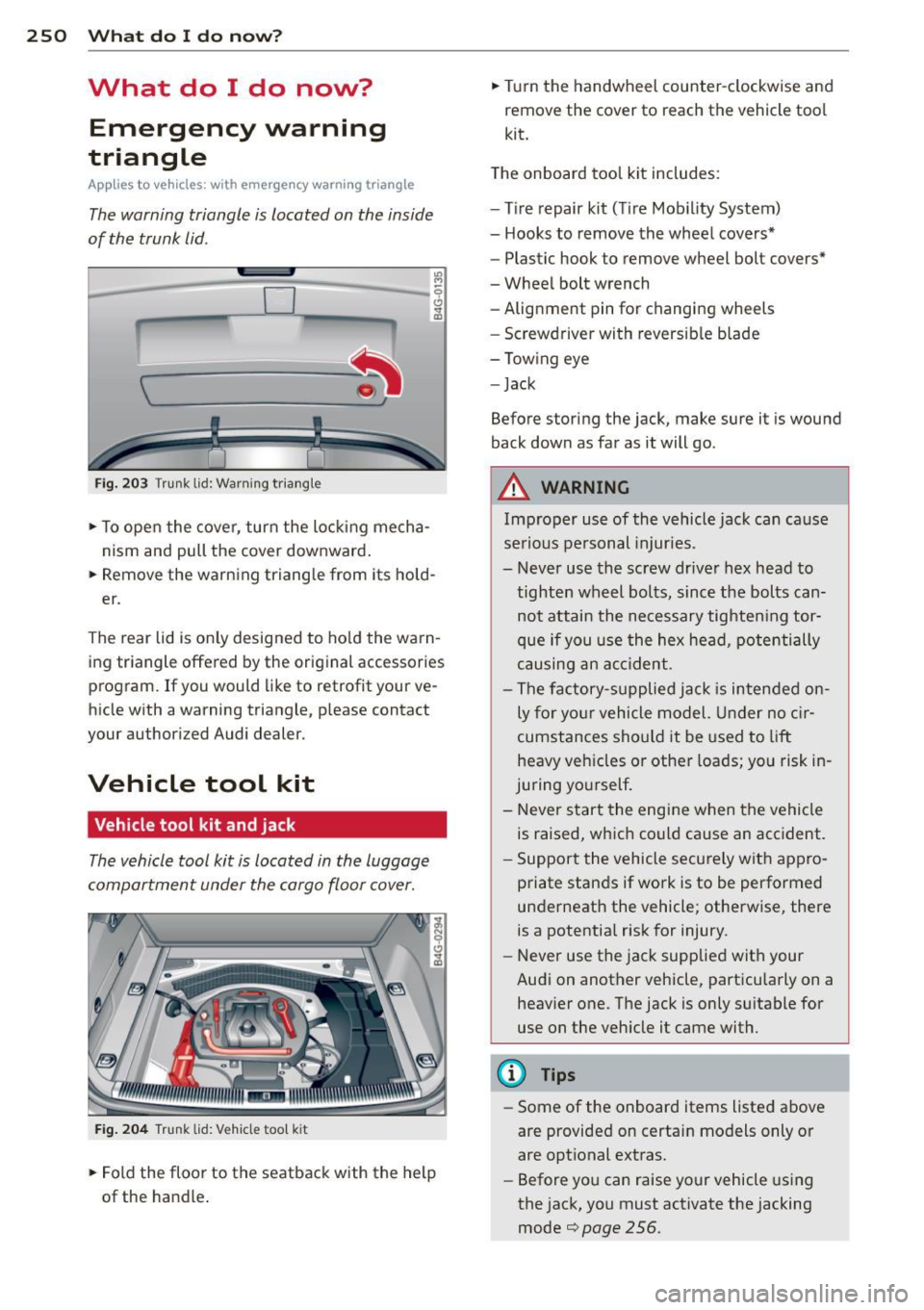
The warning triangle is located on the inside
of the trunk lid .
-
"' M ~ 0 6
~ ~
Fig. 203 Trunk lid: Warning triang le
.,. To open the cover, turn the locking mecha
nism and pull the cover downward .
" m
.,. Remove the warning triang le from its hold
er .
The rear lid is only designed to hold the warn
ing triangle offered by the original accessories
program. If you would like to retrofit your ve
hicle with a warning triangle, p lease contact
your authorized Audi dealer.
Vehicle tool kit
Vehicle tool kit and jack
The vehicle tool kit is located in the luggage
compartment under the cargo floor cover.
Fig. 204 Trunk lid: V ehicl e too l kit
.,. Fold the floor to the seatback with the help
of the handle . .,.
Turn the handwheel counter-clockwise and
remove the cover to reach the veh icle tool
kit.
T he onboard tool kit includes :
- Tire repair kit (Tire Mobility System)
- Hooks to remove the wheel covers*
- Plastic hook to remove wheel bolt covers*
- Wheel bolt wrench
- Alignment pin for changing wheels
- Screwd river with reversible bla de
-Towing eye
-J ack
Before storing the jack, make sure it is wound
back down as far as it will go .
A WARNING
Improper use of the vehicle jack can cause
serious personal injuries.
- Never use the screw driver hex head to
tighten wheel bolts, since the bolts can
not attain the necessary tighten ing tor
que if you use the hex head, potentially
causing an accident .
- The factory-supplied jack is intended on
ly for your vehicle model. Under no cir
cumstances should it be used to lift
heavy veh icles or other loads; you risk in
juring yourself.
- Never start the engine when the vehicle
is raised, which could cause an acc ident.
- Support the vehicle securely with appro
priate stands if work is to be performed
underneath the vehicle; otherwise, there
is a potential risk for injury.
- Never use the jack supplied with your
Audi on another vehicle, particularly on a
heav ier one. The jack is only suitable for
use on the veh icle it came with.
@ Tips
- Some of the onboard items listed above
are provided on certain models only or
are optional extras .
- Before you can raise your vehicle using
the jack, you must activate the jacking
mode¢
page 256 .
Page 256 of 292
254 What do I do now?
After a tire repa ir, have the sealant bottle
rep laced at a dealership. This restores full
functionality to the Tire Mob ility System.
Changing a wheel
Before changing a wheel
Observe the following precautions for your
own and your passenger's safety when chang
ing a wheel .
• After you experience a tire fa ilure, pull the
car well away from moving traffic and try to
reach
level g ro und before you stop¢ /.1..
• All passengers sho uld le ave the car a nd
move to a sa fe loca tion (fo r instance, beh ind
t h e guardrai l) ¢
/.1. .
• Engage the pa rking b rake to prevent your
vehicle from ro lling unintentionally ¢
/.1..
• Move selector leve r to position P ¢ &_ .
• Take the jack out of the luggage compart
ment
¢ page 250.
A WARNING
You or your passe ngers cou ld be injured
w hile c hanging a whee l if you do not fol
low t hese safety p re cau tions:
-If you have a flat t ire, move a safe dis
tan ce off the road. Tur n off the e ng in e,
tu rn the e mergen cy fla shers o n and use
other wa rning dev ices to alert o ther mo
torists.
- M ake su re th at passengers wai t in a safe
place away from the ve hicl e an d well
away from the road and traff ic.
- T o help p revent the veh icle from mov ing
s u dden ly and possibly slipping off the
jack, a lways fully set the parking bra ke
and bloc k the whee l diagona lly opp osite
the whee l being cha nged. When one
front whee l is lifted off the gro und, plac
ing the A utomat ic Transmiss io n in P
(Pa rk) will
not pre vent the vehicle from
moving. -
Before you change a wheel, be s ure t he
ground is level and firm. If necessary,
use a sturdy board under the jack.
- Always store the vehicle tool kit, the jack
and the rep laced tire in t he luggage com
partment
¢page 129.
(D Note
If you are changing the whee l on a steep
i ncl ine, use a roc k or similar object to
block the opposite whee l to prevent the
vehicle from moving.
(D Tips
- Before changing the wheel, you must ac
tivate the jacking mode, so that t he au
tomatic cont rols for the Adaptive Air
Suspension* do not ma ke it mo re d iff i
cult to lift the veh icle w it h the jack
¢page 256.
- Obey all laws.
Changing a wheel
When you change a wheel , follow these
quence described below step-by-step and in
exactly that order .
l. Activate the vehicle jack mode*
¢ page 256.
2. Remove the wheel bolt caps* . For more
details see also ¢
page 255, Wheels with
wheel bolt caps.
3. Loosen the wheel bolt s ¢page 255.
4. Loc ate the p roper moun ting point fo r the
j ack an d align the jack be low that poin t
¢page 256.
5. Raise the car with the jack¢ page 256.
6. Remove the wheel with the flat tire and
then insta ll the other whee[¢
page 258.
7. Tighte n all whee l bolts lightly .
8.
Lower the vehicle wi th the jack .
9 . Use the wheel bolt w rench and
firmly
t ig ht en al l w heel bo lt s¢ page 255.
10. Re place the wheel bolt caps* .
Page 258 of 292
256 What do I do now?
Loosening
.,. Slide the wheel wrench onto the wheel bolt
as far as it will go.
.,. Take tight hold of the
end of the wrench
handle and turn the wheel bolts
counter
clockwise
about one single turn in the direc
t ion of arrow
c:;, fig. 209.
Tightening
.,. Slide the wheel wrench onto the wheel bolt
as far as it will go .
.,. Take tight hold of the
end of the wrench
hand le and turn each wheel bolt
clockwise
until it is seated.
_& WARNING
- Do not use force or hurry when changing
a wheel -you can cause the vehicle to slip
off the jack and cause serious personal injuries.
- Do not loosen the wheel bolts more than
one turn
before you raise the vehicle with
the jack. -You risk an injury.
@ Tips
- Never use the hexagonal socket in the
handle of the screwdriver to loosen or
tighten the wheel bolts.
- If a wheel bolt is very tight, you may find
it easier to loosen by carefully pushing
down on the end of the wheel bolt
wrench with
one foot only. As you do so,
hold on to the car to keep your balance
and take care not to slip.
Ra ising the vehicle
The vehicle must be lifted with the jack first
before the wheel can be removed .
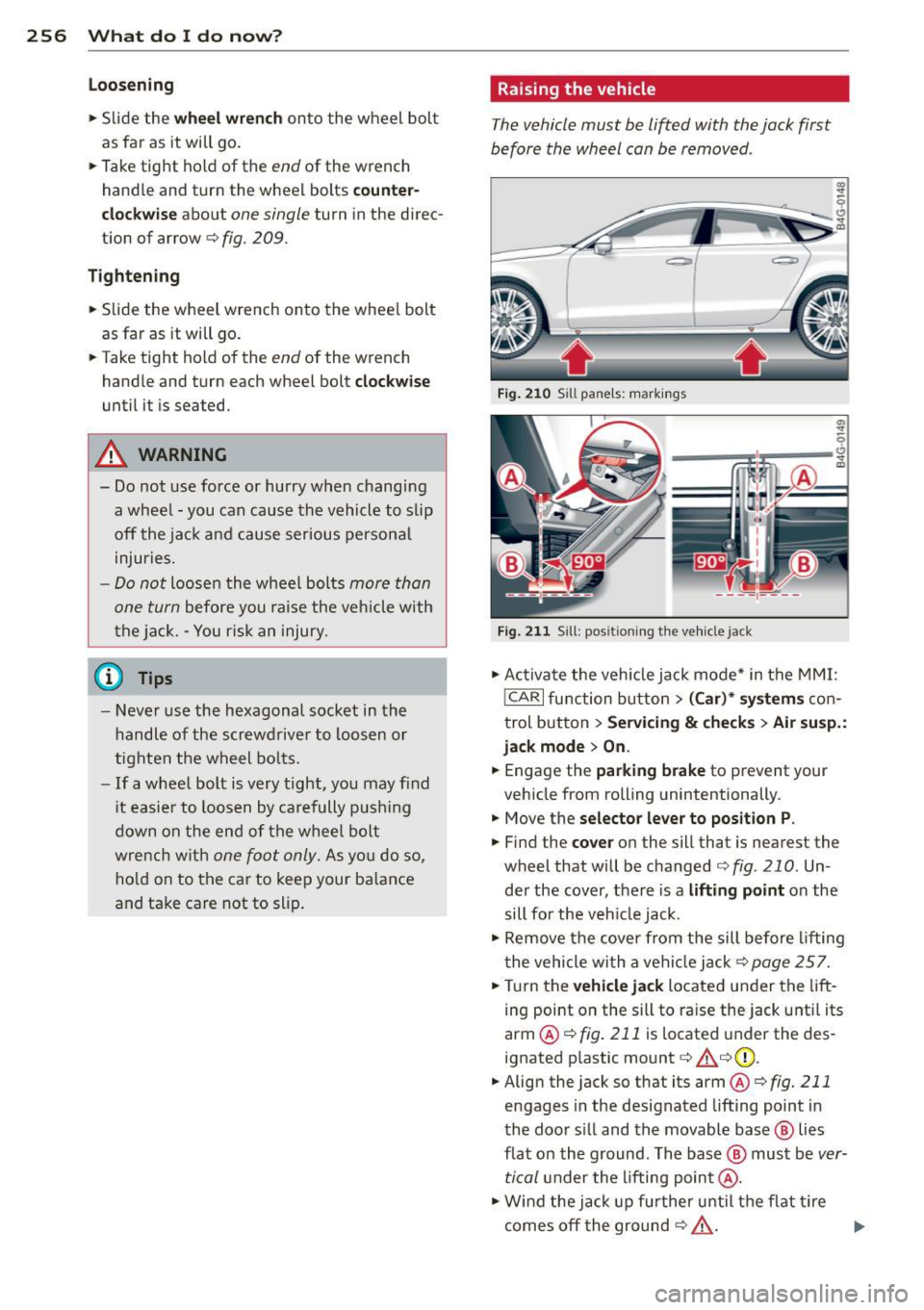
Fig. 210 Sill pane ls : markings
; q
--~~~~~-~
Fig. 211 Sill: posit ioning the Ve hicle jack
.,. Activate the vehicle jack mode* in the MMI:
!CARI function button> (Car)* systems con
trol button>
Servicing & checks> Air susp.:
jack mode
> On.
.,. Engage the parking brake to prevent your
vehicle from rolling unintentionally.
.,. Move the
selector lever to position P .
.,. Find the cover on the sill that is nearest the
wheel that will be changed
c:;, fig. 210 . Un
der the cover, there is a
lifting point on the
sill for the vehicle jack .
.,. Remove the cover from the sill before lifting
the vehicle with a vehicle jack
c:;, page 257 .
.,. Turn the vehicle jack located under the lift
ing point on the sill to raise the jack until its
arm @
c:;, fig. 211 is located under the des
ignated plastic mount
c:;, &c:;,(I) ,
.,. Align the jack so that its arm @ c:;, fig. 211
engages in the designated lifting point in
the door s ill and the movable base @ lies
flat on the ground . The base @ must be
ver
tical
under the lifting point @ .
.,. Wind the jack up further until the flat tire
comes off the ground
c:;, & . ..,.
Page 260 of 292
2 58 What do I do now ?
Taking the wheel off/installing a wheel
Follow these instructions step-by-step for
changing the wheel.
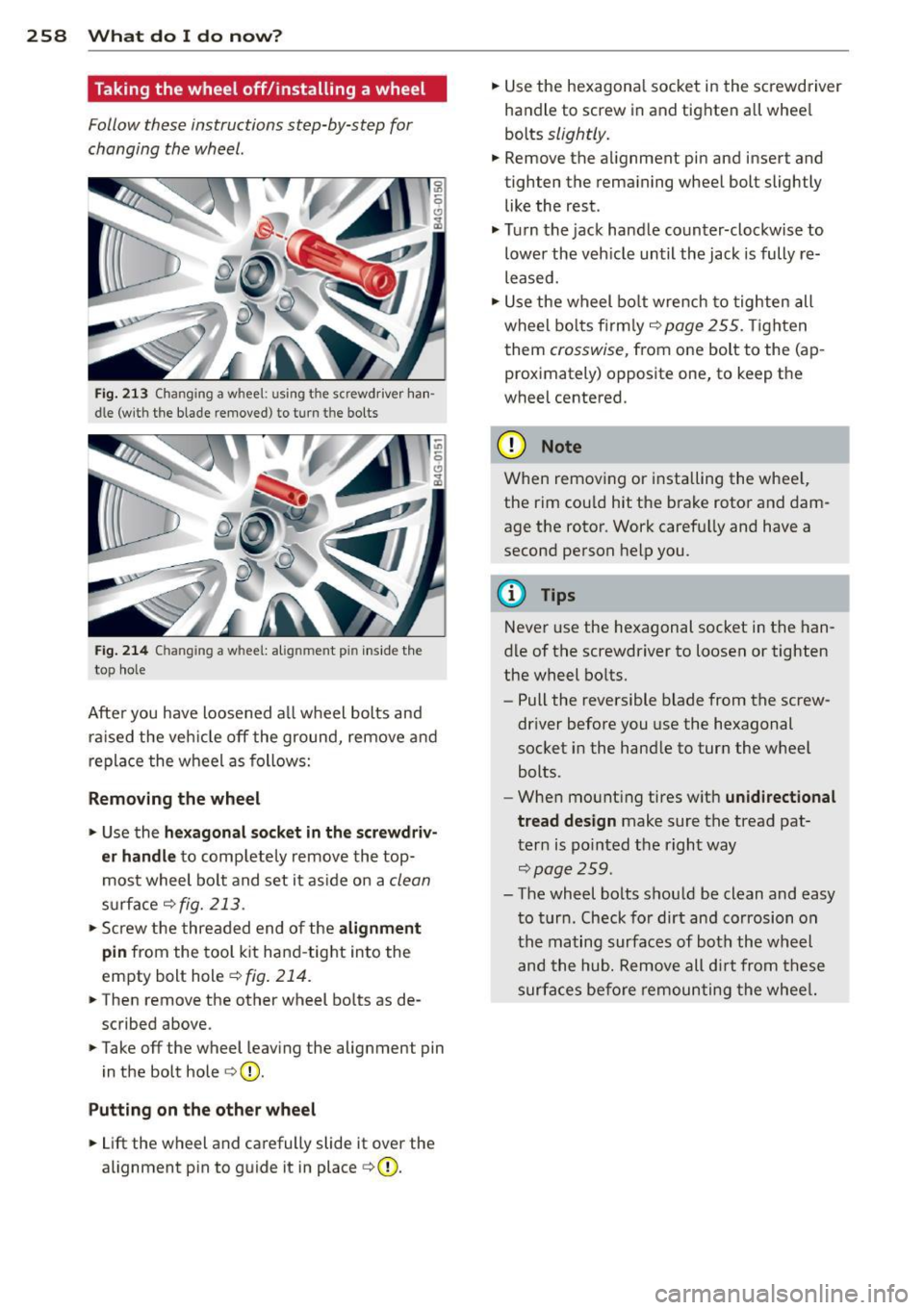
Fig. 213 Changing a whee l: u sing the screwdriver han
dle (w ith the blade removed } to turn t he bolts
Fig . 214 C hanging a w hee l: al ignm en t pi n inside the
top hole
Afte r you have loosened a ll wheel bolts and
raised the vehicle off the ground, remove and
replace the wheel as follows:
Removing the wheel
.. Use the hexagonal socket in the screwdriv
er handle
to comp letely remove the top
most wheel bolt and set it aside on a
clean
surface c:> fig. 213 .
.. Screw the threaded end of the alignment
pin
from the tool kit hand -tight into the
empty bolt hole
c:> fig. 214.
.. The n remove the other wheel bo lts as de
scribed above .
.. Take off the wheel leaving the alignment pin
in the bolt hole
c:> (D .
Putting on the other wheel
.. Lift the wheel and carefully slide it over the
alignment pin to guide it in place
c:>(D.
.. Use the hexagonal socket in the screwdriver
handle to screw in and tighten all whee l
bolts
slightly.
.. Remove the alignment pin and insert and
tighten the remaining wheel bolt slightly like the rest .
.. Turn the jack handle counter-clockwise to
lower the vehicle until the jack is fully re
leased .
.. Use the wheel bolt wrench to tighten all
wheel bolts fir m ly
c:> page 255 . Tighten
them
crosswise, from one bolt to the (ap
proximately) opposite one, to keep the
wheel centered.
(D Note
When remov ing or installing the wheel,
the rim cou ld hit the brake rotor and dam
age the rotor. Work carefu lly and have a
second person help you.
(D Tips
Never use the hexagonal socket in the han
d le of the screwdriver to loosen or tighten
the wheel bolts.
- Pull the reversible blade from the screw
driver before you use the hexagonal
socket in the handle to turn the wheel
bolts.
- When mounting tires w ith
unidirectional
tread design
make sure the tread pat
tern is pointed the right way
c:>page25 9.
-The wheel bolts should be clean and easy
to turn . Check for dirt and corrosion on
the mating surfaces of both the wheel
and the hub. Remove all dirt from these
surfaces before remounting the wheel.
Page 264 of 292
262 Fuses and bulb s
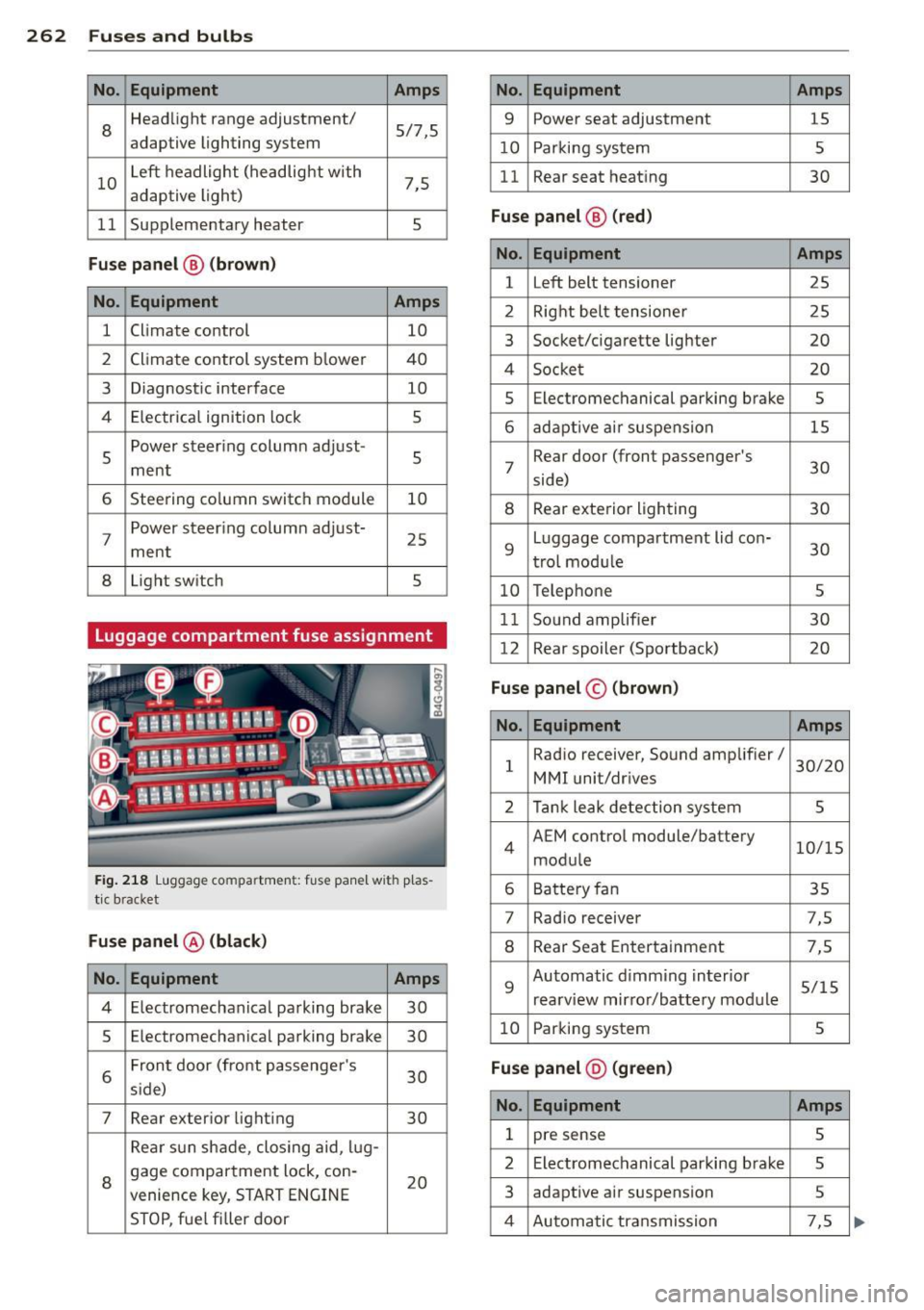
No. Equ ipment Amps
8
Headlight range adjustment/
5/7,S
adaptive lighting system
10 Left headlight
(headlight with
7,5
adaptive light)
11 Supplementary
heater
s
Fuse p ane l@ (b ro w n)
No . Equipment Amps
1 Climate control
10
2 Climate control system blower 40
3 Diagnostic interface
10
4 E lectrical ignition lock
s
s
Power steering column adjust-
s ment
6 Steering column switch module
10
7 Power steering column adjust-
ment
25
8 Light
switch
s
Luggage compartment fuse assignment
Fig. 218 Luggage compartment: fuse panel with plas
tic bracket
Fuse p anel @ (b la ck )
No. Equipment Amps
4 E lectromechanical parking brake 30
s Electromechanical parking brake
30
6 Front door
(front passenger's
30
s ide)
7 Rear exter ior lighting
30
Rear sun shade, closing aid, lug-
8 gage compartment lock, con-
20
venience key, START ENGINE
STOP, fuel filler door
No. Equipment Amps
9 Power seat adjustment
15
10 Parking system
s
11 Rear seat
heating
30
Fuse pan el@ (r e d )
No . Equipment Amps
l Left belt tensioner
25
2 Right belt tensioner 25
3 Socket/cigarette
lighter
20
4 Socket 20
s Electromechanical parking brake s
6 adaptive ai r suspension 15
7 Rear door
(front passenger's
30
side)
8 Rear exterior lighting 30
9 Luggage compartment
lid con-
30
t rol modu le
10 Telephone
s
11 Sound amplifier 30
12 Rear
spoiler (Sportback)
20
Fuse pan el© (brown)
No . Equipment Amps
1 Radio
receiver, Sound amplifier/
30/20
MMI unit/drives
2 Tank leak detection system
s
4 AEM
control module/battery
10/15
module
6 Battery fan 35
7 Rad
io receiver 7,S
8 Rear Seat Entertainment 7,5
9 Automatic d
imming interior
5/15
rearview mirror/battery module
10 Parking system
s
Fuse pan el@ (gre en)
No . Equipment Amps
1 pre sense s
2 Electromechanical parking brake s
3 adaptive
air suspension 5
4 Automatic transmission 7,5