rims AUDI RS7 SPORTBACK 2014 Owners Manual
[x] Cancel search | Manufacturer: AUDI, Model Year: 2014, Model line: RS7 SPORTBACK, Model: AUDI RS7 SPORTBACK 2014Pages: 292, PDF Size: 73.56 MB
Page 117 of 292
r::> & in General information on page 112,
r::>(D in General information on page 113 .
The blue area represents an extens ion of the
vehicle's outline by approximately 16 ft
(5 m) to the rear . The long side of the blue
area should be on the curb . The entire blue
area must fit into the parking space.
• With the veh icle stopped, turn the steering
wheel to the right as far as it w ill go.
• Back in to the park ing space u ntil the b lue
curve
r::> fig . 131 touches the curb r::> & in
General information on page 112,
r::> (D in
General information on page 113 .
Stop the
vehicle.
• With the veh icle stopped , turn the steer ing
whee l to the left as far as it will go .
• Continue to back into the parking space un
t il the vehicle is parked pa rallel to the cu rb
r::> & in General information on page 112,
r::> (D in General information on page 113 .
@ marks the rear bumper. Stop the veh icle,
at the latest, when the red orientation line
@ borders an object. Keep an eye on the
front of your vehicle whi le do ing th is .
Pa rking next to obstacles
If there is an obstacle (s uc h a s a wall) next to
the par king space, position the veh icle so
there is more space o n that s ide. Position the
l ong side of the blue s urface so that there is
sufficient space from the obstacle . The sur
face must not be to uch ing . You will also need
to star t turning the steer ing wheel much ear
lier . The blue curve
r::>fig .131 must not touch
the obstacle and should have sufficient room.
(D Note
Remember to maintain sufficient clear
ance from the curb to avoid damag ing the
wheel rims .
(D Tips
The left or right orientation lines and sur
faces will be displayed, depend ing on the
turn sig na l being used.
P arking systems 115
Peripheral cameras
Introduction
Applies to vehicles: with parking system plus with periph
eral cameras
In add ition to parking system plus
¢
page 111, this parking system conta ins pe
ripheral cameras . Depending on the vehicle
equipment , you are ass isted by vario us views
su ch a s p eriphera l view, corne r views a t the
fron t and rear of the veh icle, and views di rect
ly in front of or behind t he vehicle .
General information
Applies to vehicles: with parking system plus with periph
eral cameras
F ig . 1 32 Locat io n of per ip hera l ca meras
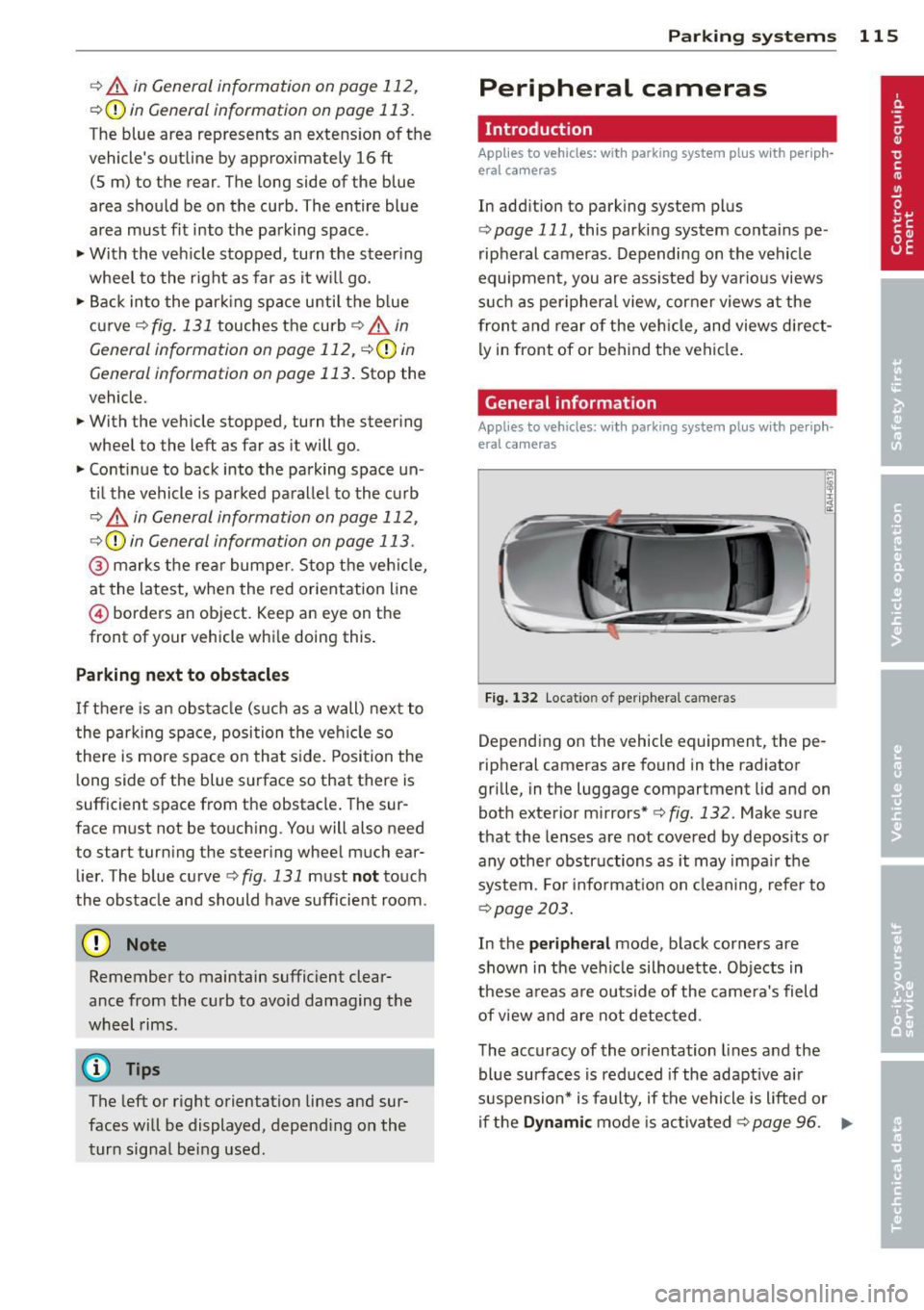
Depending on the vehicle equipment, the pe
ripheral cameras are found in the radiator
grille, in the luggage compartment lid and on
both exterior mirrors* ¢
fig. 132. Make su re
that the lenses a re not covered by depos its o r
any other obstr uctions as it may impa ir t he
system. For info rmat io n on clean ing, refe r to
¢ page 203.
In the peripheral mode , b lack corners are
shown in the ve hicle silhouette . Objects in
these a reas a re outside of the came ra's field
of view and are not detec ted .
The accuracy of the orientation lines and the
bl ue surfaces is reduced if the adaptive a ir
suspension* is faulty, if the vehicle is l ifted or
if t he
D ynamic mode is activa ted ¢ page 96. ..,.
Page 208 of 292

206 Vehicl e c are and cle aning
Component Situation Solution
Tex tile s,
Stains adhering to Vacuum cleaner
Vin yl, the surface
A lcan ta ra Water -based stains Absorbent cloth and mild soap solutiona>
such as coffee, tea,
blood, etc.
O il-based stains Apply a mild soap solutiona >, blot away the d issolved oil
such as oil, make- or dye, treat afterward w ith water, if necessary
up, etc.
Special stains such Special stain remover, blot with absorbent material,
as ballpoint pen, treat afterward with mild soap solutiona >, if necessary
na il polish, latex
pa int, shoe polish,
etc.
N atu ral l eathe r Fresh stains Cotton cloth with a mild soap solution a>
Water-based stains Fresh stains: absorbent cloth
such as coffee, tea, Dr ied stains: sta in remover suitable for leather
blood, etc.
Oil-based stains Fresh stains: absorbent cloth and stain remover suitable
such as oil, make- for leather
up, etc. dried stains: Oil cleaning spray
Special stains such Stain remover suitable for leather
as ballpo int pen,
na il polish, latex
paint, shoe polish,
etc.
Care Regular
ly apply conditioning cream that protects from
light a nd penetrates into the material. Use specially-col-
ored conditioning cream, if necessary.
Carbon part s Dirty Clean tlhe same way as plastic parts
a) Mil d soap so lution : m ax im um two ta b les poons neu tral soa p in a lite r of wate r
& WARNING
The windshie ld may not be treated with
water-repe lling windshield coating agents.
Unfavorab le conditions such as wetness,
darkness, or low sun can result in in
creased glare. W iper blade chatter is also
possible .
(V Note
-Headlights /tail li ghts
- Never clean headlights or tail lights
w ith a dry cloth or sponge. - Do not use any cleaning product that
contains alcohol, because they could
cause cracks to form.
-W hee ls
- Never use any paint polish or other
abrasive mater ials.
- Damage to the protective layer on the
rims such as stone chips or scratches
must be repa ired immediately.
- Sen sor s/c ame ra len ses
-Never use warm or hot water to re-
move snow or ice from the camera
le ns. This could cause the lens to crack . ""
Page 230 of 292
228 Tire s and wheel s
Tires and wheels
Tires
General notes
Tires may be the least appreciated and most
abused parts of a motor vehicle .
Tires may be the least appreciated and most
abused parts of a motor vehicle . Tires are,
however, one of the most important parts of a
vehicle, particularly considering the compara
tive ly small patch of rubber on each tire that
assures that all -impo rtant contact between
you, your vehicle and the road.
Maintaining the correct tire pressure, mak ing
sure that your vehicle and its tires do not have
to carry mo re weight than they can safe ly han
d le, avoiding damage from road hazards and
reg ularly inspecting t ires for damage includ
ing cuts, slashes irregu la r wear and ove rall
condition are the most important things that
you can do to he lp avoid sudden tire failure in
cluding tread separation and blowouts.
A voidin g damage
I f you have to drive over a curb or similar ob
stacle, drive very s low ly and as close as possi
b le at a right angle to the curb.
A lways keep chem ica ls includ ing grease, o il,
gasoline and b rake fluid off the ti res.
Inspect the t ires regularly for damage (cuts,
cracks or b listers, etc.). Remove any fo reign
bod ies embedded in the treads.
St oring tires
Mark tires when you remove them to indicate
the direction of rotation . Th is ensures you to
be ab le to mount them correctly when you re
install t hem.
When removed, the wheels or t ires should be
stored in a cool, dry and preferably dark place .
Store tires in a vertical pos ition if they are not
mounted on rims, in a horizontal pos it ion if
they are mounted on rims. New tire
s
New t ires have to be broken in¢&,. .
T he tread depth of new t ires may vary, accord
ing to the type a nd make of t ire and the tread
pa tte rn .
Hidden damage
Damage to tires and r ims is often not readily
vis ible . If you notice unusual v ibrat ion or the
vehicle p ulls to one side, th is may ind icate
that one of the t ires has been damaged . Th e
t ir es m ust be checked immed iate ly by an au
tho rized Aud i dea le r or q uali fied wor kshop.
Unidirectional t ires
A un idirectional tire can be identified by ar
rows on the sidewa ll, that po int in the direc
t ion the t ire is designed to rotate. You must
fol low the specified d irection of rotation . This
is necessary so that these tires can develop
their optimum characteristics regarding grip, road no ise, wear and hydrop laning resistance.
For more information
¢page 259.
A WARNING
-New tires or tires that are old, worn or
damaged cannot provide maximum con
trol and braking ability .
-
-New tires tend to be slippery and must
be broken in . To reduce the risk of losing
control, a co llision and ser ious personal
in jur ies, d rive w ith special ca re fo r the
fi rst 350 m iles (560 km).
- Driving with worn or damaged tires can
lead to loss of control, sudden tire fail
ure, including a blowou t and sudden de
fl ation, c rashes and seriou s personal in
juries . Have wo rn or damaged t ires re
p laced immediate ly .
- T ires age even if they are not being used
and can fai l sudden ly, especially at high
speeds. Tires that are more than 6 years
old can only be used in an emergency
and then w ith specia l care and at low
speed.
Page 235 of 292
Tires an d wheel s 233
you have stored. The system does not recog
nize the load condition of your vehicle.
The effectiveness of the ti re pressu re monitor
ing sys tem w ill be impaired if you store no r
mal load pressures but then operate the vehi
cle at its maximum load¢,& .
See the illustration ¢
fig. 195 for the location
of the label on dr iver's side B-pillar (color of
the actual labe l and exact location on the ve
hicle wi ll vary slig htly) .
Note that the fo llowing tab le is accurate at
the t ime o f go ing to press and is subject to
Model/ Tire de
signation
c h ange. In the event of discrepancies, the ti re
pressure label is located on the driver's side B
pillar always takes precedence .
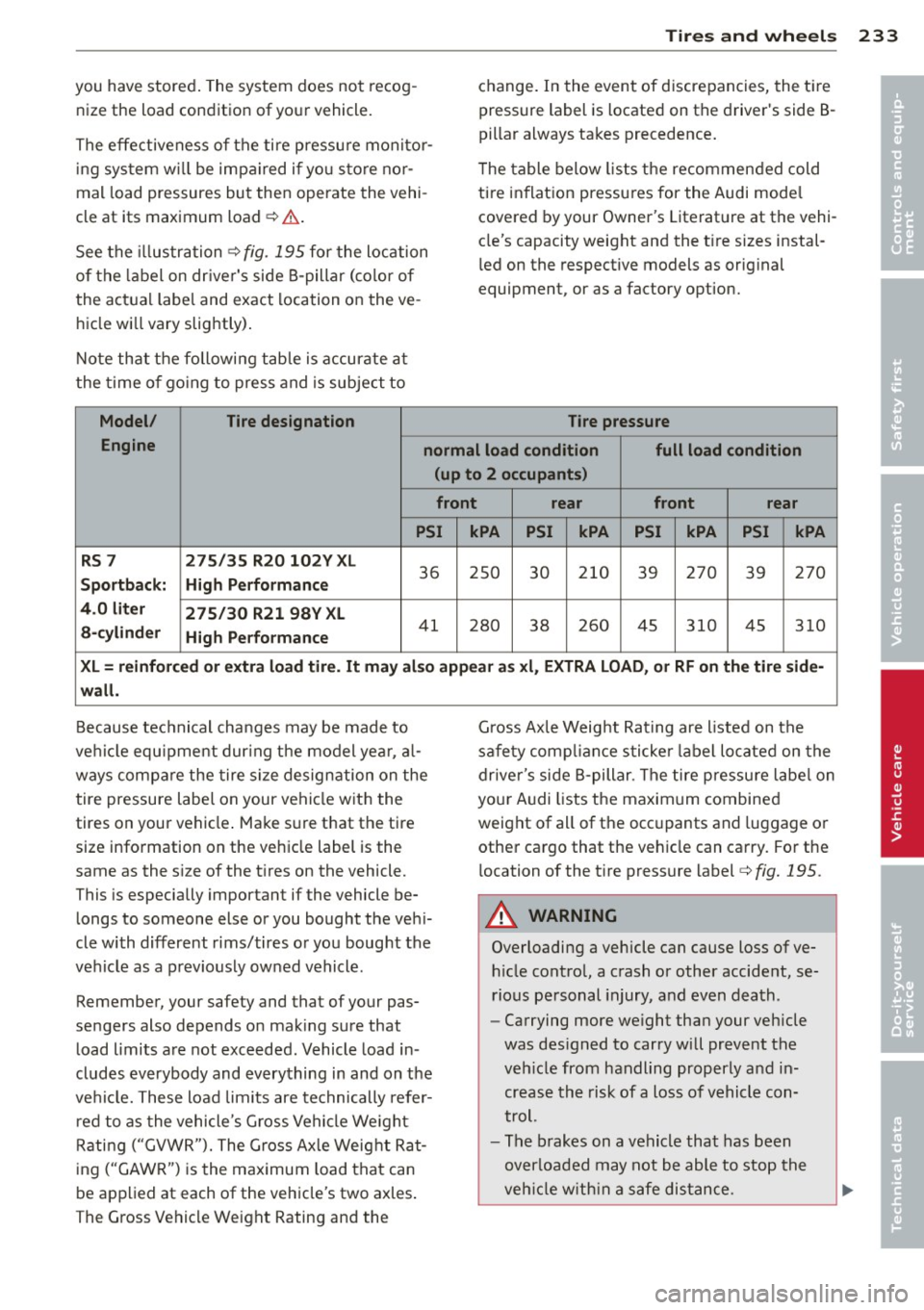
T he table below lists the recommended cold
ti re inflat ion pressures for the Audi mode l
covered by your Owner's Literat ure at the vehi
cle's capacity weight and the t ire sizes instal
l ed on the respective models as orig inal
equipment, or as a factory option.
Tire pressure
Engine normal load condition full load condition
(up to 2 occupants )
front r ear front rear
PSI kPA PSI kPA PSI kPA PSI kPA
RS 7 275/35 R20 102V XL
36 2S0 30 210 39 270 39 270 Sportback: High P erformanc e
4.0 lit er
275 /30 R21 98V XL
a -cy linder
High Performance
41 280 38 260 45 310 4S 3 10
X L = r einfor ced or extra load tir e. It ma y al so appear a s xl , EXTRA LOAD, or RF on th e tire side -
w all.
Because tec hnical changes may be made to
ve hicl e equ ipment dur ing the model yea r, a l
ways compare the tire s ize designation on the
tire pressure label on your vehicle with the
tires on your vehicle . Make s ure that the tire
size information on the vehicle label is the
same as the s ize of the t ires on the vehicle.
This is especially important if the vehicle be
longs to someone else or you bought the veh i
cle with different rims/tires or you bought the
veh icle as a previously owned vehicle.
Remember, your safety and that of your pas
sengers also depends on mak ing sure that
load limits are not exceeded . Vehicle load in
cludes everybody and everything in and on the
ve hicl e. These load limits are technically refer
r ed to as the vehicle's G ross Vehicle We ight
Rating ("GVWR"). The Gross Ax le Weight Rat
ing ("GAWR") is the maximum load that can
be applied at each of the vehicle's two axles .
The Gross Vehicle We ight Rating and the G
ross Ax le Weig ht Rating are listed on the
sa fety comp liance sticke r label lo cated on the
driver's side B-pillar . The tire pressu re labe l on
your A udi lists the maximum combined
weight of all of the occ upants and luggage o r
other cargo that the veh icle can carry. For the
location of the t ire pressure label ¢
fig. 195.
A WARNING
-Overloading a vehicle can cause loss of ve-
h icle contro l, a crash or other accide nt, se
rious personal injury, and even death.
- Carrying more we ight than your veh icle
was des igned to carry will prevent the
veh icle from handling properly a nd in
crease the risk of a loss of vehicle con
trol.
- The brakes on a vehicle that has been
overloaded may not be able to stop the
veh icle w ith in a safe distance.
•
•
Page 241 of 292
New tires and replacing tires and wheels
New tires and wheels have to be broken in.
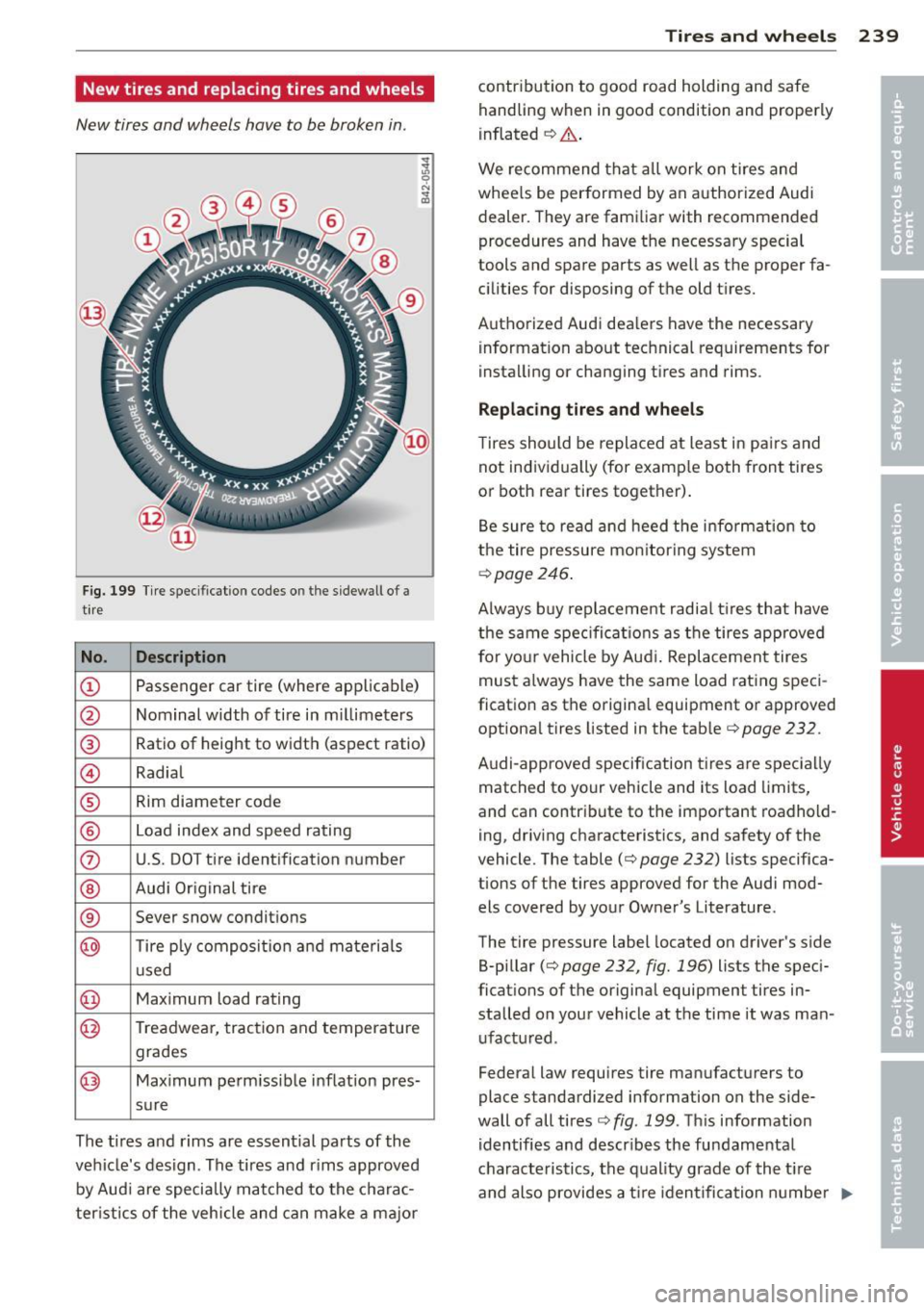
Fig. 199 Tir e speci fication codes on the s idewall of a
t ire
No . Description
CD Passenger car tire (where applicable)
@ Nominal width of tire in m illimeters
® Ratio of height to width (aspect ratio)
@ Radia l
® Rim diameter code
® Load index and speed rating
0 U.S. DOT tire identification number
® Audi Or iginal tire
® Sever snow condit ions
@ T ire p ly composi tion a nd materia ls
used
@ Max imum load rat ing
@ T readwear, traction and temperature
grades
@ Max imum pe rm iss ible inflation pres-
sure
The t ires and rims are essential parts of the
vehicle's design . The tires and r ims approved
by Aud i are specia lly matched to the charac
ter istics of the veh icle and can make a majo r
Tires and wheels 239
contribution to good road holding and safe
handling when in good condition and properly
inflated
~ .&. .
We recommend that a ll work on tires and
whee ls be per formed by an authorized Audi
dealer. They are familiar with recommended procedures and have the necessary special
tools and spare parts as well as the proper fa
cilities for disposing of the old t ires.
Authorized Audi dea lers have the necessary
information about technical requirements for
i nstalling or changing tires and rims .
Replacing tires and wheels
Tires should be replaced at least in pa irs and
not individually (for examp le both front tires
or both rear tires together) .
Be sure to read and heed the info rmation to
the tire pressure mo nitoring system
¢ page 246.
Always b uy replacement radia l tires that have
the same spe cifica tions as t he tires app rove d
for yo ur vehicle by Audi . Replacement tires
must a lways have the same load rating speci
ficatio n as the origina l equipment or approved
optiona l tires listed in the table¢
page 232 .
Audi-approved specif ication t ires a re spec ial ly
matched to your vehicle and its load limits,
and can contr ibute to the impo rtant roadho ld
ing, driv ing characteristics, and sa fety of the
vehicle. The table(¢
page 232) lists specifica
tions of the tires approved for the Audi mod
els covered by your Owner's Literature.
The tire pressure label located on driver's s ide
B-pillar (¢
page 232, fig. 196) lists the speci
ficat ions of the original equipment tires in
stalled on you r vehicle at the time it was man
ufactu red .
Federal law requires tire manufacturers to
place standardized information on the side
wall of all tires¢
fig. 199. This information
i dentifies and descr ibes the fundamenta l
c haracteristics, the q uality grade of the t ire
and also provides a t ire identification numbe r
IJi,,-
Page 243 of 292
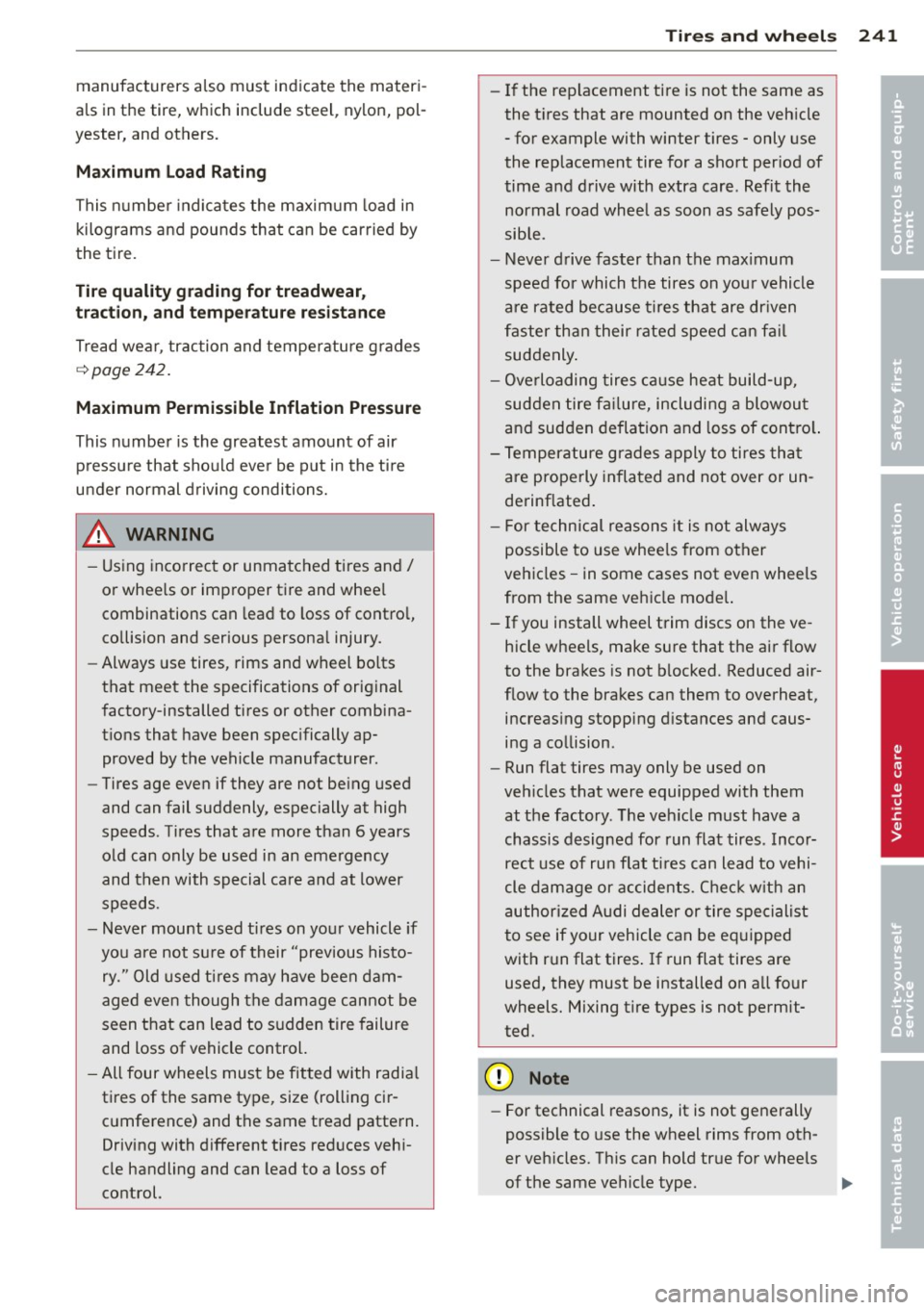
manufacturers also must indicate the materi
als in the tire, which include steel, nylon, pol
yester, and others.
M ax imum Load R atin g
This numbe r indicates the maximum load in
kilograms and pounds that can be carried by
the tire.
Tire qualit y gra ding for treadw ear,
t ract ion , and temp erature r esistanc e
Tread wear , traction and temperature g rades
¢ page 242.
Maximum Permissible Inflation Pressur e
This number is the greatest amount of air
pressure that sho uld ever be put in the ti re
under normal driving conditions.
_& WARNING ,...__._
- Using incorrect or unmatched tires and/
or whee ls or improper tire and whee l
combinations can lead to loss of contro l,
co llision and serious persona l injury.
- Always use tires, rims and wheel bo lts
that meet the specifications of original
factory-installed tires or other combina t ions that have been spec ifically ap
proved by the vehicle manufacturer.
- Tires age even if they are not being used
and can fail suddenly, especially at high
speeds . Tires that are more than 6 years
old can only be used in an emergency
and then with special care and at lower
speeds .
- Never mount used tires on your vehicle if
you are not su re of their "previous histo
ry." Old used ti res may have been dam
aged even though the damage cannot be
seen that can lead to s udden tire failure
and loss of vehicle control.
- All four wheels must be fitted with radia l
tires of the same type, size (rolling cir c u mference) and the same tread pattern.
Driving with different tires red uces veh i
cle handling and can lead to a loss of
control.
Tire s an d wheel s 241
-If the replacement tire is not the same as
the t ires that are mounted on the veh icle
- for example with winter tires - only use
the replacement tire for a short per iod of
time and drive with extra care . Refit the
normal road whee l as soon as safely pos
sible.
- Never drive faster than the max imum
speed for which the tires on you r vehicle
a re rated because tires that are dr iven
faster than thei r rated speed ca n fa il
suddenly .
- Ove rloading tires ca use heat build-up,
sudden tire fa ilure, including a blowou t
and sudden deflation and loss of cont ro l.
- Temperature grades apply to ti res that
are properly inflated and not over or un
derinf lated .
- F or technical reasons it is not always
possible to use whee ls from other
vehicles -in some cases not even whee ls
from the same veh icle mode l.
- If you install wheel trim discs on the ve
hicle wheels, make sure that the air flow
to the brakes is not b locked. Reduced air
flow to the brakes can them to overheat, increas ing stopping d istances and caus
ing a co llision.
- Run flat tires may only be used on
veh icles that were equipped with them
at the factory . The veh icle must have a
chassis designed for run flat tires . Incor
rect use of ru n flat ti res can lead to vehi
cle damage or accide nts. Che ck with an
author ized Audi dealer or tire spe cialist
to see if your vehicle can be eq uipped
with run flat tires . If run flat tires are
used, they must be installed on all four
wheels. Mixing tire types is not permit
ted.
@ Note
- For technical reasons, it is not generally
possible to use the wheel rims from oth
er veh icles. Th is can hold tr ue for wheels
of the same vehicle type. .,..
•
•
Page 246 of 292
24 4 T ire s and wheel s
Snow chains
Snow chains may be fitted on ly to the front
wheels, and only to certain tire sizes. Ask your
authorized Audi dealer on whic h tire sizes
snow chains can be used.
I f you are going to use snow chains , then you
must install them on the front wheels at
l east.
The snow chains must have low-profile links
and must not be thicker than 0.4 inch (10 ,5 mm), including the lock .
Remove wheel center covers and tr im discs
before putting snow cha ins on your vehicle
c:;, Q) _ For safety reasons cover caps must the n
be fitted over the whee l bolts. These are ava il
ab le from authorized Audi dea lers.
A WARNING
Using the wrong snow chains for yo ur vehi
cle or installing them incorrectly can in
crease the risk of loss of control leading to
ser ious personal inj ury.
- Snow chains are ava ilable in different
sizes. Always make sure to follow the in
struct ions provided by the snow chain
manufacturer .
- When driving w ith snow chains never
dr ive faster than the speed permitted for
your specific snow cha ins.
- Always observe local regulat ions .
([) Note
-Remove snow cha ins before driving on
roads not covered with snow to avoid
damaging t ires and wear ing the snow
chains down unnecessar ily.
- Snow chains, wh ich come into d irect con
tact with the wheel rim, can scratch or
damage it . Therefore, make sure that the
snow chains are suitab ly covered . Check
the position of the snow chains after
driving a few yards and correct if neces
sa ry. Follow the i nstructions from the
snow cha in manufacture r when doing so.
- If the Adaptive Air Suspension* should
malfunction, do no t mo unt or use snow chains because the vehicle will be ex
treme ly low. If you do drive with snow
chains on while the vehicle is at this lev
el, the snow cha ins might severely dam
age the whee lhouse and other parts of
the vehicle .
(D Tips
Where snow chains are mandatory on cer
tain roads, th is normally a lso applies to
vehicles with all-wheel drive.
Wheel bolts
Wheel bol ts mus t alway s be tightened to the
correc t torque.
The design of wheel bolts is matched to the
factory installed rims . If different r ims are fit
ted, the correct wheel bol ts with the righ t
length and correct ly shaped bolt heads must
be used . T his ensures that wheels are fitted
securely and that the b rake system functions
co rrect ly.
In certa in circumstances, you may not use
wheel bolts from a different veh icle -even if it
is the same model
c:;, page 275 .
A WARNING
Imp rope rly t ightened or ma inta ined wheel
bo lts can become loose c ausing loss of
control, a col lision and serio us pe rsonal i n
jury .
- Always keep the wheel bo lts and the
threads in the wheel hubs clean so the
wheel bo lts can turn easily and be prop
erly tightened.
- Never g rease or oil the wheel bolts and
the threads in t he wheel hubs . They can
become loose while driv ing if greased or
oiled, even if t ightened to the specified
torque.
- On ly use wheel bolts that belong to the
rim being installed .
- Never use different wheels bolts on yo ur
veh icle.
- Always maintain the correct t ightening
torque for the whee l bolts to reduce the
Page 261 of 292
Tires with unidirectional tread design
Tires with unidirectional tread design must be
mounted with their tread pattern pointed in the right direction .
Using a replacement tire with a tre ad
patte rn intend ed for us e in a specific
directi on
When us ing a replacement t ire with a tread
pattern intended for use in a specific direc
tion, please note the fo llowing :
- T he direction of rotation is marked by an ar
row on the side of the tire .
-If the replacement tire has to be installed in
t h e incorrect d irection, use the rep lacement
t ire only temporarily since the t ire will not
be able to achieve i ts optimum performance
characteristics with regard to aquap laning,
noise and wear .
- We recommend that you pay particular at
tention to this fact during wet weather and
that you adjust your speed to match road conditions .
- Replace the flat tire with a new one and
have it installed on you r veh icle as soon as
poss ible to restore the handling advantages
of a unid irect ional tire.
Notes on wheel changing
P lease read the information ¢ page 239, New
tires and replacing tires and wheels
i f you are
go ing to use a replacement tire w hich is dif
fe rent from the tires on your vehicle.
After you change a ti re :
- Chec k the tir e p ress ure on the rep lacement
t ire immed ia tel y aft er in stall ation.
- Ha ve the wheel bolt tight ening torque
checked w ith a to rqu e wrench as soon as
possible by your auth oriz ed Aud i dealer o r
a qu alifi ed s erv ice station .
- With steel and allo y wheel rims , the wheel
bol ts are correctl y tightened at a to rque of
9 0 ft lb (1 20 Nm ).
- If y ou no tice th at the whee l bolts are cor
roded and d ifficult to tu rn whil e cha nging
What do I do now? 259
a tire , th ey s hould be repl aced before you
c heck the tightening torq ue.
- Repl ac e th e flat ti re with a new on e and
ha ve it in sta lled on you r veh icle as s oon a s
po ssible. Remount the whee l cove r.
Until then , dri ve with extr a care and at r e
du ced sp ee ds.
A WARNING
-=
- If you are going to equip your vehicle
with tires or rims which differ from those
which were factory installed, then be sure to read the information ¢
page 239,
New tires and replacing tires and
wheels .
-Always make sure the damaged wheel or
even a flat tire and the jack and tool kit
are properly secured in the luggage com
partment and are not loose in the pas
senger compartment .
- In an accident or sudden maneuver they
co uld fly forwa rd , injuring anyone in the
veh icle.
- Always sto re damaged wheel, jack and
too ls securely in the luggage compa rt
men t. Othe rwise , in an accident or s ud
den maneuver they co uld f ly forward ,
causing injury to passengers in the vehi
cle.
([) Note
Do not use commercially avai lab le tire
sea lants . O therwise, the e lectr ica l compo
nents of the tire pressure monitoring sys
tem will no longer work properly and the
sensor for the tire pressure mon itor ing
system will have to be rep laced by quali
fied workshop. •
•