check oil AUDI RS7 SPORTBACK 2015 User Guide
[x] Cancel search | Manufacturer: AUDI, Model Year: 2015, Model line: RS7 SPORTBACK, Model: AUDI RS7 SPORTBACK 2015Pages: 302, PDF Size: 74.76 MB
Page 217 of 302
"' N
a:: I.J "". rl I.O
"' rl
"' rl
-If you have the impression your engine
consumes excessive amounts of oi l, we
recommend that yo u consult your Audi
dealer to have the cause of your concern
properly diagnosed. Keep in mind that
the accurate measurement of oil con
sumption requires great care and may
take some time . Your Audi dealer has in
str uctions abou t how to measure oil con
sump tion accurately.
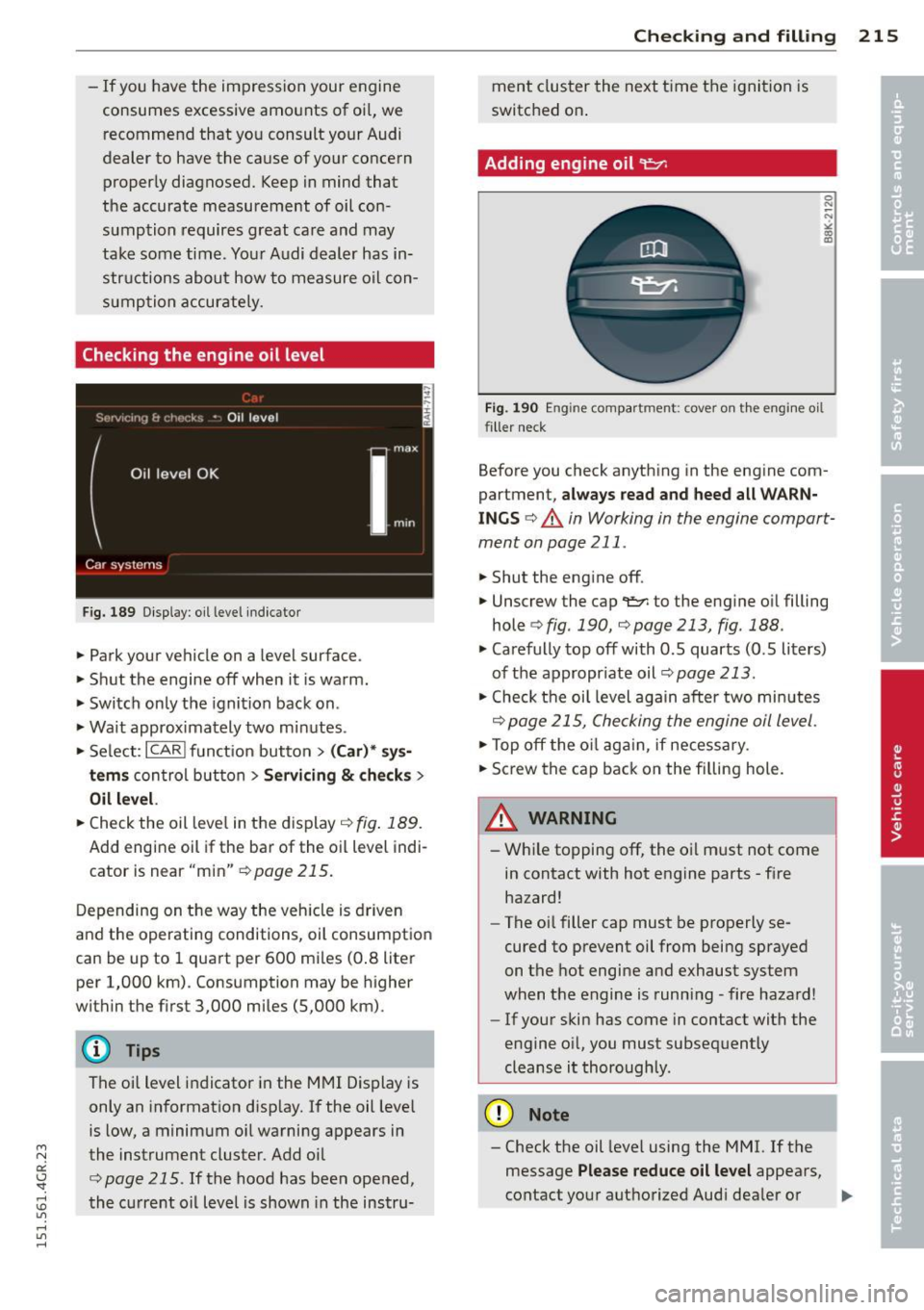
Checking the engine oil level
F ig. 189 Di splay : oil lev el indicato r
.,. Park your vehicle on a level surface .
.,. Shut the engine off when it is warm.
.,. Switch only the ignition back on .
.,. Wa it approximately two minutes .
.,. Se lect :
I C ARI funct ion button > ( Car )* sys
tems
con trol button > Ser vici ng & ch ecks >
Oil level.
.,. Check the oil leve l in the display ¢ fig. 189.
Add engine oil if the bar of the oil level indi
cator is near "min"
r:!;> page 215.
Depending on t he way the veh icle is driven
and the operating conditions, oil consumption
can be up to 1 qua rt per 600 mi les (0 .8 liter
per 1,000 km) . Consumption may be higher
within the firs t 3,000 miles (5,000 km) .
@ Tips
The oil level indicator in the MMI Display is
only an in formation disp lay.
If the oil leve l
is low, a minimum o il warning appears in
the instrument cluster. Add oi l
¢page 215. If the hood has been opened,
the c urre nt oil level is shown in the instru- Checkin
g and fillin g 215
ment cluster the next t ime the igni tion is
switched on .
Adding engine oil~
Fig. 19 0 En gin e co mpa rtm ent: cov er on th e engi ne oi l
filler neck
Before you check anyth ing in the engine com
partmen t,
always read and heed all WARN
INGS¢ A in Working in the engine compart
ment on page 211 .
.,. Shut the eng ine off .
.,. Unscrew the cap
¢ fig . 190, ¢page 213, fig.188 .
.,. Carefully top off with 0.5 quarts (0.5 liters)
of the appropr iate oil¢
page 213 .
.,. Check the oi l level again after two mi nutes
¢ page 215, Che cking the engine oil level .
.,. Top off the o il aga in, if necess ary .
.,. Screw the cap back on the fi lling hole.
A WARNING
- Wh ile topping off, the o il m ust not come
in contact with hot engine parts - f ire
hazard!
- The oi l filler cap must be properly se
cured to prevent oil from being sprayed
o n the hot engine and exhaust system
when the engine is runni ng -fire hazard!
- If your s kin has come in contact with the
e ngine o il, you must subsequently
cleanse it thoroughly .
(D Note
-Check the oil level using the MMI. If the
message
Please reduce oil level appears,
contact you r aut hori zed Aud i dea ler or
Ill>-
Page 218 of 302
216 Check ing and filling
other qualified workshop to have excess
oi l extracted if necessary.
-Audi do es not re commend th e us e of oil
additi ve s. The y ma y damage the e ngine
and ad ve rs ely a ffect yo ur New Vehicle
Wa rrant y.
@ For the sake of the environment
- Under no circumstances can the oil come
in contact wit h the sewage network or
the soil.
- Observe and follow lega l regu lations
when disposing of empty oil containers .
Changing the engine oil
We recommend that hove your oil changed by
on authorized Audi dealer or a qualified serv
ice station.
Before you check anything in the engine com
partment,
a lw ays r ead and heed all WARN
ING S
~.&. in Working in the engine comport
ment on page 211.
The engine oil must be changed according to
the intervals specified in your Warranty
&
Maintenance booklet. This is very important
because the lubricating properties of oil di
minish gradually dur ing normal vehicle use .
Under some circumstances the engine oil
should be changed more frequently. Change
oil more often if you drive mostly short dis
tances, operate the vehicle in dusty areas or
under predominantly stop-and-go traffic con
d itions, or have your veh icle where tempera
tures remain below freezing for extended pe riods.
Detergent additives in the oil w ill make fresh
oil look dark after the eng ine has been run
n ing for a short time . This is norma l and is not
a reason to change the oil mo re often tha n
recommended.
Because of the problem of proper disposal,
a long w ith the special tools and necessary ex
pe rtise required, we strong ly recommend that
you have yo ur o il changed by an authori zed
Audi de ale r or a qualified service station.
If yo u choo se to chan ge your oil yours elf ,
please note the fo llowing important informa
t ion:
A WARNING "--
To reduce the risk of personal injury if you
must change the engine oil in your vehicle
yourself:
- Wear eye protect ion.
- To reduce the risk of burns from hot en-
g ine oil, let the engine cool down to the
touch.
- When removing the oil dra in p lug with
your fingers, stay as far away as possible.
Always keep your forearm parallel to the
ground to help prevent hot oil from run n ing down your arm.
- Dra in the oil into a container designed
for this purpose, one large enough to hold at least the tota l amount of o il in
your engine.
- Engine oil is poisonous . Keep it wel l out
of the reach of children.
- Continuous contact with used eng ine o il
is harmful to your sk in . Always protect
your skin by washing oil off tho roughly
wit h soap and wate r.
(D Note
Neve r mix oil additives with you r engine
oi l. These additives can damage your en
gine and adversely affect your Audi Limit
ed New Veh icle War ranty.
@ For the sake of the environment
- Before changi ng your oil, first make sure
you know where you can prope rly dispose
o f the used oil.
- Always dispose of used eng ine oi l proper
ly. Do not dump it on garden soil, wood
ed areas, into open st reams o r down
sewage drains.
- Re cycle used engine oil by taking it to a
used eng ine oil collect io n fac ility in you r
area, or contact a service station.
Page 219 of 302
"' N
a:: I.J "". rl I.O
"' rl
"' rl
Engine cooling system
Coolant
The engine coolant performs two functions: it
keeps the engine from overheating and it pro
tects the engine from freezing in the winter .
The cooling system is sealed and generally re
qu ires little attention .
The cooling system has been filled at the fac
tory with a permanent coolant which does not need to be changed. The coolant consists of a
mixture of specially conditioned water and the
manufacturer's glycol-based coolant addi-
tive G13 antifreeze with anticorros ion addi
tives (50% for USA models; 60% for Canadian models) . This mixture both assures the neces
sary frost protection and protects metal com
ponents in the engine's cooling system from
corrosion and scaling.
It also raises the boil
ing point of the coolant.
Do not reduce the concentration of the coo l
ant in the summer by adding plain water .
The
proportion of coolant additive must be at
least 50% but not more than 60%
to main
tain antifree ze protection and cooling efficien
cy. If the coolant frost protection is too low,
the coolant could freeze and damage the vehi
cle heating and eng ine cooling system .
For year-round driving, antifree ze is added at
the factory for temperatures down to:
- -31°F(-35°C)USA
- -40 ° F ( - 40 °C) Canada.
I f you must add coo lant, use a mixture of wa
ter and coolant addit ive. Mixing the coolant
additive with distilled water is recommended.
& WARNING
Before you check anything in the engine
compartment, always read and heed all
WARNINGS ~.&.
in Working in the engine
compartment on page 211.
(D Note
- Before winter sets in, have the coolant
checked to see if the coolant additive in
Checkin g and fillin g 217
your vehicle is sufficient to meet the cli
mate conditions. This is especia lly impor
tant if you live in a region where the win
ter is extremely co ld. If necessary, in
crease the proportion of coolant additive
to 60% .
- When adding coolant additive to your
cooling system, remember :
- We recommend using only coolant ad
ditive G12++ or G13 (check the label)
for your vehicle . This coolant additive is
avai lable at authorized Audi dealers .
Other types of antifreeze can signifi
cantly reduce corrosion protection. The resulting corrosion can cause a loss of
coolant and serious engine damage.
- Do not add any type of radiator leak seal
ant to your vehicle's engine coolant.
Adding radiator repair fluid may adverse
ly affect the function and performance of
your cooling system and could result in
damage not covered by your New Veh icle
Limited Warranty.
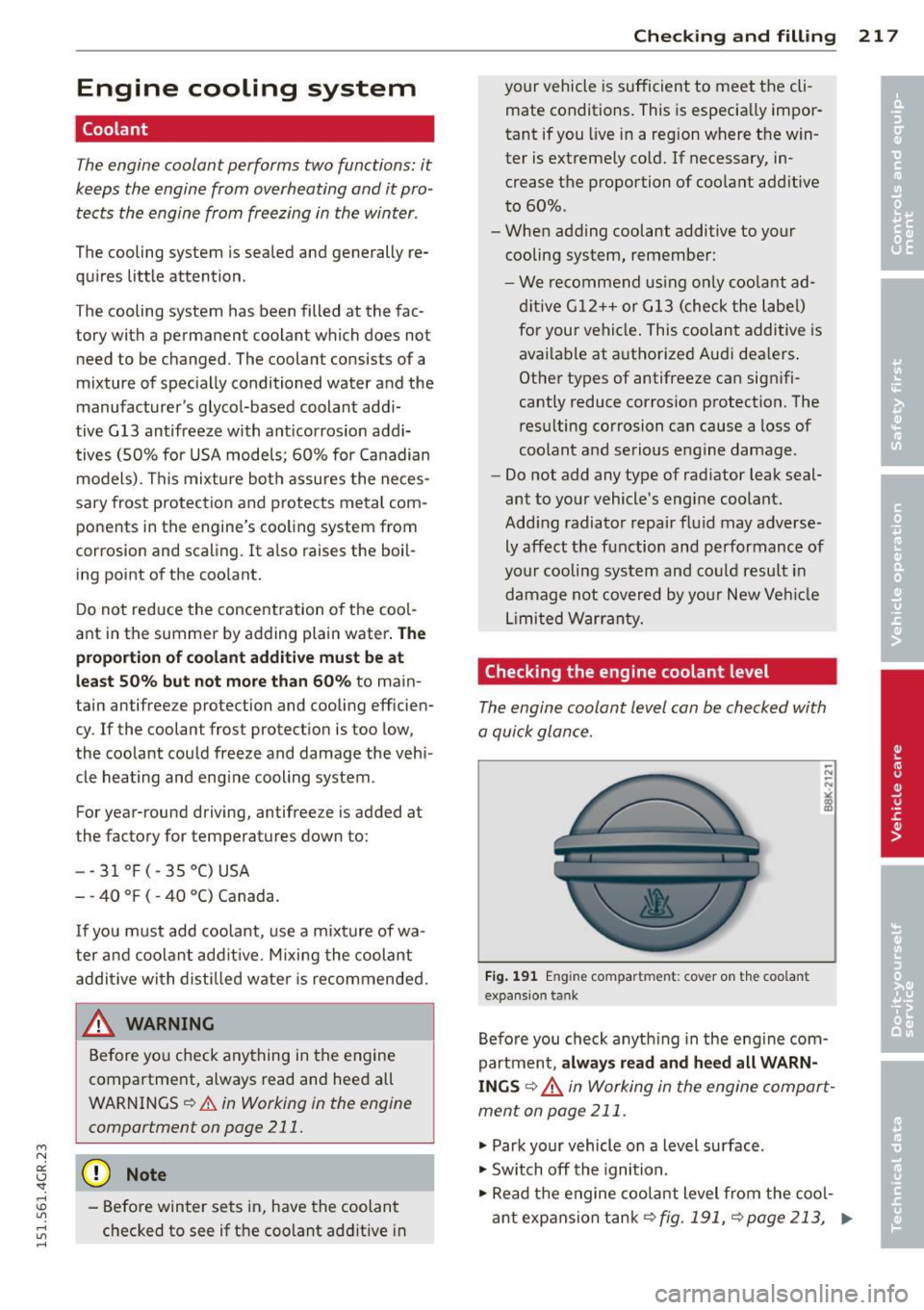
Checking the engine coolant level
The engine coolant level can be checked with
a quick glance.
Fig. 191 En gin e compar tment: cover on the coo lant
expansio n tan k
Before you check anyth ing in the eng ine com
partment,
always read and heed all WARN
INGS¢.&, in Working in the engine compart
ment on page 211 .
"'Park your vehicle on a level surface .
"' Sw itch off the ignition.
"' Read the engine coolant level from the cool
ant expansion tank ¢
fig. 191, ¢ page 213, Ill>-
Page 220 of 302
218 Check ing and filling
fig . 188. With a cold engine, the coo lant
l evel should be between the "min" and
"max" markings . When the engine is warm ,
the leve l may be slightly above the "max"
mark ing .
The location of the coolant expansion tank
can be seen in the engine compartment illus
tration
9 page 213.
To obtain an accurate reading, the engine
must be switched off .
The expans ion tank in you r vehicle is equipped
with an e lectric coolant level sensor.
When the coolant level is too low, the warning l ight in the Auto-Check System
9 page 15 w ill
illum inate unti l you add coolant and the level
has been restored to normal. Even though
there is an electric coolant level senso r, we
still recommend you check the coolant leve l
from time to time .
Coolant loss
Coolant loss may indicate a le ak in the cooling
system . In the event of coolant loss, the cool
ing system should be inspected immediately
by your authorized Audi dealer. It is not
enough merely to add coolant.
I n a
s ealed system, losses can occur only if
the boiling point of the coolant is exceeded as
a result of overheating.
A WARNING
The cooling system is under pressure and can get very hot. Reduce the risk of scald
ing from hot coolant by followi ng these
steps .
- Turn off the engine and allow it to coo l
down.
- Protect your face, hands and arms from
escaping fluid and steam by covering the
cap with a large, thick rag .
- Turn the cap slowly and very carefu lly in
a counter-clockwise direction w hile ap
plying light, downward pressure on the
top of the cap . -
To avoid being burned, do not spi ll anti
freeze or coolant on the exha ust system
or hot engine parts. Under certain cond i
tions, the ethylene glycol in engine coo l
a nt can catch fire.
(D Note
Do not add any type of radiator leak sea l
ant to your veh icle's engine coolant. Add
i ng radiator repair fluid may adverse ly af
fect the funct ion and pe rformance of you r
cooling system and could result in damage
not cove red by your New Veh icle Limited
War ran ty.
Adding coolant
Be very careful when adding engine coolant.
Befo re you check anyth ing in the eng ine com
partment,
always read and he ed all WARN
INGS ¢ ..&. in Working in the engine compart
ment on page
211.
" Requirement: There must be a residua l
amo unt of coolant in the expansion ta nk
¢ (D .
"Tu rn off the engi ne.
" Le t the eng ine cool down.
" Place a thick rag over the coolant expansion
t ank
9 page 217, fig. 191 and ca refully
twist the cap counter-clockwise ¢&,, .
" Add coolant m ixed in the correct rat io
¢
page 217, Coolant up to the MAX mark
ing.
" Make sure that the flu id leve l remains sta -
ble . Add more coo la nt if necessary .
" Twist the cap o n again
tightly .
Replacement engine coo lant must conform to
exact spec ificat ions ¢
page 217, Coolant.
We recommend using only coolant add i-
tive
Gl2++, Gl3 or in an emergency Gl2 +. Do
not use a d ifferent addit ive . In an emergency
use p la in water until you can get the correct
additive and can resto re the co rrect rat io . This
shou ld be done as soon as possib le. .,..
Page 222 of 302
220 Checking and filling
Brake fluid
Checking brake fluid level
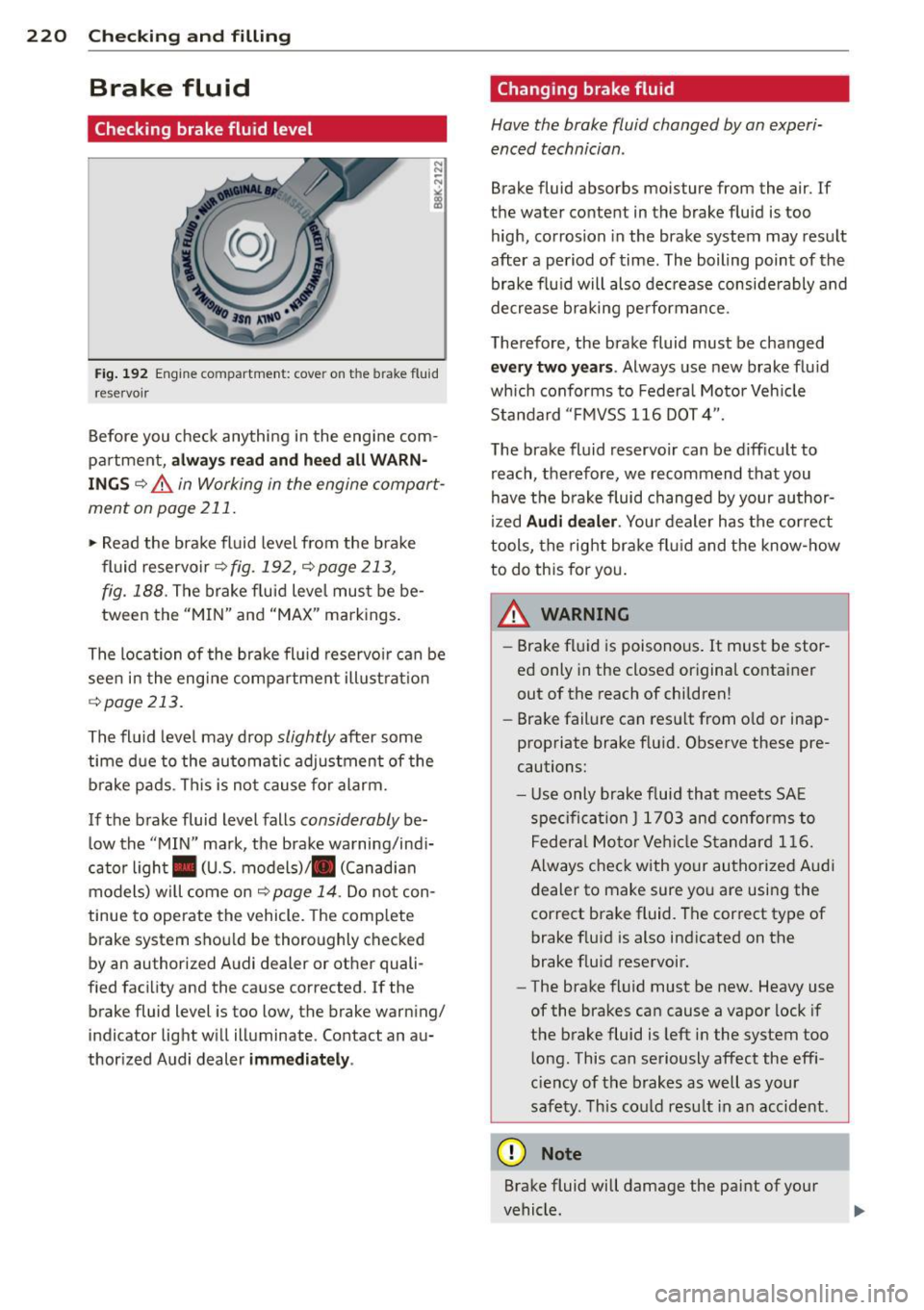
Fig . 192 Engine compar tment: cove r on the brake fl uid
reservo ir
Before you check anything in the engine com
partment,
always read and heed all WARN
INGS ¢&. in Working in the engine compart
ment on page 211.
,.. Read the brake fluid level from the brake
fluid reservoir¢
fig . 192, ¢ page 213,
fig. 188 .
The brake fluid level must be be
tween the "MIN" and "MAX" markings.
The location of the brake flu id reservoir can be
seen in the engine compartment illust rat ion
¢ page 213.
The fluid level may drop slightly after some
time due to the automatic adjustment of the
brake pads. This is not cause for alarm.
If the brake fluid level falls
considerably be
low the "MIN" mark, the brake warning/indi
cator light . (U.S. models)/ . (Canadian
models) will come on ¢
page 14. Do not con
tinue to operate the vehicle. The comp lete
brake system shou ld be thoroughly checked
by an authorized A udi dealer or other quali
fied facility and the cause corrected.
If the
brake fluid level is too low, the brake warning/
indic ator light will illuminate. Contact an au
thorized Audi dealer
immediately .
Changing brake fluid
Have the brake fluid changed by an experi
enced technician .
Brake fluid absorbs moisture from the air. If
t he water content in the brake fluid is too
high, corrosion in the brake system may result
after a period of time . The boiling point of the
brake flu id will also decrease conside rably and
decrease braking pe rformance.
Therefore, the brake fluid must be changed
every two years . Always use new brake flu id
which conforms to Federal Motor Vehicle
Standard "FMVSS 116 DOT 4".
The brake fluid reservoir can be difficult to
reach, therefore, we recommend that you
have the brake fluid changed by your author
ized
Audi dealer. Your dealer has the correct
tools, the right brake fluid and the know-how
to do this for you.
A WARNING
- Brake fluid is poisonous . It must be stor
ed only in the closed original container
out of the reach of children!
- Brake failure can resu lt from o ld or inap
propriate brake fluid. Observe these pre
cautions:
- Use only brake fluid that meets SA E
specification
J 1703 and conforms to
Federal Motor Vehicle Standard 116.
Always check with your authorized Audi
dealer to make sure you are using the
correct brake fluid. The correct type of
brake f luid is also indicated on the
brake fluid reservoir.
- The brake fluid must be new. Heavy use
of the brakes can cause a vapor lock if
the brake fluid is left in the system too
long . This can seriously affect the effi
c ie ncy of the brakes as well as your
safety. This could resu lt in an accident.
(D Note
Brake fluid will damage the paint of your
vehicle .
Page 256 of 302
254 Tire s and wheel s
Wheel bolts
Wheel bolts must always be tightened to the
correct torque .
The design of wheel bolts is matched to the
factory installed rims. If different rims are fit
ted, the correct wheel bolts with the r ight
length and correctly shaped bolt heads must
be used. This ensures that wheels are fitted
secure ly and that the brake system funct ions
correctly .
In ce rtain circumstances, you may not use
wheel bolts from a different vehicle -even if it
i s the same mode l
~page 284.
_& WARNING
Improperly tig htened o r maintained whee l
bolts can become loose ca using loss of
contro l, a co llision and serious persona l in
jury.
- Always keep the wheel bolts and the
threads in the wheel hubs clean so the
wheel bolts can turn easily and be prop
erly t ightened.
- Never grease or oil the wheel bo lts and
the threads in the wheel hubs. They can
become loose while driving if greased or
oiled, even if tightened to the specif ied
torque.
- Only use wheel bolts that belong to the
rim being installed.
- Never use different wheels bolts on your
vehicle.
-Always maintain the correct tighten ing
torque for the wheel bo lts to reduce the
risk of a wheel loss. If the tightening tor
que of the wheel bolts is too low, they
can loosen and come out when the veh i
cle is moving. If the tightening torque is
too high, the whee l bolts and threads
can be damaged and the wheel can be
come loose.
@ Note
The spec ified torque fo r the wheel bo lts is
90 ft lb (120 Nm) w ith a tolerance of± 7,4
ft lb(± 10 Nm). Torque wheel bo lts diago- nally
. After changing a whee l, the torque
must be checked as soon as possible with a
torque wrench -preferably by an author
i zed Audi dealer or qualified workshop.
Low aspect ratio tires
Your Audi is factory-equ ipped w ith low aspect
ratio tires . These tires have been thoroughly
tested and been selected specifically fo r your
model for their superb perfo rmance, road fee l
and hand ling under a variety of d riving cond i
tions . As k your au thor ized A udi dealer for
more details .
T he low aspect ratio of these tires is ind icated
by a numera l of
55 or less in the tire's s ize
designation. The numera l represen ts the ratio
of the tire's sidewall height in relation to its
tread width expressed in percentage . Conven
tiona l tires have a height/width ratio of 60 or
more.
The perf orm ance of low- aspect-r atio tire s is
p ar ticu larly s ensitive to improper infl ati on
press ure . It is t here fore im portant that low
as pect rat io tires are infl ated to the spe cified
pre ssure and that the infl ation pressu re is
r e gularl y che ck e d and mainta in ed. Tire pre s
su res should b e check ed at least onc e a
month and alwa ys bef ore a long trip
~page 237, Checking tire pressure.
What you can do to a void tire and rim
damage
Low aspect ratio tires can be damaged more
easily by impact w it h potholes, curbs, gull ies
o r r idges on the road, pa rticularly if the tire is
u nderinfla ted .
In order to minimize the occurrence of impact
damage to the tires of you r vehicle, we recom
mend that you observe the follow ing p recau
tions:
- Always ma inta in recommended inflation
pressures. Check your tire pressure eve ry
2,000 miles (3,000 km) and add air if neces
sary .
- Dr ive carefully on roads with potholes, deep
gullies o r ridges. The impact from dr iv ing ..,.
Page 280 of 302
2 78 Emergency situations
heavy components such as the engine
b lock or transmiss io n are removed.
- W he n removing heavy components like
these, ancho r vehicle to ho ist o r add cor
responding weig hts to ma inta in the cen
ter of g ravity . Othe rwise, the vehicle
might tilt or s lip off t he hoist, causing
ser ious p erson al injury.
(D Note
-Be awa re of the follow ing points befo re
li fting the vehicle:
- The vehicle should never be lifted or
jacked up from underneath the engine oil pan, the transmission housing, the
front or rear axle or the body side
membe rs. This could lead to ser ious
damage.
- To avoid damage to the underbody or
chassis frame , a rubber pad must be
i nserted between the floor jack and
the l ift points.
- Before driving over a workshop hoist,
check that the veh icle weight does not
exceed the permissible lifting capacity
of the hoist .
- Before driving over a workshop hoist,
ensure that there is sufficient clear
ance between the hoist and low parts
of the vehicle.
Page 281 of 302
"' N
a:: I.J ""'. rl I.O
"' rl
"' rl
Technical data
Vehicle identification
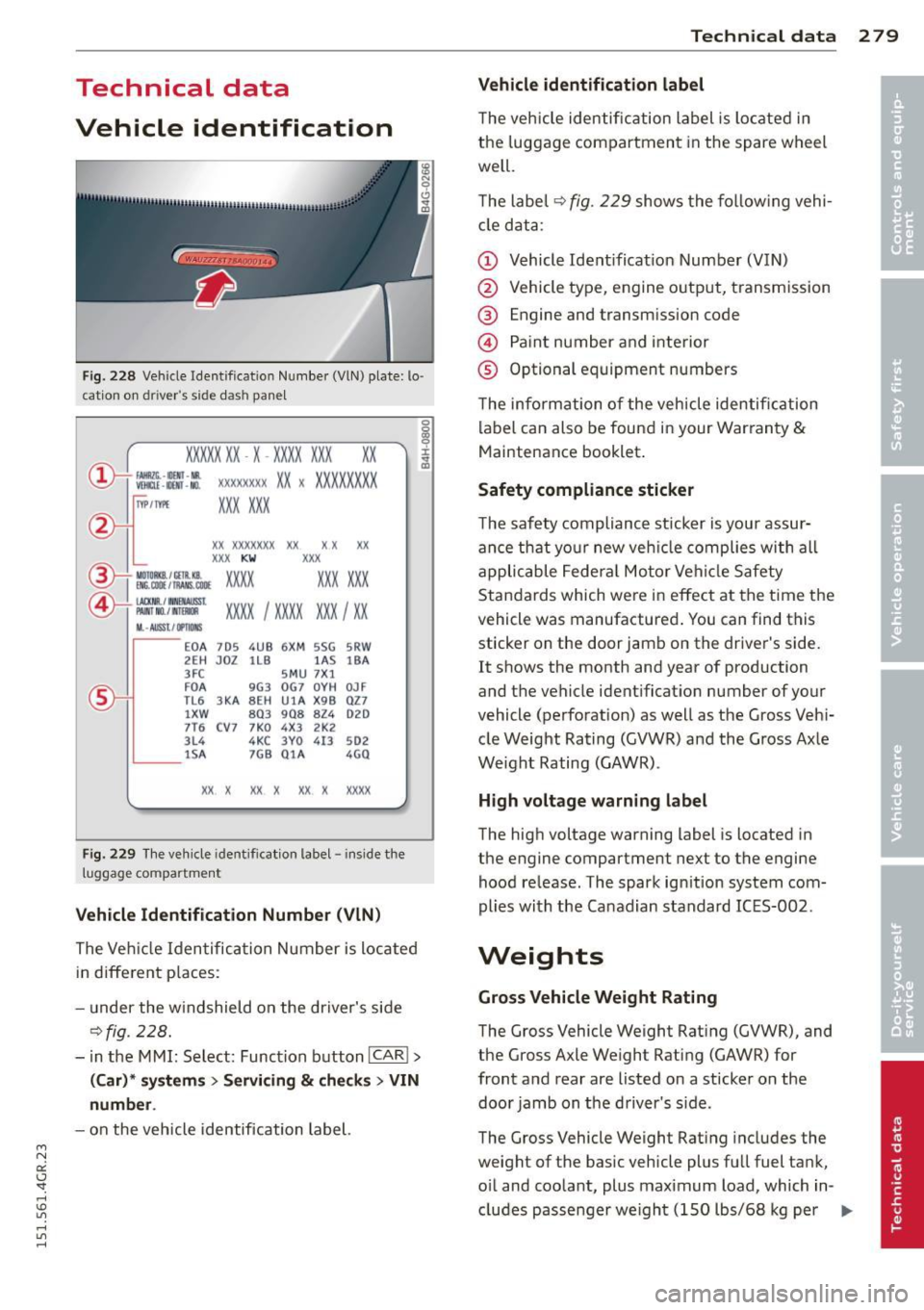
F ig. 228 Veh ide Identificat ion Number (VlN) plate: lo·
cat ion on driver's side dash pane l
XXXXX XX · X -XXXX XXX
~ fAllftlli. -llllll · NR. ~ W!ru -IIOO -NO.
xx
XXXX XXXX XX X XXXXXXXX
XXX XXX
IYP /TYPE
XX XXXXX XX XX X X XX
XXX KW XXX
®i ~W.::·f :l~~ XXXX XXX XXX
©+ ::rw= xxxx I xxxx XXX I xx
M. · AUSSt I IJ'IIDIIS
~--
EOA 7D5 4UB 6XM SSG SR W
2EH JOZ
1L B lAS 1B A
3FC SMU 7Xl
FDA 9G3 OG7 OYH OJF
TL6 3KA 8EH UlA X98 027
l XW 803 908 824 D2D
7T6 CV7 7KO 4X3 2K2
3L4 4KC 3YO 413 502
1SA 7GB 01A 4GO
XX. X XX X XX X XXXX
Fig. 229
The vehicle identification label- in side the
l u ggage compartme nt
Vehicle Identification Number (VlN)
The Veh icle Identification Number is located
in different p laces :
- under the w indshield on the driver's side
¢fig. 228.
- in the MMI: Select: Function button ICAR ! >
(Car)* systems > Servicing & checks > VIN
number .
-on the vehicle identification label.
Techni cal data 2 79
Vehicle identification label
The vehicle identification label is located in
the luggage compartment in the spare wheel
well.
T he label¢
fig. 229 shows the following vehi
cle data:
(D Vehicle Identificat ion Number (VIN)
@ Vehicle type, engine output, transmission
® Engine and transmission code
© Paint number and interior
® Optional equipment numbers
The information of the veh icle identification
label can also be found in your Warranty
&
Maintenance booklet .
Safety compliance sticker
The safety compliance sticker is your assur
ance that your new veh icle complies with all
applicable Federal Motor Vehicle Safety
Standards which were in effect at the time the
vehicle was manufactured. You can find this
sticker on the door jamb on the driver's side.
It shows the month and year of production
and t he vehicle identification number of your
vehicle (perforation) as well as the Gross Vehi
cle Weight Rating (GVWR) and the Gross Axle
Weight Rating (GAWR) .
High voltage warning label
The high voltage warning label is located in
the engine compartment next to the engine
hood release. The spark ignition system com
plies with the Canadian standard ICES-002 .
Weights
Gross Vehicle Weight Rating
The Gross Vehicle Weight Rating (GVWR), and
the Gross Axle Weight Rating (GAWR) for
front and rear are listed on a sticker on the
door jamb on the driver's s ide.
The Gross Vehicle Weight Rating includes the
weight of the basic vehicle plus full fuel tank,
oil and coolant, plus maximum load, which in
cludes passenger we ight (150 lbs/68 kg per
II>--
Page 286 of 302
28 4 Con sum er Inf ormation
in P (Park position) and the park brake is
applied.
@) For the sake of the environment
- Changing the engine settings wi ll ad
versely affect emission levels . This is det
rimental to the environment and increas
es fue l consumption .
- Always observe env ironmental regula
tions when disposing of old engine oil,
used brake fluid, dirty engine coolant,
spent batteries or worn out tires.
- Undeployed airbag modules and preten
sioners might be classif ied as Perchlo
rate Material -spec ial handling may ap
ply, see www .dtsc .ca .gov/hazardous
waste/perch lorate . When the veh icle o r
parts of the restraint system including
airbag modules safety belts wit h preten
s ioners are scrapped, all appl icable laws
and regulations must be observed. Your
a utho rized Audi dea ler is familiar with
these requirements and we recommend
that you have your dealer perform this
serv ice for you .
Additional accessories,
modifications and
parts replacement
Additional accessories and parts
replacement
Always consult an authorized Audi dealer be
fore purchasing accessories .
Your vehicle incorporates the latest safety de
sig n features ensuring a high standard of ac
tive and passive safety .
This safety could be compromised by non-ap proved changes to the veh icle. For this reason ,
if parts have to be replaced, p lease observe
the following points when installing addition
a l accessories:
Approved Audi accessor ies and genuine Audi
parts a re ava ilable from authorized Aud i deal
e rs. These dea
lers a lso have the necessary facili
ties, tools and trained specialists to install the
parts and accessories proper ly .
A WARNING
=
Using the wrong spare parts or using non-
approved accessories can cause damage to
the veh icle and ser ious perso na l injury .
- Use on ly accessories express ly approved
by Audi and genuine Audi spare parts
- These parts and accessories have been
specia lly designed to be used on your ve
h icle.
- Never install accessor ies such as tele
phone crad les or beverage ho lders on a ir
bag covers or within the airbag deploy
ment zones . Do ing so wi ll increase the
ris k of injury if a irbags are triggered in an
accident!
- Before you check anything in the engine
compa rtment, always read and heed a ll
WARNINGS
c:::> page 211 .
(D Note
-If items other than genu ine Audi spare
parts, add-on equipment and accessory
items are used o r if repair wo rk is not
performed ac cord ing to spe cified meth
ods, this c an resu lt in seve re damage to
yo ur vehicle's eng ine and body (such as
co rrosion) and adversely affect yo ur vehi
cle's warranty.
- If emergency repairs must be performe d
elsewhere , have the vehicle examined by
an authorized Audi dealer as soon as
possible.
- The manufacturer cannot be held liable
for damage wh ich occ urs due to failure
to comply with these stipu lations.
Technical Modifications
Our guidelines must be complied with when
t echnical modifica tions are made.
Always consult an authorized Audi dealer be-
fore start ing work on any modifications. ll>-
Page 289 of 302
M N
0:: <.J 'SI: ,...., \!) er, ,...., er, ,....,
Setup ..... .. .... .. .... ... .. .. .... 72
synchronizing ... .. .... ... .. .. .. .... 71
Automatic S hift Lock (ASL) .. .. .. .. .. . 104
Automatic transmission . . . . . . . . . . . . . . 103
Automatic Shift Lock (ASL) . .. .. .. .. . 104
Dnvmg .. ..... ........... ... ... .. 105
Emergency mode .............. .... 107
E mergency release ........ .. .. .. .. . 108
Kick-dow n . . . . . . . . . . . . . . . . . . . . . . . . 107
M anual sh ift program ..... .. .. .. .. . 10 7
Selec to r l ever . . . . . . . . . . . . . . . . . . . . . 103
Automatic wipe rs ....... ...... .... ... 48
Auto Safety Hotline ........ .. .. .. .. . 128
Aver age consumption ....... .. .. .. .. .. 24
Average speed . . . . . . . . . . . . . . . . . . . . . . . 24
Avoid damaging the vehicle . ... .. .. ... 197
B
B ag hoo ks . . . . . . . . . . . . . . . . . . . . . . . . . . 6 7
Battery . .. ... ...... ............. .. 22 1
C ha rging . ............ ...... .... .. 223
I mportant war nings ...... .. .. .. .. . 22 1
J um p starti ng ............ .... .. .. . 273
L ocat ion . .. ............. .. .. .. .. . 22 1
l ow ..... .. .. .. .. .. .... ... .. .. ... 193
Replacing the batte ry .. ... .. .. .. .. . 224
State of charge . ... .... ... .. .. .... . 193
W inter operation ......... .. .. .. .. . 221
Working on the battery .... .. .. .. .. . 221
B efore dr iving . ..... .... ... .. .. .. ... 120
Blended gasoline .... ...... .. .. .. .. . 206
Blower (automatic climate control) .. .. .. 71
B oost displ ay . . . . . . . . . . . . . . . . . . . . . . . . 28
Booster seats . . . . . . . . . . . . . . . . . . . . . . 17 4
Boost pressure indicator . ... .. .. .. .. .. 28
B rake flu id
C hanging the brake fl uid ... .. .. .. .. . 220
Che ckin g the br ake fl uid level . .. .. .. . 220
What is the cor rect brake flu id leve l? .. 220
What should I do if the bra ke fl uid warn-
ing light comes on? .... ... .. .. .. .. . 220
B ra ke system
Anti -lo ck bra king sys tem ... .. .. .. .. .. 18
B rake ass ist system .... ... .. .. .. .. . 18 7
Brake booster ... .. .... ... .. .. .. ... 191
Bra ke fl uid ... .... .... ... .. .. .. ... 220
Inde x 287
Brake fluid specifications fo r refill and re -
placement . ... .... . ... ...... ... .. 220
B rake pads . ... .. .. . .. ... .... ... .. 196
E lectromechanica l parking brake ... .. . 77
Flu id reservo ir . .. .... ............. 220
How does moistu re or road salt affect the
brakes? ... .. .. .. .. . .. .... .... .. .. 191
Warning/ind icator lights ........... .. 14
Wor n bra ke pads symbo l ........ .... . 19
braking guard Settings ........ .. ..... ........... 88
B raking guard ..... .. . .. .. ..... ... .. . 81
Messages ... .... .. . .. .. ..... ... .. . 88
B reak-in per iod .. .. .. .. ........... .. 196
Br ake pads .. .. .. ................. 196
T ires ... .. .. .. .... . ... ...... ... .. 196
Bulbs .. ... ... .. .... .......... ..... 272
C
Californ ia Proposition 6S Warn ing . .. .. 212
Battery spec ific .................. . 222
Capacities . ... .. .... . ... ...... ... .. 280
Engine o il ... .. .. ................. 213
Carbo n parts
Cleaning . . . . . . . . . . . . . . . . . . . . 203, 204
Car carrier Transpo rting your vehicle ........... 277
Care ......... .. .. ................. 201
Cargo area .. .. .. .. ............... .. 126
Cargo ne t . . . . . . . . . . . . . . . . . . . . . . . . . . . 66
Catalytic converter . . . . . . . . . . . . . . . . . . 197
Cen te r armres t
Cockpit . . . . . . . . . . . . . . . . . . . . . . . . . . . 56
Cent ral lock ing .. .. .. . .. .... .... .. .. . 33
E mergency locking .. .............. .. 37
Certif ication . ... .. .. .. ... ..... ... .. 285
Changi ng a wheel .. ............. .... 263
Changi ng engine oil ................. 216
Checking Engine coolant level .. .. ..... ... .. .. 217
Tire pressure . .. ...... ............. 237
C hild rest rain ts
Danger of using child restrain ts in the
fr ont seat ... .. .... . ... ...... ... .. 141
Where can I get additional informat ion
about child restraints and the ir use? .. 183
•
•