warning AUDI RS7 SPORTBACK 2016 Owners Manual
[x] Cancel search | Manufacturer: AUDI, Model Year: 2016, Model line: RS7 SPORTBACK, Model: AUDI RS7 SPORTBACK 2016Pages: 282, PDF Size: 70.78 MB
Page 135 of 282
~ Push the loop-around fittings up qfig. 153 @,
or
~ squeeze together the(!) button, and push the
loop-around fittings
do wn@ .
~ Pull the belt to make sure that the upper at
tachment is properly engaged .
A WARNING
Always read and heed all WARNINGS and oth
er important informat ion
qpage 129.
With the front seats, the height adjustment
of the seat can also be used to adjust the po
sition of the safety belts.
Improperly worn safety belts
Incorrectly positioned safety belts can cause se
vere injuries.
Wearing safety belts improperly can cause seri
ous injury or death. Safety belts can only work
when they are correctly pos itioned on the body .
Improper seating positions reduce the effect ive
n ess of safety be lts and will
even i ncrease the
ris k of injury and death by mov ing the safety belt
to cr it ica l areas of the body. Imp roper seating
positions also increase the risk of serious inj ury
and death when an airbag deploys and strikes an
occ upant who is not in the correct seat ing posi
tion. A driver is respons ible for the safety of all
vehicle occupants and espec ia lly for children.
Therefore:
~ Never permit anyone to assume an incorrect
s itting position in the veh icle wh ile traveling
Q A .
A WARNING
Improperly worn safety belts increase the risk
of serious personal injury and death wheneve r
a vehicle is be ing used.
- Always make sure that al l vehicle occupants
are correctly restra ined and stay in a co rrect
seating pos it io n whenever the ve hicle is be
ing used.
S afet y be lts
- Always read and heed all WARNINGS and
other important in format ion
q page 129.
Belt tensioners
How safety belt pretensioners work
In front, side and rear-end collisions above a
particular severity and in a rollover, safety belts are tensioned automatically.
Rever sible safety belt tensioner s
The safety belts on the front seats are equipped
with power reversible tensioners. The following
funct ions are available when the dr iver's/front
passenger's safety belts are fastened:
- Automatic tens ioners: at the start of a drive,
the safety belts automatically adjust to the passenger after a certain time period or vehicle
speed. To switch the automatic tensioners off,
select the following in the MMI :
!CARI function
button
> (Car )* system s > Vehicle setting s >
Seats > Driver's seat or Passeng er' s s eat > Au
tom atic belt ten sioner
> Off .
- In certain driving situations, the safety bel ts
may tighten w it h a reve rsib le tensioning func
tion
q page 177.
-The safety be lts may also tigh ten with this re-
versible tension ing function in m inor collisions.
Pyrotechnic safety belt pretens ioners
The safety belts are equipped w it h safety belt
prete nsioners. The system is activated by sensors
in front, side and rear -end collisions of great se
verity and in a ro llover. This tightens the belt and
takes up belt slack
q .& in Service and disposal of
safety belt pretensioner on page 134.
Taking up
the slack he lps to reduce forward occupant
movement during a collision.
A WARNING
--
- It is poss ible for the pretensioners to dep loy
incorrectly.
- The pyrotechnic system can only provide
protection for one collision. If the pyrotech
n ic pretens ioners deploy, the pretensioning
system must be replaced.
133
Page 136 of 282
Safety belts
(D Tips
The pyrotechnic safety be lt pretensioners can
only deploy once.
- The safety belt pretensioners do not deploy
in minor frontal, side and rear-end co lli
sions.
- A fine dust is released when the pyrotechnic
safety be lt pretensioners deploy. This is nor
mal and is not caused by a fire in the vehi
cle.
- The re levant safety requirements must be
observed when the vehicle or components
of the system are scrapped. A qualified
dealership is familiar with these regulations
and will be pleased to pass on the informa
tion to you.
- Be sure to observe all safety, environmental
and other regulations if the veh icle or indi
v idual parts of the system, pa rticularly the
safety be lt o r airbag, are to be disposed . We
recommend you have your authorized Audi
dealer perform this service for you.
Service and disposal of safety belt preten
sioner
The safety belt pretensioners are parts of the
safety belts on your Audi. Installing, removing,
servicing or repairing of belt pretensioners can
damage the safety belt system and prevent it
from working correctly in a collision.
There are some important things you have to
know to make sure that the effectiveness of the
system w ill not be impaired and that discarded
components do not cause injury or pollute the
environment.
A WARNING
Improper care, servicing and repair proce
dures can increase the risk of personal injury
and death by preventing a safety belt preten
sioner from activating when needed or acti
vating it unexpectedly :
- The be lt pretensioner system can be activat
ed only once.
If belt pretensioners have
been act ivated, the system must be re
placed .
134
-Never repair, adjust, or change any parts of
the safety belt system .
- Safety belt systems including safety belt
pretensioners cannot be repaired. Spec ial
procedures are required for removal, instal
lation and disposal of this system.
- For any work on the safety belt system, we strongly recommend that you see your au
thorized Audi dealer or qualified technician
who has an Audi approved repa ir manual,
tra ining and special equipment necessary .
@) For the sake of the environment
Undeployed airbag modules and pretension
ers might be classified as Perchlorate Materi
al -special handling may apply, see
www .dtsc.ca .gov/hazardouswaste/perchlo
rate. When the vehicle or parts of the re
straint system including airbag modules safe
ty belts with pretensioners are scrapped, all
applicable laws and regulations must be ob
served. Your authorized Audi dealer is familiar
with these requirements and we recommend
that you have your dealer perform this service
for you.
Page 138 of 282
Airbag syste m
also not inflate in s ide or rear collisions, or in
ro ll-overs.
Alwa ys rememb er: Airbags will deploy only once,
and on ly in ce rtain k inds of coll is ions. Yo ur safety
be lts are always there to offer protection in those
situations in which airbags are not supposed to
dep loy, or when they have already deployed ; for
examp le, when your vehicle str ikes or is struck by
another vehicle after the first coll is ion.
This is just one of the reasons why an airbag is a
supp lementary restraint and is not a substitute
for a safety belt. The a irbag system works most
effect ively when used with the safety belts.
Therefore, always properly wear your safety belts
r=;, page 127 .
A WARNING
Sitting too close to the steering wheel o r in
st rument panel will decrease the effective
ness of the airbags and will inc rease the risk
of personal injury in a co llision .
- Never sit closer than 10 inches (25 cm) to
the steering wheel or instrument panel.
- If you cannot si t mo re than 10 inches
(25 cm) from the steering wheel, invest i
gate whether adaptive equipment may be
available to help you reach the pedals and
increase your seating distance from the
steering wheel.
- All vehicle occupants and especially children
must be restrained properly whenever riding
in a vehicle. An unrestrained or improperly
restra ined child could be injured by striking
the interior or by being ejected from the ve
hicle during a sudden maneuver or impact.
An unrestrained or imp roperly restrained
child is also at greate r risk of inju ry or death
through contact with an inflating airbag .
-If you are unrestrained, leaning fo rward, s it
t ing s ideways or out of pos ition in any way,
yo ur risk of in ju ry is much h igher.
- Yo u will also receive serious injuries and
could even be killed if you are up aga inst the
airbag or too close to it when it inflates -
even with an Advanced Airbag.
136
-
- To reduce the risk of injury when an airbag
inflates, always wear safety belts properly
r=;, page 130, Safety belts.
- Always make certa in that children age 12 or
younger always ride in the rear seat. If chil
dren are not properly restrained, they may be severely injured or killed when an airbag
inflates .
- Never let ch ildren ride unrestra ined or im
properly restrained in the vehicle. Ad just the
front seats properly.
- Never ride with the backrest recl ined .
- Always sit as far as possible from the steer-
ing wheel or the instrument panel
r=;, page 119.
-Always sit upright w ith your back against
the backrest of your seat .
- Never p lace your feet on the instrument
panel or on the seat . Always keep both feet
on the floor in front of the seat to help pre
vent serious injur ies to the legs and hips if
the airbag inflates.
- Never recl ine the front passenger's seat to
transpo rt objects . Items can also move into
the area of the s ide a irbag or the front air
bag du ring brak ing o r in a sudden maneu
ver. Objects nea r the airbags can become
projecti les and cause injury when an airbag
inflates.
A WARNING
Airbags that have deployed in a crash must be replaced.
- Use on ly original equipment airbags ap
proved by Audi and installed by a trained
technician who has the necessary tools and
diagnostic equipment to properly replace
any airbag in your vehicle and assure system
effectiveness in a crash .
- Never perm it salvaged or recycled airbags to
be installed in your vehicle.
Child restraints on the front seat - some
important things to know
.,. Be s ure to read the impo rtant info rmat ion and
heed the WARN INGS for important details .,.
Page 140 of 282
Airbag syste m
Always remember, a child seat or infant carrier
installed on the front seat may be struck and
knocked out of position by the rapidly inflating
passenger's airbag in a frontal collision. The air
bag could greatly reduce the effectiveness of the
child restraint and even seriously injure the child
during inflation.
For this reason, and because the back seat is the
safest place for children -when properly restrain
ed according to their age and size -we strongly
recommend that children always sit in the back
seat
¢ page 159, Child safety.
.8, WARNING
A child in a rearward-facing chi ld seat insta l
led on the front passenger seat will be ser i
ously injured and can be killed if the front air
bag inflates -even with an Advanced Airbag
System.
- The inflating airbag will hit the child seat or
infant carrier with great force and will
smash the chi ld seat and child against the
backrest, center armrest, door or roof.
- Always install rear-facing child seats on the
rear seat.
- If you must install a rearward fac ing chi ld
seat on the front passenger seat because of
exceptional c ircumstances and the
PASSEN
GER AIR BA G OFF
light does not come on
and stay on, immediately install the rear
facing child seat in a rear seating position
and have the airbag system inspected by
yo ur Audi dealer.
- Forward-facing ch ild seats insta lled on the
front passenger's seat may interfe re with
the deployment of the airbag and cause se
rious persona l injury to the child.
.8, WARNING
If, in except ional circumstances, you must in
stall a forward-facing chi ld restraint on the
front passenger's seat:
- Always make sure the forward-facing se at
has been designed and certified by its man
ufacturer for use on a front seat with a pas
senger front and side airbag .
138
-
-Never put the forward-facing child restraint
up against or very near the instrument pan
el.
- Always move the passenger seat into its
rearmost posit ion in the seat's fore and aft
adjustment range, as far away from the a ir
bag as poss ible before installing the for
ward-facing child restraint . The backrest
must be adjusted to an upr ight position.
- Make sure that the
PASSENGER AIR BAG
OFF
light comes on and stays on a ll the time
wheneve r the ignit ion is swi tched on.
.8, WARNING
To reduce the ris k of serious injury, ma ke sure
that the
PASSENGER AIR BAG OFF ligh t will
be d isp layed whenever a ch ild rest raint is in
stalled on the front passenger seat and the ignition is switched on.
-If the PA SSENGER AIR BAG OFF light does
not stay on, perform the checks described
¢ page 146 , Monitoring the Advanced Air
bag System.
- Take the child restraint off the front passen ·
ger seat and install it properly at one of the
rear seat positions if the
PASSENGER AIR
BAG OFF
light does not stay on.
- Have the airbag system inspected by your
Aud i dea ler immediately.
- Always carefully follow instructions from
child restraint manufacturers when instal
ling child restra ints.
.8, WARNING
If, in exceptional circumstances, you must in
stall a forward or rearward-fac ing child re
stra int on the front passenger's seat:
- Improper installation of child restraints can
reduce the ir effectiveness or even prevent
them from provid ing any protect ion.
- An improperly installed child restra int can
interfere with the airbag as it deploys and
serious ly injure or even kil l the child -even
w ith an Advan ced A irbag System.
- Always carefully follow the manufacturer's
instructions provided with the child seat or
earner.
Page 141 of 282
-Always make sure that there is nothing on
the front passenger seat that will ca use the
capacit ive passenger detection system in
the seat to signal to the Airbag System that
the seat is occupied by a person when it is
not, or to signa l that it is occupied by some
one who is heavier than the person actua lly
sitting on the seat. The p resence of addi
tional objects could cause the passenger
front airbag to be turned on when it shou ld
be off, or could cause the airbag to work in a
way that is different from the way it would
have worked without the object on the seat.
Front airbags
Description of front airbags
The airbag system con provide supplemental
protection to properly restrained front seat occu
pants.
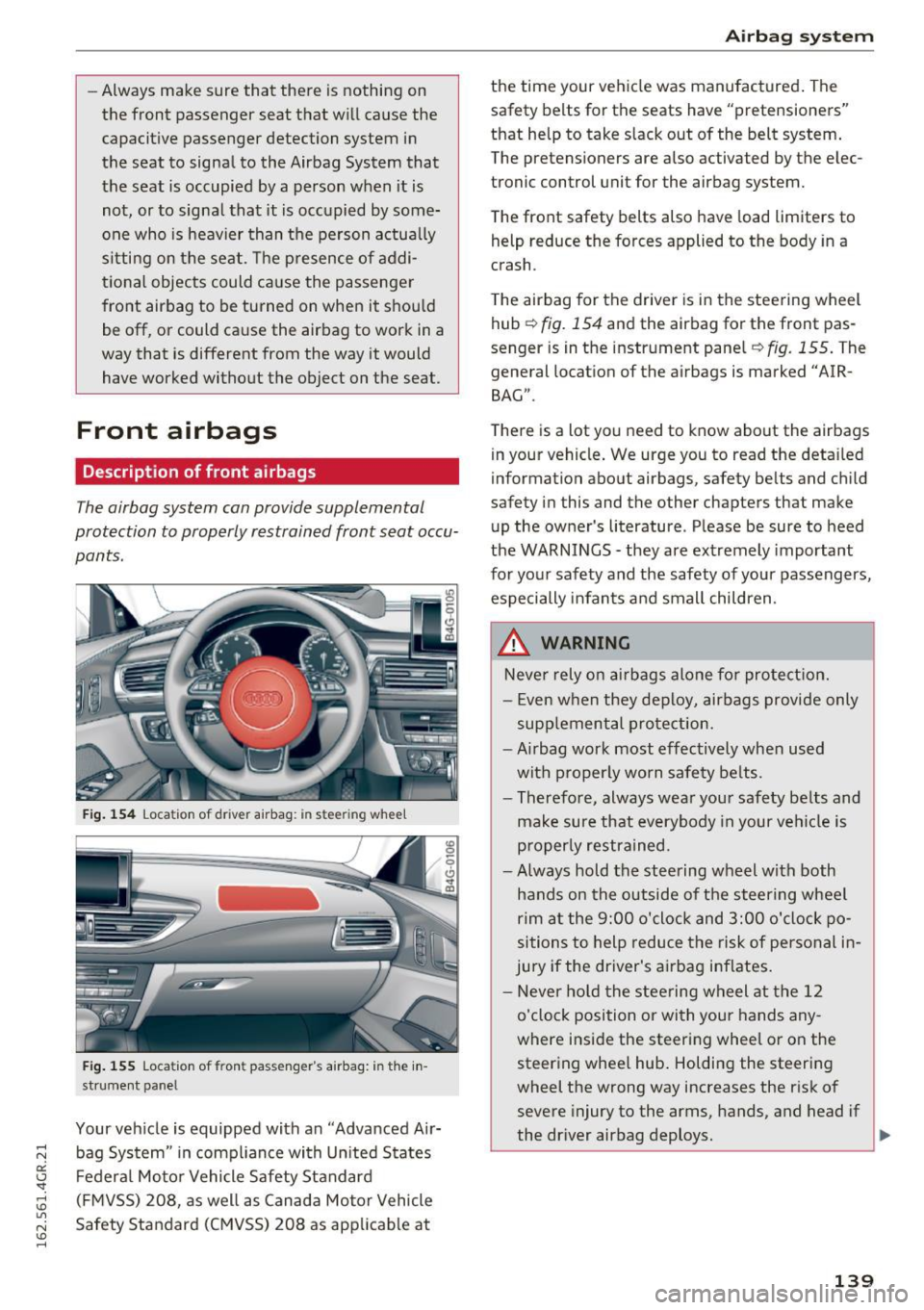
F ig. 154 Location of driver airbag: in steering whee l
Fig. 155 Location of front passenger 's airbag: in th e in
strume nt panel
Your veh icle is equipped with an "Advanced Air
bag System" in comp liance with United States
F edera l Moto r Vehicle Safety Standard
( FM VSS) 208, as well as Canad a Moto r Vehicle
Safety Standard (CMVSS) 208 as app licab le at
Airb ag sys tem
the time your ve hicle was manufactured . The
safety belts for the seats have "pretensioners"
that help to take slack out of the belt system .
The pretensioners are also activated by the elec
tronic control unit for the airbag system.
The front safety belts also have load limiters to
help reduce the forces applied to the body in a
crash.
T he airbag for the drive r is in the steering wheel
hub ~
fig. 154 and the airbag for the front pas
senger is in the instrument panel~
fig. 155 . The
general locat ion of the airbags is marked "AIR
BAG".
There is a lot you need to know about the airbags i n your vehicle . We urge you to read the deta iled
information about airbags, safety be lts and ch ild
safety in this and the other chapters that make
up the ow ner's literature . Please be sure to heed
the WARNINGS - they are extremely important
for yo ur safety and the safety of your passengers,
especially infan ts and small children.
_&. WARNING
-
Neve r rely o n ai rbags alone fo r prote ct ion.
- E ven w hen they deploy, airbags provide only
supp lemental pro tection.
- Ai rbag work most effectively when used
with p roperly worn safety belts.
- Therefo re, always wear your safety belts and
make sure that everybody in your ve hicle is
p roperly restrained.
- Always hold the steering w heel with both
ha nds on the outside of the steering wheel
rim at the 9:00 o'clock and 3 :00 o'clock po
sitions to help reduce t he risk of personal i n
jury if the driver's a irbag inflates.
- Never hold the stee ring wheel at the 12
o'clock position or wi th your hands any
where inside the steering wheel o r on the
steer ing whee l hub . Holding the steering
wheel the wrong way increases the r isk of
severe injury to the arms, hands, and head if
the dr iver airbag deploys.
~
139
Page 142 of 282
Airbag system
& WARNING
Objects between you and the airbag will in
crease the risk of injury in a crash by interfer
ing with the way the airbag unfolds and/or by
being pushed into you as the airbag inflates.
-Always make sure nothing is in the front air -
bag deployment zone that could be struck
by the airbag when it inflates .
- Objects in the zone of a deploying airbag
can become projectiles when the airbag de
ploys and cause serious personal injury.
- Never hold things in your hands or on your
lap when the vehicle is in use .
- Never place accessories or other objects
(such as cup holders, telephone brackets,
note pads, navigation systems, or things
that are large, heavy, or bulky) on the doors;
never attach then to the doors or the wind
shield; never place them over or near or at
tach them to the area marked ,,AIRBAG" on
the steering wheel, instrument panel or the
seat backrests; never place them between
these areas and you or any other person in
the vehicle.
- Never attach objects to the windshield
above the passenger front airbag, such as
accessory GPS navigation units or music
players . Such objects could cause serious in
jury in a collision , especially when the air
bags inflate .
- Never recline the front passenger seat to
transport objects. Items can also move into
the deployment area of the side airbags or
the front airbag during breaking or in a sud
den maneuver. Objects near the airbags can
fly dangerously through the passenger com
partment and cause injury, particularly
when the seat is reclined and the airbags in
flate.
& WARNING
A person on the front passenger seat, espe cially infants and small children, will receive
serious injuries and can even be killed by be
ing too close to the airbag when it inflates.
-Although the Advanced Airbag System in
your vehicle is designed to turn off the front
140
-
passenger airbag if an infant or a small child
is on the front passenger seat, nobody can
absolutely guarantee that deployment un
der these special conditions is impossible in
all conceivable situations that may happen
during the useful life of your vehicle .
- The Advanced Airbag System can deploy in
accordance with the ,,low risk" option for 3-
and 6-year-old children under the U .S . Fed
eral Standard if a child with electrical capac
itance greater than the combined capaci
tance of a typical one-year old infant re
strained in one of the forward facing or rear
ward-facing child seats with which your ve
hicle was certified is on the front passenger
seat and the other conditions for airbag deployment are met .
- Accident statistics have shown that children
are generally safer in the rear seat area than
in the front seating position .
- For their own safety, all children, especially
12 years and younger, should always ride in
the back properly restrained for their age
and size.
Advanced front airbag system
Your vehicle is equipped with a front Advanced
Airbag System in compliance with United States
Federal Motor Vehicle Safety Standard 208, as
well as Canada Motor Vehicle Safety Standard
(CMVSS) 208 as applicable at the time your vehi
cle was manufactured.
The front Advanced Airbag System supplements
the safety belts to provide additional protection
for the driver's and front passenger's heads and upper bodies in frontal crashes. The airbags in
flate only in frontal impacts when the vehicle de
celeration is high enough.
The front Advanced Airbag System for the front
seat occupants is not a substitute for your safety belts. Rathe r, it is part of the overall occupant re
straint system in your vehicle . Always remember
that the airbag system can only help to protect
you, if you are sitting upright, wearing your safe
ty belt and wearing it properly . This is why you
and your passengers must always be properly .,.
Page 143 of 282
restrained, not just because the law requires you
to be.
The Advanced Airbag System in your ve hicle has
been certified to meet the " low r isk" require
ments for 3 and 6 yea r-o ld children on the pas
senger side and very sma ll adults on the driver
side . The low r isk dep loyment cr iteria are intend
ed to help reduce the risk of injury through inter
action with the front a irbag that can occur, for
examp le, by being too close to the steering wheel
and instrument panel when the airbag inflates .
In addition, the system has been certified to
comply w ith the "suppression" requirements of
the Safety Standard, to turn off the front a irbag
for infants 12 months old and younger who are
restrained on the front passenger seat in child re
stra ints that a re listed in the Standard
¢ page 161, Child restraints and Advanced front
airbag system .
"Suppression" requ ires the front a irbag on the
passenger side to be turned off if:
- a ch ild up to about one year of age is restra ined
on the fro nt passenger seat i n one of the rear
facing or forward-fac ing infant restra ints listed
in Federal Motor Vehicle Safety Standard 208
with wh ich the Advanced Airbag System in your
vehicle was certified . For a listing of the ch ild
restraints that were used to certify your vehi
cle's compliance with the US Safety Standard
¢ page 161,
-When a person is detected on the front passen
ger seat that has an electrical capacitance that
is more than the tota l electrical capac itance of
a ch ild that is about 1 year old restra ined in one
of the rear-facing or forward-facing infant re
straints (listed in Federal Motor Veh icle Safety
Standard 208 w ith which the Advanced A irbag
System i n your veh icle was certified), the front
airbag o n the passenge r side may o r may not
deploy.
The
P A SSENGER AIR B AG OFF light comes on
when the electron ic cont rol un it detects a total
e lectrical capacitan ce on the front passenge r seat
that requ ires the front a irbag to be turned off. If
the
PAS SENGER AIR BAG OFF light does not
come on, the front airbag on the passenger side
Airb ag sys tem
has not been turned off by the contro l unit and
can deploy if the contro l unit senses an impact
that meets the cond itions stored in its memory.
If the total e lectr ica l capaci tance reg istered on
the front passenger seat is mo re than that of a
typica l 1 year -old, but less than the weight of a
small adult, the front a irbag on the passenger
s ide may deploy (the
PA SS ENGER AIR BA G OFF
light does not come on).
For example , the ai rbag ma y deplo y if:
- a small ch ild that is heav ier than a typ ica l 1
yea r-o ld child is on the front passenger seat
(regardless o f whether the child is in one of the
child seats listed
¢ page 161),
-a child who has outgrown c hild restraints is on
the front passenge r seat .
If the front passenge r a irbag is t urned off, the
PASSENGER AIR BAG OFF light in the center of
the instrument pane l wi ll come on and stay on .
If the front passenger a ir bag deploys, the Feder
al Standa rd requi res the ai rbag to meet the "low
risk" deployment criteri a to he lp redu ce the r isk
of inj ury th rough interaction with the airbag .
" Low risk" deployment occurs in those crashes
that take p lace at lower decelerations as defined
in the electronic contro l unit ¢
page 146.
Alwa ys remember : Even though your vehicle is
equipped with Advanced Airbags, the safest place
for children is properly restrained on the back
seat. Please be sure to read the important infor
mation in the sections that fo llow and be sure to
heed all of the WARNINGS.
A WARNING
To reduce the risk of injury when an airbag in
flates, always wea r safety belts properly.
- If you are u nrestra ined, leaning forward, sit
ting sideways or out of position in any way,
your r is k of injury is much highe r.
- You will also receive ser ious injuries and
could even be killed if yo u are up against the
ai rbag or too close to it when it inflates -
even with an A dvanced Airbag
¢page 135.
141
Page 144 of 282
Airbag syste m
A WARNING
A child in a rearward-facing chi ld seat instal
led on the front passenger seat will be ser i
ously injured and can be k illed if the front air
bag inflates - even with an Advanced Airbag
System.
- Although the Advanced A irbag System in
you r vehicle is designed to tu rn off the front
airbag when a rea rward-facing child re
straint has been insta lled on the fron t pas
senger seat, nobody can absolutely g uaran
tee that deployment is impossible in a ll con
ceivable situations that may happen during
the useful life of your vehicle.
- The inflating airbag w ill hit the child seat or
infant carrier w ith great force and will
smash the ch ild seat and child against the
backrest, center armrest, door, or roof.
- Always install rearward-facing ch ild re
straints on the rear seat.
- If you must install a rearward fac ing ch ild
seat on the front passenger seat because of
exceptional c ircumstances and the
PASSEN
G ER A IR BAG OFF light does not come on
and stay on, immediately insta ll the rear
facing child seat in a rea r seating pos ition
and have the airbag system inspected by
yo ur Audi dealer.
A WARNING
If, i n ex cept ional circumstances, you must i n
stall a forward-facing chi ld restraint on the
front passenger's seat:
- Always make sure the forward-facing se at
has been designed and ce rtified by its man
ufacturer for use on a f ront seat with a pas
senger front and side a irbag .
- Never put the forward -facing child restraint
u p against or very near the instrument pan
el.
- Always move the passenger seat into its
rearmost position in the seat's fore and aft
adjustment range, as fa r away from the air
bag as possib le, before insta lling the for
ward-facing child restra int. The backrest
must be adjusted to an upright posit ion.
142
- Always make sure that there is noth ing on
the front passenge r seat that will cause the
capacitive passenger detection system in
the seat to signal to the Airbag System that
the seat is occup ied by a person when it is
not, or to s ignal that it is occupied by some
one who is heavier than the person act ually
si tti ng o n the sea t. T he prese nce of addi
tional obje cts could cause the passenger
front airbag to be turned on when it should
be off , or could cause the airbag to work in a
way that is d ifferent from the way it wou ld
have wo rked without the object on the seat.
- Make sure that the
PASSENGER AIR BAG
OF F light comes on and stays on all the time
whenever the ignit ion is switched on.
Advanced Airbag System components
The front passenger seat in your veh icle has a lot
of ve ry important parts of the Advanced A irbag
System i n it. These parts incl ude t he capacitive
passenger detection system, wir ing, b rackets,
and more. The control uni t monitors the system
o n the front passenge r seat when t he ignit ion is
swi tched on and turns the airbag indica tor ligh t
o n when a malfunction in the one of the system
components is detected
~ page 147 . Because
the front passenger seat contains important
parts of the Advanced Airbag System, you must
take care to prevent it from being damaged.
Damage to the seat may prevent the Advanced
Airbag System for the front passenger seat from
do ing its job in a crash.
The front Advanced Airbag System consists
of the following:
- Crash sensors i n the front of the veh icle that
measu re vehicle acce le ration/dece le ration to
prov ide informa tion to the Advanced A irbag
System abo ut the sever ity of the cr as h .
- An elect roni c contro l unit, w ith integ rated
cr ash sensors for front an d side impacts. The
c ont rol u nit "de cides" whether to fi re the fron t
airbags based on the information received from
the crash sensors. The cont ro l unit also "de
cides" whether the safety belt pretensioners
should be activated. ..,_
Page 145 of 282
-An Advanced Airbag with gas generator and
control valve for the driver inside the steering
wheel hub.
- An Advanced Airbag with gas generator and
control valve inside the instrument panel for
the front passenger.
- A capacitive passenger detection system under
neath the front passenger seat cover. This sys
tem measures the electrical capacitance of the
person in the seat. The information registered
is sent continuously to the electronic control
unit to regulate deployment of the front Ad
vanced Airbag on the passenger side .
- An airbag monitoring system and indicator
light in the instrument cluster
~ page 146.
-A sensor in each front seat registers the dis
tance between the respective seat and the
steering wheel or instrument panel. The infor
mation registered is sent continuously to the
electronic control unit to regulate deployment
of the front Advanced Airbags.
- The
PASSENGER AIR BAG OFF light comes on
and stays on in the center of the instrument
panel ~
page 147, fig. 157 and tells you when
the front Advanced Airbag on the passenger side has been turned off.
- A sensor in the safety belt latch for the driver
and for the front seat passenger that senses
whether that safety belt is latched or not and
transmits this information to the electronic control unit.
A WARNING
Damage to the front passenger seat can pre
vent the front airbag from working properly.
- Improper repair or disassembly of the front
passenger and driver seat will prevent the
Advanced Airbag System from functioning properly.
- Repairs to the front passenger seat must be
performed by qualified and properly trained
workshop personnel.
- Never remove the front passenger or driver
seat from the vehicle.
- Never remove the upholstery from the front
passenger seat.
- Never disassemble or remove parts from the
seat or disconnect wires from it.
Airbag system
-Never carry sharp objects in your pockets or
put them on the seat. The capacitive pas
senger detection mat in the front passenger
seat will not function properly if it is punc
tured.
- Never carry things on your lap or carry ob
jects on the front passenger seat. Such ob
jects can influence the capacitance regis
tered by the capacitive passenger detection
system, so that incorrect information is pro
vided to the airbag control unit.
- Never store items under the front passenger
seat. Parts of the Advanced Airbag System
under the passenger seat could be dam
aged, preventing them and the airbag sys
tem from working properly.
- Never place seat covers or replacement up
holstery that have not been specifically ap
proved by Audi on the front seats.
- Seat covers can prevent the Advanced Air
bag System from recognizing child re
straints or occupants on the front passenger
seat and prevent the side airbag in the seat
backrest from deploying properly.
- If a seat heater has been retrofitted or oth
erwise added to the front passenger seat,
never install any child restraint system on
this seat.
- Never use cushions, pillows, blankets, or
similar items on the front passenger seat.
The additional layers prevent the capacitive
passenger detection system from accurately
measuring the capacitance of the child safe
ty seat and/or the person on the seat and
thus keep the Advanced Airbag System from
working properly.
- Never place or use any electrical device
(such as a laptop, CD player, electronic
games device, power inverter or seat heater
for child seats) on the front passenger seat if the device is connected to the 12-volt
socket or the cigarette lighter socket. Such
devices can influence the capacitance regis
tered by the capacitive passenger detection
system, so that incorrect information is pro
vided to the airbag control unit.
- If you must use a child restraint on the front
passenger seat and the child restraint
~
143
Page 146 of 282
Airbag syste m
manufacturer's instructions require the use
of a towel, foam cushion or someth ing else
to properly pos ition the child restraint,
make certain that the
PAS SENGE R A IR BAG
OFF
light comes on and stays on whenever
the chi ld restraint is installed on the front
passenge r seat.
- If the
PASSEN GER AIR BAG OFF light does
not come on and stay on, immediately in
sta ll child restraint in a rear seating position
and have the airbag system inspected by
your Audi dealer.
_& WARNING
If the front passenger seat gets wet, dry it im
mediately .
- If liquid soaks into the fron t passenger sea t,
t h is can keep the a irbag system from work
ing properly and may, for instance, deacti
vate the passenger frontal airbag. If this
happens, the
PA SSENGER AIR BAG OFF
light will come on and stay on together with
the airbag indicator light
fl (USA models)/
El (Canada models) in the instrument clus
te r.
- If liquid is pooled on the seat, but has not
soaked in, this may also keep the airbag sys
tem from working properly and ca use the
passenge r frontal a irbag to be e nabled
(tu rned on), even though there is a properly
ins talled chi ld restraint system on the seat.
Wet towe ls or other wet things on the seat
cushion can have the same effect. If the
front passenger frontal airbag is turned on,
the
PAS SENGER AIR BAG OFF light will go
out.
How the Advanced Airbag System
components work together
The front Advanced Airbag System and the side
ai rbags s upplement the protection offered by the
front three-po int safety belts with pretensioners
and load limiters and the adjustable head re
stra ints* to help reduce the risk of injury in a
wide range of accident and crash situations. Be sure to read the important information about
safety and heed the WARNINGS in th is chapter.
144
Deployment of the Advanced A irbag System and
the activation of the safety belt pretensioners de
pend on the dece leration measured by the crash
sensors and registered by the electronic contro l
unit. Crash severity depends on speed and decel
e ration as well as the mass and stiffness of the
vehicle or object involved in the crash .
On the passenger side, regard less of safety belt
use, the front passenger frontal airbag will be
turned off if the e lectr ica l capacitance measured
by the capacitive passenger detection system on
the front passenger seat is less than the amount programmed in the elec tron ic cont rol unit . The
front passenger fron tal a irbag w ill also be turned
off if the capacitance measured by the system for
the front passenger seat equals that of an infant
of about one year of age in one of the child seats
that was used to certify the Advanced Airbag Sys
tem under Federal Motor Vehicle Safety Standard 208. The
PAS SENGER AIR BAG OFF light comes
on and stays on to tell you when the front Ad
vanced Airbag System on the passenger side has been tu rned off
c:> page 147 .
_& WARNING
To reduce the ris k of injury when an airbag in
flates, always we ar safe ty belts prope rly.
- If you are un restrai ned, leaning forward, sit
ting sideways or out of posi tion in any way,
your r isk o f injury is much highe r.
- You will a lso receive ser ious injuries and
co uld even be killed if yo u are up agains t the
ai rbag or too close to it when i t inflates -
even with an Advanced Airbag
c:> page 135.
More important things to know about front
airbags
Fig . 156 Inflated front a irbags
" "' 0 ± ., a,