brakes AUDI RS7 SPORTBACK 2016 User Guide
[x] Cancel search | Manufacturer: AUDI, Model Year: 2016, Model line: RS7 SPORTBACK, Model: AUDI RS7 SPORTBACK 2016Pages: 282, PDF Size: 70.78 MB
Page 184 of 282
Intelligent Technology
- Driving in deep snow or on loose ground
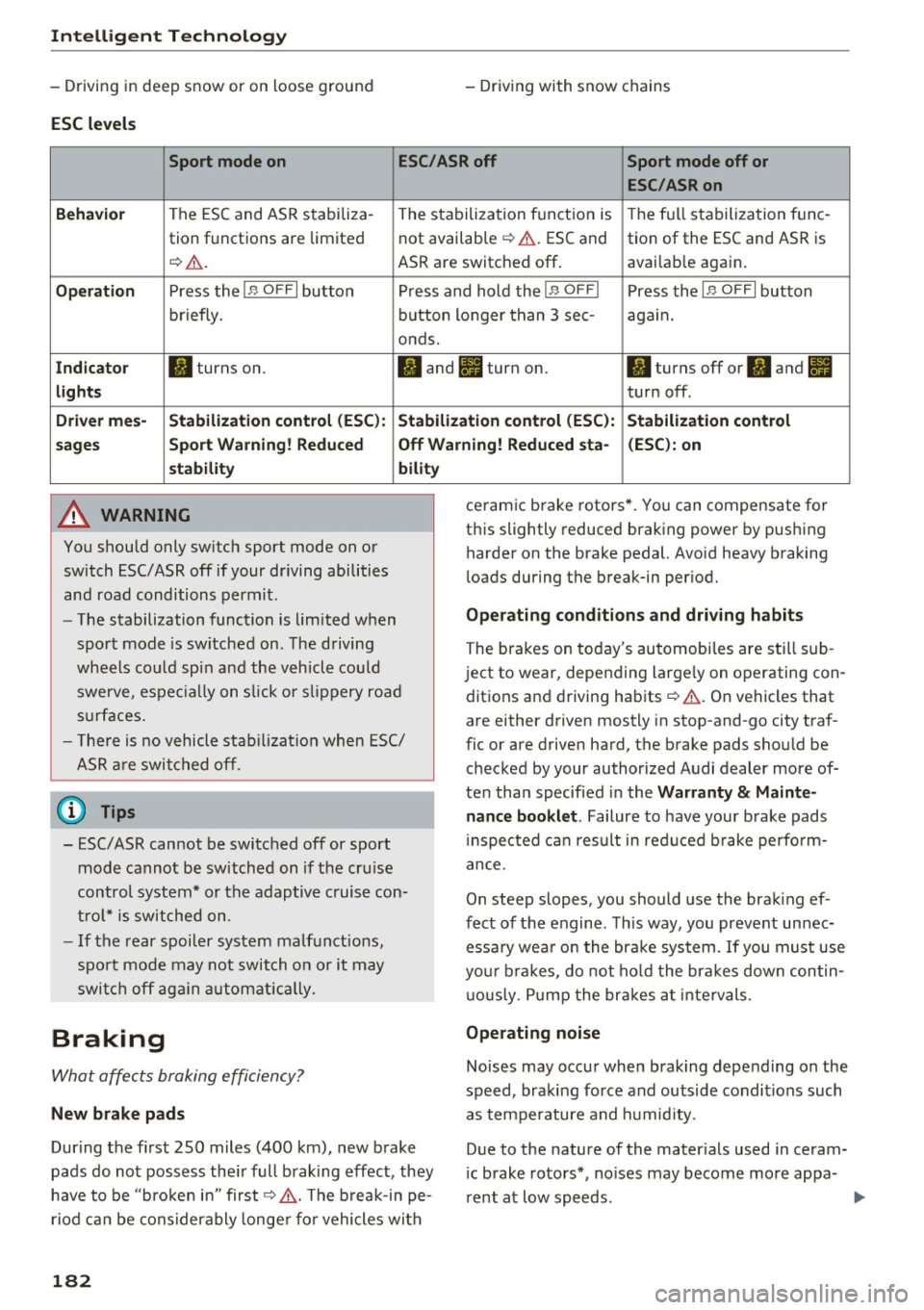
ESC levels
- Driv ing with snow chains
Sport mode on ESC/ASR off Sport mode off or
ESC/ASRon
Beha vior
The ESC and ASR stabiliza- The stabiliza tion function is The f ull stabilization tune-
tion f unctions are limited not available ¢
,&. ESC and
tion of the ESC and ASR is
¢
&. . ASR are switched off . avai
lab le aga in .
Op eration Press the I B OFF I button Press and hold the !B OFFI Press the IB OFFI button
briefly . button longer than 3 sec- again.
onds.
I n d ica to r II turns on. II and lit turn on. II turns off or II and II
light s turn off .
Driver me s- Stabili zation cont rol (E SC): S tabilization control (E SC ):
Stabili zation cont rol
s age s Sport Warning ! Redu ced Off Wa
rning! Reduced sta - (ESC ): on
st abilit y
A WARNING
You should only switch sport mode on or
switch ESC/ ASR off if your driving abilities
and road conditions permit.
bility
- The stabilization function is limited when
sport mode is sw itched on. The driving
wheels co uld spin and the vehicle could
swerve , espec ially on s lick o r slippery road
s u rfaces.
- The re is no vehicle stab ilizat ion when ESC/
ASR a re swi tched off .
(D Tips
-ESC/ASR cannot be switched off or sport
mode cannot be switched on if the cru ise
control system* or the adaptive cruise con
tro l* is switched on .
- If the rear spoiler system malfunct ions,
sport mode may not switch on or it may switch off ag ain automatically .
Braking
What affects braking efficiency?
New brake pads
During the first 250 miles (400 km), new brake
pads do not possess the ir full braking effect, they
have to be "broken in" first¢&, . The b reak-in pe
riod can be considerably longe r fo r vehicles with
182
ceramic brake rotors* . You can compensate for
this slightly reduced braking power by pushing harder on the brake pedal. Avoid heavy braking
l oads during the break-in per iod.
Op erating c ondition s and dri ving habits
The brak es on today 's automobiles are still sub
ject to wear, depending large ly on operating con
dit ions and driving habits ¢&, . On vehicles that
are either driven mostly in stop-and-go city traf
fic or are driven hard, the brake pads shou ld be
checked by your authorized Audi dealer more of
ten than specified in the
Warr ant y & Maint e
nance booklet .
Failure to have your brake pads
i nspected ca n result in red uced b rake perfo rm
ance.
On steep slopes, you should use the brak ing ef
fect of the engine . Th is way, you prevent unnec
essa ry wea r on the brake system. If you must use
you r brakes, do not ho ld the brakes down contin
u ous ly. P ump the brakes at intervals.
Operating noi se
Noises may occur when brak ing depending on the
speed, braking force and outside conditions such as temperature and h umid ity.
Due to the nature of the mater ials used in ceram
i c brake rotors*, no ises may become more appa-
rent at low speeds. ..,.
Page 185 of 282
Effect of wat er and road salt
In ce rtain situations, for example after driving
through water, in heavy rain, afte r ove rnight con
densation or after washing your car, the braking
effect can be reduced by moisture or ice on the
brake rotors and brake pads. The brakes must be
dried first w ith a few careful brake applications.
At higher speeds and with the windshie ld wipers
turned on, the brake pads press against the brake rotors for a short amount of time. Th is occurs at
regular intervals without the driver noticing and
provides for better brake response time under
wet conditions .
The effectiveness of the brakes can be reduced
when the vehicle is driven on a salt-covered road
and the brakes are not used. Likewise, you clean
off accumulated salt coat ing from brake discs
and pads with a few cautious applications of the b rake ¢_&. .
Due to their surface character istics, ceramic
brake roto rs* absorb mo isture in such condit ions.
This can cause a temporary reduc tion in braking
force compared to dry brakes. You can compe n
sate fo r th is by press ing the b rake peda l harder.
Corrosion
There may be a tende ncy for d irt to bu ild up on
the brake pads and corros ion to form on the discs
if the car is not dr iven regularly or only fo r sho rt
tr ips with little use of the brakes.
If the brakes are not used frequently, or if corro
sion has formed on the discs, it is adv isable to
clean off the pads and discs by brak ing firmly a
few t imes from a mode rately h igh speed ¢,& .
Faults in the brake system
If you should notice a sudden increase in brake
pedal travel, then one of the two brake c ircuits
may have failed
¢ ,& .
Low brake fluid le vel
Malfunct ions can occur in the brake system if the
brake fl uid level is too low. The brake fluid level
is monitored electronically .
Intelligent Technology
Brake booster
The brake boos ter works w ith v acuum press ure
which is crea ted on ly when the engine is running
¢ & .
Brake lining wear status
Brake lining wea r may be chec ked by visua l in
spe ct ion of the condition of the brake pads
t hr ough the openings in t he wheel. If necessary,
the wheel may be removed for this inspection
¢ page 243, Replacing wheels .
_8 WARNING "'----
-New b rake pads don't have the best stop
p ing power and must be "broken-in" d uring
the initial 250 miles (400 km). The b reak-in
period can be considerably longer for
veh icles with ceramic brake roto rs*. You can
compensate for this by pressing the brake
pedal mo re firmly. This also applies late r
when new p ads are inst alled.
- You shou ld pe rform braking maneuvers for
the purpose of cleaning the brake system
only i f road condit io ns pe rmit. O ther ro ad
users m ust no t be put at r is k - you may
cause an accident!
- Before descending a steep g rade, reduce
speed and shift transmission into a lower
gear o r lower driving range. Do not r ide the
brakes or hold the pedal down too long or
too often. This cou ld cause t he b rakes to get
hot and dimin ish braking effic iency.
- Do not " ride the brakes" by rest ing your foot
on the pedal when you do not intend to brake. This may cause the brakes to over
heat, premature wear and increased stop
p ing distance .
- Unde r certain climatic and ope rating condi
tions such as passing t hrough water, d riving
i n heavy rain o r afte r wash ing the veh icle,
the effectiveness of the brakes ca n be re
duce d. In winter, ice can accum ulate on the
b rake pads, lin ings, discs and dr ums. Care
fu lly apply brakes for a test. Brakes will d ry
an d ice coatings will be cleaned off after a
few ca refu l brake applications.
183
Page 186 of 282
Intelligent Technology
-Driving for an extended period of time on
salt-covered roads without using your
brakes can also affect braking efficiency .
Clean off accumulated salt coating from
brake discs and pads with a few careful
brake applications .
- If you damage the front spoiler, or if you in stall a different spoiler, be sure the air flow
to the front brakes is not obstructed. Other
wise the brake system could overheat reduc
ing the effectiveness of the entire brake sys
tem.
- Failure of one brake circuit will impair the
braking capability resulting in an increased
stopping distance. Avoid driving the vehicle
and have it towed to the nearest Audi dealer
or qualified workshop.
- Never let the vehicle roll to a stop with the
engine shut off.
- If the brake booster is not working, the
brake pedal must be pressed considerably
harder to make up for the lack of booster
assistance.
Electromechanical
steering, dynamic
steering
The electromechanical steering supports the
driver's steering movements.
Power steering adapts electronically based on
the vehicle speed .
Indicator lights and messages
• Do not drive vehicle: Steering defective
If this indicator light turns on and stays on and
this message appears, the power steering may
have failed .
Stop the vehicle in a safe location as soon as pos
sible. Do
not continue driving. See an authori zed
Audi dealer or authorized Audi Service Facility for
assistance.
'Jij Steering: System fault You can continue
driving
184
If the indicator light turns on and the message
appears, the steering may be more difficult to move or more sensitive than usual. The steering
wheel may also be at an angle when driving
straight.
Drive slowly to your authorized Audi dealer or au
thorized Audi Service Facility to have the mal
function corrected.
':r-ij Dynamic steering: Initializing
If the indicator l ight is blinking and this message
appears, dynamic steering* is being initialized.
The steering wheel will be easy to move after
starting the engine. Re-initialization might be
necessary if the steering wheel was moved hard
to the left and right while the veh icle was not
moving. The display turns off if the initialization
was successful.
(D Tips
- If the . or ':r-ij indicator light only stays on
for a short time, you may continue driving.
- The dynamic steering stability systems
opage 180 are not availab le in the event of
a system malfunction.
- For additional information on dynamic
steering, refer to
c> page 95.
All wheel drive (quattro)
Applies to: vehicles with all wheel drive
In all wheel drive, all four wheels are powered.
General information
In all wheel drive, the driving power is divided be
tween all four wheels. This happens automatical
ly depending on your driving behavior as well as
the current road conditions. Refer to
c> page 180,
Electronic Stabilization Control (£SC).
A center differential distributes the driving power
variably to the front and rear axle. It works to
gether with selective wheel torque control, which
activates when driving through curves
<=> page 181 . With the sport differential*, power
distribution to the rear wheels is variable and can
be adjusted with drive select
q page 95 . .,..
Page 190 of 282
Driving and the environment
Driving and the
environment
Breaking in
New engine
The engine needs to be run-in during the first
1,000 miles (1,500 km).
For the first 600 miles (1,000 kilometers):
.,. Do not use full throttle .
.,. Do not drive at engine speeds that are more
than 2/3 of the maximum permitted RPM .
.,. Avo id high engine speeds.
From 600 to 1,000 miles (1,000 to 1,500
kilometers):
.,. Speeds can gradually be increased to the maxi
mum perm issib le road or engine speed.
During and after break-in period
.,. Do not rev the engine up to high speeds when it
is cold . This applies whether the transmission is
i n N (Neutral) or in gear .
After the break-in period
.,. Do not exceed maximum engine speed under
any circumstances.
.,. Upshift into the next higher gear
before reach
i ng the red area at the end of the tachometer
scale~
page 10 .
During the first few hours of driving, the engine's
internal friction is higher than later when all the
mov ing parts have been broken in. How well this
break- in process is done depends to a considera
b le extent on the way the vehicle is d riven during
the first 1,000 miles (1,500 kilometers).
(D Note
Extremely high engine speeds are automati
cally reduced. However, these rpm lim its are
programmed for an engine we ll run-in, not a
new engine .
188
® For the sake of the environment
Do not drive with unnecessarily high engine
speeds -upshifting early saves fuel, reduces
noise and protects the environment.
New tires
If your vehicle is running on new tires, drive par
ticularly careful for the first 350 m iles (500 kilo
meters) after f itting .
.8, WARNING
New tires tend to be slippe ry and must also
be "broken-in". Be sure to remember this dur
ing the first 350 mi les (500 kilometers).
Brake gent ly. Avoid following closely behind
other ve hicles or other situations that might
require sudden, hard braking.
Avoid damaging the
vehicle
When you are driving on poor roads, or over
curbs, steep ramps, etc., make certain that low
lying parts such as spo ilers and exhaust system
parts do not bottom out and get damaged .
-
This is especially true for vehicles with low-slung
chassis (sports chassis)* and fully loaded
vehicles.
Driving through water on
roads
Note the following to avoid vehicle damage when
driving through water, for examp le on flooded
roads:
- The water must not be any highe r than the bot
tom of the vehicle body.
- Do not drive faster than walk ing speed .
.8, WARNING
After driving through water or mud, the brak
ing effect can be red uced due to moisture on
the brake discs and brake pads . A few careful
brake applications should dry off the brakes.
Page 191 of 282
CD Note
-Vehicle components such as the engine,
transm ission, suspension or electrical sys
tem can be severely damaged by driving
through water.
- Determine the depth before driv ing through
water.
- Do not stop the vehicle, drive in reverse or
switch the eng ine off when dr iving through
water.
- Keep in mind that oncoming veh icles may
create waves that raise the water level and
make it too deep for your vehicle to drive
through safely .
- Avo id d riving through salt water (corrosion).
Warming up and cooling
down
By carefully warm ing up and cool ing down your
veh icle, you can he lp ensure that it is not over
stressed un necessa rily during sporty driving.
When warming up, the vehicle is dr iven at a max
i mum eng ine speed of 6000 RPM in order to raise
the eng ine oi l temperature to a min imum of
140 °F (60 °C). The tires a lso on ly reac h their f ull
road ho ld ing capability once they have warmed
up .
The cooling fan can continue to run in your vehi cle after the engine is swi tched off. Howeve r,
d riving the vehicle to cool it dow n is particularly
important. D uring sporty dr iv ing, the engine and
brakes, the exhaust system, and the transmission
a ll become extremely hot. Before you park the
ve hicle, you shou ld drive it for a few m iles/kilo
meters at light load in the low rpm range to al
low it to cool down.
Driving and the envir onment
Catalytic converter
Applies to: veh icles w ith gasoli ne e ngi ne
It is very important that your emission control
system (catalytic converter) is functioning prop
erly to ensure that your vehicle is running in an
environmentally sound manner .
.. Always use lead-free gasoline¢ page 198,
Fuel supply.
.. Never run the tank down all the way to empty.
.. Never put too much motor o il in yo ur engine
¢ page 20 7, Adding engine oil 9:::r. .
.,. Never try to pus h- or tow-start your veh icle.
The catalytic co nverter is an efficient "clean-up"
device built into the exhaust sys tem of t he ve hi
cle. The catalyt ic conv erter b urns ma ny of the
po llutants in the exhaust gas before they are re
leased into the atmosphere.
The exclusive use of un leaded fuel is cr itically im
po rtant fo r the life of the catalytic converte r and
prope r fu nct io ni ng of the eng ine.
_&. WARNING
The tempe ra tu re o f th e exh aus t sys tem is
hi gh, bot h when driv ing and a fter stopping
the engine.
- Never tou ch the e xhaus t tail pipes on ce they
have become hot. This cou ld res ult in burns.
- Do not p ark or operate the vehicle in ar eas
where the hot exhaus t sys tem may come in
contact w ith dry grass, b rush, fuel spill or
other mate rial which can ca use a fire.
- Do not app ly additiona l undercoating or
r u stp roofing on or near the exhaust mani
fold, exha ust pipes, cata lytic converter or
heat shields. D uring driving, the substance
used for undercoat ing could overheat and
cause a fire.
CD Note
- Be aware that just one tank fi lling with
leaded fuel w ill already seriously degrade
the performance of the catalytic converter.
- Do not exceed the correct engine oil leve l
¢page 207.
189
Page 192 of 282
Driving and th e en vironm ent
- Do not drive until the fuel tank becomes
complete ly empty . The engine cou ld mis
fire . Unburned fuel could also get into the
exhaust system and this cou ld cause the
catalytic converter to overheat.
- Do not sw itch off the ignition while the vehi
cle is moving.
- Do not continue to operate your vehicle un
der these cond itions, as otherwise fuel can
reach the catalytic converter. This could re
sult in overheating of the converter, requ ir
i ng its replacement.
- To assure efficient operation of the Emis
sion Control System :
- Have your veh icle maintained properly and
in accordance with the service recommen
dations in your Warranty
& Maintenance
book let.
- Lack of proper maintenance as well as im
proper use of the vehicle will impair the
function of the emission control system and could lead to damage.
@ For the sake of the environment
Even when the Emission Control System is op
erating properly, the exhaust gas can have a
sulfur-like exhaust gas smell under some op
erating states. This depends on the sulfur
content of the fuel be ing used . Using a differ
ent brand of fuel may help, or filling the tank
w ith lead-free super grade gasoline.
Placing your vehicle out
of service
If you would like to take your vehicle out of serv
ice for a longer time, contact your authorized
Audi dealer or authorized Audi Service Facility.
They will advise you of important measures, such
as corrosion protection, maintenance and stor
age procedures. Also follow the information
about the battery
c:> page 212.
190
Economical and environ
mentally-friendly driving
General
Your personal style of driving will determine the
economy of your vehicle, as well as exhaust and
noise levels.
Fuel economy, env ironmental impact, and wear
on your engine, brakes and tires large ly depend
on three factors:
- your personal driving style
- operating conditions
- technical limitations
If you anticipate what you need to do next and
drive economically, you can easily cut your fuel
consumption by 10-15 percent. This section will
give you some tips on how you can help the envi
ronment and your pocketbook.
(j) Tips
The consumption estimates as published by
ENVIRONMENTAL PROTECTION AGENCY
(EPA) and Transport Canada may not corre
spond to your actual consumption on the road, which will vary depending upon vehicle
l oad and speed, road and weather conditions,
trip length, etc.
Drive smoothly and keep a lookout ahead
Vehicles use the most fuel when they are acceler
ating.
~ Avoid unnecessary accelerat ing and braking .
Vehicles use the most fuel when they are acceler ating. If you anticipate what is going to happen
next, you will need to brake less and, thus, accel
erate less . Let the vehicle coast whenever possi
ble -for example when you see that the next traf
fic light is red.
Page 214 of 282
Checking and Filling
"' Read the brake fluid level from the brake fluid
reservoir
¢ fig. 187, ¢page 205, fig. 183. The
brake fluid level must be between the "MIN"
and "MAX" markings.
The location of the brake fluid reservoir can be
seen in the engine compartment illustration
c>page205.
The fluid level may drop slightly after some time
due to the automatic adjustment of the brake
pads. This is not cause for alarm.
If the brake fluid level falls considerably below
the "MIN" mark, the brake warning/indicator
light
1111 (U.S. models)/ . (Canadian models)
will come on¢
page 14. Do not continue to oper
ate the vehicle. The complete brake system
should be thoroughly checked by an authorized
Audi dealer or other qualified facility and the
cause corrected . If the brake fluid level is too
low, the brake warning/indicator light will illumi
nate. Contact an authorized Audi dealer
immedi
ately.
Changing brake fluid
Have the brake fluid changed by an experienced
technician.
Brake fluid absorbs moisture from the air . If the
water content in the brake fluid is too high , cor
rosion in the brake system may result after a pe
riod of time. The boiling point of the brake fluid
will also decrease considerably and decrease
braking performance.
Therefore, the brake fluid must be changed
every
two years.
Always use new brake fluid which con
forms to Federal Motor Vehicle Standard "FMVSS
116 DOT 4".
The brake fluid reservoir can be difficult to reach,
therefore, we recommend that you have the
brake fluid changed by your authorized
Audi
dealer.
Your dealer has the correct tools, the
right brake fluid and the know-how to do this for
you.
212
A WARNING
-
- Brake fluid is poisonous. It must be stored
only in the closed original container out of
the reach of children!
- Brake failure can result from old or inappro
priate brake fluid. Observe these precau
tions:
- Use only brake fluid that meets SAE speci
fication
J 1703 and conforms to Federal
Motor Vehicle Standard 116. Always check
with your authorized Audi dealer to make
sure you are using the correct brake fluid.
The correct type of brake fluid is also indi
cated on the brake fluid reservoir .
- The brake fluid must be new. Heavy use of
the brakes can cause a vapor lock if the
brake fluid is left in the system too long .
This can seriously affect the efficiency of
the brakes as well as your safety. This
could result in an accident.
(D Note
Brake fluid will damage the paint of your vehi
cle.
@ For the sake of the environment
Because of the problem of proper disposal of
brake fluid as well as the special tools re
quired and the necessary expertise, we rec
ommend that you have the brake fluid
changed by your authorized Audi dealer .
Battery
General information
Under normal operating conditions, the battery
in your Audi does not need any maintenance.
With
high outside temperatures or long daily
drives we recommend that you have the electro
lyte level checked by a service facility. The elec
trolyte level should also be checked each time
the battery is charged ¢
page 214.
Have the battery checked when you take your ve
hicle in for service. You are well advised to re
place a battery that is older than S years.
Page 222 of 282
Wheels
happy to provide more informa
tion .
® Mud and snow capability
"M/S" or "M+S" indicates the tire
has characteristics that make it
suitab le for driving on mud and
snow .
& indicates a winter t ire .
@ Compos ition of the tire cord
and materials
The number of plies indicates the
number of rubberized fabric lay
ers in the tire . In general: the
more layers, the more weight a
tire can carry. Tire manufacturers must also specify the materia ls
used in the tire . These include
steel, nylon, polyester and other
materials .
@ Maximum permitted load
This number indicates the maxi
mum load in k ilograms and
pounds that the tire can carry.
@ Uniform tire quality grade
standards for treadwear,
traction and temperature
resistance
Treadwear, traction and tempera
ture ranges
c::> page 234 .
@ Running direction
The arrows indicate the running
direction of unidirec tiona l tires.
220
You must a lways follow the speci
fied runn ing direction
c::> page 247.
@ Maximum permitted
inflation pressure
This number indicates the maxi
mum pressure to which a tire can be inflated unde r normal operat
ing condit ions .
Glossary of tire and loading
terminology
Accessory weight
means the comb ined we ight (in
excess of those standard items
which may be replaced) o f auto
matic tra nsmission , power steer
ing , power brakes , power wi n
dows, power seats , radio , and
heater, to the extent that these
items a re available as facto ry-in
stalled equipment (whet her in
stalled or not).
Aspect ratio
means the rat io of the height to
the width o f the tire in pe rcent.
Numbe rs of 55 or lower indicate a
low sidewa ll for imp roved steer
ing response and better overa ll
handling on dry pavement .
...
Page 224 of 282
Wheels
(a) Curb weight
(b) Accessory weight
(c) Vehicle capacity weight, and
(d) Production options weight
Maximum (permissible )
inflation pressure
means the maximum cold infla
tion pressure to which a tire may be inflated. Also called "maxi
mum inflation pressure ."
Normal occupant weight
means 150 lbs . (68 kilograms)
times the number of occupants
seated in the vehicle up to the to
ta l seating capacity of your vehi
c le .
Occupant distribution
means distribut ion of occupan ts
in a vehic le .
Outer diameter
means the overall diamete r of an
inflated new tire.
Overall width
means the l inear distance be
tween the exter iors of the side
walls of an infla ted tire , including
elevations due to labeling , deco
rations, or protective bands or
r ibs.
222
Ply
means a layer of rubber -coated
pa rallel cords.
Production options weight
means t he comb ined we ight of
those insta lled regular production
options weighing over 5 lbs . (2 .3
kg) in excess of those standard
items which they replace , not pre
viously considered in curb weight or accessory weight, inc luding
heavy duty brakes, ride levelers,
roof rack, heavy duty battery, and
special trim.
Radial ply tire
means a pneumatic tire in which
the ply co rds that extend to the
beads are laid at subs tantially 90
deg rees to the centerline o f the
tread .
Recommended inflation
pressure
see~ page 221, Cold tire infla
tion pressure.
Reinforced tire
means a tire designed to operate
at highe r loads and at h igher in
flat ion pressures than t he corre
spond ing standa rd tire . R ein
forced tires may be identified as .,.
Page 233 of 282
that can be applied at each of the
vehicle's two axles.
The fact that there is an upper
limit to your vehicle 's Gross Vehi
cle Weight Rating means that the
total weight of whatever is being carried in the vehicle (including
the weight of a trailer hitch and
the tongue weight of the loaded
trailer) is limited. The more pas sengers in the vehicle or passen
gers who are heavier than the
standard weights assumed mean
that less weight can be carried as luggage.
The Gross Vehicle Weight Rating and the Gross Axle Weight Rating
are listed on the safety compli
ance sticker label located on the
driver 's side 8-pillar
¢ page 228,
fig. 192.
& WARNING
-
Overloading a vehicle can cause
loss of vehicle control, a crash
or other accident, serious per
sonal injury, and even death.
-Carrying more weight than
your vehicle was designed to carry will prevent the vehicle
from handling properly and increase the risk of the loss of
vehicle control.
Wheels
-The brakes on a vehicle that
has been overloaded may not
be able to stop the vehicle
within a safe distance.
-Tires on a vehicle that has
been overloaded can fail sud
denly, including a blowout and
sudden deflation, causing loss
of control and a crash.
-Always make sure that the to
tal load being transported -
including the weight of a trail
er hitch and the tongue
weight of a loaded trailer - does not make the vehicle
heavier than the vehicle's
Gross Vehicle Weight Rating.
Determining correct load
limit
Use the example below to calcu
late the total weight of the pas
sengers and luggage or other
things that you plan to transport
so that you can make sure that
your vehicle will not be overload ed.
Steps for Determining Correct Load Limit
1. Locate the statement "THE
COMBINED WEIGHT OF OCCU-
PANTS AND CARGO SHOULD .,.
231