battery AUDI RS7 SPORTBACK 2016 Owner's Manual
[x] Cancel search | Manufacturer: AUDI, Model Year: 2016, Model line: RS7 SPORTBACK, Model: AUDI RS7 SPORTBACK 2016Pages: 282, PDF Size: 70.78 MB
Page 217 of 282
Always r ead and h eed all W ARNING S below
~ A. and
¢A. in Working on the battery on
page 213.
.,. Switch off the ignition and all electrica l con
sumers .
.,. Make sure the area is well venti lated when you
charge the battery.
.,. Open the engine hood
¢page 203.
.,. Open the red cover on the positive pole
¢fig . 188 .
.,. Connect the charger co nnectors according to
the instructions to the
j ump start bo lt s. (Bolts
under the red cover= "positive", Bolts with hex
head
= "negat ive") .
.,. Only now plug the mains lead for the charging
equipment into the wall outlet and turn it on
¢&_ .
.,. M ake s ure th e char ging rate is not o ver
30 amp s/14.8 Volt.
.,. When the battery is fully charged: Turn the
charg ing equipment off and remove the mains
lead from the wall outlet.
.,. Now remove the clamps for the charging equ ip-
ment.
.,. Close the red cover on the positive pole.
.,. Close the hood
¢ page 204.
A discharged battery can fre eze at temperatures
of only 32 F
0 (0 °C). A llow a frozen battery to
thaw comp lete ly before attempt ing to charge it
¢ ,&. However, we recommend not using a
thawed battery again because the battery casing
can be cracked due to ice formation and can leak
battery acid.
Battery chargin g (Ma ximum cha rging rate of
30 amp s/14 .8 Volt )
When charging at low voltages (e.g. with a trick
le cha rger ),
the battery cables do not have to be
d isconnected first. The battery caps should
not
be opened when charging a battery .
It is not necessary to remove the battery from
the luggage compartment, and it is also not nec
essary to disconnect the cables.
Check ing and Filling
Fast charging the batt ery (charging rate
ab ove 14.8 Volt )
For technical reasons do not use a battery charg
er that uses vo ltage greater than 14.8 Volt to
charge your vehicle's battery.
A WARNING
=
Charging a battery can be dangerous .
-Always follow the operating instructions
provided by the battery charger manufactur
er when charging your battery .
- Never charge a frozen battery. It may ex
plode because of gas trapped in the ice. Al
low a froze n battery to thaw out first .
- Do not reuse batter ies which were frozen.
The battery hous ing may have cracked and
weakened when the battery froze .
- Charge the battery in a well ventilated area.
Keep away from open flame or electrical
spark. Do not smoke . Hydrogen gas generat
ed by the battery is explos ive.
- To reduce the danger of explosion, never connect or d isconnect charge r cables while
the charger is ope rating .
- Fast charg ing a battery is dangerous and
should only be attempted by a competent
technicia n w ith the prope r equipment.
- Batte ry acid that may spill during charging
should be washed off w ith a so lution of
warm water and baking soda to neutra lize
t he acid .
{[) Note
Never use a fast charger as a booster to start
the e ngine. This will se riously damage sensi
tive electronic components, such as control
units, re lays, radio, etc., as well as the bat tery
charge r.
Battery replacement
The new battery must have the same specifica
tions and dimensions as the original equipment
battery .
Intelligent ene rgy manageme nt in yo ur vehicle is
responsib le for distr ib uting the electrica l energy
Iii>-
215
Page 218 of 282
Check ing and F illing
througho ut your vehicle ¢ page 186 . The intelli
gent energy management system wi ll keep the
engine battery charged better than veh icles with
out this system . To make sure the addit ional
electrical energy is avai lab le once again after you
have changed the battery, we recommend that
you install batter ies of t he same type and manu
facture on ly (the same as those insta lled at the
time your veh icle was delive red). Spec ificat ions
are listed on t he b attery housing. Your author
i z ed dealer must code the battery in the energy
management system to enable you to use the en
ergy manag ement functions correctly after re
p lacing the battery.
The new battery must have the same capac ity,
voltage (12 -vo lt), amperage, const ruction and
p lug sealing .
W hen insta lling the ba tte ry, make sure the igni
tion and all elec trical consumers are sw itched
off .
(D Note
Mak e sure the ve ntila tio n hose on t he side of
the batte ry is connecte d, othe rw ise f umes o r
battery acid can lea k out .
@) For the sake of the environment
Because of the prob lem of pr oper disposal of
a ba ttery, we recommen d your au thor ized
Audi dea le r change the battery fo r you. Bat
teries contain su lf u ric acid and lea d and must
always be disposed o f prope rly in comp liance
w ith all environmental regulations. D isposing
of vehicle batteries improperly is very danger
ous to the e nvironment.
216
Windshield washer
system
Fi g. 189 En gin e compar tm en t: was her flui d rese rvoir cap
.., N
-N ~ a, m
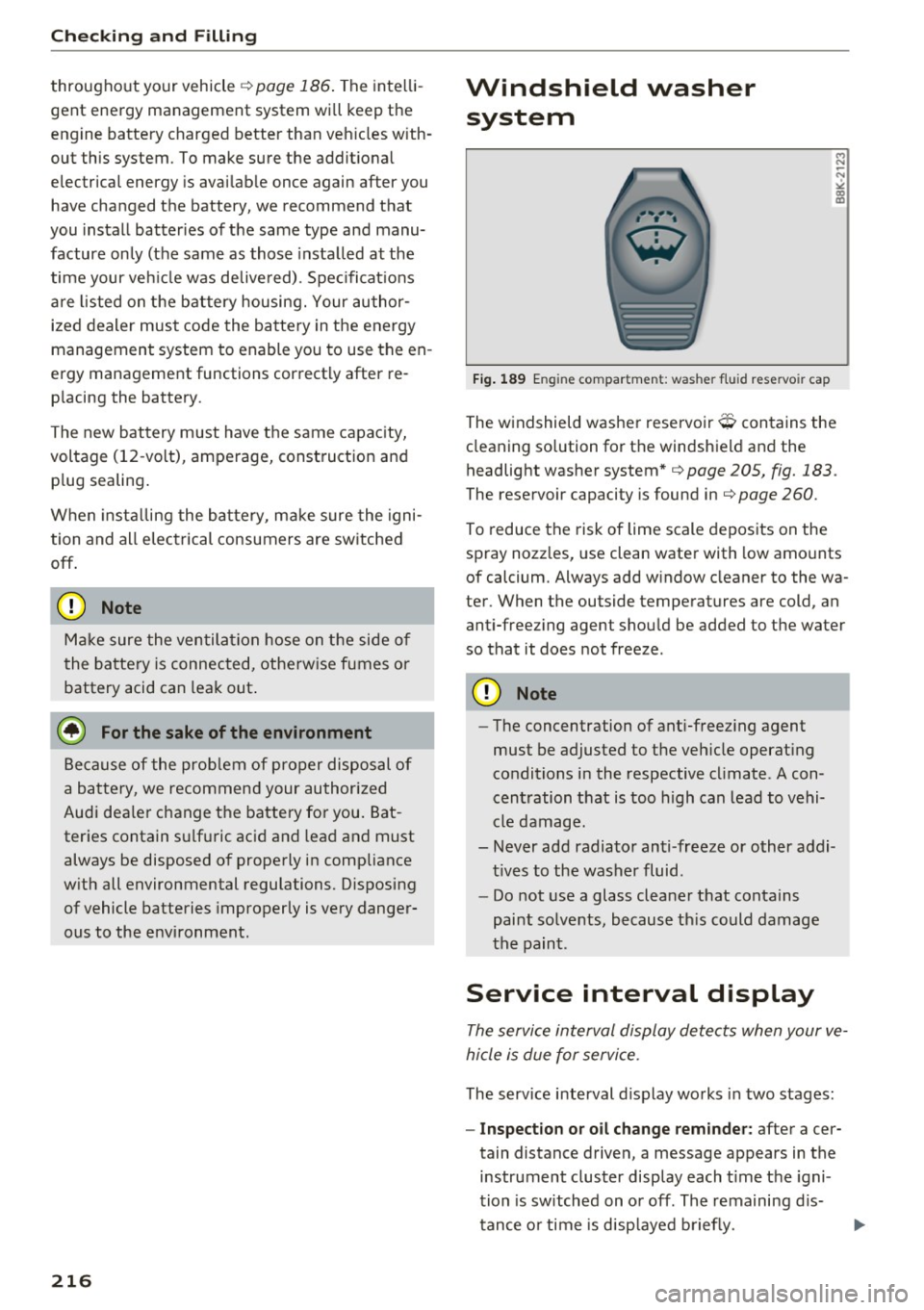
The w indshield washer reservoir O contains the
cleaning so lution for the windshie ld and the
headlight washer system *
9 page 205, fig. 183.
The reservoir capacity is found in 9 page 260 .
To reduce the risk of lime scale depos its on the
spray nozzles, use clean water with low amo unts
of calcium. Always add w indow cleaner to the wa
ter. When the outside temperatures are cold, an anti-freez ing agent shou ld be added to the water
so that it does not freeze .
(D Note
-The concentration of ant i-f reez ing agent
must be adjusted to the ve hicle operat ing
conditions i n the respective cl imate . A con
cen tration t hat is too high can lead to vehi
cle damage.
- Never ad d radia tor an ti-freeze or other addi
t ives to the washer fluid .
- Do not use a glass cleaner t hat contains
paint so lvents, because th is could damage
the pain t.
Service interval display
The service interval display detects when your ve
hicle is due for service .
The service interval d isplay wo rks i n two stages:
- Inspection or oil change rem inder: after a cer-
tain distance drive n, a message appears in the
instrument cluster display each t ime t he igni
tion is switched on o r off . The remaining d is-
t ance o r time is disp layed b riefly. .,..
Page 219 of 282
-Inspection or oil change due: If your vehicle
has reached an inspection or oi l change interval
or both intervals at the same time, the mes
sage
Inspection due! or Oil change due! or Oil
change and inspection due!
appears briefly af
ter switching the ignition on/off .
Checking service intervals
You can check the remaining distance or time un
til the next oil change or next inspection in the
Car menu. To do this, select: the
ICARI function
button
> (Car)* Systems control button > Service
& control > Service intervals.
Resetting the indicator
Your authorized Audi dealer or authorized Audi
Service Facility will reset the service interval dis
p lay after performing service.
I f you have changed the oil you rself, you must re
set the oil change interval.
To reset the indicator, select: the
ICARI funct ion
button
> (Car)* Systems control button > Service
& control > Service intervals. Turn the contro l
knob downward to
Reset oil change interval and
press the control knob.
@ Note
-Only reset the oil change indicator if the oil
was changed .
- Following the service inte rvals is critical to
maintain ing the service life and va lue of
your vehicle, especially the engine . Even if
the mileage on the vehicle is low, do not ex
ceed the time for the next serv ice.
- Calcu lating the time to the next o il change
i s interrupted when the vehicle battery is
disconnected. If the veh icle is not driven for
a long period of time, check the ma inte
nance schedule so that you can follow the
maintenance intervals.
Checking and Filling
217
Page 224 of 282
Wheels
(a) Curb weight
(b) Accessory weight
(c) Vehicle capacity weight, and
(d) Production options weight
Maximum (permissible )
inflation pressure
means the maximum cold infla
tion pressure to which a tire may be inflated. Also called "maxi
mum inflation pressure ."
Normal occupant weight
means 150 lbs . (68 kilograms)
times the number of occupants
seated in the vehicle up to the to
ta l seating capacity of your vehi
c le .
Occupant distribution
means distribut ion of occupan ts
in a vehic le .
Outer diameter
means the overall diamete r of an
inflated new tire.
Overall width
means the l inear distance be
tween the exter iors of the side
walls of an infla ted tire , including
elevations due to labeling , deco
rations, or protective bands or
r ibs.
222
Ply
means a layer of rubber -coated
pa rallel cords.
Production options weight
means t he comb ined we ight of
those insta lled regular production
options weighing over 5 lbs . (2 .3
kg) in excess of those standard
items which they replace , not pre
viously considered in curb weight or accessory weight, inc luding
heavy duty brakes, ride levelers,
roof rack, heavy duty battery, and
special trim.
Radial ply tire
means a pneumatic tire in which
the ply co rds that extend to the
beads are laid at subs tantially 90
deg rees to the centerline o f the
tread .
Recommended inflation
pressure
see~ page 221, Cold tire infla
tion pressure.
Reinforced tire
means a tire designed to operate
at highe r loads and at h igher in
flat ion pressures than t he corre
spond ing standa rd tire . R ein
forced tires may be identified as .,.
Page 255 of 282
Emergency situations
General
This chapter is intended for trained emergency
crews and working personnel who have the nec
essary tools and equipment to perform these
ope rations.
Starting by pushing or
towing
(D Note
Veh icles with an automatic transmission can
not be started by pushing or towing.
Starting with jumper
cables
If necessary, the engine can be started by con
necting it to the battery of another vehicle .
If the engine shou ld fail to start because of a dis
charged or weak battery, the battery can be con
nected to the battery of
another vehicle, using a
pair of jumpe r cables to start the engine.
Jumper cables
Use only jumper cables of suffic iently large cross
section
to carry the starter current safely. Refer
to the manufacturer's specifications.
Use only jumper cables with
insulated term inal
clamps which are dis tinct ly marked :
plus(+) cable in most cases colored re d
minus( -) cable
in most cases colored blac k.
A WARNING
Batteries contain electricity, acid, and gas.
Any of these can cause very serious or fatal in
jury. Follow the instructions below for safe
handling of your vehicle's battery.
- Always shield your eyes and avo id leaning
over the battery whenever poss ible.
- A discharged battery can freeze at tempera
tures just below 32 °F (0 °C) . Before con
necting a jumper cable, you must thaw the
Emergency situations
frozen battery completely, otherwise it
could explode .
- Do not allow battery acid to contact eyes or
skin. Flush any contacted area with water immediately.
- Improper use of a booster battery to start a
vehicle may cause an exp losion.
- Vehicle batteries generate exp losive gases.
Keep sparks, flame and lighted cigarettes
away from batteries.
- Do not try to jump start any vehicle with a
low acid level in the battery .
- The vo ltage of the booster battery must also
have a 12-volt rating. The capacity (Ah) of
the booster battery should not be lower
than that of the discharged battery. Use of
batter ies of different voltage or substantial
ly different "Ah" rating may cause an exp lo
sion and personal injury .
- Never charge a frozen battery. Gas trapped
in the ice may cause an explosion.
- Never charge or use a battery that has been
frozen . The battery case may have be weak
ened .
- Use of batter ies of different voltage or sub
stantially different capacity (Ah) rating may
cause an exp losion and injury. The capac ity
(Ah) of the booster battery should not be
lowe r than that of the discharged battery.
- Before you check anything in the eng ine
compartment, always read and heed all
WARNINGS
r::!)page 203.
(D Note
-Applying a higher voltage booster battery
will cause expensive damage to sensitive
electronic components, such as control
units, relays, radio, etc.
- Th ere must be no electrical contact between
the vehicles as otherwise current could al
ready start to flow as soon as the positive
(+) terminals are connected.
(D Tips
The discharged battery must be properly con-
nected to the vehicle's e lectrical system. ..,.
253
Page 256 of 282

Emergency situations
When jump starting or charging the battery,
never connect the negative ground cable to
the battery negative post because the battery
manager system must be able to detect the
battery's state of charge. Always connect the
negative ground cable to the negat ive ground
post of the battery manager control unit .
Use of jumper cables
Make sure to connect the jumper cable clamps in
exactly the order described below!
Fig. 212 Engine compartment: connectors for ju mp start
cab les a nd charger
® .--l @
Fig. 213 Ju mp start ing wit h the battery o f another vehicle:
@ -boos te r battery ,® -discharged vehicle battery
The procedure described below for connecting
jumper cables is intended to provide a jump start
for your vehicle.
Vehicle with discharged battery:
• Turn off lights and accessories , move lever of
automatic transmission to N (Neutral) or P
(Park) and set parking brake .
Connect POSITIVE(+) to POSITIVE(+) (red)
• Open the red cover on the positive term inal
~ fig . 212.
254
1. Connect one end of the red positive cable on
the
jump start bolt 9 fig. 213 @ (bolt under
the red cover= "positive") of the vehicle to be
started ®·
2. Connect the other end to the positive termi-
nal@ of the booster battery @.
Connect NEGATIVE (- ) to NEGATIVE (-)
(black)
3. Connect one end of the black negative cable
to the negative term inal @ of the booster
battery @.
4 . Connect the other end to the
jump start pin
@ (bolts with hex head bolt= "negat ive") of
the vehicle to be started ®·
Starting the engine
• Start the eng ine of the vehicle with the booster
battery @. Run the engine at a moderate
speed.
• Sta rt engine w ith discharged vehicle ba ttery @
in the usual manner.
• If the engine fails to start, do not keep the
starter cranking for longer than 10 seconds.
Wait for about 30 seconds and then try again.
• With engine running, remove jumper cables
from both vehicles in the exact
reverse order.
• Close the red cover on the positive terminal.
The battery is vented to the outside to prevent gases from entering the vehicle interior . Make
sure that the jumper clamps are well connected
with their metal parts in full contact with the battery terminals.
&_ WARNING
To avoid ser ious personal injury and damage
to the vehicle, heed all warnings and instruc
tions of the jumper cable manufacturer. If in
doubt, call for road service.
- Jumper cables must be long enough so that
the vehicles do not touch.
- When connecting jumper cables, make sure
that they cannot get caug ht in any moving
parts in the engine compartment.
- Before you check anything in the engine
compartment, always read and heed all
WARNINGS
¢ page 203.
Page 257 of 282
(D Note
Im pro per hook-u p of jum per cables can ru in
the gene ra tor.
- Always connect P OSITI VE( +) to POS ITI VE
( + ), and NEGATIVE( -) to NEGATIVE( -)
ground post of t he battery manager contro l
u nit .
- Check that a ll sc rew p lugs on the battery
ce lls a re sc rewed in firmly . If not, t igh ten
pl ugs p rio r to connecting clamp on negative
batte ry te rminal.
- Please note t hat the procedure fo r con nect
i ng a jumper cab le as desc ribe d above ap
p lies specifica lly to the case of yo ur vehicle
being jump s tarte d. W hen you are giv ing a
ju mp s ta rt to an othe r vehicl e, do
not con
n ect t he nega tive (- ) ca b le t o t he nega tive
(-) t ermin al on the di scharged battery @
c::> fig . 2 13 . Instead, securely connec t the
negative (-) cable to either a solid metal
com ponent that is f irm ly bolted t o the e n
gine block o r to t he engine bloc k itsel f. If
the battery that is be ing c ha rge d d oes not
vent to the outs ide, escap ing batte ry gas
could ignite and e xplode!
Towing with a tow truck
General hints
Your Audi require s speci al handling f or towing.
Th e follow ing informat ion is to be used by com
mercia l tow tr uck o pera tors who know how to op
e rat e the ir equip men t sa fely.
- Never tow your Audi. Towing will cause dam
age to the engine and transmission .
- Never wrap the safety chains or winch cables
around the brake lines.
- To prevent unnecessary damage, your Audi
must be transported with a flat bed truck.
- To load the vehicle on to the flat bed, use the
towing loop found in the vehicle tools and at
tach to the front or rear anchorage
c::> page 255 and c::> pag e 256 .
Emergency situations
A WARNING
-A vehicle being towe d is not safe for passen-
ge rs. Neve r allow a nyo ne to ride in a vehicle
b eing towed, for any reason.
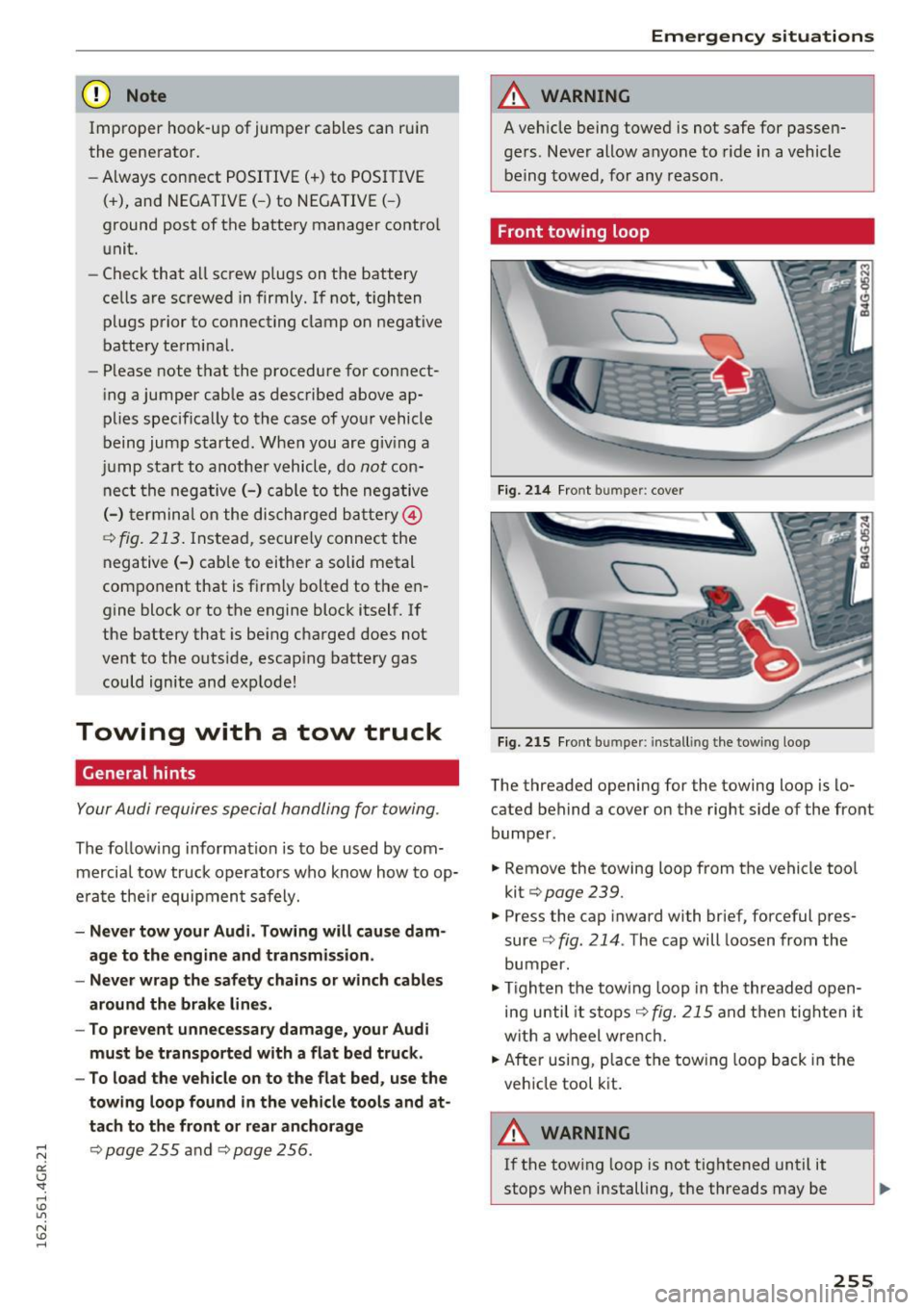
Front towing loop
Fi g. 214 Fron t bumper: cover
Fig. 215 Fron t bumper: installing the tow ing loop
The threaded opening for the towing loop is lo
cated behind a cover on the rig ht side of the front
bumper .
.,. Remove the towing loop from the vehicle too l
kit<=>
page 239.
.,. Press the cap inward with brief, forceful pres
sure <=>
fig. 214 . The cap will loosen from the
bumper.
.,. Tigh ten t he towing loop in the threaded o pen
ing until it sto ps
c::> fig. 215 and t hen tig hten it
w it h a wheel wre nc h .
.,. After usi ng, p lace the tow ing loop ba ck in t he
ve hicle tool kit.
A WARNING
--
If t he tow ing loop is not tig htened until it
stops when installing, t he threads may be
255
Page 269 of 282
Anti-theft systems Electronic immobilizer . . . . . . . . . . . . . . . . . 31
Ashtray . . . . . . . . . . . . . . . . . . . . . . . . . . . . . . 58
Audi drive select
refer to Drive select . . . . . . . . . . . . . . . . . . . 95
Audi Service Repair Manuals and Literature 262
AUTO 4-z one deluxe automatic climate control . . 68
Automatic headlights . . . . . . . . . . . . . . . . . 43
Auto Lock . . . . . . . . . . . . . . . . . . . . . . . . . . . . 32
Automatic belt retractor . . . . . . . . . . . . . . . 130
Automatic post-collision brak ing system . . 181
Automatic Shift Lock (ASL) . . . . . . . . . . . . . 102
Automatic transmission . . . . . . . . . . . . . . . . 101
Automatic Shift Lock (ASL) . . . . . . . . . . . . 102
Driving . . . . . . . . . . . . . . . . . . . . . . . . . . . . 103
E mergency mode . . . . . . . . . . . . . . . . . . . . 105
Emergency release . . . . . . . . . . . . . . . . . . . 106
Kick-down . . . . . . . . . . . . . . . . . . . . . . . . . . 105
Manual shift program . . . . . . . . . . . . . . . . 105
Selector lever . . . . . . . . . . . . . . . . . . . . . . . 101
Automatic wipe/wash system . . . . . . . . . . . . 49
Auto Safety Hotline . . . . . . . . . . . . . . . . . . . 125
Average consumption . . . . . . . . . . . . . . . . . . . 23
Average speed . . . . . . . . . . . . . . . . . . . . . . . . 23
Avoid damaging the vehicle . . . . . . . . . . . . . 188
B
Battery . . . . . . . . . . . . . . . . . . . . . . . . . . . . . 212
Charge level . . . . . . . . . . . . . . . . . . . . . . . . 186
Charg ing ... .. ............... .. .... . 214
Energy management . . . . . . . . . . . . . . . . . 186
I mportant warn ings .......... .. .. .. . 213
Jump starting . . . . . . . . . . . . . . . . . . . . . . . 253
Location . . . . . . . . . . . . . . . . . . . . . . . . . . . 213
Replacing the battery . . . . . . . . . . . . . . . . 215
Winter operation . . . . . . . . . . . . . . . . . . . . 212
Working on the battery . . . . . . . . . . . . . . . 213
Before driving . . . . . . . . . . . . . . . . . . . . . . . . 118
Belt tensioners . . . . . . . . . . . . . . . . . . . . . . . 133
Blended gasoline . . . . . . . . . . . . . . . . . . . . . 198
Blower (4-zone deluxe automatic climate con-
trol) . . . . . . . . . . . . . . . . . . . . . . . . . . . . . . . . . 69
Boost display . . . . . . . . . . . . . . . . . . . . . . . . . 26
Booster seats . . . . . . . . . . . . . . . . . . . . . . . . 168
Boost pressure indicator . . . . . . . . . . . . . . . . 26
Index
Brake fluid
Changing the brake fluid . . . . . . . . . . . . . . 212
Checking the brake fluid level . . . . . . . . . . 211
Brakes Indicator light . . . . . . . . . . . . . . . . . . . . . . . 20
Brake system Anti-lock braking system . . . . . . . . . . . . . . . 18
Brake booster . . . . . . . . . . . . . . . . . . . . . . . 183
Brake fluid . . . . . . . . . . . . . . . . . . . . . . . . . 211
Brake fluid specifications for refill and re
placement . . . . . . . . . . . . . . . . . . . . . . . . . 212
Brake power assist unit . . . . . . . . . . . . . . . 182
Brakes..... ... .. .. ................ . 182
Electromechanical parking brake . . . . . . . . 7 4
Fluid reservoir . .. .. ............... .. 211
Warning/indicator lights . . . . . . . . . . . . . . . 14
Worn brake pads symbol . . . . . . . . . . . . . . . 19
Braking Brake assist . . . . . . . . . . . . . . . . . . . . . . . . 180
Emergency braking function . . . . . . . . . . . . 76
Braking guard . . . . . . . . . . . . . . . . . . . . . . . . . 79
Messages . . . . . . . . . . . . . . . . . . . . . . . . . . . 86
Settings . . . . . . . . . . . . . . . . . . . . . . . . . . . . 86
Break-in period
Brake pads . . . . . . . . . . . . . . . . . . . . . . . . . 182
T ires ......... .... ................ .
Breaking in
New tires
C
188
188
225
California Proposition 65 Warning . . . . . . . 204
Battery specific . . . . . . . . . . . . . . . . . . . . . 214
Capacities . . . . . . . . . . . . . . . . . . . . . . . . . . . 260
Engine oil . . . . . . . . . . . . . . . . . . . . . . . . . . 205
Car carrier Transporting your vehicle . . . . . . . . . . . . . 256
Care . . . . . . . . . . . . . . . . . . . . . . . . . . . . . . . . 193
Cargo area . . . . . . . . . . . . . . . . . . . . . . . . . . . 124
Cargo net . . . . . . . . . . . . . . . . . . . . . . . . . . . . 64
Catalytic converter . . . . . . . . . . . . . . . . . . . . 189
Center armrest Cockpit . . . . . . . . . . . . . . . . . . . . . . . . . . . . . 55
Central locking . . . . . . . . . . . . . . . . . . . . . . . . 31
Emergency locking . . . . . . . . . . . . . . . . . . . . 36
Power windows . . . . . . . . . . . . . . . . . . . . . . 40
Setting . . . . . . . . . . . . . . . . . . . . . . . . . . . . . 33
Sunroof. . . . . . . . . . . . . . . . . . . . . . . . . . . . . 40
267
Page 272 of 282
Index
Starting . . . . . . . . . . . . . . . . . . . . . . . . . . . . 72
Starting with jumper cables . . . . . . . . . . . 253
Stopping . . . . . . . . . . . . . . . . . . . . . . . . . . . . 73
Engine compartment . . . . . . . . . . . . . . . . . . 205
Closing the hood . . . . . . . . . . . . . . . . . . . . 204
Opening the hood . . . . . . . . . . . . . . . . . . . 203
Safety instructions . . . . . . . . . . . . . . . . . . . 203
Working in the engine compartment . . . . 203
Engine coolant . . . . . . . . . . . . . . . . . . . . . . . 209
Adding coolant .. ............. .... .. . 210
Checking the engine coolant level. . . . . . . 209
Expansion tank . . . . . . . . . . . . . . . . . . . . . . 209
Radiator fan .... ................ .... 211
Temperature gauge . . . . . . . . . . . . . . . . . . . 10
Engine oil . . . . . . . . . . . . . . . . . . . . . . . . . . . 205
Adding . . . . . . . . . . . . . . . . . . . . . . . . . . . . 207
Additives . . . . . . . . . . . . . . . . . . . . . . . . . . . 207
Changing . . . . . . . . . . . . . . . . . . . . . . . . . . 208
Checking oil level . . . . . . . . . . . . . . . . . . . . 207
Consumption . . . . . . . . . . . . . . . . . . . . . . . 207
Indicator light . . . . . . . . . . . . . . . . . . . . . . . 16
Oil consumption . . . . . . . . . . . . . . . . . . . . . 206
Pressure malfunction . . . . . . . . . . . . . . . . . 16
Sensor defective . . . . . . . . . . . . . . . . . . . . . . 20
Specification and viscosity . . . . . . . . . . . . . 205
Temperature ind icator . . . . . . . . . . . . . . . . . 26
Eng ine sound . . . . . . . . . . . . . . . . . . . . . . . . . 95
Engine speed limitation (indicator light) 20
Engine warm-up request
I ndicator l ight . . . . . . . . . . . . . . . . . . . . . . .
20
Environment
Catalytic converter . . . . . . . . . . . . . . . . . . .
189
Disposing of your vehicle battery . . . . . . . 215
Driving at high speeds . . . . . . . . . . . . . . . . 191
Fuel. .... .. .. .. ... .......... .. .. .. . 200
Leaks under your vehicle . . . . . . . . . . . . . . 203
Letting the vehicle stand and warm up. .. 191
Proper disposal of drained brake fluid . . . 212
Proper disposal of drained engine coolant 210
Proper disposal of drained engine oil 207, 208
Recycling used engine oil . . . . . . . . . . . . . 207
Unleaded fuel . . . . . . . . . . . . . . . . . . . . . . . 198
What should I do with an old battery? . . . 215
ESC
Automatic post-co llision braking system .
181
Event Data Recorder (EDR) . . . . . . . . . . . . . 179
E . k xpans1on tan . . . . . . . . . . . . . . . . . . . . . . . 209
270
Exterior lighting . . . . . . . . . . . . . . . . . . . . . . . 43
Exterior mirrors
Adjusting . . . . . . . . . . . . . . . . . . . . . . . . . . . 47
D' .
1mming ............................
48
Heating... .. .. .. .. .. ............. ... 47
Exterior temperature display . . . . . . . . . . . . .
22
F
Fastening
Booster seats . . . . . . . . . . . . . . . . . . . . . . .
168
Convertible child safety seats . . . . . . . . . . 166
Infant seats . . . . . . . . . . . . . . . . . . . . . . . . 165
Floor mats . . . . . . . . . . . . . . . . . . . . . . . . . . . 123
Foot pedals . . . . . . . . . . . . . . . . . . . . . . . . . . 123
For the sake of the environment
Environmentally-friendly driving . . . . . . .
190
Gasoline fumes and the environment . . . . 200
Reducing eng ine noise by early upsh ifting . 10
Refueling . . . . . . . . . . . . . . . . . . . . . . . . . . 200
Saving fuel by early upshifting . . . . . . . . . . 10
w . th .
arming up e engine . . . . . . . . . . . . . . . . 72
Front airbags
D . t· escnp 10n . . . . . . . . . . . . . . . . . . . . . . . . . 139
How they work . . . . . . . . . . . . . . . . . . . . . . 144
Frontal collisions and the laws of physics . . 128
Front seats . . . . . . . . . . . . . . . . . . . . . . . . . . . 53
Adjusting . . . . . . . . . . . . . . . . . . . . . . . . . . 120
Child restraints in the front seat . . . . . . . . 136
Fuel
Additives . . . . . . . . . . . . . . . . . . . . . . . . . . .
198
Blended gasoline . . . . . . . . . . . . . . . . . . . . 198
Current consumpt ion . . . . . . . . . . . . . . . . . . 23
Fuel filler neck . . . . . . . . . . . . . . . . . . 199, 200
Fuel gauge . . . . . . . . . . . . . . . . . . . . . . . 10, 11
Gasoline . . . . . . . . . . . . . . . . . . . . . . . . . . . 198
Gasoline additives . . . . . . . . . . . . . . . . . . . 199
Indicator light . . . . . . . . . . . . . . . . . . . . . . . 20
Octane rating . . . . . . . . . . . . . . . . . . . . . . . 198
Recommendation. . . . . . . . . . . . . . . . . . . . 198
Refuelling . . . . . . . . . . . . . . . . . . . . . . . . . . 200
Saving fuel . . . . . . . . . . . . . . . . . . . . . . . . . 190
T k . an capacity . . . . . . . . . . . . . . . . . . . . . . . 260
Fueling
Fuel filler door emergency release . . . . . .
201
Fuel gauge . . . . . . . . . . . . . . . . . . . . . . . . . . 11
Page 274 of 282
Index
Key replacement . . . . . . . . . . . . . . . . . . . . . 30
Master key . . . . . . . . . . . . . . . . . . . . . . . . . . 30
M echanical key . . . . . . . . . . . . . . . . . . . . . . . 30
Replac ing the battery . . . . . . . . . . . . . . . . . 31
Kick-down tiptron ic . . . . . . . . . . . . . . . . . . . . . . . . . . . 105
Knee airbags . . . . . . . . . . . . . . . . . . . . . . . . . 15 1
D escr ipt io n . . . . . . . . . . . . . . . . . . . . . . . . . 151
H ow t hey wo rk . . . . . . . . . . . . . . . . . . . . . . 15 2
I mport ant safety ins truc tions . . . . . . . . . . 15 3
L
Lane assist
refer to A ct ive lane assis t . . . . . . . . . . . . . . 88
Lap t imer . . . . . . . . . . . . . . . . . . . . . . . . . . . . . 27
E valuating t imes . . . . . . . . . . . . . . . . . . . . . 28
P aus ing timing . . . . . . . . . . . . . . . . . . . . . . . 27
Starting . . . . . . . . . . . . . . . . . . . . . . . . . . . . 27
LATCH .............................. 172
Descr ipt io n . . . . . . . . . . . . . . . . . . . . . . . . . 173
Installing a child restraint ............ . 174
L ocation . . . . . . . . . . . . . . . . . . . . . . . . . . . 173
M ount ing and releasing the anchorage
hook . . . . . . . . . . . . . . . . . . . . . . . . . . . . . . 174
Leather care/cleaning . . . . . . . . . . . . . . . . . 196
L eaving home . . . . . . . . . . . . . . . . . . . . . . . . . 4 5
Lifting jack . . . . . . . . . . . . . . . . . . . . . . . . . . 24 5
Light Ambient lighting . . . . . . . . . . . . . . . . . . . . . 46
Com ing/Leav ing home ... ... ... .. .. .. .. 45
Daytime runni ng lights . . . . . . . . . . . . . . . . 43
E me rgency flashe rs . . . . . . . . . . . . . . . . . . . 46
H eadlig ht assistant . . . . . . . . . . . . . . . . . . . 44
H igh beam . . . . . . . . . . . . . . . . . . . . . . . . . . 44
I n terior/reading lig hts . . . . . . . . . . . . . . . . 4 6
L ow beams . . . . . . . . . . . . . . . . . . . . . . . . . . 43
Parking lights . . . . . . . . . . . . . . . . . . . . . . . . 43
Rear fog lights . . . . . . . . . . . . . . . . . . . . . . . 43
Turn signa ls . . . . . . . . . . . . . . . . . . . . . . . . .
44
Light/ rain sensor
Headlig hts . . . . . . . . . . . . . . . . . . . . . . . . . . 4 3
Indicator light . . . . . . . . . . . . . . . . . . . . . . . 21
Intermittent (w indshield wipers) . . . . . . . . 49
Lighting Exterior . . . . . . . . . . . . . . . . . . . . . . . . . . . . . 43
I nterior . . . . . . . . . . . . . . . . . . . . . . . . . . . . . 46
272
Lights
Head light range cont rol system . . . . . . . . .
43
Load ing the roof rac k . . . . . . . . . . . . . . . . . . . 62
Locking
Power lock ing switc h . . . . . . . . . . . . . . . . . . 35
Remote control . . . . . . . . . . . . . . . . . . . . . . 33
U sing the key . . . . . . . . . . . . . . . . . . . . . . . . 35
Low beam Ind icator light . . . . . . . . . . . . . . . . . . . . . . . 20
Low beams . . . . . . . . . . . . . . . . . . . . . . . . . . . 43
Lowe r universal anchorages (Canada) . . . . . 172
Luggage compartment 12 Vo lt socket . . . . . . . . . . . . . . . . . . . . . . . 59
Cargo net . . . . . . . . . . . . . . . . . . . . . . . . . . . 64
Cover ..... ... ... ... ...... ....... .. .. 63
E nla rgi ng . . . . . . . . . . . . . . . . . . . . . . . . . . . 64
Load ing ...... ... .... ..... ...........
62
Revers ib le mat . . . . . . . . . . . . . . . . . . . . . . . 65
Ski sa ck . . . . . . . . . . . . . . . . . . . . . . . . . . . . . 65
Storing c argo cor rec tly . . . . . . . . . . . . . . . 124
Stowing luggage . . . . . . . . . . . . . . . . . . . . 124
Tie-downs . . . . . . . . . . . . . . . . . . . . . . . . . . . 64
Tr unk pass-throug h . . . . . . . . . . . . . . . . . . .
66
Luggage compartmen t lid
Closi ng b utton . . . . . . . . . . . . . . . . . . . . . . . 36
Emergency release . . . . . . . . . . . . . . . . . . . . 38
movement-activated opening . . . . . . . . . . . 38
Opening/closing . . . . . . . . . . . . . . . . . . . . . . 36
Lumbar sup port
Front seats . . . . . . . . . . . . . . . . . . . . . . . . . . 54
M
Maintenance . . . . . . . . . . . . . . . . . . . . . . . . . 262
Maintenance intervals . . . . . . . . . . . . . . . . . 216
Malfunc tion Ind icator Lamp (M IL) . . . . . 19, 28
Manua l shift p rogram . . . . . . . . . . . . . . . . . 105
Massage function Front seats . . . . . . . . . . . . . . . . . . . . . . . . . . 54
Mech anica l key . . . . . . . . . . . . . . . . . . . . . . . . 30
Memory f unct io n
56
Mirror Vanity mirror . . . . . . . . . . . . . . . . . . . . . . . . 49
Mir rors
dimming . ... .. .. .. .. ... .. ..... ... .. . 48
Exterior mi rro rs . . . . . . . . . . . . . . . . . . . . . . 47
Monito ring the Advanced Airbag System . . 146