belt AUDI RS7 SPORTBACK 2016 Service Manual
[x] Cancel search | Manufacturer: AUDI, Model Year: 2016, Model line: RS7 SPORTBACK, Model: AUDI RS7 SPORTBACK 2016Pages: 282, PDF Size: 70.78 MB
Page 158 of 282
Airbag syste m
by being pushed into you as the airbag in
flates.
- Never p lace or attach accessories or other
objects (such as cup holders, telephone brackets, or even large, bulky objects) on
the doors, over or near the area marked
"AIRBAG" on the seat backrests.
- Such objects and accessories can become
dangerous projectiles and cause in ju ry
when the supplemental side airbag de ploys.
- Never carry any objects or pets in the de ployment space between them and the
airbags or allow children or other passen
gers to travel in this position.
- Always use the built-in coat hooks only for
lightweight clothing. Never leave any heavy
or sharp-edged objects in the pockets that
may interfere w ith side airbag deployment
and can cause personal i njury in an accident.
- Always prevent the side airbags from being
damaged by heavy objects knocking against
or hitting the sides of the seatbacks.
- The airbag system can only be triggered
once. If the airbag has been triggered, the
system must be replaced by an author ized
Audi dealership.
- Damage (cracks, deep scratches etc.) to the
orig inal seat covers or to the seam in the
area of the side a irbag mod ule m ust always
be repa ired immed iate ly by an authorized
Audi dealer .
- If children are sea ted improperly, their r is k
of injury increases in the ca se of an ac ciden t
~ page 159, Child safety .
-Never attempt to modify any components of
the a irbag sys tem in any way.
- In a side collision, side a irbags w il l not fu nc
t ion properly if sensors cannot correct ly
measure increasi ng air pressure ins ide the
doo rs when air escapes through larger, un
closed openings in the door panel.
- Never drive w ith inter io r door tr im panels
removed .
- Never drive when parts have been re
moved from the inside doo r panel and the
open ings they leave have not been proper
ly closed.
156
- Never drive when loudspeakers in the
doors have been removed unless the
speaker holes have been properly closed.
- Always make certain that openings are
covered or filled if additional speakers or
other equipment is installed i n the inside
door panels.
- Always have work on the doors done by an
authorized Aud i dealer or q ualified work
shop.
Side curtain airbags
Description of side curtain airbags
The side curtain airbag system can provide sup
plemental protection to properly restrained oc
cupants.
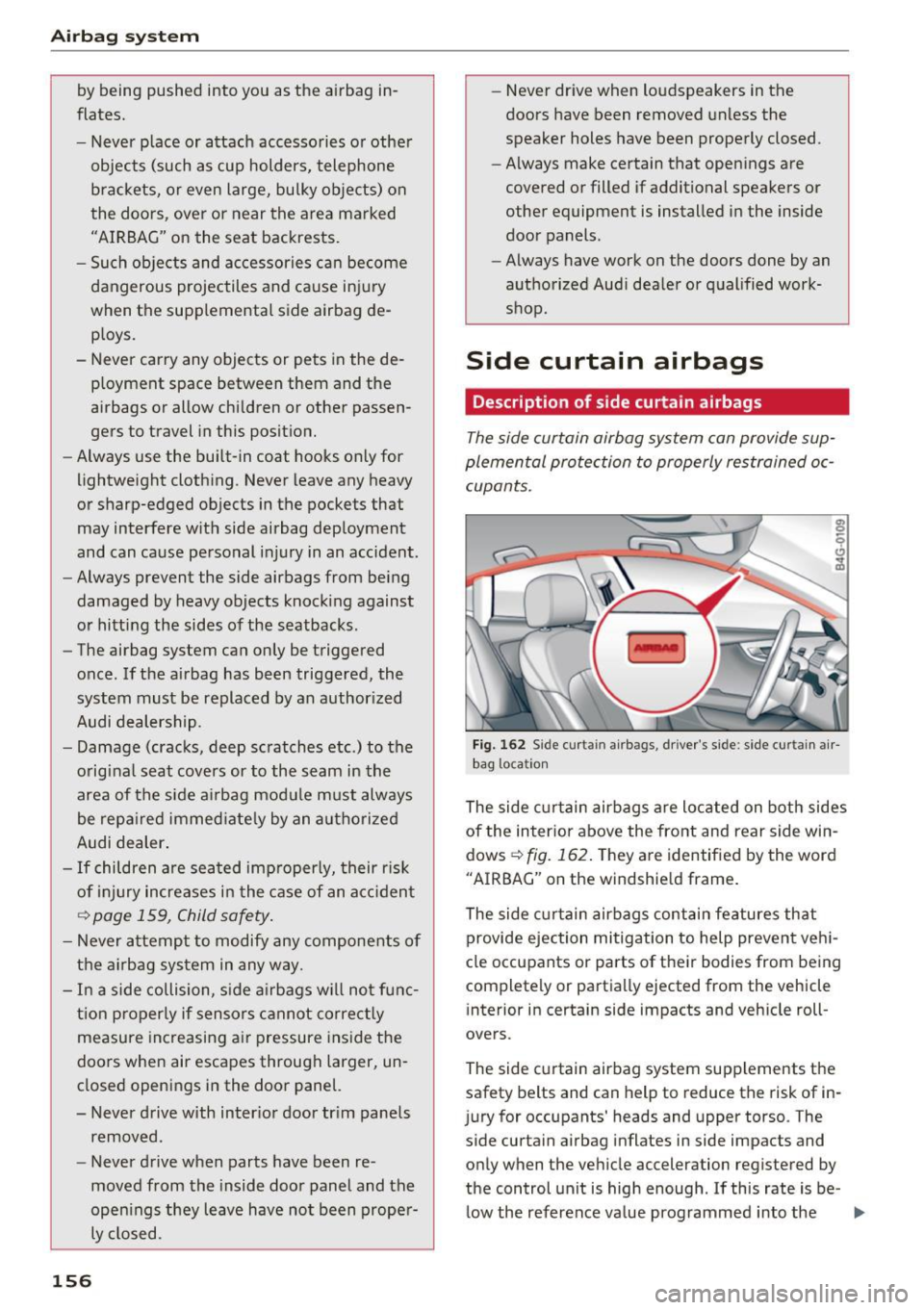
Fig. 162 S id e curt ain airbags, driver's sid e: side curtain a ir
bag locatio n
The side curtain airbags are located on both sides
of the inter ior above the fro nt and rear side win
dows~
fig. 162. T hey are identified by the word
"AIRBAG" on the windshie ld frame .
The side curtain airbags contain features that
provide ejection mitigation to help prevent veh i
cle occupants or parts of their bodies from being
completely or partially ejected from the vehicle i nterior in certain side impacts and vehicle roll
overs .
The side c urtain airbag system supplements the
safety belts and can help to reduce the risk of in
j ury for occupants' heads and upper torso . The
s ide curtain airbag inflates in side impacts and
only when the vehicle acceleration registered by
the control unit is high enough. If th is rate is be-
low the reference va lue programmed into the .,.
Page 159 of 282
control unit, the side curtain airbag will not be
triggered, even though the car may be badly
damaged as a result of the collision. It is not pos
sib le to define an airbag tr iggering range that
will cover every possib le angle of impact, since
the circumstances will vary considerably between
one collision and another. Important facto rs in
clude, for example, the nature (hard or soft) of
the impacting object, the angle of impact, vehicle speed, etc.
c:::, page 15 7, How side curtain air
bags work.
Aside from their normal safety function, safety
be lts work to he lp keep the driver or front pas
senger in posit io n in the event of a collision so
that the side curtain airbags can provide protec
tion.
The a irbag sys tem is not a s ubst itute for yo ur
safety bel t. Rat her, it is part of the overa ll occu
pant restraint system in your veh icle. Always re
member that the airbag system can only help to
protect yo u if you are wearing your safety belt
and wearing it properly . This is another reason
why you should always wear your safety belts,
not just because the law requires you to do so
c:::, page 127, General information .
It is important to remember that while the s ide
curta in airbag system is designed to help reduce
the likelihood of serious injuries, other injuries,
for example, swelling, bruising, friction burns
and minor abrasions can also be associated with
these airbags upon deployment . Remember too,
these airbags will deploy only once and only in cert ain kin ds of ac ciden ts -you r safe ty belts are
a lways there to offer protection.
The side curtain airbag system basically
consists of:
- The elec tronic contro l module and external s ide
impact sensors
- The side curtain airbags above the front and
rear s ide windows w it h ejection mi tigation fea
tures
- T he airbag indicator light in the instrument
panel
The airbag system is monitored e lectronically to
make certain it is fu nct ion ing properly at all
t imes. Each time you sw itch on the ig nition, the
Airb ag sys tem
airbag system ind icator light wi ll come on for a
few seconds (se lf diagnostics).
The side curtain airbag is not activated:
- if the ignition is sw itched off,
- in side co llisions when the acceleration meas-
ured by the sensor is too low,
- in rear-end collisions .
A WARNING
-
-Safety bel ts and the airbag system will only
p rov ide pro tect io n when occupants are in
the proper seat ing position
c:::, page 52, Gen
eral information.
- If the ai rbag ind icator light c:::, page 17
comes when the veh icle is being used, have
the system ins pected immediately by your
authorized Audi dealer . It is possib le that
the airbag will inflate when it is not sup
posed to, or w ill not inf late w hen it should.
How side curtain airbags work
Side curtain airbags can work together with side
airbags to help reduce the risk of head and upper
torso injuries for occupants who ore properly re
strained.
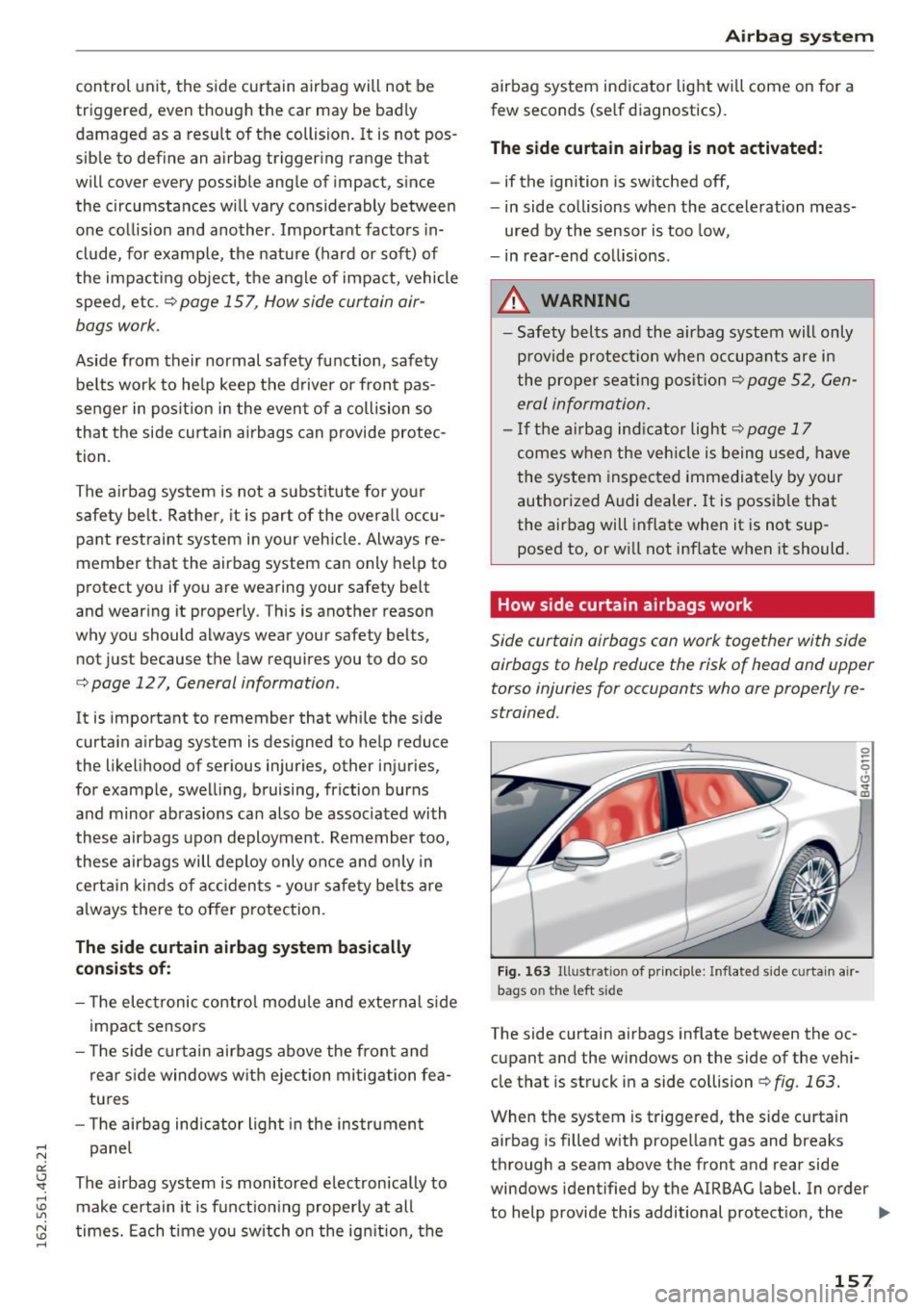
F ig. 163 Illustration of p rinciple: Inflated s ide curta in air·
bags o n the left side
The side curtain airbags inflate between the oc
cupant and the windows on the side of the vehi
cle that is struck in a side collision
c:::, fig. 163.
When the system is triggered, the s ide curtain
airbag is filled with propellant gas and breaks
through a seam above the front and rear side
windows identified by the AIRBAG label. In order
to help provide this additional protect io n, the
liJ,
157
Page 160 of 282
Airbag syste m
side curtain airbag must inflate within the blink
of an eye at very high speed and with great force .
The s ide curta in a irbag could injure you if your
seating position is not proper or upright or if
items are located in the area where the supp le
mental side curtain airbag inflates . This applies
especially to children
c:> page 159.
Although they are not a soft pi llow, side curtain
airbags can "cushion" the impact and in this way
they can help to reduce the risk of injury to the head and the upper part of the body .
A fine dust may develop when the airbag deploys.
This is quite normal and does not mean there is a
fire in the veh icle.
Important safety instructions on the side
curtain airbag system
Airbags are only supplemental restraints . Always
properly wear safety belts and ride in a proper
seating position.
There is a lot that you and your passengers must
know and do to help the safety be lts and airbags
do their job to provide supp lemental protect ion.
_& WARNING
Improperly wea ring safety belts and imprope r
seating pos it ions increase the ris k of serious
persona l injury and death whenever a vehicle
is being used.
- Never let occupan ts p lace any parts of their
bodies in the area from which the side cur
tain airbag inflate .
- Always make sure that the side curtain air
bags can inflate witho ut interference .
- U se the buil t- in coat hooks on ly for light
weight clothing. Never leave any heavy or
sharp-edged objects in the pockets that may
interfere w ith airbag deployment and can
cause personal injury in a collision.
- Never use hangers to hang clothes on the
hooks.
- Only use factory-installed s un shades or, if
shades installed after the veh icle leaves the
factory, use only genuine Aud i sun shades.
- Never swing the sun visors over to the side
windows if things such as pens, garage door
158
opene rs, hands-free speakers, etc. are at
tached to the sun visors. They could come
loose and cause serious injury if the side cur
tain airbag inflates.
- A deploying airbag inflates in a fract ion of a
second and with great force.
- Never attach objects to the cover or in the
deployment zone of a s ide curtain airbag.
- The airbag deployment zones must be kept
clear at all times. Make sure there are no
objects, pets, or other persons in the space
between any vehicle occupant and any air
bag at any time .
- Do not attach any accessories to the doors.
_& WARNING
-The airbag system can deploy on ly once. If
the airbag has been triggered, the system
must be rep laced by an author ized A udi
dea le r o r qualified wor ksh op.
- Always have wo rk involv ing the side curtain
airbag system, remova l and installat ion of
the airbag componen ts, or other repairs
pe rformed by a q ualified dea lership. Other
w ise the airbag system may not work cor
rectly.
- Never attempt to mod ify any componen ts of
the airbag system in any way .
Page 161 of 282
Child safety
Important information
Introduction
The rear seat is generally the safest place in a
collision .
The physical principles of what happens when
your vehicle is in a crash apply also to children
c:> page 128, What happens to occupants not
wearing safety belts? .
But unlike adults and
teenagers, their muscles and bones are not fully
developed. In many respects children are at
greater r isk of serious injury in crashes than
adults .
Because children's bodies are not fu lly devel
oped, they requ ire restraint systems especially
des igned for their size, we ight , and body struc
ture. Many countr ies and all states of the United
States and provinces of Canada have laws requir
ing the use of approved child restraint systems
for infants and small children .
In a frontal crash at a speed of 20-3 5 mph
(30-56 km/h) the forces acting on a 13-pound
(6 kg) infant will be more than 20 times the
weight of the child . This means the weight of the
child would suddenly be more than 260 pounds
(120 kg) . Under these conditions, only an appro
priate child restraint properly used can reduce
the risk of serious injury . Child restra ints, like
adult safety belts, must be used properly to be
effect ive. Used improperly, they can increase the
risk of serious injury in an accident .
Consult the child safety seat manufacturer's in
structions in order to be sure the seat is right for
your child's size
c:> page 162, Important safety
instructions for using child safety seats .
Please
be sure to read and heed all of the important in
formation and WARNINGS about child safety,
Advanced Airbags, and the installation of child restraints in this chapter.
There is a lot you need to know about the Ad
vanced Airbags in your vehicle and how they work
when infants and children in chi ld restraints are
on the front passenger seat . Because of the large
amount of important information, we cannot re-
Ch ild safety
peat it all here. We urge you to read the detailed
information in this owner's manual about airbags
and the Advanced Airbag System in your vehicle
and the very important information about trans
porting children on the front passenger seat.
Please be sure to heed the WARNINGS -they are
extremely important for your safety and the safe
ty of your passengers, especia lly infants and
small chi ldren.
_& WARNING
- Accident statistics have shown that children
are generally safer in the rear seat area than in the front seating position . Always restrain
any child age 12 and under in the rear.
- All vehicle occupants and especially children must be restrained properly whenever riding
in a vehicle. An unrestrained or improperly restrained child cou ld be injured by striking
the inter ior or by being ejected from the ve
h icle during a sudden maneuver or impact .
An unrestrained or improperly restrained
child is a lso at greater risk of injury or death
through contact w ith an inflating a irbag.
-A suitable ch ild restraint properly installed
and used at one of the rear seating positions
provides the h ighest degree of protect ion
for infants and small children in most acci
dent situat ions .
_& WARNING
f"-"----
Children on the front seat of any car even with
Advanced Airbags can be seriously injured or
even killed when an airbag inflates . A child in
a rearward-facing chi ld safety seat installed
on the front passenger seat will be seriously i njured and can be killed if the front airbag in
flates .
- The inflating airbag will h it the ch ild safety
seat or infant carr ier with great force and
will smash the child safety seat and child aga inst the backrest, center armrest, or
door.
- Always install rear-fac ing child safety seats
on the rear seat .
- If you must install a rearward facing child
safety seat on the front passenger seat in
159
Page 162 of 282
Child safety
exceptional circumstances and the
PASSENGER AIR BAG OFF light does not
come on and stay on, immediately install
the rear-facing child safety seat in a rear
seating position and have the airbag system inspected immediately by your Audi dealer .
A WARNING
-Forward-facing child seats installed on the
front passenger seat may interfere with the deployment of the airbag and cause serious
personal injury to the child.
- If exceptional circumstances require the use
of a forward-facing child restraint on the
front passenger's seat, the child's safety
and well-being require the following special
precautions to be taken:
- Always make sure that the forward-facing seat has been designed and certified by its
manufacturer for use on a front passenger
seat with a front and side airbag.
- Always carefully follow the manufacturer's
instructions provided with the child seat
or infant carrier.
- Never install a child restraint without a
properly attached top tether strap if the
child restraint manufacturer's instructions require the top tether strap to be used.
- Never put the forward-facing child re
straint up against or very near the instru
ment panel.
-Always set the safety belt upper anchor
age to the adjustment position that per
mits proper installation in accordance
with the child restraint manufacturer's in
structions.
- Always move the passenger seat into its
rearmost position in the seat's fore and
aft adjustment range, as far away from
the airbag as possible before installing the
child restraint. The backrest must be ad
justed to an upright position .
- Always make sure that nothing prevents
the front passenger's seat from being moved to the rearmost position in its fore
and aft adjustment range .
160
-Never place objects on the seat (such as a
laptop, CD player, electronic games de
vice, power inverter or seat heater for
child seats) . These may influence the elec
trical capacitance measured by the capaci
tive passenger detection system and can
also fly around in an accident and cause
serious personal injury.
- Never place or use any electrical device
(such as a laptop, CD player, electronic
games device, power inverter or seat heat
er for child seats) on the front passenger
seat if the device is connected to the 12-
volt socket or the cigarette lighter socket.
- If a seat heater has been retrofitted or
otherwise added to the front passenger seat, never install any child restraint sys
tem on this seat.
- Make sure that there are no wet objects
(such as a wet towel) and no water or oth
er liquids on the front passenger seat
cushion.
- Always make sure that the
PASSENGER
AIR BAG OFF
light comes on and stays on
all the time whenever the ignition is
switched on.
- If the
PASSENGER AIR BAG OFF light
does not come on and stay on, immediate ly install the forward-facing child seat in a
rear seating position and have the airbag
system inspected by your authorized Audi
dealer.
- Always buckle the child seat firmly in
place even if a child is not sitting in it. A
loose child seat can fly around during a
sudden stop or in a collision.
- Always read and heed all WARNINGS
whenever using a child restraint in a vehi
cle
¢ page 12 7, Safety belts, ¢ page 135,
Airbag system
and ¢ page 159, Impor
tant information.
(D Tips
Always replace child restraints that were in
stalled in a vehicle during a crash. Damage to
a child restraint that is not visible could cause
it to fail in another collision situation.
Page 164 of 282
Child safet y
sold in the past or will be sold ove r the course of
the useful life of your vehicle.
F or this reason, the U nited States National High
way Traffic Safety Adm inis tration has p ublished a
list of specific type, makes and models of child
restraints that must be used to certify compli
ance of the Advanced Airbag System in your vehi
cle with the suppression requ irements of Federal
Motor Vehicle Safety Standard 208. These child
restraints are:
Subpart A - Car bed child re straint s
Model Manufactured on or
after
Angel Guard Angel September 25, 2007
Ride AA2403FOF
Subp art B -Rear-facing child restr aint s
Model Manufactured on or
after
Century SmartFit 4543 December 1, 1999
Cosco Arriva September 25, 2007
22-013PAW and base
22-999WHO
E venflo Discovery Ad- December 1, 1999
jus t Right 21 2
Evenflo First Cho ice December 1, 1999
204
Graco Infant 8457
December 1, 1999
Graco Snug ride September 25, 2007
Peg Perego Primo V iag- September 25, 2007
gio SIP IMUNOOUS
Subpart C - Forward -facing and convertib le
child restraint s
Model Manufactured on or
after
Britax Roundabout September 25, 2007
E9L02xx
Cosco Touriva 02519 December 1, 1999
Cosco S umm it Deluxe September 25, 2007
High Back Booste r
2 2-262
Cosco High Back Boos- September 25, 2007
ter 22-209
162
Model Manufactured on or
after
Evenflo Tribute V September 25, 2007
379xxxx
E venflo Meda llion 254 December 1, 1999
Evenflo Generat ions September 25, 2007
352xxxx
Graco ComfortSport September 25, 2007
Graco Toddler Safety September 25, 2007
Seat Step 2
Graco Plat inum Cargo September 25, 2007
A WARNING
To reduce the risk of serious injury, make sure
that the
PASSENGER AIR BAG OFF light
comes on and stays on whenever a ch ild re
stra int is installed on the front passenger seat
and the ign ition is swi tched on.
- Take the child restra int off the front passen
ge r seat and install it prope rly at one of the
rear sea t positions i f the
PASSENGER AIR
BAG
OFF light does no t stay on .
-Have the ai rbag system in spec ted by y our
author ized Audi dealer immed iate ly.
(D Tips
The child seats listed in categor ies A to C have
been statically tested by Audi only for the Ad
van ced A irbag fun ction.
Important safety instructions for using
child safety seats
Correct use of child safety sea ts substantially re
duces the risk of injury in an accident!
As the dr iver, yo u are responsib le for the safety
of eve rybody in the veh icle, e speci ally childre n:
.,. Always use the right c hild safety seat for each
child and always use it properly
~ page 165.
.,. Always carefully follow t he chi ld safety seat
man ufac turer's ins truc tions on how to route
t he sa fety belt properly th ro ugh the ch ild safe
ty seat.
.,. When using the vehicle safety belt to install a
child sa fety seat, yo u must first activate the
convertib le locking retracto r on the safety belt
Ill-
Page 165 of 282
to prevent the child safety seat from moving
¢page 169.
~ Push the child safety seat down with your full
weight to get the safety belt really tight so that
the seat cannot move forward or sideways
more than one inch (2.5 cm).
~ Secure unused safety belts on the rear seat
¢ page 164.
Always remember: Even though your vehicle is
equipped with an Advanced Airbag system, all
children, especially those 12 years and younger,
should always ride in the back seat properly re
strained for their age and size.
_& WARNING
Not using a child safety seat, using the wrong
child safety seat or improperly installing a
child restraint increases the risk of serious
personal injury and death.
-All vehicle occupants and especially children must be restrained properly whenever riding
in a vehicle. An unrestrained or improperly
restrained child could be injured by striking
the interior or by being ejected from the ve
hicle during a sudden maneuver or impact.
An unrestrained or improperly restrained
child is also at greater risk of injury or death
through contact with an inflating airbag.
- Commercially available child safety seats
are required to comply with U.S. Federal
Motor Vehicle Safety Standard (FMVSS) 213
(in Canada CMVSS 213).
- When buying a child restraint, select one
that fits your child and the vehicle.
- Only use child restraint systems that fully
contact the flat portion of the seat cush
ion. The child restraint must not tip or
lean to either side. Audi does not recom
mend using child safety seats that rest on
legs or tube-like frames. They do not pro
vide adequate contact with the seat.
-Always heed all legal requirements per
taining to the installation and use of child
safety seats and carefully follow the in
structions provided by the manufacturer
of the seat you are using.
Child safety
- Never allow children under 57 inches
(1.45 meters) to wear a normal safety belt.
They must always be restrained by a proper child restraint system. Otherwise, they
could sustain injuries to the abdomen and
neck areas during sudden braking maneu
vers or accidents.
- Never let more than one child occupy a child
safety seat.
- Never let babies or older children ride in a
vehicle while sitting on the lap of another passenger.
- Holding a child in your arms is never a sub
stitute for a child restraint system.
- The strongest person could not hold the
child with the forces that exist in an acci
dent. The child will strike the interior of
the vehicle and can also be struck by the
passenger.
- The child and the passenger can also in
jure each other in an accident.
- Never install rear-facing child safety seats
or infant carriers on the front passenger
seat. A child will be seriously injured and
can be killed when the passenger airbag in
flates -even with an Advanced Airbag Sys
tem.
- The inflating airbag will hit the child safety
seat or infant carrier with great force and
will smash the child safety seat and child
against the backrest, center armrest, door
or roof.
- Always install rear-facing child safety seats
or infant carriers on the rear seat.
- Forward-facing child safety seats installed
on the front passenger's seat can interfere
with the airbag when it inflates and cause serious injury to the child. Always install for
ward-facing child safety seats on the rear
seat.
- If exceptional circumstances require the use
of a forward-facing child restraint on the
front passenger's seat, the child's safety and well-being require that the following
special precautions be taken: ..,.
163
Page 166 of 282
Child safety
-Make sure the forward-facing seat has
been designed and certified by its manu
facturer for use on a front seat w ith a
passenger front and side airbag .
- Always carefully follow the manufacturer 's
instructions provided with the child safety
seat o r carrier .
- Always move the front passenger seat into
the rearmost position of the passenger
seat's fore a nd aft adjustment range, and
as far away from the airbag as possible be
fore insta lling the child restraint.
- Always make sure that nothing prevents
the front passenge r's seat from be ing
moved to the rearmost posit ion in its fore
and aft adjustment range.
- Always make sure that the back rest is in
the upr ight position .
- Never place or use any e lectr ica l device
(such as a laptop , CD player , e lectron ic
g ames device, power inve rter or sea t heat
er for ch ild seats) on the front passenger
seat if the device is connected to the 12 -
volt socket or the cigarette lighter socket.
- If a seat heater has been retrofitted or
otherwise added to the front passenger
seat, never install any chi ld restraint sys
tem on th is seat .
- Make sure that there are no wet objects
(such as a wet towel) and no water or oth
er liqu ids on the front passenger seat
cushion .
- Never place objects on the seat (such as a laptop, CD p layer, electron ic games de
vice, power inverter or seat heater for
child seats). These may influence the elec
trical capacitance measured by the capaci tive passenge r detection system and can
a lso fly around in an accident and cause
serio us personal in jury.
- Always bu ckle the child safety seat firmly in
place even if a child is not s itting in it. A
loose child safety seat can fly around during
a sudden stop or in a collisio n.
- Always re ad a nd heed all WARN INGS when
ever using a child restrained in a vehicle is
being used
¢ page 12 7, Safety belts,
164
c::> page 135 , Airbag system and
c::> page 159 , Child safety .
A WARNING
To reduce the risk of serious injury, make sure
that the
PASSENGER AIR BAG OFF light
comes on and stays on whenever a ch ild re
stra int is installed on the front passenger seat
and the ign ition is switched on .
- Take the child restra int off the front passen
ge r seat and install it prope rly at one of the
rear seat positions if the
PASSENGER AIR
BAG OFF
light does no t stay on.
- Have the airbag system inspected by your
author ized Audi dealer immed iate ly.
Secure unused safety belts on the rear seat
~ - --,..---.-- --,,. N
Fig. 16 4 Schem ati c overv iew: keep unused safety belts
away from child re n in c hild safety seats. @· ou te r rear
s afety belt
"' ~
If a child safety seat is used on the rear bench,
especially with LATCH universal lower anchorag
es, the unused safety belts
must be sec ured so
that the c hild in the child rest raint cannot reach
them
c::> _&. .
- Guide the safety belt webbing @ behind the
head rest raint of the seat where the child re
st raint is installed
c::> fig . 164. When doing so,
do not engage the convert ib le loc king re trac·
to r! Yo u should not he ar a "cl icking " so und
when winding up the safety bel t.
- Let the belt retracto r wind up the safety belt
webbing.
Page 167 of 282
_& WARNING
A child in a child safety seat installed with the
LATCH lower anchorages or with the standard
safety belt or a child in a booster seat on the
rear seat could play with unused rear seat
safety belts and become entangled. This
could cause the child serious personal injury
and even death.
- Always secure unused rear seat safety belts
out of reach of children in child seats such
as by properly routing them around the head restraint of the seat where the child
restraint is installed .
- Never activate the convertible locking re tractor when routing the safety belts around
the head restraints.
Child seats
Infant seats
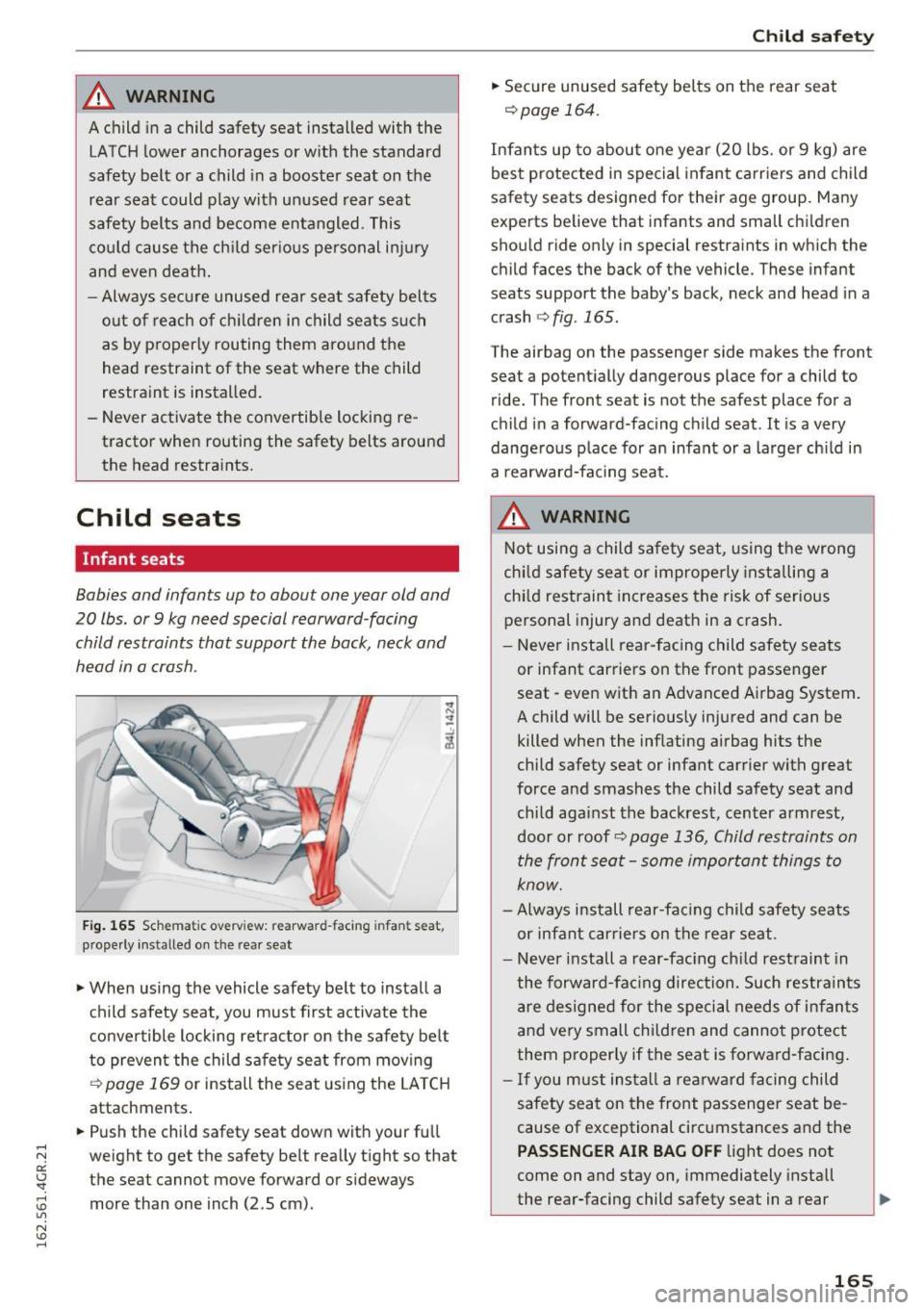
Babies and infants up to about one year old and
20 lbs. or 9 kg need special rearward-facing
child restraints that support the bock, neck and
head in a crash .
Fig. 165 Schemat ic overview: rearwa rd-facing infant seat,
properly installed on the rear seat
"'When using the vehicle safety belt to install a
child safety seat, you must first activate the
convertible locking retractor on the safety belt
to prevent the child safety seat from moving
~ page 169 or install the seat using the LATCH
attachments.
"'Push the child safety seat down with your full
weight to get the safety belt really tight so that
the seat cannot move forward or sideways
more than one inch (2.S cm).
Child safety
"' Secure unused safety belts on the rear seat
¢page 164.
Infants up to about one year (20 lbs. or 9 kg) are
best protected in special infant carriers and child
safety seats designed for their age group. Many
experts believe that infants and small children
should ride only in special restraints in which the
child faces the back of the vehicle. These infant
seats support the baby's back, neck and head in a
crash
¢fi g. 165.
The airbag on the passenger side makes the front
seat a potentially dangerous place for a child to
ride. The front seat is not the safest place for a
child in a forward -facing child seat . It is a very
dangerous place for an infant or a larger child in
a rearward-facin g seat.
_& WARNING
Not using a child safety seat, using the wrong
child safety seat or improperly installing a
child restraint increases the risk of serious
personal injury and death in a crash.
- Never install rear-facing child safety seats
or infant carriers on the front passenger
seat -even with an Advanced Airbag System.
A child will be seriously injured and can be
killed when the inflating airbag hits the
child safety seat or infant carrier with great
force and smashes the child safety seat and child against the backrest, center armrest,
door or roof¢
page 136, Child restraints on
the front seat -some important things to
know.
- Always install rear-fac ing child safety seats
or infant carriers on the rear seat.
- Never install a rear-facing child restraint in
the forward -facing direction. Such restraints
are designed for the special needs of infants
and very small children and cannot protect
them properly if the seat is forward-facing.
- If you must install a rearward facing child
safety seat on the front passenger seat be
cause of exceptional circumstances and the
PASSENGER AIR BAG OFF light does not
come on and stay on, immedia tely install
the rear-facing child safety seat in a rear
165
Page 168 of 282
Child safety
seating position and have the airbag system inspected by your Audi dealer.
- Never place
or use any electrical device
(such as a laptop, CD player, electronic
games device, power inverter or seat heater
for child seats) on the front passenger seat
if the device is connected to the 12-volt
socket or the cigarette lighter socket.
- If a seat heater has been retrofitted or oth
erwise added to the front passenger seat,
never install any child restraint system on
this seat .
- Make sure that there are no wet objects
(such as a wet towel) and no water or other
liquids on the front passenge r seat cushion .
- Never place objects on the seat (such as a
laptop, CD player, electronic games dev ice,
power inverter or seat heater for child
seats). These may influence the e lectr ical
capacitance measured by the capacitive pas
senger detection system and can also fly
around in an accident and cause serious per
sonal in jury .
- Always read and heed all WARNINGS when
ever using a child restrained in a vehicle is
being used
c:;, page 12 7, Safety belts,
c:;, page 135 , Airbag system
and
c:;, page 159, Important information.
Convertible child safety seats
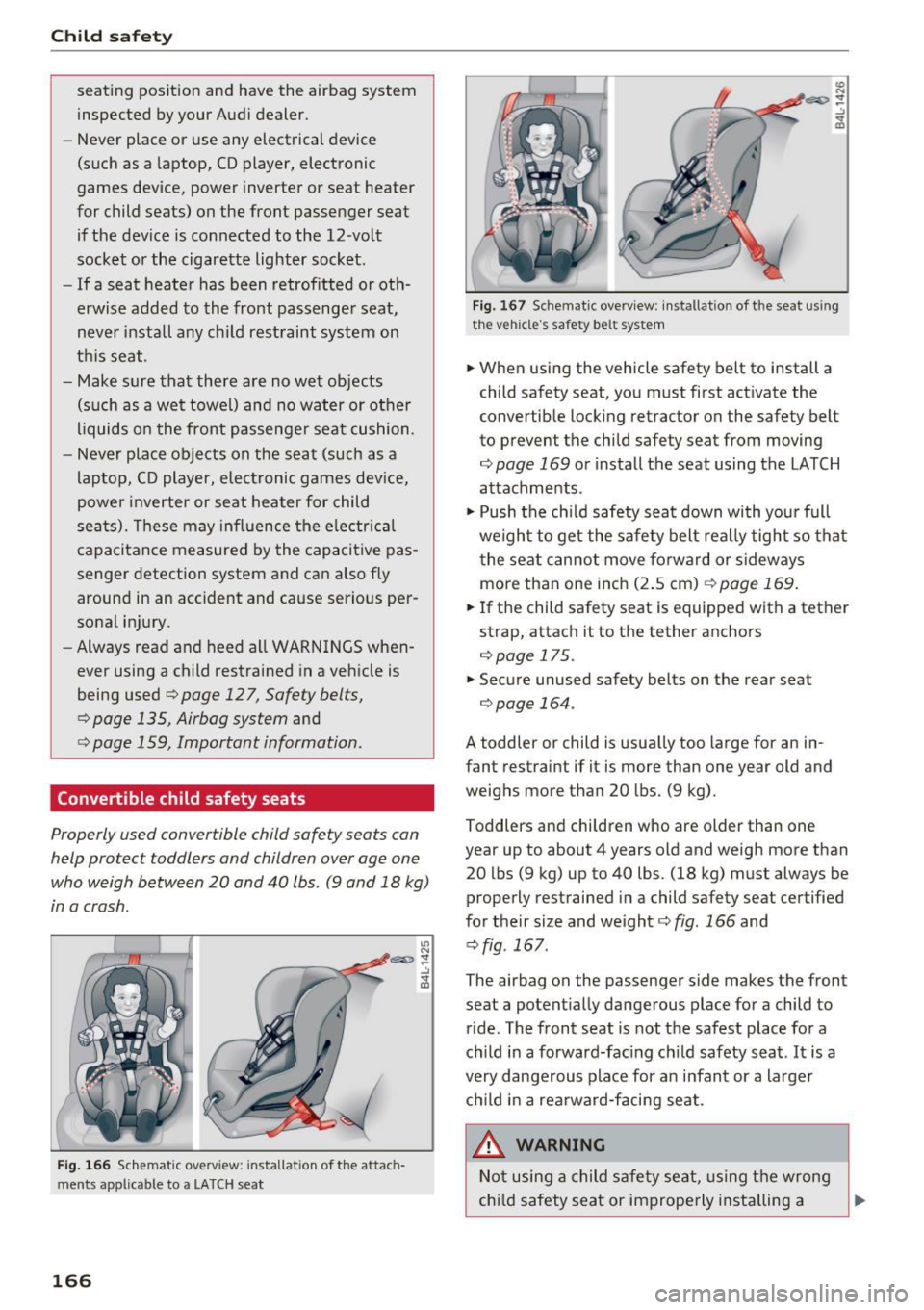
Properly used convertible child safety seats can
help protect toddlers and children over age one
who weigh between 20 and 40 lbs. (9 and 18 kg)
in a crash.
Fig. 166 Schemat ic ov erv iew : in stallat ion of the at tac h
m ents app licabl e to a LATCH seat
166
Fig. 167 Schem at ic ove rv iew: installat ion of t he seat usin g
t he vehicle's sa fety bel t system
.,. When using the vehicle safety belt to install a
child safety seat, you must first activate the
convertible locking retractor on the safety belt
to prevent the child safety seat from moving
c:;, page 169 or install the seat using the LATCH
attachments .
.,. Push the child safety sea t down with your full
weight to get the safety belt really tight so that
the seat cannot move forward or sideways
more than one inch (2 .5 cm)
¢ page 169.
.,. If the child safety seat is equipped with a tether
strap, attach it to the tether anchors
c:;, page 175.
.,. Secure unused safety belts on the rear seat
c:;, page 164.
A toddler o r child is usually too large for an in
fant restraint if it is more than one year old and
weighs more than 20 lbs. (9 kg).
Toddlers and children who are older than one
year up to about 4 years old and weigh more than
20 lbs (9 kg) up to 40 lbs. (18 kg) must always be
properly restrained in a child safety seat certified
for their size and we ight
c:;, fig . 166 and
¢ fig. 167.
The airbag on the passenger side makes the front
seat a potent ially dangerous place for a child to
ride . The front seat is not the safest place for a
ch ild in a forward-fac ing ch ild safety seat .
It is a
very dangerous place for an infant or a larger
child in a rearward-facing seat .
& WARNING
Not using a child safety seat, using the wrong
chi ld safety seat or improperly insta lling a ..,.