wheel AUDI RS7 SPORTBACK 2016 Workshop Manual
[x] Cancel search | Manufacturer: AUDI, Model Year: 2016, Model line: RS7 SPORTBACK, Model: AUDI RS7 SPORTBACK 2016Pages: 282, PDF Size: 70.78 MB
Page 184 of 282
Intelligent Technology
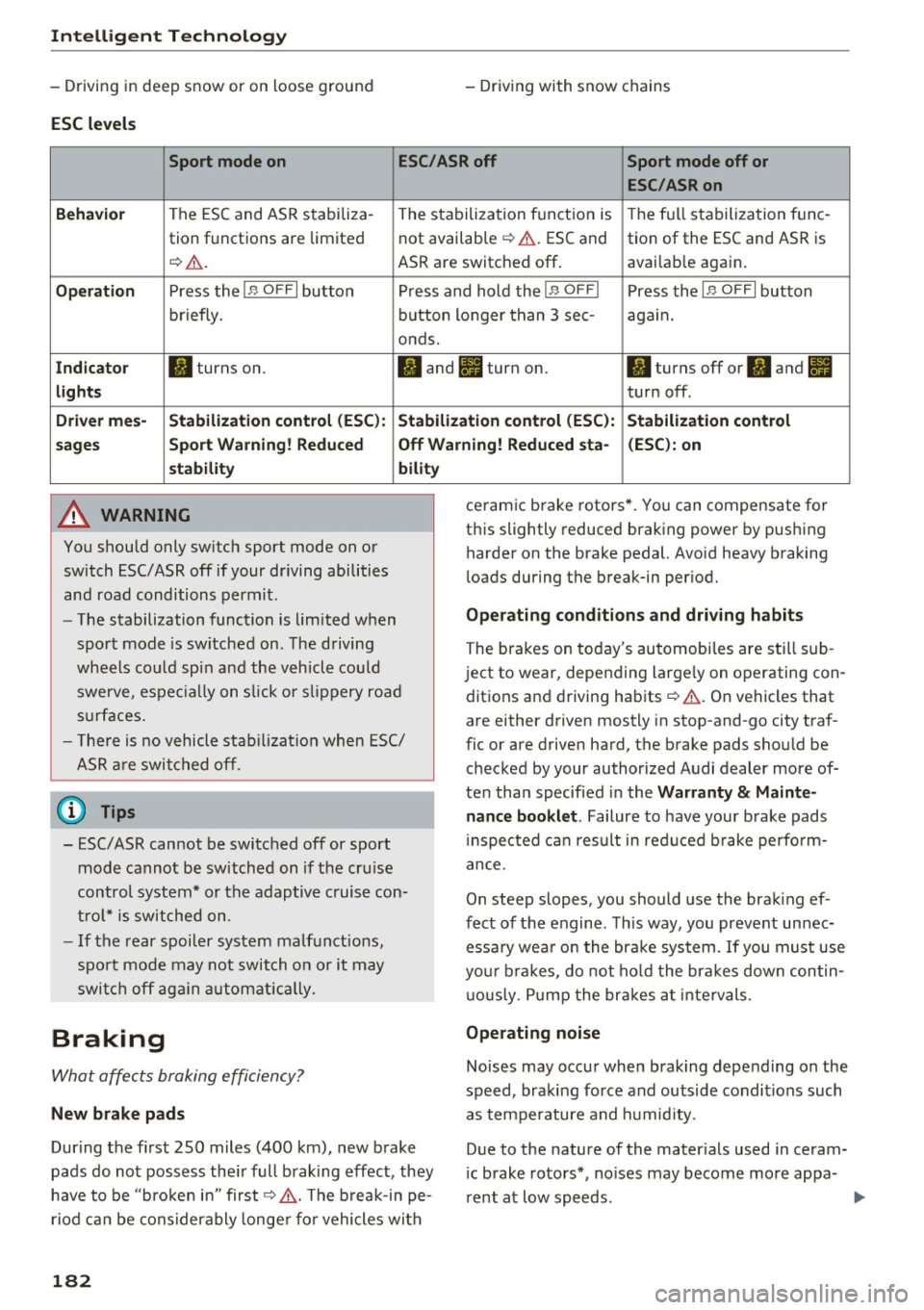
- Driving in deep snow or on loose ground
ESC levels
- Driv ing with snow chains
Sport mode on ESC/ASR off Sport mode off or
ESC/ASRon
Beha vior
The ESC and ASR stabiliza- The stabiliza tion function is The f ull stabilization tune-
tion f unctions are limited not available ¢
,&. ESC and
tion of the ESC and ASR is
¢
&. . ASR are switched off . avai
lab le aga in .
Op eration Press the I B OFF I button Press and hold the !B OFFI Press the IB OFFI button
briefly . button longer than 3 sec- again.
onds.
I n d ica to r II turns on. II and lit turn on. II turns off or II and II
light s turn off .
Driver me s- Stabili zation cont rol (E SC): S tabilization control (E SC ):
Stabili zation cont rol
s age s Sport Warning ! Redu ced Off Wa
rning! Reduced sta - (ESC ): on
st abilit y
A WARNING
You should only switch sport mode on or
switch ESC/ ASR off if your driving abilities
and road conditions permit.
bility
- The stabilization function is limited when
sport mode is sw itched on. The driving
wheels co uld spin and the vehicle could
swerve , espec ially on s lick o r slippery road
s u rfaces.
- The re is no vehicle stab ilizat ion when ESC/
ASR a re swi tched off .
(D Tips
-ESC/ASR cannot be switched off or sport
mode cannot be switched on if the cru ise
control system* or the adaptive cruise con
tro l* is switched on .
- If the rear spoiler system malfunct ions,
sport mode may not switch on or it may switch off ag ain automatically .
Braking
What affects braking efficiency?
New brake pads
During the first 250 miles (400 km), new brake
pads do not possess the ir full braking effect, they
have to be "broken in" first¢&, . The b reak-in pe
riod can be considerably longe r fo r vehicles with
182
ceramic brake rotors* . You can compensate for
this slightly reduced braking power by pushing harder on the brake pedal. Avoid heavy braking
l oads during the break-in per iod.
Op erating c ondition s and dri ving habits
The brak es on today 's automobiles are still sub
ject to wear, depending large ly on operating con
dit ions and driving habits ¢&, . On vehicles that
are either driven mostly in stop-and-go city traf
fic or are driven hard, the brake pads shou ld be
checked by your authorized Audi dealer more of
ten than specified in the
Warr ant y & Maint e
nance booklet .
Failure to have your brake pads
i nspected ca n result in red uced b rake perfo rm
ance.
On steep slopes, you should use the brak ing ef
fect of the engine . Th is way, you prevent unnec
essa ry wea r on the brake system. If you must use
you r brakes, do not ho ld the brakes down contin
u ous ly. P ump the brakes at intervals.
Operating noi se
Noises may occur when brak ing depending on the
speed, braking force and outside conditions such as temperature and h umid ity.
Due to the nature of the mater ials used in ceram
i c brake rotors*, no ises may become more appa-
rent at low speeds. ..,.
Page 185 of 282
Effect of wat er and road salt
In ce rtain situations, for example after driving
through water, in heavy rain, afte r ove rnight con
densation or after washing your car, the braking
effect can be reduced by moisture or ice on the
brake rotors and brake pads. The brakes must be
dried first w ith a few careful brake applications.
At higher speeds and with the windshie ld wipers
turned on, the brake pads press against the brake rotors for a short amount of time. Th is occurs at
regular intervals without the driver noticing and
provides for better brake response time under
wet conditions .
The effectiveness of the brakes can be reduced
when the vehicle is driven on a salt-covered road
and the brakes are not used. Likewise, you clean
off accumulated salt coat ing from brake discs
and pads with a few cautious applications of the b rake ¢_&. .
Due to their surface character istics, ceramic
brake roto rs* absorb mo isture in such condit ions.
This can cause a temporary reduc tion in braking
force compared to dry brakes. You can compe n
sate fo r th is by press ing the b rake peda l harder.
Corrosion
There may be a tende ncy for d irt to bu ild up on
the brake pads and corros ion to form on the discs
if the car is not dr iven regularly or only fo r sho rt
tr ips with little use of the brakes.
If the brakes are not used frequently, or if corro
sion has formed on the discs, it is adv isable to
clean off the pads and discs by brak ing firmly a
few t imes from a mode rately h igh speed ¢,& .
Faults in the brake system
If you should notice a sudden increase in brake
pedal travel, then one of the two brake c ircuits
may have failed
¢ ,& .
Low brake fluid le vel
Malfunct ions can occur in the brake system if the
brake fl uid level is too low. The brake fluid level
is monitored electronically .
Intelligent Technology
Brake booster
The brake boos ter works w ith v acuum press ure
which is crea ted on ly when the engine is running
¢ & .
Brake lining wear status
Brake lining wea r may be chec ked by visua l in
spe ct ion of the condition of the brake pads
t hr ough the openings in t he wheel. If necessary,
the wheel may be removed for this inspection
¢ page 243, Replacing wheels .
_8 WARNING "'----
-New b rake pads don't have the best stop
p ing power and must be "broken-in" d uring
the initial 250 miles (400 km). The b reak-in
period can be considerably longer for
veh icles with ceramic brake roto rs*. You can
compensate for this by pressing the brake
pedal mo re firmly. This also applies late r
when new p ads are inst alled.
- You shou ld pe rform braking maneuvers for
the purpose of cleaning the brake system
only i f road condit io ns pe rmit. O ther ro ad
users m ust no t be put at r is k - you may
cause an accident!
- Before descending a steep g rade, reduce
speed and shift transmission into a lower
gear o r lower driving range. Do not r ide the
brakes or hold the pedal down too long or
too often. This cou ld cause t he b rakes to get
hot and dimin ish braking effic iency.
- Do not " ride the brakes" by rest ing your foot
on the pedal when you do not intend to brake. This may cause the brakes to over
heat, premature wear and increased stop
p ing distance .
- Unde r certain climatic and ope rating condi
tions such as passing t hrough water, d riving
i n heavy rain o r afte r wash ing the veh icle,
the effectiveness of the brakes ca n be re
duce d. In winter, ice can accum ulate on the
b rake pads, lin ings, discs and dr ums. Care
fu lly apply brakes for a test. Brakes will d ry
an d ice coatings will be cleaned off after a
few ca refu l brake applications.
183
Page 186 of 282
Intelligent Technology
-Driving for an extended period of time on
salt-covered roads without using your
brakes can also affect braking efficiency .
Clean off accumulated salt coating from
brake discs and pads with a few careful
brake applications .
- If you damage the front spoiler, or if you in stall a different spoiler, be sure the air flow
to the front brakes is not obstructed. Other
wise the brake system could overheat reduc
ing the effectiveness of the entire brake sys
tem.
- Failure of one brake circuit will impair the
braking capability resulting in an increased
stopping distance. Avoid driving the vehicle
and have it towed to the nearest Audi dealer
or qualified workshop.
- Never let the vehicle roll to a stop with the
engine shut off.
- If the brake booster is not working, the
brake pedal must be pressed considerably
harder to make up for the lack of booster
assistance.
Electromechanical
steering, dynamic
steering
The electromechanical steering supports the
driver's steering movements.
Power steering adapts electronically based on
the vehicle speed .
Indicator lights and messages
• Do not drive vehicle: Steering defective
If this indicator light turns on and stays on and
this message appears, the power steering may
have failed .
Stop the vehicle in a safe location as soon as pos
sible. Do
not continue driving. See an authori zed
Audi dealer or authorized Audi Service Facility for
assistance.
'Jij Steering: System fault You can continue
driving
184
If the indicator light turns on and the message
appears, the steering may be more difficult to move or more sensitive than usual. The steering
wheel may also be at an angle when driving
straight.
Drive slowly to your authorized Audi dealer or au
thorized Audi Service Facility to have the mal
function corrected.
':r-ij Dynamic steering: Initializing
If the indicator l ight is blinking and this message
appears, dynamic steering* is being initialized.
The steering wheel will be easy to move after
starting the engine. Re-initialization might be
necessary if the steering wheel was moved hard
to the left and right while the veh icle was not
moving. The display turns off if the initialization
was successful.
(D Tips
- If the . or ':r-ij indicator light only stays on
for a short time, you may continue driving.
- The dynamic steering stability systems
opage 180 are not availab le in the event of
a system malfunction.
- For additional information on dynamic
steering, refer to
c> page 95.
All wheel drive (quattro)
Applies to: vehicles with all wheel drive
In all wheel drive, all four wheels are powered.
General information
In all wheel drive, the driving power is divided be
tween all four wheels. This happens automatical
ly depending on your driving behavior as well as
the current road conditions. Refer to
c> page 180,
Electronic Stabilization Control (£SC).
A center differential distributes the driving power
variably to the front and rear axle. It works to
gether with selective wheel torque control, which
activates when driving through curves
<=> page 181 . With the sport differential*, power
distribution to the rear wheels is variable and can
be adjusted with drive select
q page 95 . .,..
Page 187 of 282
The all wheel drive concept is designed for high
engine power. Your vehicle is exceptionally pow
erful and has excellent driving characterist ics
both under normal driving conditions and on
snow and ice. Always read and follow safety pre
cautions
¢ ,&. .
Winter tires
By using all wheel drive, your vehicle has good
forward motion with standard tires in winter con ditions . However, in winter we recommend using
winter or all season tires on all four wheels, be
cause this will improve the braking effect.
Snow chains
If there are snow chain laws, snow chains must
also be used on vehicles with all wheel drive
¢ page 233, Snow chains .
Replacing tires
For vehicles with all wheel drive, only wheels with
the same rolling circumference should be used .
Avoid wheels with different tread depths
¢ page 225, New tires or wheels.
Offroad vehicle?
Your Audi is not an offroad vehicle -there is not
enough ground clearance. For this reason, avoid
difficult terrain.
A WARNING
-Also, in vehicles with all wheel drive, adapt
your driving style to the current road and
traffic conditions. Do not let the increased
safety provided tempt you into taking risks,
because th is increases the r isk of an acci
dent.
- The braking ability of your veh icle is limited
to the tract ion of the wheels . In this way, it
is not diffe rent from a two wheel drive vehi
cle. Do not be tempted to accelerate to a
high speed when the road is slippery this in
creases the risk of an accident.
- Note that on wet streets, the front wheels
can "hydroplane" if driving at speeds that
are too high . Unlike front wheel drive
vehicles, the engine does not rev higher sud
denly when the vehicle begins hydroplaning.
Intelligent Technology
For this reason, pay attention to the road
conditions reg a rd less of your speed to re
duce the risk of an accident .
Rear spoiler
The extendable rear spoiler increases driving sta
bility .
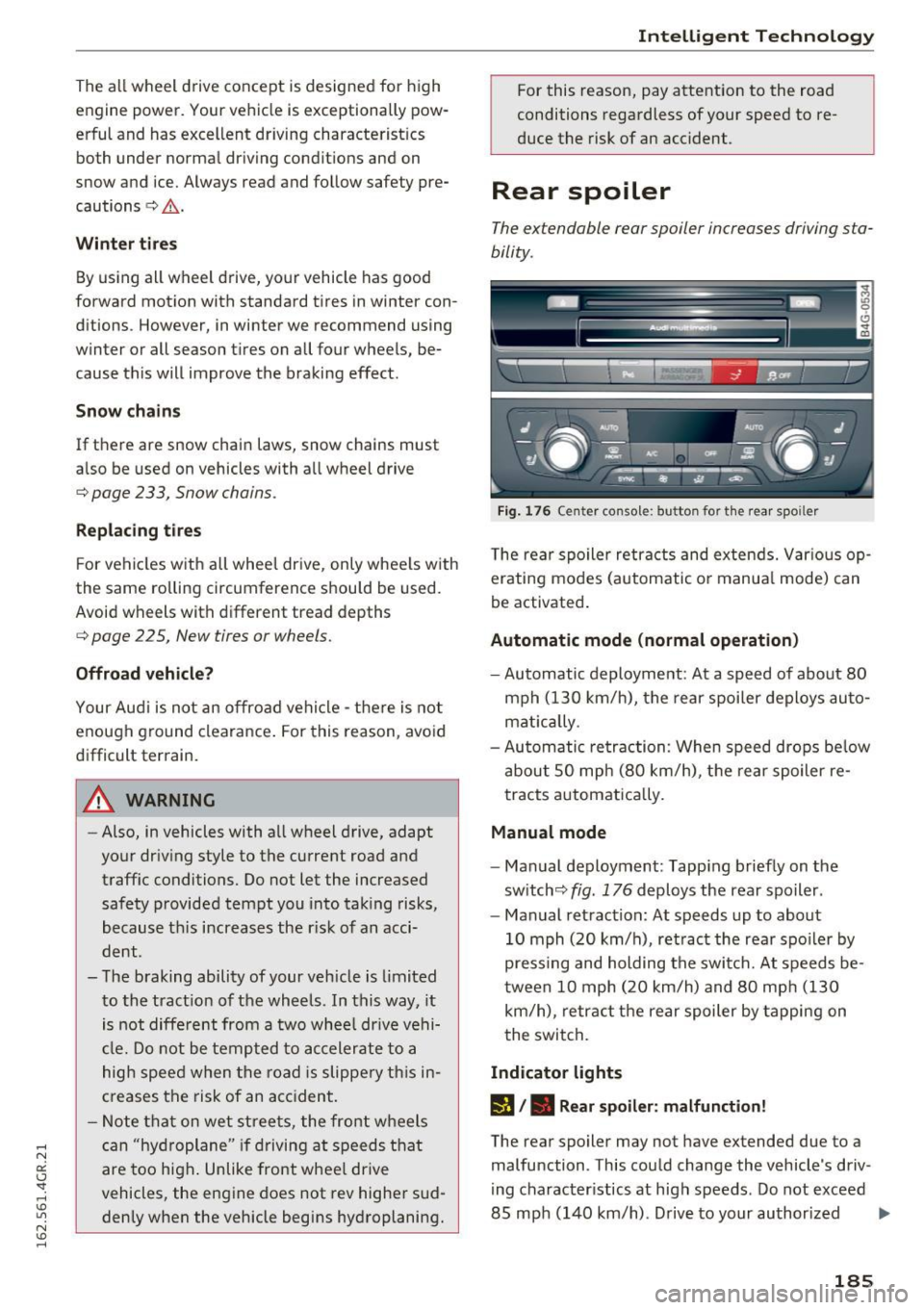
Fig. 176 Center console: button for t he rear spoiler
The rear spoiler retracts and extends. Var ious op
erating modes (automatic or manua l mode) can
be activated .
Automatic mode (normal operation)
-Automatic deployment : At a speed of about 80
mph (130 km/h), the rear spoiler deploys auto
mat ically .
- Automatic retraction: When speed drops be low
about SO mph (80 km/h), the rear spoiler re
tracts automatically.
Manual mode
-Manual deployment: Tapping briefly on the
switch<=:>
fig. 176 deploys the rear spoiler.
- Manual retraction: At speeds up to about
10 mph (20 km/h), retract the rear spoiler by
pressing and holding the switch. At speeds be
tween 10 mph (20 km/h) and 80 mph (130
km/h), retract the rear spoiler by tapping on
the switch.
Indicator lights
l'J /. Rear spoiler: malfunction!
The rear spoiler may not have extended due to a
malfunction . This could change the vehicle's driv
ing character istics at high speeds . Do not exceed
85 mph (140 km/h). Drive to your authorized ..,.
185
Page 196 of 282
Care and cleaning
Rinse the vehicle thoroughly again and let it air
dry. Remove any water residue using a leather
cloth .
_& WARNING
- Only wash the vehicle when the ignition is
off and follow the instructions from the car
wash operator to reduce the risk of acci
dents .
- To reduce the risk of cuts, protect yourself
from sharp metal components when wash
ing the underbody or the inside of the wheel
housings .
- After was hing the vehicle, the bra kin g effect
may be delayed due to mo isture on the
bra ke rotors or ice in the winte r. The bra kes
must be d ried first w ith a few careful b rake
applica tions .
(D Note
-If you wash t he ve hicle in an automatic car
wash, you m ust retract the rear spoiler if
ne cessary, and fold the e xte rior mi rrors in
to reduce the risk of damage. Power fo ld ing
-
exterior mirrors* must only be fo lded in and
o ut using the power folding f unction .
- T o prevent pa int damage, do not wash the
vehicle in direct sunlight .
- T o red uce the risk of damage to the s urf ac e,
do not use insect removing sponges, k itchen
sponges o r similar items .
- Mat te finish painted vehicle components:
- To reduce the r isk of damage to the sur-
face, do not use polis hing agents or hard
wax.
- Never use protective wax. It can destroy
the matte finish effect.
- Do not place any stickers or magnetic
signs on vehicle parts painted with matte
finish paint. The paint could be damaged
when the stickers or magne ts are re
moved .
@) For the sake of the environment
Only wash the ve hicle in facilities spec ially de
signed for that pu rpose . This will reduce the
r isk of dirty wate r contaminated with o il from
entering the sewe r system.
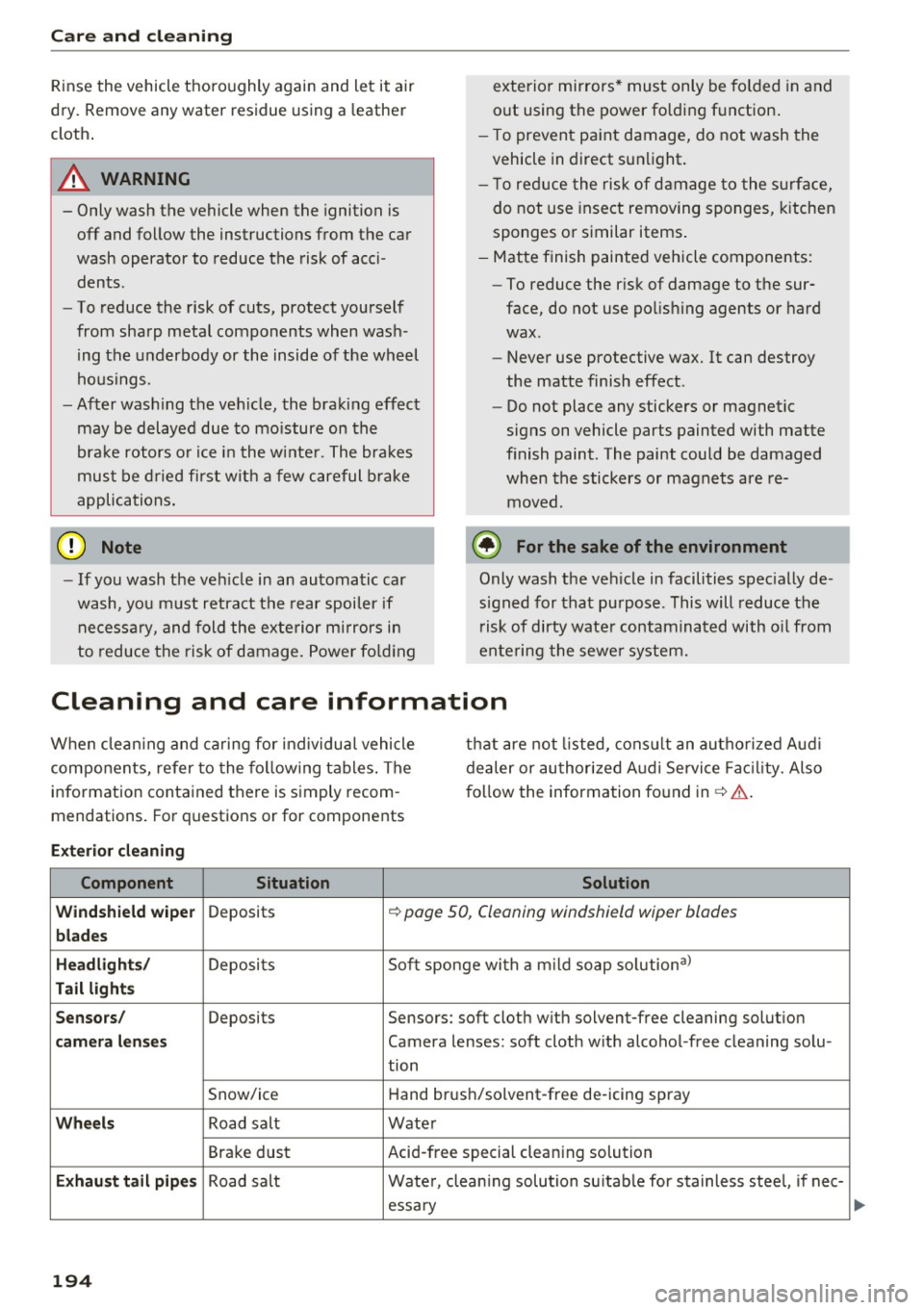
Cleaning and care information
When clean ing and caring for individua l vehicle
components, refer to the following tables . The
i n formation contained there is simply recom
mendations. Fo r questions or for components that are
not listed, cons ult an autho rized Aud i
dealer or au thori zed A udi Se rvice Fac ility. Also
f o llow the information fo und in¢&. .
Ext eri or cleaning
Component Situation Solution
Windshield wiper
Deposits ¢ page 50, Cleaning windshield wiper blades
blades
Headlights /
Deposits Soft sponge with a m ild soap solution3
)
Tail light s
S en sors /
Deposits Sensors: soft cloth with solvent-free cleaning solut ion
cam era lens es Camera lenses: soft cloth w ith alcohol -free cleaning solu -
tion
Snow/ice Hand brush/solvent-free de-icing spray
Wheels Road salt Water
Bra ke dust Acid-free special cleaning solution
Exhaust tail pipes Road salt
Water, clean ing solution su itab le for stainless stee l, if nee-
essa ry
194
...
Page 198 of 282
Care and cleaning
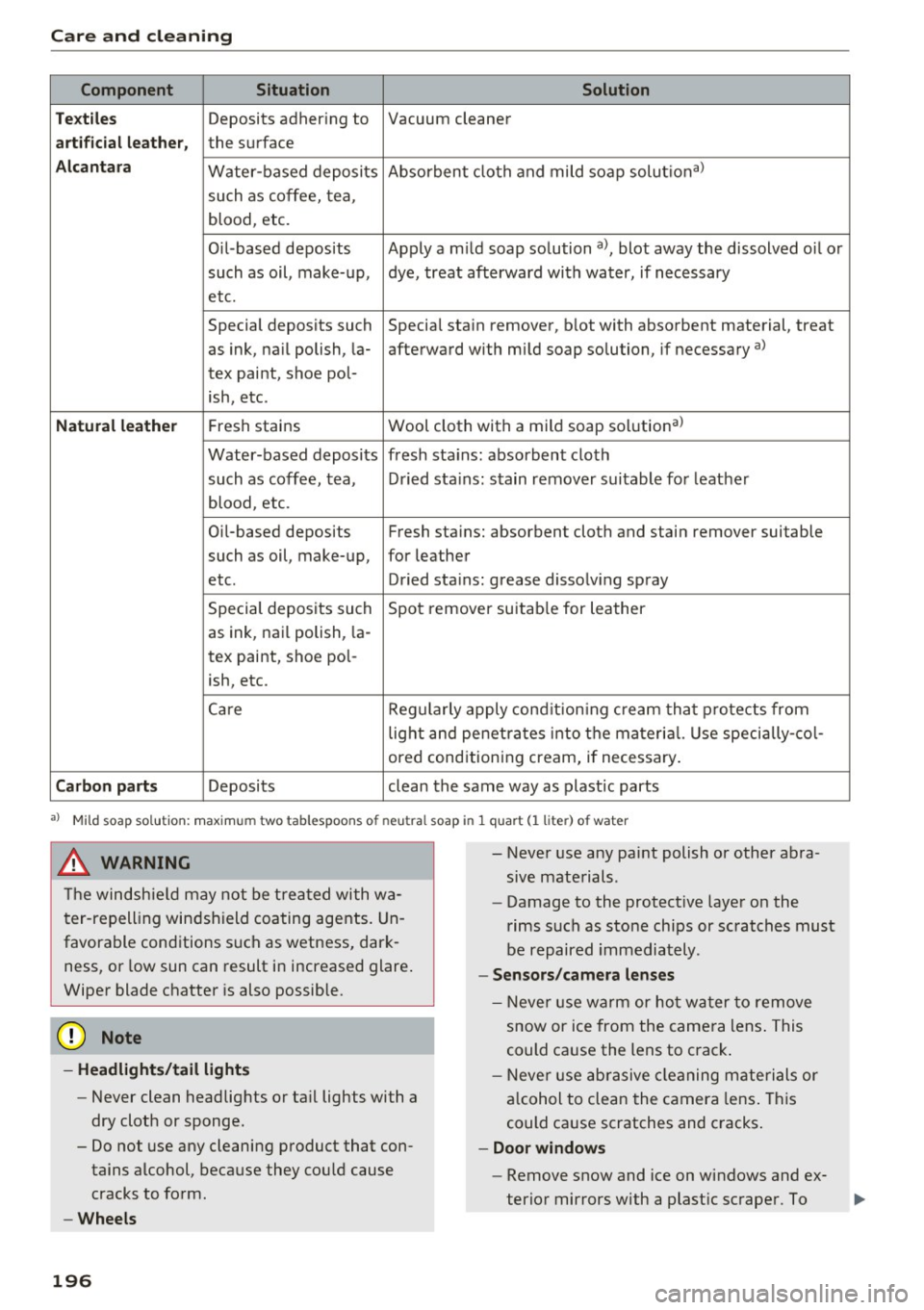
Component Situation Solution
Te xtil es
Deposits adhering to Vacuum cleaner
a rt ifici al le ather , the surface
Alcant ara Water-based deposits Absorben
t cloth and mild soap solutiona>
such as coffee, tea,
blood, etc.
O il-based deposits Apply a m ild soap solution a), blot away the dissolved oil or
such as oil, make-up, dye, treat afterward with water, if necessary
etc.
Special deposits such Special stain remover, b lot with absorbent material, treat
as ink, na il polish, la- afterward with mild soap solution, if necessary a)
tex paint, shoe pol-
ish, etc.
Natural leather Fresh stains Wool cloth with a mild soap so
lutiona)
Water-based deposits fresh sta ins: absorbent cloth
such as coffee, tea, Dried sta ins: stain remover suitable fo r leather
blood, etc.
Oil-based deposits Fresh staiins: absorbent cloth and stain remover suitable
such as oil, make-up, for leather
etc. Dried sta ins : grease dissolv ing spray
Special deposits such Spot remover suitab le for leather
as ink, nai l polish, la -
tex paint, shoe pol-
ish, etc.
Ca re Regularly apply cond ition ing cream that protects from
light and penet rates into the materia l. Use specia lly-co l-
ored conditioning cream, if necessary.
Carbon parts Deposits clean the same way as plastic parts
a) Mild soap solution: maximum two tablespoons of neutral soap in 1 quart (l liter) of water
_& WARNING
The windshie ld may not be trea ted with wa
ter-repelling windshield coating agents. Un
favorable conditions s uch as wetness, dark
ness, or low sun can result in increased glare .
Wiper blade chatter is also possible.
(D Note
- Headlights/tail light s
-Never clean headlights or tail lights with a
dry cloth or sponge.
- Do not use any cleaning product that con
tains alcohol, because they could cause
cracks to form.
- Wheels
196
-
- Never use any paint polish or other abra
sive materials.
- Damage to the protect ive layer on the
rims such as stone chips or scratches must
be repaired immediately.
- Sensors /camera lenses
- Neve r use wa rm or ho t wa ter to remove
snow or ice from the camera lens . This
could cause the lens to crack .
- N eve r use ab rasive cleaning materials or
a lcohol to clea n the camera lens . This
could cause scratches and cracks .
-Doo r window s
-Remove snow and ice on windows and ex-
terior mirrors with a plast ic scraper. To
Page 220 of 282
Wheels
Wheels
Wheels and Ti res
General information
.,. Check your tires regularly for
damage (punctures, cuts, cracks
and bulges). Remove foreign ob
jects from the tire tread.
.,. If driving over curbs or similar
obstacles, drive slowly and ap proach the curb at an angle.
.,.Have faulty tires or rims re
placed immediately.
.,.Protect your tires from oil,
grease and fuel.
.,.Mark tires before removing
them so that the same running
direction can be maintained if
they are reinstalled .
.,. Lay tires flat when storing and
store them in a cool, dry location
with as little exposure to light as
possible.
(D N ote
-Please note that summer and
winter tires are designed for
the conditions that are typical in those seasons . Audi recom
mends using winter tires dur
ing the winter months . Low
temperatures significantly de crease the elasticity of summ
er tires, which affects traction
218
and b raking ability. If summer
tires are used in very cold
temperatures, cracks can form
on the tread bars, resulting in permanent tire damage that
can cause loud driving noise
and unbalanced tires.
-Burnished, polished or chromed rims must not be used in winter driving condi
tions. The surface of the rims
does not have sufficient corro
sion protection for this and
could be permanently dam
aged by road salt or similar
substances.
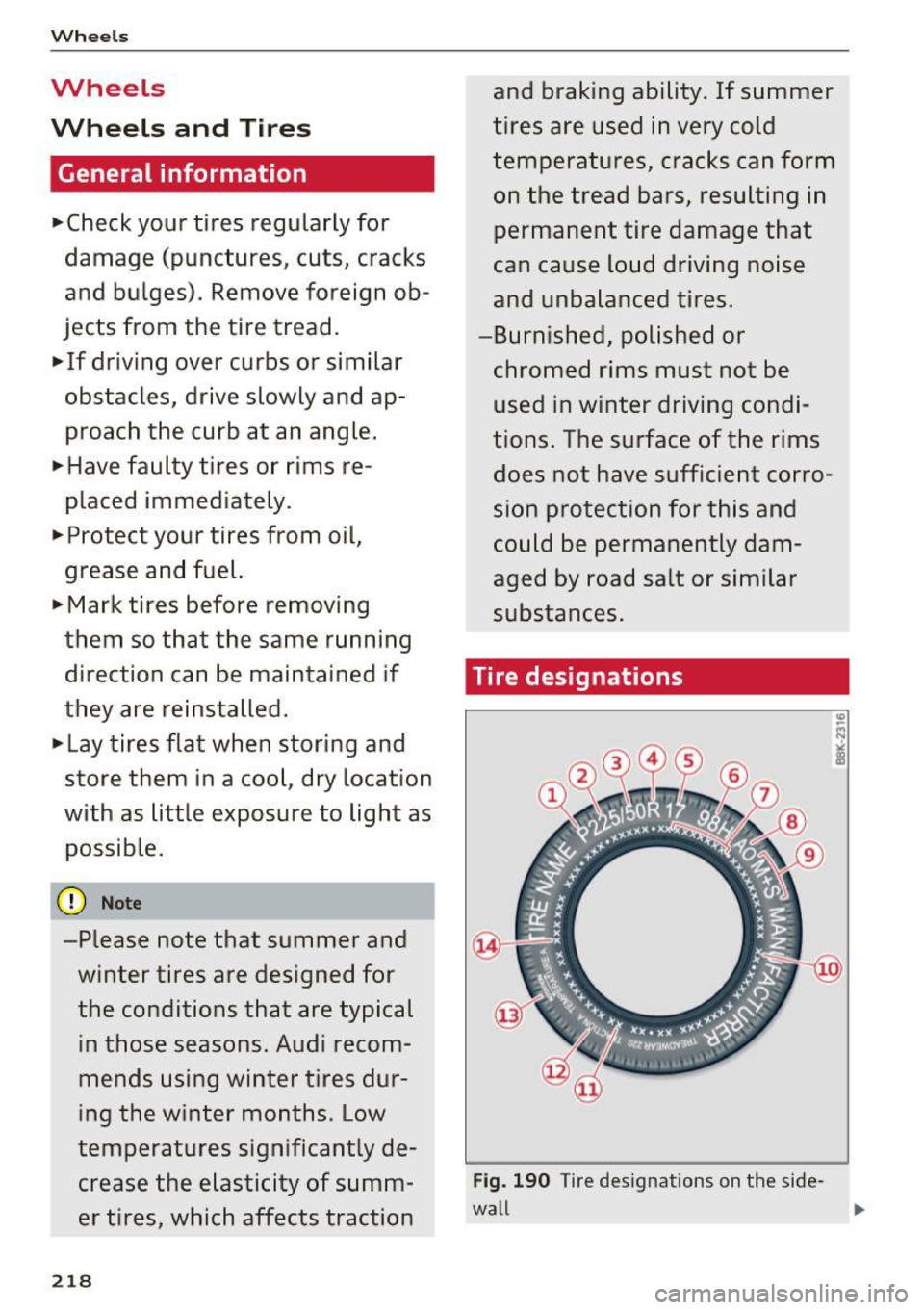
Tire designations
F ig. 19 0 Tire des ignat ions on the side-
wall II>
Page 221 of 282
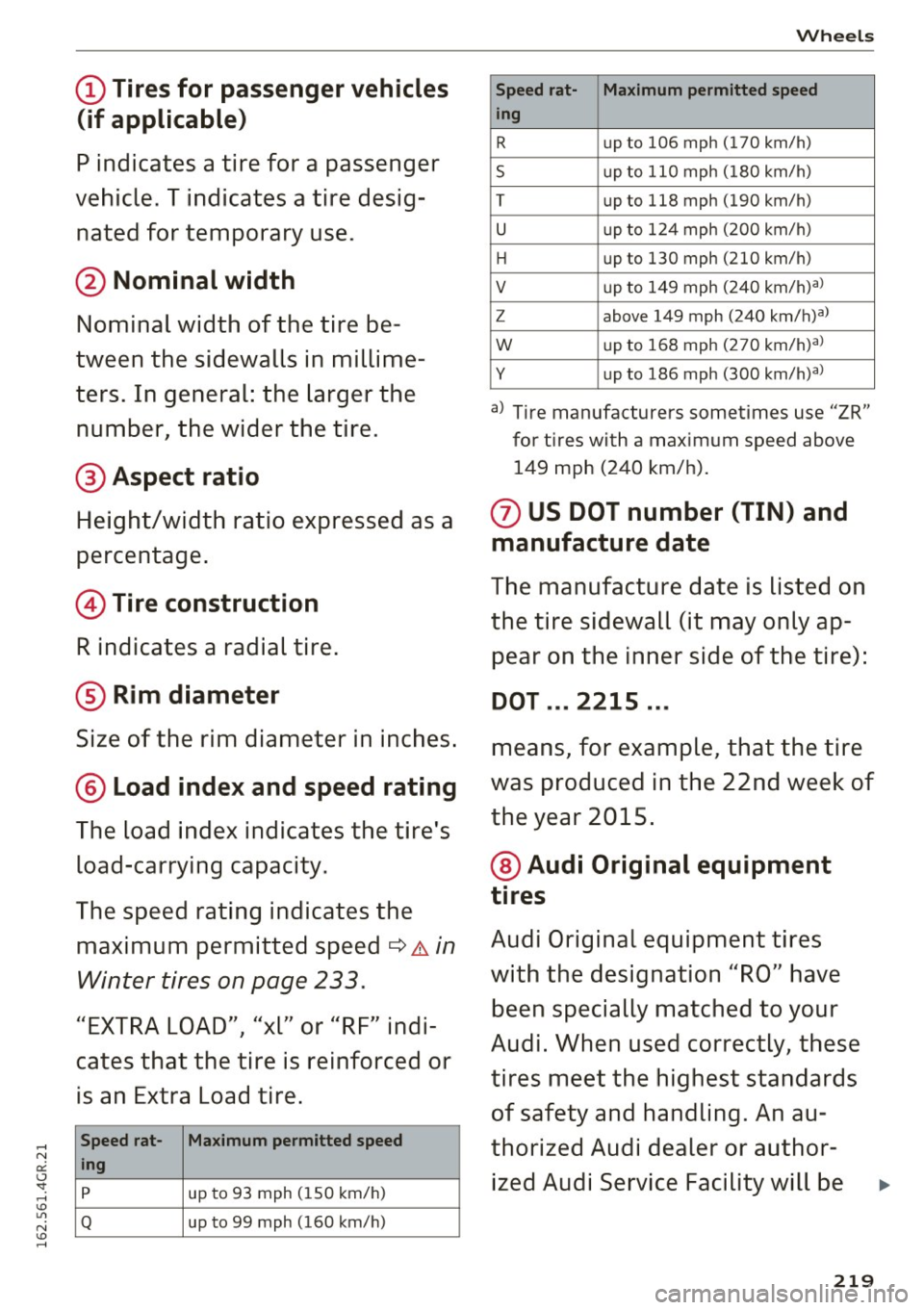
(D Tires for passenger vehicles
(if applicable)
P indicat es a tir e for a p asse ng er
vehi cle. T indi cates a tire de sig
nated for tempor ary us e.
@ Nominal width
Nominal width of the tire be
tween the sidew alls in millime
ters. In general: the larger the number, the wider the tire.
@ Aspect ratio
Height /width ratio expressed as a
percentage.
@ Tire construction
R indicates a radial tire.
® Rim diameter
Siz e of the rim diameter in inches.
@ Load index and speed rating
The load ind ex indi cates the tire' s
lo ad-ca rry in g ca pacity.
The speed rating indicates the maximum permitted speed¢.&
in
W inter tires o n page 233 .
"EXTRA LOAD", "xl" or "RF" indi
cate s that the tire i s reinfor ced or
is an Extra Load tire.
Speed rat- Maximum permitted speed
ing
p
up t o 93 mph ( 150 km/h)
Q up to 99 mph (160 km/ h)
Wheels
Speed rat- Maximum permitted speed
ing
R up to 106 mph (170 km/h)
s u p to 11 0 mph ( 180 km/h)
T up to 118 mph (190 km/h)
u u p to 124 mph ( 200 km/h)
H up to 130 mph (210 km/h)
V up to 14 9 mph (2 40 km/h)al
z above 149 mph (240 km/h)al
w up to 168 mph (270 km/h)al
y up to 186 mph (300 km/h)al
a) Tire manufac turers sometimes use "ZR"
f or tires with a max imum speed above
149 mph (2 40 km/h) .
(j) US DOT number (TIN) and
manufacture date
The m anufac ture date i s listed on
the tire sidewall (it ma y only ap
pear on the inner side of the tire):
DOT ... 2215 ...
means, for example , that the tire
was produced in the 22nd week of
the year 2015.
@ Audi Original equipment
tires
Audi Original equipment tire s
with th e designation "RO " hav e
b een specially mat ch ed to your
Audi. When u sed correctly, thes e
tires meet the high est stand ards
of safety and handling. An au
thorized Audi dealer or author
ized Audi Service Facility will be
219
Page 222 of 282
Wheels
happy to provide more informa
tion .
® Mud and snow capability
"M/S" or "M+S" indicates the tire
has characteristics that make it
suitab le for driving on mud and
snow .
& indicates a winter t ire .
@ Compos ition of the tire cord
and materials
The number of plies indicates the
number of rubberized fabric lay
ers in the tire . In general: the
more layers, the more weight a
tire can carry. Tire manufacturers must also specify the materia ls
used in the tire . These include
steel, nylon, polyester and other
materials .
@ Maximum permitted load
This number indicates the maxi
mum load in k ilograms and
pounds that the tire can carry.
@ Uniform tire quality grade
standards for treadwear,
traction and temperature
resistance
Treadwear, traction and tempera
ture ranges
c::> page 234 .
@ Running direction
The arrows indicate the running
direction of unidirec tiona l tires.
220
You must a lways follow the speci
fied runn ing direction
c::> page 247.
@ Maximum permitted
inflation pressure
This number indicates the maxi
mum pressure to which a tire can be inflated unde r normal operat
ing condit ions .
Glossary of tire and loading
terminology
Accessory weight
means the comb ined we ight (in
excess of those standard items
which may be replaced) o f auto
matic tra nsmission , power steer
ing , power brakes , power wi n
dows, power seats , radio , and
heater, to the extent that these
items a re available as facto ry-in
stalled equipment (whet her in
stalled or not).
Aspect ratio
means the rat io of the height to
the width o f the tire in pe rcent.
Numbe rs of 55 or lower indicate a
low sidewa ll for imp roved steer
ing response and better overa ll
handling on dry pavement .
...
Page 223 of 282
Bead
means the part of the tire that is
made of steel wires, wrapped or
reinforced by ply cords and that is
shaped to fit the rim.
Bead separation
means a breakdown of the bond
between components in the bead.
Cord
means the strands forming the
plies in the tire.
Cold tire inflation pressure
means the tir e pressure recom
mended by the vehic le manufac
turer for a tire of a designated
size that has not been driven for
more than a couple of miles (kilo
meters) at low speeds in the
three hour period before the tire pressure is measured or adjusted .
Curb weight
means the weight of a motor ve
hicle with standard equipment in
c luding the maximum capacity of
fuel, oi l, and coolant, a ir condi
tioning and add itional weight of
optional equipment.
E xtra load ti re
means a tire designed to operate
at higher loads and at h igher in -
Wheels
flation pressures than the corre
sponding standard tire . Extra load
tires may be identified as "XL",
" xl", "EXTRA LOAD", o r "RF" on
the sidewal l.
Gross Axle Weight Rating
( " GAWR")
means the load -carrying capacity
of a single axle system, measured
at the tire-ground interfaces .
Gross Vehicle Weight Rating
("GVWR ")
means the max imum total loaded
weight of the vehic le.
Groove
means the space between two ad
jacent tr ead ribs .
Load rating (code)
means the max im um load tha t a
tire is rated to carry fo r a g iven in
flat ion pressure . You may not find
this informat ion on all tires be
cause it is not requ ired by law.
Maximum load rating
means the load rating for a tire at
the maximum pe rmissible infla
tion pressure for that tire.
Maximum loaded vehicle
weight
means the sum o f:
22 1
..