light AUDI S3 2009 Owners Manual
[x] Cancel search | Manufacturer: AUDI, Model Year: 2009, Model line: S3, Model: AUDI S3 2009Pages: 324, PDF Size: 76.02 MB
Page 280 of 324
11111...__W_ h_ a _ t_d_ o_ l _d _o_ n_ o_ vv_ ? ______________________________________________ _
Taking the wheel off /putt ing the spare on
Follow these instructions step-by-step for changing the
wheel
M
"' ;;; u.
1li
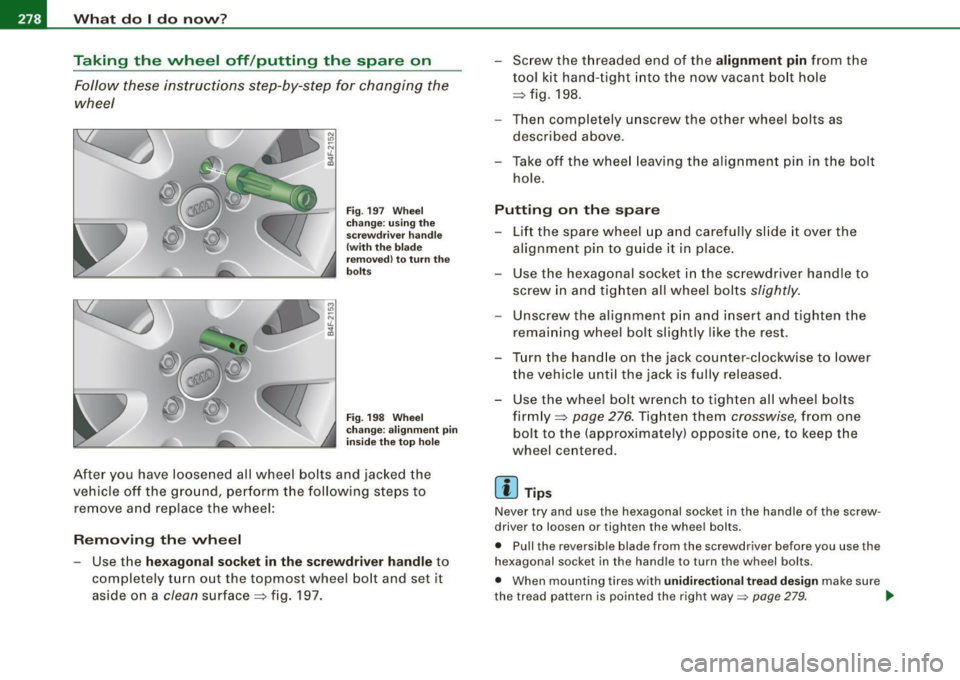
Fig . 197 Wheel
change : using the
screwdriver handle
(with the blade
removed) to turn the
bolts
Fig . 198 Wheel
change: alignment pin
inside the top hole
After you have loosened all wheel bolts and jacked the
vehicle off the ground, perform the following steps to
remove and replace the wheel:
Removing the wheel
- Use the hexagonal socket in the screwdriver handle to
completely turn out the topmost wheel bolt and set it
as ide on a
clean surface ~ fig. 197. - Screw the threaded end of the
alignment pin from the
tool kit hand-tight into the now vacant bolt hole
~ fig. 198.
- Then completely unscrew the other wheel bolts as
described above.
Take off the wheel leaving the alignment pin in the bolt
hole.
Putting on the spare
- Lift the spare wheel up and carefully slide it over the
alignment pin to guide it in place.
- Use the hexagonal socket in the screwdriver handle to
screw in and tighten all wheel bolts
slightly.
Unscrew the alignment pin and insert and tighten the
remaining wheel bolt slightly like the rest.
- Turn the handle on the jack counter -clockwise to lower
the vehicle until the jack is fully released.
- Use the wheel bolt wrench to tighten all wheel bolts firmly ~
page 276. Tighten them crosswise , from one
bolt to the (approximately) opposite one, to keep the
wheel centered.
[ i ] Tips
Never try and use the hexagonal socket in the handle of the screw
driver to loosen or tighten the wheel bolts.
• Pull the reversible blade from the screwdriver before you use the
hexagonal socket in the handle to turn the wheel bolts.
• When mounting tires with
unidirectional tread design make sure
the tread pattern is pointed the right way=>
page 279. ~
Page 284 of 324
11111.___F_ u_ s _ e_s _ a_n _ d_ b_ u_lb _ s _______________________________________________ _
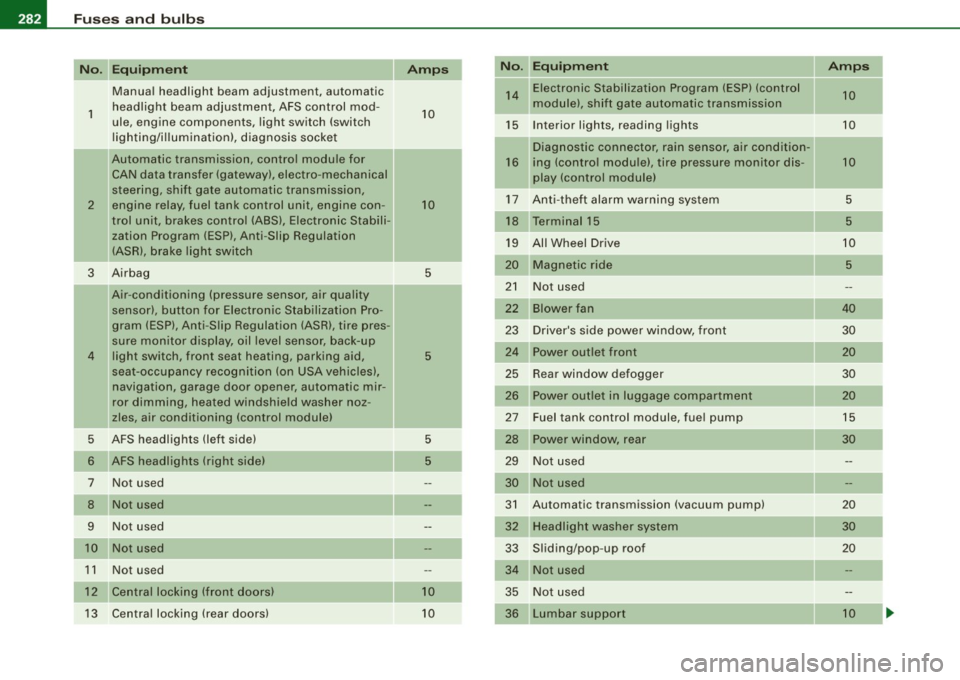
Equipment Amps No. Equipment Amps
Manual headlight beam adjustment, automatic 14 Electronic Stabilization Program (ESP) (control
10
1 headlight beam adjustment, AFS control mod-
10 module),
shift gate automatic transmission
ule, engine components, light switch (switch
15 Interior lights, reading lights 10
lighting/illumination), diagnosis socket
Diagnostic connector, rain sensor, a ir condit ion-
!! Automatic transmission, control module for
16 ing (control module), tire pressure monitor dis- 10
CAN data transfer (gateway), electro -mechanical
play (control module)
steering, shift gate automatic transmission, 17 Anti-theft alarm warning system 5
2 engine relay, fuel tank control unit, engine con
-10
trol unit, brakes control (ABS), Electronic Stabili- 18 Terminal 15
5
zation Program (ESP), Anti -Slip Regulation
19 All Wheel Drive
10
(ASR), brake light switch
-20 Magnetic ride 5
3 Airbag
5
-21 Not used
Air -conditioning (pressure sensor, air quality
sensor), button for Electronic Stabilization Pro- 22
Blower fan 40
gram (ESP), Anti -Slip Regulat ion (ASRl, tire pres -
23 Driver's side power window, front 30
sure mon itor display, oil level sensor, back-up
4 light switch, front seat heating, parking aid, 5 24 Power outlet front
20
seat-occupancy recognition (on USA vehicles), 25 Rear window defogger 30
navigation, garage door opener, automatic mir- 26 Power outlet in luggage compartment 20
ror dimming, heated windshield washer noz-
zles, air conditioning (control module) 27 Fuel tank control module, fuel pump 15
5 AFS headlights (left side)
5 28 Power
window, rear
30
6 AFS headlights (r ight side) 5 29 Not used
7 Not used 30 Not used
8 Not used 31 Automatic transmission (vacuum pump)
20
9 Not used 32 Headlight washer system 30
10 Not used
33 Sliding/pop-up roof
20
1 1 Not used 34 Not used
12 Central locking (front doors} 10 35 Not used
13 Central locking (rear doors) 10
36 Lumbar
support 10
Page 286 of 324

IIJII Fuses and bulbs i,.__....;,___;:,,;_,;,,.:_;__;;:_.:.:..:..=-=;____ ______________________ _
No. UEquipment Amps I No. Equipment Amps
F6 Steering wheel electronics, instrument cluster
5 F28
Not used
F7 Transmission control module 30 Fuse assignment in the left-side instrument
F29 50
F8 Navigation system, radio system 15/25 panel (special equipment)
Navigation system, digital radio, cell phone, TV F30 Power supply relay terminal
15 50
F9 equipment 5
F10 Engine control module, main relay 5/10 Variation
(2) with 54 Plug-in Fuses
F11 Not used No. Equipment
Amps
Control module for CAN data transfer (gateway) 5 F1
Vehicle
electrical system control unit (right)
30
F13 Engine control module 15/25 F2
ESP valves, Anti
-lock brake system (ABS) valves
20/30
F14 Ignition coils 20 F3 Not used
F15 Tank diagnosis, oxygen sensor 5/10 F4
Battery voltage
5
F16 Vehicle electrical system control unit (right) 30 F5 Horn
15
F17 Horn
15 F6 Engine components, fuel pump 15
F18 Audio amplifier 30 F7
Not used
F19 Front windshield wiper system 30 F8
Not used
F20 Water return
-flow pump, volume regulator valve F9 Engine components
10
F21 Oxygen sensor, vacuum pump 15 F10
Fuel tank control, mass air flow sensor
10
F22 Clutch pedal switch, brake light switch 5 F11 Oxygen sensors, in front of catalytic converter 10
F23 Engine relays, engine components
5/10/15 F12 Oxygen sensors, behind catalytic converter
10
F24 Engine components, water return-flow pump 10 F13 Automatic transmission
15
F25 Pump (ESP/ABS), ABS valve 30/40 F14 Not used
F26 Vehicle electrical system control unit (left)
30 F15 Water return-flow pump
10
F27 Secondary air pump 40 F16 Volume control valve
20
F17 Steering wheel electronics, instrument cluster
5
F18 Audio amplifier 30
F19 Navigation system, radio system 15/25
Page 287 of 324

_________________________________________________ F_ u_ s_ e_s _ a_n _ d_ b_ u_lb _ s __ ffllll
N "E .
o . qu1pm ent Amps I No. Equ ipment Amps
F20 Navigation system, digital radio, cell phone, TV
5 F44 Not used
equipm ent
F45 Not used
-
F21 Not used F46 Not used
Not used F47 Left-side lighting (electric system control unit)
30
F23 Engine control module, main re lay 10
Pump (ESP/ABS), ABS valve, Anti-lock brake sys-
F48 30/40
F24 Control module for CAN data transfer (gateway) 5 tern (ABS) valves
F25 Not used F49
Not used
Not us ed Not used
F27 Not used F51 Secondary air pump 40
Engine control module 15/25 F52 Power supply relay terminal 15 50
F29 Engine relays, eng ine components 5
F53 Fuse assign
ment in the left -side instrument
50
F30 Not used panel (special equipment)
F3 1 F
ront windshield wiper system
30
F54 Not use d •
F32 Not us ed
F33 Not used
Bulbs
F3 4 Not used
F35 Not used
Replacing light bulbs
F36 Not used F or your safety, we recommend that you have your autho -
rized Audi dealer replace burned out bulbs for you.
Not used
F37
F38 Eng ine components, ta nk diag nosis 10 It is becom ing increasingly more and more difficult to replace
vehic le light bu lbs since in many cases, other parts of the car must
F39 Clutch pedal switch, brake light switch 5 first be removed before you are able to get to the bulb . This applies
F40 Ignition coils 20 especia lly to the light bu lbs i n the front of your car which you can
only reach through the engine compartment .
F41 Not used
F42 Not used Sheet meta
l and bulb holders can have sharp edges t hat ca n cause
serious cuts, and parts must be correctly taken apart and then prop -
F43 Ignit ion coils 30 erly put back together
to he lp prevent breakage of parts and long
...
• Do-it -yourself service
Page 288 of 324
1111.___F_ u_ s _ e_s _ a_n _ d_ b_ u_lb _ s _______________________________________________ _
term damage from water that can enter housin gs that have not
b ee n prope rly resea le d.
For your safety , we r eco mmend that you have your authoriz ed Audi
dea ler rep lace any bu lbs for yo u, since you r dea le r has the p roper
to ols, t he corr ect b ulbs a nd t he e xp er tis e .
Gas discharge lamps (Xenon lights}* :
Due to th e h igh e lec trica l v o lt age, ha ve the b ulb s rep lace d by a qual
ified technician . Headlights with Xenon light can b e identified by the
hig h vo ltage stic ker .
& WARNING
Contact with high-voltage components of the electrical system
and improper replacement of gas d ischarge (Xenon } headlight
bulbs can cause serious personal injury and death.
• Xenon bulbs are pressurized and can explode when being
changed.
• Changing Xenon lamps requires the special training , instruc
tions and equipment.
• Only an authorized Audi dealer or other qualified workshop
should change the bulbs in gas discharge lamps .
& WARNING
There are parts with sharp edges on the openings and on the bulb
holders that can cause serious cuts.
• If you are uncertain about what to do , have the work performed
by an authorized Audi dealer or other qualified workshop. Serious
personal injury may result from improperly performed work.
[ i ] Tips
• If you must replace th e light bulbs yours elf, always rem ember
that the engine compartment of any vehicle is a haza rdou s area to w
or k in. A lways read and h eed al l WAR NINGS=>
pa ge 217, " E ngin e
com pa rtm ent" =>& .
• I t is best to ask your authorized A udi dealer whenever you need
t o chang e a bulb. •
Page 289 of 324
________________________________________________ E _m_ e_r.:g :;,. e_ n_c ...: y:.- s_ i_ t _u _a_ t_ i_ o _ n_ s __ lll
•
Emergency situations
General
This chapter is intended for trained emergency crews and working
pe rsonnel who have the necessary tools and equ ipment to perform
these operations. •
Starting by pushing or towing
(D Note
Vehicles with an automatic transmis sion cannot be started by
push ing or towing . •
Starting with jumper cables
Ju mpe r cabl e: Note the man ufa ct ure r's in for matio n.
If the battery is discharged, another veh icle can provide starting
assistance. For this you require a jumper cable. Both batteries must
h ave t he same vo ltage (V) and a s im ilar capacity (Ah).
Jumper cables
Use
only jumper cables of sufficiently large cross section to safely
car ry the starter current . Refer to the manufactu rer's specifications.
Use only j um per ca bles with
isolated term in al cl am ps and pr operly
marked for distinction :
plus
(+) cable in mo st c ases c olored red
minus( -) cable i n most cas es co lor ed black .
& WARNING
Batteries contain electricity, acid , and gas. Any of the se can cause
very ser ious or fatal injury . Follow the instructions below for safe
handling of your vehicle 's battery .
• Always shield your eyes and avoid leaning over the battery
whenever possible .
• A discharged battery can already freeze at temperatures just
below 32 °F (0 °C l. Never attempt to provide starting assistance on
a frozen or thawed out battery- Danger of explosion and chemical
burns! Replace a battery if it has been frozen.
• Do not allow battery acid to contact eyes or skin. Flush any
contacted area with water immediately .
• Improper use of a booster battery to start a vehicle may cause
an explosion .
• Vehicle batteries generate explosive gases . Keep sparks, flame
and lighted cigarettes away from batteries .
• Do not try to jump start any vehicle with a low acid level in the
battery .
• The voltage of the booster battery must also have a 12 -Volt
rating . The capacity (Ah ) of the booster battery should not be
lower than that of the discharged battery . Use of batteries of
different voltage or substantially different "Ah " rating may cause
an explosion and personal injury .
• Never charge a frozen battery . Gas trapped in the ice may cause
an explosion.
• Never charge or use a battery that has been frozen . The battery
case may have be weakened .
• Use of batter ies of different voltage or substantially different
capacity (Ah) rating may cau se an e xplosion and inju ry . The
c apacity (Ah ) of the booster battery should not be lower than that
of the discharged battery. .,.
Do-it -yourself service
Page 291 of 324
______________________________________________ E_ m_ e_r .;::g ;...e _ n_ c __,c. y_ s_it _u_ a_ ti_o _ n_ s _ __.ffllll
Use of jumper cables (4 cylinder
engine)
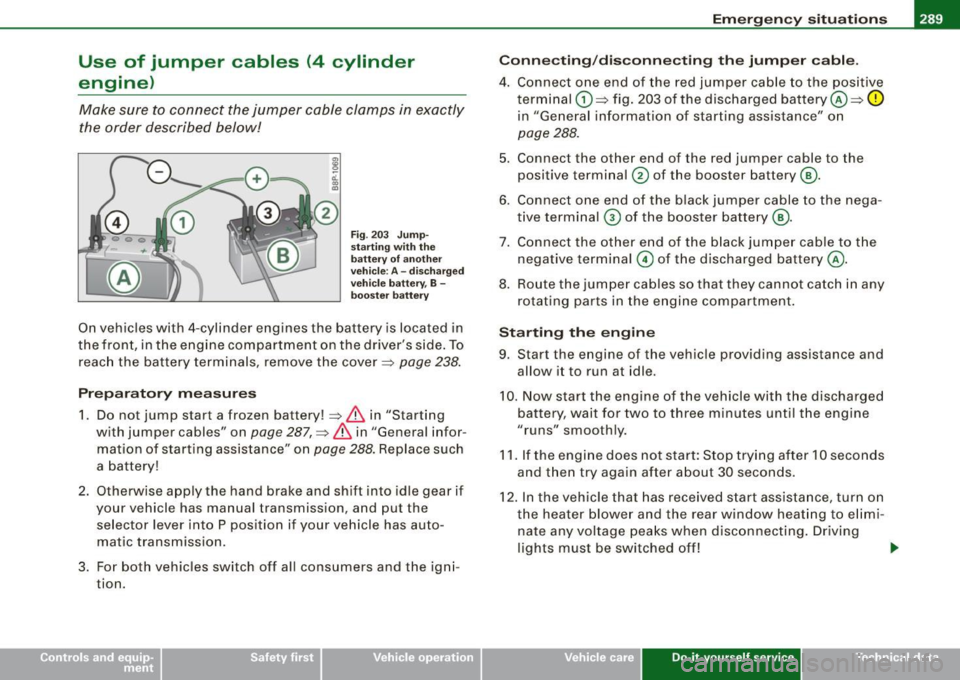
Make sure to connect the jumper cable clamps in exactly
the order described below!
Fig . 203 Jump
starting with the
battery of another
vehicle: A -discharged
vehicle battery, B -
booster battery
On vehicles with 4-cylinder engines the battery is located in
the front, in the engine compartment on the driver's side. To
reach the battery terminals, remove the cover=>
page 238.
Preparatory measures
1. Do not jump start a frozen battery!=> & in "Starting
with jumper cables" on
page 287, => & in "General infor
mat ion of starting assistance" on
page 288. Replace such
a battery!
2. Otherwise apply the hand brake and shift into idle gear if your vehicle has manual transmission, and put the selector lever into P position if your vehicle has automatic transmission.
3. For both vehicles switch off all consumers and the igni
tion.
Connecting/disconnecting the jumper cable.
4. Connect one end of the red jumper cable to the positive
terminal
G) => fig. 203 of the discharged battery©=> 0
in "General information of starting assistance" on
page 288.
5. Connect the other end of the red jumper cable to the
positive terminal
@ of the booster battery ®·
6. Connect one end of the black jumper cable to the nega tive terminal
G) of the booster battery ®·
7. Connect the other end of the black jumper cable to the negative terminal
© of the discharged battery@.
8. Route the jumper cables so that they cannot catch in any
rotating parts in the engine compartment.
Starting the engine
9. Start the engine of the vehicle providing assistance and
allow it to run at idle.
10. Now start the engine of the vehicle with the discharged
battery, wait for two to three minutes until the engine
"runs " smoothly.
11. If the engine does not start: Stop trying after 10 seconds
and then try again after about 30 seconds.
12. In the vehicle that has received start assistance, turn on
the heater blower and the rear window heating to elimi nate any voltage peaks when disconnecting. Driving
lights must be switched off! ._
Vehicle care Do-it-yourself service irechnical data
Page 293 of 324
Emergency situations -____________________________ ___,::,:.___:_ ___ _
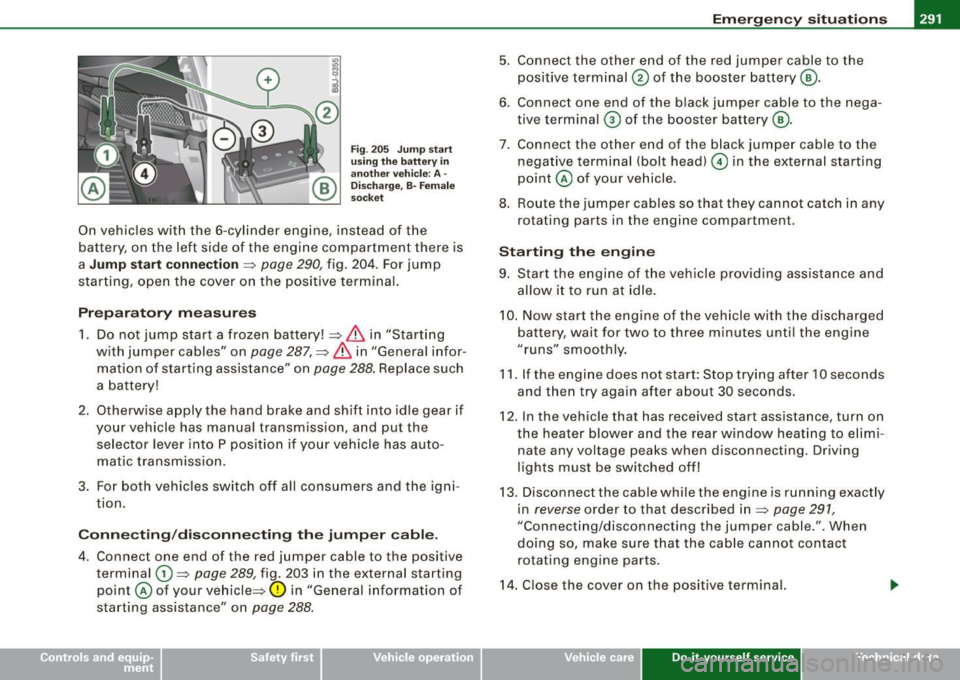
Fig. 205 Jump start
using the battery in
another vehicle: A -
Discharge, B- Female
socket
On vehicles with the 6-cylinder engine, instead of the
battery, on the left side of the engine compartment there is
a
Jump start connection => page 290, fig. 204. For jump
starting, open the cover on the positive terminal.
Preparatory measures
1. Do not jump start a frozen battery!=> & in "Starting
with jumper cables" on page
287, => & in "General infor
mation of starting assistance" on page
288. Replace such
a battery!
2. Otherwise apply the hand brake and shift into idle gear if
your vehicle has manual transmission, and put the selector lever into P position if your vehicle has auto
matic transmission.
3. For both vehicles switch off all consumers and the igni
tion.
Connecting/disconnecting the jumper cable.
4. Connect one end of the red jumper cable to the positive
terminal
G) => page 289, fig. 203 in the external starting
point @of your vehicle =>
0 in "General information of
starting assistance" on page
288.
5. Connect the other end of the red jumper cable to the
positive terminal
® of the booster battery @.
6. Connect one end of the black jumper cable to the nega tive terminal
0 of the booster battery @.
7. Connect the other end of the black jumper cable to the
negative terminal (bolt head)
© in the external starting
point @ of your vehicle.
8. Route the jumper cables so that they cannot catch in any
rotating parts in the engine compartment.
Starting the engine
9. Start the engine of the vehicle providing assistance and allow it to run at idle.
10. Now start the engine of the vehicle with the discharged battery, wait for two to three minutes until the engine
"runs" smoothly.
11. If the engine does not start: Stop trying after 10 seconds and then try again after about 30 seconds.
12. In the vehicle that has received start assistance, turn on the heater blower and the rear window heating to elimi
nate any voltage peaks when disconnecting. Driving
lights must be switched off!
13. Disconnect the cable while the engine is running exactly in reverse order to that described in=> page 291,
"Connecting/disconnecting the jumper cable .". When
doing so, make sure that the cable cannot contact
rotating engine parts.
14. Close the cover on the positive term inal. .,_
Vehicle care Do-it-yourself service irechnical data
Page 303 of 324
____________________________________________________________ D_ a _ t_a __ lllll
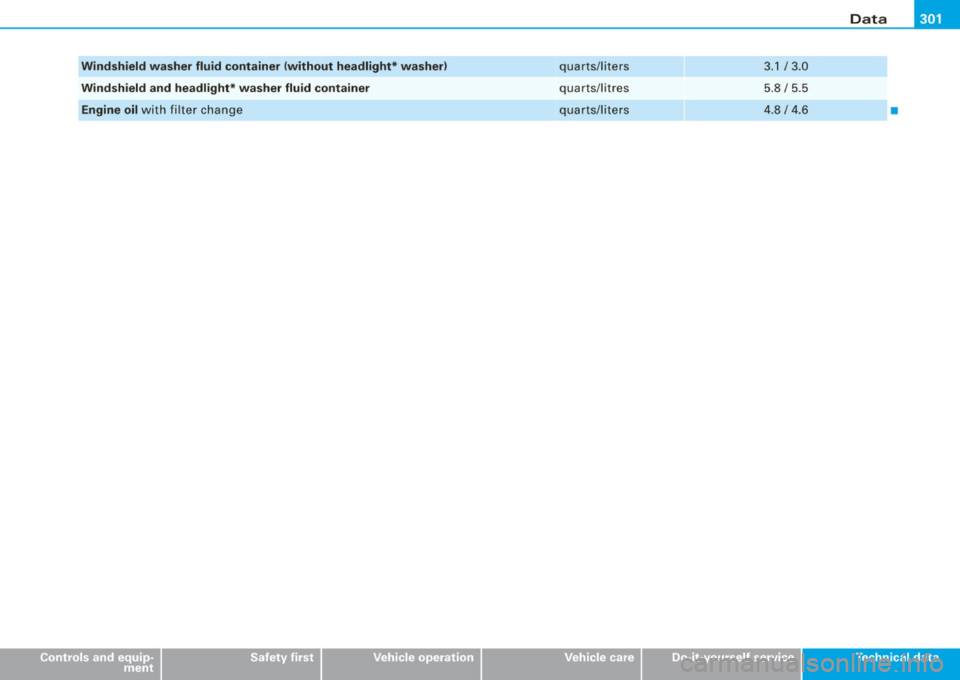
Wind shield wash er fluid container (without headlight * wash er)
Windshield and headl ight * w asher fluid cont ainer
Engine oil with filt e r ch ange
Controls and equip ment Safety first
Vehicle operation quarts/liters
quarts/litres
quarts/
liters
Vehicle care 3.1 / 3.0
5.8 / 5. 5
4.8 / 4.6
Do-it-yourself service
•
T ec hn ica l da ta
Page 304 of 324
___ D_ a_t _a ________________________________________________________ _
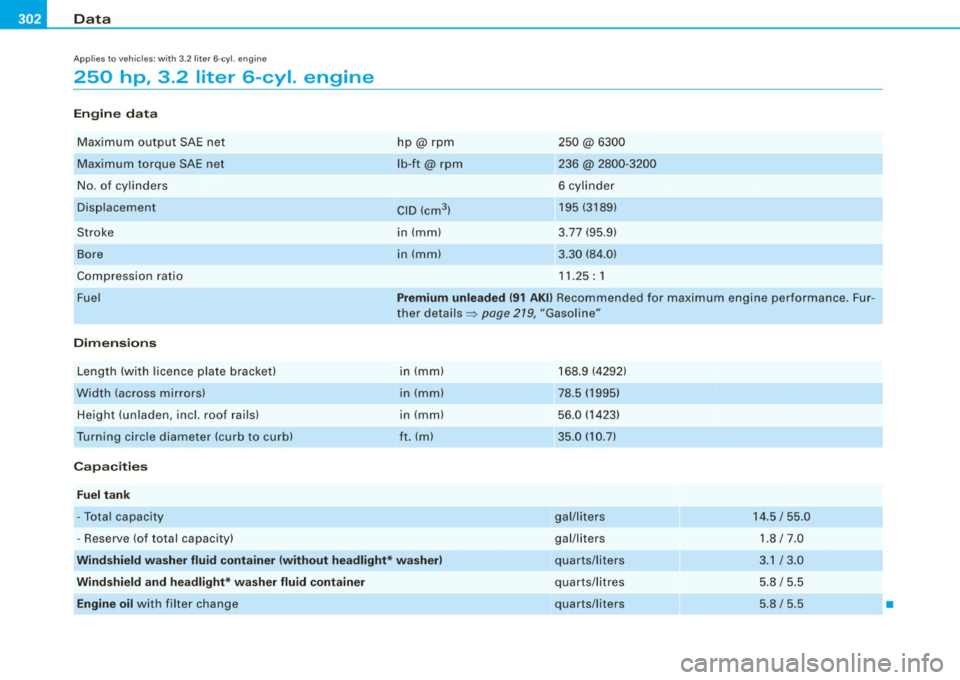
Applies to vehicles : wit h 3.2 liter 6-c yl. en gine
250 hp, 3 .2 liter 6-cyl. engine
Engine data
Max imum output SAE net
Maximum torque SAE net
No. of cy linders
Disp lacement
Stroke
Bo re
Comp ress ion ratio
Fuel
Dimensions
Length (with licence plate brac ket)
Width (across mirrors) Height (unladen, incl. roof rails)
Turning c ircle diameter (curb to curb)
Capacities
Fuel tank
- Total capacity
- Reserve (of total capacity) hp@ rpm
lb-ft@ rpm
CID (cm
3
)
in (mm)
in (m m) 250@6300
236 @ 2800-3200
6 cylinder 195 (3189)
3 .77 (95 .9)
3 .30 (84 .0)
11 .25 : 1
Premium unleaded {91 AKll Recommended for maximum engine performance . Fur
ther details =:>
page 219, "Gasoline"
in (m m)
in (m m)
in (mm)
ft . (ml 168
.9 ( 429 2)
78.5 (1995)
56.0 ( 14 23)
35 .0 (10 .7)
ga l/lit ers
gal/l iters 14.5 / 55
.0
1 .8/7 .0
Windshield washer fluid container (without headlight* washer )
Windshield and headlight* washer fluid container quarts/liters
quarts/l it res 3.
1 / 3.0
5 .8 / 5.5
Engine oil with filter change quarts/liters 5.8 / 5.5 •