driver seat adjustment AUDI S3 2009 User Guide
[x] Cancel search | Manufacturer: AUDI, Model Year: 2009, Model line: S3, Model: AUDI S3 2009Pages: 324, PDF Size: 76.02 MB
Page 133 of 324
Driving Safely ---------------=------------'-
Proper adjustment of head restraints
Correctly adjusted head restraints are an important part
of your vehicle's occupant restraint system and can help
to reduce the risk of injuries in accident situations.
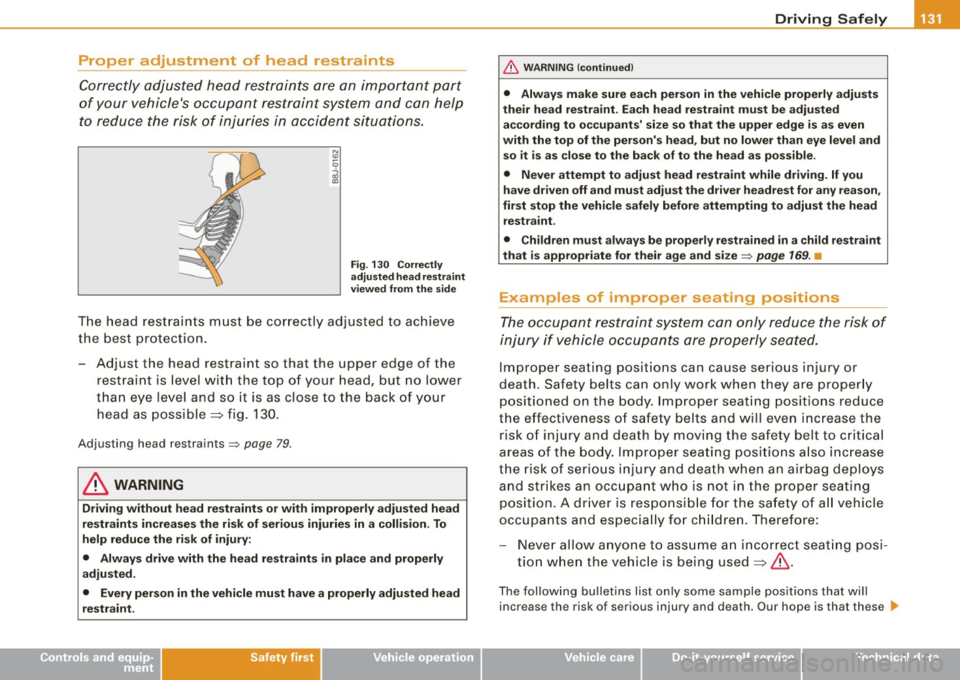
Fig. 130 Correctly
adjusted head restraint
viewed from the side
The head restraints must be correctly adjusted to achieve
the best protection.
-Adjust the head restraint so that the upper edge of the
restraint is level with the top of your head, but no lower
than eye level and so it is as close to the back of your
head as possible ~ fig. 130.
Adjusting head restraints=> page 79.
& WARNING
Driving without head restraints or with improperly adjusted head
restraints increases the risk of serious injuries in a collision . To
help reduce the risk of injury :
• Always drive with the head restraints in place and properly
adjusted.
• Every person in the vehicle must have a properly adjusted head
restraint.
Controls and equip ment Safety first Vehicle operation
& WARNING (continued)
•
Always make sure each person in the vehicle properly adjusts
their head restraint. Each head restraint must be adjusted
according to occupants' size so that the upper edge is as even
with the top of the person's head, but no lower than eye level and
so it is as close to the back of to the head as possible .
• Never attempt to adjust head restraint while driving. If you
have driven off and must adjust the driver headrest for any reason,
first stop the vehicle safely before attempting to adjust the head
restraint.
• Children must always be properly restrained in a child restraint
that is appropriate for their age and size=>
page 169 . •
Examples of improper seating positions
The occupant restraint system can only reduce the risk of
injury if vehicle occupants ore properly seated.
Improper seating positions can cause serious injury or
death . Safety belts can only work when they are properly
positioned on the body. Improper seating positions reduce
the effectiveness of safety belts and will even increase the
risk of injury and death by moving the safety belt to critical
areas of the body. Improper seating positions also increase
the risk of serious injury and death when an airbag deploys
and strikes an occupant who is not in the proper seating
position. A driver is responsible for the safety of all vehicle
occupants and especially for children. Therefore:
- Never allow anyone to assume an incorrect seating posi
tion when the vehicle is being used~& .
The following bulletins list only some sample positions that will
increase the risk of serious injury and death. Our hope is that these .,_
Vehicle care Do-it-yourself service Technical data
Page 144 of 324

___ S_a_ f_ e_ t-= y_ b_e_ l_ t _s _______________________________________________ _
-Insert t he tongue into the correct b uckle of y our seat
unt il you h ea r it la tc h securely~ fig. 138.
Pull on t he belt to make sure that it is securely latched in
the buckle.
Aut om ati c sa fe ty belt re tra cto rs
Eve ry safety be lt is equipped with an automatic belt retractor on the
shoulder belt. This feature locks the belt when the belt is pulled out
fast, during hard braking and in an accident. The belt may a lso lock
when you drive up or down a steep hill or through a sharp curve .
During normal driving the belt lets you move free ly.
Safety belt prete nsi oners
The safety belts are equipped with a be lt pretensioner that he lps to
tighten the sa fety be lt and remove slack when the pretensioner is
activated. The function of the pretensioner is monitored by a
warning light=>
page 14 .
Swit chable locking fe ature
Every safety belt except the one on the driver sea t is equipped with
a switchab le locking feature that
must be used when the safety belt
is used to a ttach a chi ld safe ty sea t. Be sure to read the important
information about this feature=>
page 179.
& WARNING
Improper ly positioned safet y belts can cause seriou s inj ury in an
accident =>
page 14 2, "S afety belt po sitio n".
• Safet y belts offer opt imum protection on ly when the seat back
i s upright and belt s are properly po sition ed on t he bod y.
• Always make sure that the rear seat backrest to whi ch the
c enter r ear sa fet y belt i s atta ched i s sec ure ly lat ched whe nev er
the rear center saf ety belt i s being us ed. If the ba ckrest is not
s ecu rely lat ched, the pas senge r will mo ve fo rward with the back
rest dur ing sudden braking , in a sudden maneu ver and e spec iall y
in a cra sh.
& W AR N ING (continu ed )
• Never attach the safety belt to the buck le for anothe r seat .
Atta ch ing th e be lt to the wrong buckle will reduce safety belt
e ffe cti venes s and can ca use seriou s per son al injur y.
• A p assenger who i s not prope rly re str ained can be s eriousl y
injured by the saf ety belt it self wh en it m ove s from the stronger
p art s of the body into criti ca l area s like the abd omen .
• Alway s lock the convert ible lo ck ing retractor when you are
s ecu ring a ch ild safety se at in the ve hi cle =>
page 18 1. •
Safety belt position
Correct belt posi ti o n is the key to getting maximum
protecti on f rom safety be lts.
Fig . 1 3 9 He ad r est ra in t
an d safe ty belt p osi
tion a s seen from th e
sid e
Standard features on your vehicle help you adjust the position of
the safety belt to match your body size .
• belt height adjustment for the front seats,
• automatic belt height adjustment for the rear seats.
Page 147 of 324

_________________________________________________ S_ a_f _e _t .:..y _ b_ e_lt_ s __ llll
• With the front seats, the height adjustment of the seat can also
be used to adjust the position of the safety belts. •
Improperly worn safety belts
Incorrectly positioned safety belts can cause severe inju
ries.
Wearing safety belts improperly can cause serious injury or
death. Safety belts can only work when they are correctly positioned on the body. Improper seating posit ions reduce
the effectiveness of safety belts and w ill even increase the
risk of injury and death by moving the safety belt to critical
areas of the body . Improper seating positions also increase
the r isk of serious injury and death when an airbag deploys
and strikes an occupant who is not in the correct seating position. A driver is responsible for the safety of all vehicle
occupants and especially for children. Therefore:
-Never permit anyone to assume an incorrect sitting posi -
tion in the vehicle while traveling~& .
The following lists only some examples of improperly worn safety
bel ts that will increase the risk of serious injury and death. Our hope
is that these examples will make you more aware of seating posi
tions that are dangerous.
Therefore, whenever the vehicle is moving:
• never wear the shoulder belt under your arm
• never let the shoulder belt pass over your neck
• never wear the safety belt loosely
• never place the lap belt portion of the safety belt across your
abdomen ~& -
Controls and equip
ment Safety first Vehicle operation
& WARNING
Improperly worn
safety belts increase the risk of serious personal
injury and death whenever a vehicle is being used.
• Always make sure that all vehicle occupants are correctly
restrained and stay in a correct seating position whenever the
vehicle is being used.
• Always read and heed all WARNINGS and other important infor
mation ~
page 140. •
Safety belt pretensioners
How safety belt pretensioners work
In front, side and rear end collisions above a particular
severity, safety belts are tensioned automatically.
The safety belts are equipped with safety belt pretensioners . The
system is activated by sensors in front, side and rear -end collisions
of great severity . This tightens the belt and takes up belt slack~ &
in "Service and disposal of safety belt pretensioner " on
page 146.
Taking up the slack helps to reduce forward occupant movement
during a collision.
0 Note
Never let the belt remain over a rear seat back that has been folded
forward.
[ i] Tips
The safety belt pretensioners can only be activated once.
• In minor frontal and side collisions, in rear -end collisions, in a
rollover and in accidents involving very little impact force , the safety
belt pretensioner are not activated . .,_
Vehicle care Do-it-yourself service Technical data
Page 149 of 324

__________________________________________________ A_ i_ r _b _a...; g::- s_ y=--- s_t _e _m __ !II
Airbag system
Important things to know
Importance of wearing safety belts and
sitting properly
Airbags are only supplemental restraints. For airbags to
do their job, occupants must always properly wear their
safety belts and be in a proper seating position.
For your safety and the safety of your passengers, before
driving off, always:
- Adjust the driver's seat and steering wheel properly
=>
page 128,
-Adjust the front passenger's seat properly=> page 75,
-Wear safety belts properly=> page 140,
- Always properly use the proper child restraint to protect
children=>
page 169.
In a collision, airbags must inflate within the blink of an eye and with
considerable force . The supplemental airbags can cause injuries if
the driver or the front seat passenger is not seated properly. There
fore in order to help the airbag to do its job, it is important, both as
a driver and as a passenger to sit properly at all times.
By keeping room between your body and the steering wheel and the
front of the passenger compartment, the airbag can inflate fully and
completely and provide supplemental protection in certain frontal
collisions =>
page 128. For details on the operation of the seat
adjustment controls =>
page 76.
It's especially important that children are properly restrained
=>
page 169.
Controls and equip ment Safety first Vehicle operation
There is a lot that the driver and the passengers can and must do to
help the individual safety features installed in your Audi work
together as a system .
Proper seating position is important so that the front airbag on the
driver side can do its job. If you have a physical impairment or
condition that prevents you from sitting properly on the driver seat
with the safety belt properly fastened and reaching the pedals, or if
you have concerns with regard to the function or operation of the
Advanced Airbag System, please contact your authorized Audi dealer or other qualified workshop, or call Audi Customer CARE at 1-
800 -822 -2834 for possible modifications to your vehicle.
When the airbag system deploys, a gas generator will fill the
airbags, break open the padded covers, and inflate between the
steering wheel and the driver and between the instrument panel
and the front passenger. The airbags will deflate immediately after
deployment so that the front occupants can see through the wind
shield again without interruption .
All of this takes place in the blink of an eye, so fast that many people don't even realize that the airbags have deployed. The airbags also
inflate with a great deal of force and nothing should be in their way
when they deploy. Front airbags in combination with properly worn
safety belts slow down and limit the occupant's forward movement .
Together they help to prevent the driver and front seat passenger
from hitting parts of the inside of the vehicle while reducing the
forces acting on the occupant during the crash. In this way they help
to reduce the risk of injury to the head and upper body in the crash.
Airbags do not protect the arms or the lower parts of the body.
Both front airbags will not inflate in all frontal collisions. The trig
gering of the airbag system depends on the vehicle deceleration
rate caused by the collision and registered by the electronic control
unit. If this rate is below the reference value programmed into the
control unit, the airbags will not be triggered, even though the car
may be badly damaged as a result of the collision. Vehicle damage,
9J),
Vehicle care Do-it-yourself service Technical data
Page 156 of 324

___ A_ ir_ b_ a-g _ s_y _ s_ t_ e_ m _________________________________________________ _
& WARNING (continued)
the PASSENGER AIR BAG OFF light does not come on and stay on,
immediately install the rear-facing child safety seat in a rear
seating position and have the airbag system inspected by your
authorized Audi dealer.
& WARNING
If, in exceptional circumstances, you must install a forward-facing
child restraint on the front passenger's seat:
• Always make sure the forward -facing seat has been designed
and certified by its manufacturer for use on a front seat with a
passenger front and side airbag.
• Never put the forward-facing child restraint up against or very
near the instrument panel .
• Always move the passenger seat into its rearmost position in
the seat's fore and aft adjustment range, as far away from the
airbag as possible, before installing the forward-facing child
restraint . The backrest must be adjusted to an upright position.
• Make sure that the PASSENGER AIR BAG OFF light comes on
and stays on all the time whenever the ignition is switched on. •
Advanced Airbag System components
The front passenger seat in your vehicle has a lot of very important
parts of the Advanced Airbag System in it. These parts include the
weight-sensing mat, sensors, wiring, brackets, and more. The func
tion of the system in the front passenger seat is checked by the elec
tronic control unit when the ignition is on. The control unit monitors
the Advanced Airbag System and turns the airbag indicator light on
when a malfunction in the system components is detected. The
function of the airbag indicator light is described in greater detail
below. Because the front passenger seat contains important parts
of the Advanced Airbag System, you must take care to prevent it from being damaged.
Damage to the seat may prevent the
Advanced Airbag for the front passenger seat from doing its job in
a crash .
The front Advanced Airbag System consists of the
following: • Crash sensors in the front of the vehicle that measure vehicle
acceleration/deceleration to provide information to the Advanced
Airbag System about the severity of the crash.
• An electronic control unit, with integrated crash sensors for front
and side impacts. The control unit "decides" whether to fire the
front airbags based on the informa tion received from the crash
sensors. The control unit also "decides" whether the safety belt
pretensioners should be activated.
• An Advanced Airbag with gas generator for the driver inside the
steering wheel hub .
• An Advanced Airbag with gas generator inside the instrument
panel for the front passenger.
• A weight-sensing mat under the upholstery padding of the front
passenger seat cushion that measures the total weight on the seat.
The information registered is sent continuously to the electronic
control unit to regulate deployment of the front Advanced Airbag on
the passenger side.
• An airbag monitoring system and indicator light in the instru
ment cluster => page 158.
• Th e PASSENGER AIR BAG OFF light comes on and stays on in the
center of the instrument panel=> page 159, fig. 146 and tells you
when the front Advanced Airbag on the passenger side has been
turned off.
• A sensor below the safety belt latch for the front seat passenger
to measure the tension on the safety belt . The tension on the safety
belt and the weight registered by the weight -sensing mat help the
control unit "decide" whether the front airbag for the front
passenger seat should be turned off or not=> page 149, "Child
restraints on the front seat -some important things to know". .,_
Page 172 of 324

-Child Safety ------=---------------------------------
& WARNING (continued )
• Always install rear-facing child safety seats on the rear seat .
• If you must install a rearw ard fa cing child safety seat on the
front passenger seat in exceptional circumstances and the
PASSENGER AIR BAG OFF light does not come on and stay on,
immediately install the rear-facing child safety seat in a rear
seating posit ion and have the airbag system inspected immedi
ately by your authorized Audi dealer .
& WARNING
If, in exceptional circumstances, you must install a forward -facing
child restraint on the front passenger's seat :
• Always make sure the forward -facing seat has been designed
and certified by its manufacturer for use on a front seat with a
passenger front and side airbag.
• Always follow the manufacturer's instructions provided with
the child safety seat or carrier.
• Always move the passenger seat into its rearmost position in
the seat's fore and aft adjustment range , as far away from the
a irbag as possible before installing the child restraint . The back
rest must be adjusted to an upright position.
• Always make sure that the PASSENGER AIR BAG OFF light
comes on and stays on all the time whenever the ignition is
switched on . •
Advanced front airbag system and children
Y our vehicle is equipped with an " Advanced Airbag Syste m" in
co mplia n ce wi th Unit ed States F edera l Moto r Veh icle Saf ety S tan
dard ( FMVSS) 208 as appl icable at the time your vehicle was manu
f actu re d . T
he Advanced Airbag system in your vehicle has been certified to
m eet the " lo w -ris k" req uiremen ts for 3 and 6 year -ol d c hildren on
the passenger side a nd smal l adults on the driver side . The low risk
de ploymen t criteria a re i ntended to reduce the risk of i nju ry t hroug h
interaction with the airbag that can occur, for example, by bei ng too
close to the s tee rin g w heel and instrume nt panel whe n the ai rbag
i n fl ates. In add it ion, t he sys tem has been cer tified to co mply wi th
the "suppre ssion" req uirement s of the Safety Standa rd, to turn off
the front a irbag f or infants up to 12 month s who ar e restrai ned on
the front passenger seat in child restraints that are listed in the
S tan dard.
E ven though your vehicle is equipped with an Advanced Airbag
sy stem , a ll ch ildr en, especia lly those 12 yea rs and yo unge r, should
a lways ride i n the back seat prop erly re stra ined for t heir a ge and
s ize . The ai rbag on the pas se nger side make s th e fr on t sea t a poten
t ia lly dangero us p lace for a c hild to r ide. The front seat is no t the
safest p lace for a child in a forward -facing child safety seat. It can be
a ve ry da nger ous place for a n inf ant or a la rg er c hild i n a rea rward
facing seat. •
Advanced Airbags and the weight-sensing
mat in the front seat
Th e Ad vanced Ai rbag Sys te m in your vehic le de tec ts the prese nce
o f an inf ant or c hild in a chi ld rest raint on the front pass eng er s eat
us ing the weight -sensing mat in the seat cushion and the senso r
b elow t he safety be lt latch on t he front pass enger s eat that
measures the tension on the safety belt.
T he weig ht-se nsin g m at m easu res total weig ht of th e chi ld an d th e
c h ild safety s eat and a ch ild bl anket on the front passen ger seat . T he
w eig ht on th e front p assenge r seat is re la te d to th e des ig n of t he
c h ild re straint and its "footpr int", t he size and shap e of the bottom
of t he child restraint a s it sits on the seat . Th e w eight of a child
r e stra int and its "footprint" vary for diff ere nt k inds of c hild ..,.
Page 284 of 324
11111.___F_ u_ s _ e_s _ a_n _ d_ b_ u_lb _ s _______________________________________________ _
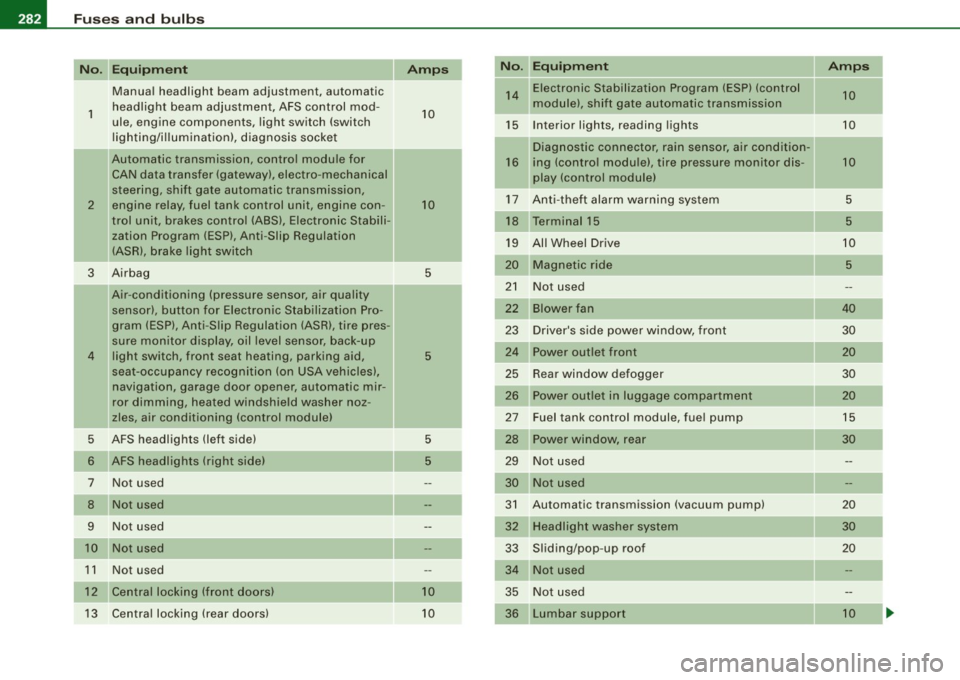
Equipment Amps No. Equipment Amps
Manual headlight beam adjustment, automatic 14 Electronic Stabilization Program (ESP) (control
10
1 headlight beam adjustment, AFS control mod-
10 module),
shift gate automatic transmission
ule, engine components, light switch (switch
15 Interior lights, reading lights 10
lighting/illumination), diagnosis socket
Diagnostic connector, rain sensor, a ir condit ion-
!! Automatic transmission, control module for
16 ing (control module), tire pressure monitor dis- 10
CAN data transfer (gateway), electro -mechanical
play (control module)
steering, shift gate automatic transmission, 17 Anti-theft alarm warning system 5
2 engine relay, fuel tank control unit, engine con
-10
trol unit, brakes control (ABS), Electronic Stabili- 18 Terminal 15
5
zation Program (ESP), Anti -Slip Regulation
19 All Wheel Drive
10
(ASR), brake light switch
-20 Magnetic ride 5
3 Airbag
5
-21 Not used
Air -conditioning (pressure sensor, air quality
sensor), button for Electronic Stabilization Pro- 22
Blower fan 40
gram (ESP), Anti -Slip Regulat ion (ASRl, tire pres -
23 Driver's side power window, front 30
sure mon itor display, oil level sensor, back-up
4 light switch, front seat heating, parking aid, 5 24 Power outlet front
20
seat-occupancy recognition (on USA vehicles), 25 Rear window defogger 30
navigation, garage door opener, automatic mir- 26 Power outlet in luggage compartment 20
ror dimming, heated windshield washer noz-
zles, air conditioning (control module) 27 Fuel tank control module, fuel pump 15
5 AFS headlights (left side)
5 28 Power
window, rear
30
6 AFS headlights (r ight side) 5 29 Not used
7 Not used 30 Not used
8 Not used 31 Automatic transmission (vacuum pump)
20
9 Not used 32 Headlight washer system 30
10 Not used
33 Sliding/pop-up roof
20
1 1 Not used 34 Not used
12 Central locking (front doors} 10 35 Not used
13 Central locking (rear doors) 10
36 Lumbar
support 10
Page 318 of 324
___ A_l.:,. p _h_ a_ b_e _t _ic _ a_l _in _ d_e _x ____________________________________________ _
Passive safety system . . . . . . . . . . . . . . . 126
Pedals . .... ... .. .... .... .... ...... 132
Physical p rinciples of a frontal collision 138
Polish ing ... ... ... .. ... .... .... .... 209
Power locking switch .. ... .... ...... .. 41
Rear center console ... ........ .... 42
Power locking system . . . . . . . . . . . . . . . . 37
Convenience close/open feature .. ... 47
Locking and unlocking the vehicle from inside ... .... ... .... .... ..... .. . 41
Opening and closing the windows .. . 47
Operating locks from with k ey . ..... 40
Rear lid .. .. .. .. .. .... .... ...... .. 42
Remo te control . . . . . . . . . . . . . . . . 36, 39
Un locking and locking vehicle .. ... .. 39
Power outlets . . . . . . . . . . . . . . . . . . . . . . . 93
Power seat Adjusting the seatback ..... ........ 77
Adjustment . ...... .... .... ... .... 76
Power steering
See Electro-mechanical power assist . 16 ,
195
Power sunroof
See panoramic sliding sunroof .... .. 48
Power window switches . . . . . . . . . . . . . . 46
In the driver's door ................ 46
Reactivating the system . . . . . . . . . . . . 48
Pregnant wom en
Special considerations when wearing a safety belt . . . . . . . . . . . . . . . . . . . . . 143
Proper occupant sea ting posi tions .... 128
Proper safety belt position . . . . . . . . . . . 142 Proper seating position
Front passenger . . . . . . . . . . . . . . . . . 129
Occupants .... ...... .... ... .. ... 128
Rear passengers 130
a
Quartz clock ...... ..... .. .... .... .... . 9
quattro®
See All Wheel Drive . . . . . . . . . . . . . . . 196
Question
R
What happens to unbelted occupants? ..
139
Why safety belts? . . . . . . . . . . . . . . . . 137
Radiato r fan . .... .... ...... .... .... . 235
Radio Replacing . .... ... .... .... .... ... 306
Rain sensor defective ... ... .... ... .... 34
Reading light
Rea r ..... ..... ...... .... .... .... . 61
Reading lights
Front ..... ..... ... .... ... .... .... 60
Rea r ... ... .... ... ... .. ...... ..... 60
Rear armrest .... ... .. .... .. .. ... .... 82
Rea r ashtray . .... ...... .... ... .. .... 93
Rear lid
Emergency release .... .... .... .... 43
Lock ing/unlocking . ... .. ....... ... . 42
Rear light defective . . . . . . . . . . . . . . . . . . 33
Rear power locking switch ... .... .... . 42 Rear seat bottom
...... .. .... .... .. . . 83
Rear view mirror
Inside rear view mirror ............ . 69
Rear window defogger with air-conditioning ... ... .. ..... 105
Refuelling ....... .... .... ...... ..... 221
Release lever for engine hood ..... .... 224
Remo te con trol . ...... .. .. ... ..... .. . 36
Resetting remote control ... .... .... 40
Un locking and locking . .... .... ... . 39
Remote mast er key
Ba ttery replacement ............... 36
Check light .... .... .... ..... .. ... . 36
Repair manuals ... .... ... .... .... .. . 303
Repairs Airbag system .... .... .... .... ... 161
Replacing Wheel rims . ... .... .... .... .. 255, 257
Replacing a fuse ... ... ....... .... ... 280
Replacing a sound system . .... .... ... 306
Replacing light bulbs . ...... .. .... ... 285
Replacing tires and wheels ........... 256
Reporting Safety Defects .. ....... 135, 136
Reset but ton . . . . . . . . . . . . . . . . . . . . . . . . 10
Resetting remote control ...... .... .... 40
Retractor . . . . . . . . . . . . . . . . . . . . . . . . . . 141
Reverse Automatic transmission .... .... .. . 117
Reversible cargo area floo r ........ .... 87
Page 319 of 324
______________________________________________ A_ l_,_ p _h_ a_ b_e _t_i c_ a _ l _in _ d_e _ x __ lll
Rims
Cast alloy ..... .. ... ........ .... . 212
Rep lacing ......... ..... .... . 255 , 257
Steel rims .... ...... ..... ...... .. 211
Roof rack Attachment points with separate roof rack system ... .... .... .. ... ...... ... 89
Loading .. .. ..... .... .... .. . ... ... 91
Mounting locations . ..... ... .... ... 90
Saf e mounting ... .... .... .. . .... .. 88
Roof weight . ... .... ..... .. .... .... .. 91
s
Stronic .. ..... .. .... .... ... .... .... 117
Driving Notes . . . . . . . . . . . . . . . . . . . . 119
Emergency program ..... ... . ... .. 123
Kick -down .. ... ... .. .... ... . ... .. 122
Launch Control Program . .... ..... . 122
Selector lever lock .. ...... .. . .... . 118
Selector lever positions . ..... .... . 117
Tiptronic . .... .... .... ... .... .... 12 1
Tiptronic controls on the steering whe el
122
SAFE ...... ... ......... ....... ...... 10
Safe driving habits .... ..... ... ..... . 126
Safety belt position .... ... .... .... ... 142
Safety belt height adjustment . ..... 144
Safety belts worn by pregnant women .. 143
Safety belt pretensioner ... ...... .. ... 145
Service and disposal . .... ... .. ... . 146
Safety belt warning light .... .... .. 15, 137
Controls and equip
ment Safety first
Safety bel
ts ... .. .. .. ....... ... . .... 141 Safety lock
cleaning . .... ...... ........ ..... 217 Ignition key , automatic transmission 108
Dange r to passengers who do not wear a
Seat adjustment
safety belt ... .. .. . .... ... .... .. 139
Driver's seat . .... ... .. .. .... .... .. 74
Fastening .. ........ ..... ... .... . 141
Front passenger's seat .... .... .... . 75
height adjustment .... .... .... .... 144
Front seats .. ... ..... .. .. ... ... .. . 74
Improperly worn . .......... .... .. 145
Head restrain ts .. .. ...... ....... .. 131
Not worn . .... ...... ....... .... .. 139
Head restrain ts, front seat .. .... .... 79
Safety belt position ... ...... ...... 142
Lumbar suppor t .. .... .... .... ... .. 78
Safe ty ins tructions . ... .... ... . .. .. 140
Manual controls .. .... .... ... ... ... 75
Securing child safety seats ....... .. 179
Manual seats .... .... .... .... ... .. 76
Special considerations for pregnant Power seat .... ... .... .... .... .... 76
women . .... .... .... .... ... .... 143
Seat belts
Unfastening .. ... .... ...... ..... . 144
Warning /indicato r light ...... .... .. 137
Why YOU MUSTwearthem ... . 137,138
Worn properly ... .... ...... ...... 140
Safety compliance sticker . ..... .... .. 298 Why YOU MUST wear them
.... 137 , 138
See also Safety belts . ... .. .... .... 137
Seating capacity .. . ... .... .... .... .. 137
Seat ing position
Driver ... .. ... ... .... ... . ... .... . 128
Safety equipment ...... ..... .... .... 126
Sa fet y fea tures for occupant r estraint and
protection ... .. .. . ... .... .... .. 126
Safety guidelines Seat adjustment ......... ... .... ... 74 Front passenger .
...... .. . .... .. .. 129
How to adjust the front seats . .. .. . . 129
Incorrect seat position .. ...... .. . . 131
Occupants .. ...... .... .. . .... ... . 128
Rear passengers . ........ . ... .... . 130
Safety instructions Seats
Engine compartm ent . .... ..... ... . 225
Number of seats ........ .. ... ... .. 137
for booster seats . .... ...... ...... 177
for sid e curtain airbags . ..... .. .... 168 Selector lever positions
Automatic transmission ......... .. 117
for using child safety seats . ........ 172
for using convertible child sea ts .... 175
for using infant seats ........... .. 174
for using safety be lts . .... .... .... . 140
Monitoring the Advanced Airbag System Service and disposal
Safety b elt pretensioner ... .... .... 146
Service interval display ... .. .. .... .. . .. 20
Service position for windshield wipers ... 66
160 Set menu
... ...... .. ... ... ..... .. . .. 26
Vehicle operation Vehicle care Do-it-yourself service Technical data