park assist AUDI S3 2009 User Guide
[x] Cancel search | Manufacturer: AUDI, Model Year: 2009, Model line: S3, Model: AUDI S3 2009Pages: 324, PDF Size: 76.02 MB
Page 122 of 324

....... _T _r_a _ n_ s_m _ i_s _s _i_o _n ______________________________________________________ _
Stopping on an incline
- Always hold the vehicle wi th t he foot bra ke or parking
b rake in orde r to prevent "rollback"=> &. Do
not try to
preve nt the ve hicle f ro m rolling back by rewi ng the
e ngin e while it is in ge ar.
Starting on a hill
-App ly the hand bra ke firm ly .
- With th e en gin e in g ea r, gradua lly accelera te an d re le as e
th e han d brake .
The engine can only be started wi th th e selector lever i n P or N
=> pa ge 109. At low ambient temperatures (14 °F / -1 0 °C), it is only
po ss ibl e to s tart the e ng ine wi th the selec tor leve r in P .
Whe n pa rki ng on leve l g ro und, i t is su fficien t to plac e th e se lec tor
lever in P. On a steeply s lop ing road, you should first app ly the
pa rk in g br ake fi rmly and then p lace th e selec tor lever in P. T hi s w ay ,
you do not overload the pawl mechanism and it is easier to move
th e s elector lever out of P .
& WARNING
• Never leave your veh icle with the engine running while in gear .
If you must leave your vehicle with the engine running, set the
parking brake and engage the park lock.
• When the engine is running and the transmission is in gear (0 ,
S or R l or in "tiptronic " mode , it is essential that you stop the
vehicle with the footbrake . When idling , the transmission of power
does not stop completely -the vehicle "creeps ".
• Do not accelerate when you change the sele ctor lever position
with the vehicle stationary and the engine running -risk of an acci
dent!
• Never place the selector lever in the R or N po sition while the
vehicle is moving -risk of an accident !
& WARNING (continued)
• If you have to bring your vehicle to a stop while on an incline,
keep the foot brake depressed all the way down so that the vehicle
does not start to roll backward . You should never hold the vehicle
using the clutch pedal if you are going to be stopped on an incline .
If you do , the clutch will start to slip when it overheats caused by
the constant overload. This is dangerous because if the vehicle starts to roll backward , you could c ause an accident . If the clutch
should start to slip , you will feel the vehicle "jerk" and the selector
lever display will start blinking .
• Before driving down a steep slope , reduce your speed and shift
i nto a lower gear with "tiptronic ".
• Do not ride the brakes or apply the brake pedal too often or too
long . Constant braking causes the brakes to overheat and
substantially reduces braking performance, increa ses braking
distance or causes complete failure of the brake system . •
Ap plies to veh ic les: wit h S tronic tra nsmiss io n and Hi ll Desce nt Assis t
Hill Descent Assist
Hi ll D esce nt Ass ist help s the driv e r w hen driv ing down
i nc lin es .
Hill Descent Ass is t is activated by press ing th e brake wh ile
descending when the selector lever is in
D /S . The S tronic t ransmis
s io n auto mati ca lly s hifts dow n to a ge ar s uita ble for the incl in e. Hill
Descent Assist attempts to maintain the current vehicle speed when
th e br akin g occu rs, as far as phys ical an d techn ica l lim it s a llow . It
may be necessary to adjust the speed using the brakes .
H ill Descent As sist switc hes off when the inc line leve ls out or when
the gas pedal is pressed.
On vehicles with cruise control*=>
page 113, Hill Descent Assist is
a lso ac tiva ted wh en th e spe ed is s et.
~
Page 125 of 324
Transmission -_______________ ___.
- With your right foot, step on the accelerator to the wide
open throttle position or Kickdown. The engine speed
settles at about 3,200 rpm.
Take your left foot off the brake.
The S tronic® in your vehicle is electronically controlled. A special
Launch Control Program provides the best acceleration from a
standing start.
& WARNING
• Always adapt your driving to the traffic flow.
• Only use Launch Control when road and traffic conditions allow
it and other drivers will not be endangered or annoyed by your
driving and the acceleration of the vehicle.
• Make sure that ESP remains enabled . With the ESP disabled,
the vehicle could brake away, particularly on a slick and slippery road -risk of skidding!
• Once acceleration is finished, switch ASR on again by briefly
pushing the ESP button. •
Applies to veh ic le s: w ith S t ron ic ®
Back -up program
In the event of a system ma/function, there is an back-up
program.
In the event of system malfunction, the automatic transmission
switches to the fail-safe mode. All of the selector lever position
displays for the automatic transmission are highlighted with a light
background in the instrument cluster display. In some cases you
cannot drive in the reverse gear any more.
If the transmission switches to fail-safe mode, you should take the
vehicle to an authorized Audi dealership as soon as possibl e to have
the condition corrected. •
Contro ls and eq uip
ment
Ap plies to vehic les: w ith S tron ic ®
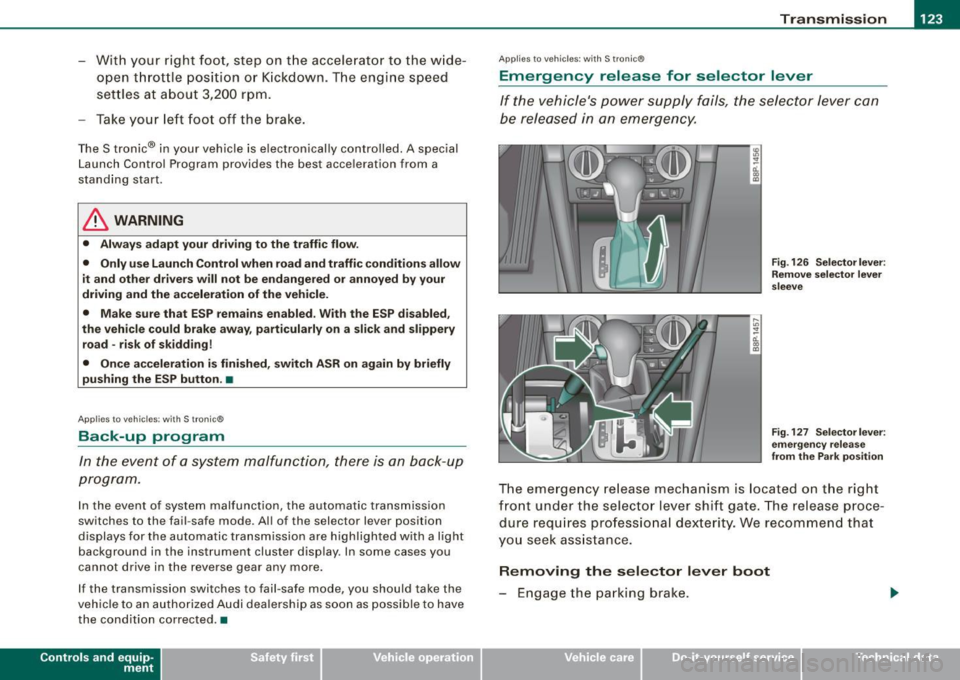
Emergency release for selector lever
If the vehicle's power supply fails, the selector lever can
be released in an emergency.
~ ..
-ti. ., m
Fig. 126 Selector lever :
Remove selector lever
sleeve
Fig . 127 Selectorlever :
emergency release
from the Park position
The emergency release mechanism is located on the right
front under the selector lever shift gate. The release proce
dure requires professional dexterity. We recommend that
you seek assistance.
Removing the selector lever boot
- Engage the parking brake.
Vehicle care I I Technical data
Page 289 of 324
________________________________________________ E _m_ e_r.:g :;,. e_ n_c ...: y:.- s_ i_ t _u _a_ t_ i_ o _ n_ s __ lll
•
Emergency situations
General
This chapter is intended for trained emergency crews and working
pe rsonnel who have the necessary tools and equ ipment to perform
these operations. •
Starting by pushing or towing
(D Note
Vehicles with an automatic transmis sion cannot be started by
push ing or towing . •
Starting with jumper cables
Ju mpe r cabl e: Note the man ufa ct ure r's in for matio n.
If the battery is discharged, another veh icle can provide starting
assistance. For this you require a jumper cable. Both batteries must
h ave t he same vo ltage (V) and a s im ilar capacity (Ah).
Jumper cables
Use
only jumper cables of sufficiently large cross section to safely
car ry the starter current . Refer to the manufactu rer's specifications.
Use only j um per ca bles with
isolated term in al cl am ps and pr operly
marked for distinction :
plus
(+) cable in mo st c ases c olored red
minus( -) cable i n most cas es co lor ed black .
& WARNING
Batteries contain electricity, acid , and gas. Any of the se can cause
very ser ious or fatal injury . Follow the instructions below for safe
handling of your vehicle 's battery .
• Always shield your eyes and avoid leaning over the battery
whenever possible .
• A discharged battery can already freeze at temperatures just
below 32 °F (0 °C l. Never attempt to provide starting assistance on
a frozen or thawed out battery- Danger of explosion and chemical
burns! Replace a battery if it has been frozen.
• Do not allow battery acid to contact eyes or skin. Flush any
contacted area with water immediately .
• Improper use of a booster battery to start a vehicle may cause
an explosion .
• Vehicle batteries generate explosive gases . Keep sparks, flame
and lighted cigarettes away from batteries .
• Do not try to jump start any vehicle with a low acid level in the
battery .
• The voltage of the booster battery must also have a 12 -Volt
rating . The capacity (Ah ) of the booster battery should not be
lower than that of the discharged battery . Use of batteries of
different voltage or substantially different "Ah " rating may cause
an explosion and personal injury .
• Never charge a frozen battery . Gas trapped in the ice may cause
an explosion.
• Never charge or use a battery that has been frozen . The battery
case may have be weakened .
• Use of batter ies of different voltage or substantially different
capacity (Ah) rating may cau se an e xplosion and inju ry . The
c apacity (Ah ) of the booster battery should not be lower than that
of the discharged battery. .,.
Do-it -yourself service
Page 311 of 324
______________________________________________ A_ l_,_ p _h_ a_ b_e _t_i c_ a _ l _in _ d_e _ x __ lll
Asterisk
What does it mean when something is marked with an asterisk? ... .. .. .. .. 5
Audi magnet ic ride .. .... .... ..... 12, 115
Description ...................... 115
Ind icator light .. ...... .... .... .... . 12
Audi parking system ................. 112
Audi Service Repair Manuals and Literature 303
AUTO Climate controls ...... .... ... .... . 101
Switching on .................... 101
When should I use AU TO? . ....... . 10 1
Au to Safety Ho tline ... .. .... .... .... . 135
Automatic air recircu lation ........... 102
A utomatic belt retracto r ...... .... .... 1 41
Automa tic car wash
See Washing ...... .... ... .. .. .... 207
Automatic headlight control ....... .... 53
Automat ic headlights
defective ... .. .... .... ... .... .... . 34
Automat ic Transmission
Au tomatic Transmission . ...... .... 120
Automatic transmission . ............. 117
Driving Notes . . . . . . . . . . . . . . . . . . . . 119
Emergency program . ........... .. 123
Emergency release . . . . . . . . . . . . . . . 123
I gn ition key safety lock ....... .... . 108
Kick-down ... .... .... .... ... .... . 122
L aunch Co ntrol Program ...... ..... 122
Se lector lever lock .. ...... ...... .. 1 18
Se lecto r lever posi tions .. ...... ... 11 7
Controls and equip
ment Safety first
T
iptronic ... .... . .. .. ... ... .. .... 121
Tiptronic controls on the steering whee l
122
Average fuel mileage ................ . 22
Average speed ... .... ..... ... .... ... . 22
Avo id damagi ng the v ehicle ...... .... . 199
B
Battery ... .. .... ... .... .... .... .... 236
charg ing (4-cy lind er engine) . ....... 240
c harging (6 -cy li n der engine) ... ..... 241
Disconnecting and c onnecting .. ... 237
I mpo rtant warnings when working on the
battery . .... .... .... .... .... ... 238
Replaci ng the battery .. ... .... .... 237
Winter operation ... .. .... .... .... 237
Working on the battery .. ...... .... 238
Battery voltage ...................... 33
Before driving . ....... .. .... .... .... 127
Bi -Xenon headlights .. ........ .... ... . 58
Blended gasoline . ... ... ..... .... .... 219
Body cavity sealing ...... ...... ... .. . 212
Booster seats .... .... .... .... .... ... 177
How do I properly install a booster seat i n
my vehicle? .. ... .... .... .... ... 177
Safety instructions ................ 177
Brake assistan t ..... .... .... .... .... 195
Brake booster .......... ...... ..... .. 194
Brake fluid Changing the brake fluid .. ........ 236
Checking the brake fluid leve l .. .... 235
Reservoir ........................ 235 What is
the correct brake fluid leve l? 235
What should I do if the brake fluid warning
light c omes on? ... .. .... .... .... 235
Brake pads ... ... .... ....... .... ... . 198
Brake system ....................... 235
Anti -lock brake system (ABS) .. .... .. 16
Brake fluid ....................... 235
Brake f luid specifications for refi ll and
r eplacement ... .. .... .... ...... . 236
Brake light defective . ........ .... .. 33
General information .. .... .... .... 193
How does moisture or road salt affect the
b rakes? .. ............... .... ... 193
Ma lfunct io n . .... .... .... .... ..... 30
Warning/indica tor lights .... .... .... 15
Worn brake pads symbo l ...... .... . 32
Break -in period ...... .... .... .... ... 197
Brake pads ....... ........ ....... 198
Tires ... .. .... .... .... ... .... .... 197
Bu lbs .... .... .... .... ... ....... .... 285
C
California Proposition 65 Warning . .... 226
Battery specific ...... ... .. ... ..... 239
Capac it ies . .... ... ... .... ... .... .... 300
Car care . .... ........ ....... .... .... 206
In ter ior . ...... .... .... ... .... .... 213
P last ic a nd vinyl . ...... .... .... ... 210
Weatherstrips ... .. .... ...... ... .. 211
Care of exterior .... ... .. .... .... .... 206
Ca rgo area
See Loading the luggage compartment
133
Vehicle operation Vehicle care Do-it-yourself service Technical data