stop start AUDI S3 2009 User Guide
[x] Cancel search | Manufacturer: AUDI, Model Year: 2009, Model line: S3, Model: AUDI S3 2009Pages: 324, PDF Size: 76.02 MB
Page 121 of 324
_______________________________________________________ T_ r _a_ n_s_ m __ is_s_ io_ n _ __.1111111
The selector lever lock is effective only when the vehicle is
stationary and at speeds below 5 km/h. At higher speeds, the lock in
the N position is automatically switched off .
The selector lever is not locked when rapid shifts are made through
the N position (e.g. from R to Dl. This allows you to "rock" the vehicle
if it becomes stuck. If the lever is in the N position for more than
1 second with the brake pedal not depressed, the selector lock
engages automatically .
Release button
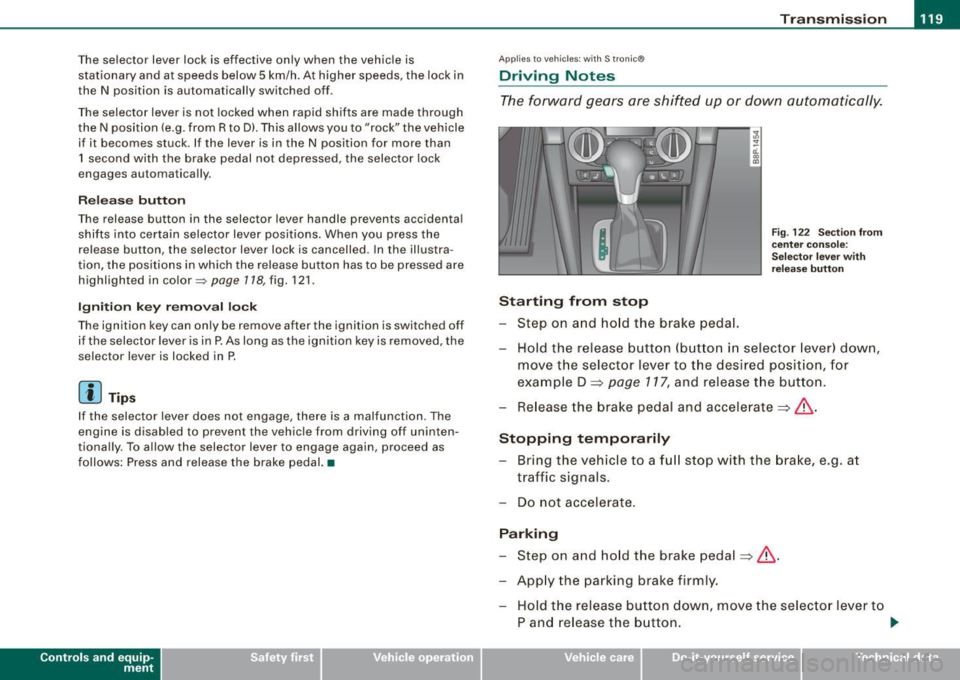
The release button in the selector lever handle prevents accidental
shifts into certain selector lever positions . When you press the
release button, the selector lever lock is cancelled . In the illustra
tion, the positions in which the release button has to be pressed are
highlighted in color~
page 718, fig. 121.
Ignition key removal lock
The ignition key can only be remove after the ignition is switched off
if the selector lever is in P. As long as the ignition key is removed, the
selector lever is locked in P.
[ i) Tips
If the selector lever does not engage, there is a malfunction . The
engine is disabled to prevent the vehicle from driving off uninten
tiona lly. To allow the selector lever to engage again, proceed as
follows: Press and release the brake pedal. •
Contro ls and eq uip
ment
Ap plies to vehic les: wit h S tron ic®
Driving Notes
The forward gears are shifted up or down automatically.
Starting from stop
Step on and hold the brake pedal.
Fig. 122 Section from
center console:
Selector lever with
release button
Hold the release button (button in selector lever) down,
move the selector lever to the desired position, for
example D =>
page 117, and release the button.
Release the brake pedal and accelerate => &, .
Stopping temporarily Bring the vehicle to a full stop with the brake, e.g. at
traffic signals.
Do not accelerate.
Parking Step on and hold the brake pedal=>&, .
Apply the parking brake firmly. Hold the release button down, move the selector lever to
P and release the button. .,.
Vehicle care I I irechnical data
Page 122 of 324

....... _T _r_a _ n_ s_m _ i_s _s _i_o _n ______________________________________________________ _
Stopping on an incline
- Always hold the vehicle wi th t he foot bra ke or parking
b rake in orde r to prevent "rollback"=> &. Do
not try to
preve nt the ve hicle f ro m rolling back by rewi ng the
e ngin e while it is in ge ar.
Starting on a hill
-App ly the hand bra ke firm ly .
- With th e en gin e in g ea r, gradua lly accelera te an d re le as e
th e han d brake .
The engine can only be started wi th th e selector lever i n P or N
=> pa ge 109. At low ambient temperatures (14 °F / -1 0 °C), it is only
po ss ibl e to s tart the e ng ine wi th the selec tor leve r in P .
Whe n pa rki ng on leve l g ro und, i t is su fficien t to plac e th e se lec tor
lever in P. On a steeply s lop ing road, you should first app ly the
pa rk in g br ake fi rmly and then p lace th e selec tor lever in P. T hi s w ay ,
you do not overload the pawl mechanism and it is easier to move
th e s elector lever out of P .
& WARNING
• Never leave your veh icle with the engine running while in gear .
If you must leave your vehicle with the engine running, set the
parking brake and engage the park lock.
• When the engine is running and the transmission is in gear (0 ,
S or R l or in "tiptronic " mode , it is essential that you stop the
vehicle with the footbrake . When idling , the transmission of power
does not stop completely -the vehicle "creeps ".
• Do not accelerate when you change the sele ctor lever position
with the vehicle stationary and the engine running -risk of an acci
dent!
• Never place the selector lever in the R or N po sition while the
vehicle is moving -risk of an accident !
& WARNING (continued)
• If you have to bring your vehicle to a stop while on an incline,
keep the foot brake depressed all the way down so that the vehicle
does not start to roll backward . You should never hold the vehicle
using the clutch pedal if you are going to be stopped on an incline .
If you do , the clutch will start to slip when it overheats caused by
the constant overload. This is dangerous because if the vehicle starts to roll backward , you could c ause an accident . If the clutch
should start to slip , you will feel the vehicle "jerk" and the selector
lever display will start blinking .
• Before driving down a steep slope , reduce your speed and shift
i nto a lower gear with "tiptronic ".
• Do not ride the brakes or apply the brake pedal too often or too
long . Constant braking causes the brakes to overheat and
substantially reduces braking performance, increa ses braking
distance or causes complete failure of the brake system . •
Ap plies to veh ic les: wit h S tronic tra nsmiss io n and Hi ll Desce nt Assis t
Hill Descent Assist
Hi ll D esce nt Ass ist help s the driv e r w hen driv ing down
i nc lin es .
Hill Descent Ass is t is activated by press ing th e brake wh ile
descending when the selector lever is in
D /S . The S tronic t ransmis
s io n auto mati ca lly s hifts dow n to a ge ar s uita ble for the incl in e. Hill
Descent Assist attempts to maintain the current vehicle speed when
th e br akin g occu rs, as far as phys ical an d techn ica l lim it s a llow . It
may be necessary to adjust the speed using the brakes .
H ill Descent As sist switc hes off when the inc line leve ls out or when
the gas pedal is pressed.
On vehicles with cruise control*=>
page 113, Hill Descent Assist is
a lso ac tiva ted wh en th e spe ed is s et.
~
Page 200 of 324
___ D_ r_iv _i _n-' g=- a _n_d_ e_ n_v _ i_r _o _n_ m_ e_ n_t _____________________________________________ _
New brake pads
--
Remember that new brake pads do not have a full braking
effect during the first 250 miles (400 kilometers) after they
are installed .
New brake pads have to be "burnished in" before they have optimal
grab =>& .
During the break -in period, you should avoid putting severe loads
on the brakes . Severe loads include, for examp le, sudden hard
braking, in particular at very high speeds or, for example, on moun
tain passes.
& WARNING
Until they develop the maximum "bite " for best stopping power,
the surfaces on new brake pads require some "breaking -in" during
the initial 100 to 150 miles (150 to 200 kilometers) of normal city
driving. You can compensate for this by pressing the brake pedal
more firmly . This applies whenever new pads are installed.•
Catalytic converter
It is very important that your emission control system
(catalytic converter) is functioning properly to ensure that
your vehicle is running in an environmentally sound
manner.
- Always use lead-free gasoline:=> page 219, "Fuel supply".
- Never run the tank down all the way to empty.
- Never put too much motor oil in your engine ==>
page 230,
"Adding engine oil 't=:;rl".
Never try to push- or tow-start your vehicle.
The catalytic converter is an efficient "clean-up" device built into the
exhaust system of the vehicle. The catalytic converter burns many
of the po llutants in the exhaust gas before they are released into the
atmosphere.
The exclusive use of unleaded fuel is critically important for the life
of the catalytic converter and proper functioning of the engine.
& WARNING
• Do not park or operate the vehicle in areas where the hot
exhaust system may come in contact with dry grass, brush, fuel
spill or other material which can cause a fire .
• Do not apply additional undercoating or rustproofing on or
near the exhaust manifold, exhaust pipes, catalytic converter or
heat shields. During driving, the substance used for undercoating
could overheat and cause a fire .
0 Note
• Be aware that just one tank filling with leaded fuel will alr eady
seriously degrade the performance of the catalytic converter.
• Do not exceed the correct engine oil level=>
page 230.
• Do not drive until the fuel tank becomes completely empty. The
engine could misfire. Unburned fuel could also get into the exhaust
system and this could cause the catalytic converter to overheat.
• Do not turn off the ignition while the vehicle is moving.
• Do not continue to operate your vehicle under these conditions,
as otherwise fuel can reach the catalytic converter. This could result
in overheating of the converter, requiring its replacement .
• To assure efficient operation of the Emission Control System:
- Have your vehicle maintained properly and in accordance with
the service recommendations in your Warranty
& Maintenance
booklet. •
Page 206 of 324

___ T_ r _a_ il_e _r_ t_ o_ vv_ in__... g,_ __________________________________________________ _
Weig ht dis tributi on
Towing a loaded trailer with an empty car resu lts in a high ly
unstable distribution of weight . If this cannot be avoided drive at
very low speeds on ly to avoid the risk of losing steering control.
A "ba lanced" rig is easier to operate and control. This means that
the tow vehicle should be loaded to the extent possible and permis
sib le while keeping the trai ler as light as possib le under the circum
stances. Whenever possible, transfer some cargo to the luggage
compartment of the tow vehicle while observing tongue load requirements and vehicle loading considerations .
Speed
The higher the speed, the more difficult it becomes for the driver to
control the rig . Do not drive at the maximum permissible speed.
Reduce your speed even more under unfavorable load, weather or
wind conditions -particularly when going downhill.
Reduce vehicle speed
imm ed ia tely if the trailer shows the sl ightest
sign of swaying. Do not try to s top the s wayi ng by a ccelerating .
Observe speed limits . In some areas speeds for vehicles towing
trai lers are lower than for regular vehicles.
Always app ly brakes early. When driving downhill, shift into lower
gear to use the engine braking effect to slow down the vehicle. Use
of the brakes alone can cause them to overheat and fail.
C oo la nt tempe ra tu re
The coolant temperature gauge ~ page 9 must be observed care
ful ly. If the needle moves close to the upper end of the scale, reduce
speed immediately and/or switch off the air condit ioner.
If the coolant temperature warning light in the instrument cluster
starts flashing -~-, pull off the road, stop and let the engine
idle for
about two minutes to prevent heat build -up .
& WARNING
An yone not p rope rly res train ed in a mo ving vehi cle is a t a mu ch
gre ater risk in a n accident. Neve r let an yone ride in your car who
is not p rop erly we ari ng th e res tra int s pro vide d b y Aud i.
c
Trailer towing tips
Important to know
Your vehicle handles different ly when towing a trailer because of
the additional weight and weight distribution . Safety, performance
and economy w ill great ly depend on how carefu lly you load your
trailer and operate your rig.
Before you actually tow you r trailer, practice turn ing, stopping and
backing up in an area away from traffic. Keep practicing unti l you
have complete ly become familiar with the way your vehicle -trailer
combination behaves and responds .
Backing up is difficult and requires practice. Backing up with a
trailer genera lly requires steering ac tion opposite of that when
backing up your vehicle without a trailer .
Maintain a greater distance between your vehicle and the one in
front of you. You will need more room to stop.
T o compensate for the trailer, you wi ll need a larger than normal
turning radius .
When passing, remember that you cannot accelerate as fast as you n ormal ly wou ld because of the added load . Make su re you have
enough room to pass. After passing, al low plenty of room for your
trailer before changing lanes again .
Avoid jerky starts, sharp turns o r rapid lane changes.
Page 207 of 324
![AUDI S3 2009 User Guide [ i] Tips
• Do not tow a trailer during the break-in period of your vehicle.
• If you tow a trailer, your Audi may require more frequent mainte
nance due to the extr](/img/6/57546/w960_57546-206.png "AUDI S3 2009 User Guide [ i] Tips
• Do not tow a trailer during the break-in period of your vehicle.
• If you tow a trailer, your Audi may require more frequent mainte
nance due to the extr")
[ i] Tips
• Do not tow a trailer during the break-in period of your vehicle.
• If you tow a trailer, your Audi may require more frequent mainte
nance due to the extra load=>
page 304. •
Parking on a slope
-----------------
Do not park with a trailer on a slope. If it cannot be
avoided, do so only after doing the following:
When parking:
-Apply the foot brake.
- Have someone place chocks under both the vehicle and the trailer wheels .
- With chocks in place, slowly release the brakes until
wheel blocks absorb the load.
- Turn the wheels towards the curb.
- Apply the parking brake.
- Place an automatic transmission in
P, respectively a
manual transmission in first or reverse gear.
When restarting after parking:
- Start the engine.
- Shift transmission into gear.
- Release the parking brake and slowly pull out and away from the wheel blocks.
- Stop and have someone retrieve the wheel blocks.
Controls and equip
ment Safety first Vehicle operation
Trailer towing
[
i] Tips
If you move the selector lever of the automatic transmission to P
before applying the parking brake and before blocking the wheels,
you may have to use more force later to move the lever out of the
P
position .•
Vehicle care Do-it-yourself service Technical data
Page 227 of 324
Checking and filling -
--------------~-
•
Closing the engine hood
-Pull the hood dow n until the pressure fro m t he s trut is
r edu ce d .
- Let the hood
drop dow n and latch in p lace . Do not try to
pus h it shut ;
it ma y fail to enga ge => & .
& WARNING
A hood that is not completely latched could fly up and block your
view while driving.
• When you close the engine hood, check it to make sure the
safety catch has properly engaged. The hood should be flush with
the surrounding vehicle body parts .
• If you notice while driving that the hood is not secured prop
erly , stop at on ce and close it. •
Working in the engine compartment
B e e speci ally ca reful wh ene ver you work in th e e ng in e
co mpartmen t!
Whenever you must perform any work in the engine compartment ,
for example checking and filling different fluids , there is a ri sk of
injury , burns and accidents . To prevent personal injury always
observe the following WARNINGS . The engine compartment of any
vehicle is a hazardous area!
~ &
& WARNING
To help avoid injury , before you check anything under the hood :
• Turn off the engine.
• Remove the ignition key .
• Set the parking brake fully .
& WARNING (continued )
• Move selector lever of automatic transmission to "P" (Park) ;
put manual transmission in Neutral .
• Always let the engine cool down . Hot components will burn
skin on contact.
• To reduce the risk of being burned , never open the hood if you
see or hear steam or coolant escaping from the engine compart
ment . Wait until no steam or coolant can be seen or heard before
carefully opening the hood .
• Keep children away from the engine compartment .
• Never spill fluids on hot engine components . They can cause a
fire.
• Never touch the radiator fan. The auxiliary electric fan is
temperature controlled and can switch on suddenly.
• Never open the coolant reservoir cap when the engine is still
warm . The coolant system is pressurized and hot coolant could
spray out!
• Protect your face , hands and arm from steam or hot engine
coolant by placing a thick rag over the cap when you open the
coolant reservoir .
• If work on the fuel system or the electri cal system is necessary :
- Always disconnect the battery .
- Never smoke or work near heaters or open flames . Fluids in
the engine compartment could start a fire .
- Keep an approved fire extinguisher immediately available.
• To avoid electrical shock and personal injury while the engine
is running or being started , never touch :
- Ignition cables
- Other components of the high voltage electronic ignition
system .
• If you must perform a check or repair with the engine running : ..,
Vehicle care
I t •
Page 253 of 324
Tires and wheels -
----------------
•
• The tire pressures should only b e chec ked and ad just ed wh en
t he tire s are co ld. The s lig ht ly rai se d pre ss u res of w arm tires mu st
not b e reduced .
• Adjust t he tire pressure to the lo ad you ar e carrying.
• Reinstal l the va lve stem cap on the va lve .
When should I check the tire pressure?
The correc t ti re p ress ure is es pec ially im portant a t high speeds. The
press ure s hou ld t here fore be checked at least once a mo nth and
a lways before starting a journey. Do not forget to check the tire pres
su re for t he spare whee l=>
page 2 71.
When should I adjust the tire pressures?
Ad just the tire pressure to the load you are carryin g. After c han ging
a whee l
or replacing whee ls you have to adj ust th e tire pre ssu re s on
a ll w he el s. In add itio n, you must the n initialize the new t ire pres
su res in the tire pressure monitoring system*=>
page 264.
& WARNING
Incorrect tire pressures and /or underinflation can lead sudden tire
failure , loss of control, collision, serious personal injury or even
death .
• When the warning symbol
l.J appears in the instrument
cluster , stop and inspect the tires .
• Incorrect tire pressure and /or underinflation can cause
increased tire wear and can affect the handling of the vehicle and
stopping ability .
• Incorrect tire pressures and/or underinflation can also lead to
sudden tire failure , including a blowout and sudden deflation ,
causing loss of vehicle control .
• The driver is responsible for the correct tire pressures for all
tires on the vehicle. The applicable pressure values are located on a st icker on the dr iver 's side B -pillar or on the inside of the fuel
filler flap.
& WARNING (continued )
• Only when all tires on the vehicle are filled to the correct pres
sure, the tire pressure monitoring system * can work correctly.
• The use of incorrect tire pressure values can lead to accidents
or other damage . Therefore it is essential that the driver observe
the specified tire pressure values for the tires and the correct pres
sures for the function of the tire pressure monitoring system *.
• Always inflate tires to the recommended and correct tire pres
sure before driving off.
• Driving with underinflated tires bend more , letting them get
too hot resulting in tread separation , sudden tire failure and loss
of control.
• Excessive speed and /overloading can cause heat build -up ,
sudden tire failure and loss of control.
• If the tire pressure is too low or too high , the tires will wear
prematurely and the vehicle will not handle well .
• If the tire is not flat and you do not have to change a wheel
immediately, drive at reduced speed to the nearest service station
to check the tire pressure and add air as required .
0 Note
Driving without valve stem caps can cause damage to the tire
va lv es. To p revent this, a lways mak e su re that fac to ry insta lled va lve
stem caps on al l wheels a re sec urely mounted on the va lve .
Tires and vehicle load limits
There are limits to the amount of load or weight that any vehicle and
any tire can ca rry. A ve hicle tha t is ove rlo ade d wi ll not h and le w ell ..,
Vehicle care I t •
Page 266 of 324
___ T _i_r e_=- p_r_e _ s_ s_ u_r_ e _ m_ o_ n_i_t _o _r_ i _ n .,;:g ::;.._ s_ y=--- s_t _e _m_ * __________________________________________ _
Tire pressure monitoring system*
Applies to vehicles: with tire pressu re monitoring system
General notes ' J
Each tire, including the spare (if provided), should be checked
monthly when cold and inflated to the inflation pressure recom
mended by the vehicle manufacturer on the vehicle placard or tire
inflation pressure label. (If your vehicle has t ires of a d ifferent size
than the size indicated on the vehicle placard or tire inflation pres
sure label, you should determine the proper tire inflation pressure
for those ti res.)
As an added safety feature, your vehicle has been equipped with a
tire pressure monitoring system (TPMS) that i lluminates a low tire
pressure tellta le when one or more of your tires is significantly
under-inflated. Accord ingly, when the low tire pressure telltale illu
minates, you shou ld stop and check your tires as soon as possible,
and inflate them to the proper pressure. Driving on a significantly
under-inflated tire causes the tire to overheat and can lead to tire
failure . Under -inflat ion also reduces fuel efficiency and t ire tread
life, and may affect the vehic le's handling and stopping ability.
Please note that the TPMS is not a substitute for proper tire mainte
nance, and it is the driver's responsibi lity to maintain correct tire
pressure, even if under -inflation has not reached the level to trigger
il luminat ion of the TPMS low tire pressure te lltale.
Your vehicle has also been equipped with a TPMS ma lfunction indi
cator to indicate when the system is not operating proper ly . The
TPMS malfunction indicator is combined with the low tire pressure
telltale. When the system detects a malfunction, the tellta le wi ll
flash for approximately one minute and then remain continuously illuminated. This sequence will continue upon subsequent vehicle
start-ups as long as the malfunction exists .
When the ma lfunction indicator is illuminated, the system may not
be able to detect or signal low tire pressure as intended. TPMS
malfunctions may occur for a variety of reasons, including the insta
llation of replacement or alternate tires or wheels on the
vehic le that prevent the TPMS from functioning properly. Always
check the TPMS malfunction tellta le after replac ing one or more
tires or whee ls on your vehicle to ensure that the replacement or
a lternate tires and wheels a llow the TPMS t o continue to funct ion
properly. •
Applies to vehicles: with tire pressur e monitoring system
Introduction
The tire pressure monitoring system monitors air pressure
in all four road wheels while the vehicle is moving.
As soon as the tire p ressure monitoring system senses a significant
loss of air pressure in one or severa l tires, text messages and ye llow
sy mbo ls appear in the instrument cluster display to alert the driver.
The warning light in the instrument cluster comes on when the
tire is significantly underinflated
=> page 13 .
Th e warning light l also i lluminates in the case of a system
malfunction.
Be aware tha t tire pressure is a lso dependent on the temperature of
the tire . For every 18 °F (1 O °C) increase in tire temperature, tire pres
sure increases by about 1.5 psi (0 .1 ba r). The tire warms up while the
vehic le is moving and tire pressure rises. So you should adjust tire
pressure on ly when they are
cold, when the temperature of the tires
is roughly the same as the ambient air temperature.
I n order to keep the tire pressure monitoring system properly ca li
b rated, tire pressure on all four tires shou ld be checked a t regu lar
interva ls, adjusted if necessary, and saved in the proper setting
(reco mmended pressure) :::>
page 266.
The tire pressure is shown either on the driver's side 8 -pi llar or on
the inside of the fuel fi ller flap. _..
Page 291 of 324
______________________________________________ E_ m_ e_r .;::g ;...e _ n_ c __,c. y_ s_it _u_ a_ ti_o _ n_ s _ __.ffllll
Use of jumper cables (4 cylinder
engine)
Make sure to connect the jumper cable clamps in exactly
the order described below!
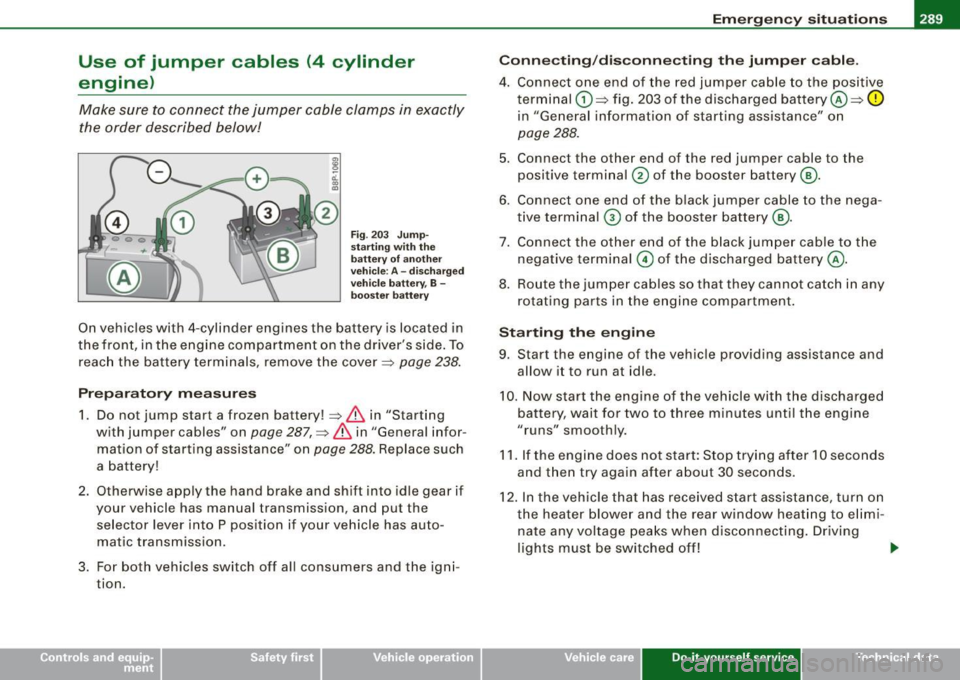
Fig . 203 Jump
starting with the
battery of another
vehicle: A -discharged
vehicle battery, B -
booster battery
On vehicles with 4-cylinder engines the battery is located in
the front, in the engine compartment on the driver's side. To
reach the battery terminals, remove the cover=>
page 238.
Preparatory measures
1. Do not jump start a frozen battery!=> & in "Starting
with jumper cables" on
page 287, => & in "General infor
mat ion of starting assistance" on
page 288. Replace such
a battery!
2. Otherwise apply the hand brake and shift into idle gear if your vehicle has manual transmission, and put the selector lever into P position if your vehicle has automatic transmission.
3. For both vehicles switch off all consumers and the igni
tion.
Connecting/disconnecting the jumper cable.
4. Connect one end of the red jumper cable to the positive
terminal
G) => fig. 203 of the discharged battery©=> 0
in "General information of starting assistance" on
page 288.
5. Connect the other end of the red jumper cable to the
positive terminal
@ of the booster battery ®·
6. Connect one end of the black jumper cable to the nega tive terminal
G) of the booster battery ®·
7. Connect the other end of the black jumper cable to the negative terminal
© of the discharged battery@.
8. Route the jumper cables so that they cannot catch in any
rotating parts in the engine compartment.
Starting the engine
9. Start the engine of the vehicle providing assistance and
allow it to run at idle.
10. Now start the engine of the vehicle with the discharged
battery, wait for two to three minutes until the engine
"runs " smoothly.
11. If the engine does not start: Stop trying after 10 seconds
and then try again after about 30 seconds.
12. In the vehicle that has received start assistance, turn on
the heater blower and the rear window heating to elimi nate any voltage peaks when disconnecting. Driving
lights must be switched off! ._
Vehicle care Do-it-yourself service irechnical data
Page 293 of 324
Emergency situations -____________________________ ___,::,:.___:_ ___ _
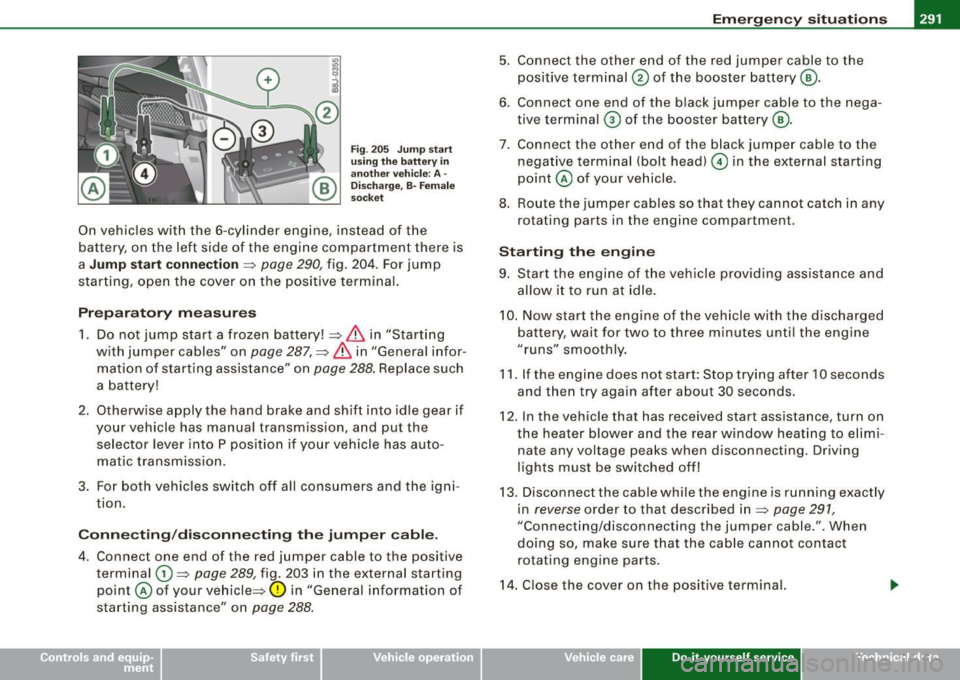
Fig. 205 Jump start
using the battery in
another vehicle: A -
Discharge, B- Female
socket
On vehicles with the 6-cylinder engine, instead of the
battery, on the left side of the engine compartment there is
a
Jump start connection => page 290, fig. 204. For jump
starting, open the cover on the positive terminal.
Preparatory measures
1. Do not jump start a frozen battery!=> & in "Starting
with jumper cables" on page
287, => & in "General infor
mation of starting assistance" on page
288. Replace such
a battery!
2. Otherwise apply the hand brake and shift into idle gear if
your vehicle has manual transmission, and put the selector lever into P position if your vehicle has auto
matic transmission.
3. For both vehicles switch off all consumers and the igni
tion.
Connecting/disconnecting the jumper cable.
4. Connect one end of the red jumper cable to the positive
terminal
G) => page 289, fig. 203 in the external starting
point @of your vehicle =>
0 in "General information of
starting assistance" on page
288.
5. Connect the other end of the red jumper cable to the
positive terminal
® of the booster battery @.
6. Connect one end of the black jumper cable to the nega tive terminal
0 of the booster battery @.
7. Connect the other end of the black jumper cable to the
negative terminal (bolt head)
© in the external starting
point @ of your vehicle.
8. Route the jumper cables so that they cannot catch in any
rotating parts in the engine compartment.
Starting the engine
9. Start the engine of the vehicle providing assistance and allow it to run at idle.
10. Now start the engine of the vehicle with the discharged battery, wait for two to three minutes until the engine
"runs" smoothly.
11. If the engine does not start: Stop trying after 10 seconds and then try again after about 30 seconds.
12. In the vehicle that has received start assistance, turn on the heater blower and the rear window heating to elimi
nate any voltage peaks when disconnecting. Driving
lights must be switched off!
13. Disconnect the cable while the engine is running exactly in reverse order to that described in=> page 291,
"Connecting/disconnecting the jumper cable .". When
doing so, make sure that the cable cannot contact
rotating engine parts.
14. Close the cover on the positive term inal. .,_
Vehicle care Do-it-yourself service irechnical data