tires AUDI S3 2009 User Guide
[x] Cancel search | Manufacturer: AUDI, Model Year: 2009, Model line: S3, Model: AUDI S3 2009Pages: 324, PDF Size: 76.02 MB
Page 205 of 324

Trailer lights
Trailer lights must meet all regulations. Be sure to check with your
authorized Audi dealer for correct wiring, switches and relays.
Mirrors
If you are unable to see the traffic behind you using the regular
outside mirrors, then you
must install extended mirrors. It is impor
tant that you
always have clear vision to the rear .
& WARNING
After removing the trailer hitch, do not store it in your vehicle. In
case of sudden braking, the hitch could fly forward and injure you
or your passengers .
.1
Operating instructions
Maximum trailer weight
A trailer for your vehicle is limited to a typical class 1 or class 2
trailer.
Trailer load distribution
Be sure the load in the trailer is held securely in place to guard
against shifting, be it forward, backward or sideways.
Never allow a passenger to ride in a trailer:::::, & in "Driving instruc
tions".
Tire pressure
When towing a trailer, inflate the tires of your vehicle to the cold tire
pressure listed under "Full load" on the sticker on the right door
jamb. Inflate trailer tires to trailer and tire manufacturers' specifica
tions.
Controls and equip ment Safety first Vehicle operation
Trailer towing
Lights
The
headlight settings should be checked with the trailer attached
before driving off. Adjust as necessary so that you can see the road
ahead but not blind oncoming traffic.
Check proper working of vehicle and trailer lights.
Safety chains
Be sure trailer safety chains are properly connected from the trailer
to the hitch on the vehicle. Leave enough slack in the chains to
permit turning corners. When you install safety chains, make sure
they will not drag on the road when you are driving.
The chains should cross under the trailer tongue to prevent it from
dropping in case of separation from the hitch. •
Driving instructions
Driving with a trailer always requires extra care and
consideration.
To obtain the best possible handling of vehicle and trailer,
please note the following:
Do not tow a loaded trailer when your car itself is not
loaded.
- Be especially careful when passing other vehicles.
Observe speed limits.
Do not drive at the maximum permissible speed.
- Always apply brakes early.
Monitor the temperature gauge.
Vehicle care Do-it-yourself service Technical data
Page 210 of 324

., __ C_ le_ a _ n_i_n ~g _ a_ n_ d __ p_r _o _t _e _c_ t_ i_o _n ___________________________________________ _
& WARN ING (c o ntinu ed )
• Always read and heed all WARNINGS and oth er informat ion
~ page 2 06.
0 Not e
• Never try to remove dirt, mud or dust if the surface of the vehicle
is dry. Never use a dry cloth or sponge, since this cou ld scratch your
veh ic le's paint or w indows .
• Never wash your car in bright sunlight. Drops of water act as
magnifying lenses and may damage your paint.
• When you wash your car in the winter : if you rinse your vehic le
with a hose, be careful not to aim the stream of water directly at
locks, or at door or hatch openings -they can freeze shut.
• Never use sponges designed to remove insects, or any kitchen
scouring s ponges or simila r products. They can damage your paint
finish .
• Never use a dry cloth or sponge to c lean the head ligh ts. O nly use
wet cloths or sponges to prevent scratches . It is best to use soapy
water.
c£, For the sake of the environment
In the interest of the environment, the vehicle shou ld on ly be
washed in specia l wash bays. •
Washing your vehicle with a power washer
Cleaning the exterior of your car wi th a high -p ressure
power washer is safe as l ong as y ou observe a few simple
rules .
-Before us ing the p ower washer, make s ure you have read
and unde rs too d t he WAR NINGS=:>
& in "General in for
mati on" o n
page 206.
-Always follow the operati ng inst ructions fo r th e pow er
washer.
Make sure that the jet on t he spray hose produces a "fan
sha ped sp ray".
D o
not hold the spray nozzle too close to soft materials.
When cleaning the vehicle with a power washer always follow the
opera ting instructions. Th is applies particularly to the
operating
pre ssure
and the spraying distance . Maintain a sufficient distance
t o soft ma teria ls such as rubber hoses a nd sound/vibrat ion dead
ening materia ls (particularly on the underside of the engine hood).
Do not use a jet which sprays water in a
direct stream o r one tha t
has a
rotating j et.
Water temperature shou ld not exceed 140 °F (60 °Cl.
& WARNING
Never wash tires with a jet that sp ray s water in a dire ct stream .
This could c ause invi sible damage to the tire s and we ake n them ,
even if the spray i s from a relatively long distan ce and for a short
time . D amag ed and weakened tires can fail and cau se ac cident s
a nd p erson al injury.
0 Note
To avoid damaging your vehic le, always make sure that there is
suffic ient distance between the spray hea d and so ft m ateria ls like
rubber hoses, plastic parts and sound -deadening materials . Never
aim the spray head at the same p oint for a l ong time . This a lso
applies to cleaning head lights and painted bumpers . Remember:
t he c loser the n ozzle is to the surface of the materia l, the greater the
stress on the material. •
Page 213 of 324
____________________________________________ _:C ::,: l~ e :,: a~ n:....:..:..: in~ g~ a~n .:.:d:!...! p~ r ~o~ te~ c~t ~io ~ n'...._ __
•
The best way to remove snow from windows and mirrors is to use a
brush . Use a non -abrasive
pla stic ice scraper -better still, a spray
deicer -to remove
ice from w indows and mirrors .
The windows must not be cleaned with insect remover or wax since
these can inter fere with the function of the w inds hie ld w iper blades
(chatter).
Oil, grease o r sil icone residue can be removed with
glass cleaner or
s ilicone remover . However, wax residue requires the use of a
spec ially fo rmulated so lvent . Please contac t your authorized Audi
dea ler for advice on safe products for wax removal.
Windows should also be c leaned on the inside at regular interva ls .
Never dry windows with the same chamois that you use to dry
painted surfaces . Wax residue on the chamois can impair vision
t hrough the windows .
& WARNING
• The windshield mu st not be treated with water -repellent mate
rials. T hey c an incre ase gl are under poor v isibility conditions such
a s wetne ss, darkne ss, or when the sun i s low on the hori zon. In
addition , they can cause the wind shield wipers to chatter .
• Alway s read and heed all WARNINGS and other information
~ page 206.
0 Note
• Never use warm or hot water to remove snow and ice from
windows a nd mirrors . This cou ld cause the glass to crack.
• T o prevent damage to the wires of the rear defogger, do not p lace
any adhesive stickers on the inside of the rear window over the
wires .
• T o he lp prevent dirt from scratching the window, always scrape
in a forward direction -pushing the scraper away from you -never
back and forth. •
Weatherstrips
Complete car car e includes the we atherst rip s as well .
App ly a suitable rubbe r con ditioner to the weatherstr ips
f ro m time to time.
To be able sea l properly, the weatherstrips around the hood, doors,
rear lid, etc . must remain pliabl e. Spray the weatherstrips with sili
co ne or coat them w ith ta lcum powder or glycer ine to retain the
f lexibility of the rubber and to protect them against freezing in the
winte r.
& WARNING
Always read and heed all WARNINGS and other information
~ page 206.
[ i ] Tip s
Keep si licone sprays off the windshield to avoid wiper smear in
ra in .•
Ap plies to veh icles : with s tee l w hee ls (e .g . if ref itt e d w ith w inter tires )
Steel wheels
The wheels also h ave to be cleaned.
- Alw ays in clu de the hu b caps and whee l rims when
washing yo ur vehi cle to remove road dir t, sal t sprays an d
b rake dust.
If necessary, use a commercial whee l cleaner to remove accumu
lated brake dust.
The wheel rims are eas ier to keep clean if they are reg ula rly coa ted
with l iquid wax . ..
Vehicle care I t •
Page 245 of 324
________________________________________________ T_ i _r_e _s_ a_n_ d_ w_ h_ e_e _ l_s __ __
•
Tires and wheels
Tires
General notes
Tires may be the least appreciated and most abused parts
of a motor vehicle.
Tires may be the least appreciated and most abused parts of a
motor vehicle. Tires are, however, one of the most important parts
of a vehicle, particularly considering the comparative ly sma ll patch
of rubber on each tire that assures that all- important contact
between you, your vehicle and the road .
Maintaining the correct tire pressure, making sure that your vehicle
and its tires do not have to carry more weight than they can safely
handle, avoiding damage from road hazards and regu lar ly
inspecting tires for damage inc luding cuts , slashes irregular wear
and overa ll condition are the most important things that you can do
to help avoid sudden tire failure including tread separation and
b lowouts .
Avoiding dama ge
If you have to drive over a curb or similar obstacle, drive very slow ly
and as close as possible at a right angle to the curb.
A lways keep chemica ls includ ing grease, oil, gasoline and brake
f luid off the tires.
I nspec t the tires regularly for damage (cuts, cracks or blis ters, etc.l.
Remove any foreign bodies embedded in the treads.
Storing tires
Mark tires when you remove them to indicate the direction of rota
tion . This ensu res you to be ab le to mount them correctly when you
reinstal l them. When removed, the wheels or tires shou
ld be stored in a coo l, dry
and preferably dark place.
St ore t ires in a vertical posit ion if they a re not mounted on rims, in
a horizontal position if they are mounted on rims.
New tire s
New tires have to be broken in~&.
The tread dep th of new tires may va ry, according to the type and
make of tire and the tread pattern.
Hidden d ama ge
Damage to tires and rims is often not readily visible. If you notice
unusua l vibration or the vehicle pul ls to one side, this may indicate
that one of the tires has been damaged . The tires must be checked
immed iately by an authorized Audi dealer or qualified workshop .
Unidire ction al tir es
A unidirectio nal tire can be iden tif ied by arrows on the s idewa ll, that
point in the direction the tire is designed to rotate. You must follow
the specified direction of ro tation . This is necessary so that these
tires can deve lop their optimum characteristics regarding grip, road
noise, wear and hydroplaning resistance . For more information
~ page 279.
in. WARNING
Ne w tire s or tire s that are old , worn or damaged cann ot pro vide
m aximum cont rol and braking ability.
• New tire s tend to be slippe ry and m ust be broken in . To redu ce
the risk of losing control, a colli sion and seriou s per sonal injurie s,
drive with speci al care for t he fi rst 350 m ile s ( 560 km l.
• Driving with worn or damaged t ire s can lead to lo ss of co ntrol ,
s udd en tire failure , in clu ding a blowout a nd sudden deflation , .,,_
Vehicle care
I t •
Page 246 of 324
-~_T_ ir_e_ s_ a_ n_d _ w_ h_ e_e _l_s _________________________________________________ _
& WARNING (continued)
crashes and serious personal injuries . Have worn or damaged tires
replaced immediately.
• Tires age even if they are not being used and can fail suddenly,
especially at high speeds. Tires that are more than 6 years old can
only be used in an emergency and then with special care and at
low speed.
Glossary of tire and loading terminology
Accessory weight
means the combined weight (in excess of those standard items
which may be replaced) of automatic transmission, power steering,
power brakes, power windows, power seats, radio, and heater, to
the extent that these items are available as factory-installed equip
ment (whether installed or not).
Aspect ratio means the ratio of the height to the width of the tire in percent.
Numb ers of 55 or lower indicate a low sidewall for improved
steering response and better overall handling on dry pavement.
Bead
means the part of the tire that is made of steel wires, wrapped or reinforced by ply cords and that is shaped to fit the rim.
Bead separation means a breakdown of the bond between components in the bead.
Cord
means the strands forming the plies in the tire.
& WARNING (continued)
• Never mount used tires on your vehicle if you are not sure of
their "previous history." Old used tires may have been damaged
even though the damage cannot be seen that can lead to sudden
tire failure and loss of vehicle control.
• If you notice unusual vibration or if the vehicle pulls to one side
when driving, always stop as soon as it is safe to do so and check
the wheels and tires for damage . •
Cold tire inflation pressure
means the tire pressure recommended by the vehicle manufacturer
for a tire of a designated size that has not been driven for more than
a couple of miles (kilometers) at low speeds in the three hour period
before the tire pressure is measured or adjusted .
Curb weight means the weight of a motor vehicle with standard equipment
including the maximum capacity of fuel, oil, and coolant, air condi
tioning and additional weight of optional equipment.
Extra load tire
means a tire designed to operate at higher loads and at higher infla
tion pressures than the corresponding standard tire . Extra load tires
my be identified as "XL",
"xi", "EXTRA LOAD", or "RF" on the side
wall.
Gross Axle Weight Rating ("GAWR")
means the load-carrying capacity of a single axle system, measured
at the tire -ground interfaces .
Gross Vehicle Weight Rating ("GVWR"l
means the maximum total loaded weight of the vehicle.
Page 247 of 324
________________________________________________ T_ i _r_e _s_ a_n_ d_ w_ h_ e_e _ l_s __ _
•
Groove
means the space between two adjacent tread ribs.
Load ra ting (code)
means the maximum load that a tire is rated to carry for a given
inflation pressure. You may not find this information on all tires
because it is not required by law.
M ax im um l oad ra tin g
means the load rating for a tire at the maximum permissib le infla
tion pressure for that tire.
Ma ximum l oaded v ehi cle weigh t
means the sum of:
(a) Curb weight
(b) Accessory weight
(c) Vehic le capacity weight, and
(ct) Production options weight
M ax im um (p er mi ssibl e) infl ati on pr essur e
means the maximum cold inflation pressure to wh ich a tire may be
inflated. Also ca lled "maximum inflation pressure."
Normal occ upa nt wei ght
means 150 lbs. (68 kilograms) times the number of occupants
seated in the vehicle up to the to tal seating capacity of your vehicle.
O ccupant di stributi on
means distribution of occupants in a vehicle .
Outer di am eter
means the overall diameter of an inflated new tire.
O ve rall wi dth
means the linear distance between the exteriors of the sidewa lls of
an inflated tire, includ ing elevations due to labeling, decorations, or
protective bands or ribs.
Pl y
means a layer of rubber -coated para lle l cords.
P rodu ction opt io ns wei ght
means the combined weight of those installed regular production
options weighing over 5 lbs . (2.3 kg) in excess of those standard
i t ems wh ich they replace, not previously considered in curb weigh t
or accessory weight, including heavy duty brakes, ride levelers, roof
rack, heavy duty battery, and specia l trim .
Radi al p ly tire
means a pneumatic tire in which the ply cords that extend to the
beads are laid at substantially 90 degrees to the centerline of the
tread .
Reco mm ended infl ati on pr essu re
see => page 244, "Cold tire inflation pressure".
Rein force d tir e
means a tire designed to operate at higher loads and at higher infla
tion pressures than the corresponding standard tire. Reinforced
t ires my be identified as "XL", "xi", "EXTRA LOAD", or "RF" on the
sidewall.
R im
means a metal support for a tire or a tire and tube assembly upon
wh ich the t ire beads are seated.
Rim di amet er
means nominal diameter of the bead seat. If you change your whee l
size, you wi ll have to purchase new tires to match the new rim diam
eter .
Rim siz e de sig nation
means rim diameter and width.
Rim wid th
means nominal distance between rim flanges.
Vehicle care I t •
Page 248 of 324
-~_T_ ir_e_ s_ a_ n_d _ w_ h_ e_e _l_s _________________________________________________ _
Sidewall
means that portion of a tire between the tread and bead.
Speed rating
extended periods of time. The ratings range from 93 mph (150 km/h)
to 186 mph (298 km/h)=>
page 257. You may not find this informa
tion on a ll tires because it is not required by law.
The speed rating letter code, where applicable, is molded on the tire sidewa ll and indicates the maximum permissible road speeds.=>
&
in "Winter tires" on page 260
Tire pressure monitoring system*
means a system that detects when one or more of a vehicle 's tires
are under inflated and illuminates a low tire pressure warning te ll
tale.
Tread
means that portion of a tire that comes into contact with the road.
Tread separation
means pu lling away of the tread from the tire carcass.
Treadwear indicators (TWI)
means the projections within the principa l grooves designed to give
a visual indication of the degrees of wear of the tread . See
=>
page 254, "Tread Wear Indicator (TWI)" for more information on
measuring tire wear .
Uniform Tire Quality Grading
is a tire information system developed by the United States National
Highway Traffic Safety Adm inistration (NHTSA) that is designed to
help buyers make relative comparisons among tires. The UTQG is
not a safety rati ng and not a guarantee that a tire will last for a
prescribed number of miles or perform in a certain way . It simply
gives tire buyers additiona l information to comb ine with other
considerations, such as price, brand loyalty and dealer recommen- dations
. Under UTQG, tires are graded by the tire manufacturers in
t hree areas : treadwear, traction and temperature resistance. The
UTQG information on the tires, molded into the sidewalls.
U .S . DOT Tire Identification Number (TIN )
This is the tire's "seria l number" It begins with the letters "DOT" and
indicates that the tire meets a ll federal standards. The next two
numbers or letters indicate the plant where it was manufactured,
and the last four numbers represent the week and year of manufac
ture. For example,
DOT ... 2207 ...
means that the tire was produced in the 22nd week of 2007. The
other numbers are marketing codes that may or may not be used by
the tire manufacturer. This information is used to contac t
consumers if a tire defect requires a reca ll.
Vehicle capacity weight
means the rated cargo and luggage load plus 150 lbs . (68 kilograms)
t imes the vehicle's tota l seating capacity as listed on the label
located either on the driver's side 8-pillar or on the inside of the fuel
filler flap.
Vehicle maximum load on the tire
means that load on an individual tire that is determined by distrib
uting to each axle its share of the maximum loaded vehicle weight
and dividing by two.
Vehicle normal load on the tire
means that load on an individual tire that is determined by d istrib
uting to each axle its share of the curb weight, accessory weight,
and normal occupant weight (distributed in accordance with table
below=>
page 2471 and dividing by two. .,_
Page 249 of 324
________________________________________________ T_ i_ r _e _s _ a_n_ d_ w_ h_ e_e _l_s _ ........
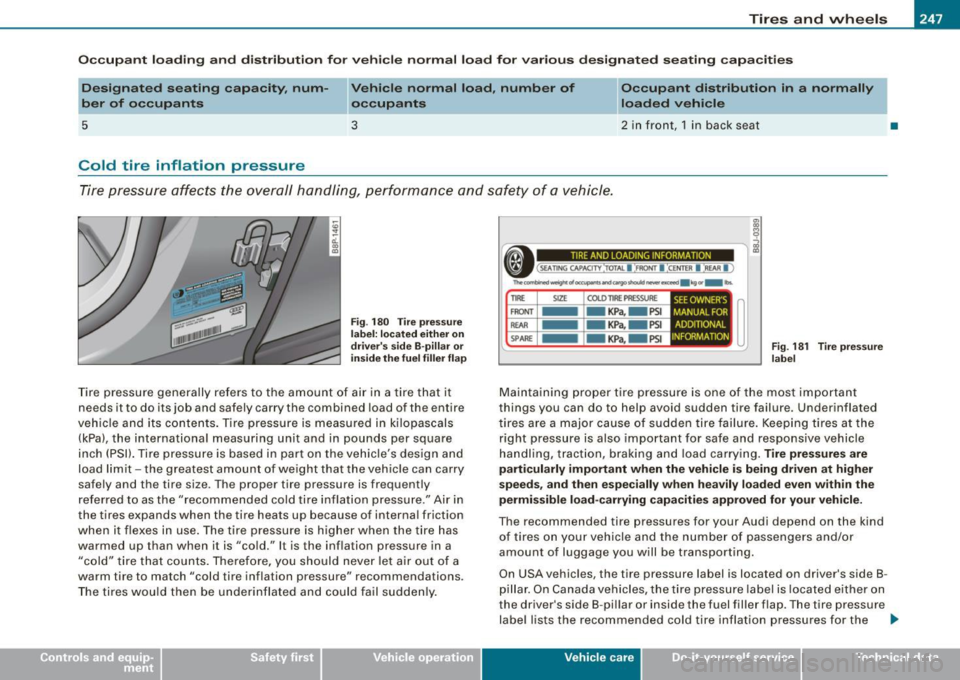
Occupant loading and distribution for vehicle normal load for various designated seating capacities
Designated seating capacity, num
ber of occupants Vehicle normal load
, number of
occupants Occupant distribution in a normally
loaded vehicle
5 3
2 in front,
1 in back seat
Cold tire inflation pressure
Tire pressure affects the overall handling, performance and safety of a vehicle.
Fig. 180 Tire pressure
label: located either on
driver's side B-pillar or
inside the fuel filler flap
Tire pressure generally refers to the amount of air in a tire that it
needs it to do its job and safely carry the combined load of the entire
vehicle and its contents. Tire pressure is measured in kilopascals
(kPa), the international measuring unit and in pounds per square
inch (PSI). Tire pressure is based in part on the vehicle's design and
load limit -the greatest amount of weight that the vehicle can carry
safely and the tire size . The proper tire pressure is frequently
referred to as the "recommended cold tire inflation pressure ." Air in
the tires expands when the tire heats up because of internal friction
when it flexes in use. The tire pressure is higher when the tire has
warmed up than when it is "cold." It is the inflation pressure in a
"cold" tire that counts. Therefore, you should never let air out of a
warm tire to match "cold tire inflation pressure" recommendations .
The tires would then be underinflated and could fail suddenly.
i
,,-,~ ---------------- ixl
• (SEATING CAPAC ITY :roTAL I :FRO NT I :cENTER I :REAR I ) al
Thecombh,d""'91wclo«U,,..,.andco,-goshoulcl.......,""""' •1cg., -b.
TIRE AND LOADING INFORMATION
TIRE SIZE COLO TIRE PRESSURE
F RONT -KPa, -PSI
REAR -KPa, -PSI
SPARE -KPa, - PSI
MANUAL FOR
INFORMATION SEE OWNER'S I
ADDITIONAL
Fig. 181 Tire pressure
label
Maintaining proper tire pressure is one of the most important
things you can do to help avoid sudden tire failure. Underinflated
tires are a major cause of sudden tire failure. Keeping tires at the
right pressure is also important for safe and responsive vehicle
handling, traction, braking and load carrying.
Tire pressures are
particularly important when the vehicle is being driven at higher
speeds, and then especially when heavily loaded even within the
permissible load-carrying capacities approved for your vehicle.
The recommended tire pressures for your Audi depend on the kind
of tires on your vehicle and the number of passengers and/or
amount of luggage you will be transporting.
On USA vehicles, the tire pressure label is located on driver's side 8 -
pillar. On Canada vehicles, the tire pressure label is located either on
the driver's side 8 -pillar or inside the fuel filler flap . The tire pressure
•
label lists the recommended cold tire inflation pressures for the _,,,
Vehicle care I I irechnical data
Page 250 of 324
-~_T_ ir_e_ s_ a_ n_d _ w_ h_ e_e _l_s _________________________________________________ _
vehicle at its maximum capacity weight and tires that were on your
vehicle at the time it was manufactured.
If you wish to improve comfort when operating the vehicle at
normal load (up to 3 occupants), you can adjust tire pressures to
those specified for normal vehicle load. Before operating the vehicle at maximum load, you must increase the tire pressures to those
specified for maximum vehicle load
=> &.
Bear in mind that the tire pressure monitoring system* can only
monitor the tire pressures you have stored. The system does not
recognize the load condition of your vehicle.
The effectiveness of the tire pressure monitoring system* will be impaired if you store normal load pressures but then operate the
vehicle at its maximum load=>&. See
the illustrat ion=>
page 247, fig. 180 for the location of the label
either on driver's side B -pillar or inside the fuel filler flap (color of
the actual label and exact location on the vehicle will vary slightly).
Note that the following table is accurate at the time of going to
press and is subject to change . In the event of discrepancies, the tire
pressure label (on USA vehicles, the tire pressure label is loc ated on
driver's side B-pillar; on Canada vehicles, the tire pressure label is
loca ted either on the driver's side B-pillar or inside the fue l filler
flap.I always takes precedence.
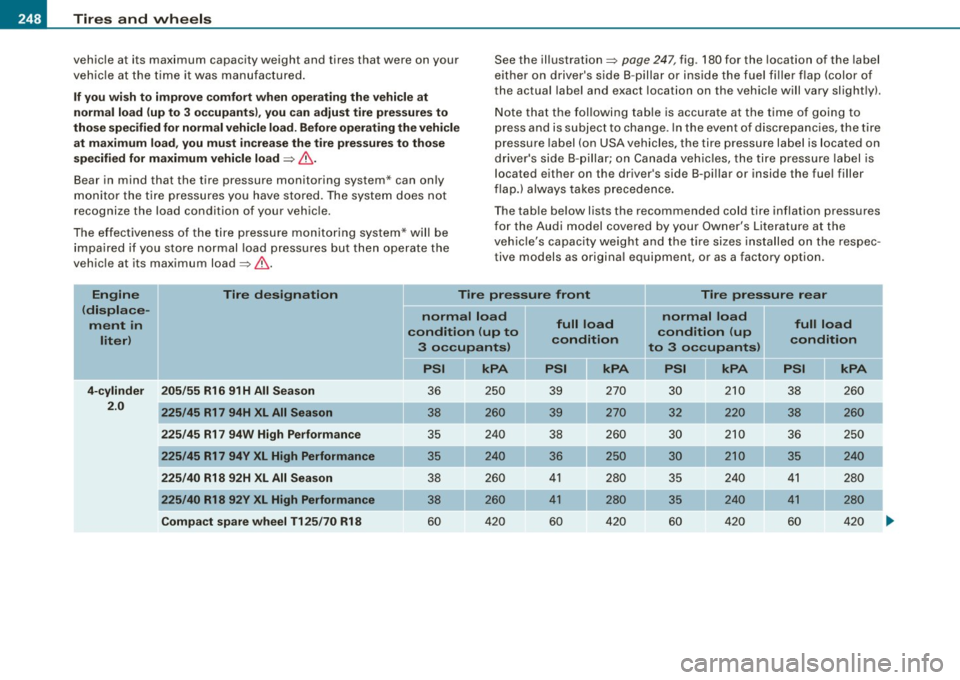
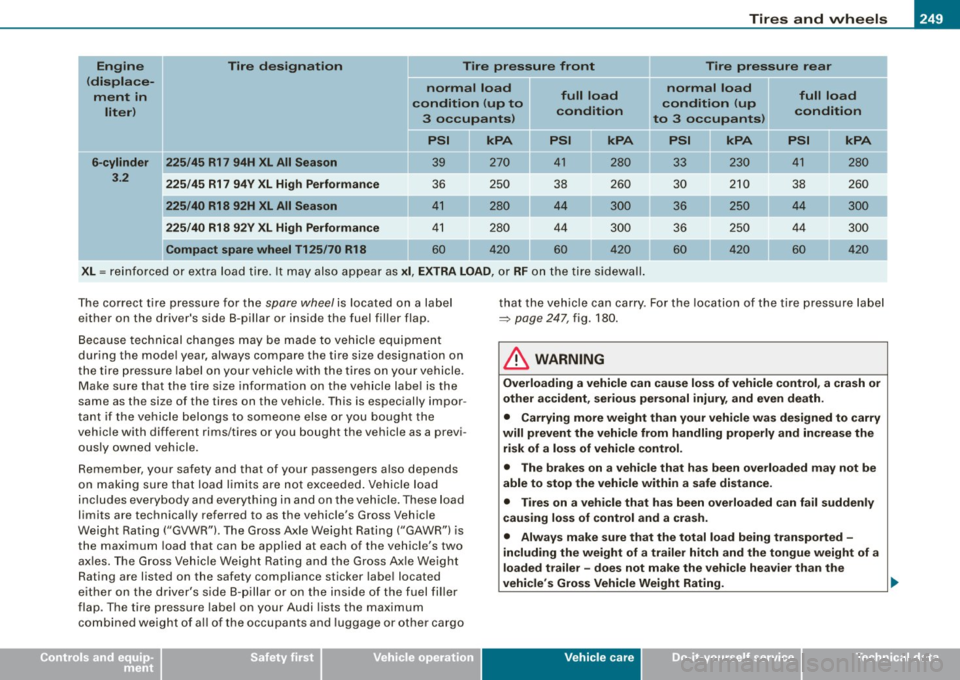
The table below lists the recommended cold tire inflation pressures
for the Audi model covered by your Owner's Literature at the
vehicle's capacity weight and the tire sizes installed on the respec
tive models as original equipment, or as a factory option.
Engine
(displace
ment in
liter)
Tire designation Tire pressure front
Tire pressure rear
4-cylinder
2.0
205/55 R16 91 H All Season
225/45 R17 94H XL All Season
225/45 R17 94W High Performance
225/45 R17 94Y XL High Performance
225/40 R18 92H XL All Season
225/40 R18 92Y XL High Performance
Compact spare wheel T125/70 R18 normal load
condition (up to
3 occupants)
PSI
36 250
38 260
35 240
35 240
38 260
38 260
60 420
full load
condition
kPA
39 270
39 270
38 260
36 250
41 280
41 280
60 420
normal load
full load
condition (up
condition to 3 occupants)
kPA kPA
30 210
38 260
32 220 38 260
30 210
36 250
30 210
35 240
35 240 41 280
35 240 41 280
60 420
60 420
Page 251 of 324
________________________________________________ T_ i _r_e _s_ a_n_ d_ w_ h_ e_e _ l_s __ lJlll
•
Engin e Tire designation Tire pressure front Tire pressure rear
(displace- normal load normal load
ment in full load
full load
liter ) c
ondit ion (up to
condition c
ondition (up
condition
3 occupants ) to 3 occupants)
PSI PSI kPA PSI kPA kPA
6-cylinder 225/45 R1 7 94H XL All Season 39 41 280 230 41 280
3 .2
225 /45 R17 94V XL High Performance
36 250 38 260 30 2
10
38 260
225 /40 R18 92H XL All Season
4 1 280 44 300 36 250 44 300
225 /40 R18 92V XL High Performance 41 280 44 3 0 0 36 250 44 30 0
Compact spare wheel T125 /70 R18
60 420
60 420
60 4
20
60 420
XL=
reinforced o r extra load tire . It may also appear a s xi , EXTRA LOAD, or RF on t he ti re s id ewa ll.
The correct tire pressure fo r t he spare wheel is located on a label
either on the driver's side B-pi llar or inside th e fuel filler flap .
Beca use technical change s may be ma de to vehicle equip ment
during the mode l year, always compare the tire size designat ion on
the tire p ressure label on your vehic le with the ti res on you r vehicle.
Make sure that the tire size informat ion on the veh icle labe l is the
same as the size of the tires on the vehicle . T his is especially impor
t ant if the veh icle belongs to someone else or you bough t the
vehic le with different rims/tires or you bought the vehicle as a previ
ousl y owne d ve hicle.
Remember , your safety and that of your passengers a lso depends
o n mak ing s ure tha t loa d limits are not exceeded . Vehicle load
includes everybody and everything in and on the vehic le. These load
limits are technical ly referred to as the vehicle's Gross Vehicle
Weight Rating ( "GVWR"). The Gross Axle Weight Rating ("GAWR") is
the maximum load that can be applied at each of the vehicle's two
a xl es . T he Gross Vehic le W eight Rat ing and the Gross A xle Weight
Rating are listed on the safety compliance sticker labe l located
ei the r on the driver's s ide B -pi ll ar or on the i nside of the fuel fill er
flap . T he tire pressure labe l on your Audi lists the maximum
co mbined weig ht o f all of the occupants a nd luggage or oth er ca rgo that t
he ve hicle can carry . For the locatio n of the ti re p ressure la bel
=> page 247, fig. 180.
& WARNING
Overloading a vehicle can cause loss of vehicle control , a crash or
other accident , serious personal injury, and even death .
• Carrying more weight than your vehicle wa s designed to carry
will prevent the vehicle from handl ing properly and increase the
ri sk of a loss of vehicle control .
• The brakes on a vehicle that has been overloaded may not be
able to stop the vehicle within a safe distance .
• Tires on a vehi cle that has been overloaded can fail suddenly
cau sing loss of control and a crash.
• Always make sure that the total load being transported -
including the weight of a trailer hitch and the tongue weight of a
loaded trailer -does not make the vehi cle heavier than the
vehicle 's Gross Vehicle Weight Rating. _,.
Vehicle care
I t •