window AUDI S3 2009 User Guide
[x] Cancel search | Manufacturer: AUDI, Model Year: 2009, Model line: S3, Model: AUDI S3 2009Pages: 324, PDF Size: 76.02 MB
Page 66 of 324
Clear vision Low wiper speed
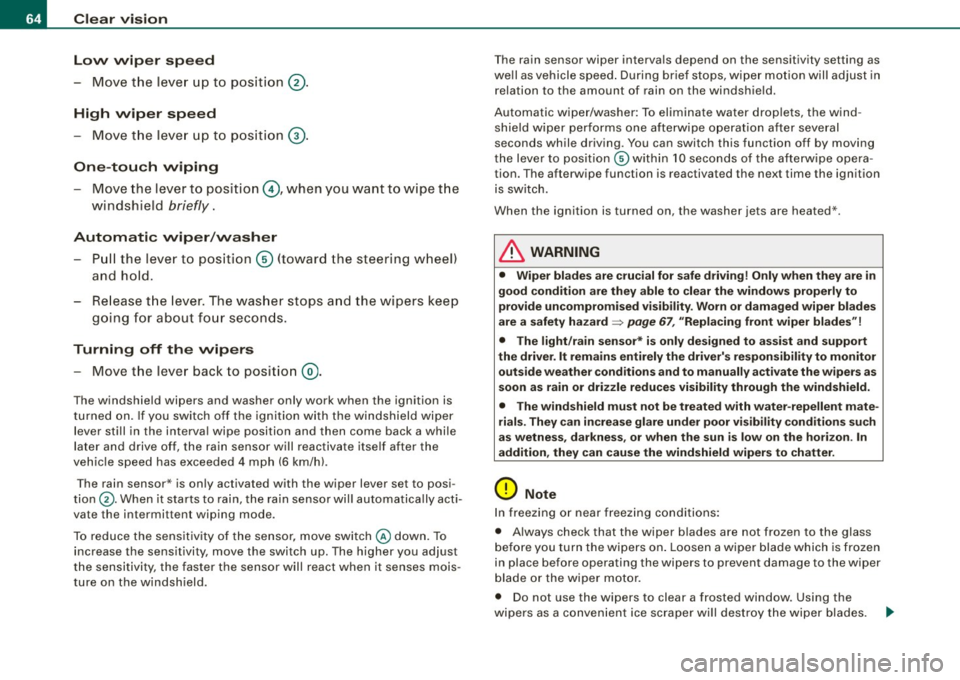
- Move the lever up to position @ .
High wiper speed
- Move the leve r up to pos ition G) .
One-tou ch wiping
Move the lever to position@, when you want to wipe t he
windshield
briefly .
Automatic wip er/ wash er
- Pull the lever to pos ition G) (toward the steering wheel)
and hold.
- Re lease t he lever . The was her stops a nd the wipers keep
g o ing for about fo ur secon ds.
Turning off th e wipers
- Move the lever back to position @.
The windshield wipers and washer only work when the ignition is
turned on . If you switch off the igni tion with the windshield wiper
lever still in the interva l wipe position and then come back a while
la ter and drive off, the rain sensor w ill reactiva te itse lf afte r the
veh ic le speed has exceeded 4 mph (6 km/hl.
The rain sensor* is only activated with the wiper lever set to posi
tion ®· When it starts to rain, the rain sensor wil l automatica lly acti
vate the intermittent wiping mode.
To reduce the sensitivity of the sensor, move switch @down. To
increase the sensitivity, move the switch up. The higher you adjust
the sensitivity, the faster the sensor will react when it senses mois
ture on the windsh ield. T
he rain sensor wiper interva ls depend on the sensitivity setting as
we ll as vehicle speed . During brief stops, wipe r mo tion will adjust in
relation to the amount of rain on the windshield.
Automatic wiper/washer: To eliminate water drop lets, the wind
shield wiper performs one afterwipe operat ion after several
seconds while driving. You can switch this function off by moving
t he lever to posit ion © within 10 seconds of the afterwipe opera
tion. The afterwipe function is reactivated the next time the ignition
is switch.
When the ignition is turned on, the washer jets are heated *.
& WARNING
• Wiper blade s are crucial for safe driving ! Only when they are in
good condition are they able to clear the window s properly to
provide uncompro mised v is ib ility. Worn or dam aged wiper bl ades
are a safety hazard =>
page 67 , "Replacing front wiper blade s"!
• The light /rain sen sor * is on ly de signed to a ssis t an d suppo rt
the driver . It remains en tirely the dr iver' s re spon sibility to monitor
out side weather cond ition s and to manuall y activate the wiper s as
s oon a s rain or dri zzle reduces visibility through the wind shield .
• The wind shield mu st not be t re ate d with water -r e pellent mat e
rial s. They can increa se glare under po or vi sibilit y conditions su ch
a s w etne ss, dar kne ss, or whe n the sun is lo w on t he hori zon . In
addition , they can cau se the windshield wipers to ch atter .
0 Note
In freezing o r near freez ing conditions:
• Always check that the wiper blades are not frozen to the glass
b efore you turn the wipers on . Loosen a wipe r blade which is fr ozen
in place before operating the wipers to prevent damage to the wiper
b lade or the wiper motor.
• Do not use the wipers to clear a frosted window . Using the
wipers as a conven ient ice scraper wi ll dest roy the wiper blades. .._
Page 67 of 324
• Before you take your vehicle to an automatic car wash , make sure
you have the windshield wiper system switched off !lever in position
Ol, otherwise the windshield wiper system could get damaged in the
car wash if it should suddenly come on.
[ i] Tips
• The rain sensor is part of the interval wiping system. Turning off
the ignition will also deactivate the rain sensor . To reactivate the
sensor, switch off the interval wiping function, then switch it back
on again.
• Worn or dirty windshield wiper blades cause smearing, which
can affect the operation of the light/rain sensor*. Check the condi
tion of your windshield wiper blades regularly .
• Applies to vehicles with light/rain sensor : When the wipers are
switched on manually and in rain conditions, the automatic head
lights* turn on~
page 53, "Sensor activated head- and tail light
control" or off during the day when the wipers are no longer oper
ating . The automatic headlights* function is available in this case
only when the light switch is in the "AUTO" position~
page 53,
fig. 48.
• Make sure the washer fluid reservoir in the engine compartment
is topped off before going on a long trip. Look up~
page 241 for
checking and filling the washer container .
• The wipers only operate with the hood complete ly c losed .•
Con tro ls and eq uip
ment
Clear vision
Rear window wiper
(Q
The wiper lever is also used to operate the rear window
wiper and the automatic wiper/washer function.
Fig. 65 Wiper leve r:
activating the rear
wi ndo w wipe r and
washer
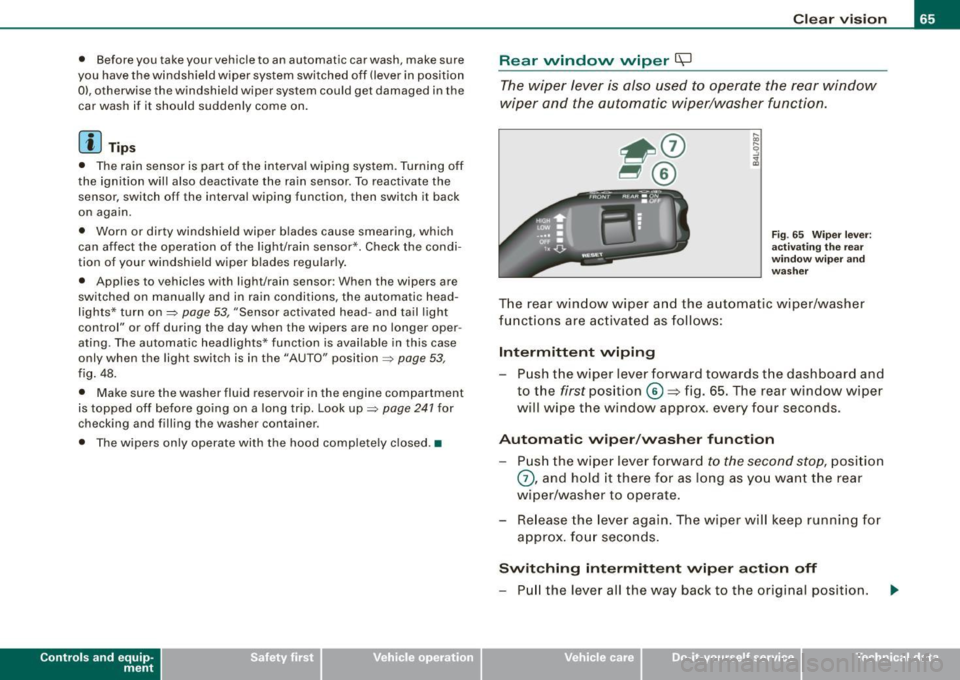
The rear window wiper and the automatic wiper/washer
functions are activated as follows:
Intermittent wiping
Push the wiper lever forward towards the dashboard and
to the
first position ©=> fig. 65. The rear window wiper
will wipe the window approx. every four seconds.
Automatic wiper/washer function
Push the wiper lever forward to the second stop, position
0, and hold it there for as long as you want the rear
wiper/washer to operate.
Re lease the lever again. The wiper will keep running for
approx . four seconds.
Switching intermittent wiper action off
-Pull the lever all the way back to the original position.
Vehicle care I I irechnical data
Page 68 of 324

Clear vision
& WARNING
Wiper blades are crucial for safe driving! Only in good condition
are they able to clear the windows properly to provide unre
stricted visibility. Worn or frayed wiper blades are a safety hazard!
=> page 67, "Replacing front wiper blades"
(D Note
In freezing or near freezing conditions:
• Always check that the wiper blades are not frozen to the glass
before you turn the wiper on. Loosen a wiper blade which is frozen
in place before operating the wiper to prevent damage to the wiper
blade or the wiper motor.
• Do not use the wiper to clear a frosted window . Using the wipers
as a convenient ice scraper will destroy the wiper blades.
[ i J Tips
For better rearward vision when parking, the rear window wiper is
automatically activated one time when the windshield wipers are
switched on and reverse gear is engaged. •
Applies to vehic les: w ith head light washer system
Headlight washer system
The headlight washer system cleans the headlights.
-Operate the windshield wiper/washer system=> page 63,
fig. 64 © with the headlights turned on by holding the
lever for longer than one second.
The washer jets extend forward out of the front bumper driven by
water pressure to spray the front headlights with water.
You should inspect the headlights regularly (for example when refu
eling) and clean off any solid dirt or insects from the lenses. To
ensure the system works properly in winter, keep the washer jets
free of snow and remove any ice using a de -icing spray. •
Service position
Replacing the windshield wiper blades is only possible
when you move the wiper arms into the service position. In
order to use the windshield wipers, the hood must be
completely closed. When there is a risk of frost, make sure
that the wiper blades are not frozen to the windshield.
Switch the ignition on.
Act ivate the service position by way of the driver infor
mation system =>
page 23.
(D Note
Never drive your vehicle when the windshield wiper arms are in the
service position and pulled away from the windshield. When you
drive faster than 4 mph (6 km/h), the wiper arms automatically
return back to the park position and could cause paint damage to
the engine hood!
[ i] Tips
• You can also turn on the service position, for example, if you
want to protect the windshield from icing by using a cover.
• Th e service position moves to
off automatically when you
operate the windshield wiper lever, or speed exceeds 4 mph
(6 km/h). •
Page 71 of 324
& WARNING (continued)
• For safety reasons, the windshield wiper blades should be
replaced once or twice a year. •
Mirrors
Manual anti -glare adjustment
Standard setting
- Move the small lever (located on the bottom edge of the
mirror) to the front.
Anti-glare setting - Move the small lever (located on the bottom edge of the
mirror) to the rear. •
Applies to veh icles: w it h a utom ati cally dim mi ng in sid e m ir ro r
Automatically dimming inside mirror
The automatic dimming function can be turned on and off
if required.
Controls and equip
ment
Fig . 69 Inside rear
view mirror
Clear vision
Disabling auto dimming
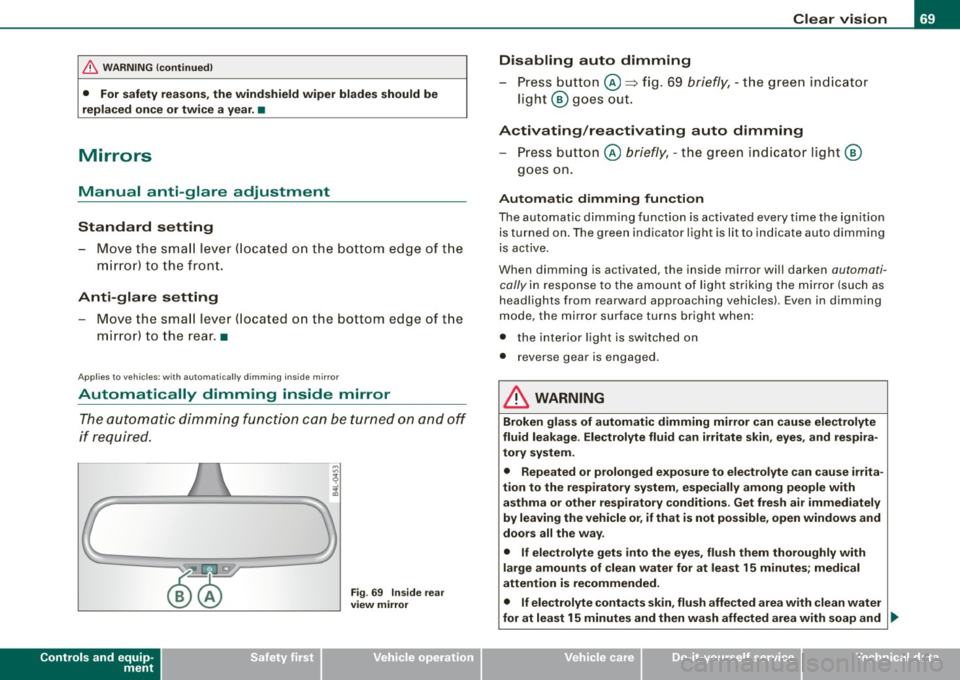
- Press button @=> fig. 69
briefly, -the green indicator
light ® goes out.
Activating/reactivating auto dimming Press button @
briefly, -the green indicator light ®
goes on.
Automatic dimming function
The automatic dimming function is activated every time the ignition
is turned on. The green indicator light is lit to indicate auto dimming
is active.
When dimming is activated, the inside mirror will darken
automati
cally
in response to the amount of light striking the mirror (such as
headlights from rearward approaching vehicles). Even in dimming
mode, the mirror surface turns bright when:
• the interior light is switched on
• reverse gear is engaged .
& WARNING
Broken glass of automatic dimming mirror can cause electrolyte
fluid leakage . Electrolyte fluid can irritate skin, eyes, and respira
tory system.
• Repeated or prolonged exposure to electrolyte can cause irrita
tion to the respiratory system, especially among people with
asthma or other respiratory conditions . Get fresh air immediately
by leaving the vehicle or, if that is not possible, open windows and
doors all the way.
• If electrolyte gets into the eyes, flush them thoroughly with
large amounts of clean water for at least 15 minutes; medical
attention is recommended.
• If electrolyte contacts skin, flush affected area with clean water
for at least 15 minutes and then wash affected area with soap and ._
I • •
Page 72 of 324
Clear vision
& W ARNING (con tinued )
water ; medic al a ttent ion is re commended . Thoroughly wash
affected clothing and shoe s before reuse .
• If sw allowed and per son is con sciou s, rinse mout h with water
fo r at lea st 15 minutes. Do not indu ce vomiting unles s instructed
to do so b y medic al professional . Get medic al attenti on immedi
ately.
0 Note
Liquid electro lyte leaked fro m a broken mirror glass will damage any
plastic surfaces it comes in contact with . C lean up spilled electrolyte
immedia tely with c lear water and a sponge .
[ i ] Tips
• If you switch off the automatic dimming function on th e ins ide
mirror , automati c dimming of the out side mirror s will lik ewi se be
di sabled .
• Check to make sure there are no objects preventing light from
reaching the inside mirror.
• Do not attach any stickers to the windshield in front of the light
sensor, as this wou ld inter fere with the au tomatic opera tion of the
headlights and the automatic dimming of the inside mirror.
• Be aware that automatic d imming of the inside mirror can only
operate properly if the rear window sun b lind * is retracted .•
Outside mirrors
The outside mirro rs are elect ric ally a djusted (powe r
mirr ors)
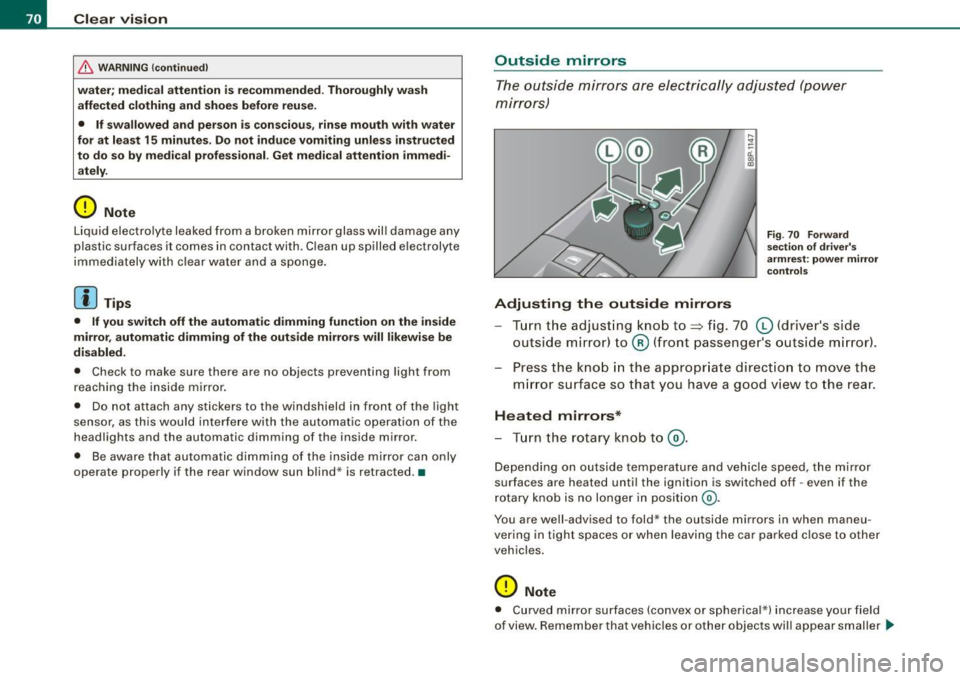
Adjusting th e outsid e mirrors
Fig . 7 0 Fo rward
sec tion of dri ve r's
ar mr est: po wer mir ror
c ontrol s
Turn the adjust ing knob to~ fig. 70 (0 (drive r's side
outside mirror) to @ (front passenger's outside m irror) .
Press the kno b in the appropr iate direction to move the
m irror surface so that you have a good view to the rear .
Heated mirrors*
-Tur n the ro tary knob to @ .
Depe nding on outside temperature and vehicle speed, the mirror
surfaces are heated unt il the ignition is switched off -even if the
r otary knob is no longer in posit ion
@ .
You are well -advised to fold* the outside mirrors in when maneu
vering in tight spaces o r when leaving the ca r parked c lose to other
vehic les.
0 Note
• Curved mirror surfaces (convex or spherica l*) increase your fie ld
of view. Remember that vehicles or other objects will appear smaller _..
Page 73 of 324
and farther away than when seen in a flat mirror. If you use this
mirror to esti mate distances of fo llowing vehicles when changing
lanes, you cou ld es timate incorrectly and cause an accident .
[ i] Tip s
If there shou ld be a malfunction in the electrica l system, you can
sti ll adjust the outside mirrors by pressing the edge of the mirror .•
Ap plie s to v ehicl es: wit h autom atic dim ming for out side m irro rs
Automatic dimming for outside mirrors
The outside mirrors are dimmed together with the automatic
dimming of the inside mir ror . When the ignition is switched on, the
mirrors darken automatical ly depending on the light striking them
(e .g. head lights from the rear) .
When the interior lighting is switched on and when reverse gear is
engaged , the mirrors are swi tched back to their original brightness
(not dimmed).
& WARNING
Broken glas s of automatic dimming mirror can c ause electrolyte
fluid le akage. Electrolyte fluid can ir ritate s kin , eyes , and re spir a
tory system .
• Repeated or prolonged e xposure to ele ctro lyte can cau se irrita
tion to the respi ratory sy stem , e specially among people with
asthm a or other respir atory co ndition s. G et fresh a ir i mmediately
by leaving the veh icle or , if that is not po ssible , open windows and
do ors all the way.
• If electrolyte get s into the eyes , flush them thoroughly with
large amounts of clean wate r fo r at least 15 minut es; medi cal
attention i s recommended .
• If ele ctrolyte cont acts sk in , flu sh affe cted are a with clean w ater
for at lea st 15 minute s and then wash affected area with soap and
Controls and equip
ment
Cl ea r vision
& WAR N IN G ( continued )
water; medic al attent ion is re commend ed . Thoroughly wash
affected clothing and shoes before reu se .
• If swallowed and person i s cons ciou s, rinse mouth w ith w ater
for at lea st 1 5 minute s. Do not indu ce vomitin g unles s instructed
to do so by medic al profession al. Get medi cal attent ion immed i
ately.
0 Note
Electrolyte leaki ng from a broken mirror g lass at tacks the veh ic le
paint and plastic surfaces . C lean up spilled electrolyte immediately
with c lear water and a sponge.
[ i ] Tips
• If automatic dimming for the inside mirror is swit ched off , the
out side m irrors are also not dimmed automati cally.
• Automatic di mming for the mirror only operates proper ly if the
sunshade * for the rear window is retracted, or the light striking the
ins ide mirror is not hindered by other ob jects. •
I • •
Page 76 of 324
Seats and storage
Seats and storage
General recommendations
Why is your seat adjustment so important?
The safety belts and the airbag system can only provide
maximum protection if the front seats are correctly
adjusted.
There are several different ways you can adjust the driver's seat and
the front passenger's seat so that it conforms to your body size. It is
especially important that the seat be adjusted properly so that:
• you can easily and quickly reach all the switches and controls in
the instrument panel
• your body is properly supported thus reducing physical stress
and fatigue
• the safety belts and airbag system can offer maximum protec
tion=>
page 147
In the following chapters, you will see exactly how you can best
adjust your seats.
There are special regulations and instructions for installing a child safety seat on the front passenger's seat. Always heed the informa
tion regarding child safety provided in=>
page 769, "Child Safety".
L1}. WARNING
Incorrect seating position of the driver and all other passengers
can result in serious personal injury.
• Always keep your feet on the floor when the vehicle is in motion
- never put your feet on top of the instrument panel, out of the
window or on top of the seat cushion! This applies especially to
the passengers. If your seating position is incorrect you increase
the risk of injury in the case of sudden braking or an accident. If
& WARNING (continued)
the airbag inflates and the seating position is incorrect this could
result in personal injury or even death.
• It is important for both the driver and front passenger to keep
a distance of at least 10 inches (25 cm) between themselves and
the steering wheel and/or instrument panel. If you're sitting any closer than this, the airbag system cannot protect you properly. In
addition to this, the front seats and head restraints must be
adjusted to your body height so that they can give you maximum
protection.
• Always try to keep as much distance as possible between your
self and the steering wheel or instrument panel.
• Do not adjust the driver's or front passenger's seat while the
vehicle is moving . Your seat may move unexpectedly, causing
sudden loss of vehicle control and personal injury. If you adjust
your seat while the vehicle is moving, you are out of position. •
Driver's seat
The correct seat position is important for safe and relaxed
driving.
We recommend that you adjust the driver's seat in the
following manner:
- Adjust the seat in fore and aft direction so that you can easily push the pedals to the floor while keeping your
knees slightly bent=>
& in "Why is your seat adjustment
so important?".
- Adjust the seatback so that when you sit with your back
against the seatback, you can still grasp the top of the
steering wheel.
~
Page 100 of 324
Warm and cold
Warm and cold
Climate controls
Description
The air conditioner is fully automatic and is designed to
maintain a comfortable and uniform climate inside the
vehicle.
We recomme nd the following s ettings:
- Select and set a temperature between 64
°F (+22 °C) and
84 °F (+28 °C).
- Press the !AUTO
I button.
With this setting, you attain maximum comfort in the least amount
of time . Change this set ting, as desired, to mee t your pe rsonal
needs.
The climate controls are a combination of heating, venti lation and
cooling systems, which automatica lly reduce humidity and coo l the
air inside your vehic le .
The air temperature, air flow and air distribution are automatically
regu lated to achieve and maintain the desired passenger compart
ment temperature as quick ly as possible.
The system automatically compensates for changes in the outside
temperature and for the intensity of the sun light entering the
veh ic le. We recommend you use the
Automat ic mode=> page 101
for year -round comfort.
P lease note the following :
Turn on the air conditioner to reduce humidity in the vehic le. This
a lso prevent the window s from fogging up. When the outside temperature is high and the air is very humid,
c
ondensat ion from the evaporator may drip under the vehicle . T his
is normal and does not indicate a leak.
I f the outside temperature is low, the fan normally only switches to
a higher speed once the engine coola nt has war med u p sufficiently .
T he air conditioner temporarily sw itches off when you drive off from
a standstill using fu ll throttle to save engine power.
The comp ressor also swi tches off if the coolant temperatu re is to o
high so that the engine can be adequate ly cooled under extreme
lo ads .
Air pollutants filt er
The air po llutants fi lter (a combined partic le filter and activated
charcoal fi lter) reduces or eliminates outside air pollution (dust, or
p ollen) from en ter ing the vehic le .
The air po llutants fi lter must be changed at the intervals specified
in your Warranty
& Maintenance bo oklet, so that the ai r conditioner
can proper ly work.
I f you drive your vehicle in an area with high air pol lution, the filter
may need to be changed m ore freque ntly tha n specified in your
Audi Warranty
& Maintenance booklet. If in doubt, ask your autho
r iz ed Aud i Service Adviso r fo r a dvice .
& WARNING
Redu ced vi sibility i s dangerou s and can cause accidents .
• For saf e driving it is very important that all window s be free of
ice , sno w and conden sation.
• Fully familiarize yourself with the proper use and fun ction of
the heating and ventil ation sy stem and especially how to defog
and defrost the windows. ...
Page 101 of 324
& WARNING (continued)
• Never use the windshield wiper/washer system in freezing
weather until you have warmed the windshield first, using the heating and ventilation system . The washer solution may freeze
on the windshield and reduce visibility.
0 Note
• If you suspect that the air conditioner has been damaged, switch
off the air conditioner and contact an authorized Audi dealer to have
the system inspected.
• Repairs to the Audi air conditioner require special technical
knowledge and special tools. Contact an authorized Audi dealer for
assistance.
[ i] Tips
• Keep the air intake slots On front of the windshield) free from ice,
snow and debris in order to maintain the proper function of the
climate control system.
• Air escapes through vents under the rear window. When placing
items of clothing on the luggage compartment cover, ensure that
the openings are not covered.
• If the inside temperature is very high (for example, if the vehicle
has been parked in sun), open the windows and allow the hot air to
escape before turning on the air conditioner .
• A sensor in the grill provides the air-conditioning system contin
uously with readings of current outside temperature . So that the air
conditioning can operate at maximum efficiency, the area below the
front license plate holder must not be covered .•
Controls and equip
ment
Warm and cold
I • •
Page 102 of 324
• ..__w_ a_ r_m _ a_ n_d_ c_ o_ ld __________________________________________________ _
Controls
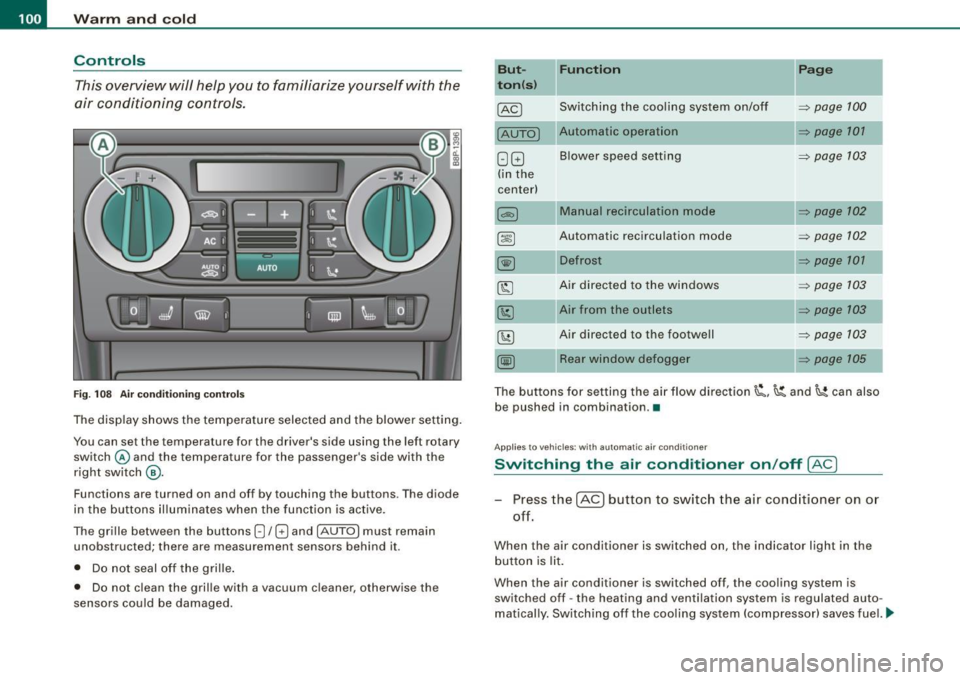
This overview will help y ou to familiarize yourself with the
air conditioning controls.
F ig. 10 8 Air cond it io ning co ntrols
The display shows the tempera ture selected and the blower setting.
You can set the temperature for the driver's side using the left rotary
switch © and the temperature for the passenger 's side with the
r ight switch
@ .
Functions are turned on and off by touching the buttons. The diode
in the butt ons il luminates when the function is active.
The grille between the buttons
8 / 8 and [AUTO) must remain
unobstructed; there are measurement sensors behind it.
• Do not seal off the grille .
• Do not clean the grille with a vacuum cleaner, otherwise the
sensors could be damaged.
But
t o n (s ) Functi
on
Switching the coo ling system on/o ff
[AUTO I Automatic operation
G GJ Blower speed setting
(in the
center)
Automatic recirculation mode
Defrost
Air direc ted to the windows
Air from the outlets
Air directed to the footwell
Rear window def ogger
Page
=> page 100
=> page 101
=> page 103
=> page 102
=> page 102
=> page 101
=> page 103
=> page 103
=> page 103
=> page 105
The buttons for setting the ai r flow direction~'~ and~ can also
be pushed in combination .•
App lies to vehicle s: wi th automat ic air condi tioner
Switching the air conditioner on /off !AC)
Press the [AC] button to switch the air cond itioner on or
off.
When the air conditioner is switched on, the indicator light in the
b utton is lit.
When the air conditioner is switched off, the cooling system is
switched off -the heating and ventilation system is regulated auto
matically. Sw itch ing of f the coo ling sys tem (compressor) saves fuel. ._